The Potential Benefits of Virgin Coconut Oil for Sperm Protection, Energy and Reproductive Health
Core message:
Coconut oil may support sperm health by contributing useful dietary energy, helping men build more satisfying whole-food meals and supplying plant compounds that have shown encouraging antioxidant and testicular-protective effects in experimental research. It should be used as part of a balanced fertility strategy—not presented as a guaranteed way to increase sperm count or motility.
Important note
This article is for education and does not replace individual medical advice, diagnosis or treatment. Fertility difficulties can have many causes. Coconut oil is a food, not a treatment for male infertility, and men with abnormal semen results or concerns about conception should seek appropriate professional assessment.
Introduction: Coconut Oil Deserves a Fairer Fertility Conversation
Coconut oil has been used as a traditional food for generations, yet modern conversations about it often swing between two extremes.
One side presents it as a miracle capable of transforming metabolism, hormones and fertility. The other treats it as though it has no nutritional value and no legitimate place in a healthy diet.
Neither position gives men the complete picture.
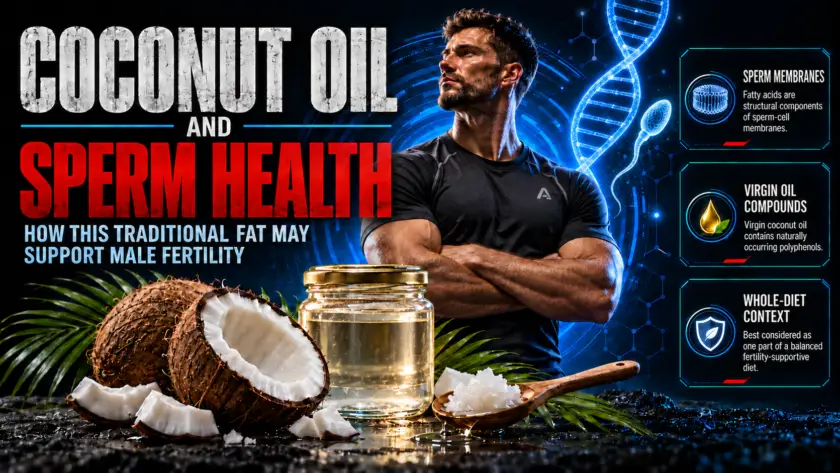
The emerging conversation around coconut oil and sperm health is more interesting than either extreme suggests. Virgin coconut oil provides concentrated energy and a distinctive mixture of fatty acids. Because it is produced from fresh coconut meat with limited processing, it can also retain minor plant compounds, including polyphenols, that have attracted scientific interest.
Experimental research has produced genuinely encouraging findings. In animal models involving alcohol, antiretroviral medicines, cadmium and other sources of testicular stress, virgin coconut oil has sometimes been associated with improved sperm motility, increased sperm count, stronger antioxidant status or better-preserved testicular structure.
Those findings matter.
They suggest that coconut oil—particularly virgin coconut oil—may possess properties relevant to the biological environment in which sperm are produced and protected.
But they must be understood correctly.
A rat exposed to a toxic substance is not the same as a healthy man trying to improve a semen analysis. A protective effect under experimental injury does not automatically prove that eating coconut oil will raise sperm count, motility or morphology in men. Direct human fertility trials are still needed.
That does not make the evidence useless. It tells us where coconut oil belongs.
It belongs inside an intelligent fertility strategy: as a purposeful food, a useful cooking fat and one possible contributor to a varied diet that supports energy, health and consistency. It does not belong on a throne above sleep, weight management, exercise, medical assessment, smoking cessation, alcohol control, heat protection and the other foundations that influence male reproductive health.
A strong man does not need to exaggerate a food before receiving value from it. He studies the evidence, respects its limits and uses what appears helpful without surrendering his judgement.
This is the balanced and positive case for coconut oil and sperm health.
Coconut Oil and Sperm Health: The Positive Potential at a Glance
| Potential benefit | Why it could matter | Strength of evidence |
|---|---|---|
| Provides concentrated dietary energy | Adequate energy supports training, recovery and wider reproductive health | Strong as a nutritional principle; not specific proof of better sperm |
| Makes nutritious meals more satisfying | Enjoyable meals can improve consistency with a whole-food fertility diet | Practical benefit rather than a fertility trial outcome |
| Supplies dietary fat | Fat is part of a balanced diet and supports absorption of fat-soluble nutrients | Established nutritional role |
| Contains minor antioxidant compounds when virgin and minimally processed | Antioxidant defences are relevant because excessive oxidative stress can damage sperm | Mechanistically plausible; composition varies |
| Has improved antioxidant status in animal research | Suggests potential protection against lipid oxidation and tissue stress | Encouraging preclinical evidence |
| Has improved sperm measures in selected animal injury models | Motility, count, glutathione and testicular structure improved in some experiments | Promising, but not yet confirmed in men |
| Works well in fertility-conscious meals | Useful with eggs, vegetables, oats, curries and other nutrient-rich foods | Practical dietary value |
| Can replace butter or heavily processed fats in selected meals | Strategic substitution may improve the overall quality and purpose of a meal | Depends on the alternative and total diet |
Alpha Insight
The positive case for coconut oil does not require a miracle claim. A food can be useful, protective and worthy of investigation without being a guaranteed fertility treatment.
1. Sperm Health Is Built Through an Entire Biological System
Before asking what coconut oil might do, a man should understand what sperm health actually involves.
Male fertility is not decided by one number. Semen analysis commonly examines several characteristics, including:
- Semen volume
- Sperm concentration
- Total sperm number
- Total and progressive motility
- Morphology
- Vitality when clinically relevant
These measures describe different parts of reproductive potential.
Concentration estimates how many sperm are present in each millilitre of semen. Total sperm number considers the entire sample. Motility assesses how many sperm move and whether they progress forwards. Morphology examines their shape. Vitality helps determine how many are alive.
Behind these visible measurements is an even larger system involving:
- Testicular function
- Hormonal signalling
- Sertoli and Leydig cells
- Mitochondrial energy production
- Cell-membrane integrity
- Antioxidant defences
- DNA packaging and protection
- The epididymis, prostate and seminal vesicles
- Ejaculation and reproductive anatomy
That is why no honest fertility strategy can be reduced to one ingredient.
A man may eat a nutritious diet and still have a blockage, varicocele, hormonal condition, genetic factor, infection, previous testicular injury or medicine-related problem. Another man may have no diagnosed condition but be undermining his reproductive health through smoking, heavy alcohol intake, anabolic steroids, chronic sleep loss, excessive heat or severe obesity.
Coconut oil cannot correct every possible cause. What it can do is occupy a constructive position within the nutritional part of this larger system.
Used intelligently, it can provide energy, help create satisfying meals and contribute plant compounds that may support antioxidant defences. That is not the whole sperm-health strategy—but it can be a useful component of one.
Alpha Insight
Do not ask one food to carry the weight of your entire fertility. Build the complete biological environment in which healthier sperm have the greatest opportunity to develop.
2. Why Coconut Oil May Be a Useful Food for Men
Coconut oil is not simply “fat in a jar.” Its usefulness depends on its form, quality, quantity and purpose.
It provides reliable energy
Fat is the most energy-dense macronutrient. For an active man who struggles to eat enough, adding a controlled amount of coconut oil to a real meal can increase energy intake without making the meal physically enormous.
This can be useful during demanding training periods or when a man is unintentionally under-eating. Chronic energy restriction is not a sign of discipline when it compromises recovery, mood, health and hormonal function.
It performs well in cooking
Coconut oil works naturally in curries, eggs, roasted vegetables, porridge and selected shakes. It can make simple whole foods more enjoyable, which matters because the diet a man follows consistently is more valuable than the perfect diet he abandons after four days.
It provides a distinctive fatty-acid profile
Coconut oil contains a high proportion of saturated fatty acids, with lauric acid as a major component. It also contains smaller proportions of caprylic and capric acids. This profile gives coconut oil its stability and distinctive culinary characteristics.
Coconut oil is sometimes described as though it were identical to concentrated MCT oil. It is not. MCT products are commonly enriched in caprylic and capric acids, while coconut oil contains much more lauric acid and remains a whole culinary oil.
Virgin coconut oil retains minor plant compounds
Virgin coconut oil is produced from fresh coconut with limited refining. Its minor components can include phenolic compounds, tocopherols, sterols and other unsaponifiable substances. The exact amount depends on the coconut, extraction method, heat exposure and storage.
These compounds are one reason researchers have investigated virgin coconut oil rather than treating every coconut-derived fat as identical.
It can help organise a better meal
A teaspoon of virgin coconut oil used to cook eggs, vegetables and herbs is not nutritionally equivalent to consuming the same energy through confectionery or heavily processed takeaway food.
The oil may be the smallest part of the meal, but it can help make the entire meal satisfying and repeatable.
That practical value should not be underestimated.
Alpha Insight
A useful food earns its place by helping the entire system work. Coconut oil is strongest when it makes nutritious eating easier, more enjoyable and more consistent.
3. Virgin Coconut Oil Offers the Most Compelling Positive Case
When discussing coconut oil and sperm health, the words virgin coconut oil matter.
Refined coconut oil and virgin coconut oil share a broadly similar fatty-acid foundation, but their minor compounds and production methods can differ. Virgin coconut oil is generally extracted from fresh coconut meat without the intensive refining, bleaching and deodorising used in standard refined oils.
Why is that relevant?
The positive reproductive research has frequently involved virgin coconut oil or virgin coconut oil extracts. Researchers have been interested not only in the fat itself but also in retained polyphenols and other minor components that may influence antioxidant activity.
A 2006 animal study found that a virgin-coconut-oil-supplemented diet increased antioxidant enzyme activity and reduced lipid peroxidation compared with the oils used as controls. The researchers attributed part of this effect to the higher level of unsaponifiable components and polyphenols in virgin coconut oil. Food Chemistry
This study did not measure human fertility, and it should not be presented as though it did. Its relevance is more foundational: it demonstrates that virgin coconut oil can contain biologically active compounds and can influence antioxidant systems in an experimental model.
For a man choosing coconut oil as a health food rather than solely as a neutral cooking fat, virgin coconut oil therefore presents the stronger positive case.
Look for:
- “Virgin” or “extra virgin” on the label
- A recognisable coconut aroma and flavour
- A clear ingredient list containing only coconut oil
- Responsible packaging and storage
- A product from a manufacturer that identifies its extraction process
“Extra virgin” is widely used commercially, although coconut oil does not have the same universally standardised extra-virgin grading system used for olive oil. The most important information is the extraction method and absence of unnecessary additives.
Refined coconut oil can still be a practical cooking option when a neutral flavour is required. However, virgin coconut oil is the form most closely aligned with the article’s antioxidant and reproductive-health discussion.
Alpha Insight
Quality strengthens purpose. If a man is choosing coconut oil partly for its minor plant compounds, virgin coconut oil is the more logical place to begin.
4. Sperm Need Protection from Excessive Oxidative Stress
Oxidative stress is one of the most important ideas in the coconut-oil-and-sperm-health conversation.
The body naturally produces reactive oxygen species. Small, controlled amounts participate in normal sperm function, including processes involved in fertilisation. The objective is not to eliminate every oxidant from the body.
The problem develops when oxidant production exceeds antioxidant protection.
Sperm are particularly vulnerable because their membranes contain fatty acids that can be damaged through lipid peroxidation. They also have limited cellular repair capacity compared with many other cells. Excessive oxidative stress may affect:
- Sperm movement
- Membrane flexibility and function
- Mitochondrial energy production
- DNA integrity
- The ability to participate successfully in fertilisation
Oxidative pressure can be influenced by many factors, including smoking, pollution, infection, inflammation, obesity, heat exposure, varicocele, toxins, poor diet and some medical conditions.
This is where the experimental findings on virgin coconut oil become relevant.
Researchers have observed stronger antioxidant enzyme activity, higher glutathione or reduced markers of lipid peroxidation in selected animal studies. In other experiments, those antioxidant changes appeared alongside improvements in sperm measurements or testicular tissue.
The responsible interpretation is not:
“Coconut oil is an antioxidant cure for infertility.”
It is:
“Virgin coconut oil contains compounds that have influenced antioxidant defences in experimental models, and some reproductive-injury models have produced encouraging sperm and testicular outcomes.”
That is a positive scientific signal. It gives researchers a reason to investigate further and gives consumers a rational reason to favour quality virgin coconut oil when they choose to use coconut oil.
But antioxidant protection is still a team effort. Coconut oil should sit beside colourful vegetables, fruit, herbs, spices, nuts, seeds and other nutrient-rich foods—not replace them.
Alpha Insight
Sperm protection is not created by one heroic antioxidant. It is built through an entire lifestyle that reduces unnecessary damage and strengthens the body’s own defences.
5. Encouraging Research on Sperm Motility, Count and Testicular Protection
The most positive evidence for coconut oil and sperm health currently comes from preclinical research.
These studies deserve attention because they have not merely measured theoretical antioxidant activity. Some have examined sperm count, sperm motility, reproductive hormones and testicular structure.
Alcohol, antiretroviral treatment and sperm quality
In a 2018 rat study, researchers investigated virgin coconut oil alongside exposure to alcohol and highly active antiretroviral therapy. Alcohol alone and alcohol combined with the medicines were associated with poorer semen quality and substantial testicular changes.
The encouraging finding was that lower-dose virgin coconut oil improved sperm motility and partially restored tissue changes. The higher dose produced greater improvements in sperm count, follicle-stimulating hormone, glutathione and preservation of testicular architecture. PubMed
This is important because motility and count are central semen measurements, while glutathione is part of the body’s antioxidant defence system.
Antiretroviral-associated testicular injury
An earlier animal study examined coconut oil alongside antiretroviral treatment. The treatment produced abnormalities in testicular structure and semen measures. Virgin coconut oil used with the treatment was associated with restoration of several distortions, and the virgin-coconut-oil-only group maintained normal testicular architecture. Toxicological Research
The results were not uniformly positive across every measurement, which is another reason to avoid oversimplification. Nevertheless, the overall testicular-protection signal added to the case for further research.
Cadmium-induced testicular toxicity
Cadmium is a toxic heavy metal capable of damaging reproductive tissue in experimental models. In a study of cadmium-exposed rats, pretreatment with virgin coconut oil was associated with improved testicular and epididymal weights, sperm count and testosterone, together with reduced tissue damage. Research Journal of Pharmacy and Technology
Alcohol-induced oxidative stress
Researchers have also examined virgin coconut oil in a rat model of alcohol-induced testicular oxidative stress and disrupted cholesterol handling. The work reported therapeutic potential related to antioxidant defence and testicular protection. Middle East Fertility Society Journal
Taken together, these experiments suggest several possible areas of benefit:
- Support for sperm motility under severe experimental stress
- Support for sperm count in selected models
- Better preservation of seminiferous tissue
- Improved glutathione or antioxidant activity
- Reduced lipid peroxidation
- Potential support for reproductive hormones in some models
These are not meaningless results. They are encouraging early evidence.
They are also not human clinical proof.
The models involved rats, substantial doses and specific injuries. A man should not convert animal doses into spoonfuls, use coconut oil to counteract alcohol or medicine toxicity, or change prescribed treatment. The correct next step for science is controlled research in men.
Alpha Insight
Promising evidence should inspire intelligent use and better research—not reckless certainty. Respecting the limits of a study protects the value of what it genuinely discovered.
6. What Coconut Oil Has Not Yet Been Proven to Do in Men
The positive case becomes stronger when the limits are stated plainly.
There is not yet convincing human trial evidence showing that coconut oil directly:
- Raises sperm count
- Increases progressive motility
- Improves morphology
- Reduces sperm DNA fragmentation
- Increases semen volume
- Corrects an abnormal semen analysis
- Treats male infertility
- Increases the chance of pregnancy or live birth
This absence of proof does not prove that coconut oil has no potential. It means the clinical question remains open.
There is a clear difference between four statements:
- Virgin coconut oil contains minor compounds with antioxidant activity.
- Virgin coconut oil has improved antioxidant or reproductive measures in some animal studies.
- Coconut oil may be a useful component of a balanced male-fertility diet.
- Coconut oil has been proven to improve sperm health in men.
The first three can be defended when worded carefully. The fourth currently goes beyond the evidence.
Why is this distinction especially important in fertility?
Because a man can lose valuable time by substituting food experiments for investigation. Low sperm count or poor motility may have a cause that requires testing, medical treatment or specialist care. Coconut oil will not reveal a varicocele, correct a blockage or diagnose a hormonal disorder.
Optimism should create action—not denial.
A man can use virgin coconut oil as part of a fertility-conscious diet and still arrange a semen analysis. He can value emerging science and still speak to a doctor. He can improve his meals without pretending food gives him control over every reproductive outcome.
That is mature responsibility.
Alpha Insight
Hope becomes powerful when it works beside evidence. Use promising foods to strengthen your foundations, but use proper testing to discover what your body is actually doing.
7. Adequate Energy Supports the Wider Fertility Environment
Coconut oil’s most certain nutritional benefit is energy.
Energy may sound less exciting than a claim about dramatically increasing sperm count, but reproductive health is built inside a body that must have sufficient resources to function.
A man who continually under-eats may experience poor training recovery, disrupted sleep, low mood, reduced libido, loss of muscle and hormonal changes. Extreme dieting, constant fasting or attempting to remain unnaturally lean can become another form of stress.
For men who genuinely need more energy, coconut oil offers several practical advantages:
- A small amount adds meaningful energy to a meal
- It can be used without increasing meal volume dramatically
- It pairs well with savoury and sweet foods
- Its flavour can make repetitive whole-food meals more enjoyable
- It can help an active man avoid accidentally turning every day into a calorie deficit
This does not mean more coconut oil automatically creates better fertility. Excess energy intake leading to unhealthy weight gain can also work against metabolic and reproductive health.
The benefit appears when coconut oil helps correct a genuine weakness in the diet.
For example:
- An active man struggling to maintain weight may add a small amount to porridge.
- A man who skips breakfast because plain eggs and vegetables feel unappealing may use coconut oil to make the meal more satisfying.
- A man relying on confectionery for extra calories may replace some of those foods with a structured meal containing protein, fibre and a controlled amount of coconut oil.
The oil becomes useful because of the problem it solves.
Alpha Insight
Energy is not the enemy. Uncontrolled excess and chronic deprivation are both forms of imbalance. Feed the body according to the work and recovery you genuinely require.
8. Coconut Oil Can Help Build More Consistent Fertility Meals
Nutrition works through repeated patterns.
One impressive meal cannot cancel months of poor eating, just as one imperfect meal cannot destroy an otherwise strong diet. The objective is to construct meals that are nutritious enough to support health and enjoyable enough to repeat.
Coconut oil can help create that bridge.
Consider a fertility-conscious plate containing:
- A quality protein source
- Several colours of vegetables or fruit
- A fibre-rich carbohydrate when appropriate
- A purposeful source of fat
- Herbs, spices or fermented foods for variety
Virgin coconut oil may occupy the purposeful-fat position in some meals.
Seven practical fertility-meal ideas
1. Coconut eggs with spinach and tomatoes
Use a small amount of coconut oil to cook eggs with spinach, tomatoes, mushrooms and herbs. The eggs provide protein and micronutrients while the vegetables add fibre and plant compounds.
2. Coconut vegetable curry
Build a curry around vegetables, lentils or a lean protein source. Use coconut oil for flavour while allowing herbs and spices to carry much of the meal’s character.
3. Fertility porridge
Add a small amount of virgin coconut oil to oats with berries, pumpkin seeds, cinnamon and a protein source. This works best when the oil supports an already nutritious bowl.
4. Roasted root vegetables
Use coconut oil with carrots, sweet potato, peppers and spices. Serve with fish, eggs, beans or meat rather than allowing the oil and starch to become the entire meal.
5. Coconut lentil bowl
Combine lentils, greens, brown rice or quinoa, herbs and a measured amount of coconut oil. Add lemon or lime to keep the meal fresh.
6. Training-day shake
When higher energy intake is genuinely needed, a small amount can be blended with milk or a suitable alternative, berries, oats and protein. Begin modestly because larger quantities may upset digestion.
7. Coconut and turmeric cooking base
Use coconut oil to soften onion, garlic, ginger and spices before adding vegetables and protein. The result uses a small amount of oil to make an entire nutrient-rich meal easier to enjoy.
The common principle is simple:
Coconut oil should improve the meal, not become the meal.
Eating spoonfuls directly from the jar does not create the same nutritional value as using a sensible amount to help prepare protein, plants and fibre.
Alpha Insight
Do not measure a fertility diet by the number of supplements or superfoods it contains. Measure it by the quality of the meals you can execute consistently.
9. Fat Balance Matters More Than Fat Worship
Coconut oil is predominantly saturated fat. That fact does not make it forbidden, but it makes context important.
Human observational studies have found associations between higher saturated-fat intake and lower sperm concentration or total sperm count in some populations. One study involved 701 young Danish men; another involved 99 men attending a fertility clinic. Because these studies were observational, they cannot prove that saturated fat caused the differences, but their findings are a reason not to treat unlimited coconut oil as a fertility strategy. PubMed, PubMed
This does not erase the positive animal research on virgin coconut oil.
It reveals an important distinction:
- A measured amount of virgin coconut oil inside a balanced diet is one question.
- A diet dominated by saturated fat is a different question.
The smartest approach is dietary diversity.
A fertility-conscious rotation might include:
- Extra-virgin olive oil
- Nuts and seeds
- Avocado
- Oily fish
- Eggs
- Natural dairy foods when suitable
- Virgin coconut oil
These foods do not need to fight for one permanent position. Different fats bring different fatty acids, nutrients, flavours and culinary strengths.
Omega-3 fats deserve particular attention because sperm membranes depend on an appropriate fatty-acid environment, and some human research has linked greater omega-3 intake with more favourable semen characteristics.
Coconut oil therefore works best as a team member.
It may provide culinary stability, energy, flavour and potentially valuable minor compounds. Olive oil contributes a different fatty-acid and polyphenol profile. Oily fish supplies long-chain omega-3 fats. Nuts and seeds contribute minerals, fibre and unsaturated fats.
The winning strategy is not to declare one fat superior in every situation. It is to build a varied pattern that supports the whole man.
Alpha Insight
A strong diet is not loyal to one jar. It uses different foods for different strengths and keeps the entire nutritional system in balance.
10. Heart Health and Sperm Health Should Advance Together
Male fertility is part of male health. A food strategy that pursues one laboratory result while ignoring cardiovascular or metabolic health is incomplete.
Coconut oil can increase LDL cholesterol compared with oils rich in unsaturated fats, although individual responses vary. A short randomised trial also found that coconut oil produced a more favourable LDL response than butter and increased HDL compared with butter and olive oil. BMJ Open
The useful conclusion is not that coconut oil is either perfect or poisonous.
It is that the comparison matters.
Replacing a heavily processed snack, excessive butter or a low-quality takeaway with a home-cooked meal using a controlled amount of virgin coconut oil may be a constructive change. Pouring coconut oil into an already high-energy, high-saturated-fat diet may not be.
Men who have high LDL cholesterol, cardiovascular disease, diabetes or significant family history should discuss their overall dietary pattern with a qualified professional. They can also monitor objective information rather than relying on how “clean” a food feels.
Useful measurements may include:
- Body weight and waist trend
- Blood pressure
- Lipid profile
- Blood glucose markers when clinically appropriate
- Energy and digestive tolerance
- Semen analysis when fertility is the concern
This is not fear. It is feedback.
A positive relationship with coconut oil should be based on intelligent use, not refusal to examine results.
Alpha Insight
Real health does not require you to sacrifice one organ system for another. Build a strategy in which fertility, cardiovascular health and metabolic strength move forwards together.
11. How to Use Coconut Oil Positively and Intelligently
There is no clinically proven “sperm-health dose” of coconut oil.
Any website promising an exact number of spoonfuls to increase sperm count is claiming more than human research has established.
The most responsible approach is to integrate coconut oil as food.
Start modestly
If coconut oil is new to your diet, begin with a small culinary amount—such as a teaspoon within a meal—and observe tolerance. This is not a medical dosage. It is simply a practical way to introduce an energy-dense fat without overwhelming digestion.
Use it to replace, not merely add
Ask what the coconut oil is displacing.
A purposeful replacement can improve a meal. Automatic addition can quietly increase energy intake without improving nutritional quality.
Choose virgin oil for the positive-health case
Virgin coconut oil is the form most relevant to research concerning polyphenols, antioxidant activity and testicular protection.
Pair it with protein and plants
Use it to cook eggs and vegetables, build a lentil curry or enrich porridge with fruit and seeds. The strongest value comes from the complete meal.
Rotate your fats
Continue using extra-virgin olive oil, nuts, seeds, avocado and oily fish where appropriate. Coconut oil should expand dietary variety, not eliminate it.
Protect the oil
Store it sealed, away from unnecessary heat and direct light. Use clean utensils to prevent contamination.
Respect digestive feedback
Large amounts can cause nausea, cramping or loose stools in some people. More is not automatically better.
Review medical context
If you have high cholesterol, cardiovascular disease, gallbladder or digestive concerns, or a condition requiring a specific diet, seek individual guidance before substantially increasing intake.
Never use it to neutralise a harmful exposure
Animal studies involving alcohol, cadmium or medicines do not mean coconut oil makes those exposures safe. It should not be used as permission to drink heavily, ignore workplace toxins or alter prescribed treatment.
Alpha Insight
Intelligent use means knowing the purpose, controlling the amount and judging the whole diet. More is not a strategy; better placement is.
12. Coconut Oil Must Sit Beside the Proven Sperm-Health Foundations
If a man is serious about sperm health, coconut oil should accompany the larger foundations rather than distract from them.
Stop smoking
Smoking exposes the reproductive system to oxidative and toxic stress. No health food can compensate fully for continuing a damaging habit.
Control alcohol
Reducing excessive alcohol matters more than attempting to use coconut oil to repair its consequences.
Avoid anabolic steroids and unsupervised testosterone
External testosterone and anabolic steroids can suppress the hormonal signalling required for sperm production. A man planning fatherhood should discuss fertility before using hormone treatment.
Maintain an appropriate weight
Both severe under-eating and excess body fat can disrupt the wider metabolic and hormonal environment.
Sleep consistently
Sleep supports recovery, appetite control, training performance and hormonal health. A fertility diet cannot repair a life built around chronic sleep deprivation.
Exercise without destroying recovery
Regular movement and resistance training can support health, but extreme overtraining combined with inadequate food and sleep creates another form of stress.
Reduce unnecessary testicular heat
Repeated high heat around the testes may affect sperm production. Review hot-tub use, prolonged laptop placement and occupational heat exposure where relevant.
Protect against toxins and injury
Use appropriate protection around pesticides, solvents and heavy metals. Seek assessment after significant testicular injury or when a lump, swelling or persistent pain develops.
Build a varied diet
Eat sufficient protein, vegetables, fruit, whole grains or suitable fibre-rich carbohydrates, legumes, nuts, seeds and diverse fat sources. Coconut oil can strengthen this pattern; it cannot replace it.
The NHS advises men with low sperm count to reduce alcohol, stop smoking, lose weight if overweight, avoid recreational drugs and consider heat and occupational chemical exposure. NHS
Alpha Insight
The most powerful fertility food is the one that joins a disciplined lifestyle. Foundations multiply one another; isolated hacks compete for attention.
13. Test What Matters: Semen Analysis Beats Guesswork
A man cannot reliably judge sperm health from libido, erections, semen appearance or how masculine he feels.
He can have strong sexual function and still have reduced sperm concentration, motility or morphology. He can also receive one abnormal result that later improves because semen measurements naturally vary and sperm production reflects the preceding months.
The main test is semen analysis.
It commonly evaluates:
- Semen volume
- Sperm concentration
- Total sperm number
- Motility
- Progressive motility
- Morphology
- Other laboratory observations when relevant
The NHS notes that a possible problem found on a first semen analysis is usually checked with another sample around three months later. Further assessment may include medical history, examination, blood tests, ultrasound or urine testing depending on the situation. NHS
Seek medical advice when:
- You and your partner have not conceived after the recommended period of regular unprotected sex
- Your partner’s age or medical history means earlier assessment is appropriate
- You have testicular pain, swelling, a lump or previous significant injury
- You have used anabolic steroids or external testosterone
- You have ejaculation or erectile problems
- You have undergone chemotherapy, radiotherapy or reproductive surgery
- A previous semen analysis was abnormal
- You have another reason to suspect impaired fertility
Do not delay assessment while waiting for coconut oil, supplements or a new diet to “work.”
You can improve the foundations while the investigation proceeds.
Alpha Insight
You cannot lead what you refuse to measure. Use nutrition to support your body—and use testing to replace assumptions with facts.
The Alpha Coconut Oil and Sperm Health System
Use five principles to integrate coconut oil without hype or fear.
1. Purpose
Define why you are using it.
Possible purposes include:
- Improving the flavour of whole-food meals
- Adding energy when you genuinely need it
- Replacing a less useful fat or processed food
- Choosing virgin coconut oil for its minor plant compounds
- Creating greater variety in a fertility-conscious diet
If you cannot identify a useful purpose, automatic addition is unnecessary.
2. Quality
Choose virgin coconut oil when the objective includes antioxidant and plant-compound potential. Check the ingredient list and buy an amount you can store and use properly.
3. Placement
Place coconut oil inside complete meals.
Good placement:
Eggs + vegetables + herbs + a small amount of virgin coconut oil
Weak placement:
Several spoonfuls added to the day without changing the poor-quality meals around them
4. Balance
Keep omega-3-rich foods, olive oil, nuts, seeds and other beneficial foods in the diet. Monitor total energy and saturated-fat intake rather than assuming a natural product has no limit.
5. Proof
Judge outcomes that can actually be measured:
- Is your diet easier to follow?
- Is your energy intake appropriate?
- Has your weight trend changed?
- Does digestion remain comfortable?
- Are blood lipids appropriate for you?
- If fertility is the objective, what does a properly timed semen analysis show?
Do not credit coconut oil for every positive change when sleep, exercise, alcohol, smoking, weight and multiple foods changed simultaneously.
Alpha Insight
Purpose chooses the food. Quality protects its value. Placement builds the meal. Balance protects the whole man. Proof keeps the strategy honest.
The Evidence Ladder for Coconut Oil and Sperm Health
Not every claim deserves equal confidence.
| Evidence level | What can reasonably be said |
|---|---|
| Established nutrition | Coconut oil provides dietary fat and concentrated energy |
| Food-composition evidence | Virgin coconut oil can retain polyphenols and other minor components |
| Experimental antioxidant evidence | Virgin coconut oil has improved antioxidant status and reduced lipid peroxidation in animal research |
| Experimental reproductive evidence | Selected rat studies have reported improvements in sperm motility, count, glutathione or testicular structure under induced stress |
| Human observational evidence | Very high saturated-fat intake has been associated with poorer semen measures in some studies; causation remains unproven |
| Missing clinical evidence | Human trials have not established coconut oil as a method for improving sperm count, motility, morphology, DNA integrity or pregnancy outcomes |
The correct conclusion is therefore positive but disciplined:
Virgin coconut oil is a promising fertility-supportive food with encouraging preclinical evidence, but it is not yet a clinically proven sperm-enhancing treatment for men.
Signature Exercise: The Coconut Oil and Sperm Health Audit
Answer these questions honestly.
Current use
- Do I already consume coconut oil?
- Is it virgin, refined or an MCT product?
- How much do I use across an ordinary week?
- Do I measure it or pour without awareness?
- Is it used inside meals or consumed by itself?
Dietary context
- What are my other main fat sources?
- Do I eat oily fish or another suitable omega-3 source?
- Do vegetables, fruit, legumes, nuts and seeds appear consistently?
- Am I under-eating, overeating or eating appropriately for my needs?
- Would coconut oil replace something less useful or simply add calories?
Fertility foundations
- Do I smoke?
- Is my alcohol intake working for or against my fertility goals?
- Have I used anabolic steroids or external testosterone?
- Am I protecting sleep and recovery?
- Am I exposed to unnecessary testicular heat or workplace toxins?
- Is my body weight supporting wider health?
Objective information
- Have I ever had a semen analysis?
- If a result was abnormal, did I complete the recommended follow-up?
- Do I have testicular symptoms or fertility concerns requiring medical assessment?
- Am I expecting food to solve a problem I have not investigated?
Now write one sentence:
I will use coconut oil to support ____________________, while protecting the rest of my sperm-health strategy through ____________________.
The 14-Day Positive Coconut Oil Integration
This is not a fertility treatment or a test of sperm improvement. Fourteen days is far too short to assess a full sperm-development cycle. It is a practical test of dietary fit, meal quality and tolerance.
Before Day One
Record:
- Current coconut oil use
- Current body-weight trend
- Digestive comfort
- Typical breakfast and evening meal
- Major dietary fat sources
- One processed food or less-useful fat you may replace
- Your reason for trying virgin coconut oil
Days 1–7: Improve One Meal
Choose one meal in which a modest amount of virgin coconut oil provides a clear benefit.
Examples:
- Cooking eggs and vegetables
- Building a vegetable-and-protein curry
- Improving an oat-based breakfast
- Roasting vegetables for a complete meal
Keep the rest of the diet stable enough to observe tolerance.
Record:
- Amount used
- Meal composition
- Hunger and satisfaction
- Energy
- Digestion
- Whether it replaced another fat or added to the meal
Days 8–14: Build Balance
Continue the successful meal while deliberately protecting fat diversity.
Across the week, include suitable sources of:
- Omega-3 fats
- Monounsaturated fats
- Nuts or seeds
- Colourful plant foods
- Quality protein
Also complete one non-food fertility action:
- Improve sleep timing
- Reduce alcohol
- Stop smoking or seek cessation support
- Remove a source of unnecessary testicular heat
- Arrange medical advice or semen analysis when appropriate
Day 14 Review
Ask:
- Did coconut oil improve meal quality or merely add calories?
- Was it enjoyable and easy to use?
- Did digestion remain comfortable?
- Did it displace a less useful food?
- Did I keep other healthy fats in the diet?
- Is continued use aligned with my weight and health goals?
- What larger sperm-health action now deserves attention?
If it improved the system, keep the useful placement.
If it added little, change the placement or stop using it.
That is disciplined experimentation.
Frequently Asked Questions
Is coconut oil good for sperm health?
Virgin coconut oil may be a useful component of a balanced fertility-conscious diet. It supplies energy and dietary fat, while animal studies have reported encouraging antioxidant, sperm and testicular effects under experimental stress. Direct improvements in human semen quality have not yet been proven.
Can coconut oil increase sperm count?
Some rat studies have reported improved sperm count in models involving toxic or medication-related stress. There is currently insufficient human clinical evidence to say that eating coconut oil increases sperm count in men.
Can coconut oil improve sperm motility?
A 2018 rat study reported improved sperm motility with virgin coconut oil under combined alcohol and antiretroviral exposure. This is promising preclinical evidence, but it does not establish the same result in men.
Can virgin coconut oil protect the testes?
Selected animal studies have found better-preserved testicular structure or reduced injury when virgin coconut oil was used in experimental toxicity models. Human testicular protection has not been established.
Why choose virgin coconut oil?
Virgin coconut oil is less refined and can retain more minor plant compounds, including polyphenols. It is also the form used in much of the positive antioxidant and reproductive research.
How much coconut oil should I take for sperm health?
There is no clinically established sperm-health dose. Use it as food rather than medicine. A modest amount within a complete meal is more sensible than consuming large spoonfuls or copying doses from animal studies.
Is coconut oil better than olive oil for sperm?
Human research has not established coconut oil as superior. The oils have different profiles and can serve different purposes. A varied diet may use virgin coconut oil for selected meals and extra-virgin olive oil, nuts, seeds, avocado and oily fish elsewhere.
Is coconut oil the same as MCT oil?
No. Coconut oil contains a broad fatty-acid mixture and a high proportion of lauric acid. Commercial MCT oil is usually concentrated in caprylic and capric acids and behaves differently in digestion and cooking.
Does coconut oil improve semen volume?
There is no strong human evidence that coconut oil increases semen volume. Semen volume can be influenced by abstinence interval, hydration, collection method, accessory-gland function and medical factors.
Can coconut oil improve sperm DNA?
There is a plausible antioxidant discussion because excessive oxidative stress can damage sperm DNA, but human trials have not shown that coconut oil reduces sperm DNA fragmentation.
How long would dietary changes take to affect sperm?
Sperm production and maturation take place over several weeks, and semen results can vary. Fertility strategies are commonly judged over months rather than days. Follow professional advice about the timing of repeat analysis.
Can I use coconut oil instead of fertility treatment?
No. Coconut oil should not replace investigation or treatment. Male infertility may involve hormonal, anatomical, genetic, medical or lifestyle factors that food alone cannot correct.
Should I use coconut oil if my cholesterol is high?
Coconut oil may increase LDL cholesterol in some people, particularly compared with unsaturated oils. Ask a qualified professional how it fits your individual cardiovascular risk and total diet.
Can coconut oil make up for smoking or heavy alcohol use?
No. Animal protection studies do not make harmful exposures safe. Removing or reducing the damaging exposure is more important than attempting to counteract it with a food.
Closing Declaration
I will treat my sperm health as part of my complete health.
I will recognise the positive potential of virgin coconut oil without turning it into a miracle.
I will use coconut oil to strengthen nutritious meals—not to disguise an undisciplined diet.
I will value the encouraging research while remaining honest about what has not yet been proven in men.
I will balance coconut oil with omega-3 foods, olive oil, nuts, seeds, plants and quality protein.
I will reduce the habits and exposures that place unnecessary pressure on my reproductive health.
I will seek testing when facts are required and professional help when a problem deserves investigation.
I will build the strongest fertility environment within my control—one intelligent decision at a time.
Final Word
Coconut oil does not need an exaggerated promise to deserve a place in the male-fertility conversation.
Virgin coconut oil supplies energy, works naturally in nutritious meals and contains minor compounds that have demonstrated antioxidant activity. More importantly, several experimental studies have reported encouraging improvements in sperm motility, sperm count, glutathione or testicular structure under serious reproductive stress.
Those findings create legitimate optimism.
They also create a responsibility to speak accurately.
We do not yet know whether coconut oil improves semen quality in men. We do know that it can be used constructively as one part of a varied diet, and that its preclinical reproductive evidence deserves further investigation.
The strongest man does not choose between enthusiasm and evidence. He carries both.
He sees potential without inventing certainty. He uses coconut oil without worshipping it. He builds complete meals, protects his health, measures what matters and refuses to delay medical assessment when it is needed.
That is how a traditional food becomes part of a modern fertility strategy.
Final Line
Coconut oil may not be a proven sperm treatment—but used intelligently, virgin coconut oil can become a positive part of the nutritional foundation from which male fertility is protected.



No spam. Unsubscribe anytime.