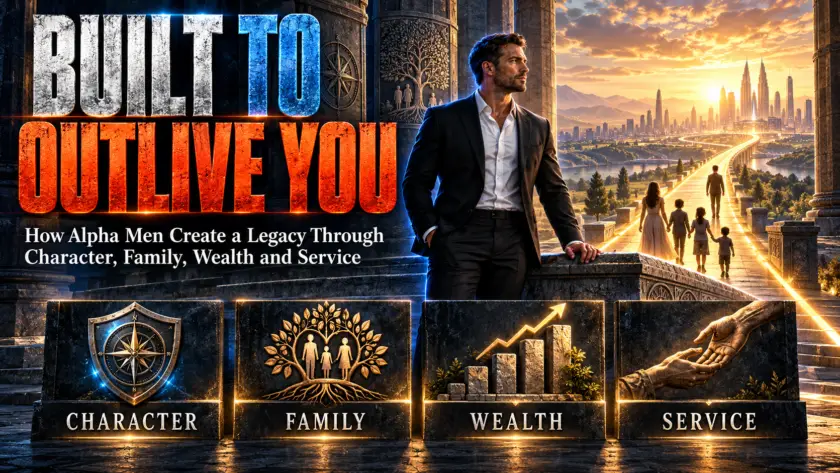
How Alpha Men Build a Legacy Through Character, Family, Wealth and Service
There comes a point in a man’s life when success must become larger than himself.
He may still want to build wealth, strengthen his body, grow a business and achieve ambitious goals. There is nothing wrong with those desires. A man should develop his potential and use his abilities fully. But eventually, a deeper question begins to follow every achievement:
What will remain because I was here?
Attention cannot answer that question. Status cannot answer it. A collection of possessions cannot answer it. These things may describe what a man experienced, but they do not necessarily reveal what his life contributed.
A meaningful legacy is created when a man leaves people stronger, standards higher and opportunities greater than he found them. It can live through the children he raises, the wisdom he records, the wealth he stewards, the business he builds, the people he mentors and the destructive cycle he finally brings to an end.
Legacy is not reserved for famous men, exceptionally wealthy men or men approaching the end of life. It is being formed now—in private decisions, ordinary conversations and promises that nobody else sees.
Every day, a man is teaching people what he values. He is demonstrating how he responds to pressure, whether his word can be trusted and what kind of example his success will provide. He is either strengthening what should continue or repeating what should have ended with him.
A real Alpha man does not live only for what he can acquire. He builds character, raises standards, creates value and strengthens people so that his influence continues beyond his lifetime.
He builds to outlive himself.
1. Legacy Is What Your Life Leaves Behind
Many men hear the word legacy and immediately think about inheritance. Money and property can certainly form part of a legacy, but they are not its full meaning.
Your legacy is the continuing effect of how you lived.
It is present in the confidence you helped another person develop. It appears in the standards your children continue to follow when you are not there to remind them. It lives in the knowledge you taught, the opportunities you created and the work that continues serving people after your direct involvement has ended.
A man with modest finances can leave a powerful legacy of faith, courage, honesty and love. A wealthy man can leave substantial assets but little wisdom, unity or moral direction. One may leave few possessions but transform generations. The other may leave millions that disappear through division, entitlement and poor judgement.
This does not make wealth unimportant. It makes wealth one instrument among several. Character, knowledge, example, service, family culture and financial resources can all become parts of the same inheritance.
There is also a difference between being remembered and leaving something valuable. A man can become memorable through scandal, noise or self-promotion. His name may remain visible, but visibility is not usefulness.
Legacy asks better questions:
- Who became stronger because I invested in them?
- What problem became smaller because I acted?
- Which standard continued because I lived it consistently?
- What opportunity exists because I built it?
- Which destructive pattern ended because I confronted it?
- What truth will still guide people after my voice is gone?
Fame concerns how many people know your name. Legacy concerns how many lives carry useful evidence that you lived.
Alpha Legacy Insight
Do not confuse being noticed with being valuable. Attention can disappear overnight; genuine contribution continues working.
2. Begin With the Man You Are Becoming
Before a man can create a strong legacy, he must become the kind of man whose influence deserves to continue.
That process begins with character.
If wealth increases while integrity weakens, the man has expanded his reach without improving what he spreads. If authority grows while emotional control remains undeveloped, more people may eventually be harmed by his unresolved weaknesses. If success produces arrogance rather than responsibility, achievement can magnify the parts of him that should have been corrected.
Legacy therefore begins long before the estate plan, the family business or the published book. It begins when a man decides what will govern him.
Will he tell the truth when dishonesty offers an advantage? Will he honour his commitments when excitement has disappeared? Will he accept correction without protecting his ego? Will he take responsibility for damage he caused? Will he treat people with dignity when they can offer him nothing?
These decisions construct the man beneath the mission.
A public platform cannot compensate for a private life without integrity. Children eventually recognise whether their father’s principles are genuine. Employees notice whether stated values survive pressure. Friends learn whether loyalty exists only when convenient.
The goal is not perfection. Every man will make mistakes. Character is revealed by what he does after the mistake: whether he hides, blames and repeats it, or admits, repairs and grows from it.
You do not build a legacy by pretending to be flawless. You build it by becoming honest enough to confront what is flawed and disciplined enough to improve it.
Alpha Legacy Insight
Before you decide what you want to leave behind, decide what kind of man you are willing to become.
3. Your Daily Choices Are Already Writing Your Legacy
Legacy can sound distant—as though it belongs to the final chapter of life. In reality, the final chapter can only reveal what the earlier chapters repeatedly built.
Your routine is writing your legacy.
The way you speak to your wife when you are tired is writing it. The attention you give your children is writing it. The work you complete when nobody is supervising you is writing it. The way you handle money, pressure, disagreement, temptation and disappointment is writing it.
Men often imagine a future moment when they will become more present, disciplined or generous. They intend to create memories with their family after the business succeeds. They plan to protect their health once work becomes quieter. They promise to record their knowledge when life becomes less demanding.
But a legacy cannot be built entirely through future intentions. It requires present evidence.
Small actions appear ordinary because we see them individually. Repeated over years, however, they become the atmosphere of a family and the identity of a man.
A weekly conversation becomes a relationship. A regular saving habit becomes capital. A consistent training routine becomes physical capacity. A daily reading practice becomes knowledge. A promise repeatedly kept becomes trust.
The opposite also compounds. Chronic absence becomes emotional distance. Avoided financial decisions become disorder. Repeated anger becomes fear. Continually postponed care becomes regret.
Ask yourself: if the next ten years repeatedly resembled this week, what kind of legacy would they produce?
That question is not intended to create shame. It is intended to return power to the present. You cannot rewrite every earlier decision, but you can write a different sentence today.
Alpha Legacy Insight
Legacy is not one heroic act at the end of life. It is the accumulated evidence of how a man chooses to live every day.
4. Fatherhood Is One of the Greatest Forms of Legacy
A father passes on far more than his DNA.
His behaviour can influence how a child understands love, strength, trust, work, responsibility, conflict and self-worth. His presence—or absence—can echo through decisions made decades later.
Children do not learn only from what a father tells them. They watch what he tolerates, how he treats their mother, whether he controls his emotions and whether his word carries weight. They observe how he responds when life refuses to follow his plan.
A father’s legacy can include:
- Emotional security
- Honest affection
- Consistent boundaries
- Faith and moral principles
- A healthy relationship with work
- Financial understanding
- Respect for women and other people
- The courage to apologise
- Confidence grounded in responsibility
- The knowledge that they matter
Providing materially is important, but provision without presence can leave a child well supplied and emotionally uncertain. Being present does not mean being physically available every minute. It means becoming reliably engaged—listening, guiding, correcting, encouraging and creating safety.
Fatherhood also requires a man to recognise what he must not pass forward. Perhaps he received anger instead of guidance, silence instead of affection or criticism instead of encouragement. He may not have been shown how to communicate or manage money. His responsibility is not to deny that history. It is to prevent history from becoming destiny.
Even men who do not have biological children can exercise fatherly influence. A mentor, uncle, coach, teacher or community leader can provide direction that changes a younger man’s future.
The strongest fathers do not attempt to create dependent copies of themselves. They help children develop character, judgement and the confidence to fulfil their own responsibilities.
Alpha Legacy Insight
A father’s greatest inheritance is not simply what he places in his child’s hands, but what he helps build within the child.
5. Build Wealth That Strengthens Future Generations
Wealth can become a powerful part of a man’s legacy when it is created honestly, managed wisely and transferred intentionally.
Money can protect a family during crisis. It can provide education, fund businesses, create homes, support charitable work and give future generations choices that earlier generations never had. It can turn years of disciplined effort into decades of opportunity.
But money without preparation can also create conflict and entitlement. If a man transfers assets without transferring responsibility, he may finance weakness rather than freedom.
Generational wealth should therefore include more than a number in an account. It should include the habits and systems that help people use resources intelligently:
- Understanding income, spending and cash flow
- Saving before consumption expands
- Investing with patience rather than gambling through emotion
- Avoiding unnecessary debt
- Protecting assets appropriately
- Creating multiple sources of value
- Giving with wisdom
- Understanding taxes, wills and succession
- Discussing money without secrecy or shame
A legacy-minded man also avoids sacrificing everyone he loves in order to build wealth supposedly intended for them. If the pursuit destroys his health, marriage or relationship with his children, the final account balance may conceal a deeper loss.
The objective is integrated wealth: resources that support family strength, not resources purchased at the cost of it.
Building wealth may begin modestly. A man can organise his finances, eliminate waste, increase his skills, create an emergency fund, invest consistently and document what his family needs to know. The size of the first step matters less than the direction it begins.
Alpha Legacy Insight
Do not merely leave money to the next generation. Teach them how value is created, protected and used responsibly.
6. Pass Down Wisdom, Not Only Assets
Some of the most valuable things a man learns cannot be transferred through a bank.
They are the lessons acquired through failure, recovery, risk, sacrifice and years of observation. They include the warning signs he once ignored, the choices he would make differently and the principles that protected him when circumstances changed.
Unfortunately, much of this wisdom disappears because men assume there will always be another opportunity to explain it.
Do not leave your most important lessons trapped inside you.
Write them. Record them. Teach them through conversations. Explain not only what you believe but how those beliefs were tested. Tell the truth about your mistakes so that the next generation can inherit instruction without having to inherit every wound.
Useful subjects may include:
- How you recovered from failure
- Why you chose your principles
- What marriage taught you
- How you handled—or mishandled—money
- The habits that protected your health
- The opportunities you nearly missed
- The people who changed your life
- The role of faith during hardship
- What you wish you had understood earlier
- The standards you hope the family will continue
Wisdom must also be demonstrated. A lecture on discipline carries little weight when the speaker continually abandons his own commitments. Advice becomes credible when people can connect it to evidence.
The goal is not to control future generations from beyond your lifetime. It is to give them a stronger starting point from which to exercise their own judgement.
Alpha Legacy Insight
An asset may give someone options. Wisdom helps them choose between those options without destroying what they inherited.
7. Your Health Determines How Long You Can Serve
A man may have a powerful mission, but he still needs a body and mind capable of carrying it.
Health is not guaranteed, and no routine can prevent every illness or injury. Nevertheless, neglecting avoidable risks can reduce a man’s energy, presence and capacity to contribute.
Protecting health is therefore not merely about appearance. It can be an act of service towards the people who rely on him.
Physical strength can help a man remain capable and independent. Cardiovascular health supports endurance. Sleep affects judgement, mood and recovery. Nutrition supplies the body with what it needs to function. Preventive care can identify problems that determination alone cannot solve. Mental health influences how he leads, communicates and responds to pressure.
A legacy-minded approach to health includes:
- Regular strength and cardiovascular exercise
- A nourishing and sustainable diet
- Sufficient sleep and recovery
- Appropriate health checks
- Addressing symptoms rather than hiding them
- Avoiding smoking and destructive drug use
- Responsible alcohol consumption
- Managing stress before it governs behaviour
- Seeking qualified help when necessary
- Maintaining relationships and a sense of purpose
Men sometimes wear exhaustion as proof of commitment. But destroying your capacity is not the same as demonstrating sacrifice. There are seasons when responsibility demands exceptional effort. They should not become an excuse for permanent self-neglect.
Care for your health so that, as far as it remains within your control, you can stay present for the mission and the people that matter.
Alpha Legacy Insight
Your health is not only personal property. It supports the years, strength and presence you may be able to give to others.
8. Create Work That Continues Helping People
One of the most powerful ways to build a legacy is to create something useful that can continue operating beyond your immediate effort.
This might be a business that provides honest employment, a book that gives readers direction, a system that solves a repeated problem, a scholarship, a community organisation, a body of educational content or a product that genuinely improves lives.
The form matters less than the value.
Legacy work requires a different question from ordinary consumption. Instead of asking only, “What can I experience?” a man also asks, “What can I build that other people can use?”
This does not require instant scale. A useful body of work is often created one article, customer, process and improvement at a time. What begins small can develop reach through consistency.
For the work to outlive its creator, however, it must eventually become transferable. Knowledge must be documented. Quality standards must be clear. Processes must not exist only inside the founder’s mind. Other people need the skills and authority to protect the purpose.
This is particularly important for entrepreneurs. If a business collapses whenever the founder steps away, he has created demanding employment for himself—not yet a lasting institution.
Build intellectual property. Create systems. Train leaders. Preserve the story behind the mission. Measure whether the work is helping the people it claims to serve.
Your legacy does not need to carry your name everywhere. Sometimes its greatest evidence is that useful work continues even when people no longer know who started it.
Alpha Legacy Insight
Do not only build work that depends on your effort. Build value that can continue serving when your hands are no longer required.
9. Reputation Is the Memory of Repeated Character
A reputation is rarely formed by one impressive speech. It emerges from patterns.
People learn whether you arrive, deliver, tell the truth, accept responsibility and remain composed under pressure. Over time, repeated behaviour becomes expectation.
This is why reputation can become one of a man’s greatest non-financial assets. Trust opens doors that talent alone cannot. It makes people willing to collaborate, recommend, invest and listen. It can also create safety within a family because loved ones know what kind of response they can expect.
A strong reputation cannot be built entirely through image management. Eventually, performance and reality meet.
Protect your name by protecting your conduct:
- Do not promise casually
- Communicate early when circumstances change
- Give credit honestly
- Admit what you do not know
- Correct false impressions that benefit you unfairly
- Refuse opportunities that require dishonesty
- Treat private conversations as private
- Apologise and repair damage where possible
- Maintain standards when nobody can reward you
This does not mean everyone will speak well of you. A man can behave honourably and still be misunderstood, criticised or lied about. Reputation is influenced by others, but character remains under personal control.
Do not surrender integrity in a desperate attempt to control every opinion. Let the long-term evidence of your life become stronger than temporary noise.
Alpha Legacy Insight
You cannot control every story told about you, but you can build a pattern of conduct that gives the truth somewhere solid to stand.
10. Break the Cycles That Should Not Be Inherited
Legacy is not only about what a man starts. It is also about what he stops.
Every family carries patterns. Some deserve to be protected: faith, loyalty, courage, generosity and commitment. Others create repeated harm: addiction, uncontrolled anger, emotional silence, financial disorder, infidelity, neglect or the belief that men must suffer without seeking help.
A man does not dishonour his past by admitting that something within it needs to change. He honours the future by refusing to transfer avoidable pain.
Breaking a cycle requires more than declaring, “I will never become like that.” Under stress, unexamined behaviour often returns. A stronger process includes:
- Naming the pattern honestly.
- Understanding how it has affected people.
- Identifying the situations that trigger it.
- Learning a healthier replacement.
- Creating accountability and support.
- Repairing damage where possible.
- Repeating the new response until it becomes normal.
Professional counselling, medical care, pastoral support or recovery services may form part of that process. Seeking help does not make a man weak. Refusing to confront destructive behaviour because of pride allows weakness to retain control.
Some of the people you help most may never know the full battle you fought. They will simply grow up without carrying a burden that once seemed inevitable.
That is legacy.
Alpha Legacy Insight
Sometimes the greatest gift you leave the next generation is a wound they never have to inherit.
11. Prepare for Succession Instead of Protecting Control
Some men say they want to build a legacy, but what they actually want is permanent control.
They remain the only decision-maker, hold knowledge too tightly and feel threatened when another person becomes capable. The mission can never grow beyond them because they need to remain indispensable.
Legacy requires a different form of leadership.
A strong leader develops people who can eventually carry responsibility without constant supervision. He teaches judgement rather than demanding obedience. He shares the reason behind the standards. He allows others to practise, make recoverable mistakes and develop confidence.
Succession may involve:
- Defining the mission clearly
- Documenting essential knowledge and processes
- Identifying people with character as well as skill
- Delegating meaningful responsibility
- Creating legal and financial continuity
- Establishing decision-making principles
- Preparing for emergencies and incapacity
- Inviting new ideas without abandoning core values
In a family, succession can mean explaining finances, responsibilities and final wishes before a crisis forces the conversation. In business, it means building leadership depth. In community work, it means allowing the next generation to improve what was started.
Yielding control is not abandoning the mission. When done wisely, it protects the mission from becoming dependent on one man’s continued presence.
Alpha Legacy Insight
If everything meaningful must stop when you stop, you have built dependence—not succession.
12. Live So That the Final Evidence Is Undeniable
No man can control exactly how history will describe him. He cannot guarantee that every sacrifice will be recognised or every intention understood.
But he can create evidence.
He can love his family actively. He can build honestly. He can keep learning, serve consistently and correct his failures. He can use his strength to protect rather than dominate. He can turn painful experiences into guidance that helps someone else avoid the same path.
The objective is not to stage a life that appears important. It is to live one that proves useful.
At the end, the strongest evidence may not be an award or headline. It may be a child who feels secure, a family that understands how to continue, a customer whose problem was solved, an employee who was given an opportunity or a younger man who finally believed his life could become more.
You do not need to wait until you possess everything you want. Begin with what is already in your hands:
- One relationship you can strengthen
- One lesson you can record
- One financial habit you can correct
- One apology you need to make
- One skill you can teach
- One system you can document
- One destructive pattern you can confront
- One piece of meaningful work you can complete
Legacy is not built by obsessing about death. It is built by using life deliberately.
Alpha Legacy Insight
Live so that the people, principles and work you strengthened become undeniable evidence that your time was used well.
The LEGACY Standard
Use this framework to examine whether your present life is creating value that can continue.
L — Live by Principles
Define the convictions that will govern your behaviour when convenience, pressure and opportunity test you. A principle becomes part of your legacy only when it survives difficult conditions.
E — Equip the Next Generation
Give younger people more than advice. Give them attention, skills, responsibility, encouragement and the opportunity to practise sound judgement.
G — Generate Lasting Value
Build useful assets: knowledge, businesses, investments, systems, relationships, educational resources and institutions that can continue producing benefits.
A — Accumulate and Transfer Wisdom
Convert experience into instruction. Record your failures as well as your successes so that others can start with lessons you had to earn slowly.
C — Correct Destructive Cycles
Identify the behaviours and beliefs that should end with you. Seek the support required to replace them rather than merely promising that you will be different.
Y — Yield Control So the Mission Can Continue
Prepare other people to lead. Document what matters, delegate responsibility and accept that a living legacy may develop beyond your personal control.
The Alpha Legacy Audit
Answer these questions honestly. Do not write what sounds admirable; write what the evidence currently shows.
Character
- Which three principles genuinely govern my life?
- Where is my public image stronger than my private conduct?
- Which promise have I delayed keeping?
- How do I respond when I am wrong?
Family and Relationships
- Do the people closest to me receive my attention or only what remains after work?
- What emotional atmosphere does my behaviour create at home?
- What do my children or younger relatives learn by watching me?
- Which important conversation have I avoided?
Health
- Am I protecting my ability to remain present and capable?
- Which preventable health risk am I ignoring?
- Do stress and exhaustion change how I treat people?
- What professional assessment or support may be necessary?
Wealth
- Am I building assets or only increasing consumption?
- Could my family understand and manage our finances without me?
- Have I made appropriate arrangements for emergencies and inheritance?
- Am I teaching financial judgement alongside financial ambition?
Work and Service
- What useful work could continue after my direct involvement?
- Which knowledge exists only inside my head?
- Who am I training to carry responsibility?
- Is my work genuinely helping the people it claims to serve?
Cycle Breaking
- Which harmful pattern has followed my family through generations?
- How is that pattern appearing in my behaviour?
- What replacement behaviour must I learn?
- Who can provide qualified help or accountability?
Contribution
- Who is stronger because I consistently invest in them?
- Which problem am I helping to solve?
- What would be missing if I stopped contributing today?
- What action can I take this week to create lasting value?
Signature Exercise: Write Your Legacy Letter
Write a private letter to the people who may one day carry your influence forward. It could be addressed to your children, future children, family, team, community or a man you mentor.
Include:
- What I believe — the principles and faith that guide you.
- What life taught me — lessons earned through experience.
- What I got wrong — mistakes you do not want others to repeat.
- What I hope continues — standards, traditions and useful work.
- What must end — cycles the next generation should not inherit.
- How I define success — the life you consider genuinely meaningful.
- What I see in you — strengths and potential worth protecting.
- What I want you to remember — the truth you hope remains when your voice is absent.
Do not attempt to sound perfect. Write honestly enough that your real voice can still be heard in the words.
Then ask yourself a difficult question:
Does the way I am living support the message I have written?
Where the answer is no, the letter has identified your next responsibility.
The Ten-Year Contribution Plan
A legacy becomes more practical when it is translated into a time horizon.
Year 1: Establish the Foundation
- Define your principles and mission
- Organise personal and family finances
- Begin protecting your health consistently
- Address one damaging behaviour
- Record the first ten lessons you want to preserve
Years 2–3: Build Useful Assets
- Develop valuable skills
- Create or strengthen an income-producing asset
- Write, record or teach your knowledge
- Establish family rituals and meaningful traditions
- Begin mentoring one person intentionally
Years 4–6: Expand the Contribution
- Create systems that reduce dependence on you
- Invest in people with character and potential
- Strengthen legal, financial and emergency arrangements
- Direct more resources towards work that genuinely helps others
- Review what your success may be costing your closest relationships
Years 7–10: Prepare Continuity
- Develop future leaders
- Transfer responsibility gradually
- Preserve the story and values behind the mission
- Confirm that your family understands important arrangements
- Measure your legacy through stronger people—not only larger numbers
Review the plan annually. Life will change, and the method may need to change with it. The purpose remains: use the next decade to create value that can survive beyond your immediate effort.
Frequently Asked Questions
What does it mean to build a legacy?
To build a legacy means creating positive value that continues influencing people after your direct involvement ends. That value may include character, family culture, wisdom, wealth, useful work, mentorship and the destructive cycles you prevent from reaching another generation.
Do I need to be wealthy to leave a legacy?
No. Wealth can increase opportunity and provide valuable protection, but a meaningful legacy can also be built through love, principles, knowledge, service and example. The strongest approach combines whatever resources a man possesses with responsible character.
When should a man begin thinking about his legacy?
Now. Legacy is created through current habits and relationships, not only through decisions made near the end of life. A young man’s discipline, health choices and developing character are already shaping what he may later be capable of giving.
Is leaving a legacy the same as becoming famous?
No. Fame is public recognition. Legacy is continuing value. A famous man may leave little that improves lives, while an unknown father, mentor or builder may transform generations.
How can fatherhood become part of a man’s legacy?
A father can pass forward emotional security, values, discipline, affection, practical skills and a model of responsible manhood. His influence is created through presence and example, not only financial provision.
What is generational wealth?
Generational wealth consists of assets and opportunities that can benefit future generations. Lasting generational strength also requires financial knowledge, character and responsible stewardship so those assets are not wasted or allowed to cause division.
What if I inherited destructive family patterns?
You are not responsible for creating the past, but you can accept responsibility for how you respond to it. Name the pattern, understand its effect, learn healthier behaviour and seek appropriate professional or community support. Ending a destructive cycle can be one of the most important parts of your legacy.
How do I create work that outlives me?
Build something genuinely useful, document the knowledge behind it, create repeatable systems and prepare capable people to continue it. The work should depend increasingly on shared principles and processes rather than one person’s constant presence.
What is the first step towards building a legacy?
Choose one area where your current actions can create lasting value. Keep an important promise, strengthen a relationship, organise your finances, record a life lesson, mentor someone or confront a destructive habit. Legacy begins when intention becomes evidence.
Closing Declaration
I will not measure my life only by what I acquire.
I will become a man whose influence deserves to continue.
I will live by principles when convenience tests them.
I will give my family presence, guidance and honest love.
I will build wealth responsibly and transfer wisdom alongside it.
I will protect my health so I can remain capable of serving.
I will create work that leaves people stronger.
I will confront the destructive cycles that should end with me.
I will prepare others to carry the mission rather than protecting my need for control.
I will build a life whose value continues long after its applause has ended.
Final Line
A successful man builds something valuable during his lifetime. A legacy-minded man builds something valuable enough to continue after it.


No spam. Unsubscribe anytime.