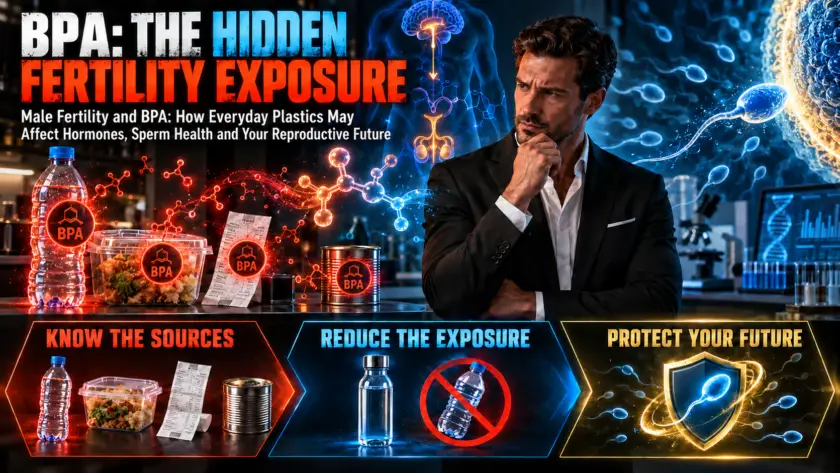
Male Fertility and BPA: How Everyday Plastics May Affect Hormones, Sperm Health and Your Reproductive Future
A man can spend hundreds of pounds on supplements, improve his diet and train several times each week—while giving little thought to the materials touching his food and drink every day.
The bottle left in his car, the container holding yesterday’s meal, the lining inside a food can and the receipt placed into his hand may all contribute to contact with chemicals he cannot see. One of the most discussed is bisphenol A, commonly known as BPA.
BPA is used in the production of certain polycarbonate plastics and epoxy resins. It has been found in or associated with food-contact materials, some can linings, certain reusable containers, thermal paper and industrial products. Because chemicals used in food-contact materials can migrate in small amounts into food or drink, regulators and researchers continue to examine potential health effects.
Male reproductive health is one area of concern.
Studies have investigated possible relationships between BPA exposure and sperm concentration, count, motility, morphology, vitality, DNA integrity and reproductive hormones. Some have reported concerning associations. Others have produced less consistent findings.
That distinction matters.
An association does not prove that BPA alone caused an individual man’s fertility problem. Exposure can be difficult to measure accurately, and semen quality is influenced by many biological, medical, lifestyle and environmental factors. A single plastic bottle does not mean a man has permanently damaged his fertility, and replacing every plastic object cannot guarantee stronger sperm.
But uncertainty is not an excuse for neglect.
When practical changes can reduce unnecessary exposure without controlling a man’s entire life, responsible action becomes worthwhile. Understanding male fertility and BPA is not about becoming frightened of the modern world. It is about identifying repeated exposures, making sensible substitutions and continuing to protect the wider foundations of reproductive health.
A man cannot eliminate every environmental exposure, but he can reduce unnecessary contact with BPA while protecting the wider health foundations supporting his fertility.
1. What Is BPA?
Bisphenol A is an industrial chemical used primarily in the manufacture of certain polycarbonate plastics and epoxy resins.
Polycarbonate can be transparent, rigid and resistant to impact. Epoxy resins have been used as protective coatings, including in some food and drink containers. BPA has also been used in thermal paper and other industrial or consumer applications.
Possible exposure sources may include:
- Certain reusable plastic bottles and containers
- Some food and beverage can linings
- Particular food-contact plastics and coatings
- Thermal-paper receipts
- Older plastic products
- Industrial or workplace materials
- Household dust and the wider environment
This does not mean every plastic contains BPA. “Plastic” describes a broad family of materials, not one chemical. A container’s appearance alone may not reveal its composition.
Exposure can occur through more than one route, but food and drink have received substantial attention because small amounts may migrate from contact materials.
The first responsible step is therefore identification—not panic.
Alpha Fertility Insight
You cannot reduce an exposure responsibly until you understand where it may enter your life.
2. Why BPA Is Called an Endocrine Disruptor
The endocrine system uses hormones as chemical messengers. These signals help coordinate growth, metabolism, sexual development and reproduction.
An endocrine-disrupting chemical may interfere with normal hormonal activity by mimicking a hormone, blocking a receptor, altering hormone production or affecting how signals are transported, broken down or received.
BPA has attracted attention partly because it can interact with hormone-related pathways. This does not mean it simply “destroys testosterone” or causes the same effect in every man.
Biological effects may depend on:
- Dose
- Frequency and duration of exposure
- Timing across development or adulthood
- Other chemical exposures
- Age and health
- Individual biological differences
Laboratory and animal studies can reveal plausible mechanisms, but results do not always translate directly into the effect of typical human exposure. Human observational studies can identify patterns, but they often cannot isolate BPA from every other influence.
This is why accurate wording matters. BPA is a legitimate subject of health research and regulation. It is not a simple explanation for every hormonal or fertility problem.
Alpha Fertility Insight
Hormonal health depends on precise biological communication. Chemicals capable of interfering with that communication deserve informed attention.
3. Male Fertility and BPA: What the Evidence Suggests
Researchers have measured BPA in urine, blood or semen and compared exposure markers with reproductive hormones or semen parameters.
Some human studies have reported associations between higher BPA measurements and poorer semen characteristics. Potential areas of concern include:
- Lower sperm concentration
- Reduced total sperm count
- Weaker motility
- Changes in morphology
- Reduced vitality
- Greater sperm DNA damage
- Altered reproductive hormones
However, the results are not completely uniform.
BPA is processed relatively quickly, so one measurement may not perfectly represent a man’s usual exposure. Fertility-clinic populations may differ from the wider population. Diet, smoking, alcohol, weight, occupational exposure, illness and other chemicals can complicate interpretation.
The correct conclusion is not “BPA definitely causes male infertility.” It is that evidence has raised sufficient concern to justify continued research, regulation and proportionate exposure reduction.
Alpha Fertility Insight
Take the evidence seriously without pretending it is more certain than it is. Responsible men need accuracy—not fear.
4. BPA and Sperm Count
Sperm count describes how many sperm are present. A semen analysis may report sperm concentration per millilitre and total sperm number across the entire sample.
Some research has linked higher BPA exposure markers with lower sperm concentration or count. This does not prove that reducing BPA will raise an individual man’s count, because low sperm levels may result from many different causes.
Possible contributors include:
- Testicular conditions
- Hormonal disorders
- Genetic factors
- Blockages or ejaculation problems
- Infection or injury
- Certain medicines and medical treatments
- Anabolic steroids
- Smoking, excessive alcohol or recreational drugs
- Obesity and wider health conditions
- Unexplained factors
A man cannot estimate sperm count by the amount of semen produced, libido, erections or sexual performance. The main test is a semen analysis.
If a result is abnormal, professional interpretation and appropriate follow-up matter more than blaming the most recent plastic container.
Alpha Fertility Insight
A man can feel healthy and perform sexually while an unseen reproductive problem remains undiscovered.
5. BPA, Sperm Motility and Morphology
Fertility depends on more than producing a large number of sperm.
Motility concerns the proportion of sperm that move. Progressive motility describes sperm moving forwards rather than merely vibrating or travelling in ineffective patterns. Morphology assesses sperm shape under laboratory criteria.
Some studies have reported associations between BPA exposure and weaker motility or less favourable morphology. Possible mechanisms remain under investigation and may involve hormonal signalling, oxidative stress, sperm development or function after sperm leave the testes.
Again, an association is not an individual diagnosis.
Men concerned about fertility should focus on measurable evidence. Semen analysis examines several parameters together, and one abnormal feature does not automatically mean conception is impossible.
Reducing exposure may be one part of a responsible health plan. It is not a substitute for testing, investigation or appropriate treatment.
Alpha Fertility Insight
Reducing a possible risk supports the foundations; it does not guarantee the biological outcome.
6. Could BPA Affect Sperm DNA?
A sperm cell carries genetic information needed for conception and early development. Researchers therefore examine more than sperm count and movement.
Studies have explored whether BPA exposure may be associated with oxidative stress and sperm DNA fragmentation. Oxidative stress occurs when reactive molecules exceed the body’s ability to control or repair their effects.
Sperm DNA fragmentation is not the same measurement as count, motility or morphology. A routine semen analysis does not provide every specialised assessment of sperm function or genetic integrity.
Specialised testing is not automatically required for every man. Its value depends on clinical history, previous results, fertility difficulties and specialist judgement.
Avoid commercial fear tactics claiming that everyone needs an expensive DNA test or detox package. Discuss concerns with an appropriately qualified fertility professional.
Alpha Fertility Insight
Protecting fertility means considering more than the number of sperm—it means respecting the quality of the reproductive information they carry.
7. Heat and Food-Contact Materials
Food-contact materials are manufactured for particular uses. A container designed for cold storage may not be suitable for boiling liquids, microwaving or repeated high-temperature use.
Heat, wear, damage, food composition and storage conditions can influence chemical migration from some materials. The practical response is to use products according to their instructions and avoid unnecessary heating in unsuitable plastic.
Useful habits include:
- Transfer food to glass or ceramic before microwaving when appropriate
- Avoid pouring boiling liquids into containers not designed for them
- Replace heavily scratched, warped or damaged plastic
- Follow temperature and dishwasher instructions
- Avoid reusing disposable packaging beyond its intended purpose
- Do not leave water or food stored unnecessarily in a hot vehicle
“Microwave safe” primarily indicates suitability for microwave use under specified conditions. It should not be treated as a universal claim about every chemical concern.
Alpha Fertility Insight
Convenience should not prevent a man from making one simple change when suitable food storage is readily available.
8. Build a Lower-BPA Kitchen
Reducing exposure does not require throwing away every item overnight.
Start with high-use products and situations involving heat, long contact or damage.
Priority one: Your daily bottle
Choose a suitable glass or stainless-steel bottle if practical. If using plastic, select a product designed for repeated use and follow its care instructions.
Priority two: Hot food
Use glass, ceramic or other suitable materials for reheating and storing hot meals.
Priority three: Damaged containers
Replace scratched, cloudy, cracked or warped food-contact plastics.
Priority four: Food choices
Use a varied balance of fresh, frozen, dried and canned foods rather than allowing one packaging type to dominate every meal.
Priority five: Gradual replacement
Replace items as they wear out. Exposure reduction should not create unnecessary financial pressure.
The goal is a better environment—not a perfect kitchen.
Alpha Fertility Insight
Exposure reduction should be practical enough to sustain—not so extreme that the man abandons it within a week.
9. Do Not Forget Receipts and Workplace Exposure
BPA and other bisphenols have been used in certain thermal papers. Briefly touching one receipt does not mean fertility damage has occurred, but men who handle large quantities may reasonably reduce avoidable contact.
Practical measures include:
- Decline unnecessary paper receipts
- Choose digital receipts where convenient
- Avoid storing loose receipts with food or frequently handled personal items
- Wash hands before eating after repeated receipt handling
- Follow workplace hygiene and protective procedures
- Avoid using receipts as notepaper for children
- Raise significant occupational concerns with the employer’s health-and-safety representative
Workplace exposure may also come from manufacturing, resins, plastics or other chemicals. Do not guess at the risk. Consult safety data, training and occupational-health guidance.
Alpha Fertility Insight
The goal is not to fear ordinary life. It is to remove repeated exposure when a reasonable alternative exists.
10. “BPA-Free” Does Not Automatically Mean Risk-Free
As concern about BPA increased, manufacturers introduced alternatives. These may include structurally related chemicals such as BPS or BPF.
A “BPA-free” label confirms that BPA was not intentionally used as specified by the manufacturer or applicable standard. It does not prove that every substitute has been exhaustively shown to be biologically inactive.
Research continues into BPA analogues and other food-contact chemicals. This does not mean every alternative is equally harmful. It means the label should not end all critical thinking.
Where practical, choose durable materials such as glass or stainless steel for repeated food and drink contact—particularly with heat. Continue using any product according to instructions.
Avoid replacing evidence with suspicion. “Chemical” does not mean dangerous, and “natural” does not automatically mean safe.
Alpha Fertility Insight
A marketing claim can describe what was removed without proving that every replacement is superior.
11. BPA Is Only One Part of the Fertility Environment
A man can become obsessed with one exposure while ignoring behaviours with wider consequences.
The foundations still matter:
- Stop smoking
- Keep alcohol within responsible limits
- Avoid anabolic steroids and recreational drugs
- Maintain an appropriate body weight
- Eat a varied, balanced diet
- Exercise consistently
- Protect sleep and recovery
- Reduce unnecessary testicular heat
- Address infections and sexual-health concerns
- Review medicines with a clinician rather than stopping them independently
- Seek semen analysis and professional assessment when appropriate
Environmental exposure is one part of a much larger reproductive picture.
Do not buy an expensive BPA detox while continuing to smoke, misuse hormones, sleep poorly and avoid medical testing. The strongest plan addresses the whole man.
Alpha Fertility Insight
Do not obsess over one chemical while ignoring the daily habits with the clearest consequences for your health.
12. Reduce Exposure Without Becoming Controlled by Fear
Complete avoidance of BPA and every endocrine-active substance is unlikely in modern life. Attempting total control can create anxiety without providing proportional benefit.
Use a controlled process:
- Identify the most frequent potential exposures.
- Replace the easiest high-contact item.
- Stop heating food in unsuitable or damaged plastic.
- Improve storage and packaging choices gradually.
- Reduce unnecessary receipt contact.
- Review occupational exposure where relevant.
- Protect wider fertility foundations.
- Seek medical investigation when concerns persist.
European authorities have concluded that BPA exposure presents health concerns, while recent regulatory actions have addressed its use in food-contact materials. Those assessments consider multiple possible health effects; they should not be misrepresented as proof that BPA caused a particular man’s infertility.
Responsible reduction creates control. Constant fear gives the chemical more power over daily life than evidence justifies.
Alpha Fertility Insight
Responsible exposure reduction creates control. Obsession merely replaces one risk with constant anxiety.
What Sensible BPA Reduction Looks Like
| Fear-based reaction | Evidence-aware action |
|---|---|
| Treats every plastic as identical | Identifies specific high-use food-contact items |
| Throws everything away immediately | Replaces damaged and frequently heated items first |
| Assumes BPA caused every symptom | Seeks proper medical and fertility assessment |
| Buys an unproven detox | Reduces exposure and strengthens wider health habits |
| Trusts every “BPA-free” claim completely | Considers material, use, heat and product guidance |
| Tries to achieve zero exposure | Focuses on practical, repeatable reduction |
The BPA Exposure Audit
Review the following areas:
- What bottle do I use every day?
- Do I leave it in a hot car?
- Which containers hold hot food?
- Do I microwave food in plastic?
- Are any containers scratched, cloudy, cracked or warped?
- How frequently do I eat canned foods?
- Could I use more fresh, frozen or dried alternatives?
- Do I handle thermal receipts repeatedly?
- Does my occupation involve plastics, resins or industrial chemicals?
- Have I read the relevant workplace safety guidance?
- Am I relying entirely on “BPA-free” labels?
- Which glass or stainless-steel replacement would have the greatest impact?
- Am I ignoring smoking, alcohol, drugs, weight, sleep or testicular heat?
- Have I had a semen analysis when clinically appropriate?
- Do I need advice from a GP or fertility specialist?
Choose three realistic actions. Exposure reduction becomes useful when it changes behaviour.
The Seven-Day BPA Reduction Reset
Day 1: Identify
List the plastic and coated items that regularly contact your food and drink.
Day 2: Remove Unnecessary Heat
Transfer food before microwaving where appropriate and stop using unsuitable containers for very hot contents.
Day 3: Replace One High-Use Item
Choose the bottle or container used most frequently and replace it with a suitable lower-exposure option.
Day 4: Review Food Storage
Move hot meals and leftovers into appropriate glass, ceramic or other suitable containers.
Day 5: Reduce Receipt Contact
Choose digital receipts where practical and improve hand hygiene after repeated handling.
Day 6: Examine Wider Fertility Habits
Review smoking, alcohol, sleep, exercise, weight, drugs, anabolic steroids and heat exposure.
Day 7: Create the Long-Term Plan
Choose the next three gradual replacements and decide whether a clinical conversation or fertility test is appropriate.
Frequently Asked Questions
What is BPA?
BPA is an industrial chemical used primarily in certain polycarbonate plastics and epoxy resins. It has been used in some food-contact products, can linings and thermal papers.
Does BPA cause male infertility?
Research has reported associations between BPA exposure markers and some semen or hormonal outcomes, but human evidence is not completely consistent and observational studies cannot prove that BPA alone caused infertility in an individual.
Can BPA lower sperm count?
Some studies have associated higher BPA exposure with lower sperm concentration or count. Many other medical, lifestyle and genetic factors can affect these measurements, so semen analysis and professional investigation are necessary.
Does BPA affect testosterone?
BPA may interact with endocrine pathways, and studies have investigated possible associations with reproductive hormones. It is inaccurate to say that ordinary exposure automatically destroys testosterone.
Should I throw away every plastic container?
No. Prioritise damaged containers, unsuitable heating practices and high-use food-contact items. Replace products gradually and follow manufacturer instructions.
Is BPA-free plastic completely safe?
The label addresses BPA, not every feature of the material or every possible substitute. Use the product as intended and consider glass or stainless steel for repeated hot-food or drink contact where practical.
Can avoiding BPA improve semen quality?
Reducing unnecessary exposure is a reasonable precaution, but it cannot guarantee improved count, motility, morphology or fertility. Wider health habits and appropriate medical care remain essential.
Do paper receipts contain BPA?
Some thermal papers have used BPA or alternative bisphenols. Occasional handling is different from repeated occupational contact. Declining unnecessary receipts and washing hands before eating are practical precautions.
Is there a BPA detox supplement?
No supplement has been established as a guaranteed BPA detox or fertility cure. Be cautious of products using fear to sell unsupported promises.
When should I seek fertility help?
Seek advice when you have reproductive symptoms, known risk factors or difficulty conceiving. In the UK, a GP can advise on appropriate testing for both partners and arrange semen analysis when indicated.
Closing Declaration
I will not become frightened by every material surrounding me.
I will seek evidence instead of surrendering to exaggerated claims.
I will reduce unnecessary BPA exposure where practical.
I will stop heating food in containers not designed for that purpose.
I will improve my food and drink storage gradually and consistently.
I will remember that environmental exposure is only one part of male fertility.
I will protect my wider reproductive health and seek qualified help when necessary.
I cannot control every chemical in my environment, but I can take responsible control of the exposures within my reach.
Final Line
You do not need to fear every plastic object—but your future fertility deserves more thought than blind convenience.



No spam. Unsubscribe anytime.