Every man feels powerful when the vision is new.
The new training programme.
The new business idea.
The new diet.
The new financial plan.
The new promise to change.
At the beginning, everything feels possible.
The music is loud.
The goals are clear.
The energy is high.
The man tells himself:
“This time will be different.”
For several days, perhaps even several weeks, he moves with purpose.
He wakes earlier.
He trains harder.
He eats better.
He saves money.
He works on the plan.
He feels as though a new version of himself has finally arrived.
Then reality enters the room.
The alarm sounds when it is dark and cold.
The body feels heavy.
Progress slows.
The work becomes repetitive.
Nobody notices.
The first excitement disappears.
The results remain invisible.
The man no longer feels inspired.
This is where most transformations end.
Not because the goal was impossible.
Not because the man lacked potential.
But because he built the plan on a feeling that was never designed to last.
Motivation is powerful.
But motivation is temporary.
It rises when the goal feels exciting.
It falls when progress becomes slow.
It appears when the future looks clear.
It disappears when the work becomes ordinary.
Discipline begins where motivation stops.
Motivation asks:
“Do I feel ready?”
Discipline asks:
“What did I commit to?”
Motivation wants the result.
Discipline accepts the process.
Motivation enjoys the beginning.
Discipline survives the middle.
The disciplined man does not always feel strong.
He gets tired.
He experiences doubt.
He becomes frustrated.
He feels temptation.
He loses momentum.
He has bad days.
The difference is not that he feels less resistance.
The difference is that resistance does not receive complete authority over his actions.
He has built standards that remain when emotion changes.
He has rules that continue when enthusiasm disappears.
He has routines that carry him through days when his mind begins negotiating with comfort.
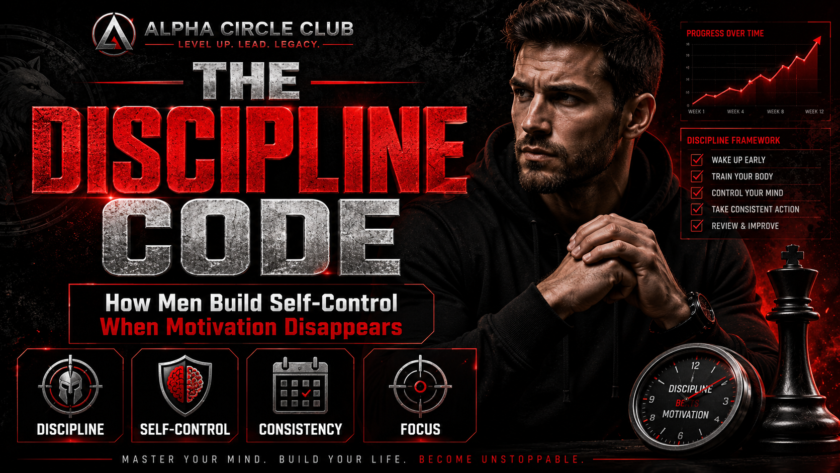
This is the Discipline Code.
It is not punishment.
It is not self-hatred.
It is not pretending to be invincible.
It is the ability to lead yourself when the weaker part of you begins asking for control.
It is the decision to act according to the man you intend to become instead of the feeling you happen to have today.
Alpha Thought:
The man you become is decided most clearly on the days you do not feel like becoming him.
Quick Alpha Summary
Discipline is the ability to act according to your principles, commitments, and long-term goals even when your emotions, comfort, and circumstances encourage you to quit.
Discipline includes:
- Self-control
- Consistency
- Delayed gratification
- Emotional regulation
- Personal responsibility
- Keeping promises to yourself
- Completing necessary work
- Refusing destructive impulses
- Returning quickly after failure
Motivation can help a man begin.
Discipline helps him continue.
A disciplined life is not created through one dramatic decision.
It is built through repeated ordinary choices:
- Getting up when the alarm sounds
- Beginning the workout
- Closing the distracting app
- Completing the difficult task
- Refusing the unnecessary purchase
- Preparing the meal
- Controlling the emotional reaction
- Going to sleep on time
- Returning after a mistake
The goal is not perfection.
The goal is to build standards stronger than excuses.
Alpha Thought:
Motivation creates movement. Discipline turns movement into identity.
What Is Discipline?
Discipline is the ability to direct your behaviour according to what matters most rather than allowing immediate emotion to make every decision.
It means acting according to:
- Principles
- Commitments
- Long-term goals
- Personal standards
- Responsibility
- Clear priorities
Discipline is often misunderstood as harshness.
Some men believe discipline means:
- Never resting
- Ignoring pain
- Working constantly
- Punishing failure
- Becoming emotionally cold
- Treating exhaustion as weakness
That is not discipline.
That is often poor judgement disguised as toughness.
Real discipline includes knowing when to push and when to recover.
It includes training hard and sleeping properly.
Working with focus and stopping before burnout.
Controlling emotion without denying that emotion exists.
Keeping standards without becoming cruel toward yourself or others.
Discipline is not about controlling life through punishment.
It is about directing life through standards.
A disciplined man can still enjoy himself.
He can rest.
He can celebrate.
He can change plans when circumstances genuinely require it.
But he does not allow comfort, distraction, fear, or impulse to make every choice.
Alpha Thought:
Discipline is not controlling your life through cruelty. It is directing your life through standards.
Discipline vs Motivation
Motivation and discipline are not enemies.
Motivation is useful.
It creates energy.
It helps a man see possibility.
It can push him through the first difficult step.
But motivation is unreliable.
Motivation:
- Changes with mood
- Depends heavily on emotion
- Is often strongest at the beginning
- Weakens when progress becomes slow
- Responds to novelty
- Can disappear without warning
Discipline:
- Functions through routine
- Continues through discomfort
- Does not require excitement
- Strengthens through repetition
- Survives ordinary days
- Produces progress after motivation fades
A man should use motivation when it appears.
But he should not build his life around it.
Motivation may start the workout.
Discipline places training on the calendar.
Motivation may inspire a business idea.
Discipline completes the work when sales are slow.
Motivation may encourage saving.
Discipline automates the transfer.
Motivation may lead to an apology.
Discipline changes the behaviour that caused the problem.
The strongest approach is simple:
Use motivation to begin.
Use systems to continue.
Use repetition to make the behaviour part of your identity.
Alpha Thought:
Motivation is a visitor. Discipline must become a resident.
Why Men Struggle With Discipline
A lack of discipline is not always simple laziness.
Men may struggle for many reasons.
No clear purpose
It is difficult to endure discomfort when the mission feels meaningless.
A man may say he wants to train, build a business, save money, or improve his life.
But if he has no emotionally powerful reason behind the goal, comfort will often win.
Goals are too vague
“Get healthier.”
“Work harder.”
“Make more money.”
“Become disciplined.”
These goals do not tell the man what to do today.
Discipline needs clear action.
Too many commitments
Some men try to improve every area at once.
They create a perfect morning routine, intense training plan, strict diet, business schedule, reading target, savings challenge, and digital detox.
Within days, the system becomes impossible to maintain.
Constant digital stimulation
The brain becomes trained to expect novelty.
Short videos.
Notifications.
Messages.
News.
Arguments.
Games.
When the mind is repeatedly rewarded for switching attention, deep work feels uncomfortable.
Poor sleep and low energy
A man who is chronically exhausted will find discipline harder.
This does not remove responsibility.
But it means sleep, recovery, nutrition, and health must be part of the plan.
Fear of failure
Some men avoid beginning because trying creates the possibility of visible failure.
Procrastination protects the ego temporarily.
Fear of success
Success may create responsibility, attention, pressure, or change.
A man may unconsciously sabotage progress because the next level feels unfamiliar.
Perfectionism
The man believes the task must be completed perfectly.
Because perfection feels impossible, he avoids beginning.
Lack of structure
Without a clear time, location, and process, even important goals remain optional.
Temptation-filled environments
A man may expect willpower to overcome a phone beside him, junk food in the kitchen, entertainment on every screen, and people who constantly pull him away from his priorities.
Broken self-trust
Every time a man makes a promise to himself and ignores it, self-trust weakens.
Eventually, he stops believing his own plans.
Discipline rebuilds this trust through small promises kept repeatedly.
Alpha Thought:
Before calling yourself lazy, examine whether your goals, energy, environment, and systems are working against you.
Discipline Begins With Identity
A man’s behaviour is strongly influenced by how he sees himself.
A goal focuses on an outcome.
Identity focuses on the kind of man who produces the outcome.
Instead of saying:
“I am trying to exercise.”
Say:
“I am a man who trains.”
Instead of:
“I am trying to control my spending.”
Say:
“I direct my money with intention.”
Instead of:
“I hope to become productive.”
Say:
“I complete the work I schedule.”
Instead of:
“I want to read more.”
Say:
“I am a man who studies.”
But identity statements must be supported by action.
Words without evidence become self-deception.
A man cannot repeatedly avoid training while claiming to be disciplined.
He cannot spend impulsively while claiming financial control.
He cannot constantly lose his temper while calling himself emotionally strong.
Identity is built through evidence.
Every completed action becomes a vote for the man you are becoming.
One workout does not transform your body.
But it proves you can begin.
One early night does not repair every health problem.
But it proves you can protect recovery.
One focused hour does not build a business.
But it proves you can create rather than consume.
The goal is to collect evidence.
Alpha Thought:
Identity is not what a man calls himself. It is what his repeated actions provide evidence for.
Build Standards, Not Wishes
Wishes are vague.
Standards are measurable.
A wish says:
“I want to become healthier.”
A standard says:
“I train four times each week, prepare most of my meals, and protect my sleep.”
A wish says:
“I want to grow my business.”
A standard says:
“I complete two hours of focused business work before entertainment.”
A wish says:
“I want better finances.”
A standard says:
“I track spending, save automatically, and wait before non-essential purchases.”
A wish says:
“I want stronger relationships.”
A standard says:
“I communicate directly, keep my promises, and address conflict respectfully.”
A standard tells a man how to behave.
It removes some negotiation.
Useful areas for standards include:
- Health
- Training
- Nutrition
- Work
- Money
- Relationships
- Learning
- Sleep
- Digital use
- Emotional conduct
- Personal integrity
Standards should be realistic enough to follow and strong enough to create change.
A standard that cannot survive an ordinary week is probably too complicated.
Alpha Thought:
A wish describes the life you want. A standard describes what you repeatedly do.
The Discipline Decision
Large goals can feel overwhelming.
But discipline is usually won or lost in a very small moment.
The alarm sounds.
You either stand up or press snooze.
The phone vibrates.
You either ignore it or break focus.
The workout begins.
You either complete the first exercise or delay again.
The purchase appears.
You either pause or act on impulse.
The argument becomes intense.
You either control the response or allow anger to speak.
These moments are the discipline decision.
A man does not need to feel ready for the entire journey.
He needs to complete the next controlled action.
Do not think about the entire workout.
Put on the training clothes.
Do not think about writing the whole book.
Open the document.
Do not think about clearing every debt.
Review the next payment.
Do not think about changing your entire life.
Choose the next disciplined decision.
Alpha Thought:
A disciplined life is constructed through thousands of decisions that seemed too small to matter.
Remove Friction From Good Habits
Discipline becomes easier when the environment supports the desired action.
This is not weakness.
It is intelligent self-leadership.
Examples include:
- Prepare gym clothes the night before
- Keep healthy food visible and ready
- Create a dedicated workspace
- Block distracting websites
- Schedule automatic savings
- Prepare tomorrow’s priorities before finishing work
- Keep books where you normally sit
- Place the phone outside the bedroom
- Pack meals in advance
- Keep useful tools organised
- Put training sessions in the calendar
A man should not depend on memory and motivation when preparation can carry part of the load.
The easier a good habit is to begin, the more likely it becomes.
Alpha Thought:
Do not make the right action harder than it needs to be.
Add Friction to Bad Habits
The same principle works in reverse.
Make destructive behaviour more difficult.
Examples include:
- Delete unnecessary apps
- Log out of distracting accounts
- Remove stored payment details
- Keep junk food out of the home
- Avoid keeping alcohol nearby
- Use website restrictions
- Put gaming equipment away from the workspace
- Create spending limits
- Leave cards at home when unnecessary
- Avoid places strongly connected to temptation
- Unfollow accounts that trigger comparison or impulsive behaviour
Willpower is useful.
But repeatedly placing yourself beside temptation and expecting perfect control is a poor system.
Alpha Thought:
Do not continually test your willpower against temptations you could have removed.
The Non-Zero Standard
Some days will not go according to plan.
The man may be tired.
Work may become demanding.
Family responsibilities may change.
Illness may reduce capacity.
The ideal routine may become impossible.
This is where the Non-Zero Standard becomes useful.
On difficult days:
- Train for ten minutes instead of skipping completely
- Write 200 words instead of 2,000
- Read two pages instead of a chapter
- Save a small amount instead of nothing
- Complete one important task instead of abandoning the day
- Take a short walk instead of the full session
- Prepare one healthy meal instead of losing the entire day
The reduced action should not become the permanent standard.
Its purpose is to protect continuity.
A non-zero action tells the mind:
“I am still the man who acts.”
Alpha Thought:
When perfection becomes impossible, protect the identity through a smaller act of discipline.
Discipline and Delayed Gratification
Discipline often requires choosing a greater future reward over immediate comfort.
This can mean:
- Saving instead of impulse spending
- Training instead of remaining comfortable
- Studying instead of endless entertainment
- Building a business before displaying wealth
- Sleeping instead of scrolling
- Eating for health instead of momentary pleasure
- Controlling anger instead of enjoying immediate release
- Completing work instead of seeking quick stimulation
Delayed gratification is not permanent deprivation.
It is intelligent timing.
The disciplined man does not reject every pleasure.
He refuses to let immediate pleasure repeatedly destroy long-term freedom.
Alpha Thought:
Every disciplined decision is a message to your future self: your freedom matters more than my present impulse.
Digital Discipline
Modern men are surrounded by systems designed to capture attention.
Notifications.
Short-form videos.
Endless feeds.
Breaking news.
Messages.
Games.
Pornography.
Online arguments.
Streaming platforms.
Attention is constantly being divided.
A man cannot build a focused life while allowing every device to interrupt him.
Practical digital standards may include:
- No phone for the first 30 minutes of the day
- No phone during focused work
- Turn off non-essential notifications
- Remove devices from the bedroom
- Set clear social-media windows
- Use website blockers
- Complete important work before entertainment
- Avoid online arguments
- Unfollow accounts that produce distraction, envy, or temptation
- Schedule periods of complete disconnection
The goal is not to reject technology.
It is to use technology without becoming controlled by it.
Alpha Thought:
A man who cannot control where his attention goes will struggle to control where his life goes.
Emotional Discipline
Discipline is not only about completing tasks.
It is also about controlling reactions.
A man may follow a perfect routine and still be undisciplined if anger, ego, jealousy, or fear controls his behaviour.
An emotionally disciplined man learns to:
- Pause before responding
- Avoid decisions made in anger
- Communicate directly
- Accept criticism without collapsing
- Resist revenge
- Admit mistakes
- Apologise sincerely
- Leave situations before losing control
- Remain calm under pressure
- Act according to values rather than emotion
Emotional discipline does not mean becoming emotionless.
It means feeling emotion without surrendering control.
A powerful man who cannot control his reactions can damage relationships, reputation, health, and opportunity.
Alpha Thought:
Strength is not only the ability to act. It is also the ability to refuse the wrong reaction.
Discipline and Physical Health
Health is rarely built through one extreme effort.
It is built through repeated ordinary choices.
Physical discipline includes consistency in:
- Strength training
- Cardiovascular exercise
- Nutrition
- Sleep
- Recovery
- Hydration
- Medical check-ups
- Alcohol control
- Smoking cessation
- Sexual health
- Fertility protection
- Stress management
A man may complete an intense workout and then ignore sleep, nutrition, and recovery.
That is not complete discipline.
Health discipline is balanced.
It respects both effort and restoration.
The body responds to what happens repeatedly.
Alpha Thought:
Your body is shaped less by occasional intensity than by the habits you repeat when nobody is watching.
Discipline and Wealth
Financial discipline is another form of self-command.
It includes:
- Tracking spending
- Controlling lifestyle inflation
- Saving consistently
- Avoiding impulsive purchases
- Addressing debt
- Building valuable skills
- Creating income
- Investing responsibly
- Thinking long term
- Refusing status spending
- Building ownership
The undisciplined man may earn more and spend more.
The disciplined man uses part of increased income to create security and assets.
He understands that every purchase has an opportunity cost.
Financial freedom is not usually created through one dramatic move.
It is built through controlled decisions repeated over years.
Alpha Thought:
Financial freedom is delayed gratification converted into ownership.
Discipline Does Not Mean Perfection
A disciplined man can fail.
He can miss a workout.
Overspend.
Procrastinate.
Lose focus.
Break a routine.
Make a poor decision.
Discipline is not proven by never falling.
It is proven by how quickly the man returns.
Perfectionism says:
“I failed, so the plan is over.”
Discipline says:
“I failed today. I return at the next opportunity.”
One missed workout does not destroy progress.
But using it as permission to quit may.
One poor meal does not destroy health.
But turning it into a week of uncontrolled eating may.
One unproductive morning does not ruin the day.
But deciding the entire day is lost can.
Never allow one mistake to become a new identity.
Return quickly.
Without drama.
Without self-hatred.
Without waiting for Monday.
Alpha Thought:
The disciplined man is not the man who never falls. He is the man who refuses to remain down.
The Alpha Discipline Scorecard
At the end of each week, score yourself from 1 to 10 in the following areas:
- Sleep
- Training
- Nutrition
- Focused work
- Financial control
- Digital discipline
- Emotional control
- Learning
- Relationships
- Keeping promises
Then ask:
- Where did I lose control?
- What triggered it?
- Which environment needs changing?
- Which promise did I keep?
- Which promise did I repeatedly break?
- What improved?
- What became harder?
- What is the one discipline priority for next week?
Do not use the scorecard to attack yourself.
Use it to identify patterns.
The goal is not to score ten in every category.
The goal is to improve awareness and direction.
Alpha Thought:
Honest measurement turns vague frustration into a problem that can be solved.
The 30-Day Alpha Discipline Reset
This reset is not designed to create a perfect life in 30 days.
It is designed to restore self-command.
Days 1–7: Remove the Chaos
- Choose three priorities
- Set a regular wake time
- Set a realistic sleep time
- Remove major distractions
- Track current habits
- Clean and organise the environment
- Identify the behaviour causing the most damage
The goal is clarity.
Days 8–14: Build the Routine
- Create a simple morning routine
- Schedule focused work
- Establish training days
- Prepare meals
- Set digital boundaries
- Choose one financial standard
- Prepare the next day each evening
The goal is structure.
Days 15–21: Strengthen Self-Control
- Delay one impulse each day
- Complete the hardest task first
- Practise pausing before emotional responses
- Reduce unnecessary consumption
- Keep one difficult promise every day
- Use the Non-Zero Standard when needed
The goal is evidence.
Days 22–30: Raise the Standard
- Review the Discipline Scorecard
- Strengthen weak areas
- Create personal non-negotiables
- Document the routine
- Remove one remaining source of friction
- Set the next 90-day discipline target
- Decide what standard must continue after the reset
The goal is continuation.
Alpha Thought:
Discipline becomes identity when the standard remains after the challenge ends.
The Alpha Discipline Code
The Discipline Code can be reduced to ten principles.
1. Know the mission
A man endures more when he understands why the goal matters.
2. Set measurable standards
Vague intentions create vague results.
3. Keep promises to yourself
Self-trust grows through evidence.
4. Control the environment
Make good choices easier and bad choices harder.
5. Begin before you feel ready
Action often creates the motivation you were waiting for.
6. Delay immediate gratification
Do not trade future freedom for temporary comfort.
7. Protect focused time
Attention is one of your most valuable resources.
8. Control emotional reactions
Power without emotional restraint becomes destructive.
9. Return quickly after failure
Do not allow one mistake to become surrender.
10. Make consistency part of your identity
The standard should survive changing moods.
Common Discipline Mistakes
Trying to change everything at once
Complex routines often collapse.
Depending on motivation
Emotion cannot carry a long-term mission.
Setting unrealistic standards
A routine that cannot survive normal life is poorly designed.
Keeping temptations nearby
Environment matters.
Confusing exhaustion with discipline
Burnout is not a badge of honour.
Punishing yourself after mistakes
Self-hatred does not create sustainable improvement.
Tracking too many habits
Focus on the few behaviours that create the greatest change.
Announcing goals instead of completing them
Talking can create the emotional reward before the work is done.
Seeking constant novelty
Progress often becomes repetitive before it becomes visible.
Refusing rest
Recovery supports long-term performance.
Allowing one failure to destroy the plan
Return immediately.
Choosing comfort while claiming to want change
A goal without sacrifice remains a wish.
Alpha Thought:
Discipline is not proved by what you say you want. It is revealed by what you repeatedly refuse to sacrifice for comfort.
Final Alpha Standard
Discipline is not built in the moments when everything feels easy.
It is built when the alarm sounds and comfort offers an excuse.
When the work becomes repetitive.
When nobody is watching.
When progress is slow.
When your emotions change.
When the old version of you asks for control again.
The disciplined man is not a man without temptation.
He is not a machine.
He is not always confident.
He is not always energetic.
He is a man whose standards have become stronger than his excuses.
He trains when motivation fades.
He keeps his word when nobody would know he broke it.
He controls his money.
He protects his health.
He completes the work.
He manages his emotions.
He returns quickly when he fails.
He does not wait to feel like the man he wants to become.
He acts like that man until the actions become his identity.
The Alpha standard is simple:
Choose the mission.
Set the standard.
Control the environment.
Do the next hard thing.
Protect your attention.
Delay the impulse.
Keep the promise.
Return after failure.
Repeat until the standard becomes normal.
Do not wait for motivation to rescue you.
Build a system that survives without it.
Final Alpha Thought:
Discipline is the bridge between the man you are today and the man your future requires.
Build the Standard. Control the Mind. Become the Man.
Alpha Circle Club helps men develop the discipline, strength, focus, and self-command required to transform every area of life.
Stop waiting for motivation.
Build a standard that survives without it.


No spam. Unsubscribe anytime.