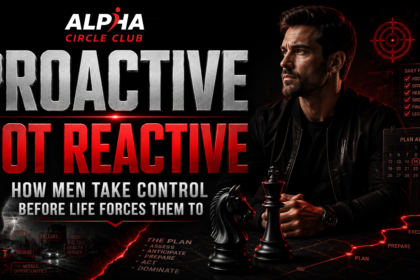
Why Your Next Level Cannot Depend on Other People Understanding Your Ambition
There may be a larger life inside you that nobody else can see yet.
You can see the business before it exists. You can imagine the stronger body before the transformation becomes visible. You feel called to develop your character, increase your income, lead your family more effectively or create work that serves people beyond your current position.
But the people around you may only see the man you have been.
They remember your failed attempt. They know your current job title, bank balance and routine. They may care about you deeply, yet still struggle to imagine you operating beyond the identity they already understand.
So you explain the goal. You wait for encouragement. You look for a reaction that confirms you are not being foolish. When approval does not arrive, doubt grows. The plan returns to the notebook. Another year passes while you wait for somebody else to recognise a future that was entrusted to you.
This is how men remain trapped without chains.
No one explicitly orders them to stay small. They simply make progress dependent on permission that was never required.
To believe in your potential does not mean believing you are guaranteed success. It does not mean rejecting advice, neglecting family responsibilities or assuming every idea is brilliant. It means accepting that your current evidence may not reveal your full capacity—and giving disciplined action enough time to discover what you can become.
You do not need everyone to understand the vision. You need enough clarity to begin, enough humility to learn and enough discipline to continue creating evidence.
Stop asking people who can only see your past to authorise the future you have not yet had the courage to build.
1. Permission-Seeking Can Look Like Preparation
Waiting for approval rarely announces itself honestly.
It sounds responsible:
- “I am waiting for people to understand the idea.”
- “I need to know everyone supports me.”
- “I should explain it one more time.”
- “I will start when my family feels confident about it.”
- “I need somebody experienced to tell me I can do it.”
Advice and preparation are valuable. The problem begins when consultation becomes a delay mechanism.
You ask another person, then another, hoping someone will remove all uncertainty. Every concern creates another round of research. Every doubtful expression becomes evidence that you should remain where you are.
This is not always caution. Sometimes it is fear seeking a respectable disguise.
Ask yourself:
- What decision am I actually avoiding?
- Which information is genuinely missing?
- Who has the expertise and character to advise me?
- Am I seeking wisdom—or emotional permission?
- What small, responsible action could test the idea now?
A man can spend years preparing to feel ready. Readiness often arrives after movement begins.
Alpha Insight
Preparation gathers what action needs. Permission-seeking gathers opinions until fear receives the answer it wanted. Know which process you are using.
2. The People Who Love You May Still Fear Your Growth
Resistance does not always come from enemies.
Family and friends may discourage ambition because they care about you. They see financial risk, possible rejection, stress and disappointment. They may be trying to protect you from pain.
They may also be protecting familiarity.
Your growth can change relationships. If you become more disciplined, other people may feel confronted by their own habits. If you build financial independence, old expectations may no longer control your choices. If you establish boundaries, relationships organised around your compliance must adjust.
None of this means your loved ones are malicious. It means their advice may contain their fears as well as your interests.
Listen respectfully. Extract useful questions:
- Have I underestimated the cost?
- Does my family have adequate protection?
- Is my timeline realistic?
- What evidence supports demand?
- Which responsibilities must remain secure?
Then separate legitimate concerns from inherited limitation.
Someone can love you and still be unable to imagine your next level. Their inability to see it does not prove it is impossible.
Alpha Insight
Love can offer wisdom, but it can also carry fear. Honour the relationship without allowing another person’s anxiety to become your permanent ceiling.
3. Society Rewards Predictability More Than Potential
The conventional path is easy to explain.
Find stable work. Follow instructions. Avoid visible failure. Wait for predictable milestones. Keep ambition small enough that nobody feels uncomfortable.
There is nothing shameful about employment, stability or an ordinary life chosen deliberately. Honest work deserves respect. The problem is not having a job; it is believing your job title defines the maximum value you can create.
Institutions are designed around roles. They reward you for performing a function, not necessarily for discovering every ability within you. A workplace may value your reliability while having no interest in your dream. Society may applaud security while remaining indifferent to the purpose that keeps calling you forward.
You must decide whether your current structure is a foundation or a prison.
It can be a foundation when income supports your household while you build skills, savings and evidence. It becomes a prison when fear convinces you that nothing outside the role is possible.
Do not rebel recklessly. Use what the current season provides. Learn, save, prepare and build during the hours you control.
Alpha Insight
Your current role may describe how you earn today. It does not possess the authority to define everything you may become tomorrow.
4. Self-Belief Is Not Evidence That You Are Already Ready
“Believe in yourself” can become empty advice when separated from preparation.
Believing in your potential does not mean pretending you already possess every required skill. Potential is capacity that may be developed—not a completed result.
Responsible self-belief says:
“I may not be ready for the full responsibility yet, but I am capable of becoming more prepared.”
Arrogance says:
“I already know enough, and anyone who questions me is a hater.”
The difference is visible in behaviour.
A man with grounded belief studies the field, seeks feedback, practises privately and improves weak areas. A man driven by fantasy announces the identity, ignores correction and expects the world to reward intention.
Use this sequence:
Believe → Prepare → Act → Measure → Improve → Repeat
Belief creates permission to begin. Preparation increases capability. Action creates evidence. Measurement reveals reality. Improvement converts experience into progress.
Alpha Insight
Real self-belief does not claim you have already arrived. It gives you the courage to begin becoming qualified for the future you desire.
5. Stop Explaining the Vision to People Committed to Misunderstanding It
Not every person deserves unlimited access to your unfinished ambition.
Some will ask questions because they want to understand. Others will ask only to find weaknesses they can ridicule. If every conversation leaves you defending the right to try, the discussion is not helping the mission.
Learn three levels of communication:
Share the vision
Use this with trusted people who have earned access through wisdom, support, relevant experience or honest accountability.
Share the plan
Use this with people affected by the decision—such as a spouse, business partner or financial stakeholder. They deserve practical details, not motivational slogans.
Share the evidence
With everyone else, let completed work speak. You do not owe a presentation to every critic.
Privacy is not secrecy when no deception is involved. It can be protection for work still developing roots.
Alpha Insight
Some ambitions grow stronger through wise discussion. Others are talked to death before their first serious action. Know who has earned access.
6. Criticism Must Be Filtered, Not Feared or Worshipped
Rejecting all criticism is not strength. Obeying all criticism is not humility.
Strong men filter feedback through four questions:
- Who is speaking? Do they have relevant knowledge, character or experience?
- What is the evidence? Are they identifying a specific weakness or expressing a preference?
- What is the motive? Are they helping you improve, protecting a legitimate interest or trying to preserve control?
- What should change? Does the goal need adjustment, or only the method?
A critic may be unpleasant and correct. A supporter may be loving and wrong. Judge the information independently from the emotional experience of receiving it.
When feedback reveals a weakness, improve. When it reveals a fatal flaw, reconsider the plan. When it offers no evidence, do not let volume impersonate authority.
Alpha Insight
The Alpha man does not need criticism to disappear. He needs the judgement to extract truth without surrendering direction.
7. Build Evidence Before Demanding Belief
The world does not owe immediate confidence to an untested ambition.
If you say you will build a business, people may remember ten previous announcements. If you claim you will transform your health, they may have watched you stop repeatedly. Their doubt may not be sabotage; it may be a rational response to missing evidence.
Do not argue. Build.
- Create the first product.
- Complete thirty days of training.
- Save the first emergency fund.
- Publish consistently.
- Serve the first customer well.
- Learn the skill until performance becomes visible.
Evidence changes the conversation, but more importantly, it changes your relationship with yourself.
Each completed action says:
“My future is no longer dependent on what I say. It is beginning to rest on what I repeatedly do.”
Alpha Insight
Do not waste your best energy convincing people that you are serious. Put that energy into producing evidence they cannot honestly ignore.
8. Responsible Ambition Protects What Already Depends on You
Permission is not required for personal growth, but responsibility still matters.
A married man cannot treat joint finances as though nobody else is affected. A father cannot abandon essential provision to chase a vague dream without planning. A business partner cannot make unilateral decisions with shared resources.
These are not requests for approval from strangers. They are duties created by commitment.
Responsible ambition asks:
- What does my household need protected?
- How much money can be risked?
- Which obligations remain non-negotiable?
- What timeline reduces unnecessary harm?
- What agreement is required because others share the consequences?
- Can I test the idea alongside current income?
Sometimes the bold move is leaving. Sometimes it is building quietly before leaving. Courage is not measured by how suddenly a man creates risk.
Alpha Insight
You do not need permission to grow, but you do need integrity when your decisions affect people who trusted you to act responsibly.
9. Stop Confusing Rebellion With Independence
A man can remain controlled by others even while doing the opposite of everything they say.
If criticism automatically makes you rebel, the critic still controls the decision.
Independent judgement is different. It does not ask, “How can I prove them wrong?” It asks, “What action best serves the mission, my values and the evidence?”
Rebellion often creates dramatic gestures: resigning impulsively, spending recklessly, announcing goals to provoke reactions or rejecting all tradition because it came from authority.
Independence is calmer. It can remain in a job while building an exit. It can accept good advice from someone who lacks vision for the entire goal. It can change direction without feeling humiliated.
Alpha Insight
If opposition can make you abandon your judgement, you are not independent—you are simply controlled from the opposite direction.
10. Your Environment Can Shrink or Expand What Feels Possible
Spend enough time around people who ridicule ambition, and smallness begins to feel sensible. Spend time around disciplined builders, and difficult work begins to feel normal.
Your environment includes:
- Conversations
- Social-media feeds
- Books and audio
- Professional networks
- Friends and mentors
- The standards tolerated in your home and workspace
You do not need to abandon everyone who thinks differently. But you may need to reduce the authority of voices that repeatedly normalise helplessness, blame and cynicism.
Seek people who combine ambition with evidence and integrity. Avoid replacing one echo chamber with another filled with exaggerated promises.
The right environment does not flatter you constantly. It increases the standard and expects execution.
Alpha Insight
Choose environments where growth is normal, honesty is valued and ambition is required to produce evidence.
11. Accept the Loneliness of the Unproven Stage
There is a period when the vision makes sense mainly to you.
The audience is small. Revenue is limited. The body has not visibly changed. The work receives little attention. This stage can feel lonely because the effort is real while public proof remains weak.
Do not interpret loneliness as confirmation that the path is wrong.
Use it productively:
- Develop skill away from applause
- Test assumptions cheaply
- Build routines
- Record progress
- Strengthen your spiritual and moral foundation
- Find a small number of credible advisers
- Review whether the evidence supports continuation
Solitude can mature ambition. Isolation can distort it. Maintain relationships, invite honest accountability and stay connected to reality.
Alpha Insight
The unproven stage is lonely because the evidence has not caught up with the vision. Use that silence to build—not to invent fantasies.
12. Give Yourself Permission Through Action
You may never receive the sentence you have been waiting to hear.
Your family may never say, “We always knew you could do it.” Your colleagues may never understand why stable employment was not the limit of your ambition. Society will not send a letter confirming that you are now authorised to become more.
Permission must become a decision:
“I am responsible for testing my capacity with disciplined action.”
Choose the smallest action that creates real evidence:
- Register the domain
- Write the first thousand words
- Complete the training session
- Make the first sales call
- Open the savings account
- Book the course
- Publish the useful article
- Ask the qualified mentor
Do not wait to feel like the future version of yourself. Action is part of how that identity is formed.
Alpha Insight
The moment you act responsibly on your potential, permission stops being something you request and becomes evidence you create.
Approval-Seeking Versus Responsible Self-Leadership
| Approval-seeking | Responsible self-leadership |
|---|---|
| Needs everyone to understand | Communicates with those genuinely affected |
| Collects endless opinions | Selects qualified advisers |
| Treats doubt as prohibition | Tests concerns against evidence |
| Announces identity | Builds capability |
| Avoids all risk | Manages risk deliberately |
| Rebels to prove independence | Acts from values and judgement |
| Hides from feedback | Filters and applies useful feedback |
| Demands belief | Produces evidence |
The POTENTIAL Permission Filter
P — Purpose
Why does this goal matter? Does it serve more than ego?
O — Obligations
Which family, financial, legal and moral duties must be protected?
T — Truth
What evidence supports the opportunity? Which assumptions remain untested?
E — Expertise
Whose advice is genuinely relevant?
N — Next Action
What small, concrete step can produce information or progress?
T — Trade-Offs
What time, money, comfort and opportunities will the goal require?
I — Identity
Which skills and standards must you develop to carry the result?
A — Accountability
How will progress be measured, and who can challenge self-deception?
L — Launch
Set a date and begin. Do not return to permission-seeking after the decision has passed the filter.
The Potential Audit
- What future keeps returning to my mind?
- Why does it matter?
- Whose approval am I waiting for?
- Why have I given that person authority?
- What useful concern have they raised?
- What fear belongs to them rather than me?
- Which responsibilities must remain protected?
- What skill am I currently missing?
- What evidence could I create within thirty days?
- What would failure teach me?
- What is the cost of another year without action?
- What will I complete in the next twenty-four hours?
The Seven-Day Permission Break
Day 1: Name the Vision
Write the goal in one clear sentence and explain why it deserves pursuit.
Day 2: Identify the Gatekeepers
List the people whose approval you believe you need. Decide which are stakeholders, qualified advisers or spectators.
Day 3: Protect Responsibilities
Define the financial, family and moral boundaries within which the goal must operate.
Day 4: Build Capability
Spend a focused hour developing one skill the future requires.
Day 5: Create Evidence
Produce something visible: a page, prototype, workout, proposal or completed application.
Day 6: Request Feedback
Ask one credible person a specific question. Do not ask whether you are “allowed” to continue.
Day 7: Commit
Set the next thirty-day result, schedule the work and complete the first action.
Frequently Asked Questions
What does it mean to believe in your potential?
It means accepting that your current position may not represent your full developed capacity and becoming willing to test that capacity through preparation, action and learning.
Should I ignore people who doubt me?
No. Examine whether their concerns contain evidence. Apply useful feedback while refusing to treat every opinion as a final verdict.
Is family approval important?
Family members affected by your decisions deserve honest communication and responsible protection. That is different from giving every relative control over your direction.
How do I know whether an ambition is realistic?
Research the field, identify costs, test demand, develop required skills and set measurable milestones. Realistic does not mean guaranteed; it means the goal can be tested against evidence.
What if I fail?
Contain the consequences, learn from the result and decide whether to improve the method, change the goal or stop. A responsible attempt can create knowledge even when it does not create the intended result.
Is leaving my job proof that I believe in myself?
Not automatically. Staying while building savings and evidence may demonstrate greater discipline. The correct decision depends on obligations, risk, opportunity and preparation.
How much should I share with other people?
Share practical plans with those affected, seek advice from qualified people and allow completed work to answer spectators.
What if nobody supports me?
Recheck the plan honestly, seek informed communities and begin with a responsible action you can control. Lack of support makes accountability more important—not less.
How can I build self-belief?
Keep small promises, develop skills, record completed actions and expose yourself gradually to challenges. Evidence creates stronger confidence than repeated slogans.
When does confidence become arrogance?
Confidence becomes arrogance when belief refuses evidence, dismisses correction and assumes desire creates entitlement. Grounded confidence remains teachable.
Closing Declaration
I will stop asking spectators to authorise the future I am responsible for building.
I will listen to wisdom without surrendering my judgement.
I will protect the people and responsibilities affected by my decisions.
I will not confuse rebellion with independence or confidence with arrogance.
I will build skills before demanding recognition.
I will create evidence instead of arguing about my seriousness.
I will accept that some people may never understand the vision.
I will allow action, measurement and integrity to reveal what I can become.
I believe in my potential enough to test it—and respect reality enough to learn from the result.
Final Line
Your next level does not require universal understanding. It requires responsible courage, disciplined action and the decision to stop treating other people’s permission as the missing ingredient in your future.


No spam. Unsubscribe anytime.