How Strong Men Decide What Deserves Their Time, Energy and Attention
A strong man does not say yes merely because an opportunity looks impressive. He examines what it serves, what it costs and who he must become to carry it well.
Every decision spends something.
Some decisions spend money. Others spend time, energy, attention, health, trust or years of future opportunity. The price is not always visible when the choice is made.
A new project can look exciting while quietly stealing focus from the work that matters most. A higher-paying role can improve income while damaging health and family life. A social invitation can provide connection or remove the only protected hours available for a critical deadline. A business partnership can promise rapid growth while requiring a man to compromise his values.
The difficult truth is that a good opportunity can still be the wrong decision.
It may be right for somebody else but wrong for your mission. It may be valuable at another stage but destructive now. It may offer money while charging too much in health. It may create status while weakening the relationship you claim matters most. It may provide immediate pleasure while reducing long-term freedom.
This is why strong men need more than ambition.
They need a filter.
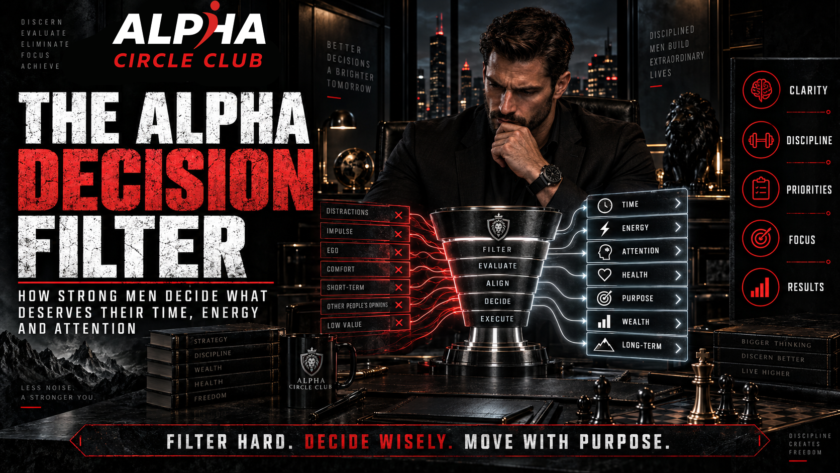
The Alpha Decision Filter is a practical system for judging choices through the areas that shape a man’s life:
- Integrity — Can this be pursued honestly?
- Purpose — Does it serve the mission or distract from it?
- Health — What will it demand from the body and mind?
- Family — Who else will carry the consequences?
- Wealth — Does it create value, protection and ownership—or only appearance?
- Time and energy — What must be removed to make room?
- Long-term consequences — What future does this decision make more likely?
Within Alpha Circle Club, Alpha does not mean dominating other people. It means self-leadership: directing your attention, choices and behaviour according to a standard stronger than impulse, pressure or image.
An Alpha man is not emotionless. He does not possess perfect foresight. He will still make mistakes and sometimes choose from incomplete information. His strength is not that every decision works.
His strength is that he decides deliberately.
He identifies what matters. He examines the cost. He rejects what violates his values. He acts before endless thinking becomes avoidance. Then he reviews the evidence and improves the filter.
If you want to learn how to make better decisions, stop asking only:
“Could this be good?”
Start asking:
“Is this good for the life I am deliberately building—and is the full price worth paying now?”
The Alpha Decision Filter at a Glance
| Filter | Central question | Warning sign |
|---|---|---|
| Integrity | Can I pursue this without deception or betraying my values? | The opportunity requires secrecy, manipulation or a false promise |
| Purpose | Does this advance the main mission? | It is exciting but unrelated to the current priority |
| Health | What will this demand physically and mentally? | Success depends on chronic exhaustion or harmful behaviour |
| Family | Who else will carry the cost? | The people I am responsible for have not been considered |
| Wealth | Does this create real value and financial strength? | It creates status, debt or concentration of unaffordable risk |
| Time and energy | What must I stop, delay or delegate? | I am pretending the opportunity requires no capacity |
| Long term | What happens if I repeat this decision for years? | The first reward is attractive but the second-order cost is dangerous |
| Evidence | What do I actually know? | Urgency, confidence or social proof has replaced verification |
| Reversibility | How difficult will this be to undo? | A permanent commitment is being treated like an experiment |
1. Your Decisions Are Quietly Building Your Identity
Men often think of decisions as isolated events.
Take the opportunity. Reject the invitation. Buy the item. Begin the project. Leave the job. Have the conversation.
But decisions accumulate.
Every repeated choice teaches the mind something about who is in command.
When a man repeatedly chooses entertainment over important work, he is not only losing hours. He is building an identity that expects distraction to win. When he tells the truth despite a cost, he builds evidence that integrity remains active under pressure. When he protects a family commitment from a tempting opportunity, he proves that his stated priorities have real weight.
This is why one decision can matter beyond its immediate result.
It becomes a vote for the kind of man who will face the next decision.
Consider two men offered the same opportunity.
One asks, “Will people be impressed?”
The other asks, “Does this advance what I have already decided matters?”
The first is led by reaction. The second is led by identity and purpose.
An Alpha man does not make every choice according to temporary preference. He builds a decision standard in advance so that pressure does not get to invent his values in the moment.
That standard might say:
- I do not make promises I know I cannot deliver.
- I do not sacrifice long-term health for a performative burst of productivity.
- I do not spend money to manufacture an image of wealth.
- I do not accept opportunities that require betrayal.
- I do not allow urgency created by someone else to erase my priorities.
- I do not make permanent decisions while emotionally flooded.
Each time he obeys the standard, the identity becomes more credible.
Alpha Insight
Every decision solves a present question and trains the man who will answer the next one.
2. Every Yes Is a Withdrawal From a Limited Account
Time and energy are finite.
Yet many men evaluate a new opportunity as though accepting it adds something without requiring anything to be removed.
They say yes to a second project while the first remains unfinished. Yes to another platform before the existing audience is served properly. Yes to social plans during the work block. Yes to a commitment because disappointing somebody feels uncomfortable.
The calendar becomes full, but the mission becomes weak.
A real yes contains at least one hidden no.
If you say yes to two hours of evening entertainment, you may be saying no to sleep, family attention or building a skill. If you say yes to a demanding business offer, you may be saying no to another product, rest or creative capacity. If you say yes to a large purchase, you may be saying no to savings, investment or financial margin.
The Alpha Decision Filter makes the hidden no visible.
Before accepting, ask:
- What time will this require?
- Which existing commitment will receive less attention?
- What emotional energy will it consume?
- What recovery will be needed?
- What money becomes unavailable elsewhere?
- Who will experience my reduced capacity?
- Am I willing to remove something—or am I pretending I can carry everything?
Many bad decisions are not bad because the opportunity lacks value. They are bad because the man lacks available capacity.
The ability to do something is not proof that it belongs in your life now.
Alpha Insight
A decision is not fully understood until you can name what your yes will force you to say no to.
3. Urgent, Attractive and Important Are Not the Same
The loudest opportunity often receives the fastest answer.
An email says the offer ends tonight. A creator announces that everybody is entering a new market. A friend wants an immediate commitment. A problem appears dramatic enough to interrupt the entire day.
Urgency narrows attention. It makes delay feel dangerous and examination feel like weakness.
Sometimes the urgency is real. A health emergency, expiring legal deadline, safety issue or time-sensitive responsibility may require immediate action.
But manufactured urgency is a common decision trap.
It asks a man to respond before he has time to compare the opportunity with his mission, capacity and evidence.
Attractiveness creates a similar problem. The idea is interesting. The potential reward is visible. The decision allows the man to imagine a more exciting identity. Yet attractiveness says nothing about fit.
Importance is different.
An important decision affects a core responsibility, goal, relationship, risk or future option. It deserves attention even when it is not dramatic.
Learning how to make better decisions means separating these categories:
| Signal | What it means | Required response |
|---|---|---|
| Urgent | Time available to act may be limited | Verify whether the deadline is real |
| Attractive | The reward creates interest or emotion | Examine the hidden cost and fit |
| Important | The choice affects a core priority or consequence | Give it deliberate attention |
A decision may be all three. It may also be only one.
Do not let speed determine significance.
Alpha Insight
Urgency asks how quickly you must answer. Importance asks how carefully the answer deserves to be made.
4. Emotion Is Information—Not the Final Authority
Strong men feel emotion.
They experience excitement, fear, anger, insecurity, hope, envy and the desire to prove themselves. The Alpha standard does not require emotional numbness.
It requires emotional literacy and control.
Emotion can reveal useful information.
Excitement may indicate genuine alignment or merely novelty. Fear may warn of real danger or signal that growth is approaching. Anger may reveal a violated boundary or a wounded ego. Envy may expose a desire the man has not admitted.
The feeling deserves examination.
It does not automatically deserve obedience.
Before making a major decision, complete this emotional separation:
- Name the feeling. “I am excited,” “I am afraid,” or “I feel pressured.”
- Identify the story attached to it. “If I reject this, I may never receive another opportunity.”
- Separate the facts. What evidence supports that story?
- Delay when possible. Allow emotional intensity to fall before making an irreversible choice.
- Reapply the filter. Does the decision still align after the emotional surge has passed?
An Alpha man can use emotion as a signal without giving it control of the steering wheel.
This is particularly important after humiliation, rejection or betrayal. A decision made to prove another person wrong may create movement, but it can also produce reckless spending, unnecessary conflict or commitments unrelated to the real mission.
Ask:
Would I still want this if nobody from my past ever saw the result?
The answer can reveal whether the decision is being directed by purpose or reaction.
Alpha Insight
Emotion should enter the meeting. It should not automatically receive the deciding vote.
5. State the Real Decision Before You Evaluate It
Vague questions create vague thinking.
“Should I do this?” is rarely enough.
What exactly is being decided? For how long? At what cost? Under which conditions? What alternative is being rejected?
The first stage of the Alpha Decision Filter is to write the decision in one sentence.
Use this structure:
I am deciding whether to __________ by __________, requiring approximately __________, in order to achieve __________.
For example:
“I am deciding whether to launch four products on 13 September, requiring four completed sales systems and divided marketing attention, in order to create a larger opening offer.”
That is far clearer than:
“Should I go big?”
The first version can be examined. The second is emotional branding disguised as a decision.
Then define the real alternatives:
- Accept the opportunity exactly as offered.
- Reject it.
- Reduce its scope.
- Change the conditions.
- Test a smaller version.
- Delay until a defined requirement is met.
- Delegate part of the responsibility.
Many men trap themselves inside false either-or decisions. They believe the only choices are total commitment or complete refusal. Often the strongest answer is redesign.
Clarity improves judgement because the mind can compare real options rather than dramatic impressions.
Alpha Insight
If you cannot state the decision precisely, you are not ready to judge it intelligently.
6. Filter One: Integrity
Integrity is the first gate because some opportunities should not be scored.
They should be rejected.
If an opportunity requires deception, deliberate harm, exploitation, betrayal or a promise you know cannot be delivered, potential profit does not make it strategically intelligent.
Integrity is not one category competing with the others. It is the foundation beneath them.
Ask:
- Would I need to mislead a customer, partner or family member?
- Am I hiding information because the decision would not survive honest examination?
- Does the offer depend on creating a false impression?
- Would I be comfortable if the complete method became public?
- Am I making a promise the evidence cannot support?
- Does this violate a principle I claim matters?
- Would success require me to become someone I would not respect?
This does not mean every decision is morally simple. Business, leadership and family choices can contain competing duties. Honest men can disagree about the best response.
The principle is that gain does not erase character.
Alpha Circle Club stands for honest marketing. Wealth built through deception may produce money, but it damages trust, reputation and the man doing the building. A strong opportunity should withstand accurate description.
Integrity Veto
If the decision requires a clear violation of your core values or the deliberate deception of another person, stop.
Do not use a high score in wealth or excitement to negotiate against character.
Alpha Insight
An opportunity that requires you to betray your values is not an opportunity. It is a price pretending to be a prize.
7. Filter Two: Purpose
Purpose is the organising principle of the filter.
Without a defined mission, every attractive possibility appears equally important. The man changes direction whenever a new idea creates stronger emotion than the old one.
Purpose asks:
- Which primary goal does this advance?
- Does it solve a current problem or create a new distraction?
- Is it part of the plan—or am I using it to escape difficult work already chosen?
- Would I still value it after the novelty disappears?
- Does it move me towards the person, business or family life I intend to build?
- If I say yes, what progress should exist after 30, 90 or 365 days?
An opportunity can be genuinely valuable and still fail the purpose filter.
A founder may be offered a new platform, partnership or product idea. Each may have potential. But if the current mission is completing one sales system, accepting all three may reduce the chance of finishing any of them.
This is where discipline becomes strategic rather than merely hard-working.
Hard work applied in five directions can produce less than concentrated effort applied in one.
Purpose gives a man permission to reject good ideas without calling them bad. He can record them, revisit them later or recommend them to someone else. He simply refuses to let possibility overthrow priority.
Alpha Insight
A strong mission does not only tell you what to pursue. It gives you a reason to refuse what would divide the pursuit.
8. Filter Three: Health
Every mission is carried through a body and mind.
Yet health is often treated as a resource that can be spent indefinitely and repaired later.
A man accepts chronic sleep loss, constant stress, inactivity and unsustainable working hours because the opportunity appears financially important. He assumes the body will continue supporting demands it was never allowed to recover from.
The Health Filter asks:
- What will this require from sleep and recovery?
- Will it strengthen or weaken physical activity, nutrition and medical care?
- Is the stress temporary and purposeful—or chronic and unmanaged?
- Am I ignoring symptoms to protect a deadline?
- Will success in this area damage the capacity required everywhere else?
- Can the plan be redesigned to protect health without abandoning the objective?
This does not mean choosing comfort whenever work becomes tiring. Meaningful goals require effort. There will be launches, family responsibilities and emergencies that temporarily demand more.
The distinction is sustainability.
Temporary intensity has a defined purpose, boundary and recovery plan. Chronic self-neglect has no end point.
A real Alpha man does not treat his body as a disposable employee. He recognises health as part of the mission.
The filter also asks whether professional help is required. A business opportunity should not become an excuse to postpone a medical concern. Pride should not replace qualified support for physical or mental health.
Alpha Insight
A decision that builds the mission by steadily destroying the man carrying it contains a design failure.
9. Filter Four: Family
Individual ambition can create shared consequences.
A decision about work may change who carries childcare, household responsibilities, financial uncertainty and emotional pressure. A purchase may reduce the family’s safety margin. A new project may remove evenings that previously belonged to connection.
The Family Filter does not mean every relative receives veto power over a man’s future. Strong leadership sometimes requires making an unpopular decision, setting a boundary or refusing expectations that no longer serve the household.
It means the people who will carry the cost deserve to be considered honestly.
Ask:
- How will this affect my wife, partner, children or dependants?
- Who will carry the work I am no longer available to do?
- Have I discussed the real risks rather than only the exciting outcome?
- Does this decision protect the family’s future or use the family to finance my ego?
- What time together would be lost?
- Can boundaries, delegation or a different schedule reduce the cost?
- If the plan fails, who absorbs the consequence?
The phrase “I am doing this for my family” can be true. It can also become a shield against examining whether the family is being repeatedly sacrificed to the performance of providing.
Money matters. Presence matters. Trust matters. Future security matters. The correct balance will change across seasons.
The Alpha standard is not perfect balance every day. It is conscious responsibility across time.
Alpha Insight
Leadership does not mean making every decision alone. It means taking responsibility for the consequences other people may be required to carry.
10. Filter Five: Wealth
The Wealth Filter examines more than immediate income.
A decision may pay well today while weakening ownership, increasing dependence or exposing a man to risk he cannot afford. Another may produce little immediate money while building a skill, asset or customer relationship with long-term value.
Ask:
- Does this create genuine value for someone?
- What is the realistic upside?
- What can be lost?
- Can I afford that loss without threatening essential responsibilities?
- Does this build income, ownership, skill or a reusable system?
- Am I buying an asset or purchasing the appearance of success?
- Does it improve financial resilience or create fragile dependence?
- What fees, debt, tax, maintenance and opportunity costs are being ignored?
- Is the return based on evidence—or on somebody else’s confident promise?
Alpha wealth is not reckless risk-taking. Nor is it permanent avoidance of risk.
It is the disciplined creation and protection of value.
Sometimes the strongest financial decision is expansion. Sometimes it is refusing an impressive purchase, preserving cash, paying down expensive debt, testing a smaller offer or seeking regulated professional advice.
The decision filter cannot guarantee profit. It can make hidden assumptions more visible and prevent excitement from pretending to be analysis.
Alpha Insight
Do not ask only how much money a decision could make. Ask what kind of financial position, dependence and risk it would create.
11. Filter Six: Time and Energy
Money can sometimes be recovered.
Time cannot.
Energy is also uneven. One hour of clear morning focus is not identical to an exhausted hour at the end of a demanding day.
The Time and Energy Filter asks:
- How many hours will this genuinely require?
- Which hours are needed: high-focus, administrative or social?
- What preparation and recovery have been excluded from the estimate?
- Does the work depend on energy I do not consistently possess?
- Can it be simplified, automated, delegated or scheduled differently?
- What existing work will move more slowly?
- Is the return worthy of my best attention?
Men often underestimate the switching cost between projects. Ten tasks do not merely require ten blocks of work; they require repeatedly reloading context, priorities and tools.
This is why concentration is a competitive advantage.
Protect your best energy for the work with the highest strategic value. Do not allow entertainment, minor administration and other people’s avoidable urgency to consume the hours your mission requires.
The Alpha standard is not to fill every empty space.
It is to direct capacity deliberately.
Alpha Insight
The opportunity is not affordable if it requires time and energy already promised to something more important.
12. Filter Seven: Long-Term Consequences
The first result of a decision is rarely the only result.
An easy purchase creates immediate pleasure. The second-order effect may be debt, reduced investment or pressure to maintain an image. Refusing a difficult conversation creates immediate relief. The later effect may be resentment and a weaker boundary.
Long-term thinking asks what the decision trains, normalises and makes possible next.
Use these questions:
- What happens immediately if I say yes?
- What happens six months later?
- What happens if I repeat this choice for five years?
- Which habit does this decision reinforce?
- What future options does it open?
- Which options might it close?
- What precedent does it establish for other people?
- Who benefits if this succeeds?
- Who carries the cost if it fails?
- Will my future self understand why I made this choice?
One late night may be necessary. A culture of late nights may damage health and judgement. One exception to a boundary may express compassion. Repeated exceptions may teach others that the boundary is fictional.
The Long-Term Filter turns a moment into a trajectory.
Alpha Insight
The first reward tells you how a decision feels today. The repeated consequence tells you what kind of life it is building.
13. Filter Eight: Evidence and Uncertainty
Confidence is not evidence.
A persuasive person can present a weak opportunity with certainty. A popular decision can still be wrong for your circumstances. A dramatic testimonial can show what happened to one person without revealing the typical result, cost or failure rate.
Ask:
- What do I know directly?
- What has been reported by someone else?
- What am I inferring?
- What am I merely hoping?
- Which assumption would most damage the plan if false?
- What evidence would change my decision?
- Can I run a small test before making a large commitment?
- Who has relevant experience without a hidden incentive?
Better decisions do not require perfect information. Perfect certainty is rarely available.
The goal is sufficient evidence for the size and reversibility of the choice.
A low-cost, reversible experiment may justify acting with limited information. A high-cost, permanent decision deserves greater investigation.
This prevents two opposite failures:
- Reckless action based on excitement.
- Endless research used to avoid commitment.
Set an evidence threshold and a decision deadline. When both are met, act.
Alpha Insight
The amount of proof you require should rise with the size, permanence and downside of the decision.
14. Filter Nine: Reversibility and Downside
Not every decision deserves the same level of caution.
Some choices are doors you can walk back through easily. Others lock behind you.
Trying a new morning routine for seven days is highly reversible. Signing a long commercial lease, leaving employment without reserves or risking essential family money is not.
The Reversibility Filter asks:
- Can I undo this decision?
- How much would reversal cost?
- How quickly would I discover that the choice is wrong?
- What is the worst credible outcome?
- Can I survive that outcome?
- Can I reduce the commitment, shorten the term or test a smaller version?
- What protection, contract or contingency is needed?
Strong men do not prove courage by ignoring downside.
They take intelligent risks.
When a choice is reversible and the potential learning is valuable, speed may be wise. When a choice is difficult to reverse and threatens essential responsibilities, caution is strength.
Alpha Insight
Move quickly through reversible doors. Slow down when the decision can close doors you may need later.
15. Four Strong Outcomes: Accept, Reject, Redesign or Defer
The Alpha Decision Filter does not produce only yes or no.
It produces four legitimate outcomes.
Accept
The opportunity aligns with integrity and purpose. The cost is understood, capacity exists and the downside is acceptable.
Acceptance requires commitment. Stop reopening the decision every time the work becomes uncomfortable.
Reject
The opportunity violates a non-negotiable, distracts from the mission, creates unacceptable risk or charges more than it is worth.
A respectful no can be complete:
“Thank you for the opportunity. It does not fit my current priorities, so I will not be proceeding.”
Redesign
The opportunity has value, but the current scope, timing, price or conditions are wrong.
Redesign may mean:
- Launching fewer products.
- Testing with a smaller budget.
- Negotiating different terms.
- Sharing responsibility.
- Reducing frequency.
- Creating a defined trial period.
Defer
The decision may be right later, but a specific requirement is missing now.
Defer only with a trigger and review date:
“I will reconsider when the current launch is complete and £X of protected capital is available.”
Without a trigger, defer becomes avoidance wearing professional language.
Alpha Insight
A strategic man does not force every opportunity into yes or no. He changes the design when the value is real but the current form is wrong.
16. Alpha Circle Club in Practice: Two Strong Launches Instead of Four Divided Ones
The Alpha Decision Filter is already visible in the Alpha Circle Club launch.
The original plan involved four products. A larger launch might have looked more impressive. It could have created a bigger headline and the appearance of greater scale.
But scale is not automatically strength.
Every product requires:
- A finished offer.
- Clear positioning.
- Sales-page attention.
- Supporting graphics.
- Customer communication.
- Delivery systems.
- Testing.
- Marketing energy.
Launching four at once would divide the same finite time and attention across four promises.
The stronger decision was to focus the launch on two:
- Male Fertility Unleashed
- The Alpha Reports
Apply the filter:
Integrity
Focusing on two offers supports the ability to present and deliver them properly rather than using quantity to create an exaggerated impression.
Purpose
Both products represent the Alpha Circle Club mission: practical knowledge, male health, responsibility and action.
Health and energy
Reducing scope lowers unnecessary overload during an already demanding launch period.
Family
A more controlled workload can protect attention and reduce the cost carried by the people around the founder.
Wealth
Two clearly positioned offers can receive stronger sales systems and marketing focus. Four incomplete offers do not automatically create more revenue.
Long term
A focused launch protects brand trust and leaves the remaining products available for future campaigns rather than exhausting every opportunity on one date.
This is not thinking smaller.
It is concentrating force.
The fake-alpha decision chooses what looks biggest. The real Alpha decision chooses what can be executed to the highest standard with the resources currently available.
Alpha Insight
Reducing the number of promises can increase the strength of delivery. Focus is not retreat; it is force under control.
17. Avoid the Decision Traps
Even a strong filter can be distorted by predictable mental traps.
Fear of missing out
The man imagines that rejecting one opportunity means losing every future chance. He accepts before examining fit.
Counter-question: What will I miss inside my existing mission if I say yes?
Sunk-cost loyalty
Time or money has already been spent, so he continues even when evidence says the path is weak.
Counter-question: If I were choosing today with no previous investment, would I enter again?
Ego expansion
The decision looks impressive and allows a more powerful identity to be displayed.
Counter-question: Would I still choose it if nobody could see or praise it?
Social proof
Many people are doing it, so he assumes it is correct.
Counter-question: Do their goals, resources, risks and timing match mine?
False urgency
The deadline is used to prevent examination.
Counter-question: What objective fact makes this decision urgent?
Analysis as avoidance
He demands certainty that no decision can provide.
Counter-question: What is the smallest reversible action that would create better evidence?
Revenge and proof
The choice is designed to show doubters that they were wrong.
Counter-question: Does this decision still matter if they never see the outcome?
Fatigue
Low energy makes immediate relief appear more valuable and long-term consequences less real.
Counter-question: Can this wait until I have slept, eaten and returned to a stable state?
Alpha Insight
A decision trap succeeds by making one emotion feel more important than the complete reality.
18. Decide by a Deadline—Then Execute
A decision system should end in action.
Without a deadline, reflection can become a hiding place. The man revisits the same options, gathers more opinions and waits for certainty to arrive.
Set a decision deadline appropriate to the stakes.
- A low-risk reversible choice may need minutes or hours.
- A moderate commitment may deserve several days.
- A major financial, health, family or career decision may require professional advice and deeper investigation.
When the deadline arrives:
- Review the facts and filter results.
- Identify the main risk.
- Choose Accept, Reject, Redesign or Defer.
- Write the reason in one paragraph.
- Define the first physical action.
- Set a review point when appropriate.
Then stop renegotiating with ordinary discomfort.
A correct decision can still feel difficult during execution. The presence of resistance does not prove the choice was wrong.
Review according to new evidence, not every passing emotion.
Alpha Insight
The purpose of a decision is not to create a perfect feeling. It is to produce a clear direction that can now receive action.
The Alpha Decision Scorecard
The scorecard is a thinking aid—not mathematical truth. Serious legal, medical, safety and financial decisions may require qualified advice regardless of the score.
First apply the Integrity Veto:
If the decision requires deliberate deception, exploitation or betrayal of a core value, reject it.
Then score each area from −2 to +2:
| Score | Meaning |
|---|---|
| −2 | Creates serious harm or conflict |
| −1 | Creates manageable but real cost |
| 0 | Neutral, unclear or insufficient evidence |
| +1 | Supports the area |
| +2 | Strongly advances or protects the area |
Score the Decision
| Area | Score from −2 to +2 | Evidence |
|---|---|---|
| Purpose | ||
| Health | ||
| Family | ||
| Wealth | ||
| Time and energy | ||
| Long-term consequences |
Interpret the Total
- +7 to +12: Strong candidate for acceptance, subject to risk and evidence.
- +2 to +6: Potential value exists; consider redesigning the scope or conditions.
- −1 to +1: The decision is weak or unclear; gather decisive evidence or reject.
- −2 to −12: The current form is likely harmful; reject unless a non-negotiable duty requires it.
Do not allow a high total to hide a catastrophic weakness. A +2 in wealth does not automatically compensate for −2 in family or health. Examine each line as well as the total.
The One-Page Alpha Decision Sheet
The decision
I am deciding whether to:
The desired result
The outcome I want is:
The real alternatives
Integrity
Can every part be pursued honestly?
Purpose
Which primary mission does this advance?
Health
What will this demand from my body and mind?
Family
Who else will carry the consequences?
Wealth
What value, ownership, income and risk could it create?
Time and energy
What must be stopped, delayed, delegated or reduced?
Long term
What becomes more likely if I repeat this choice?
Evidence
What do I know, assume and still need to verify?
Reversibility
How easily can I change direction?
Decision deadline
I will decide by:
Outcome
Accept / Reject / Redesign / Defer
Reason
I made this decision because:
First action
The first physical action is:
Review point
I will review the evidence on:
Ten Questions Before You Say Yes
- Does this require me to compromise my integrity?
- Which primary goal does it advance?
- What will my yes force me to neglect or reject?
- What will it demand from my health and recovery?
- Who else will carry the cost?
- Does it build real wealth, value or ownership?
- What evidence supports the promised reward?
- What is the worst credible outcome, and can I survive it?
- What happens if I repeat this decision for five years?
- Would I still choose it if nobody were watching?
If you cannot answer these questions, do not confuse speed with decisiveness.
The Seven-Day Better Decisions Challenge
Day 1 — Audit Your Current Yeses
List every active project, subscription, obligation and repeated commitment. Identify what each one costs.
Day 2 — Define the Main Mission
Write the single result that deserves the greatest attention during the next 30 days.
Day 3 — Reject One Distraction
Say no to one request, activity or opportunity that does not support the mission.
Day 4 — Redesign One Commitment
Reduce, delegate, renegotiate or reschedule something carrying an unnecessary cost.
Day 5 — Make One Delayed Decision
Apply the full filter to a choice you have been avoiding. Set a deadline and decide.
Day 6 — Protect Health and Family
Examine whether ambition has created a cost you have refused to acknowledge. Make one correction.
Day 7 — Review the Evidence
Ask which decision created more clarity, capacity or progress—and which trap is most likely to influence you again.
Frequently Asked Questions
What is the Alpha Decision Filter?
It is a structured system for evaluating decisions through integrity, purpose, health, family, wealth, time, energy, long-term consequences, evidence and reversibility.
How can I make better decisions?
State the choice precisely, identify the alternatives, examine the complete cost, separate evidence from emotion, set a deadline and select one of four outcomes: Accept, Reject, Redesign or Defer.
Should strong men make decisions quickly?
Speed should match the stakes and reversibility. Low-risk experiments can be decided quickly. Permanent or high-downside decisions deserve greater evidence, discussion and appropriate professional advice.
What if emotion is influencing my decision?
Name the emotion and the story attached to it. Separate that story from verified facts. Delay irreversible action when possible, then reapply the filter after the intensity falls.
Is saying no a sign of limited ambition?
No. Every serious mission requires protected capacity. Rejecting an unrelated opportunity can be evidence that ambition has become focused rather than smaller.
When should I defer a decision?
Defer when the opportunity may be valuable but a specific requirement—capital, evidence, capacity, timing or preparation—is missing. Define the trigger and review date so deferral does not become avoidance.
Can the scorecard guarantee the correct decision?
No. It is a thinking aid. Outcomes remain uncertain, and some decisions require qualified legal, financial, medical or other professional advice. The scorecard helps expose trade-offs; it does not replace judgement.
Why did Alpha Circle Club reduce its launch from four products to two?
Concentrating on Male Fertility Unleashed and The Alpha Reports protects quality, clarity, energy and marketing focus. It demonstrates that reducing scope can strengthen execution and preserve the remaining products for future launches.
Closing Declaration
I will not say yes merely because an opportunity looks impressive.
I will define the decision before emotion defines it for me.
I will protect my integrity before calculating the reward.
I will judge every opportunity by the mission it serves.
I will consider what the choice demands from my health and family.
I will build wealth through value, ownership and intelligent risk—not appearance.
I will respect the limits of my time, energy and attention.
I will examine long-term consequences before accepting immediate pleasure.
I will seek evidence without using research to hide from action.
I will move quickly through reversible doors and carefully through permanent ones.
I will accept, reject, redesign or defer with clarity.
Once the decision is made, I will execute without reopening it for every temporary discomfort.
My choices will reflect the life I intend to build—not the pressure, image or impulse of the moment.
Final Word
Your future will not be shaped only by the opportunities you receive.
It will be shaped by the standards you use to judge them.
Some doors deserve to be opened immediately. Some deserve investigation. Some should be negotiated into a different shape. Others should remain permanently closed, regardless of the money, status or approval offered behind them.
A real Alpha man understands that decision-making is stewardship.
He is responsible for where his attention goes, what his energy builds, how his choices affect his health and family, and which future his repeated yeses make possible.
He will not always be right.
But he will be deliberate, accountable and willing to learn.
That is how to make better decisions:
Tell the truth about the choice.
Measure the complete cost.
Protect what matters.
Choose a direction.
Execute.
Review.
Raise the standard.
Final Line
Weak decisions ask what feels best now. Alpha decisions ask what deserves the life, strength and future being spent.


No spam. Unsubscribe anytime.