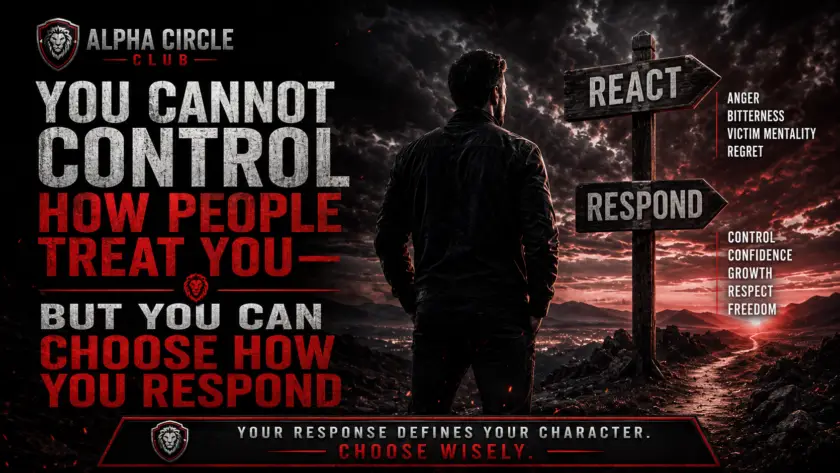
People will disappoint you.
Some will disrespect you, misunderstand you, lie about you, betray your trust or deliberately attempt to provoke a reaction.
You may not be able to control what they choose to do.
But you can control whether their behaviour destroys your peace, weakens your character or pulls you away from the man you are trying to become.
You can remain calm without becoming passive.
You can establish boundaries without becoming cruel.
You can forgive without offering unlimited access.
You can walk away without believing you have lost.
Their behaviour may belong to them—but your response belongs to you.
You may not control what another person does, but you can control whether their behaviour changes the man you have decided to become.
1. You Cannot Control Other People
Many men waste enormous amounts of energy trying to control things that were never within their authority.
They try to control:
- What people think about them
- What others say behind their backs
- Whether someone apologises
- Whether people recognise the truth
- Whether they are treated fairly
- Whether others understand their intentions
- Whether a difficult person finally changes
- Whether everyone approves of their decisions
But another person’s character belongs to them.
You can communicate clearly.
You can explain what happened.
You can set expectations.
You can warn them about the consequences of continuing.
You can remove access.
But you cannot force honesty into a dishonest person.
You cannot force maturity into someone committed to childish behaviour.
You cannot force loyalty into someone who repeatedly betrays trust.
You cannot force respect from someone who benefits from disrespecting you.
Trying to control another person’s inner character will exhaust you.
The more energy you spend trying to force them to become different, the less energy you have for strengthening your own life.
Acceptance does not mean approving of their behaviour.
It means recognising reality clearly enough to make a wise decision.
The moment a man accepts that he cannot control everybody, he can begin concentrating on what remains within his power:
His words.
His boundaries.
His standards.
His access.
His direction.
His response.
Alpha Insight
Stop wasting strength trying to control another person’s character. Use that strength to govern your own decisions and protect your future.
2. Your First Reaction Is Not Always Your Best Response
When a man feels insulted, rejected or disrespected, his first impulse can be powerful.
He may want to:
- Raise his voice
- Threaten the person
- Insult them in return
- Send an angry message
- Post publicly
- Seek revenge
- Prove that he cannot be challenged
- Make an immediate decision
- End everything without reflection
The first reaction is often driven by emotion.
A response is different.
A response considers:
- What actually happened
- Whether the situation is dangerous
- What matters most
- What consequences may follow
- Whether speaking will improve anything
- Which boundary is required
- What the strongest long-term action would be
An emotional reaction asks:
“How can I make them feel what I feel?”
A disciplined response asks:
“What action protects my dignity, future and values?”
This does not mean suppressing every emotion.
Anger may be telling you that a boundary has been violated.
Pain may be showing you that trust has been damaged.
Disappointment may reveal that someone’s character is different from what you believed.
Listen to the emotion.
But do not automatically allow it to make the decision.
Alpha Insight
Your first feeling deserves acknowledgement, but it does not always deserve authority. Let wisdom make the final decision.
3. Pause Before You Give Them Power
A pause creates distance between provocation and action.
Inside that distance, judgement can return.
Without a pause, another person can control your behaviour almost instantly.
They speak.
You react.
They provoke.
You explode.
They insult.
You abandon your standards.
At that moment, they are no longer controlling only their behaviour.
They are influencing yours.
Before responding:
- Take a slow breath.
- Lower your voice.
- Do not send the message immediately.
- Leave the room if necessary.
- Review what was actually said.
- Separate facts from assumptions.
- Ask what outcome you want.
- Consider whether a response is required.
- Think about how your actions may look tomorrow.
A pause may last five seconds.
Five minutes.
One night.
Or several days.
The seriousness of the situation should guide the length of the pause.
Many men damage their reputations, careers, relationships and futures during a few uncontrolled minutes.
They say words that cannot be withdrawn.
Send messages that can be saved.
Make threats that create new consequences.
Turn a manageable conflict into something much larger.
A pause is not cowardice.
It is tactical control.
Alpha Insight
The pause between provocation and action is where self-mastery lives. Protect that space before anger gives your power away.
4. Calmness Is Not Weakness
Some men believe that remaining calm makes them appear soft.
They think strength must be loud.
Aggressive.
Intimidating.
Explosive.
But anyone can lose control.
Real strength is remaining capable of action while still choosing the response that best serves the situation.
A calm man can still say:
- “Do not speak to me like that.”
- “That statement is not true.”
- “This behaviour is unacceptable.”
- “I will not continue this conversation.”
- “You no longer have access to that part of my life.”
- “If this continues, I will report it.”
- “This relationship is over.”
His voice does not need to shake the room for the boundary to be real.
Calmness can make a message stronger because it removes unnecessary noise.
The other person cannot hide behind your anger.
They must confront the content of what you are saying.
Calmness also protects your credibility.
When serious matters involve work, relationships, family, reputation or safety, a controlled response is usually more effective than uncontrolled aggression.
Do not mistake silence for calmness, however.
Some men remain quiet because they are afraid to speak.
That is not the goal.
The goal is to speak when necessary without surrendering control of yourself.
Alpha Insight
Calmness is not the absence of strength. It is strength disciplined enough to choose its direction.
5. Set Boundaries Instead of Repeating Complaints
A complaint describes behaviour.
A boundary explains what you will do if that behaviour continues.
A complaint says:
“I wish you would stop speaking to me disrespectfully.”
A boundary says:
“If you continue speaking to me disrespectfully, I will end the conversation.”
A complaint says:
“You keep betraying my trust.”
A boundary says:
“Because this pattern has continued, I will no longer share private information with you.”
A complaint says:
“You keep arriving late.”
A boundary says:
“If you are not here by the agreed time, I will continue without you.”
Boundaries are not threats designed to control another person.
They are decisions about your own participation.
You cannot force someone to respect your boundary.
You can decide what happens when they violate it.
This is where many boundaries fail.
A man states a consequence but never follows through.
He says the conversation will end, but remains for another hour.
He says trust must be rebuilt, then gives full access immediately.
He says he will leave if the pattern continues, but repeatedly stays.
Eventually, the other person learns that his boundary is only a complaint dressed in stronger language.
A boundary without follow-through is merely a request.
Your response gives the boundary its power.
Alpha Insight
Do not repeatedly announce boundaries you are unwilling to enforce. Your actions teach people whether your standards are real.
6. Stop Giving Unlimited Access to People Who Mistreat You
Access to your life should not be automatic or permanent.
It should be influenced by behaviour.
Some men repeatedly allow harmful people back into their lives without evidence of change.
They confuse forgiveness with unlimited access.
They believe that protecting themselves makes them bitter, unloving or weak.
But forgiveness and access are not the same.
You may forgive someone while still:
- Limiting contact
- Protecting private information
- Refusing financial involvement
- Declining future business opportunities
- Ending a friendship
- Leaving a relationship
- Blocking communication
- Requiring consistent change before rebuilding trust
Forgiveness may release your desire for revenge.
It does not require you to pretend nothing happened.
Trust should be rebuilt through evidence.
Apologies matter.
But changed behaviour matters more.
Someone can say “sorry” while continuing the same pattern.
The question is not only whether they regret the consequences.
It is whether they are becoming safer, more honest and more responsible.
Your compassion should not require the destruction of your self-respect.
Alpha Insight
Forgiveness can free your heart without reopening every door. Access should be earned through consistent behaviour, not demanded through guilt.
7. Do Not Become What Hurt You
When someone treats a man badly, he may feel justified in treating others the same way.
Betrayal makes him dishonest.
Rejection makes him cold.
Humiliation makes him cruel.
Manipulation makes him manipulative.
He begins saying:
“This is how the world works.”
“Everyone is selfish.”
“Trusting people is weakness.”
“I will hurt them before they hurt me.”
But when another person’s poor character changes yours, they have won twice.
First, they hurt you.
Then they influenced the man you became afterwards.
Pain can teach wisdom.
It can make you more observant.
More careful.
More discerning.
Stronger with boundaries.
But wisdom is not bitterness.
Strength is not cruelty.
Discernment is not suspicion of everyone.
You should learn from the experience without allowing it to become the blueprint for your character.
Do not pass another person’s damage forward.
Alpha Insight
Let pain improve your judgement without poisoning your character. Do not become a reflection of the person who hurt you.
8. Stop Personalising Every Behaviour
Not every unpleasant action is a complete judgement of your worth.
People may act badly because of:
- Insecurity
- Stress
- Immaturity
- Jealousy
- Poor communication
- Self-interest
- Unresolved pain
- Lack of discipline
- Fear
- Their own distorted beliefs
This does not excuse their behaviour.
Understanding why someone behaves badly does not mean you must tolerate it.
It simply prevents you from treating every action as proof that something is wrong with you.
Someone ignoring your value does not remove it.
Someone rejecting your kindness does not make kindness worthless.
Someone taking your loyalty for granted does not mean loyalty was foolish.
Sometimes another person’s behaviour reveals their emotional condition—not your identity.
A secure man can examine himself honestly without accepting responsibility for everything another person chooses to do.
Ask:
“Did I contribute to this situation?”
“Is there anything I should correct?”
“What belongs to me?”
“What belongs to them?”
Take responsibility for your part.
Refuse ownership of theirs.
Alpha Insight
Another person’s behaviour may contain information about you, but it is not automatically a final judgement of your value.
9. Know When to Speak
Silence is not always the correct response.
There are moments when a man must speak.
He should speak when:
- A boundary must be established
- Harmful misinformation is spreading
- His safety is threatened
- Another person may be harmed
- His work or reputation is seriously affected
- A relationship requires honest communication
- Serious misconduct must be reported
- Someone is repeatedly taking advantage of his silence
Speaking should be calm, clear and proportionate.
The goal is not to release every emotion.
It is to address what matters.
Avoid unnecessary insults.
Avoid exaggeration.
Avoid making claims you cannot support.
State:
- What happened
- Why it is unacceptable
- What needs to change
- What you will do if it continues
Then allow your actions to support your words.
Some men remain silent for too long, then explode after months of resentment.
This happens because they confuse peace with avoidance.
Healthy peace includes honest communication.
Speak before resentment becomes uncontrollable.
Alpha Insight
Silence is powerful when chosen wisely, but destructive when it protects mistreatment. Speak when truth, safety or self-respect requires it.
10. Know When to Walk Away
Some conversations cannot be repaired because the other person is not seeking understanding.
They may want:
- Attention
- Control
- Conflict
- A reaction
- Another opportunity to insult
- Endless access to your energy
- Permission to continue the same behaviour
No amount of explanation will satisfy someone committed to misunderstanding you.
No amount of patience will change someone who does not believe they need to change.
Walking away is not losing when the conversation has no productive destination.
Sometimes the strongest response is:
- Ending the call
- Leaving the room
- Refusing another argument
- Blocking contact
- Ending the relationship
- Declining further involvement
- Removing yourself from the environment
Walking away does not always mean permanently ending the relationship.
It may mean ending the interaction until both people are calm enough to speak constructively.
But repeated patterns deserve stronger consequences.
Do not keep entering the same argument and expecting a different outcome.
Alpha Insight
You do not have to remain in every place where someone has decided to disrespect you. Sometimes distance is the boundary words could not create.
11. Do Not Build Your Response Around Revenge
Revenge keeps another person at the centre of your life.
You begin training to make them jealous.
Building a business to make them regret leaving.
Posting to make them feel excluded.
Dating to provoke a reaction.
Succeeding so they will feel defeated.
This may create temporary motivation.
But it does not create freedom.
Your life remains a reaction to what they did.
They continue influencing your goals even when they are no longer present.
Build because your purpose matters.
Improve because your future matters.
Strengthen your body because your health matters.
Develop your business because your mission can help people.
Deepen your faith because God is shaping your character.
Let pain begin movement if necessary.
But do not allow bitterness to choose the destination.
Revenge asks:
“How can I hurt them?”
Purpose asks:
“What can I build from here?”
Alpha Insight
Do not let bitterness become your life coach. Build a future so meaningful that revenge becomes too small to deserve your energy.
12. Their Treatment Does Not Determine Your Worth
Someone may fail to recognise your value.
That does not remove it.
They may dismiss your work.
Misunderstand your intentions.
Reject your kindness.
Take your loyalty for granted.
Break a promise.
Leave when you needed support.
Their inability to appreciate something does not prove it lacked worth.
A valuable book remains valuable even when someone refuses to read it.
A strong opportunity remains strong even when one person cannot recognise it.
A loyal man remains loyal even when someone abuses that loyalty.
Your worth should not rise and fall according to another person’s behaviour.
This does not mean ignoring criticism.
A man should listen when correction is justified.
He should apologise when he is wrong.
He should improve when a weakness is exposed.
But he should not allow one person’s poor treatment to become the final judgement of his identity.
Alpha Insight
Do not hand another person the authority to decide your worth. Let your values, conduct, faith and continued growth define the man you are becoming.
13. Faith Gives a Man a Higher Standard
Faith helps a man respond from conviction rather than ego.
Before reacting, he can ask:
- Does this response reflect the man God is shaping me to become?
- Am I seeking justice or revenge?
- Do I need to speak, forgive, create distance or walk away?
- Am I protecting peace or avoiding responsibility?
- Can I remain firm without becoming hateful?
- Am I allowing another person’s behaviour to control my spirit?
- Is my response guided by truth or wounded pride?
God does not call men to become weak.
But neither does He call them to become reckless, bitter or cruel.
A faith-led man can be:
- Peaceful and powerful
- Forgiving and discerning
- Compassionate and firm
- Patient and boundaried
- Humble and courageous
Forgiveness does not always mean reconciliation.
Reconciliation requires honesty, responsibility and change from both sides.
A man may forgive someone before God while still recognising that the relationship is no longer safe or healthy.
He can refuse hatred without restoring access.
Alpha Insight
You do not honour God by allowing mistreatment to destroy you, nor by allowing anger to turn you into the person who hurt you.
14. Build Emotional Self-Control
The ability to choose a response must be trained.
It is not enough to promise that you will remain calm next time.
You need practices that make calmness more available when pressure arrives.
A man can strengthen emotional control through:
- Prayer
- Reflection
- Exercise
- Better sleep
- Journalling
- Slow breathing
- Pausing before sending messages
- Reviewing recurring triggers
- Speaking with trusted men
- Reducing alcohol when it weakens judgement
- Seeking professional support when anger feels uncontrollable
Sleep matters because exhaustion reduces patience.
Exercise matters because physical activity can help regulate stress.
Reflection matters because repeated conflicts often contain patterns.
A man may discover that he is especially reactive when he feels ignored, embarrassed or challenged in public.
Knowing the trigger gives him an opportunity to prepare.
Self-control is not something a man either possesses or lacks.
It is a discipline developed through repeated practice.
Every time he pauses, chooses his words and protects the long-term outcome, he becomes harder to provoke.
Alpha Insight
Emotional control is trained before the crisis. Build daily disciplines that make wisdom stronger when pressure arrives.
15. Ask What the Situation Is Teaching You
Difficult people can reveal important lessons.
They may expose:
- Where your boundaries are weak
- Where you seek too much approval
- Which behaviour you repeatedly excuse
- Where you avoid difficult conversations
- Which patterns you must stop repeating
- What kind of access should no longer be automatic
- How quickly anger controls you
- Whether you trust words more than actions
The lesson may not justify what the person did.
But refusing to learn would waste the experience.
Ask:
“What has this situation revealed?”
“What must I do differently?”
“What standard needs to change?”
“What warning sign will I respect next time?”
“How can I become wiser without becoming bitter?”
Pain becomes more useful when it produces better judgement.
Alpha Insight
Do not allow a painful experience to leave you only wounded. Extract the lesson and let it strengthen the decisions you make next.
The Alpha Response Framework
When someone treats you badly, use the following process:
PAUSE → ASSESS → CHOOSE → BOUNDARY → PROCEED
Pause
Do not allow the first emotion to make the final decision.
Create enough space for judgement to return.
Breathe.
Step away if necessary.
Delay messages that could create larger consequences.
Assess
Ask:
- What actually happened?
- Is this a pattern or an isolated mistake?
- Is there immediate danger?
- Does the situation affect my family, work or reputation?
- Is the person willing to communicate honestly?
- What outcome am I trying to create?
- What responsibility belongs to me?
- What responsibility belongs to them?
Choose
Decide whether the correct response is:
- Silence
- Clarification
- Assertive communication
- A warning
- Reporting
- Forgiveness
- Distance
- Walking away
Not every situation deserves the same response.
Match the action to the seriousness of the behaviour.
Boundary
State clearly:
- What behaviour is unacceptable
- What needs to change
- What you will do if it continues
Then follow through.
Proceed
Return to your life.
Do not spend days replaying an interaction that no longer deserves your energy.
Take the necessary action.
Learn the lesson.
Then return to your purpose.
Alpha Insight
Pause before emotion decides, assess before assuming, choose deliberately, enforce the boundary and then return to your mission.
Emotionally Controlled Response vs Alpha Response
| Emotionally controlled response | Alpha response |
|---|---|
| Reacts immediately | Pauses first |
| Tries to control the other person | Governs himself |
| Shouts to appear strong | Speaks calmly and firmly |
| Seeks revenge | Seeks the right outcome |
| Repeats complaints | Establishes boundaries |
| Accepts endless disrespect | Removes access when necessary |
| Becomes bitter | Learns without losing character |
| Replays the event constantly | Returns to his purpose |
| Confuses forgiveness with trust | Forgives while remaining discerning |
| Allows provocation to define him | Acts according to his values |
| Threatens consequences | Follows through consistently |
| Treats one person’s behaviour as proof of his worth | Separates another person’s choices from his identity |
A Personal Declaration
I cannot control how every person chooses to treat me.
I cannot force someone to respect me, understand me, apologise to me or recognise my value.
But I can control my response.
I can remain calm without becoming passive.
I can forgive without providing unlimited access.
I can speak firmly without surrendering to hatred.
I can establish boundaries without becoming cruel.
I can walk away without believing that I have lost.
I will not allow another person’s poor character to destroy mine.
I will not make permanent decisions during temporary anger.
I will not build my future around revenge.
Their behaviour belongs to them.
My response belongs to me.
Final Thoughts
People may disrespect you.
They may misunderstand you, provoke you, betray your trust or refuse to recognise your value.
You cannot always control their choices.
But you can decide whether you react from anger or respond from strength.
Pause.
Assess what happened.
Speak when speaking is necessary.
Set the boundary.
Remove access where the pattern continues.
Forgive without abandoning wisdom.
Walk away when the situation has no healthy future.
Then return to your mission.
Do not spend your life trying to force another person to become who they have repeatedly shown they are unwilling to be.
Do not allow their behaviour to control your spirit.
Do not let someone else’s poor choices determine your character.
You cannot control every hand life deals you, but you can control whether your response builds your character or destroys it.
Final Alpha Insight
The highest form of power is not controlling everyone around you. It is remaining in control of yourself when others give you every reason to lose it.

No spam. Unsubscribe anytime.