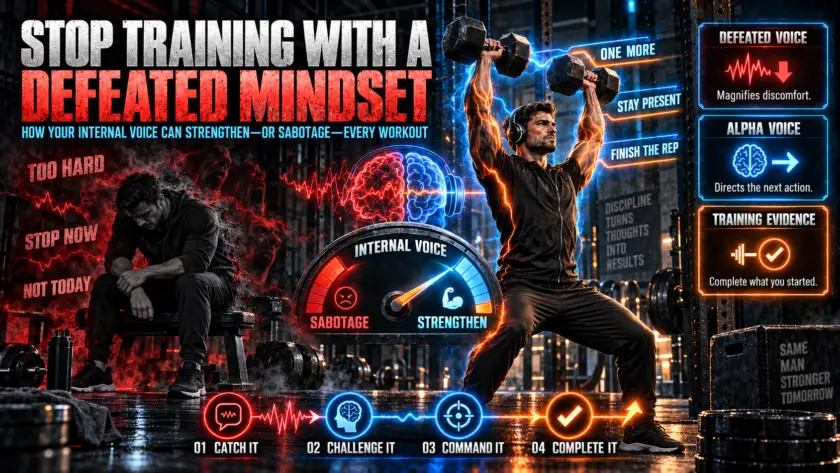
How Your Internal Voice Can Strengthen—or Sabotage—Every Workout
The workout can be lost before the first weight is lifted.
It happens quietly.
You look at the session ahead and hear the first prediction:
“I do not have the energy today.”
You remember the weight that felt difficult last time:
“I am probably going to fail again.”
You notice someone stronger, leaner or more experienced:
“I do not belong here.”
Nothing physical has happened yet. No set has been attempted. No honest measurement has been taken. But the mind has already begun writing the conclusion.
This is how a defeated workout mindset sabotages training. It turns feelings into facts, hesitation into prophecy and one difficult moment into a judgement about the whole man. The body enters the gym, but the internal voice has already surrendered the session.
That voice may have been shaped by poor experiences, repeated comparison, criticism, embarrassment, disrupted training or promises you made and failed to keep. It may sound convincing because it has been repeated for months or years.
But familiarity does not make every thought true.
You do not need to replace honest self-awareness with fantasy. You do not need to pretend you are invincible, ignore pain or shout exaggerated affirmations that your behaviour cannot support. You need a stronger kind of internal message—one that is accurate, direct and useful.
Instead of:
“I must feel confident before I begin.”
Use:
“Confidence can be built by completing the next appropriate action.”
Instead of:
“A difficult session proves I am weak.”
Use:
“A difficult session gives me information and another opportunity to respond.”
Instead of:
“I cannot do this.”
Ask:
“What can I do correctly, safely and deliberately right now?”
The goal is not to silence every doubtful thought forever. The goal is to prevent doubt from becoming the only voice with authority.
Your internal voice is part of your training environment. It can direct attention, strengthen discipline and help you return after setbacks—or it can drain the session before the work begins.
Train the voice that trains the man.
The strongest workout mindset does not promise that every session will be easy. It reminds you that difficulty does not get to make the decision alone.
1. Defeat Often Begins Before the First Repetition
Physical failure occurs during an attempt. Mental surrender often occurs before one.
A man sees the full session and imagines every difficult moment at once. He feels tired and assumes the entire workout will be poor. He remembers missing recent sessions and decides that returning will only prove how much progress he has lost.
The prediction produces hesitation. Hesitation delays action. Delay gives the prediction more time to sound true.
This can create a pattern:
- Anticipate difficulty.
- Interpret difficulty as danger or inevitable failure.
- Delay beginning.
- Reduce effort before the body has been honestly tested.
- Leave with little evidence.
- Use the poor result to confirm the original belief.
The cycle feels logical because each stage appears to support the next. But the first conclusion was never properly tested.
Break the cycle at the beginning.
Do not evaluate the full session while standing outside it. Reduce the demand to the first physical action:
- Put on the training clothes.
- Enter the gym.
- Begin the warm-up.
- Prepare the first movement.
- Complete the first controlled repetition.
You are not pretending that the session will be easy. You are refusing to issue a verdict before evidence exists.
Some days will genuinely require adjustment. Strength, energy and recovery are not identical every day. But an appropriate adjustment should follow honest observation—not automatic defeat.
Alpha Insight
Do not allow a prediction made before the warm-up to become the final result of the workout.
2. Your Internal Voice Is Influential—but It Is Not Always Accurate
Thoughts can arrive with confidence they have not earned.
“Everyone is judging me.”
“I always quit.”
“I have ruined my progress.”
“I will never become disciplined.”
These statements may feel like observations, but they often contain exaggeration, selective memory or conclusions that reach far beyond the evidence.
Notice the language:
- Always
- Never
- Everyone
- Nothing
- Impossible
- Ruined
Absolute words can turn one event into an identity.
You missed two sessions, so the voice says you are incapable of consistency. One lift did not progress, so it says the entire plan is failing. Someone nearby lifts more, so it says your work has no value.
A stronger workout mindset does not accept every internal statement without examination. It asks:
- What actually happened?
- What part of this thought is fact?
- What part is fear, comparison or frustration?
- Is there another reasonable interpretation?
- What response would help me act correctly now?
Suppose the thought is:
“I am weak because this weight feels difficult.”
An accurate response might be:
“The weight is challenging today. I will assess my technique, recovery and load, then complete the most appropriate work.”
That response is neither defeatist nor delusional. It keeps reality and action in the same sentence.
Alpha Insight
A thought can sound authoritative without being accurate. Examine the message before you obey it.
3. The Words You Repeat Become Instructions
Internal language shapes where attention goes next.
If you repeatedly tell yourself, “I am exhausted,” attention searches for evidence of exhaustion. If you say, “I always fail on the final set,” the mind approaches that set as confirmation rather than a new attempt. If you say, “I cannot train unless I feel motivated,” every ordinary low-energy day becomes permission to stop.
This does not mean words magically create strength. A phrase cannot replace appropriate training, nutrition, recovery or technique. But language can influence the response you choose within the situation.
Compare these instructions:
| Defeated instruction | Stronger, useful instruction |
|---|---|
| “This is going to be terrible.” | “Begin the warm-up and assess honestly.” |
| “I cannot do this.” | “Complete the next appropriate step.” |
| “I am too far behind.” | “Today is where the return begins.” |
| “Everyone is watching me.” | “My responsibility is my own plan and technique.” |
| “I failed last time.” | “Last time gave me information for this attempt.” |
| “I am not motivated.” | “Motivation is welcome; the plan still exists without it.” |
| “This discomfort means stop.” | “Identify whether this is effort, fatigue or a warning signal.” |
| “The whole session is ruined.” | “Reset the next set.” |
Useful self-talk should be short enough to remember under effort. It should direct the next action rather than deliver a speech.
Examples include:
- “Control the repetition.”
- “Return to the plan.”
- “Breathe and reset.”
- “The next set is new evidence.”
- “Do not rush the technique.”
- “Complete what is appropriate today.”
Your internal voice should function like a disciplined coach: honest, specific and focused on the response available now.
Alpha Insight
The voice you repeat becomes an instruction. Make sure it is directing you towards the right action.
4. Hesitation Spends Energy Without Producing Evidence
Hesitation can be exhausting.
A man stands beside the equipment imagining failure, embarrassment and discomfort. He negotiates with himself, checks his phone, changes the track, walks around and begins the same internal argument again.
He has spent mental energy, but nothing has moved.
The longer he waits, the larger the action appears. The set becomes a test of his entire identity rather than several controlled repetitions.
The answer is not reckless speed. Preparation matters. Safety checks matter. Technique matters. But once those are in place, endless mental rehearsal becomes avoidance.
Use the Three-Count Commitment:
- Confirm that the movement, load and environment are appropriate.
- State the technical cue.
- Count: three, two, one—begin.
The count is not magic. It simply gives hesitation a finish line.
Before a workout, the same principle can be applied to entering the training environment:
“Three, two, one—stand up.”
“Three, two, one—put on the shoes.”
“Three, two, one—start the warm-up.”
Confidence often follows movement rather than preceding it. Once the first action exists, you have information. The body may feel better than predicted. The plan may need adjustment. Either result is more useful than another ten minutes of imagined failure.
Alpha Insight
Hesitation repeatedly charges the mind for an action the body has not even attempted. Prepare correctly, then begin.
5. Stop Turning Comparison Into Self-Punishment
The gym makes comparison easy.
Someone is lifting more. Someone appears leaner. Someone has trained longer, recovers differently, follows another plan or is at a completely different point in life.
The defeated mind removes all that context and reaches one conclusion:
“His progress proves my inadequacy.”
Comparison can distort the purpose of training. Instead of improving technique or following a suitable plan, the man begins performing for an imaginary audience. He adds weight he cannot control, copies an advanced routine or becomes ashamed of being a beginner.
This is not confidence. It is surrender to someone else’s scoreboard.
Other men can provide information or inspiration. They can demonstrate what is possible, teach technique or reveal standards worth pursuing. The problem begins when another person’s result becomes evidence that your effort has no value.
Return to questions you can answer:
- Am I following an appropriate plan?
- Is my technique improving?
- Am I training consistently?
- Am I recovering responsibly?
- What evidence exists compared with my own starting point?
- What is the next improvement within my control?
The real competition is not always another man. It may be the pattern that repeatedly makes you quit, the distraction that fragments your effort or the fear that prevents honest progression.
Train beside others without handing them ownership of your internal voice.
Alpha Insight
Let another man’s progress inform you or inspire you—but never let it define your worth or dictate your load.
6. A Past Failure Is an Event—not an Identity
Perhaps you have stopped training before.
Perhaps you bought the equipment, created the plan and disappeared after several weeks. Perhaps you once felt strong, lost consistency and now feel embarrassed by the difference. Perhaps an injury, illness or demanding period of life changed what your body can currently do.
The defeated voice uses history as a sentence:
“You always go back to your old ways.”
“You have failed too many times.”
“There is no point starting again.”
History matters. It contains patterns that should be studied. But history is not strengthened by pretending it has no lessons, nor by allowing it to control every future decision.
Ask better questions:
- Why did I stop last time?
- Was the plan realistic?
- Did I depend entirely on motivation?
- Was the routine too complicated?
- Did I have a return plan after disruption?
- What support or knowledge was missing?
- What can I build differently now?
The return becomes stronger when it includes the lesson.
Do not promise an extreme transformation to compensate for regret. Begin with a standard you can demonstrate:
“I will complete today’s appropriate session.”
Then repeat.
The identity “I am a man who always quits” weakens each time you return and produce new evidence. It may not disappear after one workout, but it no longer holds an uncontested record.
Alpha Insight
Your past can explain the pattern without being given permanent ownership of your identity.
7. Motivational Audio Can Interrupt the Defeated Pattern
Negative self-talk becomes powerful partly because it is familiar. The same phrases appear at the same moments until they seem automatic.
Purposeful motivational audio can interrupt that pattern.
Before training, it can place a stronger message into attention. During an appropriate part of the session, it can remind you to reset after difficulty. After a setback, it can help separate one poor result from the decision to abandon the mission.
But audio is not a substitute for action.
A track can say:
“They underestimated you.”
The Alpha Action may be completing the next controlled set without performing for their approval.
A track can say:
“Keep your word.”
The evidence is following the appropriate plan you committed to.
A track can say:
“Your future is watching.”
The response is choosing the action that serves that future rather than creating another emotional fantasy about it.
This is the Alpha Fuel principle:
The message changes your state. The Alpha Action gives the state evidence.
The objective is not to cover every negative thought with noise. It is to select a useful message, connect it with a specific behaviour and repeat the connection until the stronger response becomes more accessible.
Alpha Insight
Motivational audio can interrupt a defeated message, but your next action determines which voice receives the evidence.
8. Enter Training With a Chosen Message
If you do not choose the message you bring into the workout, the day’s strongest emotion may choose it for you.
Before training, conduct a sixty-second Mindset Entry Briefing.
1. Name the current voice
What are you telling yourself?
“I am tired and I expect the session to be poor.”
2. Separate fact from interpretation
“I slept less than intended. That may affect performance. It does not tell me the entire result before the warm-up.”
3. Choose the required quality
- Focus
- Discipline
- Confidence
- Resilience
- Patience
- Controlled intensity
4. Select the stronger message
“Begin carefully, assess honestly and complete the most appropriate work.”
5. Define the Alpha Action
“I will begin the warm-up within two minutes and follow the planned session unless genuine information requires adjustment.”
This briefing prevents a temporary feeling from entering as the unquestioned leader.
Your chosen message should match reality. If you are ill, injured or seriously sleep deprived, the strongest decision may involve modification, recovery or professional guidance. Strength is not forcing one response into every situation.
The message is powerful because it directs you towards the right action—not simply the hardest-looking one.
Alpha Insight
Do not enter the session with an unexamined voice. Decide which message has earned the right to direct your effort.
9. During the Set, Use Cues Instead of Commentary
The middle of a demanding set is a poor time for a long internal speech.
Attention is limited. Technique, breathing, position and control may all require focus. A defeated mind fills that space with commentary:
- “This is too much.”
- “I look weak.”
- “I am going to fail.”
- “Why am I worse today?”
- “Everyone can see this.”
Replace commentary with cues.
A cue is short, specific and connected to execution:
- “Brace.”
- “Control.”
- “Breathe.”
- “Drive.”
- “Stay present.”
- “One clean repetition.”
- “Technique first.”
The exact cue depends on the movement and any coaching you have received. The principle is to move attention away from identity judgement and towards the next correct action.
Between sets, use a slightly longer reset:
- What happened?
- Was the issue technical, physical or mental?
- What must change on the next attempt?
- What is the one cue I will carry forward?
This keeps one imperfect repetition from becoming a twenty-minute emotional event.
You are allowed to be disappointed. But disappointment should deliver information, not control the remainder of the session.
Alpha Insight
Under effort, the mind does not need a trial about your identity. It needs one clear instruction for the next correct action.
10. Know the Difference Between Mental Surrender and an Intelligent Stop
“Never quit” sounds powerful, but without judgement it can become dangerous.
There is a difference between ordinary resistance and a legitimate reason to stop or modify training.
Ordinary resistance may sound like:
- “I would rather do something easier.”
- “The novelty has gone.”
- “I do not feel enthusiastic.”
- “The final planned work looks uncomfortable.”
- “I am tempted by entertainment.”
A genuine warning may include:
- Sharp, unusual or escalating pain
- Dizziness or feeling faint
- Concerning shortness of breath
- Sudden loss of control or technique
- Symptoms of illness
- Medical restrictions
- An unsafe environment or equipment problem
This is not a diagnostic list, and concerns should be handled with appropriate professional guidance. The important point is that a powerful workout mindset includes judgement.
Mental surrender says:
“I want to stop because comfort has become more attractive than the plan.”
An intelligent stop says:
“Continuing this movement or session may create unnecessary harm, so I will adjust, recover or seek guidance.”
Do not use “mindset” to bully yourself through every signal. Do not use “safety” as an automatic disguise for ordinary reluctance either.
Pause. Assess. Respond honestly.
The strongest man in the gym is not the one who ignores the most information. It is the one who remains capable of making the right decision while emotion is high.
Alpha Insight
Mental strength is not the refusal to stop under any circumstances. It is the refusal to let fear or ego make the decision without evidence.
11. Do Not Let One Poor Set Infect the Whole Session
One set goes badly.
The load feels heavier than expected. The repetition is missed. Technique is inconsistent. Immediately, the defeated voice expands the event:
“Today is a disaster.”
This is emotional contamination: one part of the session is allowed to define everything that follows.
Use the Set Boundary Rule:
Every set must earn its own conclusion.
After a poor set:
- Record what happened without exaggeration.
- Identify whether load, technique, rest, recovery or concentration played a role.
- Make the appropriate adjustment.
- Take several controlled breaths.
- Begin the next set as new evidence.
The next set may also be difficult. That still does not justify personal attack. Training information is valuable only when you can examine it.
This principle extends to the full week. A missed Monday does not require a wasted Tuesday. A disrupted month does not require abandoning the year. A slower season does not erase the value of returning.
The defeated mindset looks for permission to make the problem larger.
The stronger mindset contains the problem and moves towards the next appropriate response.
Alpha Insight
A poor set is an event to assess—not an infection you must spread through the rest of the workout.
12. Interpret the Workout Correctly After It Ends
The internal voice continues training after the body stops.
Two men can complete similar sessions and leave with different lessons.
One says:
“That was not my best performance. I adjusted responsibly, completed useful work and identified what to improve.”
The other says:
“I was terrible. I am going backwards. There is no point.”
The event may be similar. The interpretation changes what happens next.
Use the Post-Workout Truth Review:
What did I plan?
State the intended work.
What did I complete?
Record the result without inflating or dismissing it.
What affected the session?
Consider sleep, nutrition, recovery, focus, stress, technique and realistic programming.
What did my internal voice say?
Identify the recurring message.
How did I respond?
Did you obey, challenge, redirect or learn from it?
What is the next improvement?
Choose one action.
Avoid labelling the entire session as “good” or “bad” too quickly. A session with lower performance may still teach patience, technique or resilience. A session with impressive numbers may still reveal reckless decisions or a need for better control.
The correct interpretation helps the next session. The defeated interpretation punishes the man without teaching him.
Alpha Insight
Your post-workout story should tell the truth, extract the lesson and protect the decision to return.
13. Build a Powerful Internal Voice From Evidence
A stronger internal voice is not built solely by repeating positive sentences.
It becomes credible when behaviour supports it.
If you tell yourself, “I keep my word,” and then complete the appropriate session you planned, the statement gains evidence. If you say, “I return after setbacks,” and you actually return, the message becomes harder for doubt to dismiss.
Start with statements that can be proven today:
- “I begin before I feel perfect.”
- “I follow an appropriate plan.”
- “I reset after mistakes.”
- “I control the repetition.”
- “I do not compare another man’s chapter with my starting point.”
- “I adjust intelligently without abandoning the mission.”
- “I return.”
Then create proof.
Keep an Evidence Log:
| Date | Defeated message | Stronger instruction | Action completed | Evidence earned |
|---|---|---|---|---|
| Monday | “I am too tired to begin.” | “Warm up and assess honestly.” | Full warm-up and appropriate session | I can begin without perfect energy |
| Wednesday | “The failed set ruined everything.” | “Reset the next set.” | Adjusted load and finished correctly | I can respond without abandoning the session |
| Friday | “I am behind everyone.” | “Follow my plan.” | Trained without comparison | I can protect my own mission |
Evidence changes the relationship with your own word. The internal voice becomes less dependent on hype because it can point to completed behaviour.
Alpha Insight
The most powerful internal message is one your recent actions can defend.
14. Carry the Stronger Voice Outside the Gym
The defeated voice rarely lives in only one environment.
It may appear in work:
“Nobody will buy what I create.”
In relationships:
“There is no point addressing the issue.”
In personal development:
“I have left it too late to change.”
In opportunity:
“People like me do not succeed at that.”
The gym gives you a place to practise a different response.
You learn to identify the prediction, test it, select a useful instruction and produce evidence. Then you carry that sequence into the next area of life.
After each workout, choose one Mindset Transfer Action:
- If you challenged hesitation, begin the delayed project.
- If you overcame comparison, publish without waiting to feel superior.
- If you reset after a poor set, return to a difficult business task.
- If you controlled emotion, have the direct conversation calmly.
- If you followed the plan, complete the day’s leading responsibility.
- If you returned after absence, reopen the goal you abandoned.
Physical training becomes more valuable when the internal standard travels.
Do not be the man who can speak powerfully to himself under a bar but accepts defeat at his desk. Use the gym to rehearse a stronger response—then apply it where your future is being built.
Alpha Insight
The workout changes more than your body when the stronger voice follows you into the decisions that shape your life.
The Alpha Workout Mindset Reset
Use this five-stage process whenever a defeated message enters training.
1. CATCH
Identify the exact thought.
Do not settle for “I feel negative.” Write or say the message clearly:
“I think today’s workout will be pointless because I feel tired.”
2. CHECK
Test the thought:
- What are the facts?
- What am I assuming?
- Am I using absolute language?
- Is this ordinary resistance or a genuine warning?
- What information would an honest assessment require?
3. CHOOSE
Select a stronger, accurate instruction:
“Begin the warm-up, assess the body and complete the most appropriate work.”
4. COMPLETE
Perform one Alpha Action that gives the stronger message evidence:
- Begin the warm-up
- Complete the next set
- Reduce the load and protect technique
- Put the phone away
- Return after a missed session
- End safely when stopping is the correct decision
5. CARRY
Use the same mental quality outside the gym through one Mindset Transfer Action.
The sequence is:
CATCH → CHECK → CHOOSE → COMPLETE → CARRY
The purpose is not to eliminate every negative thought. It is to shorten the distance between hearing the thought and responding intelligently.
Defeated Voice Versus Alpha Direction
| Moment | Defeated voice | Alpha direction |
|---|---|---|
| Before training | “I do not feel ready.” | “Readiness can grow after I begin.” |
| During warm-up | “I feel slow, so today is pointless.” | “The warm-up is information. Assess before concluding.” |
| Before a hard set | “I am going to fail.” | “Prepare, use the cue and perform the next repetition.” |
| After a missed rep | “I am useless.” | “Review the cause, adjust and reset.” |
| Around stronger people | “I do not belong here.” | “Their training does not cancel mine.” |
| When motivation fades | “I should leave.” | “Complete the next appropriate part of the plan.” |
| When pain appears | “Ignore it or I am weak.” | “Assess it honestly and protect long-term progress.” |
| After a missed week | “I have ruined everything.” | “The return begins with today’s action.” |
| After the workout | “It was not perfect, so it failed.” | “Record the evidence and identify the next improvement.” |
The Pre-Workout Internal Message
Read or record this before training:
I do not need perfect motivation to begin.
I will not issue a verdict before the warm-up gives me evidence.
I will follow an appropriate plan, protect my technique and control my effort.
If doubt appears, I will return to the next correct action.
If the session becomes difficult, I will distinguish ordinary resistance from genuine warning signals.
I will neither surrender to comfort nor sacrifice intelligence to ego.
One poor repetition will not define the next one.
Another man’s progress will not make me abandon my own.
Today, my internal voice will serve the mission.
I am here to train my body, strengthen my mindset and produce honest evidence.
The Seven-Day Stronger Voice Challenge
For seven consecutive training days—or days containing appropriate physical activity—practise one stronger internal response.
Day 1: Catch the Message
Record the most common defeated thought that appears before training.
Day 2: Remove the Absolutes
Challenge words such as always, never, everyone and impossible.
Day 3: Replace Commentary With Cues
Choose one short technical or mental cue and return to it during effort.
Day 4: End Comparison
Complete the session without altering your plan to compete with someone else.
Day 5: Reset the Next Set
When something goes poorly, contain it and make the next appropriate attempt new evidence.
Day 6: Prove the Message
Choose one statement—such as “I keep my word”—and complete the action that proves it.
Day 7: Carry It Forward
Use the stronger voice to begin one important task outside the gym.
Record each day:
- The defeated message
- The facts
- The stronger instruction
- The Alpha Action
- The evidence created
- The Mindset Transfer Action
The challenge is not to think perfectly for seven days. It is to practise responding differently when the familiar voice returns.
Workout Mindset Audit
Answer honestly:
- What do I usually tell myself before a workout?
- Do I predict failure before collecting evidence?
- Which absolute words appear in my self-talk?
- Does hesitation delay the first action?
- How does comparison affect my plan and technique?
- Do I interpret one poor set as a failed session?
- Do I confuse ordinary reluctance with a genuine warning?
- Do I ever ignore genuine warning signs to protect my ego?
- What do I say to myself when motivation falls?
- How do I interpret missed sessions?
- Is my internal voice accurate, useful and specific?
- Which motivational messages help me most?
- Do I connect those messages with Alpha Actions?
- What recent evidence proves I can respond differently?
- Does the stronger voice travel into my work and responsibilities?
- What defeated message must I challenge next?
- What action will give the new message evidence today?
The audit is not another opportunity for self-attack. Its purpose is to identify the thought-action pattern that needs retraining.
Frequently Asked Questions
What is a workout mindset?
A workout mindset is the collection of thoughts, expectations, interpretations and mental responses a person brings into physical training. It influences how he approaches effort, setbacks, comparison, technique and consistency.
Can negative self-talk affect a workout?
Negative self-talk can direct attention towards fear, embarrassment and premature conclusions. It may increase hesitation or make one difficult moment feel like proof of permanent failure. The practical response is to examine the thought and replace it with a more accurate instruction.
Should I try to eliminate every negative thought?
No. Thoughts can appear automatically, especially under stress or effort. The goal is to recognise them, assess them and prevent inaccurate messages from controlling behaviour.
Is positive self-talk the same as pretending everything is easy?
No. Useful self-talk acknowledges reality. “This is difficult, and I will complete the next controlled repetition” is stronger than either “This is impossible” or “Nothing can affect me.”
What should I say before a difficult set?
Use a short instruction connected to execution, such as “brace and control,” “one clean repetition” or another appropriate technical cue from your training plan or coach.
How can motivational audio improve my workout mindset?
Purposeful audio can interrupt familiar negative messages, help you select the state you need and reinforce a stronger instruction. Its value increases when you connect the message with a specific Alpha Action.
Can motivational audio replace discipline?
No. Audio can support a change of state, but discipline is demonstrated through action. The track may remind you of the standard; you must still perform the appropriate work.
What if I genuinely have a poor session?
Record the result honestly, identify possible causes, make necessary adjustments and protect the decision to return. A poor session can provide useful information without becoming an identity judgement.
How do I stop comparing myself with stronger people?
Return to your own plan, training history, technique and current objective. Other people can provide information or inspiration, but their results should not determine your worth or loading decisions.
Is stopping a workout mentally weak?
Not automatically. Stopping or modifying may be the strongest choice when there is concerning pain, illness, unsafe equipment, medical restriction or another legitimate risk. Mental strength includes judgement.
What if I have missed several weeks?
Avoid punishment-based training. Identify what caused the break, establish an appropriate return plan and create one new piece of evidence. A missed period does not have to become permanent abandonment.
How do I build confidence in the gym?
Build it through preparation and completed evidence: following the plan, improving technique, attending consistently, attempting suitable challenges and returning after setbacks.
What is an Alpha Action?
An Alpha Action is the specific behaviour that converts a motivational message into evidence. In training, it might be beginning the warm-up, completing the next planned set, controlling the technique or returning after a missed week.
What is a Mindset Transfer Action?
It is an action outside the gym that uses the stronger mental response practised during training—for example, challenging hesitation by beginning an overdue work task.
When should I seek professional support?
Seek qualified medical or mental-health support when persistent symptoms, concerning pain, severe distress or other health issues require assessment. Motivational content is not a replacement for professional care.
Final Message: The Voice Must Serve the Mission
The defeated voice may not disappear after one powerful workout.
It may return tomorrow wearing a familiar argument. It may remind you of every missed session, poor performance and abandoned plan. It may use tiredness, comparison and uncertainty to make surrender sound reasonable.
Do not be shocked when it speaks.
Be prepared to answer.
Catch the message.
Check the evidence.
Choose the stronger instruction.
Complete the next appropriate action.
Carry the lesson forward.
This is not about pretending weakness does not exist. It is about refusing to strengthen weakness through inaccurate repetition. It is not about believing you can never fail. It is about understanding that failure, difficulty and interruption do not possess the authority to write your final identity.
Every training session gives the internal voice another opportunity to learn.
When you begin despite imperfect motivation, it learns that feelings do not make every decision.
When you reset after a poor set, it learns that one event does not have to spread.
When you follow your own plan beside stronger men, it learns that comparison does not control your mission.
When you stop intelligently instead of recklessly, it learns that discipline includes judgement.
When you return after absence, it learns that history is not destiny.
The gym may be where you hear the defeated voice most clearly. It can also become one of the places where you build the evidence that answers it.
Stop training as though the conclusion has already been written.
The next repetition has not happened yet.
Closing Declaration
I will not issue a verdict before collecting evidence.
I will examine thoughts before obeying them.
I will replace self-attack with accurate instruction.
I will not allow comparison to take ownership of my training.
I will contain one poor set instead of sacrificing the entire session.
I will distinguish ordinary resistance from genuine warning signals.
I will build confidence through preparation and completed action.
I will use motivational audio as a signal to move—not a substitute for movement.
I will carry the stronger voice beyond the gym and into the work that shapes my future.
My internal voice will no longer rehearse defeat. It will direct the next intelligent action.
Final Line
The weight is not the only resistance you must overcome. Challenge the voice that tells you the session is lost before the first repetition has begun.
About Alpha Fuel
Alpha Fuel is purposeful motivational audio for men who want to strengthen their focus, discipline, confidence, resilience and capacity for action.
Each track is designed to help you interrupt a limiting state, choose a stronger internal message and convert that message into an Alpha Action.
Fuel your training. Forge your future.
Membership: $47 per month
New tracks: Added weekly
Includes: Full members area, purposeful motivational audio, Alpha Actions, Execution Log and structured Alpha Campaigns
Call to action: EXPLORE ALPHA FUEL



No spam. Unsubscribe anytime.