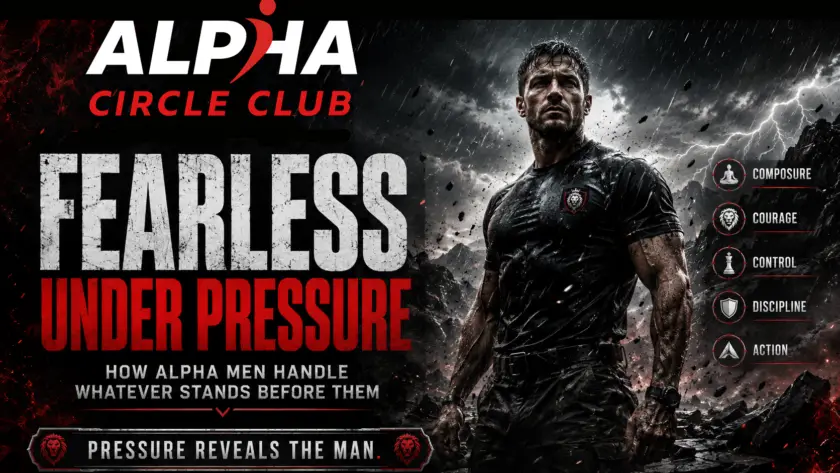
Fear may still appear.
Your heart may beat faster.
Your muscles may tighten.
Your mind may recognise that the situation is serious.
But fear does not have to control what happens next.
An alpha man does not wait until he feels completely fearless before taking action. He deals with the person, problem or pressure standing in front of him.
He observes.
He thinks.
He communicates clearly.
He protects what matters.
He chooses the most intelligent response available without allowing panic, pride or intimidation to make the decision.
Fearlessness does not mean feeling nothing.
It means remaining capable while fear is present.
Fear may enter the situation, but it does not receive command.
1. Fear Is a Signal, Not a Master
Fear is not always the enemy.
It is part of the body’s warning system.
Fear may tell a man that:
- Danger could be present
- He is underprepared
- A boundary is being crossed
- Something important is at risk
- The situation is unfamiliar
- Immediate attention may be required
The goal is not to destroy every feeling of fear.
The goal is to understand what fear is communicating without automatically obeying it.
When fear appears, ask:
- What exactly am I afraid of?
- Is the danger real, exaggerated or uncertain?
- What facts do I have?
- What am I assuming?
- What action would reduce the risk?
- Do I need distance, support or more information?
- What would I do if panic were not controlling me?
Fear can provide information.
But information is not authority.
A smoke alarm warns you that something may be wrong. It does not decide how you respond. You still assess the situation, identify the danger and take the appropriate action.
Treat fear in the same way.
Listen to the warning.
Then let judgement lead.
Alpha Insight
Listen to fear’s warning without surrendering control of your response. A signal can inform you without becoming your master.
2. Courage Is Action With Fear Present
Many men wait for fear to disappear before acting.
They tell themselves:
“I will speak when I feel more confident.”
“I will apply when I feel ready.”
“I will set the boundary when I stop feeling nervous.”
“I will begin when I know I cannot fail.”
But courage usually arrives before complete confidence.
Courage means:
- Speaking while your voice wants to shake
- Entering the room while uncertainty remains
- Setting a boundary while fearing rejection
- Applying while fearing failure
- Defending the truth while fearing judgement
- Taking responsibility while fearing the consequences
- Asking for help while fearing embarrassment
The man does not need fear to disappear.
He needs a decision stronger than the fear.
Confidence often develops afterwards.
The man acts.
Survives the discomfort.
Learns from the experience.
Then carries evidence into the next situation.
Waiting for perfect fearlessness can keep a man trapped forever.
Act wisely while fear is still present.
Alpha Insight
Courage is not the moment fear disappears. It is the moment your values, responsibility and judgement become stronger than fear.
3. Stop Imagining Fearless Men Feel Nothing
Men often look at someone who appears calm under pressure and assume he feels nothing.
But external calm does not reveal the complete internal experience.
A strong man may still feel:
- Nervous
- Uncertain
- Angry
- Vulnerable
- Pressured
- Concerned
- Physically tense
The difference is that he does not allow those feelings to destroy his judgement.
He may feel adrenaline while keeping his voice controlled.
He may feel intimidated while maintaining his boundary.
He may fear failure while still completing the attempt.
He may recognise danger while choosing the safest action.
Courage is not emotional numbness.
A man does not need to become disconnected from himself to become strong.
He needs emotional leadership.
That means recognising what he feels, understanding why it is happening and deciding how he will act.
Alpha Insight
A fearless man is not empty of emotion. He remains the leader of his behaviour while emotion is present.
4. Deal With What Is Actually in Front of You
Fear becomes larger when the mind begins fighting twenty imaginary situations at once.
The man is no longer responding to reality.
He is reacting to everything that could theoretically happen.
He imagines:
- The worst possible outcome
- What everyone may think
- Every way he could fail
- Every possible confrontation
- Every future consequence
- Every mistake he might make
The situation inside his mind becomes far larger than the one in front of him.
Bring your attention back to the present.
Ask:
- What is happening now?
- Who is in front of me?
- What has actually been said or done?
- What facts are available?
- What needs to happen next?
- What is the safest useful action?
- What can I control in this moment?
You do not need to defeat every possible outcome.
You need to handle the next real decision.
One breath.
One sentence.
One boundary.
One phone call.
One step towards safety.
Deal with reality before imagination creates a larger enemy.
Alpha Insight
You do not need to defeat every possible future. Handle the truth, person and decision standing in front of you now.
5. Control the Body Before Making the Decision
Fear affects the body.
Breathing can become shallow.
Muscles tighten.
The heart rate rises.
The voice changes.
Attention narrows.
The man may speak too quickly, misunderstand what is happening or act before thinking.
He cannot always remove the physical response immediately.
But he can reduce its control.
Where circumstances allow, he can:
- Take a slower breath
- Relax his shoulders
- Ground his feet
- Unclench his hands
- Lower his voice
- Pause before answering
- Look around the environment
- Create physical distance
- Avoid sudden, unnecessary movements
These actions do not magically eliminate fear.
They help prevent the body’s alarm response from becoming the only force directing behaviour.
When the body slows, the mind often gains more room to assess.
The man becomes better able to decide whether he should speak, leave, seek help or take another safe action.
Alpha Insight
Control the breath, posture and voice before fear controls the decision. Physical composure creates space for clearer judgement.
6. Preparation Creates Practical Fearlessness
Preparation does not guarantee that a man will never feel afraid.
It gives him options when fear appears.
Preparation may include:
- Improving communication
- Studying conflict management
- Learning first aid
- Building financial reserves
- Understanding workplace procedures
- Practising public speaking
- Improving physical fitness
- Knowing emergency contacts
- Rehearsing difficult conversations
- Learning how and when to seek professional help
A prepared man is less likely to feel completely helpless.
He may not know everything.
But he has built useful capabilities.
Fear grows in uncertainty.
Preparation reduces unnecessary uncertainty.
A man who has practised speaking directly is better prepared for confrontation.
A man with an emergency fund is better prepared for an unexpected bill.
A man who understands workplace procedures is better prepared to report misconduct.
A man trained in first aid may function more effectively during a medical emergency.
You cannot prepare for every event.
But you can become the kind of man who is harder to overwhelm.
Alpha Insight
You cannot control every situation, but preparation gives you more intelligent options when pressure arrives.
7. Speak Clearly When Pressure Rises
Fear can damage communication.
A man may:
- Speak too quickly
- Over-explain
- Apologise unnecessarily
- Become aggressive
- Say nothing
- Agree when he wants to refuse
- Make promises he cannot keep
- Use threats he later regrets
A fearless response is often calm and brief.
Useful phrases may include:
- “Stop. That is not acceptable.”
- “I do not agree.”
- “Step back.”
- “I need a clear answer.”
- “That statement is untrue.”
- “This conversation is over.”
- “I am leaving now.”
- “I need assistance.”
- “We will discuss this when everyone is calm.”
- “I will not make that decision under pressure.”
Clear language keeps fear from turning the man either passive or explosive.
He does not need to give a speech.
He does not need to prove his intelligence in the moment.
He needs to communicate what matters.
Alpha Insight
Pressure is not the time for unnecessary words. Speak calmly, directly and clearly enough for your position to be understood.
8. Fear of Conflict Makes Problems Stronger
Avoiding every difficult interaction may create temporary comfort.
But the problem often remains.
The disrespect continues.
The boundary weakens.
The resentment grows.
The decision becomes more urgent.
The other person learns that pressure produces silence.
A man should not search for unnecessary confrontation.
But he must be capable of entering necessary conflict without losing himself.
Conflict may be handled through:
- Calm conversation
- Direct boundaries
- Negotiation
- Formal reporting
- Reduced access
- Distance
- Appropriate consequences
Courage does not always sound aggressive.
Sometimes it sounds like one clear sentence:
“Do not speak to me in that way.”
“That agreement has been broken.”
“I need this behaviour to stop.”
“I will be reporting what happened.”
“I am ending this arrangement.”
The purpose is not to create drama.
It is to prevent fear from allowing a manageable issue to become a permanent pattern.
Alpha Insight
Avoiding necessary conflict does not create peace. It often allows the problem to grow stronger while your confidence becomes weaker.
9. Do Not Let Intimidating People Become Larger in Your Mind
Some people use intimidation to make others feel smaller.
They may rely on:
- Physical size
- Status
- Anger
- Titles
- Wealth
- Reputation
- Loudness
- Aggressive body language
- Social influence
The image they project may become larger inside your mind than the person actually is.
A strong man sees them accurately.
He remembers:
- They are human
- Their confidence may be performance
- Their anger does not determine the truth
- Their title does not make every statement correct
- Their wealth does not remove your dignity
- Their aggression does not require emotional submission
- Their opinion does not automatically become reality
This does not mean underestimating genuine danger.
A loud or aggressive person may present a real risk.
Use distance, support and formal help when necessary.
But do not surrender mentally merely because someone has attempted to appear powerful.
Respond to facts and behaviour—not the image they are trying to create.
Alpha Insight
See intimidating people accurately. Do not minimise genuine danger, but do not allow another person’s performance to become greater than reality.
10. Fear of Other People’s Opinions Is Still Fear
Not all fear involves physical danger.
Some of the strongest fear involves:
- Rejection
- Embarrassment
- Criticism
- Failure
- Looking foolish
- Being misunderstood
- Disappointing people
- Public judgement
This fear can prevent a man from:
- Starting a business
- Publishing his work
- Asking for an opportunity
- Setting a boundary
- Leaving a damaging relationship
- Speaking honestly
- Trying something new
- Living according to his values
The man begins allowing people who are not responsible for his future to control the decisions that shape it.
Ask:
- Do these people understand my mission?
- Will their opinion still matter in five years?
- Are they offering useful guidance or merely judgement?
- Am I abandoning my values to avoid temporary discomfort?
- What will avoidance cost me?
You do not need to ignore all feedback.
Wise criticism can improve you.
But fear of disapproval should not become the permanent ruler of your life.
Alpha Insight
Do not allow people who are not building your life to control the decisions that determine its direction.
11. Fear Can Disguise Itself as Procrastination
Fear does not always say:
“I am afraid.”
Sometimes it says:
“I need more time.”
“I need more information.”
“I will begin when conditions improve.”
“I am still preparing.”
“I will do it next week.”
Preparation can be responsible.
But endless preparation may be fear hiding behind respectable language.
The man may fear:
- Failure
- Judgement
- Rejection
- Responsibility
- Success
- Discovering his true level of ability
- Losing the safety of potential
An unfinished dream cannot be publicly judged.
But it also cannot succeed.
Ask:
“Am I genuinely preparing, or am I delaying because action would expose me to discomfort?”
The answer may reveal that the next step is already known.
Make the call.
Send the application.
Publish the work.
Begin the course.
Book the appointment.
Fear loses influence when action begins.
Alpha Insight
Preparation has a finish line. When research and planning never lead to action, fear may be using preparation as a hiding place.
12. Build Evidence That You Can Handle Difficult Situations
Confidence grows through evidence.
Every difficult situation handled well becomes part of your internal history.
You remember:
- I remained calm.
- I spoke clearly.
- I protected myself.
- I asked for help.
- I completed the task.
- I survived the discomfort.
- I learned what to improve.
- I did not abandon myself.
The challenge does not need to be dramatic.
Begin with smaller acts of courage.
Make the call you have been avoiding.
Ask the difficult question.
Enter the unfamiliar room.
State the boundary.
Share your work.
Apply for the opportunity.
Say no respectfully.
Each act adds evidence.
The mind begins to understand:
“I can feel fear and still function.”
That is practical confidence.
It is not pretending you are invincible.
It is trusting that you can face uncertainty, take the next step and learn from what happens.
Alpha Insight
Confidence is built from remembered evidence. Face manageable challenges until your mind has proof that fear does not make you powerless.
13. Fearlessness Includes Strategic Withdrawal
A man should not remain in unnecessary danger simply to protect his pride.
Walking away can be the strongest response when:
- Violence appears likely
- Weapons may be present
- The person is intoxicated
- The environment is unstable
- Children or vulnerable people are nearby
- The confrontation serves no constructive purpose
- Authorities or trained professionals should handle the issue
Leaving is not automatically cowardice.
Sometimes it is judgement.
The objective is not to prove that you fear nothing.
It is to protect:
- Life
- Health
- Family
- Freedom
- Reputation
- Future responsibilities
A pride-driven man may stay because he wants spectators to consider him brave.
A disciplined man asks what action gives everyone the best chance of leaving safely.
Strategic withdrawal is not surrender when it protects what matters and creates the opportunity for a better response.
Alpha Insight
Walking away from unnecessary danger can be an act of strength. Protecting your future matters more than performing courage for spectators.
14. Know When to Act Immediately
Some situations require fast action.
Examples may include:
- An immediate threat
- A medical emergency
- Fire
- Environmental danger
- Serious harassment
- A clear safety risk
- Someone attempting to force entry or access
- A vulnerable person facing immediate harm
The man should focus on the safest practical priorities available.
These may include:
- Creating distance
- Contacting emergency services
- Moving people towards safety
- Alerting trained staff
- Following established procedures
- Avoiding unnecessary escalation
- Providing appropriate first aid if trained
Fearlessness in an emergency does not mean performing reckless heroics.
It means remaining functional enough to take useful action.
A man should not allow the desire to appear brave to create additional victims or danger.
Do what you are trained and safely able to do.
Get appropriate help quickly.
Alpha Insight
In an emergency, courage means useful action—not reckless performance. Protect life, seek trained help and avoid making the danger greater.
15. Do Not Confuse Aggression With Courage
Aggression can grow from fear.
A man feels threatened, so he becomes louder.
He attacks first.
Uses intimidation.
Interprets every disagreement as a challenge.
Attempts to dominate before anyone can question him.
This may appear powerful from the outside.
But it can reveal insecurity underneath.
A courageous man can be:
- Firm without threatening
- Direct without insulting
- Alert without becoming paranoid
- Prepared without looking for conflict
- Strong without needing to dominate
- Confident without humiliating others
Aggression often sacrifices long-term judgement for immediate control.
Courage remains connected to purpose.
The man asks:
“What outcome am I trying to create?”
If the answer is safety, truth or resolution, uncontrolled aggression may damage all three.
Alpha Insight
Aggression tries to prove strength. Courage uses strength intelligently, proportionately and without unnecessary cruelty.
16. The Fear of Failure Must Not Prevent the Attempt
A man may refuse to begin because he cannot guarantee success.
He wants certainty before action.
But meaningful opportunities rarely arrive with complete guarantees.
Failure can provide:
- Information
- Experience
- Better judgement
- Improved strategy
- Emotional resilience
- Evidence of what must change
- Greater humility
Failure can hurt.
But permanent avoidance creates another kind of failure—the failure to discover what might have been possible.
An alpha man does not take every risk blindly.
He assesses:
- The possible reward
- The potential loss
- What can be controlled
- What can be learned
- Whether the risk is responsible
- Whether recovery is possible
Then he acts.
He does not demand certainty from life before participating in it.
Alpha Insight
Failure may teach you how to improve. Avoidance guarantees that the opportunity remains unexplored. Take intelligent risks rather than waiting for impossible certainty.
17. Fear of Success Can Also Hold a Man Back
Some men are not only afraid of failing.
They are afraid of what success may demand.
Success may bring:
- Greater responsibility
- More visibility
- Higher expectations
- More difficult decisions
- Criticism
- Financial risk
- The possibility of losing what was built
The man may delay because remaining small feels safer.
He says he wants the opportunity, but his behaviour repeatedly prevents it.
Fearlessness requires preparing for responsibility—not only chasing reward.
Ask:
- What would success require me to become?
- Which skill would I need?
- What responsibility am I avoiding?
- Do I fear judgement more than I desire progress?
- What support or structure would help me carry more?
Do not sabotage the opportunity because the stronger version of you has not yet been fully developed.
Begin developing him.
Alpha Insight
Sometimes fear does not stop a man from escaping failure. It stops him from carrying success. Build the capacity required for the opportunity you want.
18. Know When to Ask for Help
Some men believe fearlessness means handling every problem alone.
It does not.
There are situations that require:
- Emergency services
- Medical care
- Legal advice
- Workplace reporting
- Mental-health support
- Financial guidance
- Trusted friends
- Family assistance
- Professional expertise
Asking for help does not remove your responsibility.
It may be the most responsible action available.
Pride says:
“I must prove I can handle this alone.”
Wisdom says:
“What support gives this situation the best chance of being resolved safely?”
Strong men use appropriate resources.
They do not allow fear of embarrassment to keep a dangerous or serious problem hidden.
Alpha Insight
Fearlessness is not isolation. A strong man knows when personal courage must be supported by professional skill, authority or trusted people.
19. Faith Gives Courage a Foundation
Faith does not guarantee that a man will never feel afraid.
It gives him something greater than fear to stand upon.
He can pray:
“God, give me the wisdom to recognise danger, the courage to face what must be faced and the self-control to respond without panic, pride or hatred.”
Faith reminds him:
- He is not defined by another person’s judgement
- He can remain truthful under pressure
- He can seek guidance
- He does not need to control every outcome
- Courage and wisdom must work together
- Strength does not require cruelty
- Fear does not cancel his responsibility
Faith-led courage does not chase danger.
It does not seek unnecessary conflict to prove spiritual confidence.
It refuses to abandon responsibility merely because difficulty has appeared.
A faithful man acts on what is within his control and entrusts what remains beyond him to God.
Alpha Insight
Faith does not remove every fearful feeling. It gives a man a deeper foundation from which to act with wisdom, truth and self-control.
20. Fearlessness Must Be Trained Before the Crisis
A man cannot expect perfect calm in a serious situation if he has never trained himself through smaller discomforts.
Courage can be practised.
He can train by:
- Having difficult conversations
- Improving physical fitness
- Speaking in front of people
- Making decisions under reasonable time pressure
- Learning emergency skills
- Setting boundaries
- Attempting unfamiliar tasks
- Asking for honest feedback
- Remaining present during discomfort
- Completing difficult work without escaping
Voluntary challenges prepare the mind for involuntary ones.
Each experience teaches the man how his body and thoughts respond under pressure.
He learns to breathe.
Think.
Communicate.
Recover.
He also learns where further preparation is needed.
Do not wait for the crisis to begin building courage.
Train it through everyday acts of disciplined discomfort.
Alpha Insight
Courage becomes more reliable when it has been practised. Use smaller challenges to prepare your mind for larger responsibilities.
A Personal Statement on Fearlessness
I do not believe being fearless means I will never feel fear.
Fear may still appear when a difficult person, serious problem or unexpected situation stands in front of me.
My heart may beat faster.
My body may become tense.
My mind may recognise the risk.
But fear does not have to decide how I respond.
I can observe.
I can think.
I can control my breathing and my words.
I can speak directly.
I can protect myself and others.
I can walk away when wisdom requires it.
I can seek help without feeling ashamed.
I can prepare before pressure arrives.
Whatever stands in front of me, I will deal with the reality of the situation rather than allowing fear to create a larger enemy inside my mind.
Fear may be present.
But I remain responsible for the response.
Alpha Insight
You do not need to promise that you will never feel fear. Promise that fear will never automatically own your decisions.
The Alpha Fear Response
Use this five-part process when pressure, intimidation or uncertainty appears:
PAUSE → ASSESS → CONTROL → DECIDE → ACT
Pause
Interrupt the automatic reaction.
Take one controlled breath where possible.
Do not allow panic, anger or pride to speak first.
A short pause can prevent a long mistake.
Alpha Insight
The first emotional impulse does not need to become the final decision. Create one moment of space before acting.
Assess
Ask:
- Is there immediate danger?
- Who is involved?
- What facts do I know?
- What am I assuming?
- What is the safest option?
- Does this require help?
- What outcome matters most?
- What action could make the situation worse?
Assessment converts raw fear into useful information.
Alpha Insight
Courage without assessment can become recklessness. Understand the situation before choosing the response.
Control
Bring your body, language and behaviour under control.
Create distance where necessary.
Do not allow another person’s emotion to become yours.
You may not control what they do.
You can still control your contribution to the situation.
Alpha Insight
You may not control the pressure around you, but you remain responsible for the pressure you add to it.
Decide
Choose the response that best protects:
- Safety
- Truth
- Dignity
- Reputation
- Important relationships
- Long-term consequences
The response may be to:
- Speak
- Leave
- Wait
- Seek help
- Set a boundary
- Report the matter
- Take another safe action
Alpha Insight
The strongest response is not always the loudest or most immediate. It is the one that protects what matters most.
Act
Take the next clear action.
Do not remain trapped in endless analysis once the necessary response is known.
Speak.
Move.
Call.
Leave.
Report.
Complete the task.
Courage becomes real through action.
Alpha Insight
Once the wise action is clear, move. Fear grows when decisions remain permanently trapped inside the mind.
The Fearless Situation Test
Before responding to a difficult situation, ask:
- Is this genuine danger or emotional discomfort?
- What exactly is fear warning me about?
- What facts do I know?
- What part of the situation can I control?
- What action protects safety and dignity?
- Am I avoiding action—or choosing better timing?
- Is pride pushing me towards unnecessary risk?
- Do I need support, evidence or professional help?
- What would a calm and capable man do next?
- What outcome matters after this moment is over?
- Am I reacting to reality or imagination?
- What is the next clear action?
Do not use these questions to delay necessary action during an emergency.
Use them to prevent fear, anger or pride from making the situation worse.
Fear-Controlled Man vs Fearless Alpha
| Fear-controlled response | Fearless alpha response |
|---|---|
| Pretends fear does not exist | Recognises fear without obeying it |
| Panics or freezes | Pauses and assesses |
| Reacts aggressively | Responds proportionately |
| Imagines every disaster | Deals with present facts |
| Avoids all conflict | Enters necessary conflict calmly |
| Takes reckless risks | Protects safety and future |
| Waits for confidence | Builds confidence through action |
| Over-explains | Speaks clearly |
| Lets intimidating people dominate | Sees them accurately |
| Refuses help | Uses appropriate support |
| Acts to protect ego | Acts to protect what matters |
| Runs from discomfort | Moves through discomfort deliberately |
| Treats withdrawal as humiliation | Leaves when wisdom requires it |
| Allows fear to delay indefinitely | Takes the next measurable step |
| Tries to prove invincibility | Remains functional and self-controlled |
The Seven-Day Courage Challenge
Day 1: Name One Fear
Write down one fear currently influencing your decisions.
Describe exactly what you believe may happen.
Avoid vague language.
Name the specific feared outcome.
Day 2: Separate Danger From Discomfort
Decide whether the fear involves:
- Genuine physical danger
- Financial risk
- Social discomfort
- Rejection
- Embarrassment
- Uncertainty
Different fears require different responses.
Do not treat discomfort as danger.
Do not treat danger as harmless discomfort.
Day 3: Take One Controlled Action
Complete one small action you have been avoiding.
Make the call.
Send the message.
Ask the question.
Submit the application.
Day 4: Practise Direct Communication
Say something that needs to be said calmly and respectfully.
Focus on clarity rather than aggression.
Day 5: Train Under Safe Discomfort
Complete a demanding but responsible physical or mental challenge.
The purpose is to practise functioning while uncomfortable—not to harm yourself.
Day 6: Prepare for a Real Risk
Improve one practical area:
- Emergency planning
- Finances
- Health
- Communication
- First aid
- Workplace procedures
- Professional support
Preparation converts vague fear into practical action.
Day 7: Review the Evidence
Ask:
- What did I fear?
- What actually happened?
- What did I handle well?
- Where did fear still control me?
- What must I improve?
- What challenge will I face next?
The objective is not to eliminate fear in seven days.
It is to begin building proof that you can act while fear is present.
A Personal Declaration
Fear may appear, but it will not receive command.
I will not pretend that danger is unreal.
I will assess it.
I will prepare.
I will control my breathing, language and behaviour.
I will deal with the person, problem or pressure standing in front of me.
I will not become reckless to prove courage.
I will not become passive to avoid discomfort.
I will speak when speaking is required.
I will leave when leaving protects life and future.
I will seek help when the situation requires support.
I will not allow intimidating people to become greater inside my mind than they are in reality.
I will not allow fear of judgement to prevent me from building my life.
I will act according to truth, wisdom, faith and self-control.
Fear may be present.
But the response will still belong to me.
Final Thoughts
Fearlessness is not a life without fear.
It is a life in which fear has lost the authority to make every decision.
The fearless man still feels pressure.
He still recognises danger.
He still experiences uncertainty.
But he remains present.
He assesses the situation.
Controls himself.
Protects what matters.
And takes the next necessary action.
Sometimes he stands his ground.
Sometimes he speaks directly.
Sometimes he walks away.
Sometimes he calls for help.
Sometimes he admits that he does not yet know what to do and seeks wiser guidance.
None of these choices automatically makes him weak.
The question is whether he chose from wisdom or surrendered to fear.
Do not wait until you feel no fear.
Do not build your identity around appearing invincible.
Become the man who can remain functional, disciplined and truthful while fear is still present.
Prepare your mind.
Strengthen your body.
Develop useful skills.
Practise difficult conversations.
Build a history of courageous action.
Then, when the person, problem or pressure stands in front of you, deal with what is real.
Fear may enter the room.
But it does not have to take the chair of command.
An alpha man does not need to feel fearless. He needs the courage, wisdom and self-control to act correctly while fear is present.
Final Alpha Insight
Fear may enter the room, but an alpha man does not surrender command of his response.



No spam. Unsubscribe anytime.