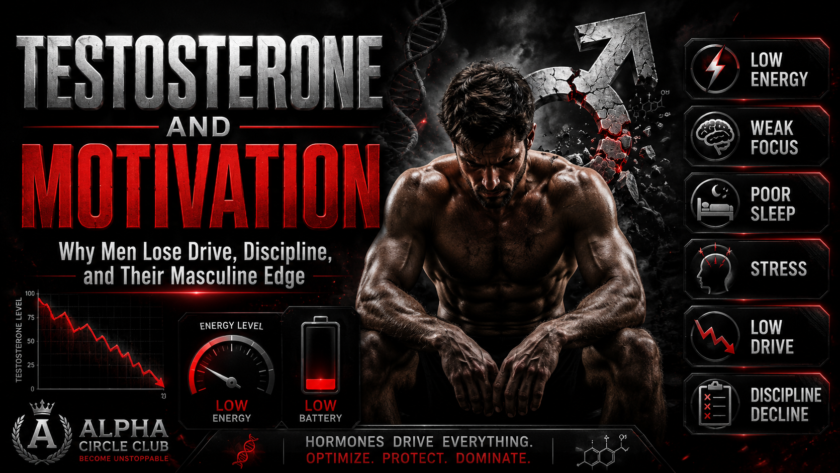
Testosterone and motivation are connected in a way many men feel before they fully understand.
A man can lose motivation slowly and it can last along time.
At first, he calls it laziness because he doesn’t fully understand what is happening to him.
He tells himself to push harder.
He blames age.
He blames stress.
He blames being busy.
He says he just needs to “get back on track.”
But then the pattern continues……. and continues and continues until one day 1 year has gone by, then 5 years and sadly 10 years or more.
He wakes up tired.
He avoids the gym.
He loses hunger for goals.
He delays tasks he used to attack.
His confidence feels weaker.
His focus feels blunt.
His sex drive drops.
His mood feels flat.
His body feels heavier.
His mind feels less aggressive toward the future.
He still has ambition, he set goals that feel good and gives him that spark he thought he lost, but over a short amount of time the lack of motivation takes over and his goals that only a short time before felt so motivating are starting to become a distant memory.
That is where the real question begins:
Is this mindset?
Is it stress?
Is it poor sleep?
Is it depression?
Is it burnout?
Is it low dopamine habits?
Or could testosterone be part of the problem?
The answer is not always simple.
Testosterone may influence energy, mood, confidence, libido, competitive drive, reward-seeking, and motivation in some men. Cleveland Clinic explains that low testosterone can affect mood, energy, muscle, sexual function, memory, and concentration.
But low motivation does not automatically mean low testosterone.
A man can lose motivation because of poor sleep, chronic stress, depression, anxiety, alcohol, overtraining, under-eating, low purpose, too much screen stimulation, relationship pressure, thyroid issues, medication side effects, or lifestyle chaos.
That is why this article is not about blaming everything on hormones.
It is about understanding the system.
Because motivation is not just a thought.
It is energy, chemistry, discipline, recovery, purpose, and biology working together.
Low motivation is not always weakness.
Sometimes it is a signal that the system needs attention.
What Motivation Really Is
Motivation is more than feeling inspired.
A man can watch a motivational video, feel a spark for five minutes, and still return to the same habits that made him feel flat in the first place.
Real motivation is deeper than hype.
It includes:
Energy
Focus
Reward drive
Confidence
Emotional state
Discipline
Purpose
Physical vitality
Mental clarity
Stress resilience
A man will not feel motivated every day.
That is where discipline matters.
Discipline carries a man when motivation is low.
But there is a difference between normal low motivation and a deeper system crash.
Some days, a man needs to push through resistance, that is where true success lies.
Other times, he needs to investigate why the engine feels drained.
If motivation has dropped hard and stays low for weeks or months, the answer may not be to shout at yourself harder.
The answer may be to rebuild the system.
Sleep.
Food.
Training.
Stress control.
Hormones.
Purpose.
Dopamine habits.
Recovery.
Discipline carries a man when motivation is low, but if the whole system is drained, he needs to rebuild the engine — not just shout at himself harder.
Can Testosterone Affect Motivation?
When my testosterone levels are higher I feel motivated, focused and in a totally different mindset, I love that.
Testosterone may affect motivation through several pathways.
It can influence energy, mood, confidence, libido, physical drive, competitive behaviour, and reward-related behaviour. Research has described testosterone as playing a role in mood, behaviour, self-perception, and perceived quality of life in men.
But this must be understood carefully.
Low motivation does not automatically mean low testosterone.
A man can lose motivation because of:
Poor sleep
Burnout
Depression
Anxiety
Stress
Overtraining
Under-eating
Alcohol
Low purpose
Too much screen stimulation
Relationship pressure
Low vitamin D
Thyroid issues
Medication side effects
Testosterone may be one suspect.
It is not the only suspect.
That distinction matters.
If a man assumes every drop in motivation is hormonal, he may ignore the lifestyle, mental health, relationship, sleep, and stress problems that are draining him.
If he assumes it is “just mindset,” he may ignore a real medical issue that needs testing.
A serious man does neither.
He investigates.
He builds.
He gets data if symptoms persist.
Testosterone, Dopamine, and Reward Drive
Dopamine is strongly connected with reward, pursuit, focus, effort, and motivation.
When the reward system is working well, a man can pursue goals, tolerate discomfort, and stay locked onto long-term progress.
He can delay gratification.
He can do difficult things.
He can keep going when the reward is not immediate.
Some research suggests testosterone may influence reward motivation partly through dopaminergic brain systems, but this field is complex and should not be oversimplified. One review stated that testosterone may increase reward motivation by acting on dopaminergic neural structures involved in behavioural activation.
That does not mean testosterone is the only driver of motivation.
It means testosterone may be part of a wider reward-and-drive system.
But modern men have another problem.
Cheap dopamine.
Endless scrolling.
Porn.
Junk food.
Gambling-style apps.
Constant YouTube.
Too much gaming.
Instant reward habits.
Notifications every few minutes.
These habits can train the brain toward quick stimulation instead of deep pursuit.
A man cannot feed his brain constant cheap rewards and expect deep motivation to stay sharp.
This is not about never enjoying life.
It is about asking a serious question:
Are my habits building my drive?
Or are they slowly stealing it?
A man with weak dopamine habits may feel flat when it is time to do hard, meaningful work because his brain has become used to easy rewards.
Testosterone matters.
But so does what a man repeatedly trains his reward system to chase.
Low Testosterone Symptoms That Can Feel Like Low Motivation
Low testosterone symptoms can overlap with low motivation.
Possible symptoms may include:
Fatigue
Low libido
Low mood
Brain fog
Poor concentration
Reduced confidence
Weak training recovery
Loss of muscle
Increased belly fat
Reduced morning erections
Irritability
Low drive
These symptoms do not prove low testosterone.
They are reasons to investigate, especially if persistent.
The NHS warns that symptoms such as depression, loss of sex drive, erectile dysfunction, tiredness, poor concentration, and short-term memory problems can have many possible causes and should not automatically be blamed on testosterone.
That is why the Alpha Circle Club rule is simple:
Test, do not guess.
Do not diagnose your hormones from one bad week.
Do not diagnose yourself from a podcast.
Do not start testosterone therapy because an influencer made it sound like the answer to every male problem.
A serious man gets data.
Sleep and Motivation
Poor sleep can destroy motivation before the day even starts.
A man who sleeps badly may wake up flat, irritated, unfocused, and less driven.
He may feel like he has no discipline, when the real issue is that his recovery is broken.
Poor sleep can affect testosterone, appetite, discipline, training performance, mood, decision-making, and stress resilience.
If a man wants stronger motivation, he needs to protect sleep like it matters.
Action points:
Set a bedtime.
Avoid late caffeine.
Reduce late-night scrolling.
Keep the room cool and dark.
Get morning sunlight.
Avoid alcohol close to bed.
Watch for snoring or sleep apnea signs.
No man wakes up hungry for greatness after treating sleep like an enemy.
Sleep is not soft.
Sleep is repair.
Sleep is where the nervous system resets.
Sleep is where the body rebuilds.
Sleep is where tomorrow’s discipline is prepared.
Stress, Cortisol, and Lost Drive
Stress can push the body into survival mode.
When stress stays high, motivation can drop because the brain is overloaded.
A man under chronic pressure may not feel driven.
He may feel tired, irritable, distracted, emotionally flat, and mentally cluttered.
Common stressors include:
Money pressure
Business pressure
Relationship pressure
Family pressure
Workload
Digital noise
Poor recovery
Unresolved anxiety
Lack of quiet
Constant problem-solving
The body can handle stress.
But it needs recovery.
Without recovery, pressure becomes a drain.
A man cannot build elite motivation in a nervous system that never switches off.
This is where men must stop confusing chaos with ambition.
Working hard matters.
Building matters.
Pushing matters.
But if a man never recovers, never sleeps properly, never creates quiet, and never controls his nervous system, the system eventually pushes back.
Sometimes low motivation is not laziness.
Sometimes it is overload.
Depression, Anxiety, and Low Motivation in Men
Low motivation may come from mental health, not testosterone.
This section matters because many men would rather blame hormones than admit they may be dealing with depression, anxiety, burnout, or emotional overload.
Depression in men may not always look like sadness.
It may show up as:
Irritability
Withdrawal
Flat mood
Anger
Low energy
Loss of interest
Alcohol use
Porn escape
Avoidance
Numbness
Low confidence
Loss of direction
Anxiety may create overthinking, avoidance, fear, tension, and mental fatigue.
A man can look strong on the outside while his mind is quietly draining his drive.
That does not make him weak.
It means he needs to take the signal seriously.
A man who wants strength must be willing to face what is happening beneath the surface.
Ignoring mental health is not masculine.
It is costly.
Exercise, Strength Training, and Motivation
Exercise can help motivation by improving energy, confidence, mood, blood flow, body composition, and discipline.
Strength training is especially powerful for men.
Not because lifting is magic.
But because it gives a man structure, progression, challenge, and physical proof that effort creates change.
A strong training structure may include:
Strength training 3 days per week
Walking daily
HIIT 1–2 days per week if recovery is strong
Mobility or recovery work as needed
Strength training can build the body.
Walking can clear the mind.
HIIT can sharpen conditioning.
Recovery keeps the system alive.
A man who trains consistently starts to rebuild trust with himself.
He proves he can keep promises.
He proves he can push.
He proves he can endure.
He proves he can return.
Lift like a man who is rebuilding his internal command system.
Nutrition for Testosterone and Motivation
Food affects energy, blood sugar, mood, training, focus, and recovery.
A man cannot eat like his body is an afterthought and expect elite drive.
Nutrition for testosterone and motivation should focus on:
Protein
Healthy fats
Carbohydrates around training
Zinc
Magnesium
Vitamin D
Omega-3
B vitamins
Hydration
Whole foods
This does not mean foods boost motivation instantly.
There is no magic meal that turns a man into a machine.
But food sets the foundation.
Protein supports repair.
Healthy fats support normal hormone function.
Carbohydrates can support hard training.
Zinc and magnesium support important body processes.
Vitamin D matters for wider health.
Omega-3s support cell membranes and inflammation balance.
Hydration supports performance.
Your drive does not run on hype.
It runs on sleep, fuel, blood flow, minerals, recovery, and purpose.
Alcohol, Porn, and Cheap Dopamine
This is one of the strongest areas for Alpha Circle Club.
Alcohol can weaken sleep, mood, recovery, libido, training performance, and discipline.
Porn and endless digital stimulation may affect motivation in some men by training the brain toward novelty and instant reward.
Not every man is affected the same way.
But if a habit is draining energy, focus, desire, confidence, or discipline, it needs to be questioned.
A man should ask:
Is alcohol helping me build?
Is porn helping me lead?
Is endless scrolling strengthening my focus?
Is junk food supporting my energy?
Is constant YouTube sharpening my mission?
Are my habits building my drive — or slowly stealing it?
That question matters.
Many men do not have a motivation problem.
They have a leakage problem.
Their drive is leaking into distractions.
Their focus is leaking into screens.
Their energy is leaking into habits that give nothing back.
A man should ask whether his habits are building his drive — or slowly stealing it.
When to Get Testosterone Tested
A man may want to discuss testosterone testing with a healthcare professional if low motivation appears alongside:
Low libido
Erectile issues
Persistent fatigue
Depressed mood
Brain fog
Loss of muscle
Increased belly fat
Poor recovery
Reduced morning erections
Infertility concerns
Testing may include:
Total testosterone
Free testosterone
SHBG
LH
FSH
Prolactin
Thyroid markers
Vitamin D
Full blood count
Metabolic markers
The Endocrine Society recommends diagnosing hypogonadism only in men who have symptoms or signs of testosterone deficiency and consistently low testosterone levels. It also recommends confirming the diagnosis by repeating morning fasting total testosterone measurement.
A serious man does not guess his hormones from his mood.
He gets data.
TRT and Motivation: Be Careful
Some men expect TRT to fix everything.
Motivation.
Focus.
Energy.
Confidence.
Libido.
Mood.
Discipline.
Purpose.
For men with clinically confirmed testosterone deficiency, testosterone therapy may help certain symptoms under medical supervision.
But TRT is not a discipline replacement.
It is not a sleep replacement.
It is not a purpose replacement.
It is not a nutrition replacement.
It is not guaranteed to fix motivation for every man.
Cleveland Clinic notes that hormone replacement therapy can help improve sex drive, symptoms of depression, and energy in men with low testosterone, but that does not mean TRT is a one-time fix or the answer for every low-drive man.
There is also evidence that testosterone therapy is not a guaranteed cognitive fix. A trial in older men with low testosterone and age-associated memory impairment found one year of testosterone treatment was not associated with improved memory or other cognitive functions compared with placebo.
TRT may support some men medically.
But it cannot build a purpose-driven life for a man who refuses to build one.
A man still needs standards.
Sleep.
Training.
Food.
Stress control.
Purpose.
Recovery.
Discipline.
The Alpha Circle Club Motivation Rebuild Checklist
This is the practical standard.
Not hype.
Not shame.
A rebuild.
1. Test, Do Not Guess
If symptoms persist, discuss proper blood work.
Low testosterone is possible.
But so are poor sleep, thyroid issues, depression, anxiety, nutrient deficiencies, medication effects, and metabolic problems.
Find the truth.
2. Protect Sleep
No motivation survives long inside a destroyed sleep routine.
Set a bedtime.
Cut late caffeine.
Reduce late-night scrolling.
Keep the room cool and dark.
Get morning sunlight.
3. Lift and Walk
Strength builds the body.
Walking clears the mind.
A man needs both pressure and recovery.
4. Eat Like Drive Matters
Protein.
Healthy fats.
Minerals.
Whole foods.
Hydration.
Do not expect strong output from weak fuel.
5. Control Cheap Dopamine
Reduce endless scrolling, porn, junk food, and digital overstimulation if they are draining focus.
Protect your reward system.
6. Manage Stress
Walk.
Pray.
Breathe.
Journal.
Set boundaries.
Create quiet.
A nervous system under constant attack will not produce elite drive.
7. Build Purpose
Motivation needs direction.
A man without a mission will drift.
Give your energy somewhere to go.
8. Track the Signals
Track energy, libido, mood, focus, sleep, training, and motivation.
Your body speaks.
Your mind speaks.
Listen before they shout.
9. Review Alcohol
If alcohol weakens sleep, mood, libido, or training, reduce it.
A man should question anything that repeatedly steals his edge.
10. Build for 90 Days
Rebuild the system before judging the result.
One good day is not transformation.
Repeated standards change the man.
What This Article Is Not Saying
This article is not saying low motivation always means low testosterone.
It is not saying TRT fixes every man’s motivation.
It is not saying supplements cure low drive.
It is not saying a man is weak if motivation drops.
It is not saying dopamine is the only answer.
It is not saying motivation is only mindset.
What this article is saying is this:
Motivation is a signal.
Testosterone may be part of the picture.
Sleep, stress, mental health, nutrition, training, dopamine habits, purpose, and testing matter.
Men should investigate persistent symptoms.
Discipline matters, but so does rebuilding the biological foundation.
That is the balanced position.
Not hype.
Not excuses.
Ownership.
Testosterone and Motivation: The Real Lesson
Testosterone and motivation are connected, but not in a simple “low drive equals low testosterone” way.
Motivation is a system.
Energy.
Sleep.
Mood.
Reward.
Purpose.
Hormones.
Health.
Discipline.
If a man has lost his drive, the answer is not shame.
The answer is investigation.
Rebuild sleep.
Lift weights.
Walk daily.
Eat real food.
Control stress.
Reduce cheap dopamine.
Find purpose.
Test hormones if symptoms persist.
A serious man does not wait for motivation to save him.
He builds the system that makes motivation easier to access.
Motivation is not just something a man feels.
It is something he protects, trains, and rebuilds.
Call to Action
Want to rebuild drive, focus, testosterone-supportive habits, and masculine discipline?
Explore more Alpha Circle Club guides built for men who want strength, purpose, fertility, and long-term vitality.



No spam. Unsubscribe anytime.