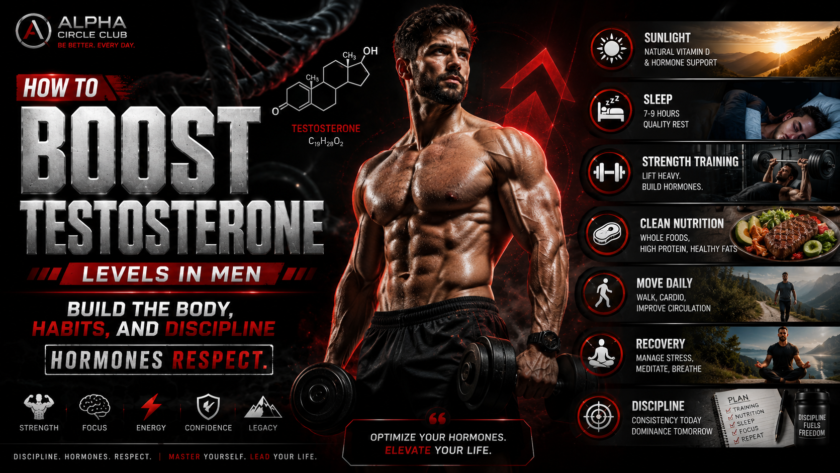
How to boost testosterone levels in men is one of the biggest questions men ask when they want more energy, stronger libido, sharper focus, better muscle, greater confidence, and a stronger masculine edge.
But most men look in the wrong place first.
They search for the shortcut before they build the foundation.
They buy the supplement before fixing sleep.
They chase the “testosterone hack” before lifting consistently.
They copy extreme routines online while ignoring recovery.
They look for a miracle capsule while drinking too much alcohol, staying up too late, eating badly, carrying excess belly fat, skipping sunlight, and living under constant stress.
That is not discipline.
That is desperation.
Testosterone does not respect hype.
It responds to the system a man builds.
A man who wants stronger testosterone-supportive health needs to stop thinking like a shortcut seeker and start thinking like a builder.
Sleep.
Strength training.
Healthy body composition.
Protein.
Healthy fats.
Vitamin D.
Zinc.
Magnesium.
Stress control.
Walking.
Recovery.
Reduced alcohol.
Medical testing when needed.
That is the foundation.
There is no magic shortcut, and persistent symptoms of low testosterone should be properly assessed. The Endocrine Society recommends diagnosing hypogonadism only in men with symptoms or signs of testosterone deficiency and consistently low testosterone levels on accurate testing. It also recommends confirming low testosterone with a repeat morning fasting total testosterone measurement.
A serious man does not guess.
He builds.
He tests.
He corrects the foundation.
He gives his body a reason to perform.
What Testosterone Does for Men
Testosterone is one of the most important male hormones.
It is involved in:
Libido
Erections
Muscle mass
Strength
Bone health
Mood
Energy
Red blood cell production
Fertility
Confidence and drive
For many men, testosterone represents vitality.
When testosterone is strong and the body is functioning well, a man may feel more driven, more energetic, more physically capable, more sexually healthy, and more mentally sharp.
But testosterone is not the only reason a man feels strong.
And low testosterone is not the only reason a man feels tired, low, unfocused, sexually flat, or unmotivated.
Symptoms can overlap with poor sleep, stress, depression, thyroid issues, medication side effects, diabetes, obesity, low vitamin D, overtraining, poor nutrition, and other health problems.
The NHS notes that symptoms sometimes blamed on “male menopause” — such as low mood, loss of sex drive, erectile dysfunction, tiredness, and poor concentration — can have several possible causes and should not automatically be blamed on testosterone.
Testosterone is powerful.
But it is not an excuse to ignore the rest of the system.
A man who wants to raise testosterone naturally has to stop thinking in one-dimensional terms.
The body is a system.
The system must be built.
Test, Do Not Guess
This is where every serious testosterone conversation should begin.
If a man has persistent symptoms of low testosterone, he should discuss proper testing with a healthcare professional.
Possible symptoms may include:
Low libido
Erectile issues
Persistent fatigue
Low mood
Brain fog
Loss of muscle
Poor recovery
Increased belly fat
Infertility concerns
Reduced morning erections
These symptoms matter, but they do not prove low testosterone by themselves.
That is why testing matters.
Possible blood work may include:
Total testosterone
Free testosterone
SHBG
LH
FSH
Prolactin
Thyroid markers
Vitamin D
Full blood count
Metabolic markers
A man should also understand that testosterone levels can vary. Timing, sleep, illness, stress, calorie intake, alcohol, medication, and testing conditions can all affect results.
That is why proper medical guidance matters.
A serious man does not guess his hormones from how he feels on a bad week.
He gets data.
Data gives direction.
Direction gives power.
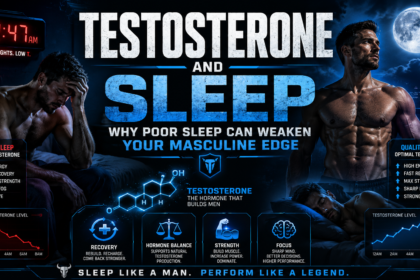
Sleep Like Testosterone Matters
Sleep is one of the first testosterone-supportive habits men should fix.
Not supplements.
Not hacks.
Not extreme routines.
Sleep.
A study in healthy young men found that restricting sleep to five hours per night for one week reduced daytime testosterone levels by 10% to 15%.
That should get a man’s attention.
Poor sleep can weaken energy, mood, libido, training performance, recovery, focus, appetite control, and testosterone-supportive function.
A man cannot sleep like a wreck and expect his hormones to operate like a machine.
Practical sleep standards include:
Set a consistent bedtime.
Avoid late caffeine.
Reduce late-night scrolling.
Keep the room cool and dark.
Get morning light.
Avoid alcohol close to bed.
Watch for snoring or sleep apnea signs.
Sleep apnea is especially important because it can affect oxygen levels, energy, mood, libido, and testosterone. Men who snore heavily, wake tired, have morning headaches, or feel exhausted during the day should consider discussing this with a healthcare professional.
No supplement can outperform a destroyed sleep routine.
Sleep is not weakness.
Sleep is masculine maintenance.
Strength Training for Testosterone
Strength training should be the physical foundation for men who want better testosterone-supportive health.
Lifting builds more than muscle.
It builds discipline.
It supports body composition.
It improves physical confidence.
It strengthens the metabolic engine.
It creates a signal that the body needs to adapt.
The best approach for most men is not random gym chaos.
It is structured training.
Focus on:
Squats
Deadlifts or hip hinges
Rows
Pull-ups or pulldowns
Presses
Loaded carries
Progressive overload
Compound movements
Recovery between sessions
Resistance training can create short-term testosterone responses, but the long-term benefit is bigger than one hormone spike.
The real power is in muscle, insulin sensitivity, body composition, training consistency, recovery, and metabolic health.
A man who lifts regularly tends to carry himself differently.
He moves differently.
He eats differently.
He sleeps with more purpose.
He respects his body more.
Lift like a man who is building armour, not punishing himself.
Lose Excess Belly Fat if Needed
Body composition matters.
Excess body fat, especially abdominal fat, can be linked with lower testosterone and weaker metabolic health. A 2024 review describes obesity and excess body fat as linked to reduced testosterone and explores how weight loss can increase testosterone levels.
This does not mean every man needs to become extremely lean.
Extreme dieting can also damage libido, recovery, mood, and performance.
The goal is healthy body composition.
Not starvation.
Not obsession.
Not punishment.
Action steps include:
Walk daily.
Strength train.
Eat protein.
Reduce ultra-processed food.
Sleep properly.
Reduce alcohol.
Create a sustainable calorie deficit if fat loss is needed.
Belly fat is not just appearance.
It can be a signal of the metabolic environment your hormones are living in.
If that environment is under pressure, the answer is not shame.
The answer is ownership.
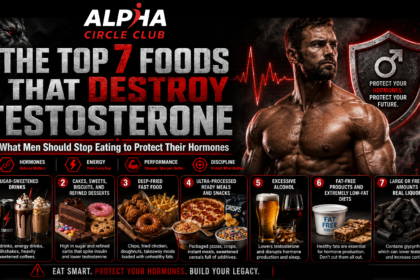
Eat Like Hormones Matter
A man cannot build strong hormones from weak fuel.
Testosterone-supportive nutrition should focus on the full foundation, not magic foods.
A good nutrition base includes:
Protein
Healthy fats
Carbohydrates around training if needed
Zinc-rich foods
Magnesium-rich foods
Vitamin D foods
Omega-3s
Whole foods
Hydration
Useful food examples include:
Eggs
Beef
Lamb
Chicken
Oily fish
Greek yoghurt
Pumpkin seeds
Brazil nuts
Avocado
Olive oil
Potatoes
Rice
Leafy greens
Berries
Beans and lentils
None of these foods should be marketed as miracle testosterone boosters.
Eggs alone will not fix a broken lifestyle.
Steak alone will not fix poor sleep.
Pumpkin seeds alone will not fix heavy alcohol use.
Oily fish alone will not fix chronic stress.
But real food gives the body materials.
Protein supports muscle repair.
Healthy fats support normal hormone production.
Zinc and magnesium support key body processes.
Omega-3s support cell membrane health and inflammation balance.
Carbohydrates can support training performance when used well.
Hydration supports everything.
A man should eat like his hormones matter.
Because they do.
Get Sunlight and Check Vitamin D
Vitamin D is often connected with testosterone, but the evidence is mixed.
That means men need balance.
Vitamin D3 is not a guaranteed testosterone booster.
But low vitamin D may be part of a weak health foundation for some men.
Vitamin D is important for bone health, muscle function, immune function, and general wellbeing. Men who rarely get sunlight, live indoors, have darker skin, cover most of their skin outdoors, or live in low-sunlight climates may be at higher risk of low vitamin D.
Action steps include:
Get sensible sunlight.
Eat oily fish and eggs.
Consider vitamin D testing if exposure is low.
Supplement responsibly if needed.
Avoid mega-dosing.
Vitamin D is not magic.
But a man who never sees sunlight should not ignore it.
The male body was not built to live permanently under artificial light, late-night screens, and indoor stress.
Get outside.
Move.
See daylight.
Build the foundation.
Zinc, Magnesium, and Testosterone
Zinc and magnesium are two minerals that naturally belong in a testosterone-supportive article.
Zinc may matter for testosterone especially when deficiency or low intake is present.
Magnesium may support testosterone indirectly through sleep, recovery, stress regulation, muscle function, and exercise performance.
But the message needs discipline.
Minerals are not shortcuts.
They are building materials.
Zinc and magnesium do not replace the standard.
They support the man who has one.
A man still needs to sleep.
He still needs to lift.
He still needs to eat real food.
He still needs to manage stress.
He still needs to reduce alcohol.
He still needs to test if symptoms persist.
Supplements do not replace discipline.
They support it.
Manage Stress Before It Manages You
Chronic stress can affect sleep, libido, mood, food choices, training recovery, energy, and motivation.
Stress is not always bad.
Training is stress.
Business is stress.
Pressure is stress.
Responsibility is stress.
But chronic stress without recovery can push the body into survival mode.
A man cannot build strong testosterone in a nervous system that never switches off.
Stress control can include:
Walking
Prayer
Breathing
Journaling
Training
Better boundaries
Less scrolling
Time outdoors
Quiet time
Reducing unnecessary chaos
This is not soft.
This is strategic.
A man who cannot control stress will eventually be controlled by it.
Use HIIT Carefully
High intensity interval training can support fitness, fat loss, conditioning, and discipline.
But too much intensity without recovery can worsen fatigue, sleep, libido, motivation, and performance.
This is where many men go wrong.
They turn every workout into war.
They think more sweat means more progress.
They confuse exhaustion with adaptation.
A smarter weekly structure may look like:
Strength training: 3 days per week
HIIT: 1–2 days per week
Walking: daily
Mobility and recovery: as needed
This is not a rigid medical rule.
It is a practical framework.
Train hard enough to grow, not so recklessly that recovery collapses.
The goal is not to destroy yourself.
The goal is to build a body that can handle pressure and recover stronger.
Reduce Alcohol and Stop Smoking
A man should reduce the obvious attackers before chasing advanced solutions.
Alcohol can disrupt sleep, recovery, body composition, libido, mood, and testosterone-supportive habits.
Smoking affects blood flow, fertility, cardiovascular health, and overall male vitality.
This does not mean a man has to live perfectly.
But he has to be honest.
If alcohol is repeatedly damaging sleep, training, mood, libido, relationships, or fertility goals, it is not harmless.
It is taking from him.
A man cannot keep attacking his body and expect his hormones to defend him forever.
Reduce the damage.
Build the system.
Protect the foundation.
Do Not Abuse TRT or Steroids
This is important, especially for men who care about fertility.
TRT may be medically appropriate for some men with confirmed testosterone deficiency, but it should be supervised by a qualified healthcare professional.
Anabolic steroids and poorly managed testosterone use can suppress natural hormone signalling and fertility.
Men who want children should be especially careful.
External testosterone can reduce LH and FSH signalling, which can reduce sperm production. That is why men should not make casual hormone decisions based on ego, panic, or social media pressure.
Do not chase higher testosterone while accidentally shutting down the system that produces sperm.
That is not strength.
That is poor strategy.
A serious man asks better questions before making decisions that affect fertility, hormones, and long-term health.
The Alpha Circle Club Testosterone Foundation Checklist
This is the practical standard.
Not hype.
Not panic.
A foundation.
1. Test, Do Not Guess
Get proper blood work if symptoms persist.
Do not diagnose yourself from one bad week.
2. Protect Sleep
No testosterone foundation survives poor sleep.
Set a standard for bedtime, recovery, and morning energy.
3. Lift Heavy
Strength training builds the body and metabolic engine.
Build armour.
Build discipline.
Build confidence.
4. Walk Daily
Walking supports fat loss, stress control, blood flow, and recovery.
Not every session needs to be brutal.
Some movement should restore you.
5. Eat Like Hormones Matter
Protein.
Minerals.
Healthy fats.
Whole foods.
Hydration.
The body needs materials.
6. Get Sunlight
Support vitamin D, circadian rhythm, mood, and energy.
A man should not live disconnected from daylight.
7. Manage Stress
Control the nervous system.
Walk.
Pray.
Breathe.
Switch off.
Create quiet.
8. Reduce Alcohol
Stop weakening sleep, libido, recovery, body composition, and discipline.
Protect your edge.
9. Protect Fertility
Avoid reckless TRT or steroid use if children may matter.
Think before you interfere with your hormone system.
10. Build for 90 Days
Give the body consistency before judging the result.
The male body responds to repeated standards, not one good week.
What This Article Is Not Saying
This article is not saying you can boost testosterone overnight.
It is not saying supplements cure low testosterone.
It is not saying every tired man has low testosterone.
It is not saying TRT is always bad.
It is not saying TRT is always good.
It is not saying semen retention guarantees high testosterone.
It is not saying one food or mineral fixes hormones.
What this article is saying is this:
Testosterone is supported by a full system.
Testing matters if symptoms persist.
Sleep, strength training, body composition, nutrition, minerals, sunlight, stress control, and recovery all matter.
Medical causes should be evaluated.
Men should avoid reckless hormone use.
That is the balanced position.
Not hype.
Not fear.
Foundation.
Testosterone Responds to the Environment a Man Builds
How to boost testosterone levels in men is not about chasing one hack.
It is about building a lifestyle that supports male hormonal health.
Sleep.
Lift.
Walk.
Eat real food.
Get sunlight.
Manage stress.
Reduce alcohol.
Protect fertility.
Test when needed.
Recover properly.
Testosterone does not respect excuses.
It responds to the environment a man builds.
A serious man does not chase miracle boosters.
He builds the body, habits, and discipline hormones can respect.
Call to Action
Want to build stronger testosterone-supportive habits, better energy, sharper discipline, and long-term male vitality?
Explore more Alpha Circle Club guides built for men who want strength, focus, fertility, and masculine health.


No spam. Unsubscribe anytime.