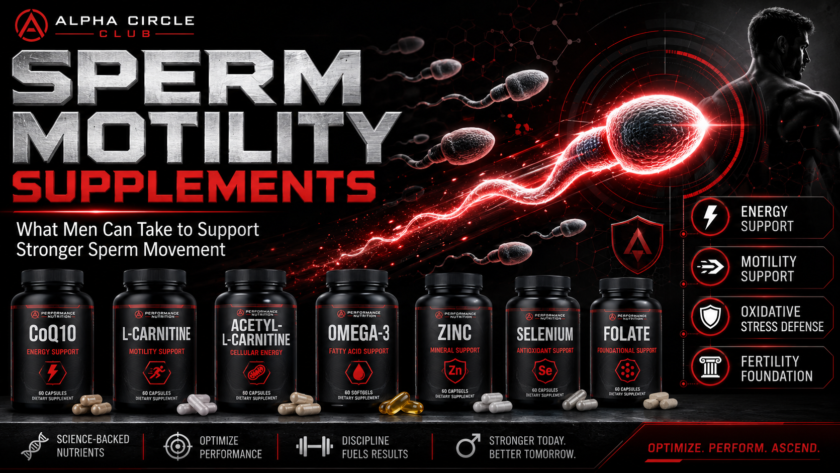
Sperm motility supplements have become a major topic for men who want stronger fertility, better sperm health, and a more powerful semen analysis.
But most men make one mistake.
They focus only on sperm count.
They want to know how many sperm they have.
They want a bigger number.
They want a stronger result.
They want proof that their fertility is moving in the right direction.
But sperm count is only one part of male fertility.
A sperm cell still has to move.
It has to travel.
It has to push forward.
It has to use energy.
It has to survive oxidative stress.
It has to reach the egg.
A man can produce sperm, but if those sperm do not move properly, fertility may still be affected.
That is where sperm motility matters.
Sperm motility is not just a technical term on a lab report.
It is movement.
It is direction.
It is energy.
It is purpose.
And when motility is low, many men start searching for the best supplements for sperm motility, hoping there is one capsule, one powder, or one fertility formula that can fix the problem.
But this subject needs discipline.
Supplements are not magic.
They are not a replacement for a semen analysis.
They are not a shortcut around poor sleep, heavy alcohol, smoking, overheating the testicles, junk food, chronic stress, or ignoring medical advice.
Supplements are support.
The foundation still has to be built.
A sperm cell without movement is like a man without direction — present, but not effective.
What Is Sperm Motility?
Sperm motility refers to how well sperm move.
This matters because sperm need to move through the female reproductive tract to reach the egg. In a semen analysis, motility is one of the key markers used to assess sperm health.
There are different types of sperm movement:
Progressive motility means sperm are moving forward effectively.
Non-progressive motility means sperm are moving, but not travelling forward properly.
Immotile sperm means sperm are not moving.
Progressive motility is especially important because sperm need forward movement to reach the egg.
Sperm count tells you how many are there.
Motility tells you how many are moving with purpose.
That is the difference.
A man can have sperm.
But if too many of them are weak, slow, or directionless, fertility may still be affected.
What Causes Low Sperm Motility?
Low sperm motility can have many possible causes.
It is not always one thing.
It is not always a supplement problem.
It is not always a diet problem.
It is not always a testosterone problem.
Possible causes may include:
Oxidative stress
Heat exposure
Smoking
Heavy alcohol use
Poor diet
Obesity
Varicocele
Infections
Inflammation
Hormone issues
Certain medications
Previous TRT or anabolic steroid use
Poor sleep
High stress
Nutrient deficiencies
Age
Mitochondrial dysfunction
This is why a man should not guess.
Low motility should be measured through a proper semen analysis. If results are abnormal, repeat testing or medical evaluation may be needed, because semen results can vary and underlying causes matter.
A man who wants stronger sperm needs information first.
Guessing creates confusion.
Testing creates direction.
Can Supplements Improve Sperm Motility?
Supplements may improve sperm motility in some men, especially when low antioxidant status, oxidative stress, mitochondrial weakness, inflammation, or nutrient gaps are part of the picture.
But not all supplements work.
Not all products are well studied.
Not every man will respond.
Not every fertility formula is worth the money.
A Cochrane review on antioxidants for male subfertility found that antioxidants may be associated with higher live birth and clinical pregnancy rates. However, when studies with a high risk of bias were removed, there was no evidence of increased live birth, meaning the evidence is promising but not perfect.
That is the balanced truth.
Some ingredients show promise.
Some men may benefit.
But supplements should not be treated like guaranteed fertility fixes.
Supplements can support the mission.
But they cannot replace the man’s standard.
CoQ10 for Sperm Motility
CoQ10 is one of the most popular male fertility supplements, and it belongs in any serious discussion about sperm motility.
CoQ10 is involved in cellular energy production and also acts as an antioxidant.
This matters because sperm need energy to move.
The sperm midpiece contains mitochondria, which help power movement. If sperm movement is the mission, mitochondrial energy matters.
A review on CoQ10, oxidative stress, and male infertility stated that CoQ10’s antioxidant properties and role in mitochondrial bioenergetics help explain its potential effect on male fertility markers, and that evidence suggests CoQ10 mainly improves sperm count and motility in infertile men.
A systematic review also described CoQ10 as one of the more promising molecules for idiopathic male infertility, while noting that randomized controlled trials are still limited and optimal dosage or combinations are not fully established.
Balanced message:
CoQ10 may support sperm motility and semen quality in some men, especially where oxidative stress and mitochondrial energy are relevant, but it should not be treated as a guaranteed fertility fix.
If sperm movement is the mission, mitochondrial energy matters.
CoQ10 belongs in that conversation.
L-Carnitine for Sperm Motility
L-carnitine is one of the strongest candidates for a blog post on supplements to improve sperm motility.
Why?
Because sperm movement is energy-demanding.
L-carnitine helps transport fatty acids into mitochondria, where they can be used for energy production. That makes it highly relevant to sperm movement and sperm energy.
A 2023 review concluded that evidence supports L-carnitine as having a positive impact on male fertility, including sperm parameters, while also noting that more research is needed to clarify mechanisms and optimal doses.
Another review found that L-carnitine and L-acetylcarnitine supplementation improved sperm swimming and production of normal-shaped sperm cells, but did not improve sperm count or pregnancy rates, and the authors noted that the evidence is limited.
That is exactly the balance men need to understand.
L-carnitine may help with sperm movement.
But it is not a magic pregnancy pill.
It is not a guarantee.
It is a support tool.
L-carnitine is not about hype. It is about fuel delivery for cells that need movement.
Zinc for Sperm Motility
Zinc is important for male reproductive health.
It has roles in sperm quality, antioxidant defence, testosterone support, immune function, and semen health.
Zinc may support sperm health, especially when intake is low or deficiency is present. But it should not be mega-dosed recklessly.
Too much zinc can cause side effects and interfere with copper status.
For Alpha Circle Club, the zinc message is simple:
Zinc is not a shortcut.
It is a building material.
A man still has to build.
If a man eats poorly, drinks heavily, sleeps badly, overheats his testes, avoids training, and ignores semen analysis, zinc alone will not rescue the system.
But if zinc intake is low, improving food quality or using supplementation responsibly may help strengthen the fertility foundation.
Selenium for Sperm Motility
Selenium is another important mineral in the male fertility conversation.
It is involved in antioxidant systems, including enzymes that help protect cells from oxidative stress.
Why does this matter?
Because sperm are vulnerable to oxidative damage.
Sperm cells have delicate membranes. They carry DNA. They need energy. They need movement. They need protection.
Selenium is often included in male fertility supplements because of its role in antioxidant defence and sperm structure.
Balanced wording matters:
Selenium may support sperm health when intake is inadequate, but high doses can be harmful. Men should avoid careless supplementation.
More is not always better.
A serious man does not mega-dose because the label sounds masculine.
He uses supplements intelligently.
Vitamin C and Vitamin E for Sperm Motility
Vitamin C and vitamin E are antioxidants.
Vitamin C is water-soluble.
Vitamin E is fat-soluble and helps protect cell membranes.
This matters because sperm membranes are vulnerable to oxidative damage, and oxidative stress is one of the major themes in male fertility research.
A 2016 review reported that antioxidant supplements such as carnitine had positive effects on sperm motility and morphology, while CoQ10 and alpha-tocopherol were linked with improvements in sperm count.
That does not mean vitamins C and E cure low motility.
It means antioxidant defence may matter.
These vitamins may support antioxidant protection, but they work best as part of a full fertility-supportive diet, not as an excuse for poor lifestyle.
A man should not eat junk all day, sleep badly, drink heavily, and think vitamin C will clean up the damage.
Food first.
Foundation first.
Supplements second.
Omega-3 for Sperm Motility
Omega-3 fatty acids are important for cell membrane health and inflammation balance.
Sperm membranes need flexibility and integrity.
That is why omega-3s are often discussed in sperm quality and male fertility.
Food sources include:
Sardines
Salmon
Mackerel
Anchovies
Herring
Omega-3 eggs
Walnuts
Chia seeds
Flaxseed
Omega-3s may support sperm quality as part of a wider nutrition foundation.
But again, they are not magic.
They work best when a man also controls the obvious fertility attackers: poor diet, alcohol overload, smoking, heat exposure, stress, and sleep deprivation.
A sperm cell is built from what a man gives his body.
Poor fuel creates poor output.
Folate, B Vitamins, and Sperm Health
Folate and B vitamins are involved in DNA synthesis, methylation, cell division, and energy metabolism.
Since sperm production involves rapid cell development, these nutrients matter.
But this area needs careful wording.
Some supplement trials involving zinc and folic acid have not shown strong fertility benefits, so men should not assume folate automatically fixes sperm problems.
Better message:
Folate and B vitamins may support sperm development, especially where intake is low, but they are not standalone fertility cures.
A man should think food-first.
Leafy greens.
Eggs.
Meat.
Fish.
Legumes.
Whole foods.
Then consider supplements only where needed, appropriate, and safe.
Vitamin D, Magnesium, and Sperm Motility
Vitamin D, magnesium, and zinc can be discussed as part of the wider male fertility foundation.
Vitamin D supports broader health, immune function, muscle function, and may be relevant to reproductive health.
Magnesium supports energy production, muscle and nerve function, sleep, stress regulation, and vitamin D metabolism.
These are not direct “motility boosters” in every man.
They support the system.
The male fertility system is not built from one nutrient.
It is built from the whole environment a man creates inside his body.
Sleep.
Food.
Minerals.
Sunlight.
Training.
Recovery.
Stress control.
Heat protection.
Testing.
All of it matters.
Best Sperm Motility Supplement Stack?
Many men want a simple answer.
They search for the best sperm motility supplement stack and hope someone will tell them exactly what to take.
But the best stack depends on the man’s actual situation.
Common male fertility supplement formulas may include:
CoQ10
L-carnitine
Acetyl-L-carnitine
Zinc
Selenium
Vitamin C
Vitamin E
Omega-3
Folate
Vitamin D
Magnesium
But the “best” option depends on:
Semen analysis results
Medical history
Diet
Medication use
Lifestyle
Hormone status
Varicocele
Age
Fertility timeline
Partner factors
Professional advice
The best sperm motility supplement is not the one with the loudest label.
It is the one that fits the man’s actual problem.
A man with a varicocele may need medical evaluation.
A man with previous testosterone or steroid use may need hormone testing.
A man with heavy alcohol use may need to stop attacking his fertility.
A man with poor sleep may need to rebuild recovery.
A man with low antioxidant intake may need better nutrition.
A man with abnormal semen results may need repeat testing and professional guidance.
Supplements should match the problem.
They should not be random panic purchases.
The 90-Day Rule for Sperm Motility
This is one of the most important parts of the article.
Sperm changes take time.
The American Society for Reproductive Medicine’s patient education fact sheet says lifestyle changes can take almost three months to show up as an improvement in semen analysis.
That means men need consistency.
Not one-week panic.
Not random supplement hopping.
Not buying ten products and expecting instant results.
Sperm motility is not rebuilt by panic.
It is rebuilt by standards repeated long enough for the body to respond.
Days 1–30: Remove the Damage
The first month is about removing the obvious fertility attackers.
Reduce heavy alcohol.
Stop smoking.
Avoid overheating the testicles.
Reduce ultra-processed food.
Fix sleep chaos.
Stop living like your body is disposable.
Days 31–60: Build the Foundation
The second month is about building.
Eat protein.
Add whole foods.
Increase antioxidants.
Walk daily.
Strength train.
Hydrate.
Sleep properly.
Protect recovery.
Days 61–90: Support and Retest
The third month is about consistency.
Use supplements if appropriate.
Keep the foundation strong.
Track habits.
Discuss repeat semen analysis if needed.
Review progress with a healthcare professional if results are abnormal or fertility concerns continue.
A man who wants stronger sperm cannot operate like a man looking for a quick hack.
He needs a standard.
What This Article Is Not Saying
This article is not saying supplements cure low sperm motility.
It is not saying CoQ10 guarantees pregnancy.
It is not saying L-carnitine fixes every motility problem.
It is not saying low motility is always caused by nutrient deficiency.
It is not saying you can ignore semen analysis and just take supplements.
It is not saying more supplements always mean better sperm.
What this article is saying is this:
Supplements may support sperm motility in some men.
Evidence is promising for some ingredients, especially CoQ10 and carnitine, but not perfect.
Testing matters.
Lifestyle matters.
Medical causes matter.
The 90-day cycle matters.
Men should use supplements wisely.
That is the balanced position.
Not hype.
Not fear.
Foundation.
Suggested Table: Sperm Motility Supplements Guide
| Supplement | Why It May Help | Best For | Important Caution |
|---|---|---|---|
| CoQ10 | Supports mitochondrial energy and antioxidant defence | Men focused on sperm energy and motility support | Not a guaranteed fertility fix |
| L-carnitine | Helps transport fatty acids for energy production | Men focused on sperm movement and motility | Evidence is promising but not perfect |
| Acetyl-L-carnitine | Related to energy metabolism and sperm function | Often paired with L-carnitine | Use responsibly and check suitability |
| Zinc | Supports reproductive health and semen quality | Men with low zinc intake or poor diet | Too much may affect copper |
| Selenium | Supports antioxidant systems | Men with low intake or antioxidant gaps | High doses can be harmful |
| Vitamin C | Water-soluble antioxidant | Antioxidant defence | Best with whole-food nutrition |
| Vitamin E | Fat-soluble antioxidant for membranes | Sperm membrane protection | Avoid excessive dosing |
| Omega-3 | Supports membrane health and inflammation balance | Men with low oily fish intake | Consider medication interactions |
| Folate/B vitamins | Support DNA synthesis and cell division | Men with low intake | Not standalone fertility cures |
| Vitamin D/Magnesium | Support wider health, recovery, and fertility foundation | Men with low levels or poor lifestyle foundation | Test and supplement wisely |
Stronger Sperm Movement Starts With the Foundation
Sperm motility matters because sperm need movement, direction, and energy.
Supplements may help support that system.
CoQ10 may support mitochondrial energy and antioxidant defence.
L-carnitine may support energy metabolism and sperm movement.
Zinc, selenium, vitamins C and E, omega-3s, folate, magnesium, and vitamin D may support the wider fertility foundation.
But supplements are not magic.
They are support tools.
The real foundation is semen analysis, sleep, nutrition, exercise, heat control, stress control, medical evaluation, and 90 days of consistency.
A man who wants stronger sperm should not chase miracles.
He should build the internal environment where sperm can move with strength and direction.
Want to improve sperm health, fertility discipline, and male vitality?
Explore more Alpha Circle Club guides built for men who want stronger sperm, stronger habits, and stronger



No spam. Unsubscribe anytime.