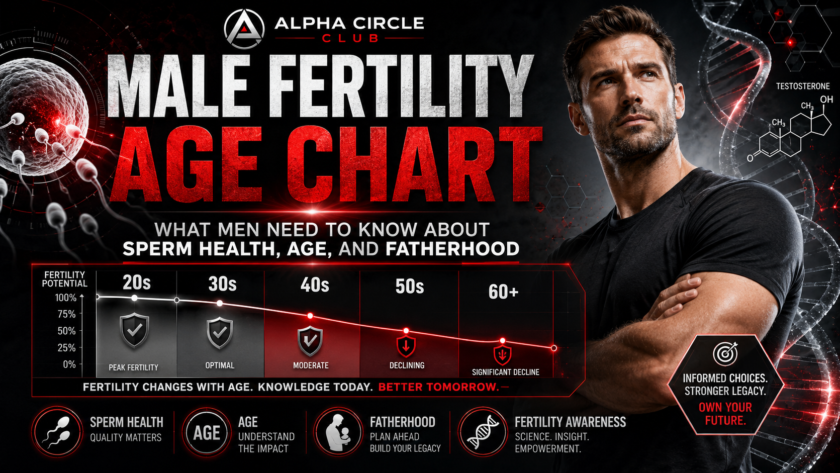
Use this male fertility age chart to understand how sperm health, testosterone, sperm count, motility, morphology, and DNA fragmentation may change as men age — and what men can do to protect fertility.
Many men think fertility is mainly a female issue.
That is one of the biggest mistakes a man can make.
Yes, female fertility has a clear biological timeline. But male fertility is not frozen in time. A man’s sperm health, hormones, semen quality, energy, recovery, and reproductive strength can also change as he gets older.
Understanding a male fertility age chart can help men see how sperm health may change through the 20s, 30s, 40s, and beyond — but the chart should be used as a wake-up call, not a fear sentence.
Because age matters.
But age is not the only thing that matters.
A man’s fertility is influenced by sleep, nutrition, stress, body fat, smoking, vaping, alcohol, heat exposure, training habits, testosterone, medication, environmental toxins, and whether he actually gets tested instead of guessing.
Some men in their 40s have strong fertility markers because they have lived with discipline. Some men in their 20s have poor semen parameters because they have abused their body for years and never realized sperm health was being affected.
That is the truth men need to hear.
Male fertility is not just about age.
It is about ownership.
Quick Answer: Male Fertility Age Chart
This chart gives a simple overview of how male fertility may change with age. It is not a diagnosis. It is a guide.
| Age Range | General Fertility Pattern | Sperm Health Considerations | Action Focus |
|---|---|---|---|
| 20s | Often strong fertility potential | Sperm count, motility, and recovery are often stronger, but poor lifestyle can still damage sperm health | Build strong habits early |
| Early 30s | Usually still strong | Fertility may remain good, but lifestyle damage can start to show | Protect sleep, nutrition, exercise, and hormones |
| Mid-to-late 30s | Gradual changes may begin | Sperm motility, morphology, testosterone, and DNA quality may become more important | Test, track, and improve lifestyle |
| 40s | Fertility is still possible, but risks may rise | Sperm quality and DNA fragmentation become more important considerations | Get a semen analysis and commit to a 90-day reset |
| 50s+ | Fatherhood is still possible for some men | Conception may take longer and sperm quality may be more variable | Medical testing, lifestyle control, and professional guidance |
This chart should not make men panic.
It should make men pay attention.
Some men can father children later in life. But the older a man gets, the more important it becomes to stop relying on confidence, libido, semen volume, or guesswork as signs of fertility.
A man who wants clarity needs testing.
A man who wants stronger fertility potential needs discipline.
What Is Male Fertility?
Male fertility is a man’s ability to contribute healthy sperm that can successfully fertilize an egg and support the possibility of a healthy pregnancy.
But fertility is not measured by one thing alone.
A man can have normal semen volume but weak sperm movement. He can have strong libido but poor sperm quality. He can look fit on the outside but still have fertility issues on the inside.
That is why men need to understand the key markers.
Sperm Count
Sperm count refers to the number of sperm in a semen sample.
A higher sperm count can improve the chances that enough sperm are available to reach and fertilize the egg. But count alone is not everything. A man could have a high sperm count but poor motility or poor sperm quality.
Sperm Concentration
Sperm concentration is the number of sperm per millilitre of semen.
This is one of the standard measurements used in semen analysis. It helps show how dense the sperm population is in the semen sample.
Sperm Motility
Sperm motility refers to how well sperm move.
This matters because sperm are not just passive cells. They need to travel through the female reproductive tract and move effectively toward the egg.
Poor motility can make conception more difficult even if sperm count is reasonable.
Sperm Morphology
Sperm morphology refers to sperm shape and structure.
This includes the head, midpiece, and tail. Shape matters because sperm structure can influence movement and fertilizing ability.
Semen Volume
Semen volume is the amount of fluid released during ejaculation.
Volume is part of the bigger picture, but it does not prove fertility on its own. A man should never assume that a larger semen volume automatically means stronger fertility.
Sperm DNA Fragmentation
Sperm DNA fragmentation refers to damage or breaks in the DNA carried by sperm.
This is a deeper marker of sperm quality. A standard semen analysis may show count, motility, morphology, and volume, but DNA fragmentation may require a separate test.
This is especially important for men who are older, couples dealing with repeated pregnancy loss, unexplained infertility, or fertility treatment failure.
The key lesson is simple:
A man should not judge fertility by confidence, libido, erection quality, or semen volume alone.
Fertility is measured through testing.
Does Male Fertility Decline With Age?
Male fertility can decline with age, but not in the same way as female fertility.
Women are born with a limited number of eggs, and fertility decline is more sharply connected to egg quantity and quality over time. Men can often continue producing sperm throughout life, but sperm production does not mean sperm quality always stays the same.
As men age, research has linked advanced paternal age with possible changes in semen parameters, reproductive outcomes, and sperm DNA quality.
Age may affect:
Semen volume
Sperm motility
Sperm morphology
Sperm DNA fragmentation
Hormone levels
Oxidative stress
Time to pregnancy
Pregnancy outcomes
Overall reproductive efficiency
But this must be understood carefully.
Age is a factor.
It is not the only factor.
A disciplined 42-year-old man with strong sleep, good nutrition, regular training, healthy body composition, no smoking, controlled alcohol, and a proactive testing mindset may have better fertility markers than a 29-year-old man who smokes, drinks heavily, sleeps poorly, overheats his testicles, lives on ultra-processed food, and never exercises.
A man’s age is written on his birth certificate.
His fertility age may be written in his habits.
Male Fertility in Your 20s: The Foundation Years
For many men, the 20s can be a strong fertility decade.
Sperm production is often active, recovery is often better, testosterone may be stronger, and many men have more biological resilience.
But this is also the decade where men can quietly damage their future.
Because the body does not always send a loud warning signal when fertility is being affected.
A man can feel normal, look normal, train normally, and still be harming his sperm health through repeated bad habits.
Common fertility-damaging patterns in the 20s include:
Poor sleep
Heavy alcohol
Smoking
Vaping
Recreational drug use
Excessive heat exposure
Poor diet
High stress
Sedentary living
Overtraining
Anabolic steroid abuse
Careless testosterone use
Ignoring testicular pain or swelling
Never getting checked when something feels wrong
Your 20s are not just your peak years.
They are your foundation years.
The habits you build here can either protect your future fertility or quietly weaken it.
Fertility Protection Checklist for Men in Their 20s
Sleep 7–9 hours consistently.
Train hard, but recover properly.
Avoid smoking and vaping.
Limit alcohol.
Eat protein-rich, nutrient-dense foods.
Protect your testicles from unnecessary heat.
Do not abuse steroids or testosterone.
Stay active and avoid becoming sedentary.
Do not ignore testicular pain, swelling, or changes.
Get tested if you are trying to conceive and struggling.
A man in his 20s should not live like fertility is guaranteed forever.
He should build the body, habits, and discipline that protect his future options.
Male Fertility in Your 30s: The Responsibility Decade
A man’s 30s are often still a strong fertility decade.
Many men father children naturally in their 30s. But this is also the decade where lifestyle begins to show its receipts.
Career pressure increases.
Stress increases.
Sleep often gets worse.
Body fat may creep up.
Training may become less consistent.
Alcohol habits may continue.
Testosterone symptoms may start appearing.
A man may still feel young, but his body may be asking for more discipline.
This is the decade where a man must stop living casually with his health.
Your 30s are where discipline starts showing its results.
The man who trains, sleeps, eats well, manages stress, protects his hormones, and takes fertility seriously is building a stronger foundation than the man who ignores his health until there is a problem.
What Men in Their 30s Should Focus On
If you are in your 30s and thinking about fatherhood now or in the future, your focus should be simple:
Protect sleep.
Improve body composition.
Lift weights consistently.
Walk daily.
Eat fertility-supportive foods.
Avoid overheating the testicles.
Reduce heavy alcohol.
Stop smoking or vaping.
Check testosterone if symptoms appear.
Get a semen analysis if trying to conceive and struggling.
Build a serious nutritional foundation.
Do not assume libido equals fertility.
This is also the decade where many men begin to understand that fertility is not just a bedroom issue.
It is a whole-body health issue.
A man’s sperm health can reflect his metabolism, inflammation, hormones, oxidative stress, stress load, and lifestyle.
That is why men in their 30s should take action before they are forced to.
Male Fertility After 35: Why Men Should Start Paying Attention
35 is not a panic point.
It is an awareness point.
For men, fertility does not usually fall off a cliff at 35. But the mid-to-late 30s can be a smart time to start paying closer attention to sperm health, hormones, and long-term reproductive planning.
This matters especially if:
You want children in the future.
You and your partner have been trying without success.
You have a history of smoking, vaping, heavy drinking, steroid use, or TRT.
You have low libido, fatigue, erectile issues, or symptoms of low testosterone.
You have had testicular injury, infection, surgery, or varicocele.
You are overweight or metabolically unhealthy.
You have never tested your fertility before.
After 35, a man should become more serious about tracking.
Not fearful.
Serious.
What May Become More Important After 35
Sperm motility may matter more.
Sperm morphology may matter more.
DNA fragmentation may become more relevant.
Testosterone and hormone balance may deserve attention.
Recovery and sleep quality become more important.
Body fat becomes harder to ignore.
Stress management becomes essential.
A semen analysis becomes a smart move, not an embarrassing one.
The strongest men do not guess.
They gather information.
Male Fertility in Your 40s: Still Possible, But Testing Matters
Many men can still father children in their 40s.
But fertility should not be taken for granted.
This is the decade where a man needs to stop using pride as a strategy.
You cannot look at yourself in the mirror and know your sperm count.
You cannot judge sperm motility by your confidence.
You cannot know DNA fragmentation from libido.
You cannot assume fertility is strong because semen volume looks normal.
Men in their 40s should not guess.
They should test.
Why Fertility Testing Matters More in Your 40s
In your 40s, sperm quality can become more variable. Some men remain strong. Others may see changes in semen parameters, hormone levels, or DNA quality.
This does not mean fatherhood is impossible.
It means clarity becomes more important.
A semen analysis can help assess:
Sperm count
Sperm concentration
Motility
Morphology
Semen volume
Other semen characteristics
Depending on your situation, a fertility specialist may also discuss:
Sperm DNA fragmentation testing
Hormone testing
Varicocele evaluation
Medical history
Lifestyle factors
Medication review
Partner factors
This is not about shame.
This is about leadership.
If a couple is struggling to conceive, the man should not sit back while the woman carries the full testing burden.
A man should step forward and get assessed too.
Tests Men Over 40 Should Consider Discussing
Semen analysis
Repeat semen analysis if results are abnormal
Total testosterone
Free testosterone where appropriate
LH
FSH
Prolactin
Thyroid markers
Vitamin D
Blood sugar markers
Inflammation and metabolic health markers
Sperm DNA fragmentation test if recommended
Varicocele assessment if symptoms or abnormal results suggest it
A semen analysis is not an attack on your masculinity.
It is information.
And disciplined men use information.
Male Fertility After 50: Fatherhood, Health, and Responsibility
Fatherhood after 50 is possible for some men.
But it should be approached with awareness, maturity, and responsibility.
At this stage, fertility is not just about whether a man can biologically father a child. It is also about his health, energy, long-term responsibility, and ability to lead as a father.
Older fatherhood can bring deeper maturity, financial stability, patience, and life experience.
But it can also bring extra considerations.
Conception may take longer.
Sperm quality may be more variable.
DNA fragmentation may become more relevant.
Medical guidance becomes more important.
General health becomes a bigger factor.
Energy, recovery, and long-term fatherhood responsibility matter.
Older fatherhood is not just a fertility question.
It is a health, leadership, and responsibility question.
A man over 50 who wants to become a father should take his health seriously, get proper testing, and work with qualified professionals rather than relying on guesswork or ego.
The 5 Male Fertility Markers That Matter Most With Age
A basic male fertility age chart is helpful, but it is not enough.
To understand fertility properly, men need to understand the markers behind the chart.
1. Sperm Count
Sperm count matters because conception requires enough sperm to give the body a realistic chance.
But count alone does not tell the whole story.
A man can have a decent sperm count but poor motility. He can have numbers that look acceptable but still have issues with DNA integrity or morphology.
Sperm count is important.
It is not the whole system.
2. Sperm Motility
Motility is movement.
Sperm need to move effectively to reach the egg. Weak movement can reduce the chance of natural conception.
Motility may be affected by oxidative stress, heat exposure, inflammation, lifestyle factors, illness, and other health issues.
For men trying to improve fertility, motility should be taken seriously.
3. Sperm Morphology
Morphology refers to sperm shape.
A sperm cell has a head, midpiece, and tail. Abnormalities in shape may affect movement and function.
Morphology can be a confusing area because fertility can still happen even when morphology is not perfect. But it remains one of the standard markers used in semen analysis.
The key is not to panic over one number.
The key is to look at the full picture with a qualified professional.
4. Semen Volume
Semen volume is often what men notice most.
But it is not the same as fertility.
A man can produce a large volume of semen and still have poor sperm concentration, motility, or morphology. Another man may have lower volume but stronger sperm markers.
Volume matters, but it should never be treated as proof.
5. Sperm DNA Fragmentation
DNA fragmentation is one of the deeper fertility markers.
It refers to damage in the DNA carried by sperm. This can matter because sperm are not just trying to reach an egg. They carry genetic information.
DNA fragmentation may be influenced by age, oxidative stress, heat, smoking, inflammation, illness, and other factors.
This is not always tested in a basic semen analysis, but it may be worth discussing with a specialist in certain situations, especially with advanced paternal age, repeated pregnancy loss, unexplained infertility, or failed fertility treatments.
The Alpha Circle Club rule is simple:
Do not judge fertility by surface signs.
Test what matters.
Age Matters, But Lifestyle Can Age Your Fertility Faster
This is where men need to wake up.
Age matters, but lifestyle can accelerate the damage.
A 28-year-old man can live in a way that weakens his fertility.
A 42-year-old man can live in a way that protects his fertility.
The calendar matters.
But conduct matters too.
Lifestyle Factors That Can Harm Male Fertility
Smoking
Vaping
Heavy alcohol use
Poor sleep
Obesity
High stress
Heat exposure
Poor nutrition
Low micronutrient intake
Sedentary lifestyle
Anabolic steroid use
TRT without fertility guidance
Environmental toxin exposure
Chronic illness
Certain medications
Untreated varicocele
Ignoring testicular symptoms
Poor metabolic health
The danger is that many of these factors do not instantly feel dramatic.
A man may not feel his sperm quality dropping.
He may not feel oxidative stress building.
He may not notice motility worsening.
He may not know his hormones are shifting.
That is why awareness matters.
A man who wants to protect his fertility must live with intention before the problem becomes obvious.
Testosterone, TRT, and Male Fertility: The Warning Men Must Understand
Testosterone matters for male health.
But men need to understand something clearly:
More testosterone does not automatically mean better fertility.
In fact, external testosterone or TRT can reduce sperm production in some men because it can suppress the hormonal signals that tell the testicles to produce sperm.
This is one of the most important warnings for men who care about future fatherhood.
A man may take testosterone because he wants more energy, better libido, more muscle, or stronger confidence. But if fertility is important, he should speak to a qualified doctor before making decisions.
This is especially important for men who are:
Trying to conceive now
Planning children in the future
Using anabolic steroids
Considering TRT
Already on TRT
Dealing with low sperm count
Dealing with testicular shrinkage
Experiencing low fertility markers
The Alpha Circle Club message is not anti-testosterone.
It is pro-wisdom.
A man should not gamble with his fertility because he wanted a shortcut.
Get tested.
Get professional advice.
Understand the consequences before making hormone decisions.
The 90-Day Male Fertility Reset
Sperm health does not usually change overnight.
That is why men should think in 90-day blocks.
A 90-day fertility reset gives a man a serious window to upgrade his habits, reduce damage, improve his health foundation, and then retest.
This is not magic.
This is discipline.
Phase 1: Remove the Damage
Before a man tries to add supplements, hacks, powders, or advanced strategies, he needs to remove the obvious damage.
Stop smoking.
Stop vaping.
Reduce alcohol.
Avoid recreational drugs.
Avoid overheating the testicles.
Stop using laptops directly on the lap.
Reduce hot baths, saunas, or heat exposure if trying to improve sperm health.
Improve sleep.
Cut down ultra-processed foods.
Stop guessing and get tested.
A man cannot build strong fertility habits while actively attacking his own system.
Remove the damage first.
Phase 2: Build the Foundation
Once the damage is reduced, build the foundation.
This means:
Resistance training
Daily walking
Protein-rich meals
Healthy fats
Fertility-supportive foods
Hydration
Sunlight
Stress control
Consistent sleep
Better body composition
Reduced inflammation
Improved metabolic health
This is where men often overcomplicate things.
They want the secret supplement before they have mastered sleep.
They want the perfect fertility food before they stop smoking.
They want the advanced biohack before they stop drinking heavily every weekend.
The foundation wins.
Phase 3: Strengthen the System
After the basics are in place, a man can strengthen the system.
This may include:
Targeted supplements if appropriate
Follow-up semen analysis
Hormone testing if symptoms suggest it
Medical support if needed
Varicocele evaluation if relevant
Better training structure
Stress management routines
Long-term consistency
The 90-day reset is not about panic.
It is about becoming the kind of man whose body is prepared for fatherhood.
Best Foods for Male Fertility as Men Age
Food will not magically reverse every fertility issue.
But food matters.
A man’s sperm production depends on nutrients, energy, antioxidants, minerals, healthy fats, and overall metabolic health.
A fertility-supportive diet should focus on real food, not fake health marketing.
Fertility-Supportive Foods for Men
Eggs
Oysters
Salmon
Sardines
Mackerel
Pumpkin seeds
Walnuts
Brazil nuts
Leafy greens
Berries
Citrus fruits
Avocado
Extra virgin olive oil
Lentils
Beans
Greek yogurt
Kefir
Beef or lamb where appropriate
Pomegranate
Sweet potatoes
Garlic
Dark chocolate in moderation
The goal is not to eat one magic food.
The goal is to build a nutrient-rich pattern.
A strong male fertility diet should support:
Zinc intake
Omega-3 intake
Antioxidant intake
Healthy fats
Protein
Folate
Magnesium
Vitamin D status
Blood sugar control
Healthy body composition
Food supports the foundation.
But food is not a replacement for testing, sleep, training, or medical care.
Supplements and Male Fertility Age
Supplements can be useful.
But they are not the foundation.
A man who sleeps 5 hours, drinks heavily, smokes, never exercises, and eats badly should not expect a supplement to rescue his fertility.
Supplements should support discipline, not replace it.
Common nutrients and compounds often discussed in male fertility include:
Zinc
Folate
Vitamin C
Vitamin E
Vitamin D
Omega-3
CoQ10
L-carnitine
Magnesium
Some men may benefit from targeted support, especially if they have deficiencies or specific needs.
But men should be careful.
More is not always better.
Supplements can interact with medication.
Quality matters.
Dosage matters.
Medical history matters.
If a man is dealing with fertility problems, taking medication, using hormones, or trying to conceive, he should speak with a qualified healthcare professional before building an aggressive supplement stack.
The Alpha Circle Club standard is simple:
Supplements may support.
Discipline builds the foundation.
Testing gives clarity.
Medical guidance protects you from reckless decisions.
When Should a Man Get a Semen Analysis?
A man should get a semen analysis when he needs clarity.
Not when his pride finally allows it.
A semen analysis is one of the most important starting points for male fertility testing. It can assess key semen parameters such as sperm count, motility, morphology, and semen volume.
A man should consider a semen analysis if:
He and his partner have been trying to conceive without success.
He is over 35 and wants a baseline.
He is over 40 and planning fatherhood.
He has a history of steroid use.
He has used or is considering TRT.
He has low libido, erectile issues, fatigue, or hormonal symptoms.
He has had testicular injury, surgery, infection, or pain.
He has a known or suspected varicocele.
He smokes, vapes, drinks heavily, or has major lifestyle risk factors.
He wants to check fertility before trying for a baby.
He has had abnormal semen results before.
He wants to measure improvement after a 90-day lifestyle reset.
If the results are abnormal, one test is not always the final answer. Semen parameters can vary. A repeat test may be recommended, often after a period of time.
The key is to stop guessing.
A semen analysis is not weakness.
It is leadership.
Common Myths About Male Fertility and Age
Myth 1: Men Stay Equally Fertile Forever
Men may continue producing sperm throughout life, but sperm quality can change with age.
Fertility is not just about whether sperm exists.
It is about quality, movement, structure, DNA integrity, hormones, and the ability to support conception.
Myth 2: If a Man Has Strong Libido, His Fertility Is Fine
Libido and fertility are not the same thing.
A man can have strong sex drive and still have poor sperm count, poor motility, poor morphology, or other fertility issues.
Sexual performance does not automatically prove sperm quality.
Myth 3: Semen Volume Proves Fertility
Semen volume is only one marker.
A larger volume does not guarantee strong sperm concentration, movement, or DNA quality.
Men should not use visual inspection as a fertility test.
Myth 4: Only Women Need to Worry About Age
Female age is extremely important in fertility, but male age can also matter.
A serious fertility conversation includes both partners.
Men should not hide behind the idea that fertility is only a woman’s responsibility.
Myth 5: Supplements Can Fix Everything
Supplements can support fertility health in some cases, but they cannot replace sleep, nutrition, training, stress control, testing, and medical support.
A man who wants real results must build the foundation.
Myth 6: TRT Always Improves Male Fertility
TRT may help some men with medically diagnosed low testosterone, but external testosterone can suppress sperm production in some men.
Men who want children should never approach TRT casually.
Fertility must be part of the conversation.
The Alpha Circle Club Male Fertility Age Action Plan
A male fertility age chart is useful.
But a chart is not enough.
A man needs action.
For Men in Their 20s
Build the foundation.
Do not damage your fertility through reckless habits.
Sleep properly.
Train with discipline.
Eat real food.
Avoid smoking and vaping.
Do not abuse steroids or testosterone.
Take testicular health seriously.
Your future self is watching what you do now.
For Men in Their 30s
Protect your system.
Take sleep, stress, testosterone, and nutrition seriously.
Do not let career pressure destroy your health.
Do not let body fat creep up unchecked.
Do not assume fertility will always be strong because you still feel young.
This is the decade where discipline starts separating men.
For Men 35+
Start tracking.
Consider a semen analysis if you want clarity.
Pay attention to sperm health, testosterone symptoms, stress, sleep, and body composition.
This is not the decade to live blindly.
35 is not a panic point.
It is an awareness point.
For Men 40+
Do not guess.
Test, improve, retest, and seek guidance where needed.
Protect sleep.
Reduce alcohol.
Remove heat stress.
Improve nutrition.
Train intelligently.
Discuss DNA fragmentation testing if appropriate.
Understand that fatherhood is still possible for many men, but fertility should not be taken for granted.
For Men 50+
Think beyond biology.
Think fertility, health, energy, responsibility, and long-term fatherhood.
Get proper testing.
Work with professionals.
Strengthen your body.
Protect your mind.
Approach fatherhood with wisdom, not ego.
Age is one factor.
Discipline is another.
You cannot control when you were born, but you can control how seriously you protect your body from this point forward.
FAQ: Male Fertility Age Chart
Is male fertility highest in the 20s?
Many men have strong fertility potential in their 20s, but this does not mean every man in his 20s is fertile or healthy. Lifestyle, illness, hormones, genetics, smoking, vaping, alcohol, heat exposure, and other factors can affect sperm health at any age.
Does male fertility decline after 35?
Male fertility does not usually fall off a cliff at 35, but the mid-to-late 30s can be a smart time for men to pay closer attention. Sperm quality, motility, morphology, hormones, and DNA fragmentation may become more important as men age.
Can a man have a baby after 40?
Yes, many men can father children after 40. However, fertility can become more variable, and testing becomes more important. Men over 40 should consider semen analysis and proper medical guidance if planning fatherhood.
Can sperm quality improve with lifestyle changes?
In some cases, lifestyle changes may support healthier sperm parameters, especially when men improve sleep, nutrition, exercise, body composition, heat exposure, smoking, alcohol intake, and stress. A 90-day improvement window is often useful because sperm development takes time.
What is the best test for male fertility?
A semen analysis is usually the starting point. It can assess sperm count, sperm concentration, motility, morphology, and semen volume. Some men may also need hormone testing, medical evaluation, or sperm DNA fragmentation testing depending on their situation.
Does testosterone affect male fertility?
Yes. Testosterone is important for male health, but external testosterone or TRT can suppress sperm production in some men. Men who want children should discuss fertility preservation and hormone options with a qualified medical professional before using testosterone.
How often should men retest sperm health?
If a semen analysis is abnormal or a man is making lifestyle changes, a repeat test may be recommended after a period of time, often around three months. Men should follow professional medical advice based on their situation.
Can poor sleep affect male fertility?
Poor sleep can affect hormones, recovery, stress, energy, metabolism, and overall health. Since fertility is connected to whole-body health, sleep should be treated as a serious part of a male fertility plan.
Does semen volume prove fertility?
No. Semen volume does not prove fertility. A man needs proper semen testing to assess sperm count, movement, shape, and other markers.
Should men over 40 test sperm DNA fragmentation?
Not every man needs this test, but men over 40, couples with unexplained infertility, repeated pregnancy loss, or failed fertility treatment may want to discuss sperm DNA fragmentation testing with a fertility specialist.
Conclusion: Use the Chart as a Wake-Up Call, Not a Fear Sentence
A male fertility age chart can show a general pattern.
But it cannot define your future.
Age matters, but it is not the only factor.
Lifestyle matters.
Testing matters.
Sleep matters.
Nutrition matters.
Hormones matter.
Heat exposure matters.
Smoking, vaping, alcohol, stress, and body composition matter.
And discipline matters.
The strongest thing a man can do is stop guessing.
If you want children now or in the future, take ownership. Get tested when needed. Build a 90-day fertility reset. Improve your health foundation. Protect your hormones. Strengthen your body. Stop living like fertility is guaranteed.
This is not about fear.
This is about responsibility.
A male fertility age chart can show you the pattern, but it cannot define your future. The real question is not just how old you are.
The real question is how seriously you are willing to protect your health, your fertility, and your future fatherhood.
Call to Action
Want more practical guides on male fertility, testosterone, sperm health, and disciplined men’s health?
Join the Alpha Circle Club newsletter and start building the habits that support stronger health, sharper focus, and future fatherhood.



No spam. Unsubscribe anytime.