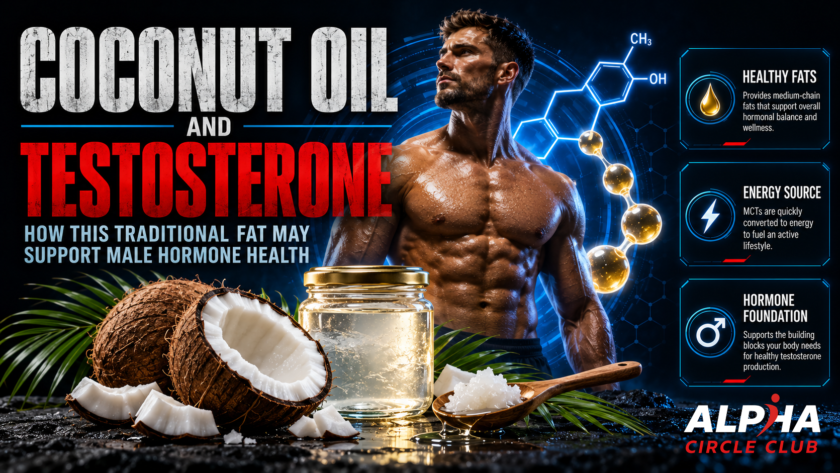
The Potential Benefits, Emerging Evidence and Smartest Ways for Men to Use Coconut Oil
Core message:
Coconut oil may support the nutritional environment required for healthy testosterone production by contributing dietary fat, energy and useful fatty acids. Early experimental research is encouraging, but men should view coconut oil as a supportive food—not a guaranteed testosterone treatment.
Important note
This article is educational and does not replace individual medical advice. Coconut oil cannot diagnose or treat testosterone deficiency. Men with persistent symptoms should speak with a qualified healthcare professional.
Introduction: Coconut Oil Deserves a Fairer Conversation
Coconut oil has become one of the most debated foods in men’s health.
One side presents it as a miracle fat capable of raising testosterone, accelerating metabolism, increasing energy and transforming male fertility. The other side focuses almost entirely on saturated fat and treats coconut oil as though it has no useful place in a health-conscious diet.
Neither extreme gives men the complete picture.
Coconut oil is not testosterone medication. There is not yet strong human evidence showing that a daily spoonful produces a reliable, clinically meaningful increase in testosterone. That boundary matters.
But a lack of direct proof does not mean coconut oil has nothing positive to offer.
Testosterone production takes place inside a much larger biological environment. The body needs sufficient energy, adequate dietary fat, functioning testes, healthy hormonal signals, appropriate micronutrients, sleep and recovery. Coconut oil can contribute to some of those nutritional foundations. It supplies energy, provides a concentrated source of fat, contains fatty acids that are metabolised differently from many longer-chain fats and may help men create satisfying meals that support consistent eating.
There is also encouraging experimental research. Animal studies have reported protective effects of virgin coconut oil in models of chemically or alcohol-induced testicular injury, oxidative stress and reproductive damage. Some have observed improvements in testosterone or sperm-related measures within those specialised models.
These findings are not proof of the same benefit in healthy men. They are, however, a legitimate reason for scientific interest rather than dismissal.
Research on total dietary fat gives another reason for a balanced view. A 2021 systematic review of intervention studies reported lower testosterone on lower-fat diets than higher-fat diets, although the evidence base was small and later research has produced less certain results. This does not make coconut oil uniquely powerful, but it supports the broader principle that male hormonal health should not be built on unnecessary dietary-fat restriction.
The strongest position is therefore positive and disciplined:
- Coconut oil can be part of a testosterone-supportive diet.
- It may help men meet energy and dietary-fat needs.
- Its fatty-acid profile makes it a distinctive cooking fat.
- Virgin coconut oil contains minor bioactive compounds of scientific interest.
- Preclinical reproductive research is encouraging.
- It has not yet been proved to raise testosterone directly in men.
- Quantity, overall diet and cardiovascular health still matter.
This article will explore coconut oil and testosterone without hype and without unnecessary fear. The objective is not to turn one food into the answer. It is to understand how that food may contribute intelligently to the whole system.
Coconut oil does not need to be a miracle to be useful. Its value becomes clearer when it is given the right role.
Coconut Oil and Testosterone: The Positive Potential at a Glance
| Potential benefit | Why it may matter to male hormone health | Evidence position |
|---|---|---|
| Provides dietary fat | Fat is part of normal nutrition and supplies material used throughout hormone physiology | Established nutritional role; not unique to coconut oil |
| Provides concentrated energy | Adequate energy availability supports training, recovery and normal body function | Useful when it helps meet genuine needs |
| Contains lauric, caprylic and capric acids | These give coconut oil a distinctive fatty-acid profile | Established composition; direct testosterone effect unproved |
| Can improve meal enjoyment | A satisfying, sustainable diet may be easier to maintain than a highly restrictive one | Practical indirect benefit |
| Helps cook nutritious foods | A measured amount can make eggs, vegetables, curries and other whole-food meals more appealing | Useful dietary application |
| May aid absorption of fat-soluble nutrients in a meal | Dietary fat supports absorption of vitamins A, D, E and K | General benefit of fat, not exclusive to coconut oil |
| Shows testicular-protective effects in some animal models | Experimental studies suggest possible antioxidant or tissue-protective actions under induced stress | Encouraging preclinical evidence; human confirmation needed |
| May compare favourably with butter in some contexts | A short human trial found a more favourable LDL response to coconut oil than butter | Relevant to substitution, not proof of testosterone benefit |
Alpha Insight
The intelligent question is not whether coconut oil performs miracles. It is how its genuine strengths can support a complete male-health strategy.
1. Testosterone Needs a Nutritional Foundation
Testosterone is a powerful hormone, but its production does not occur separately from the rest of the body.
In men, most testosterone is produced by Leydig cells in the testes. The brain and pituitary gland regulate this process through hormonal signals. The hypothalamus releases gonadotrophin-releasing hormone, the pituitary releases luteinising hormone, and luteinising hormone stimulates testosterone production in the testes.
The Society for Endocrinology explains that testosterone is tightly regulated through this feedback system. It contributes to sperm production, libido, muscle and bone maintenance, and red-blood-cell production. Society for Endocrinology: Testosterone
This system requires more than one nutrient, but it still requires nutrition.
A man who continually under-eats, removes entire food groups without reason or tries to remain extremely lean through chronic restriction may not provide the best environment for training, recovery or hormonal health. Dietary fat contributes energy, essential fatty acids and the absorption of fat-soluble vitamins. It also helps make meals satisfying.
Coconut oil can support this foundation when it is used with purpose.
For example, it may help:
- Increase the energy content of a meal for a highly active man
- Prevent an unnecessarily low-fat diet
- Make nutritious meals more satisfying
- Provide a practical cooking fat for particular dishes
- Support consistency when its flavour makes whole-food meals more enjoyable
These are indirect benefits, but indirect does not mean unimportant.
Hormonal health is often influenced by the combined effect of ordinary behaviours: eating sufficiently, sleeping consistently, training intelligently and maintaining a suitable body composition. Coconut oil can contribute to that system without needing to act like a drug.
The mistake is not using coconut oil.
The mistake is expecting coconut oil to compensate for a weak foundation.
Alpha Insight
A supportive food becomes more valuable when it is placed inside a disciplined system of sleep, nutrition, training and recovery.
2. Coconut Oil Provides More Than Empty Hype
Coconut oil is extracted from coconut flesh and is composed almost entirely of fat. It contains a distinctive mixture of fatty acids, including:
- Lauric acid
- Myristic acid
- Palmitic acid
- Caprylic acid
- Capric acid
- Smaller amounts of unsaturated fatty acids
Much of the oil is saturated fat, which makes it relatively solid at cooler room temperatures and gives it practical culinary properties.
Its positive value begins with several simple realities.
It is a concentrated source of energy
Men who train hard, perform physical work or struggle to eat enough may benefit from energy-dense foods. A measured amount of coconut oil can increase the energy content of a meal without greatly increasing its volume.
This does not mean every man needs more calories. For someone deliberately losing excess body fat, uncontrolled additions may work against the goal. The benefit depends on need.
It can make whole-food meals easier to enjoy
A health plan that tastes like punishment rarely survives. Coconut oil works naturally in curries, eggs, roasted vegetables, certain shakes, baking and dishes using coconut milk or warming spices.
If a small amount helps a man eat a balanced meal instead of reaching for ultra-processed food, its value is larger than the oil alone.
It supports the absorption of fat-soluble nutrients
Vitamins A, D, E and K require dietary fat for normal absorption. Coconut oil is not the only fat that can perform this role, but it can contribute when eaten with foods containing these nutrients.
It provides a mixture of fatty acids
Coconut oil includes caprylic and capric acids, which are metabolised more rapidly than many long-chain fatty acids. Lauric acid is the dominant fatty acid and behaves less like the shorter fatty acids concentrated in commercial MCT oil, but the overall profile remains distinctive.
Virgin coconut oil contains minor plant compounds
Less-refined coconut oils can retain phenolic compounds and other minor constituents that are studied for antioxidant activity. The quantities and biological effects vary, and this should not be converted into a guaranteed hormone claim. It does, however, help explain scientific interest in virgin coconut oil beyond calories alone.
Alpha Insight
Coconut oil has real nutritional and culinary qualities. Honest limits do not erase genuine value.
3. The Cholesterol Connection Is Relevant—but Not Automatic
Testosterone is a steroid hormone, and cholesterol is involved in steroid-hormone production. This biological connection is one reason dietary fats have attracted attention in testosterone research.
It is reasonable to recognise that the body needs raw materials and adequate energy to produce hormones normally.
It is also reasonable to avoid diets so restrictive that they remove useful foods, undermine recovery or leave a man chronically under-fuelled.
However, the cholesterol connection should be understood accurately.
Consuming more coconut oil does not force the testes to produce more testosterone. The body tightly regulates cholesterol and testosterone. Hormonal signals, testicular function, enzymes, illness, body composition, age, medicines and energy status all matter.
A useful analogy is construction.
Cholesterol is one type of building material. Testosterone production also requires the instructions, transport system, workers and functioning site. More material only helps when material availability is genuinely limiting.
The positive lesson is therefore not “eat unlimited saturated fat”.
It is:
Do not fear all dietary fat when building a nutritionally complete plan for male health.
Coconut oil can be one of several fat sources. It may sit alongside olive oil, rapeseed oil, nuts, seeds, eggs, avocado, dairy foods and oily fish according to the man’s preferences, health and energy requirements.
Variety prevents one food from carrying the entire strategy.
Alpha Insight
The body needs nutritional building materials, but intelligent men supply them through balance rather than excess.
4. Research Suggests Dietary Fat May Matter for Testosterone
The relationship between dietary fat and testosterone is still being investigated, but there are encouraging reasons not to drive fat intake unnecessarily low.
A 2021 systematic review and meta-analysis examined six intervention studies involving 206 men. It reported that low-fat diets were associated with reductions in total testosterone, free testosterone, urinary testosterone and dihydrotestosterone compared with higher-fat diets. The authors stated that more randomised controlled trials were needed to confirm the findings. PubMed: Low-fat diets and testosterone in men
For men, the practical message is important:
Adequate dietary fat may be part of protecting a healthy hormonal environment.
This does not prove that coconut oil is better than every other fat. The studies investigated broader dietary patterns rather than coconut oil alone. It does mean that the old idea that men should simply remove as much fat as possible is not automatically wise.
Later research has made the picture more complex. A 2025 meta-analysis of randomised trials reported no significant overall testosterone difference between lower-fat and higher-fat diets. Journal of Food Science: Low-fat and high-fat diets and sex hormones
These two analyses should not be treated as enemies. Together, they tell us:
- The research base is still limited.
- Total diet matters more than one macronutrient slogan.
- Men do not need to fear reasonable amounts of dietary fat.
- More fat is not always better.
- Fat quality and total energy also matter.
- Coconut oil may contribute, but it has not been isolated as a direct testosterone booster.
This is a positive but measured conclusion. Coconut oil can belong in the plan. It simply should not become the whole plan.
Alpha Insight
The evidence supports nutritional adequacy more strongly than nutritional extremism.
5. Early Reproductive Research Is Genuinely Encouraging
One of the most positive areas of research involves virgin coconut oil and male reproductive tissues in animal models.
Experimental studies have examined whether coconut oil can protect the testes during exposure to substances that create oxidative stress or tissue injury. Researchers have reported encouraging effects in some models involving alcohol, cadmium, mercury and other induced toxic stresses.
For example, animal research has reported:
- Reduced markers of testicular oxidative stress
- Improvements in antioxidant defence
- Protection of testicular structure
- Better sperm-related measures in certain injury models
- Recovery or preservation of testosterone in some experiments
One study exploring cadmium-induced testicular toxicity reported that virgin coconut oil pretreatment improved testicular and epididymal weights, sperm count and testosterone in rats exposed to cadmium. Research Journal of Pharmacy and Technology: Virgin coconut oil and testicular toxicity
Other work has explored the therapeutic potential of virgin coconut oil against alcohol-induced testicular oxidative stress and disturbances in cholesterol handling. Alcohol-induced testicular oxidative stress and virgin coconut oil
This research is promising for a reason: oxidative stress is relevant to reproductive biology, and protection of testicular tissue is an important scientific objective.
But the context must remain visible.
These were animal models, often involving deliberately induced toxicity. They do not show that a healthy man can eat coconut oil and automatically raise his normal testosterone. They also do not establish the ideal human dose.
The correct response is neither dismissal nor exaggeration.
It is:
The preclinical signal is interesting enough to justify further human research.
That is a genuinely positive conclusion. Science often progresses from mechanism and animal research to carefully controlled human trials. Coconut oil has shown enough biological interest to remain part of that conversation.
Alpha Insight
Early evidence should create informed curiosity—not an unsupported guarantee.
6. Energy Availability Can Support Training and Recovery
Many men who search for testosterone boosters are really searching for energy.
They want to train harder, recover better, think more clearly and maintain sexual vitality. Coconut oil may help indirectly when it improves overall energy intake or makes a performance-supporting meal easier to consume.
This can be particularly relevant for men who:
- Train frequently
- Perform physically demanding work
- Use a lower-carbohydrate eating pattern
- Struggle to meet energy requirements
- Need a compact source of calories
- Prefer coconut-based meals and flavours
A measured amount of coconut oil can be added to a meal containing protein, fibre-rich carbohydrate, vegetables and micronutrient-rich foods. The oil is not the testosterone treatment; it is part of the fuel supporting the man’s activity and recovery.
This distinction protects the benefit from becoming hype.
If a man has been under-eating and adds coconut oil, he may notice improved energy because he is finally consuming enough. If he uses it in a meal before a demanding day, the total meal may improve satiety and prevent an energy crash. If it makes nutritious food more enjoyable, dietary consistency may improve.
All of these outcomes can support a healthier lifestyle.
None requires claiming that the oil directly changed testosterone.
Men should also remember the opposite situation. If a man already consumes more energy than he needs, adding oil without replacing anything may make body-fat management harder. The same food can solve one man’s energy shortfall and worsen another man’s energy excess.
The benefit depends on intelligent placement.
Alpha Insight
Coconut oil can support the work when it meets a genuine energy need; it becomes a problem when “healthy” is used to mean unlimited.
7. Virgin Coconut Oil May Offer the Strongest Positive Case
Not every coconut oil is identical.
Virgin coconut oil is generally produced with less intensive refining and retains the characteristic aroma and flavour of coconut. Refined coconut oil usually has a more neutral taste and may suit cooking situations where coconut flavour is unwanted.
From a testosterone perspective, neither form has been proved to produce a direct increase in men. However, virgin coconut oil has received particular research interest because it retains minor phenolic compounds and has shown antioxidant activity in experimental settings.
That creates a plausible area of benefit.
Oxidative balance matters throughout the body, including reproductive tissues. The animal research discussed earlier often uses virgin coconut oil and suggests that these minor compounds, together with the oil’s fatty-acid profile, may contribute to tissue-protective effects under stress.
Men should interpret this positively but carefully:
- Virgin coconut oil may provide more of certain minor plant compounds than highly refined oil.
- Experimental antioxidant effects are biologically interesting.
- Tissue protection in animals may help guide future fertility and hormone research.
- The effect has not yet been confirmed as a testosterone increase in men.
Choice can therefore be guided by purpose.
Choose virgin coconut oil when:
- You enjoy the coconut flavour.
- The recipe benefits from it.
- You prefer a less-refined product.
- You want to retain more of the oil’s natural minor compounds.
Choose refined coconut oil when:
- A neutral taste is important.
- The cooking method suits the product’s specifications.
- You still intend to use a measured amount.
The strongest product is not the one with the loudest label. It is the one that fits the meal, your health needs and an evidence-aware strategy.
Alpha Insight
Virgin coconut oil has promising qualities, but the Alpha standard is to value potential without pretending potential is proof.
8. Coconut Oil and MCT Oil: Related but Different
Coconut oil is often celebrated as a source of medium-chain triglycerides, and there is some truth beneath the claim.
It contains caprylic acid and capric acid—fatty acids commonly concentrated in commercial MCT oil. These can be absorbed and used relatively rapidly for energy.
However, coconut oil is dominated by lauric acid. Lauric acid is sometimes classified as a medium-chain fatty acid by chain length, but much of it is absorbed and transported more like longer-chain fats. Coconut oil therefore does not behave exactly like a purified C8 or C8/C10 MCT oil.
Both can still be useful.
Coconut oil may be better when:
- Flavour matters
- The oil is being used in cooking
- A whole traditional food is preferred
- Texture is useful in a recipe
- A mixture of coconut fatty acids is desired
MCT oil may be better when:
- A neutral liquid oil is preferred
- Rapidly available C8 or C10 fatty acids are the main objective
- The product is being used in a shake or drink
- The man already knows he tolerates it
Neither should be introduced in a large amount immediately. Rapid increases can cause digestive discomfort in some people.
Most importantly, feeling energy from MCT oil or coconut oil does not prove that testosterone has increased. The energy benefit can still be legitimate without a hormonal explanation.
Alpha Insight
Use coconut oil for what it genuinely provides; a real benefit does not need an invented mechanism.
9. Coconut Oil May Support a Fertility-Conscious Diet
Testosterone and sperm production are closely connected, but male fertility depends on far more than circulating testosterone.
Normal sperm production requires:
- Functioning testes
- Appropriate luteinising hormone and follicle-stimulating hormone signals
- Adequate testosterone within the testes
- Healthy reproductive anatomy
- Time for sperm development
- Protection from avoidable injury, infection and harmful exposures
- Suitable nutrition and overall health
Coconut oil may contribute to the nutritional side of this system.
It can provide energy and dietary fat, help create satisfying whole-food meals and introduce fatty acids and minor compounds that have shown reproductive-tissue interest in animal studies.
For example, a fertility-conscious meal might include:
- Eggs cooked in a small amount of coconut oil with vegetables
- A coconut-based curry containing fish, herbs and colourful vegetables
- A balanced shake using a carefully measured amount alongside protein and whole-food ingredients
- Roasted vegetables with coconut oil when the flavour suits the dish
The benefit comes from the complete meal and dietary pattern—not from isolating the oil as a fertility cure.
There is not yet good human evidence that coconut oil increases sperm count, motility, morphology or conception rates. Men should therefore avoid promising outcomes that research has not established.
This is especially important because genuine fertility problems deserve investigation. A semen analysis, medical history, physical examination and appropriate hormone testing can reveal information no cooking oil can provide.
There is also an essential testosterone warning. External testosterone can suppress the pituitary signals required for sperm production. The Endocrine Society advises against starting testosterone therapy in men planning fertility in the near term. Endocrine Society testosterone guideline
Coconut oil may support the diet. It cannot replace reproductive assessment, and it should never be used to justify unregulated hormone use.
Alpha Insight
A supportive fertility food belongs inside a complete reproductive-health plan—not above testing, diagnosis or truth.
10. Heart Health and Testosterone Health Must Work Together
A positive discussion of coconut oil should include its place within cardiovascular health—not because coconut oil must be feared, but because the whole man matters.
Coconut oil is high in saturated fat. The World Health Organization recommends keeping saturated fat at no more than 10% of total energy intake and replacing excess saturated fat with unsaturated fats or suitable fibre-containing carbohydrate foods. WHO saturated-fat guideline
Clinical research gives useful context rather than a single verdict.
A short randomised trial compared daily coconut oil, extra-virgin olive oil and butter in healthy adults. Coconut oil did not significantly increase LDL cholesterol compared with olive oil and produced a lower LDL response than butter, while increasing HDL cholesterol. BMJ Open: Coconut oil, olive oil and butter trial
That is a genuinely positive finding for coconut oil—particularly when the alternative is butter.
However, a later systematic review and meta-analysis combining clinical trials found that coconut oil increased LDL cholesterol compared with non-tropical vegetable oils overall. Circulation: Coconut oil and cardiovascular risk factors
The fairest interpretation is:
- Coconut oil may compare favourably with butter in some contexts.
- It may raise HDL cholesterol.
- It is not generally as favourable for LDL as oils rich in unsaturated fat.
- The food it replaces matters.
- Dose and total saturated-fat intake matter.
- Individual cholesterol response and cardiovascular risk matter.
This allows coconut oil to keep a useful role without becoming the only cooking fat.
A balanced kitchen may contain:
- Coconut oil for selected meals and flavours
- Extra-virgin olive oil for dressings and suitable cooking
- Rapeseed oil for versatile routine use
- Whole-food fats from nuts, seeds, avocado, eggs and fish
Variety supports both enjoyment and nutritional balance.
Alpha Insight
The strongest hormone strategy protects the heart that must carry the man through the future he is building.
11. How to Use Coconut Oil in a Testosterone-Supportive Diet
Coconut oil becomes most useful when it has a defined role.
Start with food, not spoonfuls
Use coconut oil inside a balanced meal rather than swallowing it as though it were a hormone supplement. Food context makes the purpose clearer and reduces the temptation to chase an arbitrary “testosterone dose”.
Begin with a small amount
More is not automatically more effective. Start modestly, observe digestion and account for the energy and saturated fat within the complete diet.
Pair it with protein
A testosterone-conscious diet should still support muscle and recovery. Use coconut oil in meals containing eggs, fish, poultry, lean meat, dairy, legumes or another suitable protein source.
Add fibre and colour
Vegetables, fruit, pulses and whole grains contribute nutrients and fibre. Coconut oil can improve flavour, but it should not displace the foods that give the meal volume and micronutrient diversity.
Rotate fat sources
Use coconut oil alongside olive oil, rapeseed oil, nuts, seeds, avocado and oily fish. This provides a broader fatty-acid profile than relying on one oil.
Match the amount to the goal
A highly active man attempting to maintain or gain weight may use more energy-dense foods than a man reducing excess body fat. The right amount is contextual.
Use it where it adds genuine value
Coconut oil is most defensible when it improves a dish:
- Coconut curry
- Eggs with vegetables
- Homemade protein bites
- A measured addition to porridge or a shake
- Roasted root vegetables
- Occasional baking
If the meal would be better served by olive or rapeseed oil, use them. An intelligent diet is not loyal to a single ingredient.
Do not stack invisible fats
A meal containing coconut oil, fatty meat, cheese and a creamy sauce may deliver far more saturated fat than expected. Look at the whole plate.
Monitor relevant health information
Men with raised LDL cholesterol, diabetes, cardiovascular disease or a strong family history should discuss their dietary-fat pattern with a clinician or registered dietitian.
Alpha Insight
Coconut oil earns its place through deliberate use—not through the size of the spoon.
12. Coconut Oil Cannot Replace Proper Testosterone Testing
A positive view of coconut oil must never encourage men to ignore symptoms.
Possible symptoms associated with testosterone deficiency can include:
- Reduced libido
- Fewer spontaneous or morning erections
- Persistent fatigue
- Reduced muscle mass or strength
- Low mood
- Difficulty concentrating
- Changes in body composition
- Fertility difficulties
These symptoms are not proof of low testosterone. Poor sleep, excessive stress, depression, relationship difficulties, medication, under-eating, thyroid problems, obesity and other health conditions can create similar experiences.
The Endocrine Society recommends diagnosing hypogonadism only when relevant symptoms or signs occur together with unequivocally and consistently low testosterone measurements. It also recommends confirming the result with a repeat morning fasting test and investigating the cause. Endocrine Society testosterone guideline
This means a man can enjoy the potential nutritional benefits of coconut oil while still acting responsibly.
He can:
- Improve the quality and adequacy of his diet
- Use coconut oil in measured amounts
- Protect sleep and recovery
- Train consistently
- Seek proper testing when symptoms persist
- Review results with a qualified professional
- Avoid unregulated testosterone and anabolic steroids
Food and medical care are not opponents.
A strong man uses each for its proper purpose.
Alpha Insight
Use nutrition to strengthen the foundation and testing to discover what nutrition alone cannot tell you.
13. The Alpha Coconut Oil Integration System
Use this five-part system to decide whether coconut oil deserves a place in your diet.
1. Purpose
Define why you are using it.
Good reasons include:
- Flavour
- Cooking function
- Increasing energy intake when appropriate
- Preventing an unnecessarily low-fat diet
- Creating satisfying whole-food meals
- Exploring a tolerated traditional fat
“It guarantees high testosterone” is not an evidence-based reason.
2. Placement
Decide where coconut oil fits best.
Use it in meals where coconut flavour or texture improves the result. Do not add it automatically to everything.
3. Proportion
Consider the amount in relation to:
- Total energy intake
- Body-composition goal
- Other saturated-fat sources
- Unsaturated-fat intake
- Digestive tolerance
- Cardiovascular risk
4. Partnership
Partner coconut oil with the foundations of male health:
- Sufficient protein
- Plants and fibre
- Micronutrient-rich foods
- Resistance training
- Sleep
- Recovery
- Medical assessment when required
5. Proof
Judge the outcome honestly.
Do you enjoy the meals?
Does it help you meet energy needs?
Is digestion comfortable?
Does it fit your cholesterol and body-composition goals?
If you are concerned about testosterone, has it been measured correctly?
The governing order is:
Purpose → Placement → Proportion → Partnership → Proof
This turns coconut oil from an internet argument into a rational nutritional choice.
Alpha Insight
A useful food becomes powerful when purpose, proportion and the complete health plan agree.
A Positive Evidence Ladder for Coconut Oil and Testosterone
| Level | What can responsibly be said? |
|---|---|
| Strongly established | Coconut oil provides energy and dietary fat. |
| Established but not unique | Dietary fat helps absorb fat-soluble vitamins and contributes to meal satisfaction. |
| Supported by some human diet research | Very low-fat diets may reduce testosterone in some men, although findings are mixed. |
| Encouraging preclinical evidence | Virgin coconut oil has shown testicular-protective and antioxidant effects in some animal injury models. |
| Plausible indirect benefit | It may support testosterone by helping an under-fuelled man meet energy and fat needs. |
| Not yet established | Coconut oil directly and reliably raises testosterone in men. |
| Not justified | Coconut oil can treat diagnosed hypogonadism or male infertility. |
The ladder protects both optimism and honesty.
There is enough evidence to consider coconut oil useful.
There is not enough evidence to promise it as treatment.
Signature Exercise: The 14-Day Coconut Oil Integration Test
This is not a testosterone experiment and cannot establish a hormone change. It is a structured way to decide whether coconut oil improves your diet.
Before Day One
Record:
- Your reason for using coconut oil
- Current body-composition goal
- Typical dietary-fat sources
- Known cholesterol results
- Digestive tolerance
- Training schedule
- Current sleep quality
- Any symptoms that require medical assessment
Days 1–7: Observe the Current Pattern
Do not make major changes. Record:
- Meals
- Cooking fats
- Energy
- Hunger
- Digestion
- Training quality
- Sleep
- Approximate saturated-fat sources
This creates a baseline.
Days 8–14: Integrate Deliberately
Use a modest amount of coconut oil in selected meals where it has a genuine purpose. Do not simply add it on top of everything you already eat.
Examples:
- Replace butter in one suitable recipe.
- Use it in a vegetable-rich curry.
- Cook eggs and vegetables with a measured amount.
- Add a small amount to a meal when energy intake is genuinely low.
Continue recording the same measures.
Review
Ask:
- Did coconut oil improve meal enjoyment?
- Did it make balanced eating easier?
- Did it help me meet an actual energy need?
- Was digestion comfortable?
- Did it replace another fat or simply add calories?
- Is my saturated-fat intake still proportionate?
- Does it deserve a regular, occasional or minimal role?
- Am I expecting it to solve symptoms that require testing?
Choose one outcome:
- Keep: It adds useful flavour, energy or consistency.
- Reduce: It is useful, but the current amount is unnecessary.
- Rotate: Keep it alongside a wider range of fats.
- Remove: It does not suit digestion, preferences or health priorities.
- Investigate: Symptoms or cholesterol concerns require professional advice.
Frequently Asked Questions
Is coconut oil good for testosterone?
Coconut oil may support the nutritional environment associated with healthy testosterone by providing energy and dietary fat, particularly when it helps prevent chronic under-fuelling or an unnecessarily restrictive diet. However, human studies have not yet proved that coconut oil directly raises testosterone.
Can coconut oil increase testosterone naturally?
It is biologically plausible that adequate energy and dietary fat support normal hormone production, and some animal studies involving testicular stress have produced encouraging findings. A direct, reliable testosterone increase in men has not been established.
What are the potential benefits of coconut oil for men?
Coconut oil provides concentrated energy, works well in many whole-food meals, supplies a distinctive mixture of fatty acids and may help absorb fat-soluble nutrients. Virgin coconut oil also contains minor compounds studied for antioxidant activity.
Does virgin coconut oil support the testes?
Virgin coconut oil has shown protective effects in some animal models of chemically or alcohol-induced testicular damage. These findings are promising for research but cannot yet be treated as proof of testicular protection in men.
How much coconut oil should a man use?
There is no proven testosterone-boosting dose. Use a modest culinary amount based on energy needs, the complete diet, digestive tolerance and total saturated-fat intake. Men with cholesterol or cardiovascular concerns should seek personalised advice.
Is coconut oil better than butter?
A short randomised trial found that coconut oil produced a more favourable LDL response than butter. However, oils higher in unsaturated fat generally compare more favourably with coconut oil for LDL cholesterol. What coconut oil replaces is important.
Is coconut oil better than olive oil for testosterone?
There is no good human evidence establishing coconut oil or olive oil as superior for raising testosterone. They have different fatty-acid profiles and culinary roles. A varied diet can include both, with unsaturated oils used more often for cardiovascular balance.
Is coconut oil the same as MCT oil?
No. Coconut oil contains some caprylic and capric acids but is dominated by lauric acid. Commercial MCT oil is usually concentrated in C8 and C10 fatty acids and may be metabolised differently.
Can coconut oil improve male fertility?
Animal research provides encouraging signals involving testicular oxidative stress and sperm measures, but human evidence has not established improved semen quality or conception chances. Fertility concerns deserve semen analysis and appropriate medical assessment.
Can I take coconut oil if I have high cholesterol?
Coconut oil can raise LDL cholesterol compared with non-tropical vegetable oils. If your LDL is elevated or you have cardiovascular risk factors, discuss your overall dietary-fat pattern with a clinician or registered dietitian before making it a regular high-intake food.
Can coconut oil treat low testosterone?
No food should be presented as treatment for diagnosed hypogonadism. Proper diagnosis requires relevant symptoms or signs together with consistently low morning testosterone measurements and investigation of the cause.
Closing Declaration
I will recognise the potential benefits of coconut oil without demanding miracles from it.
I will use dietary fat to support energy, satisfaction and a nutritionally complete life.
I will value encouraging research while respecting the difference between animal evidence and proven human outcomes.
I will use coconut oil deliberately, in meals where it adds genuine value.
I will balance saturated fat with unsaturated fats and protect my cardiovascular health.
I will not ask one ingredient to replace sleep, training, recovery, whole-food nutrition or medical care.
I will investigate persistent symptoms instead of relying on assumptions.
I will remain positive about possibility, disciplined about evidence and responsible for the health of the whole man.
Final Word
Coconut oil can be a valuable addition to a man’s diet.
It provides energy. It contributes dietary fat. It can make nutritious meals more satisfying. It contains a distinctive fatty-acid profile, and virgin coconut oil has shown promising antioxidant and reproductive-tissue effects in experimental research.
These are meaningful positives.
The oil does not need to produce a dramatic testosterone surge to be useful. It may support the wider conditions in which the body functions well—particularly when it helps an active or under-fuelled man eat enough, avoid unnecessary fat restriction and maintain a consistent whole-food diet.
The strongest claim we can make today is not that coconut oil raises testosterone in every man.
It is that coconut oil may deserve a measured place inside a broader testosterone-supportive lifestyle.
Use it with protein, plants and nutrient-rich foods. Rotate it with oils and whole-food fats that provide more unsaturated fatty acids. Match the amount to your energy needs. Pay attention to cholesterol and individual risk. Seek proper testing when symptoms suggest a possible hormonal problem.
That is not a weak conclusion.
It is a complete one.
It allows optimism without exaggeration, benefit without obsession and tradition without abandoning evidence.
Final Line
Coconut oil may not be a testosterone cure—but used intelligently, it can help build the nutritional foundation on which healthy male hormones depend.



No spam. Unsubscribe anytime.