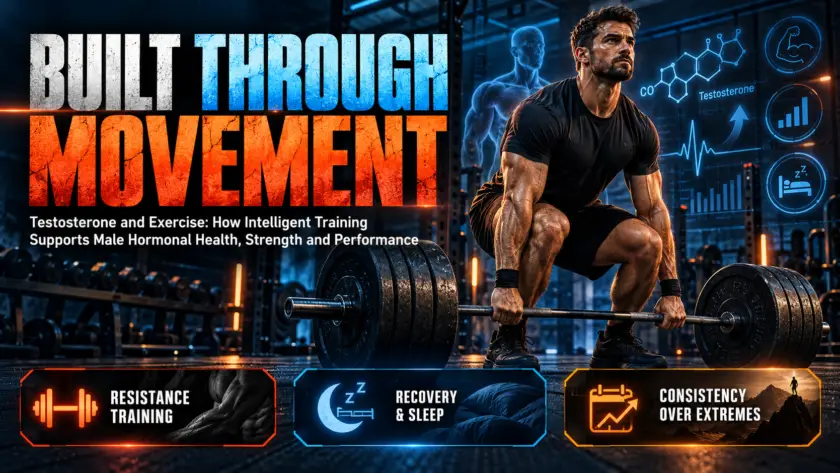
Testosterone and Exercise: How Intelligent Training Supports Male Hormonal Health, Strength and Performance
Men are often told that a particular workout will “boost testosterone”, as though one punishing session can transform their hormonal health overnight. Lift heavier. Rest less. Sprint until exhaustion. Choose the most demanding exercises. Chase the biggest possible post-workout rise.
This makes a powerful headline—but it reduces a complicated relationship to a single number.
Exercise can play an important role in male health. Resistance training builds strength and muscle. Cardiovascular activity supports the heart, circulation, work capacity and healthy body composition. Regular movement can improve physical function, sleep and metabolic health. These benefits help create conditions in which the male body can operate more effectively.
But testosterone and exercise should not be understood as a simple equation in which harder training always creates higher testosterone. A demanding workout may produce a temporary hormonal response, but that short-lived change is not the same as a lasting improvement in resting testosterone. Research involving insufficiently active men with testosterone levels in the normal range has found that exercise training may have little or no meaningful effect on resting total or free testosterone—even while producing important improvements in fitness and health.
That does not make exercise unsuccessful. It means testosterone should not be the only scoreboard.
A stronger man, a healthier heart, better mobility, improved body composition, greater work capacity and a more resilient mind are valuable outcomes whether or not a laboratory number changes dramatically. Exercise may also support testosterone indirectly when it helps a man reduce excess body fat, improve metabolic health, sleep better and establish a more active lifestyle.
The real objective is not to force testosterone as high as possible. It is to build a body capable of training, recovering, performing and ageing well.
The strongest training system is not the one that exhausts a man most. It is the one that allows him to train, recover and become stronger consistently.
1. What Testosterone Does During Exercise and Recovery
Testosterone is an androgen hormone produced mainly in the testes, with its production regulated through signals involving the brain, pituitary gland and testicles. It contributes to male sexual development, libido, sperm production, bone health, red-blood-cell production, muscle maintenance and body composition.
This is why testosterone is often discussed in strength and fitness culture. It has a genuine biological role in maintaining muscle and supporting normal male function. The mistake is turning that truth into the claim that every training result depends on creating the largest possible testosterone surge.
During and after some forms of exercise, circulating testosterone can rise temporarily. The size and duration of that response may vary according to the individual, exercises performed, muscle mass involved, intensity, volume, training status, time of day and energy availability.
Temporary means temporary. A short increase after exercise should not be confused with a permanent increase in a man’s usual testosterone level.
Exercise also creates demands that extend beyond hormones. Resistance training exposes muscle to mechanical tension. The nervous system learns to recruit force more effectively. Connective tissues adapt. Energy stores are used and later replenished. The body repairs itself during recovery.
The training session provides a signal. Adaptation depends on what happens across repeated sessions—and on the recovery, nutrition and time connecting them.
This produces a more accurate model:
Training stimulus + adequate recovery + sufficient nutrition + progressive consistency = adaptation.
Testosterone participates in this biological environment, but it does not replace any part of the process.
Alpha Hormone Insight
Do not reduce an entire training response to one temporary hormone reading. Build the complete conditions in which your body can adapt.
2. Resistance Training Should Form a Central Foundation
Resistance training gives a man a direct reason to become stronger.
It can involve barbells, dumbbells, machines, resistance bands, kettlebells or bodyweight movements. The equipment matters less than the principle: muscles must work against resistance that is challenging enough to stimulate adaptation.
Regular resistance training can improve:
- Muscular strength
- Muscle size and maintenance
- Bone and joint support
- Physical function
- Balance and movement confidence
- The ability to perform work and everyday tasks
- Healthy ageing and independence
These benefits matter at every stage of adult life. A younger man may train to develop strength and capability. A middle-aged man may use resistance training to protect muscle while improving body composition. An older man may train to preserve the power required to rise, carry, climb and remain independent.
Current UK guidance recommends muscle-strengthening activity involving the major muscle groups on at least two days each week. That is a public-health foundation, not a maximum and not a requirement that every man follows the same routine.
For many men, two or three well-designed full-body sessions provide an effective starting structure. Each session can include a knee-dominant movement, a hip-dominant movement, a push, a pull, a loaded carry or trunk exercise, and work appropriate to individual needs.
The goal is not to leave the gym destroyed. The goal is to apply enough resistance to create a reason for adaptation, then return capable of training again.
Resistance training supports a powerful male standard: progressive responsibility. The weight does not respond to excuses or image. It reveals preparation, technique, patience and consistency.
Alpha Hormone Insight
Resistance training does more than challenge muscle. It teaches a man to meet increasing demands through preparation, control and repeated effort.
3. Compound Exercises Versus Isolation Exercises
Compound exercises involve movement across multiple joints and usually recruit several muscle groups. Examples include squats or leg presses, deadlift variations, presses, rows, pull-ups and lunges.
Isolation exercises place greater emphasis on a particular muscle or joint action. Examples include biceps curls, triceps extensions, leg curls, calf raises and lateral raises.
Online discussions sometimes present compound movements as “testosterone exercises” and isolation work as almost worthless. This is an unnecessary division.
Compound exercises are efficient. They allow a man to train substantial amounts of muscle, develop coordination and progressively handle meaningful resistance. For this reason, they often deserve a central place in a strength system.
Isolation exercises remain valuable. They can provide additional volume to a target muscle, strengthen areas that need attention, support rehabilitation when professionally indicated and allow productive training without the fatigue created by another large compound lift.
The correct question is not:
“Which exercise produces the biggest temporary testosterone spike?”
It is:
“Which exercise safely and effectively trains the result I need?”
A man with limited hip mobility does not prove his masculinity by forcing a particular squat variation. A man with shoulder pain does not need to copy someone else’s press. Exercise selection should reflect anatomy, experience, goals, equipment and medical or injury considerations.
Build sessions around movements that train the major muscle groups, then use isolation work where it adds value. Technique should remain controlled, and load should be earned through competent execution.
Alpha Hormone Insight
An exercise earns its place by helping you train safely and progress—not by the mythology attached to it.
4. Intensity, Volume and Progressive Overload
Training must be demanding enough to create adaptation, but demand has several dimensions.
- Intensity can refer to how heavy a load is relative to your maximum or how difficult a set feels.
- Volume describes the amount of work completed across exercises, sets and repetitions.
- Frequency describes how often a muscle or movement is trained.
- Density describes how much work is performed within a period of time.
Progressive overload means gradually increasing the challenge as the body adapts. This could involve adding weight, completing more repetitions with the same weight, improving technique, increasing range of motion, adding a set or performing the same work with greater control.
Progression does not require forcing a personal record every session.
The 2026 American College of Sports Medicine position stand emphasises that many forms of resistance training can produce results and that prescription should reflect the desired outcome. Heavier loads are particularly useful for maximal strength, while muscle growth can occur across a range of loads when training is sufficiently challenging and weekly volume is appropriate.
This frees men from chasing one allegedly perfect hormonal routine. A beginner can progress with simple exercises performed consistently. An experienced lifter may require more careful manipulation of volume and intensity. An older or returning trainee may initially progress through improved technique and tolerance.
Keep a training record. Track exercises, loads, repetitions, effort and recovery. If performance gradually improves without persistent pain or exhaustion, the system is providing useful evidence.
Alpha Hormone Insight
Progressive overload is not reckless escalation. It is the disciplined art of asking slightly more from a body that has been prepared to give it.
5. High-Intensity Interval Training Has a Role—Not a Throne
High-intensity interval training, commonly called HIIT, alternates demanding efforts with periods of recovery. It may involve cycling, rowing, running, hill work or other suitable movements.
HIIT can be time-efficient and can improve cardiorespiratory fitness. It may also cause an immediate rise in testosterone after a session. However, a systematic review found that this rise disappeared quickly, with values moving back towards baseline over the following period.
That finding reinforces the central lesson: an acute response is not the same as a lasting hormonal transformation.
HIIT is demanding. Adding repeated interval sessions to heavy resistance training, poor sleep and a stressful life can create more fatigue than benefit. Men who are new to training, significantly deconditioned or managing health concerns may need to build a foundation before attempting very intense intervals.
Use HIIT as a tool when it serves the goal—not as a daily test of toughness.
A sensible starting approach for an appropriately prepared man might include one short weekly interval session with controlled work periods and generous recovery. The exact structure should reflect fitness, joint health, training experience and the activity chosen.
Hard does not automatically mean effective. The session should be recoverable, repeatable and integrated with the rest of the week.
Alpha Hormone Insight
Intensity is powerful when it is strategically placed. Used without recovery or purpose, it becomes fatigue wearing the uniform of discipline.
6. Cardiovascular Exercise Still Matters
Some men avoid cardiovascular exercise because they fear it will reduce muscle or testosterone. That fear ignores the difference between sensible aerobic training and extreme endurance workloads combined with inadequate fuelling and recovery.
Cardiovascular fitness supports the heart, blood vessels, lungs, work capacity and recovery between efforts. It can help a man walk further, train more effectively, manage daily demands and reduce health risks that matter far beyond appearance.
UK guidance advises adults to accumulate at least 150 minutes of moderate-intensity activity each week, or 75 minutes of vigorous activity, or an equivalent combination. Men should also reduce long periods of inactivity.
Moderate activity could include brisk walking, cycling or swimming at an effort where breathing increases but conversation remains possible. It does not need to become a competitive endurance event.
Cardio and resistance training are partners:
- Resistance training develops strength and muscle.
- Cardiovascular training develops endurance and heart-lung fitness.
- Walking adds low-fatigue daily movement.
- Mobility work helps maintain usable ranges of motion.
If muscle and strength are priorities, arrange demanding endurance and lower-body strength sessions so that fatigue does not repeatedly damage performance. This may mean separating them by several hours or placing them on different days.
Do not become hormonally obsessed and cardiovascularly unfit. Testosterone is one part of male health; the heart that supplies every working muscle deserves protection too.
Alpha Hormone Insight
A powerful body needs more than muscle. Strength must be supported by the cardiovascular capacity to use it.
7. Exercise, Body Fat and Testosterone
The relationship between body fat and testosterone is complex and varies between individuals, but obesity is commonly associated with lower testosterone levels in men. Weight reduction may improve testosterone in some men with obesity, particularly when the weight loss is meaningful and sustained.
Exercise can contribute by increasing energy expenditure, preserving or building lean tissue, improving fitness and supporting a more active lifestyle. But exercise should not carry the entire burden of fat loss. Nutrition, sleep, stress, medicines, health conditions and the broader environment also matter.
Do not reduce a man’s hormonal health to body weight alone. A higher body weight does not prove testosterone deficiency, and a lean appearance does not prove healthy hormones.
The objective should be improved health and sustainable body composition—not extreme leanness at any cost.
Aggressive dieting combined with high training volume can create low energy availability: the body receives insufficient energy after accounting for exercise demands. In male athletes, prolonged low energy availability has been associated with reduced testosterone, impaired recovery, poorer bone health and diminished performance.
There are therefore two mistakes:
- Ignoring excess body fat and inactivity that may be affecting health.
- Chasing extreme leanness through under-eating and excessive training.
The Alpha approach lies between neglect and obsession. Use a moderate, sustainable plan. Measure waist circumference, strength, energy, sleep and health markers rather than allowing the scale to become the only judge.
Alpha Hormone Insight
Healthy body composition is built through sustainable control—not through neglect at one extreme or starvation and exhaustion at the other.
8. More Exercise Is Not Always Better
Training creates fatigue as well as fitness. A well-designed system manages both.
When the body receives an appropriate challenge and sufficient recovery, capacity rises. When training stress repeatedly exceeds recovery, performance may stall or decline.
Warning signs that the current load deserves review can include:
- Persistent decline in performance
- Unusual or prolonged soreness
- Disturbed sleep
- Irritability or low motivation
- Repeated illness or injury
- Loss of libido
- Persistent fatigue
- A rising sense of effort at familiar workloads
None of these symptoms proves low testosterone or overtraining by itself. They have many possible causes, including infection, mental-health difficulties, sleep disorders, anaemia, thyroid problems, under-fuelling and other medical conditions. Persistent symptoms deserve assessment rather than a social-media diagnosis.
Reduce training load when the evidence requires it. A deload week, additional rest, lower volume or temporary change of exercise can protect long-term progress.
Rest is not the opposite of discipline. Planned rest is part of the system. The undisciplined choice is repeatedly ignoring evidence until injury, illness or exhaustion makes the decision for you.
Alpha Hormone Insight
A disciplined man knows when to apply pressure and when to remove enough pressure for adaptation to occur.
9. Recovery Determines What Training Can Build
The workout is visible. Recovery is where much of the adaptation is supported.
Sleep provides time for physical and neurological recovery. Nutrition supplies energy and raw materials. Rest days reduce accumulated fatigue. Stress management prevents every area of life from competing for the same recovery capacity.
Protect the foundations:
Sleep
Create a consistent sleep opportunity, reduce late-night stimulation and investigate persistent snoring, breathing interruptions or daytime sleepiness. No supplement can fully replace sleep.
Energy
Eat enough to support activity and goals. A fat-loss phase may require an energy deficit, but the deficit should not become an attempt to survive on as little food as possible.
Protein
Distribute adequate protein across meals to support muscle repair and maintenance. Individual needs vary with body size, age, training and health.
Dietary fat and carbohydrate
Include nutritious sources of fat as part of a balanced diet. Use carbohydrate strategically to support demanding training when appropriate. No single food has the power to guarantee higher testosterone.
Hydration
Begin sessions adequately hydrated and replace fluids according to activity and environment.
Stress management
Training adds stress even when it is beneficial. Account for demanding work, family pressure, illness and poor sleep when planning the week.
Recovery is not a reward reserved for men who have worked hard enough. It is one of the conditions that makes hard work productive.
Alpha Hormone Insight
The man who respects recovery is not lowering his standard. He is protecting his ability to meet that standard again.
10. Anabolic Steroids Are Not a Healthy Shortcut
Anabolic steroids are manufactured drugs that imitate effects of hormones such as testosterone. Some men use them without medical supervision to accelerate muscle and strength gains.
This is not the same as supporting natural hormonal health through exercise.
The NHS warns that anabolic-steroid misuse can cause serious side effects and dependence. Possible effects in men include reduced sperm count, infertility, shrunken testicles, erectile dysfunction and breast development, alongside cardiovascular, liver, psychological and other risks.
External testosterone can suppress the hormonal signals needed for the testes to produce sperm. That is especially important for men who want to become fathers. The Endocrine Society recommends against starting testosterone therapy in men planning fertility in the near term.
Testosterone replacement therapy has a legitimate medical role for appropriately diagnosed men. It is not a universal anti-ageing system, fertility treatment or substitute for training.
Never buy hormones from an unregulated source or begin using them because an influencer interpreted one result. Do not stop prescribed treatment without speaking to the clinician managing it.
A real Alpha man does not risk his fertility and long-term health to create the appearance of accelerated strength. He seeks facts, understands the trade-offs and refuses to let insecurity make a medical decision.
Alpha Hormone Insight
A shortcut that borrows muscle from your future health, fertility and hormonal function may demand a price no physique can repay.
11. Older Men Should Continue Training Intelligently
Ageing changes the body, but it does not make movement irrelevant. It makes intelligent movement increasingly valuable.
Muscle mass, strength, power, balance and bone health can decline with age, particularly when inactivity accelerates the process. Resistance training gives older men a direct method of challenging that decline.
The objective may evolve. A younger man might pursue maximal strength or athletic performance. An older man may place greater emphasis on maintaining muscle, moving without pain, carrying shopping, climbing stairs, getting up from the floor and remaining capable for his family.
Older adults are advised to be physically active every day and include strength, balance and flexibility work on at least two days each week. Those new to exercise should build gradually, and men with medical conditions or concerns should seek appropriate clinical guidance.
Intelligent adjustments may include:
- Longer warm-ups
- More gradual loading
- Stable exercise variations
- Additional recovery between demanding sessions
- Balance and power work appropriate to ability
- Careful management of joint pain
- Greater attention to sleep, protein and total nutrition
Age does not justify reckless ego lifting, but neither should it become an automatic excuse for surrender.
The strongest older man is not necessarily the one lifting the most weight. He is the one who continues building the capacity to live independently, contribute and enjoy the future he worked to create.
Alpha Hormone Insight
Do not train to prove that you are still young. Train intelligently so that age does not take more capability than it has earned.
12. Exercise Cannot Diagnose or Cure Every Testosterone Problem
Low libido, erectile difficulties, tiredness, low mood, declining strength and changes in body composition can occur with testosterone deficiency. They can also be associated with poor sleep, depression, anxiety, obesity, medicines, relationship stress, thyroid disorders, diabetes, excessive alcohol, under-eating and many other conditions.
Symptoms are reasons to investigate—not permission to diagnose yourself.
The Endocrine Society recommends diagnosing hypogonadism only when relevant symptoms or signs are accompanied by consistently and unequivocally low testosterone. Its 2026 statement emphasises accurate clinical diagnosis based on at least two early-morning fasting testosterone tests, with appropriate investigation of the cause.
This means a man should not attempt to “train through” persistent symptoms or use one private blood test as a final verdict.
Seek medical advice when symptoms are persistent, unexplained or affecting daily life. A clinician may review sleep, medicines, alcohol, weight, sexual health and other conditions before arranging appropriate tests.
Exercise can remain part of the health plan, but it cannot correct every testicular, pituitary, genetic or medical cause of testosterone deficiency.
The Alpha response is neither panic nor denial. It is evidence:
- Describe the symptoms honestly.
- Obtain appropriate testing.
- Investigate the cause.
- Discuss fertility plans before hormone treatment.
- Follow qualified advice.
- Continue building the lifestyle foundations within your control.
Alpha Hormone Insight
Train to strengthen your health—but never ask a workout to replace a diagnosis that requires qualified medical investigation.
The ALPHA Training Balance
A — Apply Resistance
Train the major muscle groups consistently. Use movements appropriate to your body, ability and equipment. Begin with a workload you can perform safely and repeat.
L — Lift Progressively
Increase the challenge gradually. Progress may mean more weight, repetitions, control, range of motion or technical quality. Do not sacrifice form merely to make the number larger.
P — Protect Recovery
Schedule rest, create sufficient sleep opportunity and eat enough to support the work. Adjust training during illness, severe sleep loss or unusually stressful periods.
H — Honour Cardiovascular Health
Build aerobic capacity through walking, cycling, swimming or other suitable activity. Do not let a narrow obsession with muscle ignore the heart and lungs supporting it.
A — Assess the Evidence
Track strength, energy, sleep, soreness, consistency and performance. Treat persistent medical symptoms as reasons for professional assessment—not as invitations to buy hormones or supplements online.
The Seven-Day Testosterone-Supportive Training Template
This is a general example, not an individual prescription. Adjust it for experience, medical conditions, injuries, recovery and professional advice.
| Day | Main activity | Purpose |
|---|---|---|
| Monday | Full-body resistance A | Strength and muscle stimulus |
| Tuesday | Moderate cardio + mobility | Cardiovascular fitness and active recovery |
| Wednesday | Full-body resistance B | Progressive resistance |
| Thursday | Walking + mobility | Low-fatigue movement and recovery |
| Friday | Full-body resistance C | Strength and whole-body capacity |
| Saturday | Moderate cardio or suitable intervals | Endurance and work capacity |
| Sunday | Genuine recovery | Adaptation, preparation and review |
Full-Body Resistance A
- Squat or leg-press variation
- Horizontal push
- Horizontal pull
- Hip hinge
- Carry or trunk exercise
Full-Body Resistance B
- Lunge or split-squat variation
- Vertical push
- Vertical pull
- Hip-dominant exercise
- Calf, arm or trunk accessory
Full-Body Resistance C
- Knee-dominant movement
- Chest press or push-up variation
- Row variation
- Hamstring or glute exercise
- Loaded carry or appropriate conditioning finish
Beginner adjustment
Begin with two resistance sessions and shorter cardio periods. Learn technique, leave several repetitions in reserve and add work gradually.
Experienced adjustment
Use the same weekly balance while dividing work according to specific strength or muscle goals. Higher volume demands greater attention to fatigue and recovery.
Older-man adjustment
Choose stable movements, begin below maximum capacity, include balance and mobility, and allow more recovery where necessary. Capability—not comparison—is the target.
Daily foundation
Walk, break up prolonged sitting, eat balanced meals, hydrate and protect sleep. The routine outside the gym influences the value of the session inside it.
The Testosterone and Exercise Audit
Answer honestly:
- Am I resistance training at least twice each week?
- Does my system train all major muscle groups?
- Am I progressing gradually or merely repeating familiar work?
- Do I include cardiovascular activity?
- How much time do I spend sitting?
- Am I recovering between demanding sessions?
- Is my sleep supporting or sabotaging my training?
- Am I eating enough to match my training demands?
- Am I chasing extreme leanness?
- Has my strength improved during the last three months?
- Do I experience persistent fatigue, declining libido or erectile difficulties?
- Am I assuming those symptoms prove low testosterone?
- Have I used anabolic steroids or unsupervised hormones?
- Do my future fertility plans require discussion with a clinician?
- What is the single most useful adjustment I can make this week?
The 30-Day Built Through Movement Challenge
For the next thirty days:
- Complete two or three scheduled resistance sessions each week.
- Train every major muscle group.
- Record exercises, sets, repetitions and effort.
- Accumulate suitable cardiovascular activity and regular walking.
- Protect at least one genuine recovery day each week.
- Create a consistent sleep opportunity.
- Eat balanced meals that support training and health.
- Avoid testing strength through reckless form.
- Record energy, performance and recovery once each week.
- Seek medical advice for persistent symptoms rather than self-diagnosing.
The objective is not to produce a miraculous testosterone transformation in thirty days. It is to create evidence that you can build and maintain the behaviours supporting long-term male health.
Frequently Asked Questions
Does exercise increase testosterone?
Some forms of exercise can produce a temporary rise after a session. Regular exercise may also support testosterone indirectly through body composition, metabolic health and general wellbeing. However, exercise does not reliably cause a large permanent increase in resting testosterone in otherwise healthy men.
Is weightlifting the best exercise for testosterone?
Resistance training is highly valuable for strength, muscle and physical function. It should usually be combined with cardiovascular activity, daily movement and adequate recovery. No single exercise can guarantee higher testosterone.
Are squats and deadlifts required?
No. They can be effective exercises, but suitable alternatives can train the same movement patterns and muscle groups. Exercise selection should reflect goals, anatomy, experience, mobility and injury history.
Does cardio lower testosterone?
Sensible cardiovascular training does not automatically lower testosterone. Problems are more likely in circumstances involving very high training loads, chronic under-fuelling and insufficient recovery. Moderate cardio remains important for overall health.
Can overtraining reduce testosterone?
Excessive training combined with inadequate energy, sleep and recovery may contribute to hormonal disruption. A single hard week is not the same as a clinical overtraining condition. Persistent fatigue or declining performance deserves a broader assessment.
How many days should a man lift weights?
Two full-body sessions per week can provide a strong foundation, while many men use three or more depending on goals and recovery. UK guidance recommends muscle-strengthening activity on at least two days each week.
Should I train to failure on every set?
No. Sets need to be challenging, but constant failure can create unnecessary fatigue and reduce technical quality. The appropriate effort depends on the exercise, goal, experience and training phase.
Can exercise cure low testosterone?
Exercise may improve health factors associated with testosterone, but it cannot correct every cause of hypogonadism. Persistent symptoms and repeatedly low results require medical investigation.
Should I take a testosterone booster?
Do not assume an over-the-counter product can correct a medical deficiency. Claims may exceed the evidence, ingredients can interact with medicines and product quality varies. Discuss persistent symptoms and supplements with an appropriate healthcare professional.
What if I want children in the future?
Tell your clinician before considering testosterone therapy. External testosterone can suppress sperm production, and major clinical guidance recommends against starting it when fertility is planned in the near term.
Closing Declaration
I will train to build health—not merely to chase a temporary hormonal response.
I will apply resistance, progress intelligently and respect correct technique.
I will develop my heart and endurance alongside my muscular strength.
I will fuel the work and protect the recovery that allows adaptation.
I will not confuse exhaustion with effectiveness.
I will not risk my fertility or long-term health for an unsupervised shortcut.
I will adjust my training as I age without surrendering my physical capability.
I will investigate persistent symptoms instead of diagnosing myself through social media.
I will build a body that is strong enough to perform, disciplined enough to recover and healthy enough to serve the life I am creating.
Final Line
Do not train merely to create a short-lived hormonal spike. Train to build the strength, health and capacity your future will require from you.


No spam. Unsubscribe anytime.