Why a Good Diet Is So Important for Male Fertility
Every sperm cell begins inside a body that must provide the energy, building materials, hormonal signals and protective environment required to produce it.
That body cannot manufacture reproductive health from motivation alone.
It depends partly on the food a man repeatedly eats, the weight he maintains, the alcohol he consumes and the wider lifestyle supporting—or undermining—his health.
Yet many men do not think seriously about nutrition until conception becomes difficult or a semen analysis reports a problem.
Then the search begins.
What is the best food for sperm count?
Which fruit improves motility?
Can one supplement repair morphology?
How much water produces more semen?
Is there a fertility superfood capable of transforming the result quickly?
These questions are understandable. A man wants something practical he can control. But they can direct his attention towards individual foods and products when the stronger foundation is the quality of his entire dietary pattern.
Male fertility is not controlled by one meal.
Sperm production takes place inside a complex biological system involving the testicles, brain, pituitary gland, hormones, blood supply, metabolism and the wider health of the man. Nutrition contributes to that system, but it does not act alone.
A good diet cannot guarantee conception.
It cannot promise a particular sperm count, perfect motility, normal morphology, fertilisation, pregnancy or a live birth. It cannot remove a reproductive blockage, correct every hormonal disorder or replace investigation of a varicocele, infection, genetic condition, medication effect or unexplained semen abnormality.
But diet still matters.
It supplies nutrients required throughout normal cellular function. It helps a man manage body weight and supports cardiovascular, metabolic and general health. It can reduce reliance on heavily processed foods, excessive alcohol and eating patterns that leave the body poorly nourished despite receiving more than enough calories.
The World Health Organization identifies obesity, smoking and excessive alcohol intake among lifestyle factors that can affect fertility. The NHS guidance on low sperm count similarly advises men to reduce alcohol, stop smoking and lose weight if they are overweight.
This does not turn food into medicine for every fertility problem.
It makes good nutrition one of the foundations within a responsible male-fertility strategy.
The meals eaten today become part of the wider environment in which future sperm develop. A man who wants to protect his reproductive future should therefore stop treating nutrition as an afterthought and begin building a diet capable of supporting the body responsible for creating life.
Sperm are produced by the body a man feeds every day. A good diet cannot guarantee conception, but it can help build the nutritional foundation reproductive health deserves.
1. Sperm Are Built Inside the Body You Feed
Sperm do not appear independently of the rest of a man’s health.
They are living reproductive cells produced through an organised biological process. That process requires energy, normal hormonal signalling, functioning testicular tissue and the materials used throughout cell growth and development.
Food contributes:
- Protein and amino acids
- Essential fatty acids
- Carbohydrates used as an energy source
- Vitamins and minerals
- Fibre and plant compounds
- Energy required to support normal bodily function
This does not mean the body sends a piece of salmon, one walnut or a zinc tablet directly to the testicles and converts it into better sperm.
Nutrition is more complex.
The body digests food, absorbs nutrients, regulates their use and distributes them according to need. Reproductive health exists within that whole system.
A diet that repeatedly lacks variety may make it harder to obtain a broad range of nutrients. A diet dominated by highly processed choices may deliver substantial energy while displacing fruit, vegetables, fibre, quality protein and other nutrient-dense foods.
This is why men should think beyond a list of “fertility foods.”
The question is not only:
“Which food contains zinc?”
It is:
“Does the way I eat consistently support the health of the body responsible for producing sperm?”
One nutrient may be important, but the body requires many systems to work together.
A strong diet for male fertility is therefore not built around one ingredient. It is built around quality, variety, adequacy and consistency.
Alpha Fertility Insight
You cannot separate sperm health from the health of the body responsible for producing sperm.
2. Diet Supports Fertility—It Does Not Control Every Outcome
Responsible fertility nutrition begins with an honest boundary.
A healthy diet may support reproductive health.
It does not give a man complete control over reproduction.
Conception depends on multiple factors involving both partners. Male-factor infertility can involve sperm production, movement, shape, ejaculation, reproductive anatomy, hormones, genetics and other medical causes. Some fertility problems remain unexplained even after investigation.
Nutrition cannot guarantee:
- A particular sperm concentration
- A specific total sperm count
- Normal progressive motility
- Normal morphology
- Healthy sperm DNA
- Successful fertilisation
- Implantation
- Pregnancy
- A live birth
This does not weaken the case for eating well.
It places nutrition in the correct position.
Diet is part of the health foundation a man can influence. It should not become a promise used to blame him if conception remains difficult.
This distinction matters because fertility marketing often turns possibility into certainty.
A food is described as “sperm boosting.” A supplement is presented as though it can repair every semen problem. A before-and-after story becomes more persuasive than the limitations of the evidence.
Men deserve a stronger message:
Eat well because reproductive health is part of whole-body health.
Address known deficiencies because deficiencies deserve appropriate treatment.
Improve weight and lifestyle factors where relevant because they may affect fertility chances.
Obtain professional evaluation because nutrition cannot diagnose the cause of an abnormal result.
Alpha Fertility Insight
Nutrition is a foundation of fertility care—not a replacement for fertility investigation.
3. Think in Months, Not Miracle Meals
Men often begin a fertility diet with an urgent timeline.
They eat well for ten days and wonder whether their sperm count has increased. They add several supplements and expect the next ejaculation to reveal a transformation. They judge an entire nutritional strategy by how they feel after one week.
Male reproductive biology does not operate like an instant performance supplement.
Sperm production and maturation take time. NHS fertility information commonly works with a period of approximately three months when reassessing semen. The NHS low-sperm-count page states that an abnormal semen analysis is usually repeated around three months later. An NHS fertility lifestyle leaflet explains that sperm take roughly eight to ten weeks to mature and that relevant events can affect production for up to three months.
This does not prove that every dietary change will improve semen quality after twelve weeks.
It explains why meaningful lifestyle change should be considered over months rather than days.
A man should focus on:
- Repeated balanced meals
- Sustainable weight management where required
- Reduced alcohol exposure
- Smoking cessation
- Consistent sleep and exercise
- Appropriate medical investigation
- Follow-up testing at the recommended time
The aim is not to perform a perfect fertility diet for a week.
It is to create a more supportive environment that can be maintained throughout the sperm-development window and beyond.
If the next semen analysis remains abnormal, the answer is not automatically a more extreme diet.
The result should be interpreted with a clinician and investigated appropriately.
Alpha Fertility Insight
Future sperm are influenced by repeated conditions. Build a nutritional pattern—not a temporary fertility performance.
4. Nutrient Density Matters More Than Fertility Marketing
The fertility market knows that concerned men want a clear solution.
That can make impressive packaging, proprietary blends and words such as vitality, performance and male optimisation feel more powerful than ordinary food.
But a label does not become evidence merely because it uses reproductive language.
Before purchasing a specialised product, examine the foundations:
- How many portions of vegetables and fruit do you eat?
- Do your meals contain a reliable protein source?
- Do you regularly choose higher-fibre carbohydrates?
- Do you eat beans, pulses, fish, eggs, nuts or seeds?
- Are most meals prepared from recognisable foods?
- Does alcohol regularly replace better nutrition?
- Are takeaway meals and sugary drinks dominating the week?
- Are you eating enough—or repeatedly crash dieting?
The NHS Eatwell Guide recommends a balanced pattern across food groups rather than dependence on one perfect meal. NHS guidance includes at least five portions of varied fruit and vegetables daily, higher-fibre starchy foods, some dairy or alternatives, varied protein sources and small amounts of unsaturated oils.
This is not marketed as a male-fertility cure.
That is part of its strength.
It provides a practical whole-health foundation without promising an outcome food cannot guarantee.
The fertility diet should begin in the supermarket and kitchen—not automatically in the supplement aisle.
Alpha Fertility Insight
Build meals from foods that support your whole health before spending money on products that promise to target one result.
5. Protein Supplies Essential Building Materials
Protein provides amino acids used throughout the body.
Men sometimes interpret this fact as a reason to pursue an extreme high-protein diet. But reproductive nutrition is not a competition to consume the largest quantity possible.
The goal is adequate, varied protein within a balanced diet.
Useful sources can include:
- Fish
- Eggs
- Poultry
- Lean meat
- Greek yoghurt
- Cottage cheese
- Milk or suitable alternatives
- Beans
- Lentils
- Chickpeas
- Tofu
- Tempeh
- Nuts and seeds
Different sources offer different combinations of protein, fats, vitamins and minerals. Variety helps prevent the diet becoming dependent on one food while other nutritional needs are neglected.
Protein should also be interpreted in context.
A protein shake added to a diet containing very few vegetables and large amounts of takeaway food does not create a balanced fertility plan.
Likewise, some bodybuilding or performance products may contain undeclared or problematic ingredients. Men trying to conceive should be particularly cautious around products associated with anabolic steroids or hormone-like substances. External anabolic steroids can suppress normal sperm production and deserve medical discussion.
Food-first protein choices are usually easier to understand and integrate into complete meals.
Use protein to support the meal—not to replace every other food group.
Alpha Fertility Insight
Adequate protein supports the body’s work. Excessive protein does not automatically create exceptional fertility.
6. Healthy Fats Support More Than Calories
Some men still approach fertility nutrition with the belief that all dietary fat should be avoided.
That is unnecessary.
Fat is part of a balanced diet and plays roles throughout normal cell function. The more useful distinction is between food sources and the overall pattern.
Options can include:
- Oily fish
- Extra-virgin olive oil
- Nuts
- Seeds
- Avocado
- Eggs
- Other unsaturated oils used appropriately
The NHS healthy-eating guidance recommends choosing unsaturated fats in place of saturated fats more often, while remembering that all fats are energy dense.
This matters for two reasons.
First, a fat-free diet is not required for fertility or general health.
Second, adding unlimited amounts of “healthy” fat can still make weight management difficult because these foods contain substantial energy.
The fertility plate does not need oil poured over every meal or enormous handfuls of nuts.
It needs appropriate portions inside a balanced pattern.
Do not obsess over whether one type of fat can increase sperm count.
Focus on replacing poorer habitual choices with foods that support the quality of the whole diet.
Alpha Fertility Insight
The objective is not a fat-free diet. It is a better-quality dietary pattern containing appropriate fats.
7. Colourful Plants Provide More Than Decoration
Vegetables and fruit should not appear beside the main meal as an afterthought.
They contribute vitamins, minerals, fibre and a wide range of plant compounds. The goal is not to identify one colour, berry or juice capable of “boosting” fertility. It is to build variety the body can use as part of a complete diet.
Options include:
- Berries
- Citrus fruit
- Apples and pears
- Tomatoes
- Peppers
- Leafy greens
- Broccoli and other cruciferous vegetables
- Carrots
- Beetroot
- Beans and pulses
- Herbs and spices
- Frozen mixed vegetables
- Seasonal produce
Fresh produce is not the only valid choice.
Frozen vegetables and fruit can be practical, affordable and reduce waste. Canned vegetables, beans and fruit can also contribute when selected thoughtfully, particularly when excess salt or added sugar is considered.
The NHS recommends at least five portions of varied fruit and vegetables daily as part of a healthy diet.
For men who currently eat very little plant food, the first target does not need to be a perfect plate.
Add one portion to breakfast.
Add two vegetables to the evening meal.
Keep fruit visible.
Use frozen vegetables when time is limited.
Build repeatable access before chasing novelty.
Alpha Fertility Insight
Do not search for one perfect fertility fruit. Build the dietary variety that one food cannot provide.
8. Important Nutrients Should Come From a Complete Diet
Male-fertility content frequently focuses on individual nutrients:
- Zinc
- Selenium
- Folate
- Vitamin C
- Vitamin E
- Vitamin D
- Vitamin B12
- Omega-3 fatty acids
- Iron where required
- Protein and essential amino acids
These nutrients are involved in normal processes throughout the body, and deficiencies deserve attention.
But the body does not work from a marketing list.
One nutrient cannot compensate for inadequate sleep, heavy alcohol use, smoking, obesity, anabolic-steroid exposure or an untreated medical cause of infertility.
More is also not automatically better.
High-dose supplements can create excessive intakes, interact with medicines or duplicate ingredients already present in a multivitamin and separate fertility product.
A food-first pattern helps distribute nutrients across meals:
- Meat, shellfish, dairy, eggs, beans, nuts and seeds provide various minerals and protein
- Vegetables, fruit, beans and wholegrains provide fibre and micronutrients
- Fish supplies protein and, in oily varieties, omega-3 fats
- Dairy or fortified alternatives can contribute protein and other nutrients
Men following vegetarian or vegan diets can still build nutritionally sound eating patterns, but planning becomes important. The NHS vegan-diet guidance highlights nutrients that may require particular attention, including vitamin B12, vitamin D, iodine, selenium, calcium and iron.
The goal is not anxiety around every micronutrient.
It is dietary variety, justified testing where appropriate and professional help when deficiency risk is present.
Alpha Fertility Insight
A nutrient is essential because the body needs an appropriate amount—not because unlimited amounts create unlimited benefits.
9. Body Weight and Metabolic Health Matter
Diet affects more than nutrient intake.
It influences energy balance, body weight and metabolic health.
The World Health Organization associates obesity with higher chances of infertility in both women and men. The NHS advises men with low sperm count to lose weight if they are overweight.
This does not mean every larger man is infertile or every lean man has excellent sperm quality.
It means weight is one relevant part of the assessment.
Men should also avoid turning fertility anxiety into extreme restriction.
Crash dieting may be difficult to sustain and can leave the diet nutritionally poor. Aggressive weight loss can disrupt training, sleep, mood and the consistency needed for long-term health.
A stronger approach includes:
- Gradual, sustainable changes
- Appropriate portions
- More vegetables and fibre-rich foods
- Reliable protein
- Reduced liquid calories
- Fewer takeaway meals
- Regular physical activity
- Sufficient sleep
- Professional guidance when weight management is complex
The objective is not to reach the lowest number possible.
It is to move towards a healthier, sustainable position that supports the man’s whole health.
Body weight may also be influenced by medicines, medical conditions, mental health, sleep, finances and environment. Responsibility should be practical—not humiliating.
Alpha Fertility Insight
A fertility diet should improve the health supporting reproduction—not punish the body through extreme restriction.
10. Reduce Foods That Displace Better Nutrition
Fear-based fertility content often divides food into two dramatic categories:
Foods that “boost sperm” and foods that “kill sperm.”
Real diets are rarely that simple.
The occasional takeaway, dessert or processed meal is unlikely to define a man’s reproductive future on its own.
The repeated pattern deserves more attention.
Consider whether the week is dominated by:
- Ultra-processed convenience foods
- Sugar-sweetened drinks
- Frequent takeaway meals
- Processed meats
- Excessive confectionery
- Large portions eaten automatically
- Very low fruit and vegetable intake
- Refined foods that repeatedly displace higher-fibre options
The aim is not moral purity.
Food is not a test of whether a man is good or bad.
The useful question is what these choices replace.
If takeaway meals repeatedly replace fish, vegetables, pulses and home-prepared food, the overall pattern loses variety.
If sugary drinks replace water and contribute substantial energy, weight management may become harder.
If constant snacking replaces proper meals, hunger and portion control may become more difficult.
Reduce the largest recurring weakness first.
Do not attempt to remove every enjoyable food overnight. Build a pattern strong enough that occasional flexibility does not become the entire diet.
Alpha Fertility Insight
The occasional imperfect meal is not the real threat. The repeated pattern that leaves little room for nourishment deserves attention.
11. Alcohol Can Undermine the Wider Fertility Plan
A man can prepare balanced meals, take supplements and exercise consistently while leaving alcohol unexamined.
That weakens the integrity of the plan.
WHO recognises excessive alcohol consumption as a lifestyle factor that can affect fertility. The NHS advises men with low sperm count to reduce alcohol and recommends no more than fourteen units per week, spread across three days or more.
This limit should not be interpreted as a target a man must reach.
Drinking less may be appropriate, particularly when conception is a priority or a clinician has advised further reduction. Some NHS fertility services recommend minimising alcohol while trying to conceive.
Ask:
- How many units am I actually drinking?
- Are measures larger than I assume?
- Does drinking change food choices?
- Does it reduce sleep quality?
- Is alcohol being used to manage stress?
- Can I reduce it without difficulty?
Men who may be dependent on alcohol should obtain medical advice before suddenly stopping, because withdrawal can be dangerous.
For other men, a practical first step may include alcohol-free days, removing alcohol from the home, choosing smaller amounts and replacing drinking rituals with healthier alternatives.
Alpha Fertility Insight
Do not build a disciplined fertility diet while allowing alcohol to remain an unexamined exception.
12. Hydration Supports Health—but More Water Is Not a Sperm Treatment
Hydration matters for normal bodily function.
The NHS balanced-diet guidance suggests six to eight glasses of fluid daily for general health, although individual needs vary with body size, activity, temperature, diet and health conditions.
Water is a strong default drink because it hydrates without adding sugar, alcohol or substantial energy.
But fertility advice often extends hydration claims too far.
Drinking an excessive amount of water is not a proven treatment for low sperm count, poor motility, abnormal morphology or low semen volume.
Semen volume can be influenced by collection conditions, abstinence period, gland function, ejaculation, medicines and medical factors. A persistently low volume deserves proper interpretation rather than forced fluid intake.
Simple hydration habits include:
- Drinking regularly across the day
- Increasing fluids appropriately around exercise and hot conditions
- Using urine colour as a rough guide while recognising its limitations
- Making water easily available
- Limiting reliance on sugary drinks
- Following medical advice if fluid intake is restricted
The fertility plate includes sensible hydration.
It does not turn water into a reproductive cure.
Alpha Fertility Insight
Stay adequately hydrated, but do not confuse drinking more water with treating male-factor infertility.
13. Supplements Cannot Rescue a Poor Diet
Fertility supplements are attractive because they feel precise.
A capsule lists nutrients associated with reproductive health. The packaging uses confident language. Taking it requires less preparation than changing breakfast, shopping differently or reducing alcohol.
But convenience is not proof of effectiveness.
The AUA/ASRM guideline on male infertility advises clinicians to explain that the benefits of supplements such as antioxidants and vitamins are of questionable clinical utility and that evidence is inadequate to recommend particular agents.
This does not mean every supplement is useless.
A supplement may be appropriate when:
- A deficiency has been identified
- The diet excludes a major food group
- A clinician recommends it
- A health condition changes nutritional need
- A medicine affects nutrient status
- A recognised public-health recommendation applies
The problem is using multiple products without understanding the total dose.
A man may take zinc in a multivitamin, fertility blend and separate tablet. Selenium, vitamin E and folate can also appear in several products. Higher intake is not automatically safer or more effective.
Before taking a supplement, ask:
- What justified need is this addressing?
- What evidence supports this dose?
- Does another product contain the same ingredient?
- Could it interact with medication?
- Is the manufacturer reputable?
- What will determine whether I continue?
Never use supplements to postpone semen testing or medical investigation.
Alpha Fertility Insight
A supplement should fill a justified need—not provide expensive reassurance while the foundations remain neglected.
14. Build Meals That Are Good for the Whole Man
A fertility-supportive meal does not need to look medicinal.
It does not need a rare powder, imported berry or expensive product.
It can be ordinary food arranged intelligently.
Examples include:
Breakfast
- Eggs, wholegrain toast, tomatoes and fruit
- Greek yoghurt, oats, berries and walnuts
- Porridge with milk or fortified alternative, fruit and seeds
- Wholegrain toast with avocado and eggs
Lunch
- Sardines on wholegrain toast with tomatoes and salad
- Chicken, bean and vegetable wrap
- Lentil soup with wholegrain bread and fruit
- Chickpea salad with olive oil, vegetables and a wholegrain side
Evening meal
- Salmon, potatoes and mixed vegetables
- Chicken, brown rice and roasted vegetables
- Lentil curry with vegetables and wholegrain rice
- Bean chilli with avocado and salad
- Tofu stir-fry with vegetables and noodles
- Lean meat, sweet potato and greens
Snacks where needed
- Fruit
- Yoghurt
- A suitable portion of nuts or seeds
- Vegetables with hummus
- Wholegrain crackers with cottage cheese
These are examples—not fertility prescriptions.
Food allergies, intolerances, cultural preferences, medical conditions, calorie needs and finances all matter.
The best meal plan is not the one that appears perfect online.
It is the one that supplies variety, fits the man’s needs and can be repeated consistently.
Alpha Fertility Insight
The strongest fertility meal is not exotic. It is balanced, varied, repeatable and capable of supporting the man’s wider health.
15. Make Nutrition Part of a Complete Fertility Strategy
Diet matters.
It does not act alone.
A complete male-fertility strategy may include:
- Appropriate medical history and examination
- Semen analysis
- Repeat testing when recommended
- Hormone or genetic testing in selected cases
- Healthy weight management
- Regular physical activity
- Sufficient sleep
- Smoking cessation
- Alcohol management
- Avoidance of anabolic steroids and recreational drugs
- Protection from excessive testicular heat
- Review of medicines with a clinician
- Management of diabetes and other health conditions
- Mental-health support
- Honest communication with a partner
Men sometimes become intensely focused on food because it feels easier than seeking help.
They keep adjusting supplements while avoiding the semen analysis that could reveal whether a problem exists.
They attempt another elimination diet while ignoring testicular pain, swelling, a history of undescended testicle or previous cancer treatment.
Nutrition should increase responsibility—not become a hiding place from investigation.
According to the NHS, a couple should speak with a GP after more than one year of regular unprotected sex without conception, or after six months when the female partner is aged thirty-six or older. Men with known reproductive risks or concerning symptoms should seek advice sooner.
Alpha Fertility Insight
Male fertility is influenced by a system. Nutrition is powerful because it supports that system—not because it acts alone.
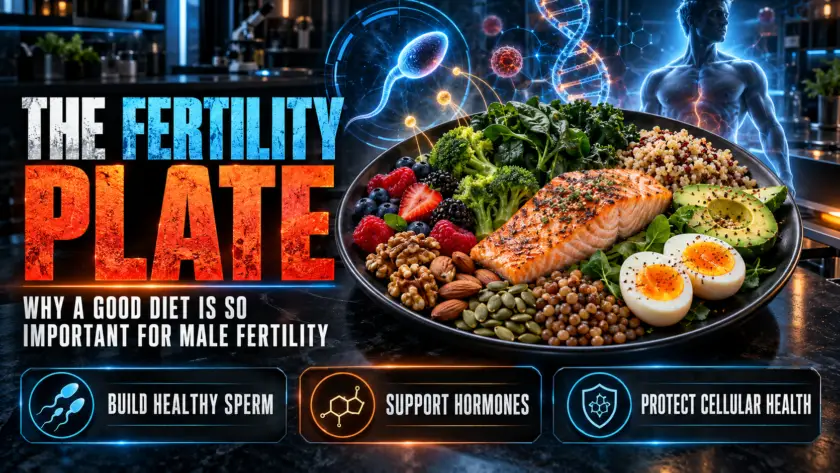
The Alpha Fertility Plate
The Alpha Fertility Plate is a practical meal-building model—not a medical prescription or guarantee of improved semen results.
1. Build the Plant Base
Choose vegetables or fruit of different colours.
Aim for variety across the week rather than forcing every available colour into one meal.
Use fresh, frozen or suitable canned options according to budget and convenience.
2. Add Quality Protein
Include fish, eggs, poultry, lean meat, dairy, beans, lentils, tofu, tempeh or another suitable source.
Rotate sources to improve variety.
3. Choose Higher-Fibre Carbohydrates
Use oats, potatoes with skins, wholegrain bread, brown rice, wholegrain pasta, beans or other appropriate foods.
Carbohydrates are not the enemy of fertility. Source, quantity and overall dietary context matter.
4. Include Better-Quality Fats
Use olive oil, nuts, seeds, avocado, eggs or oily fish in suitable amounts.
Remember that healthy fats remain energy dense.
5. Hydrate Normally
Make water the regular drink without forcing excessive quantities.
6. Repeat Consistently
One impressive meal cannot transform fertility.
Build a pattern capable of surviving busy days, limited time and ordinary life.
PLANTS → PROTEIN → HIGHER-FIBRE CARBOHYDRATES → SUITABLE FATS → WATER → CONSISTENCY
The Male Fertility Food Audit
Answer honestly:
- How many portions of fruit and vegetables do I usually eat?
- How much variety appears across the week?
- Does each main meal contain a meaningful protein source?
- How often do I eat fish?
- Do I regularly eat beans, lentils, nuts or seeds?
- Are most carbohydrates refined or higher in fibre?
- How often do takeaway meals replace home-prepared food?
- How many sugary drinks do I consume?
- How many alcohol units do I consume weekly?
- Do I know what a unit looks like in my usual drink?
- Am I adequately hydrated?
- Is my weight stable, increasing or decreasing?
- Am I crash dieting or under-eating?
- Does my diet exclude a major food group?
- Which supplements am I taking?
- Do any ingredients overlap?
- Has a deficiency been diagnosed?
- Could any supplement interact with medication?
- Have I had a semen analysis?
- Do symptoms or fertility history require professional advice?
The purpose of the audit is not guilt.
It is visibility.
The 90-Day Fertility Nutrition Reset
The reset is designed to improve nutritional consistency over approximately one sperm-development window. It does not promise that every semen parameter will improve.
Weeks 1–2: Observe
Record:
- Meals
- Snacks
- Drinks
- Alcohol
- Supplements
- Takeaway meals
- Fruit and vegetable portions
- Hunger and energy patterns
Do not improve the record by leaving out inconvenient choices.
Weeks 3–4: Remove the Largest Weakness
Choose one recurring problem:
- Sugary drinks
- Frequent takeaway meals
- Inadequate vegetables
- Excessive alcohol
- Skipped meals
- Unplanned evening eating
- Reliance on processed snacks
Replace it with a defined alternative.
Weeks 5–8: Build Five Repeatable Meals
Create five meals that contain:
- Vegetables or fruit
- Quality protein
- Higher-fibre carbohydrates where suitable
- An appropriate fat source
Make the ingredient list affordable and easy to obtain.
Weeks 9–12: Strengthen the System
Improve:
- Shopping routines
- Batch preparation
- Portion awareness
- Workday meals
- Alcohol-free days
- Sleep
- Training and recovery
- The environment influencing food choices
End-of-Reset Review
Assess:
- Dietary consistency
- Energy
- Weight trend
- Alcohol intake
- Supplement use
- Barriers
- Whether medical follow-up is required
- Whether repeat semen testing is due
The reset succeeds when a healthier pattern becomes easier to continue—not only when a number changes.
A Seven-Day Fertility Plate Starter
Day 1: Record Without Judgement
Write down everything eaten and drunk.
Day 2: Add Two Colours
Add two different vegetables or fruits to the day.
Day 3: Strengthen Breakfast
Build breakfast around protein, fibre and a fruit or vegetable where practical.
Day 4: Replace One Processed Meal
Prepare one balanced meal from recognisable ingredients.
Day 5: Review Alcohol
Calculate the week’s actual units and identify one reduction.
Day 6: Build the Shopping List
Choose ingredients for three repeatable fertility-plate meals.
Day 7: Prepare the Environment
Batch-cook, organise snacks, fill the freezer and remove one recurring dietary obstacle.
Frequently Asked Questions
What is the best diet for male fertility?
There is no single proven fertility diet that guarantees conception. A strong foundation is a varied, balanced eating pattern containing vegetables, fruit, higher-fibre carbohydrates, suitable protein sources and unsaturated fats while supporting a healthy weight and limiting excessive alcohol.
Can diet increase sperm count?
Diet may support the health environment in which sperm are produced, particularly when it improves nutritional adequacy or weight-related health. It cannot guarantee a higher count or correct every cause of low sperm production.
Which foods support sperm motility?
No single food can promise improved motility. Build a varied pattern containing vegetables, fruit, fish, eggs, beans, pulses, wholegrains, nuts, seeds and other minimally processed foods according to your needs.
How long should I improve my diet before repeating a semen analysis?
Follow the clinician or laboratory’s instructions. The NHS states that a repeat analysis after an abnormal result is usually performed around three months later, although severe abnormalities may require a different timeline.
Are eggs good for male fertility?
Eggs can contribute protein, fats and micronutrients to a balanced diet. They should be viewed as one useful food—not a treatment for low sperm count or poor motility.
Is fish beneficial for sperm health?
Fish can provide protein and, in oily fish, omega-3 fatty acids. It fits well within a balanced diet, but eating fish does not guarantee improved semen results.
Do nuts improve sperm quality?
Nuts provide unsaturated fats, protein, fibre and micronutrients. Some research has explored their relationship with semen quality, but they should not be marketed as a guaranteed fertility intervention. Use suitable portions as part of the wider diet.
Should men avoid red meat?
Red meat does not need to be automatically eliminated. Lean, minimally processed meat can fit into a balanced diet. Variety matters, and processed meats should not dominate protein intake.
Can being overweight affect male fertility?
Yes. WHO associates obesity with a higher chance of infertility, and the NHS advises weight loss when an overweight man has low sperm count. Weight is one factor and should be addressed without assuming it explains every fertility problem.
Does sugar damage sperm?
It is inaccurate to claim that one sugary food directly destroys sperm. However, a pattern high in sugary drinks and heavily processed foods may displace better nutrition and make weight management more difficult.
How much alcohol should a man drink when trying to conceive?
The NHS advises no more than fourteen units weekly, spread across three or more days, for men with low sperm count. Drinking less may be appropriate, and some fertility services advise minimising alcohol.
Does drinking more water increase semen volume?
Adequate hydration supports normal health, but forcing excessive water is not a proven treatment for low semen volume. Persistently low volume should be interpreted professionally.
Are male-fertility supplements worth taking?
They may be appropriate for a documented deficiency or specific clinical recommendation. However, AUA/ASRM guidance describes the fertility benefits of antioxidant and vitamin supplements as uncertain. Review ingredients, doses, medicines and medical history with a qualified professional.
Can a vegetarian or vegan diet support male fertility?
Yes, a well-planned vegetarian or vegan diet can support general health. Men avoiding animal products should pay particular attention to nutrients such as vitamin B12, vitamin D, iodine, selenium, calcium, iron, protein and omega-3 sources.
Should both partners improve their diets?
Preconception health is a shared responsibility. Both partners can benefit from balanced nutrition, healthy lifestyle habits and appropriate medical advice without blaming either person for conception difficulties.
When should a man seek professional fertility help?
The NHS advises seeing a GP after one year of regular unprotected sex without conception, or after six months if the female partner is thirty-six or older. Seek help sooner for known reproductive conditions, testicular concerns, sexual difficulties, previous cancer treatment or other significant risks.
Final Message: Feed the Body Responsible for Your Future
Your fertility is not created at the moment you decide you want a child.
The body responsible for producing sperm has been influenced by years of meals, habits, weight changes, alcohol, sleep, stress, health conditions and environmental exposures.
That history should not create panic.
It should create responsibility.
You cannot return to every previous meal.
You can change the next one.
You cannot guarantee that a bowl of vegetables, a piece of fish or a handful of nuts will improve your semen analysis.
You can stop asking one food to perform the work of an entire lifestyle.
You can build breakfasts that provide more than sugar and convenience.
You can make vegetables part of the meal rather than decoration.
You can choose protein sources deliberately.
You can replace some refined foods with higher-fibre options.
You can reduce alcohol.
You can review supplements instead of assuming more capsules create more fertility.
You can address weight without attacking yourself.
You can obtain a semen analysis instead of guessing.
You can seek professional help when the result or history requires it.
A good diet is important for male fertility because sperm are produced within the man’s wider health—not outside it.
The fertility plate is therefore not only about sperm.
It supports the man who may become a father.
It supports the energy required to provide, lead and remain present.
It supports cardiovascular and metabolic health that will matter long after conception.
It supports the future family that may need him healthy, capable and alive.
Do not eat well only because you want a better number.
Eat well because fatherhood, health and responsibility deserve a stronger foundation.
Closing Declaration
I will stop searching for one food to solve what requires a complete foundation.
I will feed the body responsible for producing my future sperm.
I will build meals around quality, variety and consistency.
I will protect my health without expecting nutrition to control every outcome.
I will not use supplements to disguise a neglected diet.
I will address weight, alcohol and unhealthy habits honestly.
I will seek testing and qualified support when fertility concerns require investigation.
I will remember that reproductive health is being influenced before conception becomes urgent.
My diet will become part of the responsibility I take for my fertility, my health and my future family.
Final Line
You cannot guarantee the sperm your body will produce—but you can stop asking it to build your reproductive future from a diet that neglects the foundations.
Medical Disclaimer
This article provides general educational information and is not a diagnosis, treatment plan or substitute for personalised medical or dietetic advice. Men with fertility concerns, symptoms, abnormal semen results, medical conditions or questions about supplements should speak with a GP, fertility specialist, registered dietitian or other appropriately qualified professional. Do not stop prescribed medication without medical advice.
About Male Fertility Unleashed
Male Fertility Unleashed helps men understand the foundations of sperm production, semen quality, reproductive health and responsible preconception preparation.
The system is designed to help men move from confusion towards informed action through practical education, structured lifestyle foundations and a ninety-day fertility blueprint.
Call to action: EXPLORE MALE FERTILITY UNLEASHED



No spam. Unsubscribe anytime.