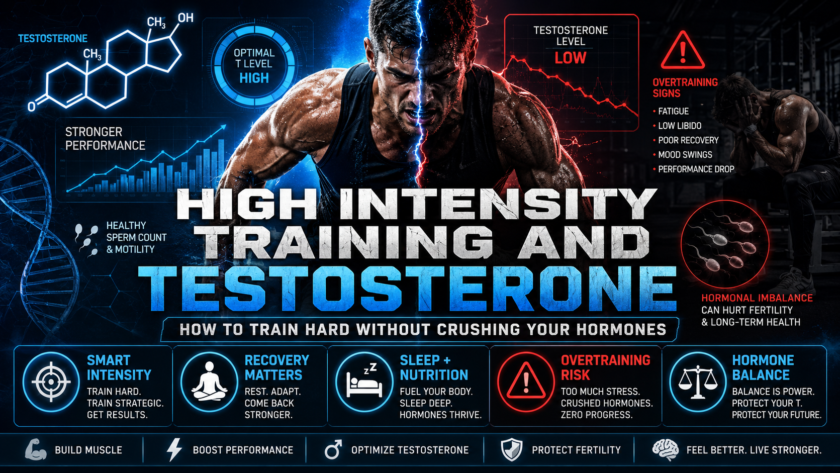
Most men hear high intensity training and think of sweat, aggression, fat loss, discipline, testosterone, and beast mode.
They imagine sprinting until their lungs burn.
They imagine pushing through pain.
They imagine walking out of the gym feeling like they have conquered something.
And yes, high intensity training can be powerful.
But here is where many men get it wrong:
Intensity without recovery is not strength. It is stress.
High intensity training can improve conditioning, support fat loss, build mental toughness, and help a man become fitter, leaner, and more resilient. But if he abuses it, performs it too often, under-eats, sleeps badly, ignores recovery, and turns every workout into punishment, he may not be building testosterone-supportive health.
He may simply be stacking stress on top of stress.
This article explains the relationship between high intensity training and testosterone, how HIIT affects the body, why recovery matters, and how men can train hard without crushing their hormones, energy, libido, and performance.
This is not about training soft.
This is about training smart.
Because the goal is not to destroy yourself.
The goal is to become stronger.
What Is High Intensity Training?
High intensity training usually refers to short bursts of hard physical effort followed by rest or lower-intensity movement.
In fitness, this is often called HIIT, which stands for high intensity interval training.
Examples include:
Sprint intervals
Assault bike intervals
Rowing intervals
Hill sprints
Battle ropes
Kettlebell circuits
Bodyweight circuits
Burpees, push-ups, squats, and mountain climbers
But HIIT is not just random hard exercise.
That is where many men make the first mistake.
They think if they are sweating, suffering, and gasping for air, they must be doing something productive.
Not always.
Done properly, HIIT is structured stress.
It has a purpose.
It has work periods.
It has rest periods.
It has progression.
It has recovery.
The body adapts when the stress is strong enough to create a signal, but not so excessive that recovery collapses.
That is the line men need to understand.
HIIT is not punishment.
HIIT is a tool.
Does HIIT Increase Testosterone?
This is the question many men want answered:
Does HIIT increase testosterone?
The honest answer is: it can influence testosterone, but it is not a magic testosterone switch.
Research suggests that HIIT can cause short-term hormone changes, including changes in testosterone and cortisol, but the long-term effect depends on the man, the training style, recovery, body composition, sleep, nutrition, and stress levels. A review on exercise and testosterone found that the relationship between exercise and testosterone is affected by many factors, including exercise type, intensity, age, weight, and timing.
That means a man should not think:
“I did one brutal HIIT workout, so my testosterone is fixed.”
That is not how the body works.
A better way to think is this:
HIIT may support testosterone indirectly by helping improve body composition, cardiovascular fitness, insulin sensitivity, discipline, and metabolic health. But if it is abused, it can become another stress load the body has to survive.
The testosterone response may depend on:
Age
Fitness level
Body fat
Sleep quality
Nutrition
Workout duration
Training frequency
Recovery
Stress levels
Whether strength training is included
High intensity training can be part of a testosterone-supportive lifestyle.
But it cannot replace the foundation.
Sleep still matters.
Food still matters.
Strength training still matters.
Recovery still matters.
Testosterone vs Cortisol: The Hormone Balance Men Must Understand
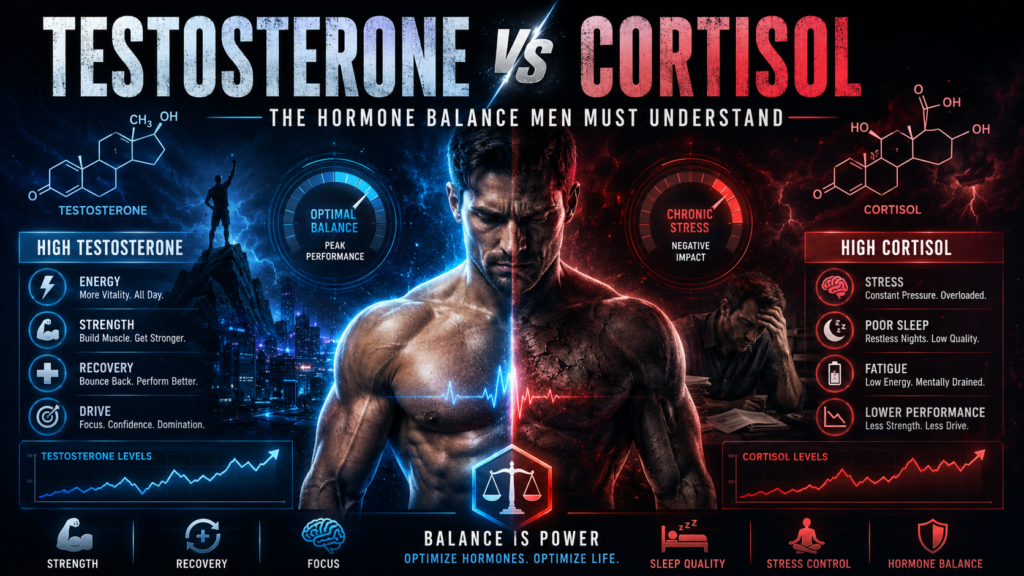
Testosterone is associated with male vitality, libido, muscle, drive, confidence, mood, and reproductive health.
Cortisol is often called the stress hormone.
But cortisol is not evil.
A man needs cortisol. It helps the body respond to stress, wake up, mobilise energy, and deal with challenges.
The problem is not cortisol itself.
The problem is chronic stress without recovery.
When training stress, work stress, poor sleep, under-eating, anxiety, caffeine, late nights, and emotional pressure all stack together, the body can struggle to recover.
That is where men get trapped.
They think they need more intensity.
But what they really need is better recovery.
A systematic review on HIIT and hormones found that testosterone and cortisol can rise immediately after HIIT, then fall below baseline before returning to baseline within 24 hours.
That is important.
It means the hormonal response to HIIT is dynamic. It rises, falls, and recovers.
So the real question is not just:
“Did testosterone rise after my workout?”
The better question is:
“Am I recovering well enough to benefit from the workout?”
Because testosterone is not just built in training.
Testosterone is built in training, but protected in recovery.
Why HIIT Can Be Good for Men
High intensity training can be excellent when used properly.
It can help a man build conditioning, burn energy, improve cardiovascular fitness, and develop the ability to push under pressure. Some research has found that HIIT and moderate-intensity continuous training can improve insulin sensitivity, cardiorespiratory fitness, and body composition markers, though results can vary depending on the group and training protocol.
For men, HIIT can support:
Fat loss
Cardiovascular fitness
Insulin sensitivity
Conditioning
Mental toughness
Time-efficient training
Athletic performance
Discipline under pressure
HIIT teaches a man to move with urgency, breathe under pressure, and recover with control.
There is something powerful about that.
When a man sprints up a hill, attacks the assault bike, or pushes through a brutal interval, he meets himself.
He learns whether he quits when it gets uncomfortable.
He learns whether he can stay calm when his lungs are burning.
He learns whether he can recover, reset, and go again.
That has value.
Not just physically.
Mentally.
But the same tool that builds a man can break him if he uses it without wisdom.
Where Men Go Wrong With HIIT
The biggest problem with HIIT is not the method.
It is the ego.
Many men turn high intensity training into self-punishment.
They do HIIT every day.
They turn every workout into war.
They skip strength training.
They do not eat enough.
They train late at night, then wonder why they cannot sleep.
They ignore soreness, fatigue, low libido, and poor performance.
They use HIIT while already stressed from life, work, business, family, and poor recovery.
They copy athlete workouts without living like athletes.
They think sweat equals progress.
But sweat is not the standard.
Adaptation is the standard.
A man can sweat and still be going backwards.
A man can suffer and still be training badly.
If every workout is war, your body never gets time to rebuild the kingdom.
That is the key.
The body does not grow stronger during the workout.
The workout creates the signal.
Recovery creates the result.
The Recovery Rule
HIIT should be programmed, not abused.
For many men, a sensible general framework may look like this:
Beginners: 1–2 HIIT sessions per week
Intermediate men: 2–3 HIIT sessions per week
Advanced men: 2–4 sessions per week, depending on recovery, training history, and goals
This is not a rigid medical rule. It is a practical training framework.
The right amount depends on your fitness level, age, stress, sleep, nutrition, injury history, and total training volume.
A man who sleeps eight hours, eats well, manages stress, and has years of training experience can usually handle more than a man who sleeps five hours, skips meals, lives on caffeine, and has not trained properly in years.
Recovery signs to monitor include:
Sleep quality
Morning energy
Libido
Mood
Motivation
Resting heart rate
Workout performance
Joint pain
Persistent soreness
Appetite
Irritability
Discipline is not ignoring warning signs.
Discipline is adjusting before your body forces you to stop.
Best HIIT Workouts for Testosterone-Supportive Training
HIIT does not need to be complicated.
In fact, simple is often better.
The goal is not to create the most chaotic workout possible.
The goal is to create a strong training signal, then recover from it.
Before doing intense exercise, men with health conditions, heart concerns, injuries, very low fitness, dizziness, chest pain, or medical uncertainty should speak to a healthcare professional.
Workout 1: Sprint Intervals
Warm up properly with light jogging, mobility, and gradually faster runs.
Then perform:
Sprint hard for 10–20 seconds
Walk for 90–120 seconds
Repeat for 6–10 rounds
This is simple, brutal, and effective.
But sprinting is demanding. Do not go from zero training to full-speed sprints on day one.
Build up.
Respect the body.
Workout 2: Assault Bike Power Intervals
The assault bike is one of the safest ways for many men to push hard because it is lower impact than sprinting.
Try:
20 seconds hard
100 seconds easy
Repeat for 8–10 rounds
The goal is controlled violence.
Hard effort.
Clean breathing.
Full recovery between rounds.
Workout 3: Bodyweight Warrior Circuit
Use:
Push-ups
Squats
Mountain climbers
Burpees
Plank
Work for 30 seconds.
Rest for 30–60 seconds.
Repeat for 3–5 rounds.
This is useful for men training at home, travelling, or building consistency without equipment.
Workout 4: Hill Sprint Session
Hill sprints are powerful because the incline naturally limits speed and may reduce some impact compared with flat-out sprinting on level ground.
Try:
Sprint uphill for 10–15 seconds
Walk back down
Rest fully
Repeat for 6–8 rounds
This is not a casual session.
Warm up properly.
Do not rush progression.
Respect the hill.
HIIT vs Strength Training for Testosterone
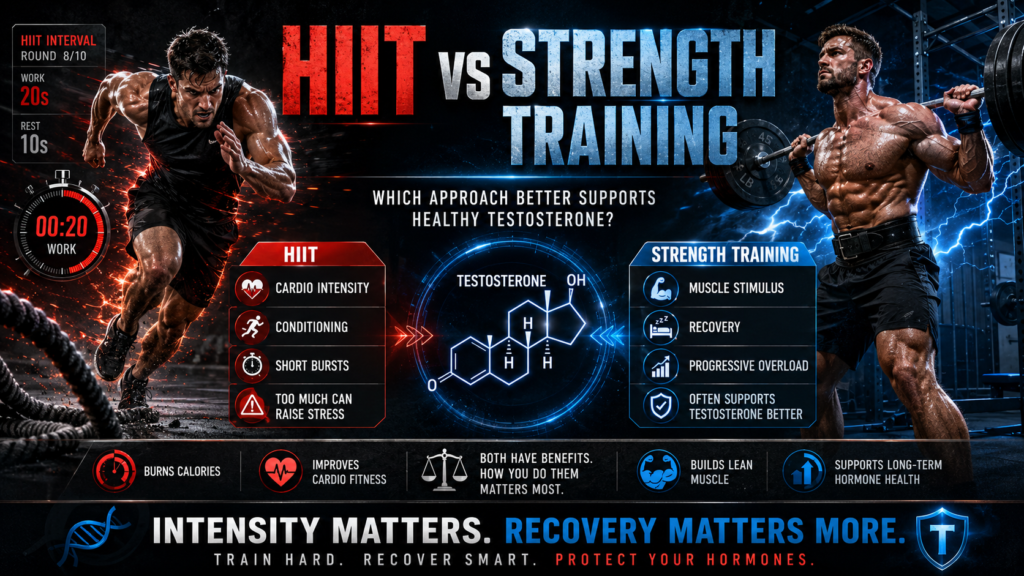
HIIT is powerful, but strength training should be the foundation for most men who want muscle, strength, physique development, and testosterone-supportive health.
Resistance training has a strong connection with male strength and muscle development, and testosterone plays an important role in muscle growth and strength adaptation.
HIIT is the conditioning weapon.
Strength training is the foundation.
Walking is the recovery tool.
Sleep is the multiplier.
Nutrition is the raw material.
The best formula is simple:
Strength training builds the armour. HIIT sharpens the engine. Recovery keeps the system alive.
A strong weekly structure for many men could look like this:
3 days strength training
1–2 days HIIT
1–2 days walking, mobility, or recovery
For example:
Monday: Strength training
Tuesday: Walking or mobility
Wednesday: HIIT
Thursday: Strength training
Friday: Walking or recovery
Saturday: Strength training
Sunday: Optional light walk or rest
This gives a man structure.
It gives him intensity.
But it also gives him recovery.
That is where the power is.
Nutrition for HIIT and Testosterone
You cannot train like a warrior and eat like a man who does not respect his body.
HIIT demands fuel.
Strength training demands fuel.
Hormone health demands fuel.
Recovery demands fuel.
Men who under-eat while doing hard training may feel good for a short burst, but eventually the body pushes back.
Energy drops.
Sleep weakens.
Libido falls.
Motivation fades.
Cravings rise.
Performance declines.
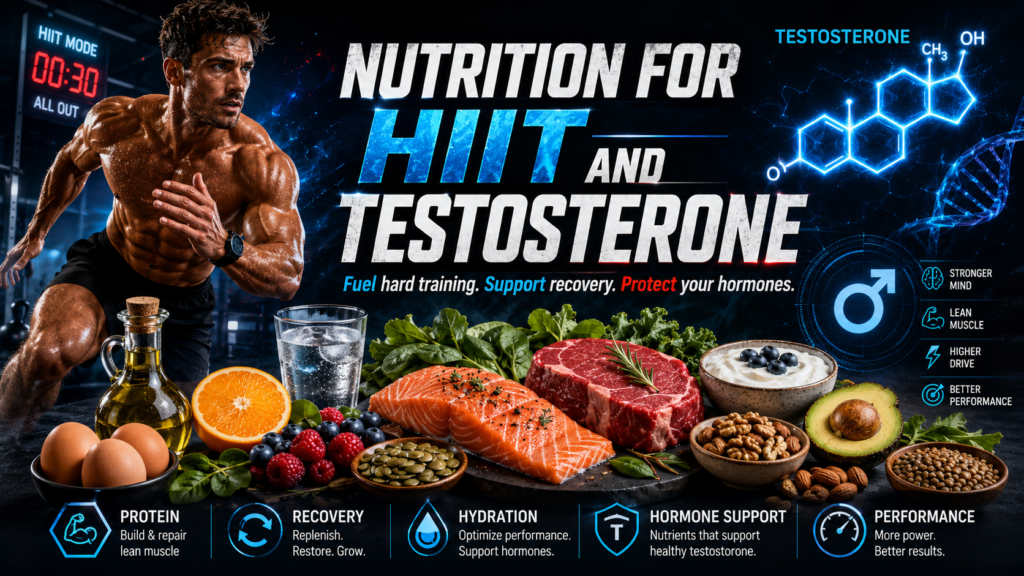
For testosterone-supportive training, men should focus on:
Protein
Healthy fats
Carbohydrates around training
Hydration
Magnesium
Zinc
Vitamin D
Omega-3s
Whole foods
Adequate calories
Protein helps support muscle repair.
Carbohydrates can support intense training performance.
Healthy fats are important in a balanced diet.
Minerals like zinc and magnesium support normal body functions.
Hydration supports performance.
Whole foods support recovery.
This does not mean a man needs a perfect diet.
But he needs standards.
Eggs.
Lean meat.
Oily fish.
Greek yoghurt.
Potatoes.
Rice.
Fruit.
Vegetables.
Olive oil.
Avocado.
Nuts.
Seeds.
Water.
Salt when needed.
Real food.
Real recovery.
Real output.
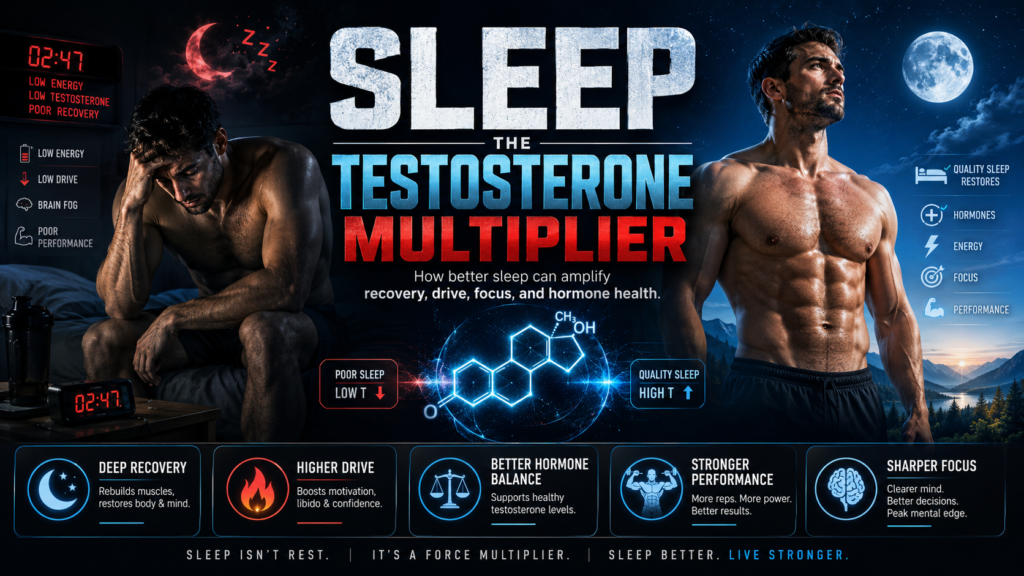
Sleep: The Testosterone Multiplier
If a man wants better testosterone, better training, better recovery, better mood, and better discipline, he cannot treat sleep like an optional extra.
Sleep is not weakness.
Sleep is repair.
One study in healthy young men found that one week of sleep restriction to five hours per night reduced daytime testosterone levels by 10% to 15%.
That should get a man’s attention.
You can train hard.
You can eat well.
You can take supplements.
But if you are sleeping badly, you are fighting your own biology.
HIIT done too late, too often, or too aggressively may interfere with sleep in some men, especially if they are already stressed, over-caffeinated, or under-recovered.
Practical sleep habits include:
Train earlier when possible
Avoid caffeine too late
Cool down properly after intense sessions
Use light walking after hard training
Keep a consistent bedtime
Keep the room cool and dark
Aim for 7–9 hours where possible
A man who sleeps better usually trains better.
A man who trains better usually recovers better.
A man who recovers better builds better.
Signs HIIT Is Helping You
HIIT is probably working well when your body is improving, not collapsing.
Positive signs include:
Energy improves
Body composition improves
Fitness improves
Strength sessions still feel strong
Sleep stays solid
Libido stays stable
Mood improves
Resting heart rate improves
Recovery feels manageable
You feel challenged, not destroyed
This is the sweet spot.
You are pushing.
But you are also adapting.
You feel sharper.
You feel stronger.
You feel more capable.
That is what training should do.
Signs HIIT Is Hurting You
HIIT may be hurting you if the warning signs keep stacking up.
Watch for:
Poor sleep
Low libido
Irritability
Constant fatigue
Declining performance
Persistent soreness
Loss of motivation
Elevated resting heart rate
Increased cravings
Feeling wired but tired
More injuries
More anxiety
No desire to train
These signs do not always mean HIIT is the only problem.
Life stress, diet, work pressure, poor sleep, illness, and emotional stress can all play a role.
But if you are doing frequent HIIT and your body is sending warning signals, pay attention.
A serious man does not ignore feedback.
He studies it.
He adjusts.
He comes back stronger.
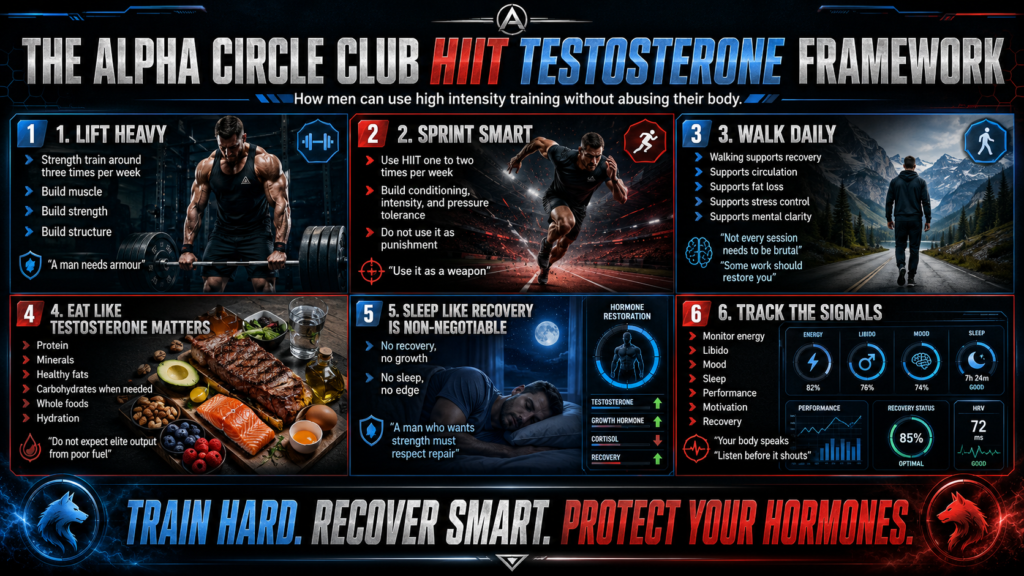
The Alpha Circle Club HIIT Testosterone Framework
Here is a simple framework for men who want to use high intensity training without abusing their body.
1. Lift Heavy
Strength train around three times per week.
Build muscle.
Build strength.
Build structure.
A man needs armour.
2. Sprint Smart
Use HIIT one to two times per week to build conditioning, intensity, and pressure tolerance.
Do not use it as punishment.
Use it as a weapon.
3. Walk Daily
Walking is underrated.
It supports recovery, circulation, fat loss, stress control, and mental clarity.
Not every session needs to be brutal.
Some work should restore you.
4. Eat Like Testosterone Matters
Protein.
Minerals.
Healthy fats.
Carbohydrates when needed.
Whole foods.
Hydration.
Do not expect elite output from poor fuel.
5. Sleep Like Recovery Is Non-Negotiable
No recovery, no growth.
No sleep, no edge.
A man who wants strength must respect repair.
6. Track the Signals
Monitor energy, libido, mood, sleep, performance, motivation, and recovery.
Your body speaks.
Listen before it shouts.
Final Thoughts: Train Hard, Recover Harder
High intensity training can be a powerful tool for men.
But it is not magic.
It does not replace sleep.
It does not replace nutrition.
It does not replace strength training.
It does not replace recovery.
HIIT works best when it is used with discipline.
Not ego.
Not punishment.
Not desperation.
The goal is not to destroy yourself.
The goal is to become stronger, leaner, more conditioned, more disciplined, and more hormonally resilient.
A weak man chases pain to feel productive.
A disciplined man trains with purpose.
He knows when to attack.
He knows when to recover.
He knows when to push.
He knows when to rebuild.
High intensity training is a weapon.
Recovery is the rule that keeps the weapon sharp.
Train hard.
Recover harder.
Build the kind of body that can handle pressure — and still come back stronger.
Want to build a stronger body, sharper discipline, and better male health?
Explore more Alpha Circle Club guides built for men who want strength, testosterone, focus, and long-term vitality.

No spam. Unsubscribe anytime.