Testosterone and sleep are connected more than most men realise.
Most men think testosterone is built in the gym.
They think it comes from lifting heavy, eating steak, taking supplements, and pushing harder.
But part of your testosterone rhythm is built in bed.
When your sleep is broken, your recovery suffers. Your energy drops. Your discipline weakens. Your cravings rise. Your training performance declines. And over time, poor sleep may work against the hormone system that helps support masculine drive, strength, fertility, and confidence.
A man cannot build high-performance testosterone on low-quality sleep.
If you want to raise your standard, you cannot treat sleep like weakness.
You must treat it like recovery.
You must treat it like repair.
You must treat it like biological discipline.
Why Sleep Matters for Testosterone
Sleep is not wasted time.
Sleep is when the body repairs, regulates, and rebuilds.
When a man sleeps properly, he gives his body the conditions it needs to recover from training, regulate stress, support energy, sharpen focus, and maintain a healthier internal rhythm. Testosterone is part of that rhythm.
Testosterone does not stay at the same level all day. It follows a daily pattern, often rising during sleep and tending to be higher in the morning. Research has shown that sleep contributes significantly to the daily testosterone rhythm in men, which is one reason poor sleep should not be ignored by men who care about hormone health.
This is where many men get it wrong.
They think sleeping less makes them tougher.
They think pushing through exhaustion proves discipline.
They think late nights, caffeine, and willpower are enough.
But if your body is under-recovered, your performance eventually pays the price.
A man who disrespects sleep disrespects recovery.
And a man who disrespects recovery cannot expect his body to keep operating at a high level forever.
Does Poor Sleep Lower Testosterone?
The honest answer is that sleep and testosterone research is not always perfectly simple.
One bad night does not automatically destroy your testosterone.
But repeated poor sleep, chronic under-recovery, and extreme sleep deprivation can work against the hormonal foundation serious men should protect.
A well-known controlled study found that when young healthy men were restricted to 5 hours of sleep per night for one week, their daytime testosterone levels dropped by around 10% to 15%.
That is not something to ignore.
Another systematic review and meta-analysis found that total sleep deprivation of 24 hours or more reduced male testosterone levels, while short-term partial sleep deprivation did not show a significant effect across all included studies.
So the responsible message is this:
The evidence is not saying one bad night ruins your hormones.
It is saying sleep is part of the hormonal foundation serious men should protect.
If a man is repeatedly sleeping badly, staying up too late, waking through the night, relying on caffeine to function, and dragging himself through the day, he should not only ask, “What supplement should I take?”
He should ask:
Why am I not recovering?
Why is my sleep broken?
Why am I treating rest like it does not matter?
Because testosterone support is not only about adding more.
Sometimes it is about removing what is weakening the system.
The Masculine Cost of Poor Sleep
Poor sleep does not just make you tired.
It makes discipline harder.
A tired man is more likely to skip the gym, crave junk food, lose focus, react emotionally, procrastinate, and choose comfort over standards.
That matters.
Because the masculine edge is not built on motivation alone.
It is built on energy, recovery, clear thinking, controlled emotion, and consistent action.
Poor sleep may affect:
Energy.
Mood.
Motivation.
Training performance.
Recovery.
Libido.
Focus.
Decision-making.
Cravings.
Stress control.
Patience.
Mental sharpness.
Discipline.
This is why sleep must be respected.
A man who sleeps badly often becomes a man who performs badly.
Not because he is weak.
But because his system is running under pressure.
You cannot keep taking withdrawals from the body and expect unlimited output.
Sooner or later, the body demands repayment.
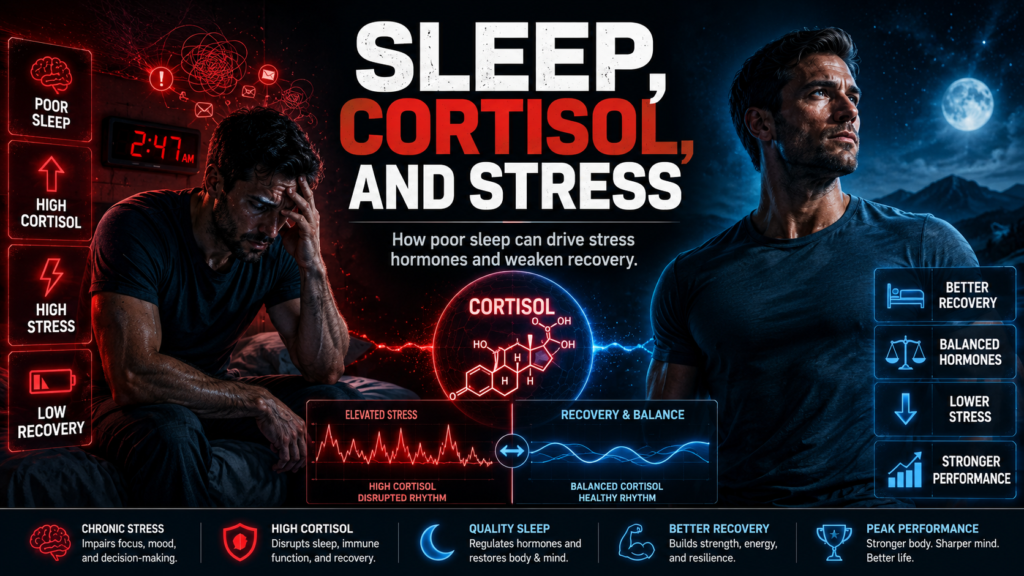
Sleep, Cortisol, and Stress
Sleep and stress are connected.
When sleep is poor, the body can feel more stressed.
When stress is high, sleep can become worse.
Then the loop begins.
You sleep badly, so you wake up tired. You wake up tired, so your focus is weaker. Your focus is weaker, so work feels heavier. Work feels heavier, so stress rises. Stress rises, so the mind is still active at night. Then you sleep badly again.
This is how many men get trapped.
They are not lazy.
They are not broken.
They are under-recovered.
A tired man is not always weak.
Sometimes he is running on a nervous system that has not been given time to calm down.
This matters for testosterone because male hormone health is not separate from the rest of the body. Stress, sleep, training, nutrition, body fat, alcohol, and recovery all interact.
A man cannot live in chaos and expect his biology to produce order.
If your nights are uncontrolled, your mornings will feel harder.
If your evenings are full of screens, stress, caffeine, alcohol, and overstimulation, your body may struggle to switch into recovery mode.
That is not a sleep problem only.
That is a standard problem before bed.
Sleep and Gym Performance
Testosterone is not only about libido.
Men also care about strength, muscle, power, confidence, recovery, and performance.
But training does not work properly without recovery.
You do not grow from training alone.
You grow from training plus recovery.
The gym creates the stimulus.
Sleep helps support the repair.
If your sleep is poor, your training may suffer. You may lift less, recover slower, feel less explosive, lose motivation, struggle with appetite control, and find it harder to stay consistent.
Poor sleep can make it harder to:
Train intensely.
Recover between sessions.
Build muscle.
Stay consistent.
Control appetite.
Avoid late-night eating.
Keep body fat under control.
Avoid skipping workouts.
Maintain a strong mindset.
This is why sleep is not soft.
Sleep is part of the performance system.
A serious man does not only ask, “What is my workout?”
He asks:
Am I recovering from the workout?
Am I sleeping enough to adapt?
Am I giving my body the conditions to grow?
Because if you train like a warrior but sleep like a fool, you are weakening your own results.
Sleep, Testosterone, and Fertility
Testosterone is connected to male reproductive health.
But fertility is bigger than testosterone alone.
Male fertility involves sperm count, sperm motility, sperm shape, sperm DNA quality, hormone signalling, testicular function, oxidative stress, nutrition, sleep, lifestyle, and medical factors.
Sleep may support the wider hormonal environment, energy balance, recovery, stress control, and discipline needed for better male health.
But this is where men need to be careful.
More testosterone is not always better for fertility.
Some men hear “testosterone” and immediately think they need testosterone therapy, anabolic steroids, or aggressive hormone manipulation. That can be dangerous, especially for men who want children.
The Endocrine Society recommends against starting testosterone therapy in men who are planning fertility in the near term.
Why?
Because external testosterone can suppress the hormonal signals involved in sperm production.
That means a man could raise testosterone in the bloodstream while damaging the very system that helps produce sperm.
That is not strength.
That is reckless.
The goal is not shortcuts.
The goal is a healthy hormone system.
Sleep is part of that system.
Training is part of that system.
Nutrition is part of that system.
Medical testing is part of that system.
A man who wants fertility should not gamble with hormones.
He should build the foundation and get proper guidance.
The Biggest Sleep Mistakes Men Make
Most men do not have a sleep problem.
They have a standard problem before bed.
They say they want more energy, more testosterone, more drive, and more discipline — then they sabotage their own recovery every night.
Here are the biggest mistakes.
Staying on the Phone Late at Night
The phone is one of the biggest enemies of deep rest.
Scrolling keeps the mind stimulated. Videos, messages, notifications, arguments, news, and social media keep the brain active when it should be slowing down.
A man cannot expect deep recovery while feeding his mind endless stimulation before bed.
Your phone should not be the last thing your mind obeys at night.
Drinking Caffeine Too Late
Caffeine can be useful.
But timing matters.
Many men drink caffeine too late in the day and then wonder why their sleep is poor. Even if they fall asleep, sleep quality may still be affected.
If you are serious about testosterone support, energy, and recovery, treat caffeine like a tool.
Not a crutch.
Training Too Intensely Too Late
Some men can train in the evening and sleep well.
Others cannot.
Hard late-night training can leave the body stimulated, especially if combined with bright lights, loud music, pre-workout, caffeine, and a racing mind.
Pay attention to your body.
If late training damages your sleep, adjust the standard.
Eating Huge Meals Before Bed
Heavy meals close to bedtime may make sleep more uncomfortable for some men.
This does not mean you must go to bed hungry.
But it does mean your evening eating should support recovery, not overload digestion.
Drinking Alcohol to “Relax”
Alcohol may make you feel sleepy, but it can reduce sleep quality.
This is one of the biggest traps.
A man drinks to unwind, then wakes up tired, foggy, dehydrated, and under-recovered.
That is not recovery.
That is sedation.
Sleeping in a Hot Room
A hot bedroom can make sleep harder.
Your body usually sleeps better in a cooler environment. If your room is too hot, too bright, or too noisy, you are making recovery harder than it needs to be.
Your bedroom should be a recovery chamber.
Not a battlefield.
Inconsistent Bedtime
The body likes rhythm.
If your bedtime is random, your wake time is random, and your routine is random, your energy may become random too.
Consistency matters.
Not perfection.
Consistency.
Working Until the Mind Is Overstimulated
Some men work until the final minute, then expect the mind to switch off instantly.
That is unrealistic.
The brain needs a shutdown process.
A man who wants better sleep needs to create a transition from performance mode to recovery mode.
How to Improve Sleep to Support Testosterone Naturally
You do not need a complicated sleep routine.
You need a consistent one.
Here are practical ways to improve sleep and support your hormonal foundation.
Keep a Consistent Sleep Schedule
Go to bed and wake up around the same time most days.
This helps train your body into a rhythm.
A consistent sleep schedule is not childish.
It is disciplined.
Get Morning Daylight
Morning light helps support your body’s internal clock.
Get outside early if possible.
Walk.
Breathe.
Let your body know the day has started.
The stronger your morning rhythm, the easier your night rhythm can become.
Reduce Caffeine After Midday
Some men can tolerate caffeine later than others, but a safer standard is to reduce or stop caffeine after midday or early afternoon.
If your sleep is poor, this is one of the first things to fix.
Keep the Bedroom Cool, Dark, and Quiet
Your bedroom should support recovery.
Make it dark.
Keep it cool.
Reduce noise.
Remove unnecessary distractions.
A man’s environment shapes his behaviour.
Build an environment that makes sleep easier.
Avoid Screens Before Bed Where Possible
You do not need to be perfect.
But reduce screen time before bed where possible.
Dim lights.
Avoid aggressive content.
Stop scrolling.
Give your brain permission to slow down.
Use a Wind-Down Routine
A good wind-down routine might include:
Preparing clothes for tomorrow.
Writing tomorrow’s priorities.
Stretching lightly.
Reading.
Breathing exercises.
Prayer or reflection.
A warm shower.
Low light.
Calm music.
No phone in bed.
This is not weakness.
This is command.
You are telling your body: the work is done, now recover.
Avoid Heavy Alcohol
If you are serious about sleep, testosterone, fertility, training, and recovery, be careful with alcohol.
You do not need to be perfect.
But you do need to be honest.
If alcohol is damaging your sleep, it is damaging your foundation.
Train Consistently, But Recover Properly
Training supports health, strength, and confidence.
But training must be balanced with recovery.
A man who trains hard and never recovers is not disciplined.
He is incomplete.
Get Tested if You Suspect Sleep Apnoea
Sleep apnoea can severely disrupt sleep and leave men exhausted even after spending enough hours in bed. NHS guidance lists symptoms such as breathing stopping and starting during sleep, gasping or choking noises, waking often, loud snoring, daytime tiredness, difficulty concentrating, mood swings, and morning headaches.
If you suspect sleep apnoea, speak to a healthcare professional.
Do not ignore it.
A serious man investigates warning signs.
The Alpha Sleep Protocol
This is a simple structure you can use to build better sleep discipline.
Morning: Set the Rhythm
Get sunlight.
Hydrate.
Move your body.
Take a walk.
Eat a solid breakfast if that suits your routine.
Start the day with command, not chaos.
Your morning helps set the tone for your night.
Afternoon: Protect the System
Avoid late caffeine.
Train or walk.
Eat protein-rich meals.
Do not let stress build without release.
Keep your work structured.
Stay in control of your energy.
The afternoon is where many men accidentally sabotage the night.
Evening: Begin the Shutdown
Dim the lights.
Reduce screens.
Prepare tomorrow.
Stop overstimulating the mind.
Avoid heavy alcohol.
Avoid unnecessary arguments, doom-scrolling, and stressful content.
Calm the nervous system.
A strong evening routine is not boring.
It is strategic.
Night: Enter Recovery Mode
Keep the room cool.
Keep the room dark.
Keep the phone away from the bed.
Go to bed at a consistent time.
Let the body recover.
Win the night, and you make it easier to win the morning.
When Poor Sleep Needs Medical Attention
Poor sleep is not always just a lifestyle issue.
Sometimes there is a deeper problem.
A man should consider speaking to a healthcare professional if he experiences:
Loud snoring.
Waking up gasping or choking.
Breathing stopping and starting during sleep.
Morning headaches.
Constant daytime tiredness.
High blood pressure.
Poor concentration.
Mood swings.
Falling asleep during the day.
Low libido with severe fatigue.
Waking up repeatedly through the night.
These symptoms may suggest sleep apnoea or another sleep disorder. NHS guidance says symptoms of sleep apnoea can include loud snoring, waking a lot, gasping or choking noises, daytime tiredness, concentration problems, mood swings, and morning headaches.
Do not ignore warning signs because of pride.
Pride does not fix biology.
Data does.
Testing does.
Action does.
A serious man does not ignore warning signs.
He investigates them.
Final Thoughts: Testosterone Is Protected Through Recovery
Before you chase another testosterone booster, fix the foundation your hormones depend on.
Sleep deeper.
Recover harder.
Train smarter.
Reduce stress.
Get morning light.
Cut late-night distractions.
Protect your bedroom like a recovery chamber.
Because testosterone is not just built through effort.
It is also protected through recovery.
Most men want more fire.
But they keep destroying the fuel.
They stay up late, wake up tired, train inconsistently, eat poorly, scroll endlessly, and then wonder why they feel flat.
The answer is not always another supplement.
Sometimes the answer is a higher standard.
Sleep is not weakness.
Sleep is repair.
Sleep is recovery.
Sleep is discipline.
And discipline is the Alpha Standard.

Medical note: This article is for educational purposes only and is not medical advice. If you have symptoms of low testosterone, fertility concerns, severe fatigue, loud snoring, breathing interruptions during sleep, or possible sleep apnoea, speak with a qualified healthcare professional.


No spam. Unsubscribe anytime.