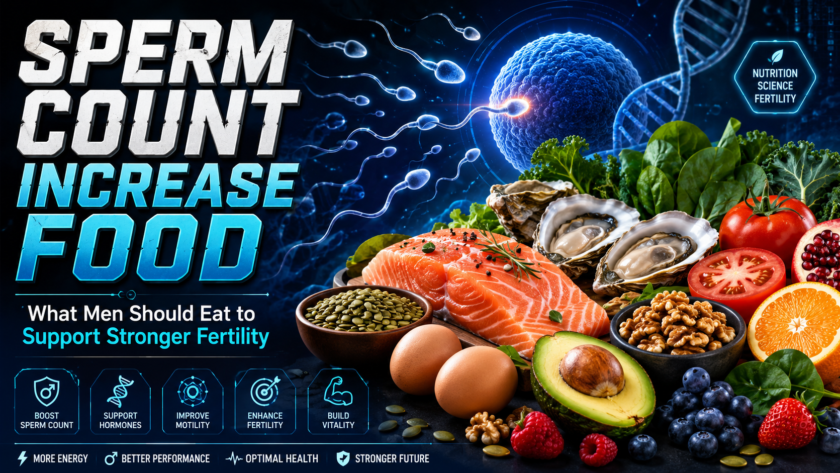
Sperm count increase food is one of the first things many men search for when they want to improve fertility naturally.
They want a simple answer.
They want to know what to eat, what to avoid, and whether food can help them produce stronger, healthier sperm.
But the truth is this:
Male fertility is not built by one magic food, one smoothie, or one supplement.
It is built by the daily environment you create inside your body.
Your sleep.
Your nutrition.
Your stress.
Your body fat.
Your training.
Your habits.
Food matters because food helps build the internal terrain where sperm are created. The right foods may support sperm production, protect sperm cells from oxidative stress, and provide the raw materials needed for stronger male reproductive health.
But food is not magic.
It is a foundation.
And foundations are built daily.
Why Food Matters for Sperm Count
Your sperm are not built from motivation.
They are built from raw materials.
Every day, your body uses nutrients, energy, hormones, minerals, fats, proteins, and antioxidants to maintain your health. Sperm production is part of that system. If the body is underfed, inflamed, stressed, poorly rested, or missing key nutrients, fertility may suffer.
Food does not guarantee fertility. A man can eat well and still have fertility problems caused by medical issues, varicocele, hormone imbalance, infection, medication, genetics, heat exposure, or past steroid use.
But diet quality can still matter.
Research reviews have linked healthier dietary patterns — especially diets rich in omega-3 fatty acids, antioxidants, zinc, selenium, vitamin D, and folate — with better semen quality markers, while diets higher in saturated and trans fats have been associated with poorer semen quality.
That means food should not be treated as a quick fertility hack.
It should be treated as part of a serious male fertility strategy.
Sperm Count Is Only One Part of Male Fertility
Many men focus only on sperm count.
That is understandable. Sperm count matters. If sperm count is low, conception may become more difficult.
But sperm count is not the whole picture.
Male fertility also includes:
Sperm motility — how well sperm move.
Sperm morphology — the shape and structure of sperm.
Sperm DNA quality — the integrity of the genetic material.
Semen volume — the amount of semen produced.
Hormone balance — including testosterone, LH, FSH, and other markers.
Oxidative stress control — how well sperm are protected from damage.
A higher sperm count means more when the sperm are also healthy, mobile, and protected.
That is why the goal should not only be “more sperm.”
The goal should be better sperm health.
A man who wants stronger fertility should think beyond numbers. He should think about the whole system: the food he eats, the damage he reduces, the testing he gets, and the standard he lives by.
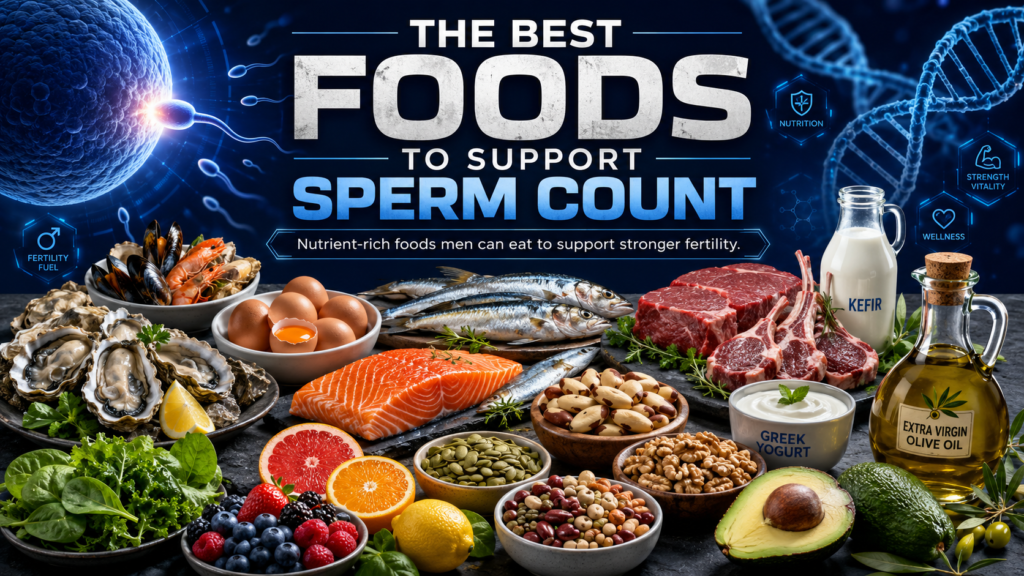
The Best Foods to Support Sperm Count
There is no single best food for sperm count.
The better question is:
What foods support the nutrients, hormones, antioxidants, and internal environment needed for healthy sperm production?
Here are some of the best food groups to consider.
Oysters and Shellfish
Oysters are famous for fertility because they are rich in zinc.
Zinc is an essential mineral involved in many processes in the body, including immune function, cell division, DNA synthesis, and normal reproductive function.
For men, zinc matters because sperm production and reproductive health depend on proper mineral status.
But the key is balance.
If a man is low in zinc, improving zinc intake may help support his foundation. But taking extreme amounts of zinc is not the answer. More is not always better.
Food-first is usually the smarter approach.
Oysters, shellfish, beef, lamb, pumpkin seeds, beans, and nuts can all contribute zinc to the diet.
Eggs
Eggs are simple, affordable, and powerful.
They provide protein, healthy fats, choline, selenium, vitamin B12, and other nutrients that support general health.
For fertility, eggs can fit well into a nutrient-dense diet because sperm production requires raw materials. Protein supports tissue repair and hormone-related processes. Healthy fats support the body’s wider reproductive system. Selenium contributes to antioxidant protection.
Eggs are not a miracle fertility food.
But they are a strong foundation food.
Salmon, Sardines, and Mackerel
Oily fish such as salmon, sardines, and mackerel provide omega-3 fatty acids.
Omega-3 fats are important because sperm cells have membranes, and healthy fats may support membrane quality, inflammation balance, and general reproductive health. Studies and reviews have linked omega-3 fatty acids with improved semen quality parameters in some research, although results should still be interpreted carefully because fertility is complex.
A strong fertility diet should not be built only on protein.
It should also include quality fats.
Oily fish is one of the best ways to get them.
Pumpkin Seeds
Pumpkin seeds are small, but they carry serious nutritional value.
They contain zinc, magnesium, healthy fats, and plant-based protein.
For men who want a simple fertility-supportive snack, pumpkin seeds are a strong option. They can be added to porridge, Greek yogurt, salads, smoothies, or eaten on their own.
Again, the point is not magic.
The point is consistency.
A handful of pumpkin seeds will not transform fertility overnight.
But repeated nutrient-dense choices help build a better internal environment.
Brazil Nuts
Brazil nuts are known for selenium.
Selenium is involved in antioxidant defence and has been studied in relation to male fertility and sperm quality. Some research has found selenium supplementation may improve certain semen parameters, but the evidence should be handled carefully and not turned into exaggerated claims.
Brazil nuts are powerful because they can be very high in selenium.
That also means you should not overdo them.
One or two Brazil nuts a day may be enough for many people, depending on diet and selenium content. Excess selenium can be harmful, so this is not a “more is better” food.
The Alpha Standard is not excess.
It is precision.
Leafy Greens
Leafy greens such as spinach, kale, rocket, watercress, and Swiss chard provide folate, magnesium, vitamin C, vitamin K, and antioxidants.
Folate is involved in DNA synthesis and cell division, which makes it relevant to reproductive health. Because sperm carry genetic material, nutrients involved in DNA-related processes matter.
Leafy greens also support overall health, digestion, and micronutrient intake.
A man serious about fertility should not eat like a child.
He needs greens.
He needs minerals.
He needs discipline on the plate.
Berries
Berries are rich in vitamin C, polyphenols, and antioxidants.
This matters because sperm are vulnerable to oxidative stress. Antioxidant-rich foods help support the body’s defence systems. Reviews on male fertility have discussed antioxidants such as zinc, selenium, omega-3 fatty acids, CoQ10, and carnitines in relation to sperm quality, but the evidence varies depending on the nutrient and study design.
Berries are not just “healthy.”
They are useful because they help shift the diet away from processed snacks and toward nutrient-dense food.
Blueberries, strawberries, raspberries, and blackberries can all fit into a fertility-supportive diet.
Citrus Fruits
Oranges, lemons, grapefruit, and kiwi provide vitamin C.
Vitamin C is an antioxidant and supports immune health, collagen formation, and general wellbeing. For fertility, antioxidant support matters because oxidative stress can damage sperm cells.
Citrus fruits are an easy daily addition.
Add fruit to breakfast.
Add lemon to water.
Add orange slices after training.
Keep it simple.
Simple standards repeated daily beat complicated plans that never happen.
Avocado
Avocado provides healthy fats, fibre, potassium, vitamin E, and other nutrients.
Vitamin E is an antioxidant that helps protect cell membranes from oxidative damage. Because sperm membranes are important for function, foods containing healthy fats and antioxidants can fit well into a fertility-supportive diet.
Avocado is not essential.
But it is useful.
Especially when it replaces ultra-processed spreads, fried sides, or low-quality snack foods.
Extra Virgin Olive Oil
Extra virgin olive oil is a key part of a Mediterranean-style diet.
Mediterranean-style eating patterns are often associated with better general health and have been discussed in male fertility research because they tend to include fish, vegetables, fruit, legumes, nuts, olive oil, and fewer ultra-processed foods.
A fertility-supportive diet does not need to be extreme.
It needs to be high quality.
Extra virgin olive oil is one of the simplest upgrades a man can make.
Use it on salads.
Use it with vegetables.
Use it instead of low-quality oils where appropriate.
Small upgrades repeated daily create momentum.
Lentils and Beans
Lentils, chickpeas, black beans, kidney beans, and other legumes provide folate, fibre, plant protein, magnesium, and minerals.
They also support gut health and help create a more balanced diet.
For men who eat too much processed food and not enough fibre, beans and lentils are a serious upgrade.
Fertility nutrition is not only about “masculine” foods like steak and eggs.
It is about the full nutritional picture.
A strong man eats for function.
Beef or Lamb in Moderation
Beef and lamb can provide protein, zinc, iron, creatine, B vitamins, and other nutrients.
For some men, moderate amounts of high-quality red meat can fit into a fertility-supportive diet.
But balance matters.
A diet dominated by processed meats, fried foods, and low-quality takeaways is not the same as a diet that includes lean, high-quality meat alongside vegetables, fruit, fish, nuts, seeds, and whole foods.
The issue is not one food.
The issue is the overall pattern.
Greek Yogurt or Kefir
Greek yogurt and kefir can provide protein, calcium, and potentially beneficial bacteria if tolerated.
Gut health is not separate from overall health. Digestion, nutrient absorption, inflammation balance, and metabolic health all matter.
Choose plain versions where possible.
Avoid turning yogurt into dessert by adding loads of sugar.
A fertility-supportive diet should support the body, not overload it.
Nutrients That Matter for Sperm Health
Instead of only asking, “What foods increase sperm count?” it is better to ask:
What nutrients support sperm health?
Here are some of the key nutrients to know.
Zinc
Zinc supports many functions linked to male reproductive health, cell division, and DNA synthesis. It is found in oysters, shellfish, beef, lamb, pumpkin seeds, beans, and nuts.
Selenium
Selenium contributes to antioxidant defence and has been studied in relation to sperm motility and sperm function. Brazil nuts, seafood, eggs, and some meats can provide selenium.
Folate
Folate is involved in DNA synthesis and cell division. Leafy greens, lentils, beans, asparagus, avocado, and fortified foods can provide folate.
Vitamin C
Vitamin C is an antioxidant that helps protect cells from oxidative stress. Citrus fruits, kiwi, berries, peppers, and broccoli are strong sources.
Vitamin E
Vitamin E helps protect cell membranes. Avocado, nuts, seeds, olive oil, and some leafy greens can contribute vitamin E.
Omega-3 Fatty Acids
Omega-3 fats support cell membrane health and have been studied in relation to semen quality. Oily fish such as salmon, sardines, and mackerel are strong food sources.
Vitamin D
Vitamin D supports bone health, immune function, muscle function, and wider male health. Low levels are common in many people, especially those with limited sunlight exposure. If concerned, testing is better than guessing.
Protein
Protein supplies amino acids needed for tissue repair, recovery, hormones, enzymes, and general health. Eggs, fish, meat, poultry, Greek yogurt, beans, lentils, and quality protein sources can all contribute.
The goal is not to chase one nutrient.
The goal is to build a diet that repeatedly gives your body what it needs.
Antioxidant Foods: Protecting Sperm From Oxidative Stress
Oxidative stress is one of the silent enemies of sperm quality.
Sperm cells are vulnerable to oxidative damage because their membranes contain delicate fats and they carry genetic material. When oxidative stress becomes too high, it may affect sperm motility, sperm DNA, and overall sperm function. Antioxidant-rich diets and antioxidant nutrients have been studied as possible ways to support semen quality, but they should be viewed as support tools rather than guaranteed fertility cures.
Strong antioxidant foods include:
Berries.
Kiwi.
Oranges.
Peppers.
Spinach.
Broccoli.
Tomatoes.
Pomegranate.
Green tea.
Dark leafy vegetables.
These foods help give the body defensive tools.
But antioxidants are not an excuse to keep damaging the system.
You cannot eat berries at breakfast and then destroy your health with cigarettes, alcohol, poor sleep, and processed food every night.
That is not a strategy.
That is contradiction.
Foods Men Should Reduce for Better Sperm Health
Fertility nutrition is not only about what you add.
It is also about what you stop allowing to damage your system.
A man trying to support sperm count and fertility should consider reducing:
Ultra-processed foods.
Trans fats.
Excess sugar.
Heavy alcohol.
Processed meats.
Deep-fried foods.
Too many refined carbs.
Poor-quality takeaway meals.
Sugary drinks.
Constant snacking on low-quality foods.
This does not mean you need a perfect diet.
But it does mean you need an honest one.
If most of your calories come from processed food, alcohol, sugar, and takeaway meals, you are not building a strong fertility foundation.
You are asking your body to perform while giving it poor materials.
That is not the Alpha Standard.
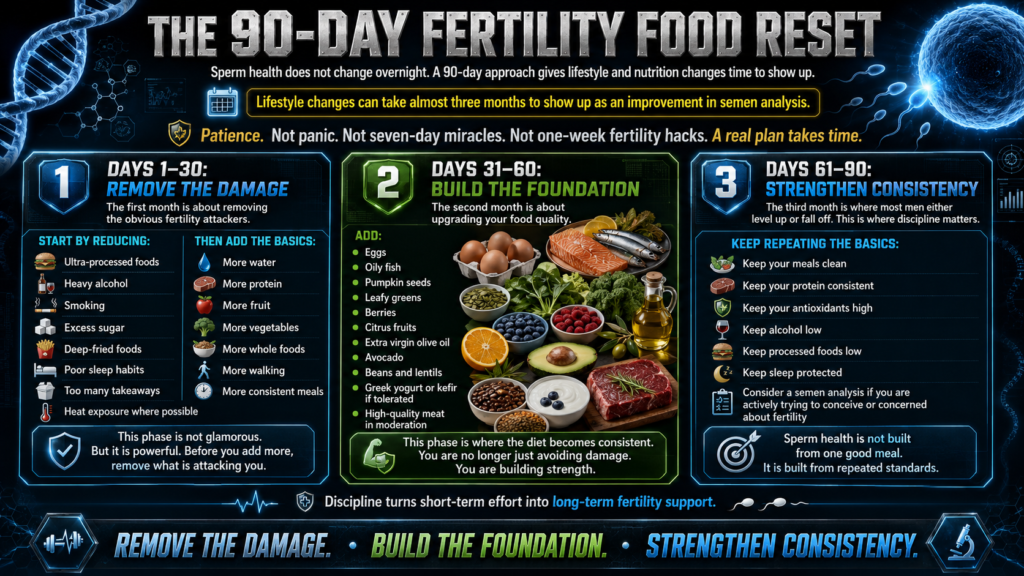
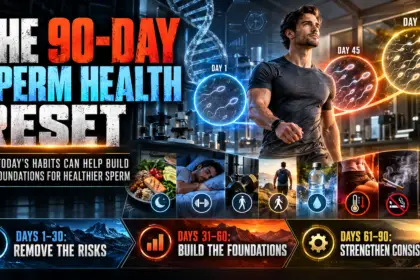
The 90-Day Fertility Food Reset
Sperm health does not change overnight.
That is why a 90-day approach makes sense.
The American Society for Reproductive Medicine says lifestyle changes can take almost three months to show up as an improvement in semen analysis.
That means men need patience.
Not panic.
Not seven-day miracles.
Not one-week fertility hacks.
A real plan takes time.
Days 1–30: Remove the Damage
The first month is about removing the obvious fertility attackers.
Start by reducing:
Ultra-processed foods.
Heavy alcohol.
Smoking.
Excess sugar.
Deep-fried foods.
Poor sleep habits.
Too many takeaways.
Heat exposure where possible.
Then add the basics:
More water.
More protein.
More fruit.
More vegetables.
More whole foods.
More walking.
More consistent meals.
This phase is not glamorous.
But it is powerful.
Before you add more, remove what is attacking you.
Days 31–60: Build the Foundation
The second month is about upgrading your food quality.
Add:
Eggs.
Oily fish.
Pumpkin seeds.
Leafy greens.
Berries.
Citrus fruits.
Extra virgin olive oil.
Avocado.
Beans and lentils.
Greek yogurt or kefir if tolerated.
High-quality meat in moderation.
This phase is where the diet becomes consistent.
You are no longer just avoiding damage.
You are building strength.
Days 61–90: Strengthen Consistency
The third month is where most men either level up or fall off.
This is where discipline matters.
Keep repeating the basics.
Keep your meals clean.
Keep your protein consistent.
Keep your antioxidants high.
Keep alcohol low.
Keep processed foods low.
Keep sleep protected.
Consider a semen analysis if you are actively trying to conceive or concerned about fertility.
Sperm health is not built from one good meal.
It is built from repeated standards.
The Alpha Fertility Plate
If you want a simple way to build fertility-supportive meals, use the Alpha Fertility Plate.
Build each meal around five areas.
Protein: eggs, fish, chicken, beef, Greek yogurt, lentils, beans.
Healthy fats: olive oil, avocado, nuts, seeds, oily fish.
Antioxidants: berries, citrus, leafy greens, peppers, broccoli.
Minerals: oysters, pumpkin seeds, Brazil nuts, beef, eggs.
Quality carbs: potatoes, oats, rice, beans, fruit.
This does not need to be complicated.
A fertility-supportive meal could be:
Eggs, spinach, avocado, and berries.
Salmon, rice, broccoli, and olive oil.
Greek yogurt, pumpkin seeds, blueberries, and oats.
Beef, sweet potato, leafy greens, and citrus fruit.
Lentil stew with olive oil, vegetables, and a side of fruit.
Every meal is either supporting your future or weakening your foundation.
Choose with standards.
When Food Is Not Enough
Food can support fertility.
But food cannot fix every cause of low sperm count.
A man should consider medical testing if he and his partner have been trying to conceive without success. The NHS advises seeing a GP if pregnancy has not happened after a year of trying, and sooner if the female partner is 36 or older or if either partner already knows there may be a fertility problem.
The World Health Organization defines infertility as failure to achieve pregnancy after 12 months or more of regular unprotected sexual intercourse.
A man should also consider getting checked if he has:
A history of TRT or anabolic steroid use.
Testicular pain or swelling.
Possible varicocele.
Very low libido.
Symptoms of low testosterone.
Past chemotherapy.
Past testicular injury.
Previous infections.
Abnormal semen analysis results.
Difficulty conceiving.
A history of undescended testicles.
Medication use that may affect fertility.
A semen analysis can give useful information about sperm count, motility, morphology, semen volume, and other markers. Fertility clinics and medical guidance commonly use semen analysis as an early step in evaluating male fertility.
A serious man does not hide behind guesswork.
He gets tested.
Final Thoughts: Build the Body That Produces Stronger Sperm
Before you search for another miracle fertility food, build the body that produces stronger sperm.
Eat better.
Sleep deeper.
Train smarter.
Reduce alcohol.
Avoid smoking.
Protect your testicles from unnecessary heat.
Get tested if needed.
Raise your standard.
Because sperm health is not just about reproduction.
It is about responsibility.
Your future family deserves more than random habits and hopeful guesses.
Your body needs raw materials.
Your sperm need protection.
Your fertility needs consistency.
There is no single food that guarantees higher sperm count.
But there is a standard that gives your body a better chance.
A diet rich in protein, omega-3 fats, antioxidants, zinc, selenium, folate, vitamin C, vitamin E, and whole foods can help support the internal environment where sperm are produced.
That is the real message.
Not magic.
Not hype.
Not one superfood.
A higher standard.
Repeated daily.
That is the Alpha Standard.

Medical note: This article is for educational purposes only and is not medical advice. If you are concerned about sperm count, fertility, hormones, or conception, speak with a qualified healthcare professional, GP, urologist, or fertility specialist.



No spam. Unsubscribe anytime.