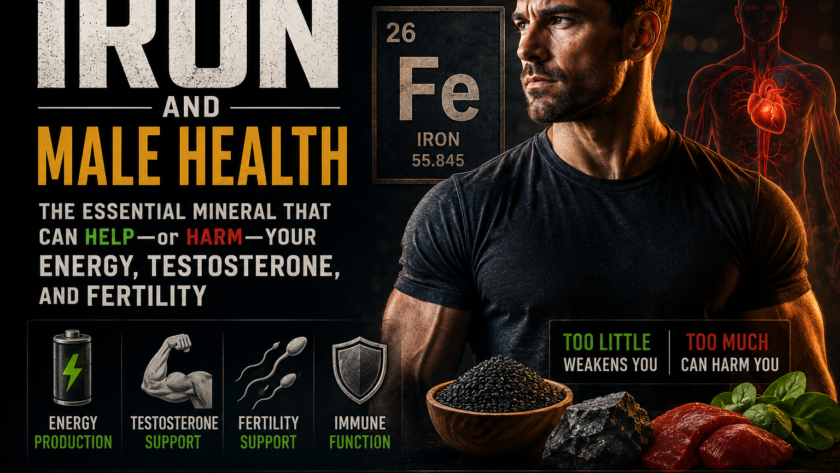
It is built into the language of masculinity: iron discipline, iron will, iron body.
But inside the human body, iron is not simply a symbol of power. It is a tightly controlled mineral that can support a man’s energy, performance, mental clarity, hormone function, and reproductive health—or quietly damage them when levels become excessive.
That is what makes iron different from many of the nutrients promoted within the health and fitness industry.
A man who is deficient may feel exhausted, weak, breathless, mentally foggy, and unable to perform at his best. However, a man who accumulates too much iron may also experience fatigue, weakness, reduced sex drive, joint pain, hormone disruption, and progressive organ damage.
The symptoms can overlap, but the solutions are completely different.
One man may genuinely need more iron. Another may need to stop taking it. A third may have an underlying medical problem that requires investigation rather than another supplement.
This is why the Alpha Circle Club position is clear:
Iron is not a mineral men should blindly supplement. It is a mineral men should understand.
Why Iron Matters for Men
Iron is essential because it forms part of haemoglobin, the protein inside red blood cells that carries oxygen from the lungs to tissues throughout the body.
It is also present in myoglobin, a protein that helps supply oxygen to muscle tissue. Beyond oxygen transport, iron contributes to cellular function, neurological health, physical growth, muscle metabolism, and the production of certain hormones. me you walk, think, train, work, recover, or concentrate, your cells require energy.
To create that energy efficiently, they need oxygen.
Iron helps make that oxygen delivery possible.
When your iron status is healthy, you may never think about it. Your red blood cells transport oxygen, your muscles receive the resources they need, and energy production continues in the background.
When iron becomes too low, that system begins to struggle.
Your blood may become less capable of transporting oxygen effectively. Everyday tasks can feel harder. Exercise may become more demanding. Concentration can decline. Recovery may feel slower.
Iron does not create discipline, fitness, or strength by itself. However, inadequate iron can make it considerably harder to express the strength you have built.
Iron Is Essential—but More Is Not Automatically Better
The body requires iron, but it also controls iron carefully.
Unlike certain nutrients that can be readily removed through urine, the body has a limited ability to eliminate excess iron. Most iron is recycled, stored, or reused. This makes iron balance extremely important.
Too little can interfere with oxygen transport and normal cellular function.
Too much can accumulate in tissues and contribute to oxidative damage.
Iron therefore follows a biological principle that men should remember:
The correct amount supports performance. The wrong amount creates dysfunction.
The goal is not to drive iron as high as possible.
The goal is to maintain an appropriate iron status for your individual body, health, diet, training demands, medical history, and current circumstances.
Signs a Man May Be Low in Iron
Iron deficiency does not always announce itself dramatically. It may develop gradually, with symptoms becoming normalised over time.
A man may assume he is tired because he is working too hard. He may blame his poor gym performance on age, stress, low motivation, or inadequate sleep. He may increase caffeine, change his training plan, or buy another supplement without identifying the real problem.
Common symptoms of iron-deficiency anaemia include:
- Persistent tiredness
- Low energy
- Shortness of breath
- Heart palpitations
- Paler-than-usual skin
- Headaches
Some people may also experience hair loss, changes in taste, a sore tongue, restless legs, difficulty swallowing, or unusual cravings for non-food substances such as ice. th low iron may also notice:
- Reduced exercise tolerance
- Unexplained weakness
- Poor stamina
- Difficulty concentrating
- Feeling colder than usual
- Slower recovery
- A noticeable decline in normal physical output
These symptoms do not prove that iron is low. Fatigue and poor performance can result from sleep deprivation, low calorie intake, overtraining, thyroid problems, vitamin B12 deficiency, infection, depression, low testosterone, cardiovascular disease, and many other conditions.
The symptoms are a reason to investigate—not a reason to diagnose yourself.
Why Iron Deficiency Can Be Overlooked in Men
Iron deficiency is often discussed in connection with menstruation and pregnancy. As a result, some men assume that iron deficiency cannot affect them.
It can.
Men generally lose less iron than menstruating women, but they can still become deficient through chronic blood loss, digestive problems, poor absorption, an inadequate diet, frequent blood donation, surgery, certain medications, or underlying disease.
Bleeding within the stomach or intestines is an important potential cause. Ulcers, inflammatory bowel conditions, haemorrhoids, regular use of non-steroidal anti-inflammatory drugs such as ibuprofen or aspirin, and—less commonly—gastrointestinal cancers can contribute to blood loss and iron-deficiency anaemia. Society of Gastroenterology guidance emphasises that confirmed iron-deficiency anaemia should be treated while the underlying cause is appropriately investigated. In adult men, unexplained iron deficiency should not simply be blamed on diet without considering other possible causes. tinction matters.
Iron tablets may temporarily improve a laboratory value while the original cause of the iron loss continues.
The Alpha approach is not:
“My iron is low, so I will take a supplement forever.”
It is:
“Why is my iron low, what needs correcting, and how will I confirm that the problem has been resolved?”
Low iron is not only a nutritional problem. In some men, it is a signal.
Iron, Energy, and Physical Performance
Iron’s relationship with energy begins with oxygen.
During physical activity, working muscles require increased oxygen delivery. Haemoglobin transports oxygen through the blood, while myoglobin helps make oxygen available within muscle tissue.
When iron stores decline far enough to affect red blood cell production and haemoglobin, oxygen transport can become impaired. This may lead to fatigue, breathlessness, weakness, and reduced exercise capacity. y notice that:
- His usual weights feel heavier.
- He becomes breathless earlier.
- His heart rate feels unusually elevated.
- His endurance declines.
- He needs longer between sets.
- He struggles to maintain concentration during training.
- Recovery between sessions becomes more difficult.
However, taking iron when you are not deficient will not automatically improve oxygen delivery.
Once the body has enough iron to perform its normal functions, additional iron does not turn the blood into a superior oxygen-delivery system. It may only increase the risk of side effects or excess accumulation.
Iron is not a pre-workout stimulant.
It is not a shortcut to endurance.
It is not a substitute for sleep, programming, nutrition, cardiovascular conditioning, or recovery.
Correcting a genuine deficiency may restore lost capacity. Taking unnecessary iron will not create superhuman capacity.
Iron and Brain Function
The brain is one of the most energy-demanding organs in the body.
Iron supports neurological development and cellular function, while adequate oxygen delivery helps the brain continue performing its demanding work. ps explain why low iron can be associated with more than physical tiredness. Some men describe:
- Brain fog
- Reduced concentration
- Poor mental stamina
- Irritability
- Difficulty staying focused
- A decline in work performance
Once again, these symptoms are not unique to iron deficiency. They should be considered within the full picture of sleep, stress, mental health, nutrition, hormones, medication use, and general health.
The lesson is not to assume that every tired mind needs iron.
The lesson is to stop treating persistent mental and physical exhaustion as something a man should simply endure.
Iron and Testosterone
Iron and testosterone have a complicated relationship.
Iron contributes to normal cellular processes and the synthesis of some hormones. A body struggling with severe nutritional deficiency, anaemia, chronic disease, or inadequate oxygen delivery may not operate at its best. this does not mean that iron supplements are testosterone boosters.
There is no sound reason for a man with adequate iron status to assume that increasing his iron intake will raise his testosterone.
In fact, excessive iron accumulation can have the opposite effect.
Iron overload disorders have been associated with hypogonadotropic hypogonadism, sexual dysfunction, infertility, and reduced hormone function. Excess iron can accumulate in the pituitary gland, liver, testes, and other tissues involved in reproductive and endocrine health. itary gland helps regulate the hormonal signals that tell the testes to produce testosterone and sperm.
If iron overload damages this system, a man may experience:
- Reduced libido
- Erectile difficulties
- Low testosterone
- Fatigue
- Reduced fertility
- Loss of strength or muscle
- Changes in mood
The correct message is therefore balanced:
Healthy iron status supports the biological environment in which hormones operate. Excess iron is not hormonal optimisation.
When investigating low testosterone, iron studies may sometimes be relevant—particularly when symptoms, family history, liver abnormalities, or other findings raise concern about iron overload.
Iron and Male Fertility
Iron also plays a role within the male reproductive system.
The testes, developing sperm cells, and supporting reproductive tissues require tightly regulated iron metabolism. Iron is involved in cellular energy production and other processes necessary for normal testicular function.
But iron is a double-edged sword.
Too little iron can interfere with normal cellular activity. Too much can promote the generation of reactive oxygen species and increase oxidative stress.
Recent scientific reviews describe iron regulation in the testes as highly complex. Disturbances in iron balance may negatively affect testicular function, hormone signalling, spermatogenesis, and reproductive health. Researchers also emphasise that important gaps remain in the evidence, meaning iron should not be presented as a simple fertility supplement. e stress is particularly relevant to male fertility because sperm cells are vulnerable to damage.
Excessive reactive oxygen species can affect:
- Sperm membranes
- Motility
- Mitochondrial function
- Proteins
- Sperm DNA integrity
Research consistently connects excessive oxidative stress with impaired sperm function and male infertility. s not mean that dietary iron from a normal balanced diet is harmful to fertility.
It means that iron balance matters.
A man should not take high-dose iron in an attempt to increase semen volume, testosterone, sperm count, or motility without evidence of deficiency and professional guidance.
More iron does not mean more fertility.
The Hidden Danger of Excess Iron
The supplement industry often encourages men to focus on deficiency.
It rarely places equal emphasis on accumulation.
Hereditary haemochromatosis is a condition in which the body absorbs and stores too much iron. Over time, excess iron can build up in areas including the liver, heart, pancreas, pituitary gland, skin, and joints.
If untreated, this accumulation can contribute to serious health problems, including liver damage, heart problems, diabetes, arthritis, hormonal dysfunction, and loss of sex drive. particularly relevant to this conversation because they do not experience regular menstrual blood loss. The CDC notes that men with hereditary haemochromatosis are more likely than women to develop complications and are often diagnosed earlier. symptoms of iron overload can include:
- Persistent tiredness
- Weakness
- Joint pain
- Abdominal discomfort
- Unexplained weight loss
- Reduced sex drive
- Erectile dysfunction
- Changes in skin colour
- Abnormal liver results
Notice the problem: fatigue and weakness can occur with both insufficient and excessive iron.
This is why symptoms cannot replace blood testing.
Iron overload may result from hereditary haemochromatosis, repeated blood transfusions, certain medical conditions, liver disease, excessive iron intake, or long-term use of unnecessary supplements. o continually takes iron “for energy” without testing may be attempting to correct the wrong problem.
Oxidative Stress: When an Essential Mineral Becomes Destructive
Iron can participate in chemical reactions that generate highly reactive molecules.
The body normally uses protective proteins and regulatory systems to bind, transport, store, and control iron safely. When iron balance is disrupted, excess reactive iron can contribute to oxidative stress.
Oxidative stress occurs when the production of reactive molecules exceeds the body’s ability to neutralise or control them.
This can damage:
- Cell membranes
- Proteins
- Mitochondria
- DNA
- Tissues and organs
Within the male reproductive system, excessive iron-related oxidative stress may affect testicular cells and sperm function. In other tissues, long-term iron accumulation can contribute to progressive organ damage. why iron must be respected.
It is powerful because it can participate in energy and oxygen-related biology.
That same chemical power can become damaging when iron is no longer properly controlled.
Should Men Take an Iron Supplement?
For most men, the answer should not begin with a supplement bottle.
It should begin with a reason.
A man may need supplemental iron when blood tests confirm deficiency and a qualified healthcare professional recommends treatment.
That is very different from taking iron because:
- You feel tired.
- You want more testosterone.
- You train hard.
- You want to increase sperm quality.
- A social-media influencer recommended it.
- Iron sounds masculine.
- It was included in a general multivitamin.
- You assume more oxygen requires more iron.
Iron supplements can cause gastrointestinal side effects including nausea, constipation, diarrhoea, stomach pain, and heartburn. Very high amounts can be toxic, and accidental iron overdose is particularly dangerous for children. n-only supplements provide doses considerably higher than an adult man’s normal daily dietary requirement. The US National Institutes of Health notes that many iron-only products provide around 65 mg per dose, while multivitamins marketed to men often contain little or no iron. K, the NHS states that men aged 19 and over generally need approximately 8.7 mg of iron per day and should normally be able to obtain the iron they require through their diet. Individual medical needs can, however, differ. tic doses used to correct diagnosed deficiency are different from normal dietary requirements and should be followed according to professional advice.
The Blood Tests That Help Build the Full Picture
Iron status cannot always be understood from a single number.
A healthcare professional may consider several measurements, depending on the situation.
These may include:
Full Blood Count
A full blood count can assess haemoglobin, red blood cell numbers, red blood cell size, and other blood components.
It can help identify anaemia, but a normal haemoglobin result does not always rule out earlier-stage iron depletion.
Serum Ferritin
Ferritin is commonly used as a marker of stored iron.
Low ferritin can indicate depleted iron stores. However, ferritin may rise during inflammation or illness, which means the result must be interpreted in context rather than treated as a perfect standalone measurement. sferrin Saturation
Transferrin is a protein that transports iron through the blood.
Transferrin saturation helps show how much of that transport protein is carrying iron. It can be useful when assessing both deficiency and possible iron overload.
Liver Tests
Because excess iron can affect the liver, liver-function testing may be appropriate when iron overload is suspected.
Genetic Testing
When blood tests suggest hereditary haemochromatosis—or when there is a close family history—genetic testing may be considered.
The NHS lists full blood count, liver tests, transferrin saturation, and serum ferritin among the tests used when investigating haemochromatosis. Genetic testing may follow when initial results suggest the condition. ose of testing is not to chase one “perfect” number.
It is to understand the pattern.
Never Interpret Ferritin in Isolation
Ferritin is extremely useful, but it is not the whole story.
A low ferritin result can support the diagnosis of depleted iron stores. A high ferritin result does not automatically prove iron overload because ferritin can also rise with inflammation and other health conditions. why a healthcare professional may consider:
- Ferritin
- Haemoglobin
- Red blood cell indices
- Transferrin saturation
- Inflammatory markers
- Liver function
- Symptoms
- Diet
- Supplement use
- Alcohol intake
- Family history
- Existing medical conditions
A number without context can create unnecessary fear or false reassurance.
Interpretation matters as much as measurement.
The Best Food Sources of Iron
Men who do not have a diagnosed deficiency or overload disorder can usually focus on obtaining iron through a balanced diet.
Iron-containing foods include:
Red Meat
Beef and lamb provide haem iron, which is generally absorbed more efficiently than plant-based non-haem iron.
Red meat can be included as part of a balanced diet without treating every meal as an opportunity to maximise iron.
Liver and Organ Meats
Liver is rich in iron and several other nutrients. Because it is highly concentrated and also contains large amounts of preformed vitamin A, it is better viewed as an occasional nutrient-dense food rather than something that automatically needs to be eaten daily.
Shellfish and Seafood
Some shellfish provide meaningful amounts of iron alongside protein and other minerals.
Men with diagnosed haemochromatosis may receive specific advice regarding raw shellfish because certain infections can be more dangerous in people with high iron levels. try and Fish
Chicken, turkey, and fish can contribute iron, although the amount varies by food and portion.
Eggs
Eggs contain iron, mainly within the yolk, though they should not be treated as one of the most concentrated sources.
Beans, Lentils, and Peas
Pulses provide non-haem iron along with fibre, protein, carbohydrates, and other micronutrients.
Pumpkin Seeds and Other Seeds
Seeds can contribute plant-based iron and are easy to add to yoghurt, oats, salads, or meals.
Dark-Green Leafy Vegetables
Kale, spinach, watercress, and other leafy greens contain non-haem iron, though absorption varies.
Fortified Foods
Some breads and breakfast cereals are fortified with iron. Check the label, especially when combining several fortified foods with an iron-containing multivitamin.
The NHS recommends iron-containing foods such as meat, dark-green leafy vegetables, pulses, dried fruit, and fortified breads or cereals for people who need to improve dietary intake. Iron vs Non-Haem Iron
Dietary iron exists mainly in two forms.
Haem Iron
Haem iron is found in animal foods such as meat, poultry, and seafood.
It is generally absorbed more efficiently and is less affected by other components of a meal.
Non-Haem Iron
Non-haem iron is found in plant foods and fortified products.
Sources include:
- Beans
- Lentils
- Tofu
- Pumpkin seeds
- Leafy greens
- Whole grains
- Fortified cereals
Non-haem iron is less readily absorbed, but the body can still obtain useful iron from a well-planned diet.
The National Institutes of Health confirms that meat and seafood provide both haem and non-haem iron, while plant foods and iron-fortified foods contain non-haem iron. owing vegetarian or vegan diets do not automatically become deficient, but they may need to pay closer attention to food combinations, total intake, and laboratory results when symptoms or risk factors are present.
Vitamin C and Iron Absorption
Vitamin C can improve the absorption of non-haem iron.
This makes certain food combinations useful:
- Lentils with peppers
- Beans with tomatoes
- Leafy greens with lemon juice
- Fortified cereal with berries
- Chickpeas with broccoli
- Pumpkin seeds with kiwi or citrus fruit
The objective is not to create an extreme iron-loading meal.
It is simply to improve the nutritional quality and absorption of plant-based iron sources.
Vitamin C is particularly useful when most dietary iron comes from plants. men with diagnosed iron overload may be advised to avoid high-dose vitamin C supplements because vitamin C can increase iron absorption. This is different from telling every man to avoid vitamin-C-containing fruit and vegetables. Medical advice should be individualised. Coffee, Calcium, and Meal Timing
Certain foods and drinks can reduce iron absorption when consumed alongside iron-rich meals or iron tablets.
Tea and coffee contain compounds that can bind iron and make some of it less available for absorption.
Calcium may also interfere with iron absorption under some conditions. Foods high in phytates, including some whole grains and legumes, can reduce the absorption of non-haem iron as well. s not mean tea, coffee, dairy, whole grains, or legumes are unhealthy.
It means timing may matter when a person is actively trying to correct confirmed iron deficiency.
A healthcare professional or dietitian may advise separating iron tablets from:
- Tea
- Coffee
- Calcium supplements
- Large amounts of dairy
- Certain medications
Do not change prescribed treatment or medication timing without professional advice.
Digestive Health and Iron Status
A man can consume iron and still struggle to absorb it.
Conditions affecting the stomach or intestines may interfere with nutrient absorption. Coeliac disease, inflammatory bowel disease, previous gastrointestinal surgery, and other digestive problems can contribute to iron deficiency in some people.
Long-term blood loss from the digestive tract can also gradually reduce iron stores.
This is why persistent or unexplained deficiency deserves investigation.
The question is not only:
“Am I eating enough iron?”
It is also:
“Am I absorbing it, retaining it, and losing it somewhere?”
Nutrition is one part of the investigation—not always the complete explanation.
Men Who Should Be Especially Careful With Iron
A man should be particularly cautious about self-supplementation when he:
- Has a close relative with hereditary haemochromatosis
- Has previously had high ferritin or transferrin saturation
- Has unexplained abnormal liver results
- Regularly consumes iron-fortified products
- Takes a multivitamin containing iron
- Has received repeated blood transfusions
- Has chronic liver disease
- Drinks alcohol heavily
- Has unexplained fatigue combined with joint pain or reduced libido
- Has never had his iron status tested
Family history is especially important. A parent, brother, or sister with hereditary haemochromatosis may justify discussing testing with a healthcare professional, even when symptoms are absent. istake of Treating Every Symptom With a Supplement
Modern supplement culture trains men to respond quickly.
Tired? Buy something.
Poor gym performance? Add something.
Low libido? Stack something.
Brain fog? Increase something.
But intelligent health optimisation begins with understanding.
Fatigue could be caused by iron deficiency.
It could also be caused by iron overload.
It could be caused by poor sleep, low testosterone, thyroid dysfunction, insufficient calories, depression, infection, medication, cardiovascular disease, vitamin B12 deficiency, or dozens of other factors.
The symptom is the alarm.
It is not the diagnosis.
A disciplined man does not randomly press buttons because an alarm is sounding. He investigates the system.
The Alpha Iron Standard
The Alpha Iron Standard is a practical four-stage framework:
TEST → UNDERSTAND → CORRECT → RETEST
1. Test
Do not guess your iron status based on tiredness, gym performance, skin colour, or social-media advice.
Speak with a qualified healthcare professional when symptoms persist or risk factors are present.
Testing may include a full blood count, ferritin, transferrin saturation, liver tests, and other investigations selected for your circumstances.
2. Understand
Do not look at one result in isolation.
Ask:
- Is iron genuinely low?
- Is anaemia present?
- Could inflammation be affecting ferritin?
- Is transferrin saturation elevated?
- Is there evidence of blood loss?
- Could absorption be impaired?
- Is there a family history of haemochromatosis?
- Does my multivitamin contain iron?
- Am I taking multiple fortified products?
- Could another health problem explain my symptoms?
Understanding the cause is more powerful than reacting to a number.
3. Correct
If deficiency is confirmed, follow the treatment plan provided by your healthcare professional.
Correction may involve:
- Treating an underlying source of blood loss
- Improving dietary intake
- Addressing absorption problems
- Using oral iron
- Using another medically supervised form of replacement
- Changing the timing of tablets or meals
- Managing side effects
- Investigating other deficiencies
If overload is identified, treatment is completely different and may involve scheduled removal of blood or other specialist management. Regular blood removal is the main treatment for many people with hereditary haemochromatosis. tempt to treat suspected iron overload by donating blood or changing treatment without medical guidance.
4. Retest
Treatment should produce measurable change.
Repeat testing can help confirm:
- Whether haemoglobin is improving
- Whether iron stores are recovering
- Whether treatment is being absorbed
- Whether iron is becoming excessive
- Whether the underlying cause has been addressed
- Whether further investigation is needed
The NHS notes that repeat blood tests may be used over the following months to confirm that iron levels are returning to normal during treatment for iron-deficiency anaemia. g closes the loop.
Without it, a man may continue treatment after it is no longer required—or assume a problem has been solved when it has not.
Final Thoughts: Respect the Mineral
Iron can support energy, oxygen transport, exercise capacity, mental performance, hormone function, and reproductive biology.
But iron is not a symbol to be chased.
It is a mineral to be regulated.
Too little can weaken the system.
Too much can damage the system.
The strongest approach is not reckless supplementation. It is informed action.
Do not take iron because you feel tired.
Do not take it because it sounds powerful.
Do not take it because another man takes it.
Do not take it because a supplement company connected iron with strength, masculinity, or testosterone.
Test.
Understand.
Correct what genuinely needs correcting.
Then retest.
That is how a man takes control of his health—not through guessing, but through clarity.
Iron can help build the machinery of male performance, but only when the body is given the amount it needs—not the amount the marketing industry can sell.
Medical Disclaimer
This article is for general education and does not provide personal medical advice, diagnosis, or treatment. Fatigue, breathlessness, reduced exercise performance, low libido, suspected anaemia, abnormal iron results, or fertility concerns should be discussed with a qualified healthcare professional. Do not begin, stop, or change an iron supplement or prescribed treatment without appropriate medical guidance. Persistent iron deficiency in an adult man may require investigation to identify an underlying cause.


No spam. Unsubscribe anytime.