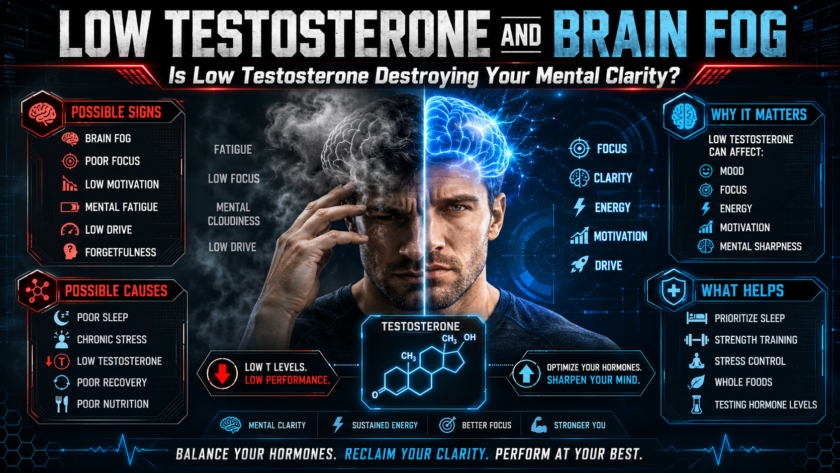
Low testosterone and brain fog is a subject more men need to take seriously.
Because brain fog does not always look dramatic from the outside.
A man can still show up.
He can still go to work.
He can still train.
He can still answer messages.
He can still look like he is functioning.
But inside, something feels off.
I felt flat and empty for years, no motivation, no feeling of purpose just going through life as a zombie. I had no idea about testosterone when I was in my 20s and little knowledge when I was in my 30s. I started Alpha Circle Club to help other men who are stuggling being men.
I know what it feels like to be on the wrong side of low testosterone, I know how it feels to not feel how a man should.
A man who has low testosterone will feel the following symptoms……
His mind feels blunt.
His focus feels weak.
His memory feels slower.
His energy feels flat.
His motivation feels lower than it should.
He reads the same sentence three times and still does not absorb it.
He walks into a room and forgets why.
He starts tasks but struggles to finish them.
He knows he has potential, but his brain feels like it is moving through fog.
That is the silent frustration many men experience.
They are not lazy.
They are not weak.
They are not lacking ambition.
Something in the system may be under pressure.
For some men, low testosterone and brain fog may be connected. Low testosterone may contribute to low energy, reduced motivation, low mood, poor concentration, and a general loss of drive. Cleveland Clinic lists concentration and memory issues, depressed mood, increased body fat, reduced muscle strength, and reduced endurance among possible symptoms of low testosterone in men.
But this needs to be said clearly:
Brain fog does not automatically mean low testosterone.
Brain fog can come from poor sleep, chronic stress, overtraining, under-eating, dehydration, depression, anxiety, blood sugar issues, thyroid problems, sleep apnea, alcohol, nutrient deficiencies, medication side effects, and too much screen time.
Low testosterone may be one suspect.
It is not the only suspect.
This article will explain what brain fog is, how testosterone may be involved, what other causes men should check, when to consider testing, and how to rebuild mental clarity with a stronger foundation.
Because brain fog is not weakness.
It is a signal.
And a serious man does not ignore signals.
He investigates them.
He adjusts.
He rebuilds.
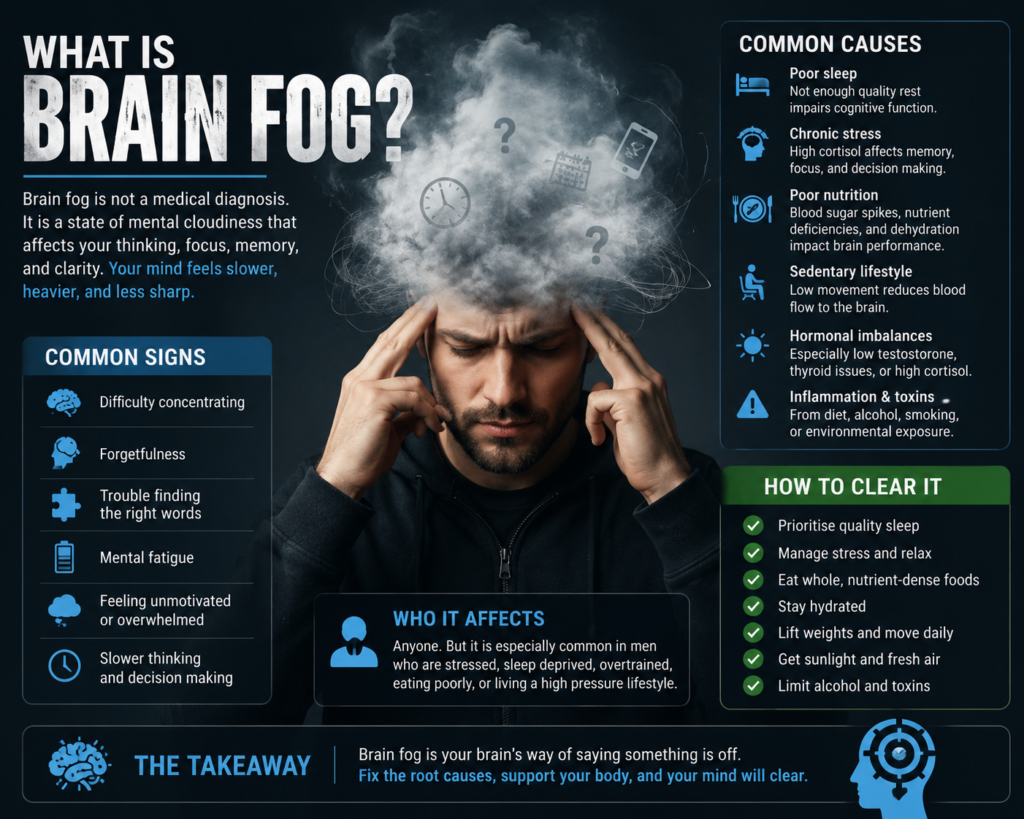
What Is Brain Fog?
Brain fog is not usually a formal medical diagnosis.
It is a term people use to describe a state of mental cloudiness.
You are awake, but not sharp.
You are present, but not fully switched on.
You can function, but you do not feel clear.
Brain fog can feel like:
Poor focus
Mental fatigue
Forgetfulness
Slow decision-making
Low motivation
Feeling disconnected
Reduced verbal sharpness
Difficulty finishing tasks
Lack of mental drive
Reading without absorbing
Struggling to organise thoughts
Feeling mentally heavy
For a man with ambition, this can be deeply frustrating.
Because he knows what he wants to do.
He knows he needs discipline.
He knows he has goals.
But his mind does not feel like it is firing properly.
That can affect work, training, relationships, confidence, and self-respect.
A sharp man wants a sharp mind.
When that sharpness fades, he needs to pay attention.
Can Low Testosterone Cause Brain Fog?
Low testosterone may contribute to symptoms that feel like brain fog in some men.
Testosterone is often associated with libido, muscle, strength, and male sexual health. But it may also be connected to energy, mood, motivation, mental drive, and general wellbeing.
Mayo Clinic says adult male hypogonadism can include less sex drive, less energy, and depression, and over time may involve reduced muscle mass and other changes. The NHS also explains that some men in midlife report symptoms such as depression, loss of sex drive, erectile dysfunction, mood swings, loss of muscle mass, poor concentration, and short-term memory problems, although these symptoms can have many causes and should not automatically be blamed on hormones.
So yes, low testosterone may be part of the brain fog picture.
But the evidence around testosterone and cognition is complicated.
A major clinical trial in older men with low testosterone and age-associated memory impairment found that testosterone treatment for one year was not associated with improved memory or other cognitive functions compared with placebo.
That means men need to be careful.
Low testosterone may contribute to fatigue, low mood, poor motivation, and concentration issues in some men.
But TRT is not guaranteed to fix brain fog.
And brain fog is not automatic proof of low testosterone.
The stronger truth is this:
Low testosterone may be one suspect. It is not the only suspect.
A disciplined man does not guess.
He tests.
He reviews his lifestyle.
He looks at the full system.
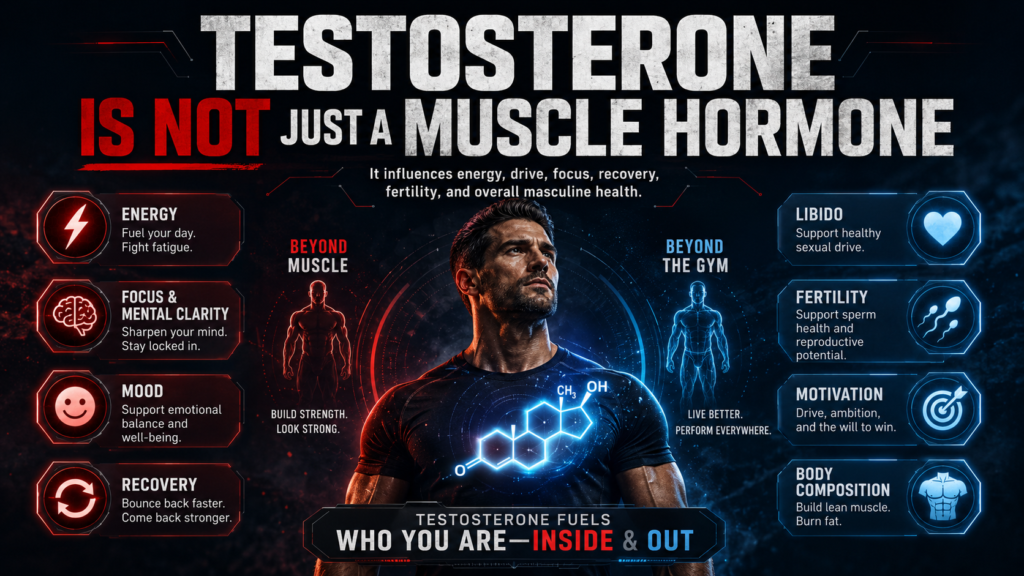
Testosterone Is Not Just a Muscle Hormone
Most men think about testosterone in a very narrow way.
They think testosterone means:
Muscle
Libido
Aggression
Gym performance
Beard growth
Confidence
Those things may be part of the picture, but testosterone is more than a gym hormone.
Testosterone is part of a man’s wider operating system.
It plays a role in male sexual function, muscle and bone health, red blood cell production, mood, energy, and general male vitality.
When the system is working well, a man may feel more driven, physically capable, sexually healthy, and emotionally stable.
When the system is under pressure, symptoms can show up in the body and the mind.
That does not mean testosterone is always the cause.
But it does mean hormone health should not be ignored.
A man is not just a mind.
He is not just a body.
He is a system.
Sleep affects hormones.
Hormones affect energy.
Energy affects training.
Training affects mood.
Mood affects discipline.
Discipline affects food choices.
Food choices affect recovery.
Recovery affects mental clarity.
Everything connects.
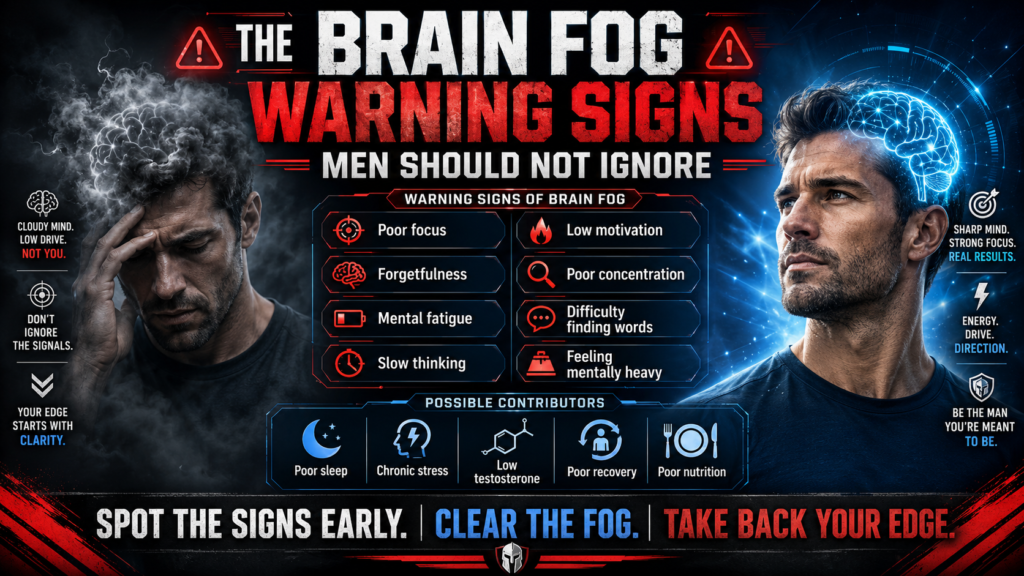
The Brain Fog Warning Signs Men Should Not Ignore
Brain fog becomes more important when it appears alongside other symptoms.
A man may want to pay closer attention if he notices:
He wakes up tired even after sleeping.
He struggles to focus at work.
He feels emotionally flat.
He loses drive.
His libido drops.
His workouts feel weaker.
He feels less confident.
He feels irritable or low.
He forgets simple things.
His motivation disappears.
He gains belly fat more easily.
He struggles to recover from training.
His morning energy is poor.
His mood feels unstable.
These signs do not automatically prove low testosterone.
But when brain fog appears with low libido, persistent fatigue, erectile issues, mood changes, loss of muscle, increased belly fat, or poor recovery, it may be worth discussing hormone testing with a healthcare professional.
Do not diagnose yourself from a TikTok video.
Do not buy random supplements because an influencer told you to.
Do not jump straight to TRT because you feel tired.
Get proper information.
Get proper testing.
Get proper guidance.
The Other Causes of Brain Fog Men Must Check First
This is where many men need honesty.
Some men want to blame testosterone while living in a way that destroys mental clarity.
They sleep badly.
They eat badly.
They drink too much.
They overtrain.
They live on caffeine.
They scroll late at night.
They never switch off.
They carry stress all day.
Then they wonder why their brain feels broken.
Low testosterone may be one factor, but brain fog can also be linked to:
Poor sleep
Sleep apnea
Chronic stress
Overtraining
Under-eating
Low protein intake
Blood sugar swings
Too much alcohol
Nutrient deficiencies
Dehydration
Depression or anxiety
Medication side effects
Thyroid issues
Low vitamin D
Too much screen time
Lack of movement
Poor cardiovascular health
That is why the full system matters.
Do not demand more testosterone while living in a way that destroys mental clarity.
A serious man starts with ownership.
How is your sleep?
How is your food?
How is your stress?
How is your training?
How much alcohol are you drinking?
How much time are you spending scrolling?
How much sunlight are you getting?
How often are you moving?
How often are you recovering?
The body gives feedback.
The mind gives feedback.
Brain fog is feedback.
Testosterone, Sleep, and Mental Clarity
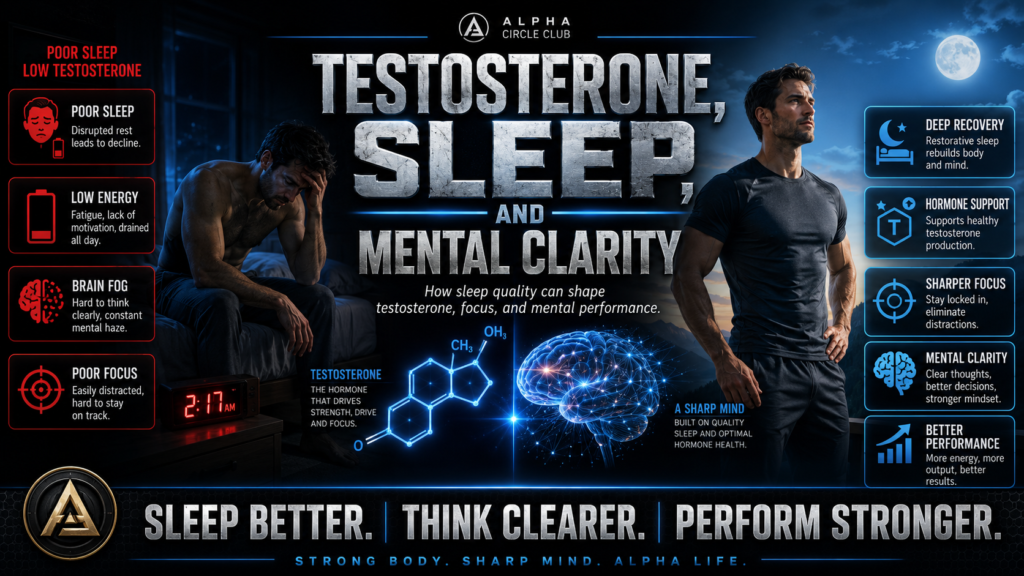
Sleep is one of the most important parts of this conversation.
Poor sleep can damage mental clarity by itself.
It can make a man feel tired, distracted, irritable, emotionally unstable, and mentally slow.
But sleep may also affect testosterone.
A study in healthy young men found that restricting sleep to five hours per night for one week reduced daytime testosterone levels by 10% to 15%.
That is serious.
A man cannot sleep badly, wake up exhausted, drink caffeine all day, train hard, scroll at night, and then wonder why his brain feels blunt.
Sleep is not weakness.
Sleep is repair.
Sleep is where the body restores.
Sleep is where the brain resets.
Sleep is where the nervous system recovers.
Sleep is where hormones are protected.
A man who wants testosterone and mental clarity cannot treat sleep like an optional extra.
Practical sleep standards:
Keep a consistent bedtime where possible.
Avoid caffeine late in the day.
Reduce late-night scrolling.
Keep the bedroom cool and dark.
Get morning light when possible.
Avoid brutal late-night workouts if they disrupt sleep.
Aim for 7–9 hours where possible.
No recovery, no edge.
Stress, Cortisol, and Brain Fog
Cortisol is often called the stress hormone.
But cortisol is not evil.
A man needs cortisol to wake up, respond to pressure, mobilise energy, and handle challenges.
The problem is not cortisol.
The problem is chronic stress without recovery.
When life stress, business pressure, financial pressure, poor sleep, intense training, emotional pressure, and constant digital stimulation stack together, the brain can feel overloaded.
A man may feel:
Wired but tired
Irritable
Distracted
Restless
Mentally drained
Unable to relax
Unable to focus deeply
Unmotivated despite having goals
This is where brain fog can become a sign that the nervous system is carrying too much load.
A man cannot build sharp focus on a nervous system that never switches off.
Recovery is not laziness.
Recovery is strategy.
Walk.
Pray.
Breathe.
Train smart.
Sleep properly.
Switch off screens earlier.
Create quiet.
Protect your mind like it matters.
Because it does.
Overtraining and Brain Fog
Training should sharpen a man.
It should build strength, discipline, confidence, energy, and resilience.
But if a man trains too hard without recovery, the same training that was meant to build him can start draining him.
Overtraining or under-recovery may show up as:
Fatigue
Poor sleep
Low libido
Low motivation
Irritability
Poor performance
Persistent soreness
Reduced enthusiasm
Higher stress
Brain fog
This does not mean hard training is bad.
Hard training is valuable.
Strength training, high intensity training, sprinting, circuits, and conditioning can all be powerful tools.
But they must be used wisely.
If training constantly makes you feel destroyed, unfocused, flat, and mentally heavy, something is wrong.
The goal is not to prove how much punishment you can survive.
The goal is to build a stronger body and a sharper mind.
Train hard.
Recover harder.

Nutrition for Testosterone and Brain Clarity
Your brain does not run on motivational quotes.
It runs on fuel, sleep, oxygen, blood flow, hydration, nutrients, and recovery.
If a man is under-eating, skipping meals, living on junk food, avoiding protein, dehydrated, or relying on caffeine and sugar, his mental clarity may suffer.
Food matters.
A testosterone-supportive, brain-supportive diet should include:
Protein
Healthy fats
Carbohydrates when needed
Hydration
Magnesium
Zinc
Vitamin D
Omega-3s
B vitamins
Iron status
Whole foods
This does not mean a man needs a perfect diet.
It means he needs a standard.
Eggs.
Oily fish.
Lean meat.
Greek yoghurt.
Fruit.
Vegetables.
Potatoes.
Rice.
Avocado.
Olive oil.
Nuts.
Seeds.
Water.
Minerals.
Real food.
Real fuel.
Real recovery.
A man cannot expect elite mental performance while feeding his body like an afterthought.
When to Get Testosterone Tested
A man may want to discuss testosterone testing with a healthcare professional if brain fog appears alongside other symptoms such as:
Low libido
Erectile issues
Persistent fatigue
Depressed mood
Loss of muscle
Increased belly fat
Poor recovery
Low morning energy
Reduced motivation
Infertility concerns
Testing may include more than just total testosterone.
Depending on the situation, a healthcare professional may consider:
Total testosterone
Free testosterone
SHBG
LH
FSH
Prolactin
Thyroid markers
Vitamin D
Full blood count
Metabolic markers
Why does this matter?
Because a man can have symptoms that look hormonal but are actually caused by sleep apnea, thyroid dysfunction, depression, stress, nutrient deficiencies, alcohol, medication side effects, or poor recovery.
Testing helps separate guessing from reality.
And reality is where strong men operate.
TRT and Brain Fog: Be Careful
Some men expect TRT to fix everything.
They think it will fix focus, motivation, libido, mood, confidence, energy, and brain fog.
For some men with clinically confirmed testosterone deficiency, testosterone replacement therapy may be medically appropriate under professional supervision.
But TRT should not be treated like a shortcut for discipline, sleep, nutrition, stress management, or proper diagnosis.
The evidence does not show guaranteed cognitive improvement for every man. As mentioned earlier, a one-year randomized clinical trial found testosterone treatment was not associated with improved memory or other cognitive functions in older men with low testosterone and age-associated memory impairment.
TRT also needs proper monitoring and medical oversight.
It is not something to start casually because of brain fog.
A serious man asks questions before making decisions that affect his hormones, fertility, cardiovascular health, and long-term wellbeing.
Ask:
Do I actually have clinically low testosterone?
Have I tested more than once, properly timed?
Have I checked sleep, stress, thyroid, vitamin D, and metabolic health?
Do I want children in the future?
Have I discussed fertility implications?
Am I prepared for medical monitoring?
TRT may help some men.
But it is not a replacement for ownership.
The Alpha Circle Club Mental Clarity Reset
If a man feels mentally foggy, he needs a reset.
Not panic.
Not excuses.
A reset.
1. Sleep Like Your Brain Depends on It
Because it does.
Aim for 7–9 hours where possible.
Create a consistent bedtime.
Reduce late-night scrolling.
Keep the room cool and dark.
Respect sleep like a man who wants his edge back.
2. Lift and Walk
Strength training builds the body.
Walking clears the mind.
Do not abuse HIIT when you are already exhausted.
Build the armour.
Clear the system.
Move daily.
3. Eat for Hormones and Focus
Protein.
Minerals.
Healthy fats.
Whole foods.
Hydration.
Do not expect a sharp brain from weak fuel.
4. Reduce the Fog Triggers
Cut back on the obvious attackers:
Alcohol
Poor sleep
Junk food
Constant scrolling
Overtraining
Dehydration
Late caffeine
Chaotic routines
Remove what is weakening you before searching for advanced solutions.
5. Test, Do Not Guess
If symptoms persist, speak to a healthcare professional.
Ask about proper blood work.
Look at testosterone, thyroid, vitamin D, blood count, metabolic health, and other relevant markers.
A man who wants truth must be willing to measure.
6. Rebuild the Standard
Track:
Energy
Libido
Mood
Focus
Sleep
Training performance
Motivation
Recovery
Your body speaks.
Your mind speaks.
Listen before it shouts.
Final Thoughts: Brain Fog Is a Signal
Low testosterone is a real thing, yes testosterone levels do decline as men age but men can “Counter the Decline”
Why do some men in their 50s and 60s have higher natural testosterone levels then men in their 20s, 30s and 40s? and I do mean natural!. Just because alot of men on social media promote “testosterone supplements” the latest protein powder or more worrying the next best testosterone injection it doesn’t mean that is the only way to raise your testosterone levels.
Please understand the male human body is amazing and under the right conditions not only can it survive and recover it can thrive God designed us that way. Never lose hope, it will take time but it is really worth it.
So understand brain fog is not weakness.
It is a signal.
A signal that something in the system may need attention.
It might be sleep.
It might be stress.
It might be nutrition.
It might be overtraining.
It might be depression or anxiety.
It might be low testosterone.
It might be several things at once.
A serious man does not ignore the signal.
He investigates it.
He adjusts.
He rebuilds.
Low testosterone and brain fog may be connected for some men, but the answer is not blind guessing.
The answer is ownership.
Sleep better.
Eat better.
Train smarter.
Recover harder.
Test properly.
Get medical guidance when needed.
Build a life that supports mental clarity instead of destroying it.
Because mental clarity is not a luxury.
It is part of masculine performance.
A man with a foggy mind struggles to lead himself.
A man with a sharp mind sees clearly, moves decisively, and builds with discipline.
The mission is simple:
Clear the fog.
Rebuild the standard.
Get your edge back.

Want to build stronger focus, better energy, and sharper discipline?
Explore more Alpha Circle Club guides built for men who want testosterone, mental clarity, strength, and long-term vitality.



No spam. Unsubscribe anytime.