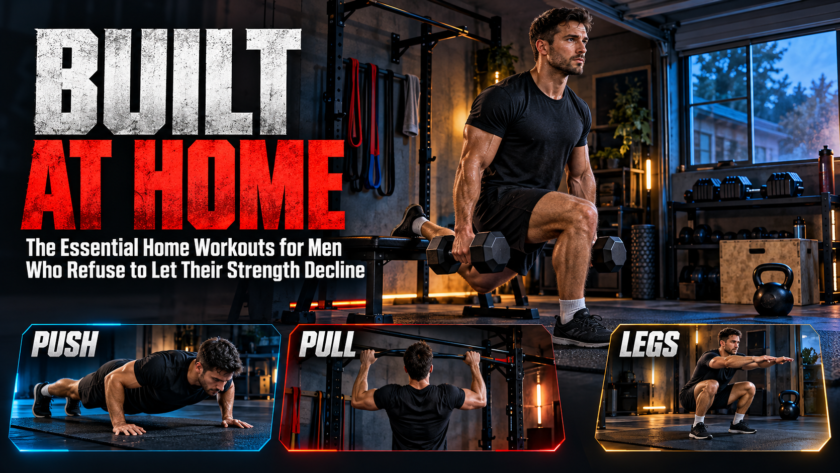
The Essential Home Workouts for Men Who Refuse to Let Their Strength Decline
Your body does not require a polished gym before it can become stronger.
It requires resistance. It requires movement. It requires recovery. Above all, it requires consistency.
Yet many men allow their strength to decline because they believe the conditions are not perfect. They do not have a gym membership. They cannot train for ninety minutes. They lack an expensive rack, a room full of machines or enough space to create an impressive home gym.
So they wait.
Weeks become months. The body becomes less active, ordinary tasks feel harder and the man who once promised to regain his fitness continues looking for the ideal Monday on which everything will finally begin.
An Alpha man refuses to make perfect conditions a requirement for basic physical responsibility.
He uses the space, time and equipment available. He understands that push-ups, squats, lunges, rows, bridges, carries, walking and intelligent conditioning can create a demanding training system when they are performed properly and progressed consistently.
This does not mean a home workout and a fully equipped gym are identical. Heavy barbells, machines and specialist equipment provide options that may be difficult to reproduce at home. Men with performance-specific goals may benefit from a gym, qualified coaching and carefully selected equipment.
But the absence of those things does not make physical decline inevitable.
The purpose of this article is not to create the largest man in the room. It is to help a man develop a body capable of supporting his responsibilities: a body with usable strength, cardiovascular capacity, balance, mobility, core control and enough physical confidence to keep moving forward.
“Alpha level” is not a medical classification, a body-fat percentage or a social-media appearance. Within Alpha Circle Club, it means accepting responsibility for the body carrying your mission. It means training for capability rather than applause and refusing to let avoidable excuses determine your physical future.
UK guidance recommends that adults build strength in all the major muscle groups on at least two days each week and accumulate at least 150 minutes of moderate-intensity activity, 75 minutes of vigorous activity or an appropriate combination. It also encourages adults to be active every day and break up long periods of inactivity. A home system can contribute meaningfully to those targets when it is appropriate for the individual and performed consistently.
You do not need to wait for a gym to begin.
The floor beneath you is enough for the first repetition.
A gym can provide useful equipment, but it cannot provide discipline. An Alpha man uses the space, time and resources available to keep his body strong, mobile and prepared.
Before You Begin: Train With Intelligence
This article provides general education, not personalised medical or exercise advice.
Speak to a GP or appropriate healthcare professional before beginning or intensifying exercise if you have not exercised for some time, have a medical condition, are recovering from surgery or injury, or have concerns about whether a particular activity is appropriate. NHS guidance specifically advises people who have been inactive for a while or have medical concerns to check first and select an intensity suited to their fitness.
Stop exercising and seek appropriate help if you experience warning signs such as chest pain, fainting, severe or unusual breathlessness, or sudden significant pain. A burning sensation in a working muscle is not the same as sharp, electrical, unstable or escalating pain in a joint or other structure. When unsure, stop and obtain qualified advice.
Inspect the environment before every session:
- Clear the floor of objects and slippery surfaces.
- Use supportive footwear where appropriate.
- Keep children and pets away from the training area.
- Use only a solid, stable chair that cannot roll or slide.
- Check resistance bands for cracks, thinning or damage.
- Anchor bands only with equipment designed and secured for that purpose.
- Ensure steps, benches and pull-up bars are correctly installed and rated.
- Secure the contents of a loaded backpack and inspect the straps.
Discipline is not ignoring danger. Discipline is creating conditions in which you can train again tomorrow.
1. Strength Begins With the Decision to Train
A gym membership can provide equipment, atmosphere and structure. It cannot complete a repetition for you.
Men sometimes spend more energy designing the perfect routine than performing a basic one. They compare benches, bands, dumbbells and apps while the body receives no training stimulus at all. Preparation creates the feeling of progress without the discomfort of beginning.
Home training removes several common barriers:
- Travelling time
- Membership fees
- Waiting for equipment
- Restricted opening hours
- Feeling self-conscious around experienced trainees
- Poor weather affecting the journey
- Complicated preparation
It also removes a convenient excuse. When the workout can begin within metres of where you are standing, the decision becomes clear: act or avoid.
The first session does not need to be extreme. In fact, a man returning after a long break should resist the temptation to punish himself with the volume he remembers from years ago. Excessive soreness can damage consistency before the habit has formed.
Begin with movements you can control. Leave several technically sound repetitions in reserve. Finish the session knowing you could have done a little more. Then return on the planned day.
The objective of the first month is not to prove how much pain you can survive. It is to establish that training now has a reliable place in your life.
Choose three things before you begin:
- The location: the exact space in which you will train.
- The time: when the session begins, not merely which day it happens.
- The minimum session: the shortened version you will complete when time or motivation is limited.
A twenty-minute workout completed consistently will outperform an impressive sixty-minute plan that remains inside a notebook.
Alpha Physical Insight
The most effective training location is the one in which you repeatedly complete the work.
2. Define What an Alpha-Level Body Means
The fitness industry often encourages men to measure their bodies primarily through appearance. Larger arms, visible abdominal muscles and a lower body-fat percentage become evidence of success.
Appearance can be a legitimate goal. There is nothing wrong with wanting to look stronger, leaner or more athletic. But a body can photograph well while lacking mobility, endurance, balance or healthy training habits.
An Alpha-level body should be:
- Strong enough to handle ordinary responsibilities
- Mobile enough to reach useful positions without unnecessary restriction
- Conditioned enough to sustain effort
- Stable enough to control movement
- Balanced enough that one area is not developed while another is neglected
- Resilient enough to recover from appropriate training
- Healthy enough to support long-term purpose
- Disciplined enough to keep developing
This definition changes how a man trains.
He stops judging every workout by the pump in his chest. He trains his back. He stops treating leg work as optional. He includes cardiovascular activity rather than claiming weights make it unnecessary. He practises balance and mobility instead of waiting until a restriction becomes a problem.
His standard also adapts to his life. A beginner, a father returning after years of inactivity, a trained athlete and a man managing a health condition should not use the same session. The Alpha principle is responsibility, not imitation.
Your present level is not a source of shame. It is information.
If one controlled push-up is your starting point, own it. If a wall push-up is the appropriate variation, perform it with precision. If you need professional rehabilitation before conventional training, follow that path without allowing ego to rush the process.
Strength begins when reality is accepted and development starts from there.
Alpha Physical Insight
The purpose of strength is not merely to be seen—it is to make you more capable of carrying life.
The Essential Alpha Home Exercises
3. Push-Ups: Upper-Body Strength Without a Machine
The push-up is one of the most useful home exercises because it trains several areas together:
- Chest
- Triceps
- Front shoulders
- Core
- Shoulder-blade control
It is also easy to progress or regress. A man does not need to choose between standard push-ups and doing nothing.
Basic technique
- Place the hands slightly wider than shoulder width or in a comfortable position.
- Create a straight, controlled line through the head, trunk and legs.
- Brace the abdomen and glutes without holding the breath unnecessarily.
- Lower under control while allowing the shoulder blades to move naturally.
- Keep the elbows at a comfortable angle rather than forcing them directly sideways.
- Press the floor away and finish without allowing the lower back to collapse.
The range of motion should suit the individual’s current shoulder comfort and control. The goal is not to touch the floor at any cost.
Progression ladder
- Wall push-up
- High elevated push-up using a secure surface
- Lower elevated push-up
- Knee push-up
- Standard push-up
- Close-grip push-up
- Tempo push-up with a slow lowering phase
- Paused push-up
- Decline push-up for trained men
Choose a variation that allows roughly 6–15 controlled repetitions while leaving about two good repetitions in reserve. These numbers are practical training ranges, not medical rules. A beginner may start with fewer; an endurance-focused session may use more.
Do not shorten every repetition simply to claim a high number. Record the variation and the standard used. Ten controlled elevated push-ups are more useful than twenty collapsing standard push-ups performed for ego.
Men with wrist discomfort may find handles, dumbbells that cannot roll or an appropriate elevated position more comfortable, but pain deserves assessment rather than improvisation.
Alpha Physical Insight
Do not count the repetitions your body did not properly control.
4. Squats: Build the Foundation
The squat pattern appears throughout daily life: sitting, standing, lifting, lowering and getting up from the floor. Training it develops more than visible legs.
Bodyweight squats can challenge the:
- Quadriceps
- Glutes
- Adductors
- Trunk
- Hip and ankle control
- Lower-body coordination
Basic technique
- Stand with the feet in a comfortable position, often around shoulder width.
- Keep the whole foot connected to the floor.
- Brace gently and begin by allowing the hips and knees to bend together.
- Let the knees travel in line with the toes.
- Descend only as far as you can control without pain or loss of position.
- Push through the feet and stand tall without violently locking the knees.
There is no single foot angle or squat depth that suits every body. Limb lengths, mobility, injury history and structure differ. A useful squat is one that can be performed safely, comfortably and progressively.
Progression ladder
- Sit-to-stand from a stable chair
- Supported squat while lightly holding a secure surface
- Bodyweight squat to a target
- Free bodyweight squat
- Paused squat
- Slow-tempo squat
- Backpack or goblet-style squat with secure resistance
- More advanced single-leg preparation where appropriate
If ordinary bodyweight squats become easy, do not immediately jump through them. Add a controlled pause, slow the lowering phase, use a greater safe range, add repetitions or introduce appropriate load.
A backpack can provide resistance, but it must be in good condition, securely closed and held where you can control it. Begin lighter than you think necessary.
Alpha Physical Insight
A strong body requires a strong foundation. Never build the upper body while neglecting the legs carrying it.
5. Lunges and Split Squats: Strengthen Each Side
Two-legged exercises can allow the stronger side to contribute more without the difference becoming obvious. Split-stance work asks each leg to accept greater independent responsibility.
Useful options include:
- Supported split squat
- Stationary split squat
- Reverse lunge
- Forward lunge
- Lateral lunge
- Step-up using a secure platform
- Rear-foot-elevated split squat for experienced trainees
Start with stability
A stationary split squat is often easier to learn than repeated lunging because the feet remain planted. Hold a stable support lightly if balance limits the leg muscles before they have been properly trained.
Keep enough distance between the feet to create a stable base. Lower under control. Allow the front knee to move in line with the foot. Drive through the front foot and avoid pushing excessively from the rear leg.
Reverse lunges can be more comfortable for some men because stepping backwards may make control easier. Step-ups are useful, but the platform must be stable, non-slip and low enough to maintain control.
Never use a lightweight dining chair as a step. Furniture designed for sitting may tip or fail when loaded from an unusual angle.
Train both sides and begin with the weaker side if a meaningful difference exists. Match the stronger side to the controlled work completed by the weaker one rather than allowing the imbalance to grow.
Single-leg training can develop strength, balance and coordination, but it also increases demand. A man with knee, hip, ankle or balance concerns may need a simpler variation or professional guidance.
Alpha Physical Insight
Balanced strength is built by addressing the weaker side instead of allowing the stronger side to hide it.
6. Glute Bridges and Hip Hinges: Train What You Cannot See
Men often prioritise the muscles visible in a mirror. The back of the body receives less attention until weakness, poor lifting habits or discomfort makes it impossible to ignore.
The posterior chain includes the glutes, hamstrings and muscles supporting the back. At home, it can be trained through:
- Glute bridges
- Paused glute bridges
- Single-leg glute bridges
- Hip thrusts against a secure surface
- Backpack Romanian deadlifts
- Good mornings with light, controlled resistance
- Hamstring walkouts
Glute bridge technique
- Lie on your back with knees bent and feet planted.
- Brace the trunk gently.
- Press through the feet and lift the hips.
- Finish through the hips without aggressively arching the lower back.
- Pause briefly, then lower under control.
Hip-hinge technique
The hinge is different from a squat. The hips travel backwards while the trunk inclines as one controlled unit and the knees bend only as much as required.
Practise first without load. Stand a short distance from a wall and reach the hips backwards until they touch it. Maintain a long spine and feel tension develop in the hamstrings. Once the pattern is controlled, a secure backpack or suitable weight can be added.
Do not chase floor depth. Lower only as far as the hips and hamstrings allow while maintaining the intended position. A Romanian deadlift is measured by control and tension, not by whether the weight touches the ground.
Men with persistent back pain should obtain appropriate assessment instead of assuming that one exercise will solve the problem.
Alpha Physical Insight
A capable body must be strengthened from behind as deliberately as it is trained from the front.
7. Rows: Do Not Build a Push-Only Body
Push-ups are convenient. Pulling exercises require more planning, which is why many home routines neglect the back.
That creates an incomplete system.
Rows can train the upper back, rear shoulders, arms and shoulder-blade control. Home options include:
- One-arm backpack rows
- Dumbbell rows
- Resistance-band rows using a correctly installed anchor
- Suspension-trainer rows with professionally secured equipment
- Pull-ups using a properly installed and rated bar
One-arm backpack row
- Load a sound backpack evenly and close every fastening.
- Support the free hand against a stable surface if needed.
- Hinge at the hips and maintain a controlled trunk position.
- Pull the bag towards the side of the torso.
- Pause without twisting the body.
- Lower slowly until the arm is long and the shoulder remains controlled.
Band-row safety
Resistance bands can recoil violently if they snap or detach. Inspect the band and anchor before every use. Use equipment designed for anchoring and position the body so the band is not pulling directly towards the face. Do not loop a band around an unstable table, radiator, loose door handle or improvised object.
The internet contains inverted-row variations beneath household tables. Furniture varies widely and may collapse or tip. A home exercise is not worthwhile if its setup cannot be trusted.
Balance pushing volume with pulling volume across the week. The exact ratio depends on the man and his plan, but the back should not be treated as an optional extra.
Alpha Physical Insight
Balanced strength requires pulling as well as pushing. What you neglect eventually limits what you build.
8. Pike Push-Ups: Develop the Shoulders
The standard push-up emphasises horizontal pressing. The pike push-up changes the body angle to place more demand upon the shoulders.
Basic technique
- Begin in a push-up position.
- Walk the feet towards the hands and lift the hips.
- Keep the hands rooted and the trunk controlled.
- Bend the elbows and lower the head towards a position in front of the hands.
- Press the floor away to return.
The movement should feel like an angled overhead press, not a shortened push-up with the hips randomly raised.
Progression ladder
- Elevated pike press with hands on a secure surface
- Standard pike push-up
- Paused pike push-up
- Feet-elevated pike push-up for trained men
- Wall-supported handstand preparation under suitable instruction
Advanced handstand work is a skill category of its own. It demands shoulder mobility, wrist tolerance, confidence and safe progressions. It should not be attempted simply because ordinary pike push-ups have become familiar.
Men with existing shoulder or wrist problems may need an alternative. Pain is not evidence that an exercise is working. It may be evidence that the variation, volume or movement is unsuitable.
Shoulder training should also include pulling work and, where appropriate, light external-rotation or shoulder-control exercises. Pressing harder does not correct every shoulder limitation.
Alpha Physical Insight
Progression should increase the challenge without sacrificing control.
9. Planks and Dead Bugs: Build a Core That Controls Movement
The core is often reduced to visible abdominal muscles and endless sit-ups. Its larger purpose is to control the relationship between the ribs, pelvis and spine while force moves through the body.
Useful home exercises include:
- Front plank
- Side plank
- Dead bug
- Bird dog
- Bear hold
- Slow mountain climber
- Suitcase carry using an appropriate load
Front plank
Create a long line from head to heels. Tighten the glutes and abdomen enough to prevent the lower back from sagging, but continue breathing. End the set when position deteriorates—not several seconds afterwards.
A plank should not become a contest in tolerating poor posture. Shorter, high-quality holds can be progressed by improved tension, additional sets or more demanding variations.
Dead bug
Lie on your back with hips and knees raised. Maintain controlled contact between the trunk and floor while slowly extending the opposite arm and leg. Reduce the range if the lower back arches or the movement becomes rushed.
Side plank
The side plank develops lateral trunk control. Begin from the knees or elevate the upper body if necessary. Progress towards a full version only when the shoulder and trunk can maintain position.
Core work should make the rest of your training more controlled. It should not leave the spine irritated because the chosen variation exceeded your present ability.
Alpha Physical Insight
A strong core does more than create appearance—it transfers strength through the entire body.
10. Calf Raises, Tibialis Raises and Balance: Train the Lower Legs
The lower legs contribute to walking, climbing stairs, running, changing direction and maintaining balance. They are easy to neglect because they appear less dramatic than chest or arm training.
Useful exercises include:
- Two-leg calf raises
- Single-leg calf raises
- Paused calf raises
- Bent-knee calf raises
- Tibialis raises against a wall
- Controlled ankle mobility drills
- Supported single-leg balance
Calf raise technique
Rise through the balls of the feet without rolling the ankles outward. Pause near the top, then lower under control. Use a stable support for balance when necessary; balance should not prevent the target muscles from working.
Tibialis raise
Stand with the back against a wall and feet slightly forward. Keep the heels down while lifting the front of the feet towards the shins. Control the lowering phase.
Balance practice
Stand near a wall or secure surface. Lift one foot slightly and maintain an upright position. Progress by reducing hand support or adding controlled movement—but do not turn a simple drill into a fall risk.
NHS home-balance guidance recommends building gradually and practising near a wall or stable chair when support may be needed.
Train the structures that keep you moving, not only the muscles that attract attention.
Alpha Physical Insight
Small muscles still carry important responsibilities. Train what your body depends upon—not only what attracts attention.
11. Conditioning: Train the Heart and Lungs
Strength allows a man to produce force. Conditioning helps him continue when effort lasts.
Cardiovascular work should not be treated as punishment for eating or something performed only when fat loss is the goal. It is an important part of physical capacity.
Home and neighbourhood options include:
- Brisk walking
- Stair climbing where safe
- Marching or jogging in place
- Shadow boxing
- Step-ups on a secure platform
- Skipping
- Low-impact circuits
- Cycling
- Mountain climbers
- Burpees for appropriately conditioned men
Intensity matters. The NHS uses a simple talk test: during moderate activity, you should generally be able to talk but not sing; during vigorous activity, speaking more than a few words without pausing becomes difficult.
UK adult guidance recommends at least 150 minutes of moderate-intensity activity each week, 75 minutes of vigorous activity or a suitable combination. Men who are inactive should build gradually rather than treating the full target as a first-week test.
Start with walking if that is the appropriate level. A brisk ten-minute walk counts. Add duration, frequency or pace as capacity develops.
High-impact conditioning is not automatically more Alpha. Burpees and jumping drills may be inappropriate for some joints, spaces or fitness levels. Low-impact shadow boxing, marching and fast walking can still create a meaningful demand when performed purposefully.
Use conditioning that you can recover from and repeat. The goal is to increase capacity, not destroy the next strength session.
Alpha Physical Insight
Strength allows you to produce force. Conditioning allows you to keep going when effort continues.
12. Mobility: Preserve the Ability to Move
Mobility is the ability to control useful movement through an available range. Flexibility contributes to it, but passive stretching alone does not create complete movement control.
A short home sequence may address:
- Ankles
- Hips
- Hamstrings
- Thoracic spine
- Shoulders
- Wrists
Practical mobility sequence
- Ankle rocks: move the knee gently towards the toes while keeping the heel down.
- Supported deep-squat hold or sit-to-stand practice: use a range appropriate to your body.
- Hip-flexor stretch: maintain a controlled pelvis rather than arching the lower back.
- Open-book rotation: rotate through the upper back without forcing the shoulder.
- Wall slides: move the arms through a pain-free range while controlling the ribs.
- Wrist preparation: gently load different hand positions before floor-based pressing.
Mobility work should support the movements you use. If your heels lift during squats, ankle mobility may deserve attention. If reaching overhead causes the lower back to arch dramatically, shoulder and trunk control may require development.
Do not force extreme ranges or bounce aggressively into discomfort. Persistent restriction, pain or a sudden loss of movement deserves appropriate professional assessment.
A five- to ten-minute mobility block performed consistently can be more useful than one exhausting session completed occasionally.
Alpha Physical Insight
The strongest body is less useful when it cannot move through the positions life requires.
The Alpha Home Training System
The following system is a general example for men who are healthy enough to exercise and can perform the selected variations safely. It is not a personalised prescription.
Train on three non-consecutive days when possible—for example Monday, Wednesday and Friday. Begin with two working sets of each strength movement if you are returning after a long break. Build towards three or four sets only when recovery and technique remain strong.
For most movements, select a variation that allows approximately 6–15 controlled repetitions while leaving around two technically sound repetitions in reserve. Core holds may begin at 10–30 seconds. Rest long enough to repeat the intended quality, commonly 60–120 seconds depending on difficulty and fitness.
Five-Minute Alpha Warm-Up
Before every session:
- March in place for 60 seconds.
- Perform 8–10 controlled sit-to-stands or shallow squats.
- Complete 8 hip hinges without weight.
- Circle the shoulders and perform gentle wall slides.
- Practise 5 elevated push-ups.
- Rehearse the first exercise with an easy set.
The warm-up should raise temperature, move the relevant joints and prepare the exact patterns you will train. It should not exhaust you.
Workout A: Push, Squat and Core
- Push-up variation: 3 sets of 6–15
- Bodyweight or backpack squat: 3 sets of 8–15
- Reverse lunge or split squat: 2–3 sets of 6–12 per side
- Pike push-up or alternative shoulder press: 2–3 sets of 5–12
- Front plank: 3 controlled holds
- Brisk walking or marching: 10–20 minutes
Workout B: Pull, Hinge and Stability
- Backpack, dumbbell or resistance-band row: 3 sets of 8–15
- Glute bridge: 3 sets of 10–20
- Backpack Romanian deadlift: 3 sets of 8–15
- Side plank: 2–3 controlled holds per side
- Calf raise: 3 sets of 10–20
- Shadow boxing, walking or safe stair work: 10–15 minutes
Workout C: Full-Body Capacity
Perform 2–4 controlled rounds. Rest whenever technique requires it.
- Squat: 8–15 repetitions
- Push-up variation: 5–12 repetitions
- Row variation: 8–15 repetitions
- Reverse lunge: 5–10 per side
- Glute bridge: 10–20 repetitions
- Dead bug: 5–10 per side
- Low-impact conditioning: 30–60 seconds
This is not a race. Record the time if useful, but do not let speed replace range, breathing or control.
Short Alpha Session: When Time Is Limited
Complete three controlled rounds of:
- 10 squats
- 5–10 push-ups at the appropriate level
- 10 rows per side
- 10 glute bridges
- 20 seconds of plank
This shortened session is not intended to replace every full workout. It protects the habit on unusually demanding days.
Weekly Conditioning Example
Alongside strength work:
- Tuesday: 20–30 minutes of brisk walking
- Thursday: 20–30 minutes of brisk walking, cycling or suitable intervals
- Weekend: longer comfortable walk or chosen activity
Accumulate activity according to your health, fitness and current UK guidance. Break up long periods of sitting with light movement wherever possible.
How to Progress Without Heavy Gym Equipment
A workout stops creating the same adaptation when the body has fully adjusted to its demand. The answer is progressive overload: increasing the training challenge over time while maintaining appropriate technique and recovery.
At home, progression can come from:
- Adding repetitions
- Adding a set
- Increasing resistance
- Slowing the lowering phase
- Pausing in a difficult position
- Increasing a safe range of motion
- Using a harder variation
- Improving stability and control
- Reducing rest modestly for conditioning goals
- Increasing weekly consistency
Use a simple double-progression method.
If your target range is 8–15 repetitions, remain with the same variation until you can complete every planned set near the top of the range with good form and repetitions still under control. Then add a small amount of resistance or move to a slightly harder variation, allowing the repetitions to fall towards the lower end again.
Example:
| Week | Push-up variation | Sets × repetitions |
|---|---|---|
| 1 | Elevated push-up | 3 × 8 |
| 2 | Elevated push-up | 3 × 10 |
| 3 | Elevated push-up | 3 × 12 |
| 4 | Lower elevation | 3 × 7 |
Progress is not required every session. Sleep, stress, nutrition, illness and responsibilities affect performance. Look for an upward trend across weeks rather than demanding a personal record every day.
Avoid changing several variables at once. If you add load, slow the tempo and cut rest simultaneously, you will not know which change produced the result or excessive fatigue.
Progressive overload does not always require more weight. It requires the body to face a greater, well-controlled demand.
Recovery Is Part of the Workout
Home training is convenient enough to create a new problem: doing too much because the equipment is always available.
Muscles and connective tissues need time to adapt. Training creates the stimulus; recovery helps the body respond.
Protect:
- Sufficient sleep
- Appropriate food and hydration
- Rest between demanding sessions for the same muscles
- Gradual increases in volume
- Easier activity during high-stress periods
- At least one complete rest or very light day where appropriate
Muscle soreness can occur after unfamiliar exercise, but soreness is not the objective and does not prove that a workout was effective. Severe soreness that disrupts normal movement is often a sign that the starting dose was too high.
If performance keeps declining, motivation collapses, sleep worsens or joints remain irritated, review the training load rather than assuming greater aggression will solve the problem.
An Alpha man does not train to demonstrate that his body can be punished. He trains so his body becomes more capable.
The Alpha Home Fitness Audit
Answer honestly before choosing your next training block.
Consistency
- How many strength sessions did I complete last month?
- Do I have fixed training days and times?
- What repeatedly causes me to miss sessions?
- What is my minimum session when time is limited?
Movement balance
- Do I train pushing and pulling movements?
- Do I train squatting and hip-hinge patterns?
- Do I train each leg independently?
- Do I include core control rather than only abdominal flexion?
- Do I train the lower legs and balance?
Cardiovascular fitness
- How much moderate or vigorous activity do I accumulate each week?
- Can I walk briskly without unusual breathlessness?
- Do I spend long periods sitting without movement breaks?
Progression
- Am I recording sets and repetitions?
- Have I increased any demand during the last month?
- Am I repeating the same easy session without purpose?
- Am I attempting advanced variations before mastering the basics?
Recovery and safety
- Am I sleeping sufficiently?
- Which movements cause pain or instability?
- Is my equipment secure?
- Am I allowing the body to recover?
- Do I need medical, physiotherapy or qualified coaching support?
Choose the three weakest areas and turn each one into a specific action.
The 30-Day Built at Home Challenge
This challenge is designed to establish a balanced training habit, not produce a complete physical transformation in one month.
Week 1: Establish the Baseline
- Complete two or three introductory strength sessions.
- Select safe variations for every movement.
- Record all sets and repetitions.
- Walk or perform suitable conditioning twice.
- Identify any pain, major restriction or equipment concern.
Objective: learn where you are without judgement or exaggeration.
Week 2: Build Consistency
- Complete three planned strength sessions if recovery is appropriate.
- Add five minutes of mobility after each session.
- Break up long periods of sitting.
- Protect the exact start time.
- Use the short session instead of skipping completely when necessary.
Objective: make training a scheduled responsibility.
Week 3: Create Progression
- Add one or two repetitions to selected exercises.
- Improve one range of motion or pause.
- Add resistance only where form remains controlled.
- Extend one conditioning session slightly.
- Keep at least one recovery day protected.
Objective: create a greater demand without creating chaos.
Week 4: Produce Evidence
- Repeat the opening week’s variations.
- Compare controlled repetitions and technique.
- Review energy, mobility and consistency.
- Identify the next progression.
- Write the following month’s training schedule.
Objective: finish with evidence and a continuation plan.
For all 30 days:
- Train strength on two or three days each week.
- Accumulate appropriate cardiovascular activity.
- Include pushing, pulling, squatting, hinging and core work.
- Record completed work.
- Progress only when technique supports it.
- Protect sleep and recovery.
- Never sacrifice safety to claim a higher number.
Frequently Asked Questions
Can home workouts for men really build muscle?
Yes, home resistance training can support muscle development when exercises create sufficient tension, sets are performed with appropriate effort, the training system progresses and nutrition and recovery support the goal. Equipment expands the options and makes heavy loading easier, but it is not the only way to challenge muscle.
Can I become as strong at home as I can in a gym?
It depends on the type of strength and equipment available. Bodyweight, bands, dumbbells and loaded bags can build substantial general strength, especially for beginners and intermediate trainees. Very high levels of maximal strength usually require heavier, precisely loadable equipment and suitable coaching.
How many days should men train at home?
UK guidance recommends strengthening all major muscle groups on at least two days each week. Many men can use two or three full-body sessions effectively. The correct frequency depends on exercise difficulty, volume, recovery, experience and health.
How long should a home workout last?
There is no compulsory duration. A focused session may take 20–45 minutes. The session needs enough work to train the intended movements without adding unnecessary exercises merely to make it longer.
Do I need to train to complete muscular failure?
No. Sets can be productive without reaching the point at which another repetition is impossible. Leaving one to three technically sound repetitions in reserve is a practical approach for many home sessions, especially while learning movements. Advanced methods should be selected deliberately rather than used through habit.
What equipment is worth buying first?
A non-slip exercise mat, a set of quality resistance bands, an appropriate door anchor, adjustable dumbbells or a professionally installed pull-up bar can expand options. Buy according to the movements missing from your system. Equipment must be inspected, rated and used according to its instructions.
Are push-ups, squats and planks enough?
They form a useful beginning but do not create a complete long-term system. Add pulling, hip-hinge, single-leg, lower-leg, mobility and cardiovascular work. As the body adapts, the exercises also need progression.
What should I do if an exercise hurts?
Stop the exercise and reassess. Check the setup, range, variation and load. Do not train through sharp, unusual or increasing pain. Persistent pain, swelling, weakness or instability should be assessed by an appropriate healthcare professional.
Can I use household furniture as exercise equipment?
Only when the object is designed or unquestionably suitable for the load and cannot slide, tip or break. Avoid improvised pulling and stepping setups. A stable floor is better than a dangerous creative variation.
How do I stay motivated when training alone?
Use a fixed schedule, prepare the space, record every session and begin with a defined first exercise. Motivation becomes less important when training is treated as an appointment. Alpha Fuel or another purposeful audio system can help establish intention, but the audio must lead to movement rather than replace it.
Can walking count as exercise?
Yes. Brisk walking can contribute towards moderate-intensity activity. It is accessible, scalable and useful for cardiovascular health. The talk test can help judge intensity: moderate activity generally allows conversation but not singing.
When should I move to a gym?
Move when a gym provides equipment, loading or coaching that your goals genuinely require—not because home training appears less impressive. You can also combine gym and home sessions. The objective is a system you can sustain and progress.
Important Safety Standard
Men who are inactive, have a medical condition, are recovering from injury or experience concerning symptoms should seek appropriate medical advice before beginning or intensifying exercise.
Every exercise should be adapted to individual ability. Household equipment, chairs, platforms, backpacks, bands and anchors must be stable, secure and suitable for the demand.
Training through sharp or unusual pain is not an Alpha act. It is ignoring information the body is providing.
Alpha Physical Insight
Discipline is not proving that you can ignore pain. It is training intelligently enough to return and progress again.
Closing Declaration
I will not wait for perfect conditions before protecting my body.
I will use the space, time and equipment available to me.
I will train for capability—not merely appearance.
I will build my chest, back, legs, core, mobility and conditioning.
I will progress without sacrificing control.
I will respect pain, recovery and proper technique.
I will record the work instead of exaggerating the result.
I will refuse to let convenience become an excuse for physical decline.
My home may be the location—but discipline will be the equipment that transforms me.
Final Line
You do not need a perfect gym to build a stronger body. You need a clear system, progressive effort and the discipline to begin where you are.



No spam. Unsubscribe anytime.