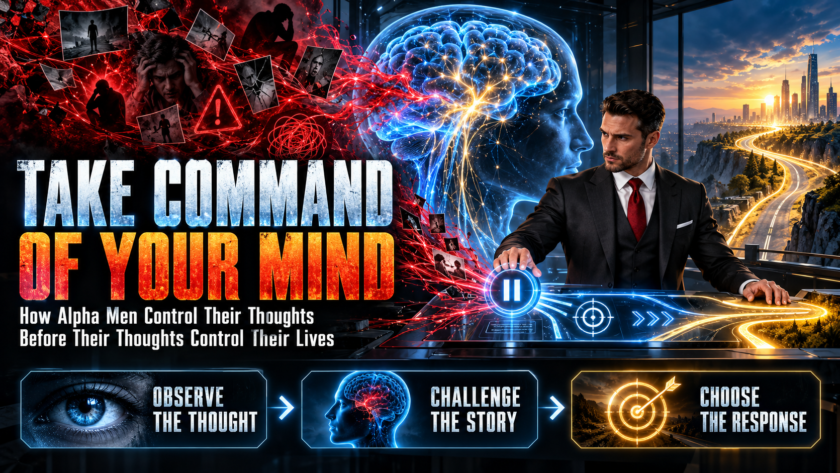
How Alpha Men Control Their Thoughts Before Their Thoughts Control Their Lives
There is a voice inside every man that can either strengthen his direction or sabotage it.
It speaks before the difficult conversation. It speaks when the alarm sounds. It speaks after rejection, during uncertainty and when the first attempt fails. Sometimes it says, You can handle this. Take the next step. At other times it says, You are not ready. This will never work. Avoid the risk. Give up before you are embarrassed.
The first thought can arrive quickly. It may be influenced by fear, stress, tiredness, past experiences or the emotional pressure of the moment. You may not have deliberately invited it. But its arrival does not make it true, and it does not give it authority over your next action.
This is where mental discipline begins.
An Alpha man is not someone who never experiences doubt, anger, anxiety, disappointment or unwanted thoughts. He is a man who refuses to hand every passing thought the controls to his life. He learns to pause, examine what his mind is telling him and choose a response that serves his values, responsibilities and long-term future.
He does not pretend pain is absent. He does not bury every emotion beneath a performance of strength. He does not attempt to become a machine. He develops something far more useful: the ability to feel pressure without immediately becoming its servant.
Your mind can warn you of genuine danger, reveal problems and generate powerful ideas. It can also exaggerate risk, replay old wounds, predict disasters and offer excuses disguised as logic. If you believe everything it produces, your decisions will be controlled by whatever thought happens to be loudest.
But when you learn how to control your thoughts, a different pattern becomes possible:
Notice the thought. Test the thought. Direct your attention. Choose the action.
This article is not about controlling every mental event. It is about controlling the relationship you have with your thoughts—and preventing an untested thought from becoming an unnecessary limit on your life.
1. You Are Not Every Thought You Experience
A thought is an event in the mind. It is not automatically a fact, instruction, prophecy or definition of your character.
You can think, I might fail, without being a failure. You can think, I want to avoid this conversation, while still choosing to have it. You can experience an angry thought without behaving aggressively. You can remember an old mistake without agreeing that it determines your future.
This separation is essential because men often turn temporary thoughts into permanent identities:
- “I made a poor decision” becomes “I am useless.”
- “I feel nervous” becomes “I am weak.”
- “This business idea failed” becomes “I am not built for business.”
- “I missed a week of training” becomes “I have no discipline.”
- “Someone rejected me” becomes “Nobody will ever value me.”
Notice what happened. A specific event was transformed into a total judgement. Once that judgement is accepted, the man begins behaving as though it were proven.
Mental strength interrupts this process. It says:
“That thought is present, but I am going to examine it before I build a decision around it.”
This does not mean ignoring useful warnings. If you are about to take a financial risk, concern may be appropriate. If a relationship repeatedly damages your wellbeing, discomfort may contain important information. The point is not to dismiss the mind. It is to question it intelligently.
Ask:
- What exactly am I thinking?
- What triggered this thought?
- Is it a fact, a prediction or an emotional reaction?
- What evidence supports it?
- What evidence challenges it?
- What action would reflect my values even if the thought remained?
You are the man observing the thought and deciding what happens next. That position creates space—and within that space lives choice.
Alpha Insight
A thought may enter your mind without permission. It does not receive authority without your cooperation.
2. Control Does Not Mean Mental Suppression
Some men misunderstand thought control as a command to feel nothing, admit nothing and force every uncomfortable thought out of awareness.
That is not control. It is concealment.
Trying to overpower every thought can create another battle inside the mind. A man notices fear, becomes ashamed that he feels fear and then exhausts himself attempting to prove that the fear is absent. He has not resolved the situation; he has added self-judgement to it.
Real control is more honest:
“I am experiencing fear. I understand why it may be here. I will listen for useful information, but fear will not make this decision alone.”
Emotions and thoughts are signals. Some signals are accurate. Some are distorted by fatigue, stress, previous hurt or incomplete information. A disciplined man receives the signal without automatically obeying it.
There is a major difference between:
- Acknowledgement: “I am angry, so I need to slow down before I speak.”
- Suppression: “I am not angry, and anyone who says otherwise is wrong.”
- Submission: “I am angry, so I have the right to say anything I want.”
Acknowledgement creates control. Suppression hides the condition. Submission gives the condition command.
An Alpha man can say, “That affected me,” without surrendering his identity. He can admit uncertainty without becoming paralysed. He can ask for help without abandoning responsibility. He can take time to process a painful event without turning avoidance into a permanent home.
The goal is not a permanently positive mind. Forced positivity can become another form of dishonesty. The goal is a mind capable of seeing difficulty clearly and still choosing the next constructive action.
You do not need to defeat every uncomfortable thought before moving forward. Sometimes the victory is carrying doubt with you while doing what matters anyway.
Alpha Insight
Mental control is not the absence of difficult thoughts. It is the ability to prevent them from becoming unquestioned commands.
3. Separate Facts From Mental Predictions
The mind is a powerful prediction machine. It takes limited information and attempts to complete the story.
Your manager requests a meeting, and the mind says you are about to lose your job. A prospect does not reply, and the mind declares that the offer is worthless. Your partner seems quiet, and the mind assumes the relationship is in danger. You experience one disappointing workout, and the mind predicts that all progress has stopped.
Predictions can feel like facts because they create real emotions. But feeling certain is not the same as possessing evidence.
Use a simple two-column test:
| What I know | What my mind is adding |
|---|---|
| My manager requested a meeting | I am definitely being dismissed |
| The prospect has not replied for two days | They hated my proposal |
| One launch underperformed | My business will never succeed |
| I feel tired today | I have permanently lost my drive |
| Someone criticised my work | Everyone believes I am incompetent |
The left column deserves action. The right column deserves investigation.
This distinction protects men from decisions based on imagined conclusions. If the meeting is uncertain, prepare rather than panic. If the prospect is silent, follow up rather than write a tragedy. If the launch failed, examine the offer, audience and marketing rather than attacking your entire identity.
Facts are often narrower than fear. That is good news because a defined problem can be addressed.
Try this language:
- “The fact is…”
- “The story I am currently telling myself is…”
- “What I still need to discover is…”
- “The next useful action is…”
This does not guarantee the outcome you want. Bad news remains possible. But it prevents you from suffering an invented future before reality has even arrived—and it prepares you to meet reality with clearer judgement.
Alpha Insight
Do not allow a prediction to borrow the authority of a fact. Investigate what you know before reacting to what you fear.
4. Watch the Thought That Comes Before the Excuse
An excuse rarely begins as a polished sentence. It starts as a small internal permission.
You can miss today.
You will start when you feel more motivated.
You need more research first.
One more hour of entertainment will not matter.
The timing is not perfect.
If that thought is accepted without examination, behaviour follows. The workout is postponed. The sales call is avoided. The application remains unfinished. The difficult conversation is transferred to another day.
Then the mind often protects the decision by creating a respectable explanation. “I am waiting for the right strategy” sounds better than “I am afraid to be judged.” “I work better under pressure” sounds better than “I keep choosing immediate comfort.”
To control negative thoughts that create avoidance, catch them at the earliest stage. Ask:
- What is this thought trying to help me avoid?
- Is the delay genuinely useful, or merely comfortable?
- What will postponement cost?
- What would the disciplined version of me do in the next ten minutes?
You do not need to complete the entire mission immediately. You need to break the connection between the excuse and automatic obedience.
Open the document. Put on the training clothes. Make the first call. Write the first paragraph. Review the bank statement. Book the appointment. Begin the conversation.
Action exposes excuses because reality replaces imagination. The task may still be difficult, but it is no longer untouched. You have moved from mental debate to physical evidence.
Be particularly alert when an excuse uses self-care language to justify endless avoidance. Rest is necessary. Recovery is intelligent. But rest has a defined purpose and an ending. Avoidance keeps renegotiating the starting time.
Alpha Insight
The excuse becomes powerful when the first thought receives no challenge. Catch the permission before it becomes the pattern.
5. Stop Rehearsing Defeat
Repetition gives thoughts familiarity, and familiarity can begin to feel like truth.
If a man repeatedly tells himself, People like me never succeed, he enters opportunities expecting rejection. He withholds full effort, interprets neutral events negatively and notices every setback that supports the story. The thought begins influencing the evidence it later claims to prove.
This is mental rehearsal—but for defeat.
Many men would never speak to a son, friend or teammate with the cruelty they direct towards themselves:
- “You always ruin everything.”
- “You have wasted your life.”
- “Nobody will take you seriously.”
- “It is too late for you.”
- “You will embarrass yourself again.”
Harshness is not automatically honesty. A statement can sound tough while remaining inaccurate and useless.
Replace total condemnation with precise accountability:
- Instead of “I always fail,” say, “This method failed; I need to understand why.”
- Instead of “I have no discipline,” say, “My current routine is inconsistent; today I will complete the scheduled action.”
- Instead of “It is too late,” say, “I have less time than I once had, which makes today more important.”
- Instead of “I cannot handle this,” say, “I do not yet know how to handle every part, so I will begin with the part I can address.”
The purpose is not to create empty affirmations. Telling yourself you are already a millionaire, champion or perfect leader does not make it true. Strong internal language must connect to evidence and action.
Use statements you can honour:
“I can take the next step.”
“I can learn what I do not know.”
“This feeling is temporary; my standards remain.”
“I have recovered before, and I will begin recovering again.”
Stop practising the identity you are trying to escape.
Alpha Insight
Every repeated thought is rehearsal. Make sure you are not training your mind to expect the defeat your actions are meant to overcome.
6. Question the Internal Voice
Not every internal voice belongs to the man you are becoming.
Some thoughts are echoes. They may carry the tone of a critical parent, a humiliating teacher, an abusive relationship, a past employer or a culture that repeatedly told you to remain small. A sentence can live in the mind for years after the person who said it has disappeared from your life.
When the voice says, Who do you think you are?, ask a better question: Who taught me that growth required permission?
When it says, You are not the kind of man who builds something, ask: Is that a fact—or an identity formed before I tested my capacity?
Interrogate the message:
- Whose standard does this thought reflect?
- When did I first begin believing it?
- What evidence has appeared since then?
- Does this belief make me more responsible or merely more afraid?
- Would I teach this belief to a man I wanted to help?
- What more accurate statement should replace it?
Questioning the voice does not require blaming the past forever. The point is to stop allowing old words to control new decisions.
You may discover that a belief once protected you. Remaining unnoticed may have reduced conflict. Avoiding ambition may have protected you from ridicule. Distrusting people may have reduced vulnerability. But a strategy that helped you survive one season can prevent you from living fully in the next.
Thank the old defence for what it attempted to do, then judge whether it still serves you.
The Alpha mindset is not “Nobody influenced me.” Every man is influenced. The stronger position is: “I will examine what shaped me, keep what is useful and refuse to carry what destroys my future.”
Alpha Insight
A voice can live inside your mind without deserving a permanent vote in your future. Question who taught you to think small.
7. Direct Attention Towards What You Can Control
Thoughts become exhausting when they circle matters a man cannot command.
You cannot control whether everyone approves of you. You cannot rewrite yesterday. You cannot guarantee a customer says yes, a relationship survives, an investment rises or a plan succeeds exactly as intended. You cannot control another person’s honesty, mood or judgement.
You can control preparation, effort, conduct, communication, boundaries and the next decision.
This does not mean pretending outcomes do not matter. Outcomes matter greatly. The discipline is directing your energy towards the parts of the outcome your behaviour can influence.
Use three categories:
Direct control
Your actions, words, preparation, schedule, spending and response.
Influence
The quality of your offer, relationships, leadership, reputation and communication.
Outside your control
Other people’s final decisions, the past, random events and many external conditions.
When worry appears, place the problem into one category.
If it is under direct control, act. If you can influence it, prepare and communicate. If it is outside your control, decide how you will respond rather than demanding certainty that cannot be provided.
For example, you cannot guarantee that a job application succeeds. You can improve your CV, research the employer, practise the interview and submit more suitable applications. You cannot control whether someone spreads a false story. You can preserve evidence, respond calmly when appropriate, protect your reputation through consistent conduct and choose where further engagement serves a purpose.
Attention is a resource. Every hour spent mentally arguing with the uncontrollable is an hour unavailable for building what remains possible.
Alpha Insight
Strength grows when attention moves away from what you cannot command and towards the action that still belongs to you.
8. Protect What Enters Your Mind
Thought control begins before the thought appears.
What you repeatedly watch, hear and read supplies material for your internal voice. If your attention is constantly exposed to outrage, humiliation, comparison, fear and empty status displays, those themes will begin occupying mental space.
This is not because you are weak. Repetition influences familiarity, focus and expectation. A disciplined man therefore treats his information environment as part of his mental training.
Audit the inputs:
- Which accounts leave you informed, and which leave you agitated?
- Which voices encourage responsibility, and which encourage blame?
- Which content teaches a useful skill, and which merely creates envy?
- Which conversations strengthen your standards, and which normalise defeat?
- Does your morning begin with your mission or somebody else’s crisis?
- Does entertainment restore you or consume the hours needed for progress?
Protection does not mean constructing an echo chamber where nobody challenges you. Mature men need disagreement, correction and uncomfortable truth. The question is whether an input improves judgement or simply captures attention.
Choose inputs deliberately:
- Read material that develops knowledge.
- Follow people whose evidence matches their claims.
- Spend time with men who combine ambition with integrity.
- Restrict accounts built around rage, deception or constant comparison.
- Create phone-free periods for thinking and focused work.
- Seek opposing perspectives from credible sources.
- Protect sleep from late-night stimulation.
Your mind cannot become perfectly sealed, nor should it. But unrestricted access is not the same as openness. A home has a door because entry matters. Your attention deserves the same standard.
Alpha Insight
If you allow everyone unrestricted access to your attention, do not be surprised when your inner voice begins sounding like the noise you repeatedly consumed.
9. Use Action to Challenge Negative Thinking
Some thoughts cannot be argued away. They need evidence.
The mind says, You cannot stay consistent. Complete today’s session.
It says, You cannot speak confidently. Practise the presentation and deliver the first sentence.
It says, Your business will never move. Contact one prospect and improve one part of the offer.
It says, You always avoid hard things. Choose one difficult task and finish it.
Action will not instantly remove every negative thought, but it changes the case. You are no longer depending only on positive language. You are creating proof.
Start with an action small enough to complete and meaningful enough to count. “Work on my future” is too vague. “Write 300 words,” “walk for twenty minutes,” “send the invoice” or “book the GP appointment” can be executed.
Then record the evidence. Men often forget their completed actions while remembering every imperfection. Keep a simple proof list:
- What did I say I would do?
- What did I complete?
- What obstacle did I face?
- What did completion teach me?
- What is the next action?
This is how self-trust is rebuilt. Not through one heroic speech, but through repeated moments in which behaviour answers doubt.
However, action must remain intelligent. Do not use relentless activity to escape grief, exhaustion or a serious health concern. Sometimes the correct action is recovery, medical support, an honest conversation or changing an ineffective plan.
The Alpha standard is not constant motion. It is purposeful action based on reality.
Alpha Insight
When the mind claims you cannot move forward, create one piece of evidence that proves movement has already begun.
10. Do Not Make Decisions at the Peak of Emotion
Anger demands speed. Fear demands escape. Excitement demands immediate commitment. Shame demands disappearance.
Important decisions made at the peak of emotion can create consequences that remain long after the emotion falls.
An Alpha man learns to insert time between emotional activation and irreversible action. He does not send the message while furious, resign in the middle of humiliation, invest because of sudden excitement or end a relationship merely to stop one painful conversation.
Use a pause protocol:
- Name the emotion. “I am angry,” is clearer than “Everything is ruined.”
- Reduce immediate activation. Step away, breathe slowly, walk, drink water or sleep before responding where circumstances allow.
- Protect against irreversible action. Do not publish, purchase, threaten or make a permanent decision in the emotional peak.
- Write the facts. Separate the event from the interpretation.
- Identify the standard. What response would reflect your character?
- Choose the appropriate timing. Return when you can speak and think clearly.
Pausing is not cowardice. It is command.
There will be emergencies requiring immediate decisions. In those moments, rely on preparation, safety procedures and clear priorities. But many conflicts presented as urgent are merely emotionally loud.
Calm does not require passivity. After the pause, you may need to set a firm boundary, leave a dangerous situation, challenge dishonesty or make a major change. The difference is that the action comes from judgement rather than emotional overflow.
Do not let another person’s loss of control recruit you into losing yours.
Alpha Insight
A pause is not surrender. It is the space in which emotion returns authority to judgement.
11. Train the Mind Through Repetition
Mental discipline is not installed by reading one article. It is trained through repeated practice.
You will catch some thoughts late. You will occasionally react before reflecting. Old patterns will reappear during stress. This does not mean the training has failed. It means the mind, like the body, develops through consistent correction.
Practise the basic cycle:
Notice → Pause → Question → Redirect → Act → Review
At first, the cycle may feel slow. Over time, recognition becomes faster. You notice the catastrophic prediction before it controls the afternoon. You identify the excuse before missing the workout. You catch the insulting reply before pressing send.
Daily practices can include:
- A five-minute morning review of your priorities.
- Writing down one recurring thought and testing its evidence.
- Brief breathing or mindfulness practice to improve observation.
- Recording completed promises at the end of the day.
- Replacing one vague judgement with a specific fact.
- Rehearsing a calm response before a difficult conversation.
- Scheduling recovery before exhaustion damages judgement.
Do not turn mental training into another perfection test. Missing a day is information, not an identity. Resume at the next opportunity.
Progress may look like experiencing the same thought but recovering in twenty minutes instead of two days. It may mean asking for clarification rather than assuming rejection. It may mean noticing anger while your words remain controlled. These changes matter.
The goal is not to win a permanent war against your own mind. It is to build a working relationship in which thoughts provide information but your principles retain command.
Alpha Insight
The disciplined mind is built through thousands of small corrections, not one dramatic moment of permanent control.
12. Build Thoughts That Serve the Man You Are Becoming
Every major future places demands on the man who wants to reach it.
Fatherhood requires patience, responsibility and emotional control. Business requires judgement, recovery and courage. Wealth requires delayed gratification and intelligent risk. Health requires consistency. Leadership requires the ability to remain clear when other people are uncertain.
Ask what kind of thinking these responsibilities require.
The future father may need to replace My comfort comes first with My choices affect people who depend on me.
The future business owner may need to replace Failure proves I am not capable with Results are feedback; I will learn and improve the method.
The man rebuilding his health may need to replace I have gone too far to change with My past created the starting point, not the final destination.
The leader may need to replace I must appear certain about everything with I will tell the truth, gather evidence and make the best available decision.
These are not slogans. They are operating beliefs. They shape attention, choices and repeated action.
Choose a personal mental standard:
“I do not exaggerate setbacks.”
“I investigate before assuming.”
“I speak to myself with honesty, not humiliation.”
“I act from values, not temporary emotion.”
“I ask for help when the problem exceeds my current tools.”
The man you are becoming is influenced by the thoughts you rehearse today. You do not need to pretend you have already arrived. You need to practise thinking in a way that makes responsible progress possible.
Alpha Insight
Your future requires more than new circumstances. It requires a pattern of thought capable of carrying the responsibilities you are asking to receive.
Common Thought Patterns That Steal Control
Learning how to manage your thoughts becomes easier when you can name recurring patterns.
| Thought pattern | What it sounds like | Stronger response |
|---|---|---|
| All-or-nothing thinking | “If I cannot do it perfectly, there is no point.” | “A useful imperfect action still creates progress.” |
| Catastrophising | “This setback will destroy everything.” | “What has actually happened, and what can I address?” |
| Mind-reading | “They definitely think I am incompetent.” | “I do not know their thoughts. I can ask, observe or focus on my conduct.” |
| Overgeneralising | “This always happens to me.” | “What is specific about this event?” |
| Emotional reasoning | “I feel incapable, so I must be incapable.” | “The feeling is real, but it is not a complete measurement of my ability.” |
| Comparison thinking | “He is ahead, so I am failing.” | “His position does not determine my next action.” |
| Helpless thinking | “There is nothing I can do.” | “Which part remains under my control or influence?” |
| Identity judgement | “I failed, therefore I am a failure.” | “An outcome describes an event, not my entire identity.” |
Naming a pattern is not a diagnosis. It is a way of creating distance. Once you can say, “My mind is catastrophising,” you are better positioned to examine the thought instead of disappearing inside it.
The CONTROL Method
Use this seven-step framework whenever a thought begins pulling you away from clear judgement or disciplined action.
C — Catch the Thought
Slow the process enough to identify the exact sentence in your mind.
Do not settle for “I feel bad.” Write the thought: “If this presentation goes poorly, everyone will lose respect for me.”
O — Observe Without Obeying
Notice the thought and the emotion it creates. You do not need to fight it or follow it.
Say: “I am noticing the thought that…” This wording creates useful separation.
N — Name the Pattern
Is it prediction, catastrophising, comparison, an excuse, old criticism or all-or-nothing thinking?
Naming the pattern reduces confusion.
T — Test the Facts
What evidence supports the thought? What evidence challenges it? What remains unknown? What is the most balanced explanation?
R — Redirect Attention
Move attention towards the controllable part of the situation. Identify the next physical action.
O — Operate From Values
Ask: “What would honesty, courage, responsibility, patience or self-respect require here?”
Values provide direction when emotions provide noise.
L — Learn From the Result
After acting, review what happened. Did the prediction come true? What helped? What needs improving? What will you do sooner next time?
The CONTROL method is not designed to make every thought pleasant. It is designed to ensure that your next action belongs to you.
Defeated Thinking vs Alpha Thinking
| Defeated thought | Alpha response |
|---|---|
| “I cannot do this.” | “I can identify and complete the next step.” |
| “I must feel confident first.” | “Confidence can grow after action begins.” |
| “One mistake ruined everything.” | “I will contain the damage, learn and correct the method.” |
| “They do not believe in me.” | “Their belief is not required for today’s work.” |
| “I have wasted too much time.” | “I will not waste today punishing myself for yesterday.” |
| “I am angry, so I must respond now.” | “The issue can remain important while I regain composure.” |
| “I should handle everything alone.” | “Responsibility includes seeking qualified help when needed.” |
| “I failed.” | “The attempt failed; I am still responsible for what happens next.” |
Alpha thinking is not boastful. It does not guarantee victory or deny risk. It returns the man to reality, responsibility and action.
Real-Life Applications
When a business idea is rejected
Automatic thought: “Nobody wants what I have created.”
CONTROL response: One person or one audience rejected the current offer. Review the feedback, positioning, price and target customer. Improve one variable and test again.
When training has been inconsistent
Automatic thought: “I have lost all discipline.”
CONTROL response: The recent record is inconsistent. Schedule the next realistic session, prepare the equipment and complete it before designing a perfect new system.
When conflict creates anger
Automatic thought: “I need to show them they cannot disrespect me.”
CONTROL response: Respect does not require emotional retaliation. Identify the behaviour, establish the boundary and choose whether direct conversation, documentation or walking away serves the best outcome.
When another man appears more successful
Automatic thought: “I am behind in life.”
CONTROL response: You are seeing part of his evidence, not the full cost or history. Study anything useful, then return to your own mission and measurement.
When a bad day damages confidence
Automatic thought: “I am back to being the old version of myself.”
CONTROL response: A bad day is an event. Recover with the next meal, decision, conversation or work block. Identity is built through the pattern, not one imperfect day.
The Alpha Thought Audit
Choose one recurring thought that has influenced your behaviour and answer honestly:
- What is the exact thought?
- When does it usually appear?
- What emotion accompanies it?
- What action does it encourage—or prevent?
- Is it fact, interpretation, prediction or memory?
- What evidence supports it?
- What evidence challenges it?
- Whose voice or experience may have shaped it?
- What is it attempting to protect me from?
- What does obeying it cost me?
- What more balanced thought fits the evidence?
- What action would reflect my values?
- What support, knowledge or preparation would help?
- How will I review the result?
Do not use the audit to shame yourself for having the thought. Use it to understand the pattern well enough to choose differently.
The Seven-Day Thought Command Challenge
For the next seven days, practise controlling your response rather than demanding a perfectly controlled mind.
Day 1: Catch
Record three recurring thoughts without attempting to correct them. Learn what your mind repeats.
Day 2: Separate
For one stressful situation, write two columns: facts and mental predictions.
Day 3: Question
Choose one limiting belief. Test the evidence for and against it.
Day 4: Redirect
When worry appears, identify one action under your direct control and complete it.
Day 5: Protect
Remove or restrict one source of mental noise for twenty-four hours. Replace it with useful input or silence.
Day 6: Prove
Complete one task your internal voice has encouraged you to avoid. Record the evidence.
Day 7: Build
Write three operating beliefs for the man you are becoming. Attach one behaviour to each belief.
Example:
“I address problems early.” → I will make the call before midday.
At the end of the week, ask which thought appeared most often, which response worked best and what practice should continue for the next thirty days.
When Thought Control Requires More Than Self-Discipline
Mental discipline is valuable, but it is not a substitute for professional support.
Some thoughts are persistent, intrusive, frightening or connected to anxiety, depression, trauma or other mental-health conditions. They may interfere with sleep, work, relationships and daily functioning. Experiencing an unwanted thought does not mean you want it, agree with it or will act on it.
Strength does not require handling every mental struggle alone.
Consider speaking with a GP or qualified mental-health professional when thoughts or low mood persist, become difficult to manage, repeatedly disrupt daily life or cause significant distress. In England, adults can often refer themselves to NHS talking therapies without first receiving a diagnosis. The NHS advises seeking help when low mood lasts more than two weeks, you are struggling to cope or self-help is not improving the situation.
If urgent mental-health help is needed in the UK, contact NHS 111 and select the mental-health option. If someone is in immediate danger or cannot stay safe, call 999 or go to A&E.
Asking for help is not handing away control. It is using an appropriate resource to regain it.
Alpha Insight
Self-command includes recognising when determination alone is not the right tool and qualified support is the responsible next action.
Frequently Asked Questions
Can I completely control every thought?
No. Thoughts can appear automatically, particularly during stress, fatigue or emotional pressure. The practical goal is to improve how you respond: whether you accept the thought as fact, where you direct attention and what action you choose.
How do I stop overthinking?
Define the decision or problem, separate facts from predictions, set a reasonable time for thinking and identify the next physical action. If more information is genuinely required, decide exactly what information and when you will obtain it. Endless thinking without a decision point often becomes avoidance.
Are negative thoughts a sign of weakness?
No. Negative or unwanted thoughts are part of human experience. Strength is demonstrated through honest examination, responsible action and seeking help when thoughts become persistent or distressing.
Should I replace every negative thought with a positive one?
Replace distorted thoughts with balanced, evidence-based ones. “Everything will definitely be perfect” may be as unrealistic as “Everything will fail.” A stronger thought is: “There are risks, and I can prepare for the parts within my control.”
Can action really change my mindset?
Action can produce evidence, experience and momentum that challenge limiting beliefs. It is not a cure for every mental-health difficulty, but completing meaningful actions can strengthen self-trust and reduce the power of avoidance.
What if the negative thought is true?
Then clarity still helps. If a mistake occurred, accept it, repair what can be repaired and change the method. Thought control is not denying uncomfortable facts; it is responding to them without unnecessary exaggeration or self-destruction.
How can I control my thoughts during conflict?
Slow your breathing, name the emotion, identify the factual issue and delay irreversible words or actions when possible. Decide whether the situation requires a boundary, a calm conversation, documentation, support or walking away.
How long does it take to develop mental discipline?
There is no fixed deadline. Progress comes through repeated practice. Look for earlier recognition, shorter recovery times, fewer impulsive actions and more decisions aligned with your values.
Is asking for therapy or medical help an Alpha action?
Yes. Responsibility means using the right support for the problem. Seeking professional help when thoughts are persistent, distressing or disruptive is a form of intelligent self-leadership.
Closing Declaration
I will not believe every thought simply because it entered my mind.
I will separate facts from predictions and feelings from final decisions.
I will listen to emotion without handing it complete authority.
I will catch excuses before they become repeated avoidance.
I will stop rehearsing identities built from old mistakes and other people’s limitations.
I will direct my attention towards what I can control.
I will protect my mind from inputs designed to capture, anger and weaken it.
I will use disciplined action to create evidence of who I am becoming.
I will pause before making permanent decisions from temporary emotions.
I will seek qualified support when strength requires more than self-discipline.
My thoughts may speak—but my values, judgement and actions will decide the life I build.
Final Line
You may not control every thought that enters your mind, but you can decide which thoughts receive your belief, your attention and the power to shape your next action. Take command of your mind before an untested thought takes command of your life.


No spam. Unsubscribe anytime.