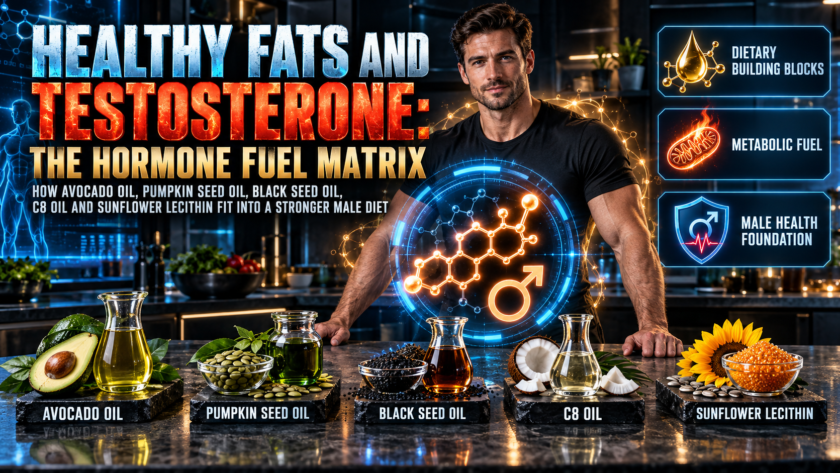
How Avocado Oil, Pumpkin Seed Oil, Black Seed Oil, C8 Oil and Sunflower Lecithin Fit Into a Stronger Male Diet
Healthy fats do not act like testosterone injections. Their real power is helping a man build a nutritious, sustainable diet that supports the body in which healthy hormone function must take place.
Testosterone is often marketed as if it can be unlocked by a single ingredient.
One bottle. One capsule. One spoonful. One secret oil that supposedly transforms a man’s hormones, energy, muscle, confidence and sexual performance.
That story is attractive because it is simple. It is also a poor way to understand male health.
Testosterone production belongs to a complete biological system. The brain must send the right signals. The testes must respond. The body needs sufficient energy and nutrients. Sleep, body composition, training, illness, medicines, alcohol, stress and age can all influence the environment in which this system operates. No cooking oil can take control of that entire process.
But that does not make dietary fat unimportant.
Fat is an essential part of human nutrition. It supplies energy, provides essential fatty acids, helps the body absorb the fat-soluble vitamins A, D, E and K, and contributes to cell membranes and many signalling processes. Cholesterol is used as a starting material in steroid-hormone synthesis, including testosterone production. However, this does not mean that every gram of fat a man eats becomes testosterone, or that adding unlimited oil will drive his hormone levels higher.
The intelligent question is not:
“Which oil will boost my testosterone the fastest?”
It is:
“How can I use healthy fats as part of a complete diet that supports my energy, body composition, cardiovascular health and normal hormonal function?”
That is where the Hormone Fuel Matrix begins.
This article examines five ingredients—avocado oil, pumpkin seed oil, black seed oil, coconut C8 oil and sunflower lecithin. Each offers something different. None deserves to be worshipped. None can compensate for sleep deprivation, inactivity, excess body fat, chronic under-eating or an untreated medical problem. Used intelligently, however, they can each occupy a practical place within a disciplined male diet.
The goal is not hormonal hype. The goal is to build stronger nutritional foundations.
1. Testosterone Needs a Complete Biological System
Testosterone is an androgen hormone produced mainly by the testes, with a smaller contribution from the adrenal glands. Its production is regulated through communication between the hypothalamus, pituitary gland and testes—sometimes called the hypothalamic-pituitary-gonadal axis.
In simplified form:
- The hypothalamus releases gonadotrophin-releasing hormone.
- The pituitary releases luteinising hormone and follicle-stimulating hormone.
- Luteinising hormone signals Leydig cells in the testes to produce testosterone.
- Follicle-stimulating hormone, testosterone within the testes and other local signals help support sperm production.
This system helps regulate much more than visible muscle. Testosterone contributes to sexual development, libido, bone health, muscle mass, red-blood-cell production and general reproductive function.
Dietary fat matters within this wider picture because the body needs adequate energy and essential nutrients to function normally. Fat also helps build cell membranes and absorb fat-soluble vitamins. Yet the body does not operate like a simple factory in which eating more cholesterol or more oil automatically produces more testosterone.
Hormonal health is influenced by the total environment:
- Energy intake and nutritional adequacy
- Body weight and waist circumference
- Sleep quantity and quality
- Resistance training and general activity
- Recovery from exercise
- Alcohol, smoking and recreational drugs
- Prescription medicines
- Acute and chronic illness
- Testicular or pituitary disorders
- Age and individual biology
This distinction matters. A man may improve the quality of his fats and still feel exhausted because he sleeps five hours a night. He may buy expensive oils while remaining sedentary and gaining abdominal fat. He may blame his diet when an underlying medical condition needs investigation.
Healthy fats support the system. They are not the whole system.
Alpha Hormone Insight
Do not search for one food powerful enough to replace an entire disciplined life. Testosterone is supported by a system, so build the system.
2. Extremely Low-Fat Eating May Work Against Hormonal Health—but the Evidence Is Not Simple
Men sometimes remove nearly all fat from their diets in an attempt to become leaner. The intention may be positive, but an extreme approach can create new problems.
Dietary fat is essential. A diet so restrictive that it lacks essential fatty acids, fat-soluble vitamins, sufficient energy or meals a man can sustain is not a victory. It may also make food less satisfying, increasing the likelihood of uncontrolled eating later.
Research on fat intake and male sex hormones is still developing—and it should not be simplified into “more fat equals more testosterone.” A 2021 systematic review and meta-analysis of six intervention studies involving 206 men found lower total, free and urinary testosterone on low-fat diets compared with higher-fat diets. The authors explicitly stated that further randomised trials were required. A larger 2025 meta-analysis of 11 trials involving 888 adults found no significant difference in testosterone or several other sex hormones between low-fat and higher-fat diets, while rating the certainty of the evidence as low.
That newer evidence changes the responsible conclusion. It would be wrong to promise that increasing fat intake will raise testosterone. A more defensible position is this:
- Men should not fear all dietary fat.
- Extreme restriction is unnecessary for most people.
- Total diet quality and energy balance matter.
- The type of fat matters for long-term health.
- Individual hormone symptoms should not be treated through dietary guesswork.
The NHS recommends choosing unsaturated oils and spreads and consuming them in small amounts because all fats are energy-dense. This offers a better principle than either extreme: do not eliminate fat, and do not pour it into every meal as if calories no longer count.
A strong diet includes enough fat to support nutrition, enough protein to support tissue repair and muscle, adequate carbohydrates for training and daily activity, and a wide range of whole foods. The correct proportions depend on the individual’s size, activity, medical needs and goals.
Alpha Hormone Insight
Do not confuse avoiding excess with avoiding an essential nutrient. Strength is built through balance, not nutritional fear.
3. Fat Quality Matters More Than Testosterone Marketing
The label “healthy fat” is useful only when it leads to better decisions.
Most oils contain a mixture of saturated, monounsaturated and polyunsaturated fatty acids. They differ in their proportions, natural compounds, flavour, processing and suitable uses. Health authorities generally advise replacing some saturated fat with unsaturated fat rather than simply adding more fat to an already excessive diet.
This is why the following two meals are not hormonally or metabolically equivalent merely because both contain fat:
- A meal built around vegetables, beans, whole grains, fish and a measured amount of unsaturated oil
- A highly processed meal containing excess calories, refined carbohydrates, salt and large amounts of saturated fat
The first supports a broader pattern of nutrition. The second may promote weight gain and poor metabolic health when repeated frequently.
There is another important distinction: supporting normal function is not the same as treating a deficiency.
An oil can provide energy or useful fatty acids. A seed product can provide vitamin E compounds or plant sterols. Lecithin can provide phospholipids. These are legitimate nutritional features. They should not be inflated into a clinical promise that the product will correct hypogonadism.
When assessing any “testosterone food,” ask five questions:
- What nutrients or compounds does it actually contain?
- What human evidence exists—not only animal or test-tube research?
- Was testosterone directly measured?
- Was any change statistically and clinically meaningful?
- Does the claim apply to ordinary men, or only to a small, specific group?
This filter immediately improves the quality of health decisions. It allows a man to appreciate a food without inventing benefits the evidence has not established.
Alpha Hormone Insight
A real nutritional advantage does not need a fake hormonal promise attached to it. Use foods for what they genuinely offer.
4. Avocado Oil: The Monounsaturated Foundation
Avocado oil earns the foundation position in the Hormone Fuel Matrix because it is a practical source of predominantly monounsaturated fat.
Monounsaturated fats can form part of a heart-conscious eating pattern when they replace less favourable sources of saturated or trans fat. That matters to male health because cardiovascular and metabolic health are deeply connected with energy, physical performance and sexual function.
Avocado oil also offers practical versatility. Depending on how it has been processed and the manufacturer’s guidance, it can work in:
- Salad dressings
- Marinades
- Roasted vegetables
- Sauces
- Eggs and lean proteins
- General cooking
Refined avocado oil is usually more neutral in flavour and commonly marketed for higher-temperature cooking. Cold-pressed or extra-virgin products may retain more flavour and colour but may be better suited to dressings or lower-temperature use. Smoke-point claims vary, so use the product label rather than assuming every bottle behaves identically.
What avocado oil may contribute
- A convenient unsaturated-fat source
- Oleic acid, the main fatty acid also associated with olive oil
- A way to make vegetables and nutrient-dense meals more satisfying
- A replacement for some butter, ghee or heavily saturated cooking fats
- Small quantities of plant compounds, depending on processing and quality
What avocado oil has not proved
There is no robust human evidence showing that avocado oil by itself meaningfully raises testosterone in men. Animal findings about the prostate, oxidative stress or reproductive tissues cannot be treated as proof of a testosterone effect in humans.
That does not make avocado oil worthless. It makes the claim more precise.
Its value lies in helping construct a better overall diet. If a measured amount encourages a man to eat vegetables, prepare meals at home and replace less favourable fats, it is doing useful work. If he adds several unmeasured tablespoons to meals already supplying excess energy, it can work against weight-control goals.
Avocado oil is not a hormone treatment. It is a versatile tool.
Alpha Hormone Insight
The strongest everyday ingredient is often the one you can use consistently without turning it into a miracle.
5. Pumpkin Seed Oil: A Male-Health Specialist
Pumpkin seed oil has developed a strong reputation in men’s health, particularly around prostate and urinary comfort. It contains unsaturated fatty acids, phytosterols, tocopherols and other compounds that have attracted scientific interest.
Small human studies involving pumpkin seed preparations have reported improvements in some lower urinary tract symptoms or quality-of-life measures in men with benign prostate enlargement. That is relevant, but it must be interpreted correctly:
- Prostate-symptom research is not testosterone research.
- A pumpkin seed extract is not always equivalent to pumpkin seed oil.
- A change in urinary symptoms does not prove a rise in testosterone.
- Small trials require confirmation before broad promises can be made.
Where pumpkin seed oil fits
Pumpkin seed oil has a distinctive nutty flavour and is generally best used as a finishing oil rather than as the default high-heat cooking fat. It can be added in a measured amount to:
- Salads
- Soups after cooking
- Roasted vegetables
- Yoghurt-based dressings
- Beans, lentils or grain bowls
- Dips
Whole pumpkin seeds deserve attention too. Unlike isolated oil, they provide protein, fibre and minerals as well as fat. They can therefore offer greater fullness and nutritional variety. A man interested in zinc or magnesium should remember that whole seeds contain minerals, while purified oil contains little or none of the mineral content found in the seed itself.
That is an important protection against marketing confusion. “Made from pumpkin seeds” does not mean pumpkin seed oil delivers every nutrient in whole pumpkin seeds.
A balanced conclusion
Pumpkin seed oil can be a useful unsaturated finishing oil with an interesting male-health research profile. However, there is not strong clinical evidence that it directly increases testosterone. Use it for flavour, dietary variety and the compounds it genuinely contains—not as a substitute for medical investigation.
Alpha Hormone Insight
A food can support a man’s diet without controlling his hormones. Respect the distinction and you protect yourself from expensive promises.
6. Black Seed Oil: Promising, but Do Not Exaggerate It
Black seed oil comes from Nigella sativa, sometimes called black cumin. Its best-known active compound, thymoquinone, has been studied for antioxidant, inflammatory and metabolic effects.
This makes black seed oil scientifically interesting. It does not make every online claim true.
A small double-blind, placebo-controlled trial in centrally obese men did not find a significant increase in free testosterone. The treatment group experienced a smaller decline than the control group, but this is not the same as proving that black seed raises testosterone. Another small trial in infertile men reported improvements in several semen measures after black seed oil, yet semen quality and testosterone are different outcomes. Neither study justifies calling black seed oil a proven testosterone booster.
That careful reading protects the positive case rather than destroying it. Black seed oil may still deserve a place in some diets or supplement routines. It contains bioactive compounds worthy of further research, and limited early human data justify scientific interest. What it does not justify is certainty.
Practical use
Black seed oil has a strong, peppery or bitter flavour. It is usually used in small measured amounts and is generally not the oil to choose for high-heat frying. Depending on the product instructions, it may be added to:
- A dressing
- Yoghurt or a dip
- A smoothie
- A finished meal
Start conservatively if you decide to use it. More is not automatically better.
Safety matters
Botanical oils can cause side effects and may interact with medicines. People taking medication for blood pressure, blood glucose or blood clotting, those with medical conditions, and anyone preparing for surgery should ask a pharmacist or clinician before using concentrated black seed products. Product purity and concentration also vary.
Men should be especially sceptical of proprietary blends that hide the actual amount, attach dramatic testosterone claims or present animal research as human proof.
The Alpha approach is neither blind enthusiasm nor automatic dismissal. It is disciplined curiosity.
Alpha Hormone Insight
Promising evidence is a reason to stay interested—not a licence to pretend the verdict has already been delivered.
7. Coconut C8 Oil: Rapid Fuel, Not Liquid Testosterone
Coconut C8 oil is usually a purified medium-chain triglyceride product rich in caprylic acid, an eight-carbon fatty acid. It is not identical to whole coconut oil.
Ordinary coconut oil contains a mixture of fatty acids, much of it saturated, with lauric acid forming a large proportion. A C8 product isolates a narrower component. C8 is absorbed and handled differently from many longer-chain fats and can be converted relatively quickly into ketones, which the body can use as fuel.
That gives C8 oil a legitimate functional identity:
- A rapidly available source of dietary energy
- A possible aid for people following certain lower-carbohydrate eating patterns
- A convenient addition to a shake or meal when extra energy is genuinely required
- A measured training-day fuel option for some men
It does not give C8 oil proven testosterone-raising power.
The most common C8 mistake
Because C8 is marketed as “quick energy,” men can forget that it still supplies substantial calories. Adding it to coffee, shakes and meals without accounting for the rest of the diet can quietly push energy intake above requirements. For a man trying to reduce excess body fat, that may undermine the metabolic goal he hoped the oil would support.
C8 can also cause stomach cramps, nausea or diarrhoea when a large amount is introduced too quickly. Beginning with a small amount and increasing only if needed and tolerated is more intelligent than proving toughness to a bottle of oil.
Where C8 fits best
C8 belongs in the matrix as an energy tool, not as the default cooking fat and not as a mandatory daily supplement. It is most useful when there is a clear purpose:
- The man needs additional energy within a planned intake.
- He follows a dietary pattern in which rapid ketone production is useful.
- He tolerates it well.
- It replaces, rather than merely adds to, other calories.
If those conditions do not exist, there is no hormonal penalty for leaving it out.
Alpha Hormone Insight
A tool becomes valuable when it has a defined job. Without a purpose, even useful fuel becomes unnecessary weight.
8. Sunflower Lecithin: The Phospholipid Component
Sunflower lecithin is different from the other ingredients in this matrix.
It is not simply sunflower oil. Lecithin is a mixture rich in phospholipids—fat-like compounds that are important components of cell membranes. Products may contain phosphatidylcholine and other phospholipids, although amounts vary.
Sunflower lecithin is often used as:
- An emulsifier that helps fats and liquids mix
- A powder or liquid ingredient in shakes
- A soy-free alternative to soya lecithin
- A source of phospholipids and some choline-related compounds
- A texture aid in homemade foods
Choline is an essential nutrient involved in cell membranes, nerve signalling and normal liver function. However, the exact choline contribution from sunflower lecithin depends on the product. It should not be assumed from the front label alone.
Testosterone and semen-volume claims
Sunflower lecithin is sometimes promoted online as a way to increase testosterone, semen volume or sexual performance. Strong human evidence supporting those claims is lacking. A biological role for phospholipids does not prove that taking extra lecithin will raise a hormone or produce a visible reproductive effect.
This is a recurring error in supplement marketing:
A nutrient participates in a process; therefore, more of that nutrient must intensify the process.
Human biology is rarely that simple. Once requirements are met, additional intake may not produce an additional benefit.
Where sunflower lecithin fits
Its practical role is as the phospholipid and formulation component of the matrix. A man might use it in a protein shake, homemade dressing or recipe where its emulsifying function is useful. It can contribute dietary variety, but it is not essential if the rest of the diet already supplies sufficient choline and nutrients from foods such as eggs, fish, meat, soya beans and other sources.
Read the label. Compare serving sizes. Do not assume every powder contains the same percentage of phosphatidylcholine. And do not mistake a useful food ingredient for a fertility or testosterone treatment.
Alpha Hormone Insight
The fact that a substance belongs inside the body does not prove that taking more will amplify the body’s performance. Function must not be confused with guaranteed effect.
9. The Five-Fat Function Matrix
The power of this system lies in giving each ingredient a defined role.
| Ingredient | Primary nutritional or practical role | Best practical use | Evidence for directly raising testosterone | Important caution |
|---|---|---|---|---|
| Avocado oil | Predominantly monounsaturated everyday fat | Dressings, roasting and cooking as directed on the label | No robust human evidence of a direct rise | Energy-dense; quality and suitable heat use vary by product |
| Pumpkin seed oil | Unsaturated finishing oil with plant compounds; male-health research interest | Salads, soups, vegetables and dips after cooking | Insufficient direct evidence | Oil does not contain all the protein, fibre and minerals of whole seeds |
| Black seed oil | Concentrated botanical oil containing thymoquinone | Small measured amount in cold foods or as labelled | Small human trial did not show a significant increase in free testosterone | May cause side effects or interact with medicines; product quality varies |
| Coconut C8 oil | Rapidly absorbed energy and ketone substrate | Measured addition to a shake or meal when extra energy serves a purpose | No robust human evidence of a direct rise | Calorie-dense; larger amounts may cause digestive distress |
| Sunflower lecithin | Phospholipid mixture and emulsifier | Shakes, dressings and recipes | No strong human evidence for testosterone or semen-volume claims | Composition varies; not equivalent to sunflower oil |
This matrix prevents a common mistake: treating five ingredients as five versions of the same “testosterone booster.”
They are not.
Avocado oil is the versatile unsaturated foundation. Pumpkin seed oil brings flavour and a specialised research story. Black seed oil is a concentrated botanical with promising but limited evidence. C8 is a rapid-energy tool. Sunflower lecithin supplies phospholipids and emulsification.
A practical rotation
You do not need all five every day. A sensible rotation might look like this:
- Use a measured amount of avocado oil in a meal that needs a versatile cooking or dressing fat.
- Use pumpkin seed oil occasionally as a cold finishing oil.
- Use black seed oil only when you have a clear reason, have checked safety and can tolerate the flavour.
- Use C8 when its rapid-energy role fits your eating system—not from fear that missing it will lower testosterone.
- Use sunflower lecithin when its phospholipid or emulsifying function improves a shake or recipe.
The matrix is a decision system, not a five-bottle challenge.
Alpha Hormone Insight
Intelligent nutrition assigns every ingredient a purpose. Hype tells you to consume everything and hope for transformation.
10. Do Not Turn Five Useful Fats Into a Calorie Trap
One tablespoon of oil can supply roughly 100 to 130 calories, depending on the product and serving size. Five casual pours can therefore add hundreds of calories before the man has counted the food on his plate.
This matters because energy balance does not disappear when the ingredient is considered healthy.
If a man adds avocado oil to breakfast, C8 to coffee, pumpkin seed oil to lunch, black seed oil to a shake and extra lecithin at night—without replacing anything—he may build a calorie surplus he never intended. Over time, unwanted weight gain and increased waist circumference can work against metabolic health and may contribute to the very hormone concerns he is trying to solve.
Replacement beats accumulation
The best use of a healthy oil is often substitution:
- Replace some butter with an unsaturated cooking oil.
- Replace a heavily processed dressing with a measured homemade version.
- Replace an unplanned snack with a balanced meal containing whole-food fats.
- Replace random supplement stacking with one ingredient serving a defined purpose.
Do not simply pour oils on top of an unchanged diet.
Measure before you estimate
For one week, use an actual spoon or the serving measure stated on the label. This is not obsessive. It is educational. Most people are poor at estimating free-poured oils.
Track:
- How much you use
- Where it is used
- What it replaces
- Whether it increases fullness
- Whether it causes digestive discomfort
- Whether your weight goal is being supported
The objective is not to fear calories. Calories are energy, and energy is necessary. The objective is to make sure the amount serves the mission.
Alpha Hormone Insight
Healthy ingredients still require discipline. If the quantity defeats the objective, the label cannot rescue the result.
11. Build the Whole-Food Fat Foundation First
An oil should not be the first place a man looks for every nutritional benefit.
Whole foods usually deliver more than extracted fat alone. They can provide protein, fibre, vitamins, minerals and a structure that increases fullness. Before building a shelf of specialist oils, strengthen the foundations with foods such as:
- Oily fish, including salmon, sardines and mackerel
- Eggs, where appropriate for the individual diet
- Avocados
- Olives and olive oil
- Nuts
- Pumpkin, sunflower, chia, flax and sesame seeds
- Beans and soya foods
- Plain dairy or fortified alternatives, according to personal needs
The NHS Eatwell Guide recommends at least two portions of fish each week, including one portion of oily fish, and advises choosing unsaturated oils in small amounts. Oily fish also supplies the long-chain omega-3 fats EPA and DHA—something none of the five featured products reliably replaces.
Oil is not the whole food
This distinction is especially important with seeds:
- Pumpkin seeds contain protein, fibre, magnesium and zinc; pumpkin seed oil mainly contains fat and fat-soluble compounds.
- Sunflower seeds contain protein, fibre and minerals; sunflower lecithin is a separated phospholipid mixture.
- Whole coconut contains fibre; purified C8 oil does not.
An extract can be useful, but extraction narrows the nutrient package.
Build the plate before decorating it
A hormone-supportive meal does not begin with the oil. It begins with:
- A high-quality protein source
- Vegetables or fruit
- A useful carbohydrate source matched to energy needs
- A measured source of fat
- Enough total food to support health and training without uncontrolled excess
The oil improves the meal. It should not become the meal.
Alpha Hormone Insight
Build nutrition from foods that bring multiple strengths to the plate. Specialist oils should complete the structure—not pretend to be the structure.
12. Lifestyle Still Has the Greater Role
A man can create a perfect oil rotation and still undermine his hormonal health through the rest of his life.
If healthy fats and testosterone are the subject, the full lifestyle cannot remain outside the conversation.
Protect sleep
Sleep is not spare time. It is biological work. Maintain a consistent schedule, give yourself enough opportunity to sleep and investigate persistent snoring, breathing pauses or severe daytime sleepiness with a clinician.
Train with resistance
Regular strength training helps build and preserve muscle, supports physical function and can improve body composition. The goal is progressive, recoverable training—not punishment that produces constant exhaustion.
Maintain an appropriate body composition
Excess body fat, particularly around the waist, is associated with metabolic problems and can coexist with lower testosterone. For men with obesity-related low testosterone and no other identified cause, current Endocrine Society guidance places weight loss first rather than treating a lab number in isolation.
Eat enough—but do not live in surplus
Chronic crash dieting, severe under-fuelling and nutrient deficiency can strain the body. Permanent overeating creates a different problem. Match intake to your goal, training and health.
Limit excessive alcohol
Alcohol can undermine sleep, recovery, food decisions and reproductive health. If you drink, keep it within current health guidance and avoid using alcohol as the foundation of stress management.
Avoid anabolic steroids and unsupervised hormones
External testosterone and anabolic steroids can suppress the hormonal signals needed for sperm production. A man who wants children must discuss fertility before starting testosterone treatment.
Treat the actual problem
Low mood, fatigue, poor libido and erectile difficulties can arise from many causes—including stress, depression, poor sleep, diabetes, cardiovascular disease, medicines and relationship difficulties. Assigning every symptom to testosterone can delay the correct help.
These lifestyle foundations are less exciting than a bottle with a powerful label. They are also far more capable of changing the total environment in which a man lives.
Alpha Hormone Insight
A supplement can enter your body in seconds. A strong hormonal environment is built by the standards you repeat for months and years.
13. Low Testosterone Requires Testing, Not Dietary Guesswork
If you have persistent symptoms that may suggest testosterone deficiency, do not attempt to diagnose yourself through social media, a symptom checklist or your response to an oil.
Possible symptoms can include:
- Reduced sexual desire
- Fewer spontaneous or morning erections
- Persistent fatigue
- Reduced muscle strength
- Changes in body composition
- Low mood or irritability
- Fertility difficulty
- Reduced body hair or other physical changes in established cases
These symptoms are real, but they are not specific. They can have many different causes.
The Endocrine Society recommends diagnosing hypogonadism only when a man has relevant symptoms or signs and unequivocally and consistently low testosterone concentrations. Diagnosis should be confirmed with repeat early-morning fasting measurements using accurate tests, followed by evaluation of the cause.
That process may include:
- Review of symptoms and medical history
- At least two properly timed testosterone tests
- Luteinising hormone and follicle-stimulating hormone measurements
- Other hormone tests when indicated
- Review of medicines and substance use
- Physical examination
- Investigation of testicular, pituitary, sleep or metabolic causes
Protect fertility before testosterone therapy
Testosterone treatment is not a male fertility treatment. External testosterone can reduce or stop sperm production by suppressing luteinising hormone and follicle-stimulating hormone. Clinical guidance recommends against starting testosterone therapy in men planning fertility in the near term.
Never start, stop or alter prescribed testosterone without qualified medical advice. If fatherhood is part of your future, say so before treatment begins.
Food remains valuable—but it has a different job
A healthy diet can support weight management, cardiovascular health, energy and nutritional adequacy. It may remove barriers to normal function. But avocado oil, pumpkin seed oil, black seed oil, C8 oil and sunflower lecithin cannot diagnose or cure hypogonadism.
Real responsibility means knowing when disciplined self-care is appropriate and when professional assessment is required.
Alpha Hormone Insight
Do not treat symptoms with confidence alone. A strong man seeks the truth, measures what must be measured and acts on evidence.
Signature Exercise: The Hormone Fat Audit
Use this audit to examine your current diet without exaggeration or guilt.
1. Total diet quality
- How many meals each week are built from minimally processed foods?
- Do vegetables, fruit, protein and high-fibre carbohydrates appear consistently?
- Am I using oils to improve good meals, or trying to compensate for poor ones?
2. Fat sources
- Which fats do I use most often?
- How much comes from whole foods?
- How much comes from butter, fatty processed meats, pastries and fried foods?
- Could I replace some saturated fat with unsaturated sources?
3. Quantity
- Do I measure oils or free-pour them?
- Am I adding specialist oils without removing other calories?
- Is my current intake moving my body weight in the intended direction?
4. Purpose
For every featured ingredient you use, complete this sentence:
“I use this because __________, and it replaces or improves __________.”
If you cannot define its job, question whether it belongs in the system.
5. Evidence
- Have I confused animal research with human proof?
- Have I mistaken prostate research, semen research or metabolic research for direct testosterone evidence?
- Am I relying on an influencer’s confidence instead of a credible source?
6. Lifestyle foundations
- Am I sleeping enough?
- Am I strength training consistently?
- Is my waist circumference moving in a healthy direction?
- Am I recovering from training?
- Is alcohol interfering with sleep or nutrition?
- Am I using anabolic steroids or unprescribed hormones?
7. Symptoms and medical care
- Do I have persistent symptoms that require assessment?
- Have I received at least two appropriate morning tests rather than relying on one isolated result?
- Have I discussed fertility plans before considering testosterone therapy?
- Could a medicine, health condition or sleep problem be contributing?
Finish the audit by identifying:
- One fat source to reduce
- One unsaturated or whole-food fat to use more intelligently
- One oil serving to begin measuring
- One lifestyle foundation to strengthen
- One medical question to ask if symptoms persist
The 30-Day Hormone Fuel Reset
This reset is not a testosterone treatment. It is a practical system for improving the nutritional and lifestyle environment that supports male health.
Days 1–7: Measure the Current Reality
- Record your usual meals without attempting perfection.
- Measure every added oil for one week.
- Note your main sources of saturated and unsaturated fat.
- Record sleep duration, training and alcohol.
- Identify any oil or supplement purchased mainly because of a testosterone claim.
- Choose one physical result to monitor: waist measurement, body weight trend, gym performance or energy pattern.
Objective: Replace assumption with evidence.
Days 8–14: Build the Whole-Food Foundation
- Include vegetables or fruit at every main meal.
- Use a clear protein source at each main meal.
- Add nuts, seeds, avocado, eggs or oily fish as appropriate.
- Plan at least two fish portions during the week, including one oily fish portion, unless medically unsuitable.
- Replace one heavily processed meal with a balanced home-prepared meal.
- Keep added oils measured.
Objective: Build the plate before adding specialist ingredients.
Days 15–21: Assign Each Fat a Job
Select only the ingredients that serve a real purpose.
- Avocado oil: everyday unsaturated cooking or dressing option
- Pumpkin seed oil: cold finishing oil for flavour and variety
- Black seed oil: optional concentrated botanical after checking safety
- C8 oil: optional rapid-energy tool when it fits your planned intake
- Sunflower lecithin: optional phospholipid or emulsifying ingredient
Do not introduce all five at once. If a new ingredient causes digestive symptoms, stop and reassess. Follow the label and seek professional advice where medicines or health conditions create uncertainty.
Objective: Move from collecting products to using tools.
Days 22–30: Strengthen the Surrounding System
- Keep a consistent sleep and waking window.
- Complete at least two or three recoverable resistance-training sessions each week, according to your ability.
- Walk or remain generally active on non-training days.
- Reduce alcohol if it is affecting sleep, calories or decisions.
- Prepare tomorrow’s first meal or training action the night before.
- Review whether your intake supports your body-composition goal.
- Arrange a medical appointment if persistent symptoms warrant investigation.
Objective: Prove that nutritional discipline belongs inside a complete life.
End-of-reset review
At day 30, ask:
- Which change was easiest to sustain?
- Which ingredient had a genuine function?
- Which product was unnecessary?
- Did measuring oil reveal hidden calories?
- Did sleep, training or meal preparation improve?
- What will I continue for the next 60 days?
Do not judge the reset by whether you “felt a testosterone surge.” Judge it by whether you built a more nutritious, controlled and repeatable system.
Frequently Asked Questions
Do healthy fats increase testosterone?
Healthy fats are part of an adequate diet and support many normal biological functions, but it is not accurate to promise that adding a particular oil will increase testosterone. Research comparing lower- and higher-fat diets has produced mixed, low-certainty findings. Total diet quality, energy balance, body composition, sleep, exercise and health conditions all matter.
Which oil is best for testosterone?
No oil has been proved to be the single best testosterone booster. Avocado oil is a versatile unsaturated option; pumpkin seed and black seed oils have specialised research interest; C8 provides rapid energy; sunflower lecithin provides phospholipids. Choose according to purpose, not marketing.
Is avocado oil good for male hormones?
Avocado oil can contribute monounsaturated fat to a balanced diet and may replace less favourable fat sources. There is no robust human evidence that avocado oil alone significantly raises testosterone.
Does pumpkin seed oil increase testosterone?
Direct human evidence is insufficient. Pumpkin seed preparations have been studied more often for prostate and urinary symptoms than for testosterone. Whole pumpkin seeds also provide protein, fibre and minerals that the oil largely lacks.
Does black seed oil boost testosterone?
A small placebo-controlled study in centrally obese men did not find a significant increase in free testosterone. Black seed remains an interesting botanical, but it should not be described as a proven testosterone booster.
Is C8 oil better than coconut oil?
They serve different purposes. C8 oil is a purified source of caprylic acid and is used for rapid energy or ketone production. Coconut oil contains a broader fatty-acid mixture. Neither is a proven testosterone treatment. Both are energy-dense, and C8 may cause digestive symptoms if introduced too quickly.
Does sunflower lecithin increase semen volume?
Strong human evidence is lacking. Sunflower lecithin supplies phospholipids and can act as an emulsifier, but online semen-volume claims should not be treated as established fact.
Can I take all five ingredients together?
You can combine foods only if they suit your health, diet and energy needs, but there is no established advantage to using all five together. Stacking them can add significant calories and make it difficult to identify side effects. A purpose-led rotation is usually more sensible.
How much fat should a man eat for testosterone?
There is no single percentage that guarantees healthy testosterone for every man. Requirements vary with energy needs, medical conditions, activity and dietary pattern. Avoid extreme restriction, prioritise unsaturated and whole-food sources, and ask a registered dietitian for personalised guidance.
Should I take testosterone if food does not fix my symptoms?
Do not move directly from food experiments to testosterone therapy. Persistent symptoms require professional assessment and at least two accurate early-morning fasting testosterone tests. Treatment decisions depend on symptoms, repeated results, the cause, medical risks and fertility plans.
Can testosterone therapy affect fertility?
Yes. External testosterone can suppress the pituitary signals needed for sperm production. Men planning fatherhood should discuss fertility before starting treatment and should never alter prescribed therapy without medical guidance.
Closing Declaration
I will not search for masculinity inside a bottle.
I will use healthy fats to strengthen my diet—not to avoid the discipline my health requires.
I will choose quality, measure quantity and give every ingredient a purpose.
I will build my meals from whole foods before relying on extracts and oils.
I will not turn early research into false certainty.
I will protect my sleep, train my body, manage my weight and respect my recovery.
I will investigate persistent symptoms instead of diagnosing myself through social media.
I will protect my fertility before considering hormones that may suppress it.
I will build the complete environment in which stronger male health can exist.
Final Line
Healthy fats can help build the nutritional environment testosterone depends upon—but the strongest hormone strategy is still the disciplined life surrounding them.



No spam. Unsubscribe anytime.