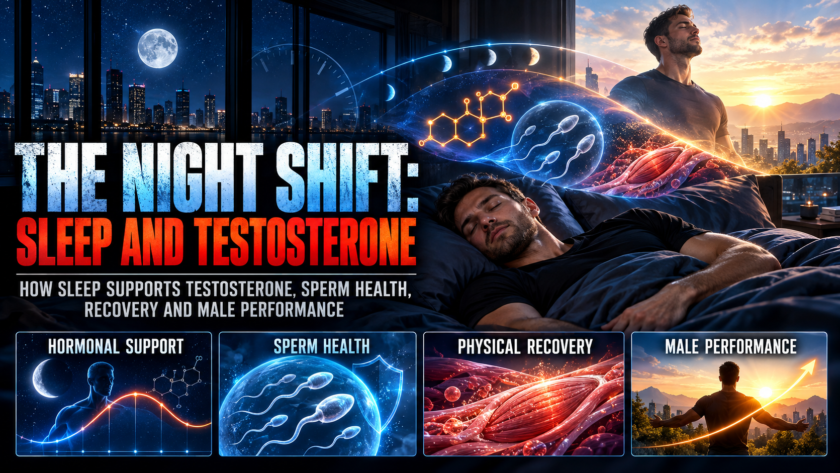
How Sleep Supports Testosterone, Sperm Health, Recovery and Male Performance
Sleep is not empty time. While a man rests, his body performs essential work that supports hormonal function, physical recovery, mental strength and reproductive health.
Every night, a second shift begins inside the male body.
The brain sorts and strengthens memories. The nervous system moves through carefully regulated sleep stages. Heart rate and blood pressure change. Metabolic and hormonal signals follow their daily rhythms. Muscles begin recovering from the work placed upon them, and the reproductive system continues biological processes that cannot be replaced by motivation, caffeine or another supplement.
Yet sleep is often the first foundation ambitious men sacrifice.
They stay awake answering messages, watching one more video, scrolling through information or attempting to force another hour of work from an exhausted mind. They call it dedication because admitting that entertainment stole the night would be uncomfortable. They tell themselves that five hours is enough, then wonder why training feels heavier, concentration becomes weaker, appetite becomes harder to control and patience disappears more quickly.
Some men spend hundreds of pounds on oils, minerals, testosterone supplements and fertility products while refusing to protect the recovery their bodies receive for free.
This does not mean sleep is a miracle testosterone booster. The research is more complicated than online headlines suggest. One small experiment found reduced daytime testosterone after a week of restricted sleep, but other controlled studies have not found the same effect, and a systematic review concluded that short-term partial sleep deprivation did not significantly reduce testosterone overall. Total sleep deprivation did. Sleep disorders have also been associated with poorer semen parameters, but much of that evidence is observational and cannot prove that poor sleep alone caused the difference.
That uncertainty does not make sleep unimportant. It makes the message more honest.
Sleep supports brain function, physical health, mood, appetite regulation, training recovery, alertness and decision-making. It helps create the environment in which normal hormonal and reproductive systems must operate. Protecting sleep cannot guarantee higher testosterone or conception—but continually destroying it can place unnecessary pressure on nearly every part of a man’s performance.
A disciplined man does not treat sleep as weakness. He recognises it as biological preparation for everything tomorrow will demand.
Welcome to The Night Shift.
1. Sleep Is Active Biological Work
From the outside, sleep appears passive. The eyes are closed, movement is limited and the conscious mind is largely disconnected from the environment.
Inside the body, the opposite is true.
Sleep unfolds through repeating cycles of non-rapid-eye-movement sleep and rapid-eye-movement sleep. Different stages are associated with different patterns of brain activity, muscle tone, breathing, heart rate and hormonal signalling. The body does not simply switch off. It changes operating mode.
During sleep, the body supports:
- Memory processing and learning
- Brain function and emotional regulation
- Cardiovascular recovery
- Immune function
- Metabolic regulation
- Tissue repair and adaptation
- Hormonal and circadian rhythms
- Alertness, reaction time and judgement the following day
The US National Heart, Lung, and Blood Institute states that sleep helps support healthy brain function and maintain physical health. Persistent inadequate sleep can affect thinking, reactions, work, learning and relationships while increasing long-term health risks.
This explains why a man can technically complete a day after very little sleep but still perform below his real capacity. He may be awake, yet slower to recognise problems. He may be present, yet less emotionally controlled. He may complete the workout, yet use worse technique or lower effort. He may believe he is making rational decisions while fatigue is quietly changing what feels difficult, urgent or rewarding.
Sleep quality is more than total hours
A healthy night is influenced by several dimensions:
- Duration: Was there enough time asleep?
- Continuity: Was sleep repeatedly interrupted?
- Timing: Did sleep occur at a time compatible with the body’s internal clock?
- Regularity: Were bedtime and waking time reasonably consistent?
- Depth and architecture: Did the body move normally through sleep stages?
- Daytime result: Did the person wake restored and function well?
This is why eight hours in bed is not always eight hours of restorative sleep. Alcohol, sleep apnoea, pain, stress, noise, caring responsibilities, shift work and repeated phone use can all reduce continuity or quality.
It is also why a wearable score should never become the sole judge of recovery. Consumer devices can be helpful for observing trends, but they do not diagnose sleep disorders and can sometimes create anxiety. Your functioning, symptoms and professional assessment matter more than chasing a perfect score.
Alpha Hormone Insight
Sleep is not time removed from the mission. It is one of the biological systems that makes sustained pursuit of the mission possible.
2. The Sleep and Testosterone Connection
Testosterone follows a daily rhythm. Levels are commonly higher in the morning and lower later in the day, although age, health, sleep pattern, shift work and individual biology influence that pattern.
Sleep interacts with this rhythm. In healthy men, testosterone often begins rising after sleep begins and remains elevated through part of the night, with morning measurement used clinically because of this daily variation.
This has created a popular statement:
“Less sleep destroys testosterone.”
The truth requires more precision.
A widely discussed 2011 experiment studied ten healthy young men. After one week in which their sleep opportunity was restricted to five hours per night, their daytime testosterone levels were lower than during a well-rested condition. The study was small, but it raised an important question about repeated sleep restriction.
Later research has not produced one perfectly consistent result. Randomised studies published in 2019 found no significant reduction in testosterone after acute or chronic partial sleep restriction in healthy young men. A 2021 systematic review and meta-analysis of 18 studies involving 252 men concluded that short-term partial sleep deprivation did not significantly reduce testosterone overall, while total sleep deprivation did.
The responsible conclusion is not that sleep never matters. It is that the size of the testosterone effect depends on the intensity, duration and context of sleep loss, and that the evidence is not strong enough to promise a predictable hormonal response for every man.
What this means in real life
- One late night does not automatically create testosterone deficiency.
- Sleeping longer than your biological need will not necessarily keep raising testosterone.
- Persistent poor sleep may still undermine health, energy, weight control and sexual wellbeing through several pathways.
- Sleep apnoea, obesity, medicines and illness can coexist with both fatigue and low testosterone.
- A man cannot diagnose his hormone level from how tired he feels.
Protect sleep because it supports the entire male system—not because an influencer promised a precise percentage increase.
Morning testosterone testing
If testosterone deficiency is suspected, the Endocrine Society recommends diagnosis only when relevant symptoms or signs occur alongside unequivocally and consistently low testosterone. Testing should be repeated using early-morning fasting measurements, followed by investigation of the cause.
This matters for poor sleepers. A late, disrupted or shift-work night can complicate interpretation. Tell the clinician about your sleep schedule, recent illness and work pattern rather than treating a single result as a permanent verdict.
Alpha Hormone Insight
Protecting sleep supports the environment testosterone depends upon. It does not give a man permission to diagnose himself or manufacture certainty from one study.
3. Sleep and Sperm Health
Sperm production is a continuous, highly organised process. Developing sperm cells require weeks inside the testes followed by further maturation in the epididymis. The semen released today therefore reflects influences extending well beyond last night.
That makes sleep and sperm health an important—but easily exaggerated—subject.
A 2022 systematic review and meta-analysis reported that sleep disorders were associated with lower total sperm count, concentration, progressive motility and normal morphology. However, the authors also warned that the number and quality of included studies were limited and called for stronger research.
A 2025 North American preconception study involving 690 men and 1,247 semen samples found that poor sleep health—including short or long sleep, frequent sleep trouble and poorer sleep quality—was associated with less favourable measures such as sperm concentration and total sperm count. Yet the study was cross-sectional, used self-reported sleep and could not eliminate unmeasured confounding. It identified an association, not proof that changing sleep alone would change semen.
Why the association may exist
Researchers have proposed several possible pathways:
- Disruption of circadian rhythms
- Hormonal changes
- Oxidative stress and inflammation
- Metabolic dysfunction
- Effects of shift work and irregular timing
- Coexisting behaviours such as alcohol use, inactivity or poor diet
- Sleep-disordered breathing and repeated oxygen disruption
These mechanisms remain areas of research. They should not be presented as a guarantee that every poor sleeper has poor sperm—or that every man who sleeps eight hours will have excellent semen parameters.
Fertility cannot be judged by sleep alone
A man can have disciplined sleep and still experience fertility difficulties because of:
- Varicocele
- Infection or inflammation
- Hormonal disorders
- Genetic conditions
- Testicular injury
- Blockages
- Previous cancer treatment
- Medicines or drug exposure
- Anabolic steroid or testosterone use
- Unexplained male-factor infertility
Likewise, a man who sleeps poorly may still have semen parameters within reference ranges.
If conception is not occurring, the correct response is not to wait indefinitely for better sleep to solve everything. Seek appropriate fertility assessment. A semen analysis evaluates factors such as volume, sperm concentration, total count, motility and morphology. An abnormal result may need confirmation because semen naturally varies.
Think in months, not one perfect night
Because sperm development takes time, reproductive-health habits should be viewed across months. Improving sleep tonight is still worthwhile, but the goal is consistency—not expecting tomorrow’s ejaculation to reveal a transformation.
Alpha Hormone Insight
A single early night cannot rebuild sperm health, but repeated nights of recovery can become part of the environment in which healthier sperm have the opportunity to develop.
4. Recovery Determines What Training Builds
Training provides a stimulus. Recovery determines how effectively the body can respond to that stimulus.
When you lift weights, you create mechanical tension and metabolic demands. The session signals the body to adapt. Protein intake supplies amino acids. Energy intake supports the work. Sleep provides a major recovery window in which the nervous system, muscles and wider physiology continue responding.
This does not mean muscle is built only while sleeping, nor that one poor night erases a workout. It means that training and recovery form one system.
Poor sleep can weaken the session before it begins
Insufficient sleep may affect:
- Alertness and reaction time
- Motivation and perceived effort
- Coordination and technique
- Decision-making under fatigue
- Repeated high-effort performance
- Recovery between sessions
- Pain perception and mood
The exact effect varies by task. Some research finds that maximal strength can be relatively resistant to one short night, whereas repeated sleep loss or total deprivation produces more noticeable impairment. A man may therefore lift a heavy repetition after poor sleep and conclude that recovery does not matter, while missing reductions in total work, concentration or consistency.
Muscle protein synthesis
In one controlled study, a single night of total sleep deprivation reduced post-meal muscle protein synthesis in healthy young adults. That finding should not be used to claim that every shortened night causes an identical percentage loss. Total deprivation is an extreme condition, and the study was small. It does reinforce a broader point: sleep participates in the anabolic and recovery environment.
Adapt training when necessary
If one night goes badly, you do not always need to cancel exercise. Make an intelligent decision based on the session, symptoms and safety.
Possible adjustments include:
- Reduce load or volume.
- Avoid testing maximal strength.
- Choose simpler exercises that demand less coordination.
- Extend the warm-up.
- Emphasise technique rather than records.
- Walk or complete light conditioning.
- Finish earlier and protect the next night.
If severe sleepiness makes driving, heavy lifting or equipment use unsafe, recovery takes priority.
Discipline is not blindly following the plan when the conditions have changed. It is protecting the long-term objective.
Alpha Hormone Insight
The workout proves your willingness to create the demand. Recovery proves your wisdom in helping the body answer it.
5. Poor Sleep Can Change Appetite and Body Composition
Many men treat weight management as a test of willpower alone. They count calories, remove foods and demand more discipline—but ignore the sleep deprivation changing how difficult those decisions feel.
Sleep interacts with appetite, glucose regulation and reward processing. The National Heart, Lung, and Blood Institute notes that insufficient quality sleep can alter hormones involved in hunger and reduce the body’s ability to respond to insulin.
After a short night, a man may notice:
- Stronger cravings for highly palatable food
- Larger portions
- More impulsive snacking
- Greater dependence on sugary or caffeinated products
- Reduced willingness to prepare food
- Lower spontaneous activity
- Poorer training quality
- Less patience with a planned diet
None of this removes personal responsibility. It explains why responsibility must include sleep.
The fatigue-reward loop
Poor sleep can create a repeating cycle:
- The man goes to bed late for entertainment.
- He wakes tired and seeks rapid stimulation.
- Caffeine and convenience food help him push through.
- Low energy reduces activity and meal preparation.
- He consumes more entertainment because difficult work feels harder.
- Late caffeine and screens delay the next night.
The solution is not to blame hormones for every food choice. It is to remove avoidable pressure from the system.
Weight, sleep and testosterone form a network
Excess body fat, particularly central obesity, can coexist with lower testosterone, sleep apnoea and metabolic problems. Poor sleep may make weight management harder; excess weight can increase sleep-apnoea risk; untreated sleep apnoea can fragment sleep and worsen daytime fatigue.
This is not a moral judgement. It is a biological network that deserves an integrated response.
For a man with obesity-related low testosterone and no other identified cause, current endocrine guidance generally prioritises weight reduction and treatment of reversible contributors rather than immediately prescribing testosterone.
Alpha Hormone Insight
When sleep is repeatedly neglected, discipline must fight battles that better recovery could have prevented. Make self-control easier by protecting the system around it.
6. The Libido Problem May Not Begin Where Men Think
Reduced sexual desire often creates immediate anxiety about testosterone.
That is understandable. Testosterone contributes to libido, and genuine deficiency can affect sexual health. But libido is not controlled by one hormone alone.
Sexual desire can be influenced by:
- Physical exhaustion
- Stress and anxiety
- Depression or low mood
- Relationship tension
- Medicines
- Alcohol and recreational drugs
- Chronic illness
- Body-image concerns
- Pain
- Poor cardiovascular health
- Sleep disorders
- Testosterone or other hormonal problems
A sleep-deprived man may have less interest in sex simply because his nervous system is overwhelmed and his body is exhausted. He may also become more irritable or emotionally distant, creating relationship strain that further reduces desire.
Erectile function is also broader than testosterone
Erections depend heavily on blood flow, nerve function, psychological state and cardiovascular health. Poor sleep can sit beside high blood pressure, diabetes, stress or sleep apnoea. Treating every erectile difficulty as proof of low testosterone can delay investigation of a more important cause.
Persistent erectile difficulties should be discussed with a GP because they can sometimes be an early sign of cardiovascular or metabolic disease.
Sleep and intimacy require communication
There is a practical relationship issue too. Different work patterns, parenting, late-night phone use and television in bed can reduce both sleep and connection.
A stronger approach includes:
- Discussing exhaustion without shame
- Agreeing boundaries for phones in bed
- Protecting time for closeness before both partners are depleted
- Addressing snoring or breathing pauses rather than normalising them
- Seeking help when sexual changes persist
Better sleep cannot guarantee stronger libido. It removes one common source of physical and emotional strain.
Alpha Hormone Insight
Do not reduce sexual health to one hormone or one performance. Examine the complete man—his body, mind, relationship, recovery and medical health.
7. Late-Night Entertainment Is Borrowed Energy
Not every late night is forced by work, parenthood or unavoidable responsibility.
Sometimes the truth is simpler: the man did not want the day to end.
He wanted time that belonged only to him, so he watched another episode, scrolled through videos, played a game or followed links with no stopping point. The entertainment gave immediate relief. Tomorrow received the cost.
This is borrowed energy.
Platforms do not protect your bedtime
Modern entertainment is designed to continue:
- Autoplay removes the decision to begin the next video.
- Infinite scrolling removes the natural stopping point.
- Notifications reopen attention.
- Recommendations promise that the next item will be more interesting.
- Social comparison keeps the mind emotionally activated.
The phone does not know that you plan to train at 6:30am. It does not care that you need patience with your children or concentration for your business. If you do not set the boundary, the platform receives the night.
The hidden exchange
When a man stays awake for low-value consumption, he is not only spending time. He may be exchanging:
- Tomorrow’s focus for tonight’s novelty
- Tomorrow’s training quality for tonight’s entertainment
- Tomorrow’s patience for tonight’s escape
- Tomorrow’s appetite control for tonight’s stimulation
- Tomorrow’s reproductive and hormonal environment for a habit he barely remembers
This does not mean entertainment is forbidden. Recreation matters. The problem begins when it repeatedly consumes the sleep required to live the life the man claims to value.
Create an entertainment closing time
Do not rely on feeling tired enough to stop. Decide beforehand:
- When the last episode ends
- When gaming stops
- When the phone begins charging outside reach
- Which apps become unavailable
- What time the evening shutdown begins
An alarm can signal the start of bedtime preparation rather than only the start of the morning.
The discipline is not “never enjoy yourself.” It is “do not allow an algorithm to negotiate against tomorrow.”
Alpha Hormone Insight
Entertainment is not free when it repeatedly purchases pleasure with tomorrow’s energy. Set the price you are no longer willing to pay.
8. Caffeine Cannot Replace Recovery
Caffeine can improve alertness and aspects of performance. It can be useful. It can also conceal the consequences of poor sleep long enough for the cycle to continue.
A stimulant does not perform the biological work of sleep. It does not complete memory processing, restore normal sleep architecture or repair every system affected by fatigue. It changes how sleepy you feel for a period of time.
The caffeine-sleep loop
- A man sleeps too little.
- He uses caffeine to function.
- Caffeine is consumed late because energy falls again.
- Sleep begins later or becomes lighter.
- He needs more caffeine the next day.
The answer is not necessarily to remove caffeine. It is to use it strategically.
Build a personal caffeine boundary
Caffeine sensitivity and clearance vary. A 2023 systematic review estimated that, on average, a standard coffee may need to be consumed nearly nine hours before bedtime to avoid reducing total sleep time, while a stronger pre-workout serving may require an even earlier cutoff. These are population estimates, not universal laws.
A practical system is:
- Record all caffeine sources, including coffee, tea, energy drinks and pre-workout.
- Identify the latest daily dose.
- Move the cutoff earlier for two weeks.
- Observe sleep onset, night waking and morning energy.
- Reduce total intake if the earlier cutoff is not enough.
For some men, midday is the correct boundary. Others tolerate a later coffee. The purpose is to discover what protects your sleep—not to copy another man’s metabolism.
Be honest about pre-workout
A late training session followed by a high-stimulant pre-workout can create a strange trade: more intensity tonight, poorer recovery afterwards. If evening training is necessary, consider a stimulant-free product, a lower dose or a different session structure.
Do not use “performance” to justify a habit that repeatedly weakens recovery.
Alpha Hormone Insight
Caffeine can lend alertness, but it cannot repay sleep debt. Use stimulation as a tool—not as camouflage for a broken recovery system.
9. Recognise Possible Sleep Apnoea
A man can create the perfect bedtime routine and still wake exhausted because his breathing repeatedly stops during sleep.
Obstructive sleep apnoea occurs when the upper airway narrows or closes during sleep. Breathing interruptions can fragment the night and reduce oxygen, even when the person does not remember waking.
Warning signs
The NHS advises seeing a GP when major symptoms include:
- Breathing that stops and starts during sleep
- Gasping, choking or snorting noises
- Persistent severe daytime tiredness
Other possible clues include:
- Loud habitual snoring
- Morning headaches
- Dry mouth on waking
- Difficulty concentrating
- Mood changes or irritability
- Waking repeatedly to urinate
- A partner noticing breathing pauses
Not everyone who snores has sleep apnoea, and not everyone with sleep apnoea fits one body type. Risk can be influenced by excess weight, neck anatomy, age, alcohol, smoking, sleeping position and family history.
Why willpower is not treatment
Sleep apnoea is not solved by telling yourself to sleep more. You may spend eight hours in bed while breathing disruption prevents restorative sleep.
Assessment may involve an overnight home test or sleep-clinic testing that monitors breathing, oxygen and heart rate. Treatment depends on severity and individual circumstances. It may include weight management, reducing alcohol, changing sleep position, a mandibular advancement device, continuous positive airway pressure or other specialist options.
The NHS notes that untreated sleep apnoea is associated with problems including high blood pressure, stroke, type 2 diabetes, heart disease, mood changes and accidents caused by sleepiness.
Driving safety
Severe daytime sleepiness is not merely inconvenient. It can make driving dangerous. In the UK, confirmed sleep apnoea with excessive sleepiness can create DVLA obligations, and a person must not drive until symptoms are controlled as required by current guidance.
If you suspect sleep apnoea, do not attempt to solve it with more caffeine or over-the-counter sleeping tablets. Seek assessment.
Alpha Hormone Insight
Strength is not pretending a medical warning sign does not exist. Strength is confronting the problem early enough to protect your life and the people around you.
10. Build the Alpha Sleep Environment
Sleep cannot be forced like another repetition in the gym. You can, however, create conditions that make it more likely.
The best sleep environment reduces the signals for wakefulness and strengthens the signals for rest.
1. Anchor the waking time
A reasonably consistent waking time helps stabilise the sleep-wake rhythm. Wild swings between workdays and weekends can make Monday feel like crossing time zones.
Perfection is unnecessary. Aim for a range you can sustain while allowing enough sleep opportunity.
2. Seek morning light
Light is one of the strongest signals to the circadian system. Natural outdoor light after waking can help reinforce daytime alertness and the timing of sleep later. This is especially useful during dark UK winters, although individual needs and shift work can complicate timing.
3. Make the room dark
Use curtains, blinds or an eye mask when needed. Remove unnecessary light sources. If you wake during the night, use the minimum light required for safety.
4. Reduce noise
Earplugs, a fan or steady background sound may help where traffic, neighbours or a partner’s schedule creates disruption. Important alarms and family-safety needs must still be heard.
5. Keep the temperature comfortable
Many people sleep better in a cool room, but there is no single perfect temperature for every person, home or season. Choose bedding and ventilation that prevent overheating or shivering.
6. Protect the bed’s purpose
When possible, reserve the bed for sleep and intimacy. Working, arguing, scrolling and watching intense content in bed can strengthen the association between the bedroom and wakefulness.
7. Reduce stimulating light and content
The problem is not only blue light. Content can provoke anger, comparison, sexual stimulation, worry or excitement. Dim screens, use night settings and—more importantly—create a period in which the phone is no longer part of the evening.
8. Manage fluids and food
Going to bed painfully hungry or overfull can disturb sleep. Large late meals, reflux, excessive fluids and alcohol may all create problems. Build an eating schedule that supports sleep without inventing rigid rules.
9. Exercise regularly
Regular activity can support sleep, health and stress management. If intense late exercise keeps you awake, move it earlier or adjust intensity. Other men tolerate evening training well.
10. Do not chase perfection
An obsession with ideal sleep can itself create anxiety. The goal is a repeatable environment, not a flawless night. When sleep is difficult, remain calm, follow evidence-based insomnia guidance and seek help if the problem persists.
Alpha Hormone Insight
You cannot command sleep to arrive, but you can stop building an environment that repeatedly tells it to stay away.
11. Win the Night Before It Begins
Most failed nights are not decided at bedtime. They are decided earlier, when caffeine is consumed, work is left open-ended, the phone remains unrestricted and tomorrow has not been prepared.
The solution is an evening shutdown system.
The Alpha Night Shift Protocol
Phase 1: Close the day
Before the final hour:
- Record what was completed.
- Identify tomorrow’s first important task.
- Write down unresolved thoughts instead of carrying them into bed.
- Prepare clothing, training equipment and breakfast if useful.
- Set a stopping point for work.
The purpose is to tell the mind: “Nothing important needs to be held in working memory tonight.”
Phase 2: Reduce stimulation
During the final hour:
- End high-intensity work where circumstances allow.
- Dim unnecessary lighting.
- Stop news, arguments and endless short-form content.
- Put the phone on charge outside reach.
- Choose reading, prayer, quiet conversation, stretching or another calming activity.
This period does not need to become a complicated performance involving twelve products and perfect rituals. It needs to be repeatable.
Phase 3: Enter the sleep environment
- Keep the room dark, quiet and comfortable.
- Ensure the alarm is set once.
- Avoid repeatedly checking the time.
- If worries appear, place them on paper and return to rest.
- If persistent insomnia continues, seek evidence-based support rather than spending hours fighting in bed.
Shift workers need a modified protocol
Men working nights cannot always follow daylight-based advice. Their discipline is not measured by pretending they work a conventional schedule.
Useful priorities may include:
- Protecting a consistent sleep window where possible
- Using darkness and eye protection during daytime sleep
- Managing light exposure strategically
- Planning caffeine early in the shift rather than near intended sleep
- Reducing noise and family interruptions
- Discussing severe fatigue with occupational health or a clinician
The governing principle remains the same: sleep must be scheduled and defended like any other essential responsibility.
Recover when the evening goes wrong
One disrupted night does not justify abandoning the week.
The next day:
- Wake near the planned time unless safety or illness requires otherwise.
- Seek daylight.
- Keep caffeine deliberate.
- Use a short nap cautiously if appropriate, without allowing it to destroy the next night.
- Adjust risky training or driving.
- Return to the normal system that evening.
Do not turn a poor night into a personal identity.
Alpha Hormone Insight
A strong morning often begins with a man who knew when to close the previous day. Preparation is the first stage of recovery.
12. Test Hormonal Problems Properly
Sleep improvement is valuable, but it should not become a reason to delay medical assessment.
Persistent fatigue, low libido, erectile difficulties, low mood, reduced strength or fertility problems can have many causes. These include:
- Insufficient or disrupted sleep
- Sleep apnoea
- Depression or anxiety
- Thyroid disorders
- Anaemia
- Diabetes or metabolic disease
- Medication effects
- Alcohol or drug use
- Chronic illness
- Testosterone deficiency
- Relationship or psychological factors
Symptoms are a starting point, not a diagnosis
Current Endocrine Society guidance states that hypogonadism should be diagnosed only when compatible symptoms or signs are present alongside consistently and unequivocally low testosterone measured accurately.
A responsible pathway includes:
- Discussing symptoms and medical history with a clinician.
- Completing properly timed early-morning fasting testosterone testing.
- Repeating the measurement to confirm a consistently low result.
- Reviewing sleep, weight, medicines, alcohol and health conditions.
- Measuring luteinising hormone and follicle-stimulating hormone when appropriate.
- Investigating testicular or pituitary causes where indicated.
- Discussing benefits, risks and fertility before treatment.
Testosterone therapy can suppress sperm
External testosterone reduces the pituitary signals that drive testosterone production inside the testes and support sperm production. It may substantially reduce sperm count, sometimes to zero during use.
For this reason, clinical guidance recommends against starting testosterone therapy in men planning fertility in the near term. A man who wants children must make that goal clear before treatment begins.
Testosterone therapy can be appropriate for properly diagnosed men under medical supervision. It should not be used as a shortcut around sleep deprivation, obesity, untreated sleep apnoea or an incomplete investigation.
Fertility assessment also deserves action
If a couple has difficulty conceiving, both partners should be assessed. A semen analysis provides information that sleep tracking cannot. Men with testicular symptoms, previous cancer treatment, known reproductive conditions or strong fertility concerns may need earlier help.
Sleep is part of preparation. Testing establishes what is actually happening.
Alpha Hormone Insight
A disciplined man improves what he can control and investigates what he cannot explain. He does not use lifestyle advice to hide from medical truth.
Sleep Loss Versus Recovery Leadership
| Sleep-loss pattern | Recovery-leadership response |
|---|---|
| Uses entertainment until exhaustion | Sets an entertainment closing time |
| Relies on motivation to stop scrolling | Uses app limits and charges the phone away from bed |
| Drinks caffeine whenever energy falls | Establishes a personal caffeine cutoff |
| Treats snoring as a joke | Investigates breathing pauses and daytime sleepiness |
| Trains heavily regardless of severe fatigue | Adjusts the session when safety or recovery requires it |
| Sleeps at wildly different times | Anchors a reasonably consistent waking time |
| Expects one long weekend sleep to repair everything | Builds repeatable nightly opportunity |
| Diagnoses low testosterone from tiredness | Seeks symptoms-based assessment and repeat testing |
| Uses testosterone without discussing children | Protects fertility before treatment |
| Calls sleep laziness | Recognises sleep as biological preparation |
Signature Framework: The Alpha Sleep Audit
Answer honestly. The audit is not designed to produce shame. It is designed to show where tomorrow’s strength is being lost.
1. Sleep opportunity
- What time do I normally enter bed?
- What time do I normally wake?
- How much time do I genuinely allow for sleep?
- Is my schedule different on weekends?
- Am I expecting seven or eight hours of sleep from a six-hour window?
2. Sleep continuity and quality
- How often do I wake during the night?
- Do pain, temperature, noise or urination disturb me?
- Do I wake feeling restored?
- Do I need repeated alarms?
- Do I become dangerously sleepy during the day?
3. Evening behaviour
- How much time do I spend scrolling in bed?
- Which content keeps me activated?
- What is my entertainment closing time?
- Do I take unfinished work and conflict into the bedroom?
- What would a simpler final hour look like?
4. Caffeine and alcohol
- What is my total daily caffeine intake?
- What time is the final dose?
- Does my pre-workout contain caffeine?
- Do I use alcohol to become sleepy?
- Do I wake more often after drinking?
5. The environment
- Is the room dark enough?
- Is noise interrupting sleep?
- Is the temperature comfortable?
- Is my phone within reach?
- Does the bed feel connected with sleep or with work and entertainment?
6. Breathing and warning signs
- Do I snore loudly?
- Has anyone witnessed breathing pauses?
- Do I gasp or choke during sleep?
- Do I wake with headaches or a dry mouth?
- Am I persistently exhausted despite enough time in bed?
- Should I speak to a GP about possible sleep apnoea?
7. Performance and health
- Is poor sleep affecting training form or motivation?
- Has appetite become harder to manage?
- Has my mood or patience changed?
- Have libido or erectile function changed?
- Do persistent symptoms require a medical assessment?
8. Fertility
- Is fatherhood part of my near or long-term future?
- Am I giving sleep the same attention as supplements and nutrition?
- Have I used anabolic steroids or external testosterone?
- Do fertility concerns require semen analysis rather than guesswork?
Finish by choosing:
- One evening habit to remove
- One environmental improvement to make
- One caffeine boundary to test
- One consistent waking time to protect
- One medical warning sign to investigate
Practical Challenge: The Seven-Night Recovery Reset
Seven nights will not prove a testosterone change or transform sperm production. The purpose is to establish evidence that you can control the behaviours surrounding sleep.
Before Night One
Record:
- Usual bedtime and waking time
- Average morning energy from 1 to 10
- Latest caffeine dose
- Night-time phone use
- Current bedroom obstacles
- Any snoring or breathing concerns
Every Night
1. Set the sleep opportunity
Work backwards from the required waking time and allow a realistic window. Most healthy adults need at least seven hours, while individual need varies.
2. End caffeine early
Choose a cutoff that gives your body sufficient time before bed. Keep it consistent for all seven days.
3. Remove automatic entertainment
No infinite scrolling, autoplay or gaming during the final hour. Put the phone out of reach.
4. Close tomorrow’s open loops
Write tomorrow’s leading task, prepare what you need and place unresolved worries on paper.
5. Prepare the environment
Make the room dark, quiet and comfortable. Set the alarm and stop checking the time.
6. Record the morning evidence
Note:
- Approximate sleep duration
- Number of remembered awakenings
- Morning energy from 1 to 10
- Mood
- Training readiness
- Whether you followed the system
Do not allow one device score to control your mood.
7. Investigate warning signs
If breathing stops, choking, severe snoring or dangerous daytime sleepiness appears, arrange medical advice. Do not wait for the challenge to finish.
End-of-Challenge Review
After seven nights, ask:
- Which habit most often delayed sleep?
- Did an earlier caffeine cutoff help?
- Did removing the phone reduce bedtime drift?
- Did morning energy or emotional control improve?
- Which barriers require a family, work or medical solution?
- What will I continue for the next 30 nights?
The victory is not perfection. It is replacing accidental nights with deliberate recovery.
Frequently Asked Questions
Does sleep increase testosterone?
Sleep supports normal hormonal rhythms, but research does not show that simply adding sleep will raise testosterone in every man. One small study found lower daytime testosterone after a week of five-hour sleep opportunities, while a larger review found no significant overall effect from short-term partial deprivation and a reduction after total sleep deprivation. Protect sleep for whole-body health rather than expecting a guaranteed hormone boost.
How many hours should a man sleep for healthy testosterone?
There is no precise number that guarantees a testosterone result. Most adults should obtain at least seven hours, and many function best with roughly seven to nine. Individual needs vary. Quality, regularity, timing and freedom from disorders such as sleep apnoea also matter.
Can one bad night lower testosterone?
One poor night may affect energy, mood and performance, but it does not automatically create clinical testosterone deficiency. Total sleep deprivation has reduced testosterone in research, while findings from partial restriction are mixed. Resume a healthy schedule rather than panicking over one result.
Does poor sleep reduce sperm count?
Sleep disorders and poor sleep health have been associated with lower sperm count, concentration, motility or morphology in several observational studies and reviews. These findings do not prove that sleep alone caused the changes. Sperm health is influenced by many medical, environmental and lifestyle factors.
How long would better sleep take to affect sperm?
There is no proven timetable guaranteeing improvement. Sperm production and maturation take several weeks, so fertility habits should be maintained over months rather than days. Men with conception difficulties should seek assessment instead of waiting for sleep changes alone.
Can caffeine compensate for too little sleep?
Caffeine may temporarily improve alertness and aspects of performance, but it does not reproduce the biological functions of sleep. Late intake may also delay or disrupt the next night, creating a repeating cycle.
When should I stop drinking caffeine?
Sensitivity differs. Research suggests caffeine can affect sleep many hours later, especially at larger doses. Begin by moving your cutoff earlier—often to midday or early afternoon—and track the result. Include pre-workout, energy drinks, tea and cola in the calculation.
Does alcohol help sleep?
Alcohol may make a person feel sleepy initially, but it can fragment sleep later and worsen breathing problems. It should not be used as a sleep treatment.
How do I know whether I have sleep apnoea?
Warning signs include breathing that stops and starts, gasping or choking, loud snoring and persistent daytime tiredness. A GP may refer you for overnight testing, often performed at home. Only proper assessment can confirm the diagnosis.
Should I take melatonin?
Melatonin can be appropriate for certain conditions and is a prescription medicine in the UK. It is not the automatic answer to every sleep problem. Speak to a pharmacist or clinician, particularly if you take other medicines or suspect sleep apnoea.
Should I train after a poor night’s sleep?
That depends on severity, the planned session and safety. Light or moderate training may be reasonable, but heavy technical lifting, maximal attempts or driving to train may be unsafe when severe sleepiness is present. Adjust rather than attempting to prove toughness.
Can low testosterone cause sleep problems?
Sleep and hormonal health can influence one another, but symptoms overlap with many conditions. Testosterone treatment can also affect sleep-disordered breathing in some men. Persistent symptoms require professional evaluation rather than self-treatment.
Will testosterone therapy improve my energy if I am tired?
Only appropriately diagnosed men should consider testosterone therapy. Fatigue alone is not proof of deficiency. Diagnosis requires compatible symptoms and repeatedly low, accurately measured morning testosterone, followed by investigation of the cause.
Can testosterone therapy affect sperm production?
Yes. External testosterone can suppress the hormonal signals required for sperm production. Men planning children should discuss fertility before treatment and should not start or stop prescribed hormones without medical supervision.
Closing Declaration
I will stop treating sleep as disposable time.
I will protect the recovery my body and mind require.
I will not allow entertainment to steal tomorrow’s strength.
I will use caffeine deliberately rather than hiding exhaustion behind it.
I will respect the relationship between sleep, hormonal health, fertility and performance without believing exaggerated promises.
I will investigate breathing problems, persistent fatigue and sexual-health changes instead of ignoring them.
I will prepare tomorrow before I enter bed tonight.
If one night goes wrong, I will recover without surrendering the entire week.
Every night, I will prepare my body and mind to carry tomorrow’s responsibilities.
Final Line
You do not become weaker when you protect your sleep—you become better prepared to use your strength.



No spam. Unsubscribe anytime.