A sperm cell may be microscopic, but the challenge in front of it is enormous.
It must survive.
Move.
Navigate through a changing environment.
Respond to biological signals.
And remain functional long enough to participate in fertilisation.
That journey requires energy.
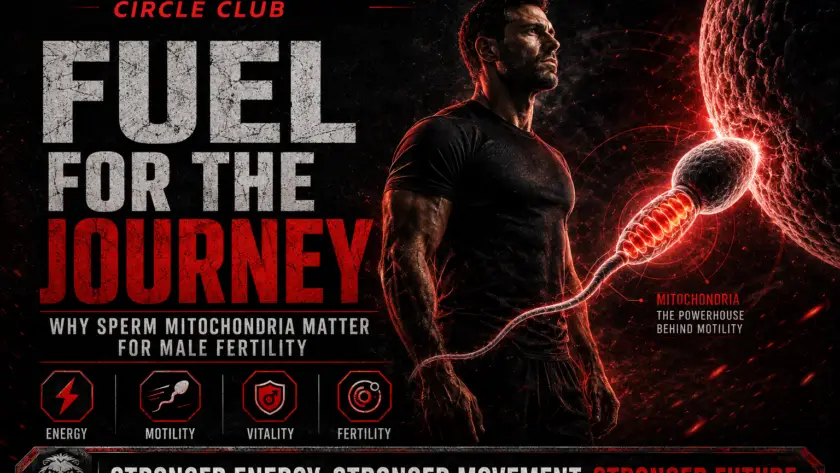
Inside the sperm’s midpiece are tightly packed mitochondria—specialised structures involved in cellular energy production, redox balance and several processes needed for sperm function. Research reviews describe sperm mitochondria as important to motility, capacitation, the acrosome reaction and the interaction between sperm and egg. However, sperm energy metabolism is complex: mitochondria are important, but they are not the only source of energy used by sperm cells.
This is why male fertility cannot be reduced to one question:
“How many sperm do I have?”
Count matters.
But movement matters too.
Structure matters.
Cellular function matters.
And the internal systems supporting those sperm matter.
A man may have a substantial number of sperm present, but if too few are moving effectively—or if their movement is poorly directed—conception may still be more difficult.
An alpha man should therefore think beyond producing more sperm.
He should seek to understand the health, habits and medical factors that may influence whether sperm are capable of performing the journey ahead.
Sperm need more than existence. They need the energy, movement and functional ability required to complete the journey.
1. Sperm Are Living Cells With an Energy Demand
Sperm are highly specialised reproductive cells.
They need energy to support functions including:
- Movement of the tail
- Progressive travel
- Changes that prepare the sperm to interact with the egg
- Regulation of calcium
- Responses to the surrounding environment
- The acrosome reaction involved in fertilisation
Mitochondria contribute to these functions by participating in energy production and other regulatory processes.
But the science is more complicated than saying:
“Mitochondria are the sperm’s battery.”
That description can be useful, but it is incomplete.
Sperm can generate energy through mitochondrial oxidative phosphorylation and through glycolysis occurring elsewhere in the cell. The relative importance of these pathways varies, and researchers continue to investigate how they interact in human sperm function.
The practical lesson is not that men need to become cellular biologists.
It is that sperm function depends on more than the number of cells produced.
The quality of the system matters.
Alpha Insight
Sperm do not reach their destination through numbers alone. They require energy, movement and coordinated cellular function.
2. Meet the Sperm Midpiece
A mature sperm cell is usually described in three main sections:
- The head
- The midpiece
- The tail
The head contains the genetic material and structures involved in interacting with the egg.
The tail produces the movement that propels the cell.
Between them sits the midpiece.
The midpiece contains a tightly arranged mitochondrial sheath. These mitochondria contribute to the metabolism and regulation needed to support sperm movement and other fertilisation-related processes.
This tiny region performs an important role.
If mitochondrial structure or function becomes impaired, sperm performance may also be affected.
Researchers have associated mitochondrial dysfunction with:
- Reduced mitochondrial membrane potential
- Lower motility
- Increased oxidative stress
- Damage to mitochondrial or nuclear DNA
- Reduced sperm quality
These associations do not mean mitochondrial dysfunction explains every case of poor motility or infertility.
They show that the midpiece deserves greater attention than it usually receives in popular discussions about male fertility.
Alpha Insight
The sperm midpiece may be small, but it contains an energy system with an important influence on how effectively the cell can perform.
3. Why Sperm Motility Matters
Sperm being present is not the same as sperm moving effectively.
A semen analysis can assess:
- Total motility
- Progressive motility
- Sperm concentration
- Total sperm number
- Semen volume
- Vitality
- Morphology
Total motility includes sperm moving in any direction.
Progressive motility refers to sperm moving forwards effectively rather than merely vibrating or travelling without meaningful progression.
Under the World Health Organization-based values used in the updated 2026 NICE fertility guideline, the lower reference values include total motility of 42% and progressive motility of 30%. These are reference values rather than sharp dividing lines between “fertile” and “infertile.” A result must be interpreted alongside the wider semen profile, medical history and reproductive circumstances of both partners.
A man cannot judge motility by looking at semen.
High semen volume does not prove strong movement.
A high sperm concentration does not automatically mean most sperm are moving progressively.
Testing is required.
Alpha Insight
Count reveals how many sperm are present. Motility helps reveal whether they are capable of moving effectively.
4. Mitochondria Matter—but They Are Not the Only Fertility System
Mitochondria are an important part of sperm function.
But they are not a single fertility switch.
Reduced motility may also be connected with:
- Sperm structure
- Testicular function
- Hormonal disorders
- Genetic factors
- Infection or inflammation
- Varicocele
- Medical treatment
- Anabolic-steroid use
- Ejaculatory problems
- Wider health and lifestyle factors
WHO explains that male infertility may involve low or absent sperm, difficulties with semen ejection, hormone disorders, impaired sperm production, or abnormal sperm shape and movement.
A man should therefore avoid assuming that a mitochondrial supplement will solve every fertility concern.
The body is an interconnected system.
Sperm need to be:
- Produced
- Matured
- Transported
- Protected
- Released
- Capable of moving
- Structurally functional
- Able to interact with the egg
Mitochondrial health contributes to that system.
It does not replace it.
Alpha Insight
There is no single fertility switch. Strong sperm performance depends on several biological systems working together.
5. Oxidative Stress: Useful at the Right Level, Damaging in Excess
Reactive oxygen species are often described as completely harmful.
But that is not accurate.
At controlled physiological levels, reactive oxygen species participate in normal sperm signalling and fertilisation-related processes.
Problems can occur when reactive molecules are produced faster than the body’s antioxidant defences can manage them.
That imbalance is called oxidative stress.
Sperm are particularly vulnerable because their membranes contain large amounts of polyunsaturated fatty acids and their capacity for cellular repair is limited.
Excessive oxidative stress may contribute to:
- Lipid peroxidation of sperm membranes
- Reduced membrane fluidity
- Lower motility
- Disrupted mitochondrial membrane potential
- Damage to proteins
- Nuclear and mitochondrial DNA damage
- Reduced fertilising potential
Oxidative stress and mitochondrial dysfunction can also reinforce one another: damaged mitochondria may produce more reactive molecules, which may cause further cellular damage.
The objective is not to eliminate every reactive molecule.
That would neither be possible nor desirable.
The objective is to reduce avoidable conditions that may drive damaging oxidative imbalance.
Alpha Insight
The goal is not zero oxidation. It is balance—enough cellular signalling for normal function without uncontrolled damage overwhelming the system.
6. Smoking Can Work Against Sperm Quality
Smoking is one of the clearest modifiable habits a man should examine.
Cigarette smoke exposes the body to numerous chemicals and can contribute to oxidative stress.
NICE advises men that smoking is associated with reduced semen quality, although the precise impact on an individual man’s fertility remains uncertain. ASRM has also reviewed evidence linking tobacco exposure with changes in sperm parameters and reproductive outcomes.
No responsible article can promise that quitting smoking will automatically restore fertility.
But stopping smoking improves general health and removes a repeated source of toxic exposure.
A man should not spend heavily on fertility supplements while continuing to smoke and expecting the capsules to cancel the habit.
They cannot guarantee that.
If stopping is difficult, seek structured help through a GP, pharmacist or smoking-cessation service.
Strength is not pretending an addiction has no control.
Strength is using every available resource to break it.
Alpha Insight
A supplement cannot reliably compensate for a habit that repeatedly exposes the reproductive system to harm. Remove the obstacle before chasing another solution.
7. Excessive Alcohol Can Affect the Foundation
Alcohol is another area where dose and pattern matter.
NICE’s 2026 guidance advises that excessive alcohol intake is detrimental to semen quality. Drinking within the UK Chief Medical Officer’s low-risk guideline of no more than 14 units per week, spread over several days, is considered unlikely to affect semen quality—but “unlikely” is not the same as guaranteed for every individual.
A fertility-focused man should examine:
- How many units he actually consumes
- Whether he binge drinks
- Whether alcohol damages his sleep
- Whether it affects food choices
- Whether it reduces training consistency
- Whether it has become a coping mechanism
The issue is not only the direct reproductive effect.
Alcohol can also weaken the wider routine supporting health, recovery and disciplined decision-making.
Alpha Insight
Do not measure alcohol only by what happens during the night. Measure the sleep, recovery, discipline and health it may take from the following day.
8. Metabolic Health Influences the Cellular Environment
A sperm cell’s mitochondria do not exist separately from the rest of the man.
They develop within a body influenced by:
- Body composition
- Blood-glucose regulation
- Cardiovascular health
- Hormonal signalling
- Sleep
- Physical activity
- Chronic illness
- Inflammation
ASRM notes that male obesity may affect reproduction through endocrine changes, sexual dysfunction, diabetes, sleep apnoea and increased scrotal temperature. Some studies have associated obesity with lower sperm count or motility, sperm DNA damage, oxidative stress and reduced mitochondrial activity, although not every study has found the same relationships. Evidence that weight loss reliably improves semen parameters also remains limited.
The responsible conclusion is not:
“Every man with obesity is infertile.”
Most men with obesity are fertile.
Nor is it:
“Lose weight and fertility is guaranteed.”
That is not supported.
The better message is:
Improve metabolic health because it strengthens the whole system, even when the exact fertility outcome cannot be predicted.
This may involve:
- Gradual fat loss where appropriate
- Regular physical activity
- Improved food quality
- Management of diabetes
- Investigation of suspected sleep apnoea
- Medical assessment of hormonal symptoms
- Reducing severe inactivity
Alpha Insight
Your reproductive cells develop inside the body you build every day. Strengthen the whole environment rather than searching for one isolated fertility trick.
9. Exercise Can Support the System—But More Is Not Always Better
Exercise can support wider metabolic, cardiovascular and psychological health.
A sustainable routine may include:
- Regular walking
- Strength training
- Moderate cardiovascular exercise
- Mobility work
- Appropriate recovery
The objective is not to destroy the body.
It is to build capacity.
A fertility-focused training plan should avoid becoming entangled with:
- Chronic sleep deprivation
- Severe calorie restriction
- Constant overtraining
- Unmanaged injury
- Anabolic steroids
- Inadequate recovery
Anabolic steroids deserve particular attention.
WHO states that anabolic-steroid use can produce abnormal semen parameters, including changes in sperm count and shape. NICE also advises clinicians to ask about anabolic steroids and testosterone-replacement therapy when assessing fertility concerns, and its 2026 guidance says androgens should not be offered to treat semen abnormalities.
Do not stop prescribed medication without medical guidance.
Tell the prescribing clinician that future fertility matters to you and ask how treatment may affect sperm production.
Alpha Insight
Train to strengthen the system—not to punish it. Muscle gained at the expense of reproductive function may carry a hidden price.
10. Recovery Is Part of Performance
A man may train intensely, work long hours and then treat sleep as an inconvenience.
But recovery supports the wider systems influencing:
- Energy
- Appetite
- Metabolic health
- Hormonal regulation
- Emotional control
- Training quality
- Daily decision-making
Sleep should not be advertised as a direct cure for poor sperm motility.
The evidence does not justify that promise.
It should be treated as part of the health environment in which reproductive function operates.
A strong recovery routine may include:
- A reasonably consistent sleep schedule
- Sufficient time in bed
- Reducing late-night screen use
- Avoiding repeated heavy meals or alcohol before bed
- Addressing persistent insomnia
- Seeking assessment for severe snoring or suspected sleep apnoea
The man who constantly under-recovers is asking every system in his body to perform while receiving inadequate restoration.
Alpha Insight
Recovery is not the absence of discipline. It is the discipline that allows training, metabolism and health to continue functioning.
11. Build a Strong Dietary Foundation
Men are often attracted to one “mitochondrial food” or one ingredient said to transform sperm energy.
But cellular health is not built through one meal.
A balanced dietary foundation may include:
- Adequate protein
- Fruit
- Vegetables
- Fibre-rich carbohydrates
- Healthy dietary fats
- Sufficient energy intake
- Hydration
- A varied supply of vitamins and minerals
The precise dietary approach may differ according to body size, activity, health conditions, culture and medical needs.
The principle remains the same:
Build a pattern before chasing a product.
A man cannot continually under-eat, overeat, rely heavily on ultra-processed food and then expect one powder to repair the entire system.
Food supplies the raw materials.
But food is only one part of fertility.
Medical problems still require medical assessment.
Alpha Insight
Cellular energy is supported by the quality of the entire system—not one miracle ingredient added to an otherwise neglected foundation.
12. Antioxidants Are Not Automatically Better in Larger Amounts
Because oxidative stress can damage sperm, it is tempting to assume that more antioxidants must always be better.
Biology is rarely that simple.
Reactive oxygen species also participate in normal sperm function.
Excessive or poorly selected antioxidant use could disturb the balance rather than improve it.
Supplements may also:
- Interact with medication
- Produce side effects
- Provide excessive nutrient doses
- Vary in quality
- Duplicate ingredients across several products
- Create false reassurance
- Delay proper medical investigation
A 2025 systematic review of 50 randomised controlled trials found no overall improvement in pregnancy or live-birth outcomes from male fertility supplements. Some individual supplements improved isolated semen parameters, but better semen numbers do not automatically prove an increased chance of taking home a healthy baby.
NICE’s 2026 guidance specifically advises against offering supplements, antioxidants or medical treatments for the purpose of improving sperm DNA integrity because current evidence does not support that use.
This does not mean every supplement is useless.
A diagnosed deficiency may require treatment.
A clinician may recommend a nutrient for a specific reason.
But the decision should be individual—not driven by the assumption that larger doses always produce stronger fertility.
Alpha Insight
Antioxidants are tools, not magic. More is not automatically better, and improved laboratory numbers do not always translate into pregnancy or live birth.
13. CoQ10: Promising Results, Incomplete Answers
Coenzyme Q10 attracts attention because of its role in mitochondrial energy transfer and antioxidant activity.
Some randomised-trial meta-analyses have reported improvements in measures such as total or progressive motility and total sperm count among men receiving CoQ10.
However, the research contains important limitations:
- Study populations differ
- Doses and treatment periods vary
- Some trials are small
- Results are heterogeneous
- Pregnancy and live-birth data are limited
An earlier meta-analysis found improvements in some semen parameters but no evidence that CoQ10 increased pregnancy rates. A more recent analysis reported improvements in several semen measures but still called for larger, better-designed trials before firm conclusions could be reached.
The responsible conclusion is:
CoQ10 may be worth discussing in certain circumstances, but it is not a guaranteed fertility treatment.
Men taking medication, managing chronic health conditions or combining several supplements should seek professional advice.
Alpha Insight
A promising supplement is not the same as a proven outcome. Judge the evidence by pregnancy and live birth—not semen numbers alone.
14. Carnitine and Other “Mitochondrial” Nutrients
L-carnitine and acetyl-L-carnitine are commonly marketed for sperm energy and motility.
Other frequently promoted nutrients include:
- Selenium
- Zinc
- Vitamins C and E
- Folate
- Alpha-lipoic acid
A recent broad systematic review found that carnitine, selenium and CoQ10 improved motility in some trials, while other nutrients affected different individual semen measures. But the same review found no overall effect from supplements on pregnancy or live-birth outcomes.
That distinction is critical.
A supplement may alter one laboratory parameter without proving that it improves the complete reproductive outcome.
Before taking a product, ask:
- What problem am I trying to address?
- Do I have a confirmed deficiency?
- Is the dose appropriate?
- Does it duplicate another supplement?
- Could it interact with medication?
- Is there evidence for men with my specific condition?
- Has a clinician identified a cause of the abnormal result?
Do not create a large supplement stack simply because every ingredient has a plausible mechanism.
Plausibility is not proof.
Alpha Insight
A biological theory may explain why a supplement could work. Only strong clinical evidence can show whether it meaningfully improves the outcome that matters.
15. Protect the Testicular Environment Sensibly
The testes operate at a lower temperature than the body’s core.
NICE states that elevated scrotal temperature is associated with reduced semen quality, although it remains uncertain whether changing to loose-fitting underwear improves fertility. Certain occupations may also involve fertility hazards and should be discussed with occupational-health professionals when appropriate.
Practical precautions may include:
- Avoiding prolonged laptop use directly on the lap
- Taking breaks from long periods of sitting
- Reviewing frequent high-heat exposure
- Following workplace safety procedures
- Avoiding extreme or unproven cooling devices
- Seeking advice where occupational exposure is a concern
The objective is not to become afraid of warmth.
It is to reduce obvious, unnecessary and repeated exposure.
Extreme ice treatments or unregulated “testicular cooling” products should not be mistaken for evidence-based medical care. ASRM notes that proposed scrotal-cooling interventions remain impractical or unproven.
Alpha Insight
Protect the testicular environment with sensible habits—not fear, obsession or unproven extremes.
16. Do Not Ignore Possible Varicocele or Testicular Symptoms
A varicocele is an enlargement of veins around the testicle.
WHO lists varicocele among conditions that may contribute to testicular failure or impaired sperm production in some men.
The proposed mechanisms may involve:
- Increased local temperature
- Oxidative stress
- Changes in testicular function
- Effects on semen quality
But a man should not attempt to diagnose a varicocele by reading an article.
Seek medical assessment for:
- Persistent testicular pain
- Swelling
- A new lump
- A noticeable change in one testicle
- A heavy or dragging sensation
- Repeatedly abnormal semen results
- Fertility concerns
Not every varicocele requires treatment.
Management depends on symptoms, examination, semen findings and the couple’s reproductive circumstances.
Alpha Insight
Do not guess about testicular changes. Early medical assessment is stronger than silent worry or self-diagnosis.
17. Test Motility Instead of Guessing
A clinical semen analysis is the standard starting point for assessing several characteristics of semen and sperm.
The WHO laboratory manual provides standardised methods intended to improve the quality and comparability of semen testing between laboratories.
The analysis may include:
- Volume
- Concentration
- Total sperm number
- Total motility
- Progressive motility
- Vitality
- Morphology
Testing provides information.
It does not provide a complete verdict on a man’s identity or future.
WHO emphasises that laboratory results must be interpreted in context and that fertility ultimately concerns the reproductive situation of the couple—not one number belonging to one individual.
A man cannot see sperm movement with the naked eye.
He cannot determine mitochondrial function from semen appearance.
He cannot accurately judge fertility from volume alone.
Measure what can be measured.
Then interpret it responsibly.
Alpha Insight
Testing replaces assumption with evidence. A man cannot improve intelligently when he does not understand what is actually happening.
18. One Semen Result Is Not the Entire Story
Semen parameters can vary between samples.
Collection conditions, recent illness, laboratory methods and natural biological variation may all influence results.
NICE recommends repeating an abnormal initial semen analysis. The confirmatory test should ideally occur around three months later to allow a sperm-production cycle to be completed. However, severe sperm deficiency or complete absence of sperm should be reassessed sooner rather than automatically waiting three months.
After two or more abnormal analyses, NICE recommends a physical examination of the scrotum and testes and consideration of testosterone and gonadotrophin testing.
The correct response to an abnormal result is not panic.
It is a process:
- Confirm the result.
- Review the collection conditions.
- Discuss medical history.
- Examine possible causes.
- Follow clinical advice.
- Repeat testing at the appropriate time.
- Build a plan based on evidence.
Alpha Insight
One result deserves attention, not hopelessness. Confirm it, investigate it and use it to create the next intelligent action.
19. Mitochondrial Health Is Not a DIY Diagnosis
Poor motility does not automatically prove that sperm mitochondria are the primary problem.
A semen analysis does not directly explain every cellular mechanism behind an abnormal result.
Further investigation may consider:
- Medical history
- Medication
- Hormonal symptoms
- Previous surgery or injury
- Infection
- Varicocele
- Testicular examination
- Lifestyle exposures
- Genetic factors where indicated
A man should seek medical advice when:
- He has persistent testicular pain, swelling or a lump
- Semen tests are repeatedly abnormal
- He has used anabolic steroids or testosterone
- He has sexual or ejaculatory problems
- He has undergone chemotherapy or reproductive surgery
- Conception has not occurred within the expected time
- A clinician advises earlier assessment because of known risks
Do not suddenly stop prescribed medication.
Do not begin hormone treatments through unregulated sources.
Do not allow embarrassment to delay an important examination.
Alpha Insight
Cellular science should lead you towards better questions—not false certainty or self-treatment.
The Alpha Sperm Energy Framework
Use this five-part framework to support the wider health environment in which sperm develop:
REMOVE → FUEL → TRAIN → RECOVER → TEST
Remove
Reduce avoidable factors that may work against reproductive health:
- Smoking
- Excessive alcohol
- Anabolic steroids
- Recreational drug use
- Unnecessary prolonged heat
- Chronic sleep neglect
- Repeated exposure to workplace hazards
Do not attempt to change prescribed treatments without medical advice.
Alpha Insight
Every obstacle removed gives the body one less burden to work against.
Fuel
Build a balanced nutritional foundation.
Prioritise:
- Protein
- Fruit
- Vegetables
- Fibre
- Healthy fats
- Sufficient energy
- Hydration
- Variety
Use supplements to address a justified need—not to replace food, testing or medical assessment.
Alpha Insight
The foundation should come from the complete pattern, not one ingredient promoted as a miracle.
Train
Use consistent, recoverable exercise to support wider health.
Train hard enough to improve.
Recover enough to continue.
Avoid sacrificing hormonal and reproductive goals for extreme short-term physical results.
Alpha Insight
Intelligent training builds capacity. Reckless training consumes it.
Recover
Protect:
- Sleep
- Rest
- Mental wellbeing
- Training recovery
- Time away from constant stimulation
Do not treat exhaustion as proof of masculinity.
Alpha Insight
A system cannot perform indefinitely when recovery is treated as weakness.
Test
Measure:
- Concentration
- Total sperm number
- Motility
- Progressive motility
- Morphology
- Volume
- Vitality where reported
Repeat testing when advised and interpret results with clinical context.
Alpha Insight
Measure the result instead of assuming the strategy worked. Evidence should guide the next decision.
The Sperm Energy Audit
Ask yourself:
- Do I understand the difference between count and motility?
- Have I had a properly conducted semen analysis where appropriate?
- Do I know my progressive-motility result?
- Am I judging fertility from semen volume alone?
- Do I smoke?
- Is my alcohol intake excessive?
- Am I using anabolic steroids, testosterone or unregulated hormones?
- Is my metabolic health being managed?
- Do I exercise consistently?
- Am I overtraining or under-recovering?
- Is my sleep repeatedly poor?
- Is my diet built on a strong foundation?
- Am I relying on supplements without understanding the cause of the problem?
- Am I taking unnecessarily high or duplicated doses?
- Am I regularly exposed to excessive heat?
- Does my occupation involve potential reproductive hazards?
- Do I have testicular pain, swelling or possible varicocele symptoms?
- Do abnormal results require repeat testing?
- Do I need a physical examination or hormone assessment?
- What one action would strengthen my reproductive-health foundation today?
Sperm Count Thinking vs Complete Fertility Thinking
| Sperm-count thinking | Complete fertility thinking |
|---|---|
| Focuses only on quantity | Considers quantity, movement and function |
| Judges fertility by semen volume | Uses appropriate testing |
| Assumes more is always better | Examines the complete semen profile |
| Chases one supplement | Builds a wider health foundation |
| Treats mitochondria as the only answer | Recognises several interacting systems |
| Panics over one result | Confirms and investigates |
| Uses hormones without considering fertility | Aligns treatment with fatherhood goals |
| Ignores recovery | Protects sleep and metabolic health |
| Assumes all oxidation is harmful | Understands that balance matters |
| Expects lifestyle to guarantee conception | Improves controllable factors without false promises |
| Treats testing as judgement | Treats testing as information |
| Focuses only on sperm production | Prepares the whole man for fatherhood |
A Practical 30-Day Foundation
Thirty days is not enough to guarantee a meaningful change in semen quality.
It is enough to begin creating the foundation.
Week 1: Establish the Facts
- Review current habits
- Record smoking and alcohol intake honestly
- List every supplement and medication
- Arrange appropriate testing or medical advice
- Identify possible occupational or heat exposure
- Record sleep and exercise patterns
Week 2: Remove the Greatest Obstacle
Choose the most important modifiable risk.
This might involve:
- Beginning a smoking-cessation programme
- Reducing excessive alcohol
- Discussing steroid or testosterone use with a clinician
- Improving sleep timing
- Reducing unnecessary heat exposure
Do not attempt to fight ten battles at once.
Start with the one carrying the greatest consequence.
Week 3: Build the Foundation
Create a realistic routine involving:
- Regular movement
- Strength training
- Balanced meals
- Fruit and vegetables
- Hydration
- Consistent sleep opportunities
Avoid extreme dieting or punishing exercise.
Week 4: Review and Prepare
Ask:
- Which habit changed?
- Which obstacle remains?
- What did testing reveal?
- Which advice requires follow-through?
- Do I need repeat testing?
- What will I maintain for the next two months?
Thirty days should become the beginning of a longer standard—not a temporary performance.
A Personal Declaration
My fertility is not defined by sperm count alone.
I will respect the energy, movement and cellular function required for sperm to perform.
I will not reduce reproductive health to one number, one food or one supplement.
I will remove habits that work against my body.
I will build a stronger nutritional foundation.
I will train without destroying my recovery.
I will protect my sleep.
I will avoid hormone decisions that conflict with my future fatherhood goals.
I will test instead of guessing.
I will not panic over one result.
I will seek qualified medical guidance when something requires investigation.
I will not expect one product to repair an entire lifestyle.
I will strengthen the whole system.
My future family deserves preparation at every level—including the cellular level.
Final Thoughts
Every sperm faces an extraordinary journey.
Count matters.
Structure matters.
Movement matters.
And the cellular systems supporting that movement matter.
Mitochondria help sperm produce and regulate the energy needed for important reproductive functions.
But they do not operate alone.
Hormones matter.
Testicular health matters.
Metabolic health matters.
Lifestyle matters.
Medical conditions matter.
Testing matters.
Do not focus only on producing more sperm.
Build the internal environment that may help sperm function more effectively.
Remove what may damage the system.
Fuel it properly.
Train intelligently.
Recover consistently.
Test rather than guess.
And seek medical support when a result, symptom or history requires more than lifestyle advice.
A man cannot guarantee fertility through discipline alone.
But he can refuse to remain careless, uninformed or dependent on miracle claims.
Sperm need more than existence—they need the energy, movement and functional ability required to complete the journey.
Final Alpha Insight
True fertility preparation does not chase one cellular shortcut. It strengthens the complete system in which sperm are created, protected and required to perform.
This article is for general education and does not diagnose infertility or replace individual advice from a GP, fertility specialist, urologist, endocrinologist or other qualified healthcare professional.


No spam. Unsubscribe anytime.