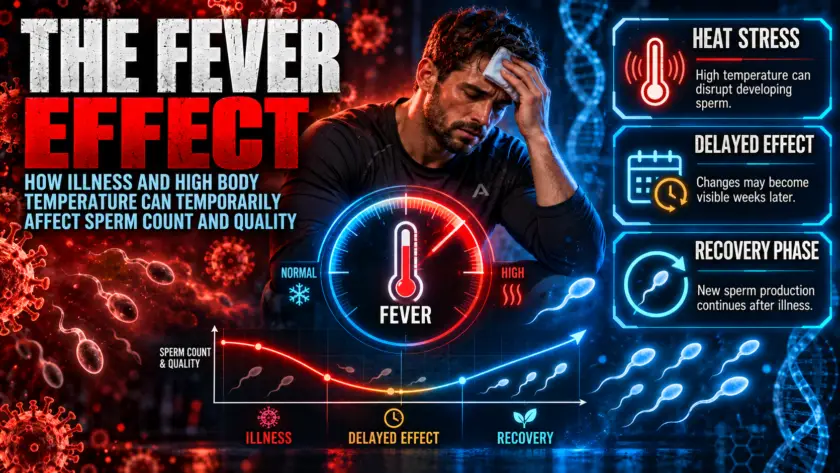
A fever can disappear in a few days while its effect on sperm may not become visible until weeks later.
That delay can be frightening when a man does not understand it.
He recovers from influenza, a chest infection or another febrile illness. His temperature returns to normal. His energy gradually comes back. Several weeks later, however, a semen analysis reports a lower sperm concentration, weaker motility or poorer morphology than expected.
The result can feel like a permanent verdict:
My fertility has suddenly collapsed.
This is my new normal.
I may have lost my chance of becoming a father.
Those conclusions may be premature.
Sperm appearing in an ejaculate today began developing many weeks earlier. A high temperature can disturb vulnerable cells at particular stages of that process. The effects therefore may not appear immediately. They can emerge later as the affected cells reach the semen—and may then improve as a new generation develops after the illness has passed.
This does not mean fever is irrelevant. Research has documented temporary changes in sperm concentration, total count, motility, morphology and measures of sperm DNA integrity after febrile illness. It means the result must be interpreted in the correct biological timeline.
The relationship between fever and sperm count is not a story of automatic permanent infertility. It is a story of delayed effects, individual variation, recovery and the importance of testing at the right time.
A semen analysis taken after a fever may reveal what the testicles experienced weeks earlier—not necessarily what they will produce permanently.
Important medical note
This article provides general education and is not a diagnosis or individual treatment plan. Fever can have many causes, and abnormal semen results can result from medical, hormonal, genetic, anatomical and lifestyle factors unrelated to fever. Seek medical advice about persistent or severe illness, testicular pain or swelling, fertility difficulties and abnormal semen tests. Do not stop prescribed medication or delay treatment for an infection because of fertility concerns.
1. Fever and Sperm Count: Understand the Risk Without Assuming the Worst
A fever is usually considered a body temperature of 38°C or above. It is commonly part of the body’s response to an infection, although there are other causes. The NHS advises rest, fluids and appropriate symptom relief, and recommends urgent GP or NHS 111 advice when a high temperature is not improving or is getting worse. NHS: High temperature in adults
The male reproductive system is particularly sensitive to temperature. That does not mean every mild fever causes measurable damage. It means a sufficiently high or prolonged rise in body temperature can temporarily disrupt stages of sperm development.
The words temporarily and can matter.
Fever does not affect every man identically. The response may depend upon:
- How high the temperature became
- How many days the fever lasted
- Which stage of sperm development was exposed
- The man’s starting semen quality
- The illness causing the fever
- Other effects of illness, including inflammation, dehydration and reduced food intake
- Medicines, existing health conditions and reproductive problems
- The timing of the semen analysis
A 2003 prospective study followed 27 healthy men with monthly semen samples and daily fever records for 16 months. Fever during particular stages of sperm development was associated with reduced sperm concentration and changes in motility and morphology. The effect increased with the number of fever days, but the researchers also found large differences between individual men. Carlsen and colleagues: History of febrile illness and variation in semen quality
This is the correct starting point: fever is a legitimate factor to consider, but it is not a calculator capable of predicting one man’s future fertility.
Alpha Insight
Take fever seriously enough to record it—but never turn a temporary biological disruption into a permanent verdict without evidence.
2. Why the Testicles Need a Cooler Environment
The testicles are positioned in the scrotum outside the main body cavity. This helps maintain a temperature below the body’s internal temperature—an environment required for normal sperm production.
The male reproductive system uses several temperature-control mechanisms:
- The scrotum moves the testicles closer to or farther from the body.
- Scrotal skin can contract or relax.
- Blood vessels participate in heat exchange.
- Sweat and air exposure can assist cooling.
These systems manage ordinary temperature changes. A fever is different because the body’s central temperature rises. The testicles cannot simply move far enough away to escape a systemic temperature increase.
Developing sperm cells are not all equally vulnerable at the same moment. Sperm production occurs through a sequence of divisions and transformations. Heat experienced during one stage may affect the count in a later sample; heat at another stage may appear through changes in movement, shape or cellular integrity.
This explains two observations that otherwise seem contradictory:
- A man can recover from a fever and initially see little change in his semen.
- The same man can receive an abnormal result several weeks later.
The body temperature has returned to normal, but affected cells are still travelling through the production and maturation system.
Internal fever should also be distinguished from external heat exposure. Hot tubs, saunas, heated seats and occupational heat warm the testicular environment from outside. Fever raises body temperature from within. Both involve heat, but their intensity, duration and whole-body effects differ.
Do not assume that one sauna session is biologically identical to several days of high fever. Do not assume that surviving a high fever without obvious symptoms means the reproductive system was unaffected. Context matters.
Alpha Insight
The testicles are designed to operate cooler than the rest of the body. Fever temporarily removes that temperature advantage.
3. Why the Effect May Appear Weeks Later
Sperm production is a pipeline, not a single event.
At any moment, the testicles contain developing germ cells at different stages. Some have only recently begun. Others are dividing, reshaping or preparing to leave the testicle. More mature sperm are passing through the epididymis, where they continue acquiring the functional abilities needed for movement and fertilisation.
A fever does not affect only the sperm ejaculated during the illness. It can affect cells that will not appear in the semen until later.
This creates a delayed fertility timeline:
| Period | What may be happening |
|---|---|
| During the fever | Body temperature rises and vulnerable developing cells may be stressed |
| First days afterwards | The man feels better, but affected cells remain within the reproductive pipeline |
| Approximately 2–6 weeks later | Changes may become more visible as exposed cells enter later development or appear in semen |
| Following months | Newer cells produced after recovery move through the system and semen parameters may improve |
The timing is not identical for every man.
A case series involving men who experienced high fever reported pronounced semen changes three to six weeks afterwards, with recovery towards baseline over several months. Jung, Schuppe and Schill: Fever as etiology of temporary infertility in the man
Another detailed report followed a previously fertile volunteer after two days of fever at 39–40°C. His total sperm count was significantly reduced on days 15, 37 and 58 after the fever and had returned to normal by day 79. Motility was reduced on days 15 and 37 and had returned to normal by day 58. Sergerie and colleagues: High risk of temporary alteration of semen parameters after recent acute febrile illness
That study involved one man. It is valuable because samples were available before and repeatedly after the illness, but it must not be treated as a universal timetable.
The lesson is not “every man recovers by day 79”. The lesson is that fever-related changes may be delayed and reversible—and that timing must be considered when interpreting a semen test.
Alpha Insight
The fever may be over before its effect reaches the semen. Always interpret the result against the biological timeline.
4. How Fever May Affect Sperm Concentration and Total Count
Sperm concentration is the number of sperm present in each millilitre of semen. Total sperm number combines concentration with semen volume.
Fever may temporarily reduce one or both measurements by disrupting developing cells before they become mature sperm.
In the 27-man prospective study, fever occurring during meiosis was associated with a 32.6% reduction in sperm concentration, while fever during the post-meiotic transformation stage was associated with a 35% reduction. The size of the effect increased with each additional day of fever. Carlsen and colleagues
Those percentages describe averages and statistical associations within one small study. They do not mean that every fever reduces every man’s concentration by one-third.
A lower post-fever count can also be misinterpreted in several ways.
A lower count does not automatically mean zero fertility
Natural conception may still be possible with a reduced sperm count. Fertility is influenced by total motile sperm, timing, the reproductive health of both partners and other biological factors.
One sample does not establish a permanent baseline
Semen parameters vary. Collection problems, abstinence time, illness and natural biological fluctuation can all affect a result.
Semen volume is not sperm production
A visibly large ejaculation can contain a low sperm concentration. A smaller volume does not prove that few sperm were produced. Laboratory testing is required.
A fever is not always the complete explanation
If results remain abnormal after an appropriate recovery and repeat-testing period, other causes must be considered rather than continuing to blame an illness indefinitely.
The strongest response to a low count after fever is neither panic nor denial. It is documented history, correctly timed repeat testing and appropriate medical follow-up.
Alpha Insight
A reduced post-fever count is information about one point in time—not proof that your reproductive capacity has been permanently rewritten.
5. Fever Can Affect More Than the Number of Sperm
Count receives most of the attention because it is easy to understand. But sperm health cannot be reduced to quantity.
Fever may influence several semen measurements.
Motility
Motility describes the proportion of sperm that move. Progressive motility refers to sperm moving forwards effectively rather than merely twitching or travelling in unproductive patterns.
The 2003 prospective study found that fever during spermiogenesis was associated with a higher proportion of immotile sperm. The 2007 case report found a temporary motility decline after fever, with recovery occurring earlier than recovery of total count in that individual. Carlsen and colleagues, Sergerie and colleagues
Morphology
Morphology examines sperm shape according to strict laboratory criteria. Fever during vulnerable transformation stages may reduce the proportion classified as normally formed.
Morphology is often misunderstood. A low percentage does not mean every sperm is incapable of fertilisation, and morphology should not be interpreted in isolation.
Vitality
Vitality considers how many sperm are alive. It can be especially useful when many sperm appear immotile, helping distinguish living but non-moving cells from dead cells.
DNA and chromatin integrity
The sperm head contains tightly packaged paternal DNA. Heat and systemic illness may be associated with oxidative and cellular stress that affects this packaging.
In the 2007 case report, the sperm DNA fragmentation index rose after the fever and later declined. This is a notable observation, but it came from one volunteer and does not prove that every fever causes the same DNA change. Sperm DNA fragmentation testing is also not required after every ordinary illness.
The wider lesson is essential:
Fever and sperm count should never be discussed as though count were the only reproductive measurement that can change.
Alpha Insight
A fertility assessment must examine how sperm function—not merely how many appear in the sample.
6. Temperature, Duration and Timing All Matter
Not all fevers carry the same reproductive significance.
A brief temperature of 38°C is not the same event as several days at 39–40°C. The strongest reports of dramatic semen changes often involve higher or longer fever, but no precise temperature-duration formula can predict an individual result.
Three variables deserve attention.
1. How high was the temperature?
Higher body temperatures create greater heat exposure. Record the highest measured temperature when possible, while recognising that home measurements may be imperfect.
2. How long did it last?
The prospective study found a relationship between the number of fever days and the size of semen changes. Duration therefore matters rather than fever being a simple yes-or-no event.
3. Which cells were exposed?
Because sperm are at different developmental stages, the same fever can influence different future samples in different ways.
Other details may also shape recovery:
- Whether the man already had a low sperm count
- Age and wider health
- Repeated fevers close together
- Testicular conditions such as varicocele
- Smoking, alcohol or drug exposure
- Nutritional intake during recovery
- Sleep and metabolic health
- Additional external heat exposure
This is why a fertility clinician needs more than the sentence “I was ill recently”. Useful information includes the date, temperature, duration, diagnosis and relationship to the sample date.
Alpha Insight
Record the severity and timing of the fever. Accurate history turns a vague concern into clinically useful context.
7. Separate the Fever from the Illness That Caused It
It is tempting to attribute every post-infection semen change to heat alone. Real illness is more complicated.
Fever can occur alongside:
- Systemic inflammation
- Immune activation
- Dehydration
- Poor sleep
- Reduced calorie and protein intake
- Vomiting or diarrhoea
- Physical inactivity
- Medication use
- Direct effects of a particular infection
- Testicular or reproductive-tract inflammation in some illnesses
These factors may overlap.
For example, a respiratory virus causing high fever, appetite loss and severe fatigue creates a different total stress from a short, mild illness. An infection involving the testicles is more concerning than a simple cold because orchitis can directly affect testicular tissue.
This distinction is especially important when discussing COVID-19. Studies conducted during and after the pandemic have examined changes in semen parameters following infection, but illness severity, fever, inflammation, treatment and direct viral effects are difficult to separate. A post-COVID result should not automatically be attributed entirely to temperature.
Medication creates another source of confusion. Do not avoid necessary treatment because you are afraid that reducing the fever will “hide” what the body is doing. Do not stop antibiotics or other prescribed medicines without professional advice. If you need a fertility assessment, provide the clinician with a complete list of what you took.
Treat the illness first. Then interpret reproductive changes with the full medical history.
Alpha Insight
The fever is one part of the event. The infection, inflammation, treatment and recovery environment may also influence what appears later.
8. Why One Abnormal Semen Analysis Is Not a Final Verdict
A semen analysis can reveal valuable information, but one result is not an unchangeable fertility identity.
The NHS states that when an initial semen analysis finds a possible problem, another analysis is usually performed around three months later. If the second test also shows a problem, specialist assessment may include blood tests, testicular ultrasound or urine testing. NHS: Low sperm count
Repeat testing is particularly important when the first sample was collected after:
- A recent fever
- Significant infection
- Incomplete sample collection
- An unusual abstinence period
- Acute stress or sleep disruption
- A major medication change
- Another temporary health event
Why samples vary
Semen is a biological output, not a factory product made to identical specifications. Results can vary naturally between samples. A complete interpretation considers:
- Sperm concentration
- Total sperm number
- Motility
- Progressive motility
- Morphology
- Semen volume
- Abstinence period
- Collection completeness
- Illness and fever history
- Laboratory methods
Repeat does not mean ignore
Reassurance should not become avoidance. A severely abnormal result, azoospermia, persistent abnormality or worrying symptoms may require earlier investigation. A clinician may recommend a different timetable based on the result and the couple’s fertility circumstances.
Do not conceal the fever
Tell the laboratory or clinician when the fever occurred. A result obtained six weeks after a high fever may be interpreted differently from the same result with no recent illness.
One test deserves attention. It does not always deserve the word permanent.
Alpha Insight
A semen analysis is evidence—not destiny. Confirm an unexpected result before building your future around it.
9. How Long Might Recovery Take?
There is no universal recovery date.
Available studies suggest that fever-related semen changes can improve over a period ranging from weeks to several months. The precise timetable depends on the fever, the illness, the affected development stage and the individual.
The published evidence illustrates this variation:
- In the single-volunteer report, motility had returned to normal by day 58 and total count by day 79.
- In the five-patient case series involving high fever, the most pronounced changes appeared around three to six weeks later and baseline recovery was reported within approximately four to six months.
- In the 27-man study, the size and type of change depended on the development stage exposed and the number of fever days.
These studies are informative but limited. They involve small numbers, and two are case reports or case series. They establish biological plausibility and a pattern—not a promise.
A responsible recovery timeline
First 0–2 weeks: recover from the illness
The priority is the illness itself. Rest, hydrate, follow medical advice and record what happened.
Weeks 2–6: delayed effects may emerge
Semen changes may become more visible even though you feel physically recovered.
Weeks 6–12: a newer sperm population is progressing
Parameters may begin improving, but not every man will follow the same curve.
Months 3–6: reassess persistent abnormality
If repeat results remain abnormal, investigate other causes instead of assuming the fever still explains everything.
The correct question is not simply, “When will I be normal?”
It is:
“What evidence will show whether my parameters are recovering, and when should another cause be investigated?”
Alpha Insight
Recovery is a process to monitor, not a date to demand from your body.
10. Trying to Conceive After a Fever
A recent fever does not automatically mean a couple must stop trying to conceive for a fixed number of months.
There is no universal rule instructing every man to avoid conception after every fever. The decision depends on the severity of the illness, semen results, fertility history, the female partner’s age, previous pregnancy loss, treatment plans and professional advice.
If you are trying naturally
Continue following ordinary conception guidance unless a clinician gives different advice. The NHS recommends sex every two to three days without contraception for couples trying to conceive. NHS: Low sperm count
If conception does not occur within the recommended period, arrange assessment for both partners rather than assuming the fever is the only explanation.
If you already have an abnormal semen analysis
Tell the clinician:
- The date the illness began
- The highest known temperature
- The number of fever days
- The illness or diagnosis
- Medicines taken
- The date the semen sample was collected
- Any earlier semen results
If assisted reproduction is planned
Inform the fertility clinic promptly. Timing matters when semen is being collected for intrauterine insemination, IVF, ICSI or freezing. The clinic may recommend proceeding, retesting, using a previously frozen sample or changing timing according to the full circumstances.
Do not cancel treatment independently. Do not hide the fever because you fear delay. Accurate information gives the clinic more options.
Alpha Insight
A strong man does not make fertility decisions from panic. He gives the clinical team the facts and makes the decision with evidence.
11. The Post-Fever Sperm Recovery Foundations
There is no supplement proven to erase a fever’s effect overnight. Recovery is primarily about supporting the body while a new generation of sperm develops and ensuring another medical cause is not being missed.
1. Recover fully from the illness
Do not rush back into extreme training while you remain weak, breathless or unwell. Follow the advice given for the underlying condition.
2. Restore hydration
The NHS recommends drinking enough fluid during fever to avoid dehydration. Hydration supports normal body function, but excessive water will not manufacture additional sperm. NHS: High temperature in adults
3. Rebuild nutritional consistency
Return to a varied diet containing:
- Quality protein
- Vegetables and fruit
- Whole grains or other high-fibre carbohydrates
- Oily fish when suitable
- Nuts and seeds
- Healthy fats
- Adequate total energy
Do not respond to a low appetite during illness by beginning an aggressive fat-loss diet immediately afterwards.
4. Protect sleep
Illness can disrupt sleep for days or weeks. Re-establish a consistent sleep opportunity and address persistent symptoms that prevent rest.
5. Return to exercise gradually
Movement and exercise support general health, but hard training before recovery may add unnecessary stress. Build back progressively.
6. Avoid additional testicular heat
During the recovery cycle, reduce unnecessary prolonged heat from hot tubs, laptops directly on the lap and repeated heated-seat exposure. This does not require obsessive cooling or placing ice against the skin.
7. Remove other reproductive suppressors
Smoking, heavy alcohol use, recreational drugs, anabolic steroids and external testosterone can complicate recovery and interpretation.
8. Use supplements cautiously
Correct diagnosed deficiencies and discuss supplements with a clinician or pharmacist. Do not stack high doses because one semen result frightened you.
The body does not need punishment after illness. It needs stable conditions and enough time to complete the next production cycle.
Alpha Insight
Recovery is not created by one heroic intervention. It is supported by the conditions you repeat after the illness has passed.
12. Mistakes That Turn Temporary Disruption into Lasting Anxiety
The psychological response to an abnormal result can become more damaging than the information itself.
Avoid these common mistakes.
Mistake 1: Testing too soon and treating the result as permanent
An early test may still be useful, especially when clinically required. The mistake is failing to interpret it in relation to the fever.
Mistake 2: Repeating tests every few days
Sperm production cannot be meaningfully judged through constant short-interval testing. Follow a clinician’s timetable.
Mistake 3: Buying an extreme supplement stack
An abnormal result creates urgency, which marketers can exploit. More capsules do not create faster spermatogenesis.
Mistake 4: Blaming every future result on one fever
Fever can produce temporary changes. Persistent abnormality still deserves investigation for varicocele, hormonal problems, obstruction, genetic causes, medication effects and other contributors.
Mistake 5: Comparing your recovery with one case report
A man in a published report may recover by day 79. Another may take longer, recover sooner or have a different underlying problem.
Mistake 6: Attempting unsafe cooling
Direct ice, extreme cold exposure or unregulated devices can injure the skin and testicles. Sensible heat reduction is enough.
Mistake 7: Hiding the illness from a fertility clinic
The fever is not an embarrassing failure. It is clinically relevant context.
Mistake 8: Assuming low count means permanent sterility
Low count can reduce conception chances without making conception impossible. It also cannot be interpreted without the rest of the semen analysis and couple’s fertility picture.
Alpha Insight
Do not allow a temporary result to create permanent fear before the evidence has had time to develop.
13. Know When to Seek Medical Help
Fertility concerns should never distract from treating the illness itself.
The NHS advises seeking urgent GP or NHS 111 help when a high temperature is not improving or is getting worse. NHS: High temperature in adults
Seek prompt medical advice when fever is accompanied by:
- Testicular pain or swelling
- A red, hot or tender scrotum
- A testicular lump or sudden change
- Severe pelvic or urinary symptoms
- Blood in the urine or persistent blood in semen
- Inability to keep fluids down
- Breathing difficulty or severe deterioration
- Symptoms suggesting a medical emergency
Seek fertility assessment when:
- Two semen analyses remain abnormal
- No sperm are detected
- You have a history of undescended testicle, torsion, surgery or significant injury
- You used testosterone or anabolic steroids
- You received chemotherapy or radiotherapy
- You have known hormonal or genetic conditions
- Ejaculation or sexual-function problems are present
- Conception has not occurred after one year of regular unprotected sex, or after six months when the female partner is aged 36 or over
The last recommendation reflects current NHS guidance. Both partners should be assessed because fertility is a shared biological picture. NHS: Low sperm count
Do not wait months with sudden testicular pain because you assume it is a fever effect. Acute testicular symptoms require urgent assessment.
Alpha Insight
Patience is appropriate for sperm recovery. Delay is not appropriate when warning signs demand medical attention.
14. Build Your Fever-to-Fertility Record
Memory becomes unreliable once several weeks have passed. A written record can make a later semen result easier to interpret.
Record:
- Date the illness began
- Suspected or confirmed diagnosis
- Highest measured temperature
- Total number of fever days
- Whether fever was continuous or intermittent
- Medicines and doses taken
- Dehydration, vomiting or appetite loss
- Testicular pain or swelling
- Date normal temperature returned
- Date normal activity resumed
- Semen-analysis dates
- Abstinence period before each sample
- Whether the complete sample was collected
- Results for volume, concentration, total count, motility and morphology
- Clinician’s recommendation for repeat testing
The Fever Effect Timeline
| Date or period | Event | Information to record |
|---|---|---|
| Illness begins | Symptoms appear | Diagnosis, symptoms and test results |
| Fever period | Temperature rises | Highest temperature and duration |
| Early recovery | Fever resolves | Medicines, hydration and remaining symptoms |
| Weeks 2–6 | Possible delayed semen effect | Any semen test and full result |
| Around three months | Common repeat-testing point | Compare with the first sample |
| Months 3–6 | Further recovery or investigation | Specialist findings and next actions |
This record does not diagnose the cause of an abnormal result. It gives a clinician a clearer sequence from which to reason.
Alpha Insight
When the biology is delayed, the man who records the timeline gives himself a stronger chance of understanding the result.
The 90-Day Post-Fever Sperm Recovery System
This framework is designed for responsible recovery, not guaranteed improvement.
Phase One: Recover — Days 1–14
- Treat the illness according to medical advice.
- Rest and restore hydration.
- Record temperature and duration.
- Note every medicine taken.
- Report testicular pain or swelling.
- Avoid hard training until appropriately recovered.
- Inform a fertility clinic if treatment or collection is imminent.
Primary objective: recover safely and preserve accurate information.
Phase Two: Protect — Days 15–42
- Rebuild normal meals and protein intake.
- Restore a consistent sleep schedule.
- Return to activity gradually.
- Avoid smoking, recreational drugs and heavy alcohol.
- Reduce unnecessary testicular heat.
- Avoid panic-driven supplement changes.
- Interpret any semen test in the context of the recent fever.
Primary objective: protect the environment experienced by developing sperm while delayed effects may be emerging.
Phase Three: Rebuild — Days 43–90
- Maintain the health foundations consistently.
- Complete any medical investigation already arranged.
- Follow the clinician’s testing timetable.
- Compare results only when collection conditions are reasonably similar.
- Do not assume that feeling recovered proves semen has already normalised.
Primary objective: allow a newer sperm population to move through development under healthier conditions.
Phase Four: Reassess — Three to Six Months
- Review repeat semen results.
- Investigate persistent abnormalities.
- Discuss specialist referral when appropriate.
- Review hormones, testicular health, medicines and other causes.
- Adjust the plan according to evidence rather than fear.
Primary objective: determine whether the result is recovering or whether another limiting factor requires attention.
The Post-Fever Fertility Audit
Answer each question honestly:
- What was my highest measured temperature?
- How many days did the fever last?
- What illness caused it?
- Did I experience testicular pain or swelling?
- What medicines did I take?
- When was my semen sample collected relative to the fever?
- Was the complete sample collected?
- What abstinence period did I follow?
- Do I have an earlier result for comparison?
- Which parameters changed: count, motility, morphology or volume?
- Has repeat testing been scheduled?
- Do I have other fertility risks unrelated to fever?
- Is assisted reproduction time-sensitive?
- What question do I need to ask my GP or fertility specialist?
Finish with one sentence:
My next evidence-based action is ________________________________.
Frequently Asked Questions About Fever and Sperm Count
Can fever lower sperm count?
Yes. Research has found that febrile illness can temporarily reduce sperm concentration or total count, particularly when fever is higher, lasts longer or occurs during vulnerable development stages. The response varies considerably between men.
How soon after a fever can sperm count fall?
Changes may appear within a few weeks rather than immediately. Published reports have observed effects beginning around two weeks and becoming pronounced three to six weeks after high fever. These are approximate observations, not a universal timetable.
Why is the effect delayed?
Sperm ejaculated today developed over many weeks. Fever can affect immature cells that do not reach the semen until later.
How long does sperm recovery take after fever?
Some men may show improvement within two to three months, while recovery after a high or prolonged fever may take four to six months. Persistent abnormalities require investigation rather than endless waiting.
Does a mild fever always affect sperm?
No. Not every fever produces a measurable change. Temperature, duration, timing, starting fertility and individual sensitivity all matter.
Can fever affect sperm motility?
Yes. Research has reported increased immotile sperm and temporary reductions in motility after febrile illness.
Can fever affect sperm morphology?
It can. Fever during sensitive transformation stages has been associated with a lower proportion of normally shaped sperm in subsequent samples.
Can fever damage sperm DNA?
A detailed case report documented a temporary increase in sperm DNA-fragmentation measurements after high fever. This does not mean every fever causes the same change or that every man needs DNA-fragmentation testing.
Does fever cause permanent infertility?
Fever-related changes are often temporary, but no individual outcome can be guaranteed. Very severe illness, direct testicular infection or an unrelated fertility condition may create a different situation.
Should I take a semen test immediately after fever?
That depends on why the test is needed. An immediate test may still provide useful information, especially before time-sensitive treatment, but it must be interpreted in context. Ask the clinic whether testing now or later is more useful.
Should I repeat an abnormal semen analysis?
Usually, yes. The NHS states that a second analysis is commonly performed around three months after an initial result showing a possible problem. Severe abnormalities or urgent fertility circumstances may require a different schedule.
Should we stop trying to conceive after my fever?
There is no universal instruction that every couple must stop. Discuss individual circumstances with a clinician, particularly after severe fever, abnormal semen results, previous pregnancy loss or planned fertility treatment.
Can supplements speed up recovery?
No supplement has been proven to erase the effect of fever or guarantee faster recovery. Correct genuine deficiencies and support overall health, but avoid panic-driven high-dose stacks.
Should I cool my testicles with ice?
No. Direct ice or extreme cooling can injure the skin and tissue. Reduce unnecessary prolonged heat without using unsafe cooling methods.
When should I be concerned?
Seek advice for persistent abnormal semen results, absent sperm, testicular pain or swelling, repeated high fevers, known reproductive conditions or difficulty conceiving within the recommended period.
Conclusion: A Delayed Effect Is Not Necessarily a Lasting One
Fever can end quickly. Sperm development cannot.
That mismatch explains why a man may feel completely recovered while his semen still reflects an illness from several weeks earlier. The sample is not lying. It is reporting a biological history.
The mistake is assuming that this history must become the future.
Research shows that high fever can temporarily reduce sperm count and alter motility, morphology and measures of DNA integrity. It also shows that recovery can occur as later sperm populations develop. The strength and duration of the effect vary, and the available studies cannot predict an exact result for every man.
Record the illness. Tell the clinic. Interpret the timeline. Repeat the test when advised. Support recovery and investigate abnormalities that persist.
Do not deny the result—but do not surrender to it either.
One abnormal semen analysis after a fever may represent a temporary disruption moving through the sperm-production system. Give the biology time to reveal whether it is recovering, and give qualified professionals the information needed to identify when something more than fever is involved.
Closing Declaration
I will not panic because one result captured a temporary moment.
I will record the fever, its severity and its timing.
I will understand that reproductive effects may appear after the illness has passed.
I will protect my recovery without chasing miracle treatments.
I will repeat testing when advised and investigate abnormalities that persist.
I will respond to evidence rather than fear.
I will take urgent symptoms seriously and seek qualified medical help.
A delayed effect will not become a permanent verdict until the evidence proves that it is one.
Final Line
The fever may influence one generation of sperm—but one affected generation does not automatically define every generation that follows.



No spam. Unsubscribe anytime.