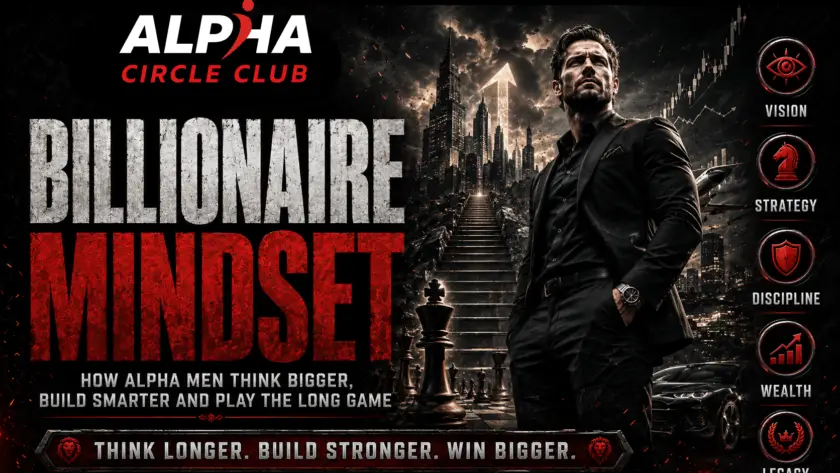
A billionaire mindset does not begin with a billion pounds.
It begins with a different way of looking at:
Money.
Time.
Ownership.
Opportunity.
Risk.
Value.
Attention.
And the future.
Many people think becoming wealthy is mainly about earning more money.
Work harder.
Get promoted.
Increase the salary.
Save more.
Buy impressive things.
Look successful.
But income alone is not the same as wealth.
And looking wealthy is certainly not the same as being wealthy.
The man who wants to build substantial wealth eventually has to begin asking different questions.
Instead of:
“How much can I earn?”
He begins asking:
“What can I own?”
Instead of:
“How can I work more hours?”
He asks:
“How can the work I do today continue creating value tomorrow?”
Instead of:
“What can this money buy me?”
He asks:
“Where can this capital be deployed?”
Instead of:
“How quickly can I become rich?”
He asks:
“What could this become if I build intelligently for the next ten or twenty years?”
That is the shift.
A billionaire mindset is not about pretending you are already extraordinarily wealthy.
It is about developing the judgement, patience, discipline and thinking required to create, protect and multiply something valuable over time.
The money is not the mindset. The mindset is what builds the money.
1. Billionaire Thinking Begins With Ownership
Employment can be valuable.
A job can provide:
- Income
- Skills
- Experience
- Stability
- Professional relationships
- Capital to invest
But there is a fundamental difference between being paid for your labour and owning something that can continue producing value.
An employee is primarily compensated for work performed.
An owner participates in what an asset becomes.
That asset could be:
- A business
- Shares
- Property
- Intellectual property
- Software
- A website
- A brand
- A content library
- A book
- A course
- A licensing agreement
- A royalty-producing asset
The important shift is from asking:
“Who will pay me?”
to asking:
“What can I build or acquire that I can own?”
Ownership gives a man the possibility of participating in growth beyond the immediate hour he worked.
That does not make ownership risk-free.
Businesses fail.
Investments fall.
Property creates costs.
Intellectual property may never sell.
Ownership creates opportunity—but also responsibility.
The billionaire mindset understands both.
Alpha Insight
Income pays you for what you did. Ownership gives you the possibility of participating in what an asset becomes.
2. Stop Thinking Only in Hours
A man has limited time.
No matter how disciplined he becomes, there are still only twenty-four hours in a day.
He must sleep.
Recover.
Eat.
Think.
Spend time with people who matter.
If his entire financial model depends on personally performing every hour of value creation, there will eventually be a ceiling.
This is where leverage becomes important.
Leverage allows effort, capital, technology or systems to produce results beyond one person’s immediate labour.
Forms of leverage may include:
- People
- Software
- Automation
- Media
- Capital
- Distribution
- Intellectual property
- Systems
Consider the difference between two models.
A consultant may earn £500 for an hour of specialist advice.
That can be excellent income.
But the hour can only be sold once.
If the consultant turns years of expertise into a specialised training programme, book, software product or licensable system, the same knowledge may potentially serve many people.
The question becomes:
“How can one hour of intelligent work create value more than once?”
Alpha Insight
There is a limit to how many hours you can sell. Leverage begins when the value created by your work is no longer limited to the hour that produced it.
3. Build Once, Benefit Many Times
One of the most important wealth concepts is repeatable value.
A man might spend a hundred hours creating:
- A book
- A course
- Software
- A digital product
- A training system
- A research database
- A piece of intellectual property
Those hours are spent once.
But the finished asset may potentially continue producing value repeatedly.
That is very different from doing the same work from the beginning every time a customer appears.
This is one reason scalable business models can become powerful.
They separate some portion of value creation from the founder’s physical presence.
The billionaire mindset looks for questions such as:
- Can this process be standardised?
- Can this product serve another customer without being recreated?
- Can this knowledge become intellectual property?
- Can technology reduce repeated manual work?
- Can an audience continue discovering this asset later?
Not everything needs to scale.
Premium consulting, craftsmanship and specialised services can still be highly valuable.
But a wealth builder should understand the difference between repeatable work and repeatable value.
Alpha Insight
Do not only ask what today’s work earns. Ask what today’s work may continue producing after today has ended.
4. Billionaire Thinking Builds Systems
Many people operate entirely at task level.
Send the email.
Make the sale.
Post the content.
Answer the customer.
Create the product.
Builders eventually begin looking above the task.
They ask:
“What system produces this outcome repeatedly?”
Instead of:
“I need another sale.”
They ask:
“What process consistently converts interested people into customers?”
Instead of:
“I need more traffic.”
They ask:
“Which distribution channels can repeatedly bring the right audience here?”
Instead of:
“I need another product.”
They ask:
“What process helps us identify customer problems, validate demand, create solutions and improve them?”
A system can include:
- A clear process
- Tools
- Responsibilities
- Metrics
- Automation
- Documentation
- Feedback loops
Systems reduce dependence on memory, mood and improvisation.
They make performance more repeatable.
Alpha Insight
A task produces one result. A system creates the conditions for results to happen repeatedly.
5. Think in Decades, Not Days
Short-term thinking asks:
“What happened this week?”
Long-term thinking asks:
“What am I building that could matter ten years from now?”
Some of the most valuable assets begin unimpressively.
A website may initially receive almost no visitors.
A business may start with a handful of customers.
An investment portfolio may begin with a few hundred pounds.
A brand may initially be unknown.
A book may initially sell slowly.
But time can change the picture if:
- Demand grows
- Skills improve
- The product improves
- Distribution expands
- Customer trust increases
- Capital compounds
- Intellectual property accumulates
- Reputation strengthens
This does not mean blindly continuing a failing project for twenty years.
Long-term thinking still requires evidence.
You review.
Measure.
Adapt.
Stop what is clearly not working.
But you do not abandon a sound strategy simply because it failed to create dramatic results immediately.
Alpha Insight
What looks insignificant in year one may become difficult to compete with by year ten—if the asset is useful, improving and consistently developed.
6. Every Pound Is Capital
A consumer asks:
“What can this £100 buy me?”
An investor also asks:
“What could this £100 become?”
That single question can change the relationship a man has with money.
Money can become:
- Education
- Equipment
- Advertising
- Shares
- Inventory
- Product development
- Software
- Research
- Cash reserves
- Intellectual property
- Income-producing assets
This does not mean refusing all enjoyment.
Money is also meant to support life.
But every financial decision carries opportunity cost.
The £1,000 spent today cannot also be invested tomorrow.
The money reinvested into a business cannot simultaneously purchase a luxury item.
Capital allocation therefore becomes a series of choices about future value.
Think of every pound as a seed.
You can consume it.
Save it.
Protect it.
Or plant it somewhere with the potential to grow.
Not every seed grows.
That is why judgement matters.
Alpha Insight
A pound can be consumed once—or planted somewhere capable of producing future value.
7. Become an Allocator, Not Merely an Earner
Earning money is important.
But as resources grow, another skill becomes increasingly important:
allocation.
A man constantly allocates:
- Money
- Time
- Attention
- Staff
- Technology
- Energy
- Opportunities
The question is:
“Where will this resource produce the greatest long-term value for an acceptable level of risk?”
Imagine a business produces £10,000 of surplus cash.
Possible uses include:
- Paying the owner
- Increasing reserves
- Buying equipment
- Hiring
- Advertising
- Developing products
- Paying down debt
- Acquiring another asset
The money has not changed.
The outcome may change dramatically depending on where it is allocated.
The same applies to time.
One hour may be used watching random content.
Or it may be used:
- Learning
- Selling
- Creating
- Negotiating
- Building systems
The billionaire mindset treats allocation as a serious discipline.
Alpha Insight
Wealth is influenced not only by what enters your hands, but by where you send it after it arrives.
8. Protect Your Attention Like Capital
Money is not the only scarce resource.
Attention is limited too.
A distracted man can possess:
- Great intelligence
- Excellent opportunities
- Strong ideas
- Useful skills
and still build very little.
Every hour spent on:
- Endless scrolling
- Pointless arguments
- Gossip
- Drama
- Low-value entertainment
- Other people’s agendas
is an hour unavailable for:
- Thinking
- Learning
- Building
- Creating
- Selling
- Investing
- Planning
This does not mean a man should work every waking minute.
Rest has value.
Family has value.
Entertainment has value.
The question is whether these activities are chosen deliberately or simply consuming whatever attention remains.
A man building something significant cannot allow anyone with a notification to decide where his mind goes.
Alpha Insight
Your attention is capital. Invest it where it can create a return in knowledge, health, relationships or wealth.
9. Solve Bigger Problems
One of the most useful wealth questions is not:
“How do I become rich?”
It is:
“How do I become extremely useful?”
Wealth often follows value creation.
The more painful, expensive, widespread or urgent a problem is, the greater the potential value of solving it well.
Ask:
- What problem can I solve?
- How painful is that problem?
- How many people experience it?
- What are they currently doing about it?
- How much value would a better solution create?
- Can the solution scale?
The builder focuses on usefulness first.
He becomes obsessed with understanding the customer.
Not merely with taking their money.
Businesses ultimately survive when customers believe they receive sufficient value in return.
Alpha Insight
Stop asking only how to make money. Ask how to create enough value that people willingly exchange money for the solution.
10. Understand Leverage
Leverage allows a man to increase output without increasing personal effort at exactly the same rate.
Four major forms are particularly useful to understand.
Capital leverage
Money can fund:
- Expansion
- Equipment
- Investments
- Acquisitions
- Advertising
- Product development
Capital may allow opportunities to grow faster than labour alone could manage.
People leverage
A capable team allows expertise and execution to expand beyond one person.
But people are not machines.
Leadership requires:
- Fair pay
- Clear expectations
- Respect
- Training
- Accountability
- Good management
Technology leverage
Software and automation can perform repetitive work quickly and consistently.
Technology may reduce:
- Administration
- Manual processing
- Communication delays
- Operational friction
Media leverage
An article, video, podcast, email or book can reach many people without requiring the creator to repeat the exact message individually.
The man does not need every form immediately.
He needs to recognise which form can responsibly increase the impact of what he is building.
Alpha Insight
Leverage does not replace work. It allows good work to travel further than one person could carry it alone.
11. Stop Trying to Look Rich
One of the easiest financial traps is purchasing the appearance of wealth.
Luxury car.
Designer clothes.
Expensive watch.
Jewellery.
High-end holidays.
Large house.
There is nothing automatically wrong with any of these.
The problem begins when lifestyle grows faster than the assets supporting it.
A man may earn £100,000 and spend £100,000.
Another may earn £60,000 and steadily acquire productive assets.
The first may appear richer.
The second may actually be becoming wealthier.
Status spending becomes especially dangerous when funded through:
- Consumer debt
- High-interest borrowing
- Business cash needed elsewhere
- Investments that had to be sold
- Emergency reserves
Do not purchase evidence for strangers that you are successful.
Build the financial position first.
Enjoy luxury later from strength rather than insecurity.
Alpha Insight
Do not sacrifice tomorrow’s assets to finance today’s image. Looking rich and becoming wealthy are not the same mission.
12. Learn to Delay Gratification
Significant wealth often requires a willingness to postpone some consumption.
A business owner might earn a profit and reinvest part of it.
An investor may allow returns to remain invested.
A professional may spend money developing a valuable skill rather than upgrading a car.
This requires patience.
The immediate reward is visible.
The future reward is uncertain.
That is why delayed gratification is difficult.
A man must be capable of saying:
“I could consume this now, but the future use may be more valuable.”
This does not mean postponing life forever.
Tomorrow is not guaranteed.
Balance matters.
The principle is simply that a man who consumes every reward immediately leaves very little available to compound.
Alpha Insight
You cannot compound what you consume immediately. Some rewards become larger only when you are willing to leave them working.
13. Build Wealth Engines, Not Random Side Hustles
The internet often promotes the idea that everyone needs endless income streams.
Dropshipping.
Trading.
Property.
Affiliate marketing.
Freelancing.
Courses.
Cryptocurrency.
Print-on-demand.
The result can be fragmentation.
The man begins ten projects and builds none properly.
Multiple income sources can reduce dependence on one source.
But diversification should not become distraction.
A stronger sequence may be:
- Build one reliable engine.
- Understand it deeply.
- Strengthen the system.
- Create reserves.
- Add another compatible asset when capacity allows.
Possible engines include:
- Business profits
- Investments
- Property
- Royalties
- Licensing
- Intellectual property
- Equity ownership
- Digital products
Do not collect income streams like trophies.
Build assets worth maintaining.
Alpha Insight
Do not build ten weak income streams. Build strong wealth engines that deserve your capital and attention.
14. Turn Knowledge Into Intellectual Property
Knowledge can become an asset.
A man who understands something valuable may convert that knowledge into:
- Books
- Courses
- Frameworks
- Training
- Research
- Software
- Licensing systems
- Brands
- Methodologies
That does not mean placing ordinary information inside a PDF and expecting wealth.
The intellectual property must solve something.
Organise something.
Explain something.
Improve something.
Help someone achieve an outcome.
The value comes from transformation.
The billionaire mindset learns to distinguish between temporary content and durable intellectual property.
A social post may disappear from attention within hours.
A strong framework could potentially be taught, licensed, expanded and reused for years.
Alpha Insight
Knowledge becomes an asset when it is organised into something useful, transferable and capable of creating value repeatedly.
15. Distribution Can Matter as Much as Creation
A brilliant product nobody discovers may produce nothing.
This is where many builders fail.
They spend months perfecting:
- The product
- The website
- The branding
- The course
- The book
Then they launch.
And silence follows.
The problem may not be the product.
It may be distribution.
Builders therefore learn:
- Search optimisation
- Advertising
- Email marketing
- Partnerships
- Affiliates
- Content marketing
- Social distribution
- Public relations
- Referral systems
The question is not only:
“What should I create?”
It is also:
“How will the right people discover it?”
Creation and distribution must work together.
Alpha Insight
A great solution hidden from the market cannot create its full value. Build the product—and build the road that brings people to it.
16. Learn Sales
Many intelligent men dislike selling.
They associate it with:
- Pressure
- Manipulation
- Dishonesty
- Aggressive persuasion
Bad selling can involve those things.
Good selling does not have to.
Ethical sales involves:
- Understanding the problem
- Listening
- Establishing whether the solution fits
- Communicating benefits
- Explaining limitations
- Answering objections
- Making a clear offer
If a product genuinely helps the right customer, explaining its value is not unethical.
A builder must become comfortable asking for the sale.
Otherwise, value may be created without ever becoming revenue.
Alpha Insight
If you cannot communicate value, the marketplace may never discover how valuable your solution actually is.
17. Think in Return, Not Only Cost
Average thinking may ask:
“How much does this cost?”
That is important.
Billionaire-style thinking adds:
“What return might this create?”
A £2,000 training programme may be expensive.
If it develops a skill that eventually adds £20,000 a year to earning capacity, the economics may be different.
A £500 advertising test may seem expensive.
If it produces profitable customer acquisition data, it may be valuable.
But this mindset requires discipline.
Not everything labelled an “investment” produces a return.
Courses can be poor.
Advertising can fail.
Equipment can sit unused.
Therefore ask:
- What is the expected benefit?
- What evidence supports it?
- How will I measure success?
- What is the downside?
- What happens if it fails?
Alpha Insight
Price tells you what leaves your account. Value asks what may return because of it.
18. Billionaire Thinking Requires Risk Management
Thinking bigger does not mean becoming reckless.
Smart builders ask:
- What could go wrong?
- How much could I lose?
- Could I survive that loss?
- What assumptions am I making?
- What evidence supports this?
- What would change my mind?
- How concentrated is the risk?
- What happens in the worst realistic case?
Risk cannot be eliminated.
Avoiding all risk creates another risk:
Never building anything.
The objective is intelligent exposure.
A man may seek opportunities where:
- The downside is controlled
- The potential upside is meaningful
- The probability is understandable
- Failure is survivable
This is sometimes called asymmetric risk.
But the concept should never become an excuse for gambling.
Alpha Insight
Think big enough to pursue opportunity, but intelligently enough to survive being wrong.
19. Protect the Downside
Wealth cannot compound if one catastrophic mistake repeatedly destroys it.
Protection may involve:
- Emergency reserves
- Insurance
- Diversification where appropriate
- Legal structures
- Contracts
- Cybersecurity
- Due diligence
- Avoiding excessive leverage
- Avoiding scams
- Protecting reputation
A man may spend years building something and destroy it through:
- One reckless investment
- One dishonest decision
- One enormous debt
- One preventable legal problem
- One unmanaged operational risk
The objective is not merely:
Make money.
It is:
Stay capable of continuing to build.
Alpha Insight
You cannot compound what you repeatedly destroy. Staying in the game is part of winning the game.
20. Reputation Is an Asset That Compounds
Reputation is invisible on a bank statement.
But it can become extremely valuable.
If people know that you:
- Keep your word
- Deliver
- Communicate honestly
- Pay fairly
- Correct mistakes
- Protect customer trust
- Refuse dishonest shortcuts
trust becomes easier.
That trust can influence:
- Partnerships
- Customer retention
- Referrals
- Hiring
- Negotiations
- Opportunities
Reputation compounds slowly.
It can also collapse quickly.
The billionaire mindset therefore thinks beyond the immediate transaction.
Do not ask only:
“How much can I make from this person?”
Ask:
“What relationship am I building through this transaction?”
Alpha Insight
The strongest deal may be the one that leaves the other person willing to deal with you again.
21. Learn Faster Than Your Competition
Knowledge compounds.
A man who improves his judgement every year becomes increasingly dangerous—in the productive sense—to complacent competitors.
Study:
- Finance
- Marketing
- Sales
- Leadership
- Technology
- Negotiation
- Psychology
- Economics
- Your industry
But information alone is not enough.
Many men consume business books endlessly without building anything.
The sequence should be:
LEARN → APPLY → REVIEW → IMPROVE
Read something.
Use it.
Measure what happened.
Keep what works.
Discard what does not.
Learning becomes valuable when it changes behaviour.
Alpha Insight
Knowledge compounds only when information is converted into better decisions.
22. Ask Higher-Level Questions
Your questions influence what your brain searches for.
Instead of:
“How much does this cost?”
Ask:
“What could the return be?”
Instead of:
“Can I do all of this myself?”
Ask:
“Who could do part of this better than I can?”
Instead of:
“How do I make another £1,000?”
Ask:
“What system could eventually produce £1,000 repeatedly?”
Instead of:
“What should I sell?”
Ask:
“What problem will people continue paying to solve?”
Instead of:
“Why am I not successful yet?”
Ask:
“Which part of the system is preventing growth?”
Better questions do not guarantee better outcomes.
But they direct the mind towards more useful problems.
Alpha Insight
The quality of the questions you repeatedly ask influences the quality of the opportunities your mind learns to recognise.
23. Think Bigger Without Losing Reality
There is a dangerous form of wealth motivation that says:
“Believe strongly enough and the money will come.”
That is fantasy.
Vision matters.
Ambition matters.
Belief matters.
But reality still requires:
- Customer demand
- Cash flow
- Execution
- Numbers
- Evidence
- Timing
- Risk management
Thinking bigger means allowing yourself to consider possibilities beyond your current circumstances.
It does not mean pretending constraints do not exist.
The strongest builder holds two ideas simultaneously:
“This could become much bigger.”
and:
“What evidence would prove that?”
Vision points towards the destination.
Numbers tell you whether the vehicle is moving.
Alpha Insight
Dream beyond your present circumstances—but make decisions using evidence, numbers and execution.
24. The Billionaire Mindset Is Built Before the Billions
A man does not automatically become:
- Disciplined
- Patient
- Responsible
- Strategic
- Financially intelligent
- Emotionally controlled
the moment he becomes wealthy.
Greater resources often amplify existing behaviour.
If a man wastes £100 carelessly, giving him £1 million does not guarantee wisdom.
If he cannot control emotion in small negotiations, larger deals may create larger mistakes.
If he cannot manage one employee, a company of one hundred people may expose him.
Therefore, build the character before the capital becomes large.
Learn to manage:
£100.
Then £1,000.
Then £10,000.
Learn how to:
- Budget
- Allocate
- Invest
- Assess risk
- Negotiate
- Keep records
- Make decisions
The principles scale.
Alpha Insight
Do not wait for wealth to become the man capable of managing wealth. Build that man while the numbers are still small.
25. Build Something That Can Outlive You
At some point, wealth thinking can move beyond personal consumption.
The man begins thinking about:
- Family
- Employees
- Customers
- Community
- Philanthropy
- Future generations
- Institutions
- Legacy
The question changes from:
“What can I buy?”
to:
“What can I build that continues creating value after I am gone?”
A business may employ people.
A book may educate someone decades later.
An investment portfolio may support children and grandchildren.
A charitable foundation may help people the founder never meets.
A system may continue working after its creator is gone.
This is where wealth becomes bigger than lifestyle.
It becomes stewardship.
Alpha Insight
The highest level of wealth thinking is not only asking what money can give you, but what your resources can continue giving after you are gone.
The Alpha Billionaire Mindset Framework
Use this five-stage framework:
CREATE → OWN → LEVERAGE → REINVEST → COMPOUND
Create
Wealth begins with value creation.
Ask:
- What problem can I solve?
- Who needs the solution?
- How valuable is solving it?
- Can I solve it better?
- Can the solution become repeatable?
Create:
- Products
- Services
- Technology
- Knowledge
- Businesses
- Experiences
Alpha Insight
Before demanding more money from the market, become capable of creating more value for the market.
Own
Build ownership.
That may involve:
- Equity
- Intellectual property
- Investments
- Property
- Brands
- Digital assets
Employment may provide income.
Ownership gives the possibility of participating in appreciation and recurring value.
Alpha Insight
Ownership changes the question from “What did I earn?” to “What am I building that may become more valuable?”
Leverage
Use:
- People
- Capital
- Technology
- Media
- Systems
to increase the reach of valuable work.
Leverage should multiply useful output—not amplify chaos.
Alpha Insight
Do not automate a broken process or scale a weak product. Strengthen the foundation before multiplying it.
Reinvest
Do not consume every reward immediately.
Redirect part of what you produce towards:
- Growth
- Education
- Distribution
- Systems
- New assets
- Product improvement
- Financial reserves
Reinvestment sacrifices some present consumption for future capacity.
Alpha Insight
Reinvestment is the decision to let today’s success help finance tomorrow’s opportunity.
Compound
Allow:
- Capital
- Skills
- Reputation
- Audience
- Relationships
- Intellectual property
- Systems
to become stronger over time.
Compounding is rarely dramatic in the beginning.
Its power becomes clearer as time increases.
Alpha Insight
The first years build the base. Time reveals the power of what was consistently allowed to compound.
The Billionaire Mindset Audit
Ask yourself:
- Am I primarily behaving like a consumer or a builder?
- What do I currently own?
- What asset am I building?
- Where is most of my money going?
- Where is most of my attention going?
- What problem can I solve extremely well?
- Can that solution serve more people without equal increases in my time?
- What could I automate?
- What could I delegate?
- What intellectual property am I creating?
- Do I understand sales?
- Do I understand distribution?
- Am I thinking in months or decades?
- Am I buying assets—or merely appearances?
- Which skill could dramatically increase my earning capacity?
- What could destroy my current financial position?
- Am I protecting against that downside?
- What could I reinvest instead of consume?
- What am I building that becomes stronger with time?
- What could eventually continue without my constant involvement?
Do not answer these questions with motivational phrases.
Use numbers.
Names.
Assets.
Dates.
Actions.
The objective is to turn ambition into something measurable.
Consumer Mindset vs Billionaire Mindset
| Consumer mindset | Billionaire mindset |
|---|---|
| What can I buy? | What can I build or own? |
| How much do I earn? | What assets produce value? |
| Trades more hours | Builds leverage |
| Wants instant results | Thinks in decades |
| Consumes every profit | Reinvests strategically |
| Chases status | Builds substance |
| Follows opportunities | Creates opportunities |
| Focuses only on price | Considers value and return |
| Collects information | Applies knowledge |
| Performs every task | Builds systems |
| Protects comfort | Protects capital |
| Depends on one source | Builds strong complementary assets |
| Thinks about today | Builds for generations |
| Wants to look wealthy | Wants to become financially strong |
| Avoids all risk | Manages risk |
| Chases money first | Creates value first |
The 30-Day Billionaire Mindset Challenge
Week 1: Think Like an Owner
Write down every meaningful asset you currently own.
Then identify one asset you could begin building.
It may be:
- A business
- Intellectual property
- An investment portfolio
- A website
- A product
- A skill that significantly increases earning power
The objective is ownership.
Week 2: Audit Your Capital
Review where your money went during the previous thirty days.
Separate spending into:
- Necessary living costs
- Enjoyment
- Waste
- Investment
- Business building
- Education
- Asset acquisition
Ask:
“Which spending created future value?”
Week 3: Build One System
Choose one repeated activity.
Document the process.
Examples:
- Lead generation
- Customer onboarding
- Content production
- Product research
- Saving
- Investment research
Turn repeated improvisation into a process.
Week 4: Create a Ten-Year View
Ask:
- What could I own ten years from now?
- Which skills should I master?
- What business could I build?
- What assets could compound?
- What reputation do I want?
- What should I begin this year?
Then bring the horizon back to today.
Choose one action.
A Personal Declaration
I will stop thinking only like a consumer.
I will think like an owner.
I will create value.
I will solve meaningful problems.
I will build assets.
I will protect my attention.
I will learn how money works.
I will understand sales, marketing and distribution.
I will build systems.
I will use leverage responsibly.
I will protect against catastrophic risk.
I will reinvest rather than consume every reward.
I will think in years and decades rather than days.
I will not pretend to be wealthy.
I will build real financial strength.
I will not allow status to consume the capital required for my future.
I will learn continuously.
I will act on what I learn.
I will become capable of managing greater resources before those resources arrive.
I will build something that can outlive me.
The money is not the mindset.
The mindset is what builds the money.
Final Thoughts
Billionaire thinking does not begin with billions.
It begins when a man stops asking only what money can buy and begins asking what money can build.
It begins when he stops selling every hour and begins creating assets.
When he stops chasing appearances and begins acquiring ownership.
When he stops consuming every reward and begins reinvesting.
When he stops thinking about one payday and begins thinking about years of compounding.
When he stops asking only:
“How do I make more money?”
and begins asking:
“How do I create more value?”
Create.
Own.
Leverage.
Reinvest.
Compound.
Protect the downside.
Think in decades.
Then repeat.
You may never become a billionaire.
No mindset, business strategy or investment approach can guarantee that outcome.
But you can become a better builder.
A better allocator.
A better owner.
A better thinker.
A man who understands that wealth is rarely built by one spectacular decision.
It is usually built through years of intelligent decisions working together.
You do not need a billion pounds to begin thinking like a builder—you need to stop consuming your future and start creating it.
Final Alpha Insight
Extraordinary wealth begins long before extraordinary numbers appear. It begins when ownership, patience, leverage, discipline and long-term value creation become the way you think.



No spam. Unsubscribe anytime.