The internet tells men they need seven income streams.
So they begin seven projects.
None of them earns meaningful money.
They spend one week building an online store.
Two weeks studying trading.
Three days designing a digital product.
They upload several videos to YouTube.
Create an affiliate account.
Research property.
Open a print-on-demand shop.
Then abandon everything for the next opportunity.
They become busy—but not profitable.
Their attention is divided.
Their skills remain shallow.
Their offers remain unclear.
Their projects stay unfinished.
This is not income diversification.
It is financial distraction.
Building multiple income streams can make a man more financially resilient. It can reduce his dependence on one employer, one client, one product, or one platform.
But multiple streams only become valuable when they are built on skill, demand, systems, patience, and real customer value.
The disciplined man does not chase every opportunity placed in front of him.
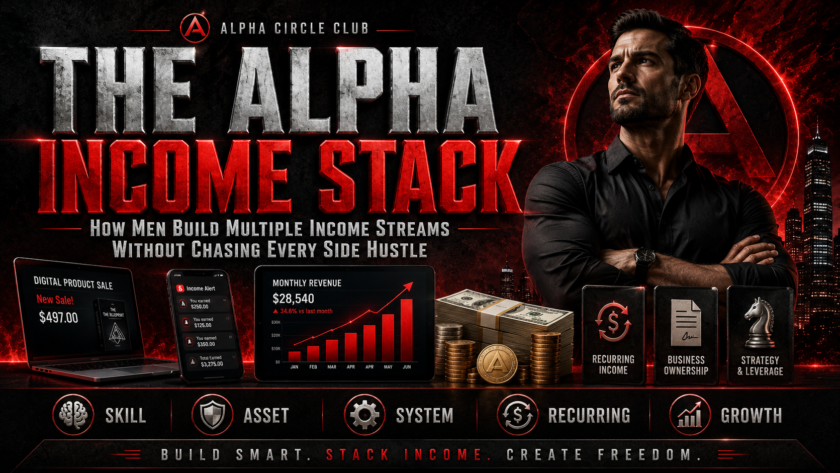
He builds an income stack.
One strong foundation.
One valuable skill.
One service.
One product.
One asset.
Each layer supports the next.
He does not start seven disconnected projects and hope one becomes successful.
He builds one capability deeply enough that it can produce several connected sources of income.
That is the Alpha Income Stack.
It is not a fantasy about effortless passive income.
It is a structured path from dependence to resilience.
From skill to service.
From service to product.
From product to ownership.
From income to assets.
The goal is not to appear busy.
The goal is to become financially harder to break.
Alpha Thought:
Financial freedom is not built by starting everything. It is built by finishing and strengthening what matters.
Quick Alpha Summary
An income stack is a group of connected income sources built from the same skills, knowledge, audience, systems, or assets.
A strong income stack may include:
- Primary employment or business income
- A high-value professional skill
- Freelance or consulting income
- Digital products
- Membership or licensing income
- Business ownership
- Pension or investment assets
The goal is not to launch everything at once.
A man should strengthen one layer before adding the next.
A useful sequence may look like this:
- Protect primary income
- Develop a valuable skill
- Sell that skill as a service
- Turn repeated solutions into products
- Build an audience and systems
- Use profits to create ownership and assets
Multiple income streams do not guarantee financial freedom.
Every stream can fail.
Businesses require work.
Digital products require marketing.
Investments carry risk.
Side income may also create tax, record-keeping, legal, insurance, and administrative responsibilities.
The first goal is therefore not seven income streams.
It is one proven source strong enough to support the second.
Alpha Thought:
Do not collect side hustles. Build a connected income system.
What Is an Income Stack?
An income stack is a group of earning layers that support and strengthen one another.
It is different from a random collection of unrelated side hustles.
For example, imagine a man learns copywriting.
He could use that one skill to create:
- Employment income as an in-house copywriter
- Freelance copywriting income
- Consulting income
- Sales-page templates
- Email-marketing templates
- A copywriting eBook
- An online course
- A paid membership
- Licensing income
- A specialist agency
The streams are different, but the roots are the same.
They share:
- Knowledge
- Experience
- Customers
- Marketing
- Reputation
- Systems
- Content
- Tools
- Case studies
This makes the stack more efficient.
Every client project improves his skill.
Every completed project may create a case study.
Every repeated customer question may become an article.
Every repeated process may become a template.
Every template may become a product.
Every product customer may join an email list.
Every email subscriber may later purchase another relevant offer.
One layer feeds the next.
A random side-hustle collection works differently.
The man may try to operate a clothing store, study foreign-exchange trading, build a YouTube channel, write fiction, offer gardening services, and research property at the same time.
Each project requires different:
- Skills
- Customers
- Marketing methods
- Platforms
- Tools
- Knowledge
- Financial risks
His effort is fragmented.
An income stack concentrates effort.
That concentration can create mastery, proof, and momentum.
Alpha Thought:
The strongest income streams grow from the same roots.
Why Depending on One Income Source Can Be Risky
One income source may feel secure.
But complete dependence creates vulnerability.
A man may depend on:
- One employer
- One major client
- One product
- One social platform
- One affiliate programme
- One advertising channel
- One investment
- One customer group
- One supplier
That source may disappear because of:
- Redundancy
- Illness
- Industry decline
- Business closure
- Client loss
- Algorithm changes
- Account restrictions
- Platform policy changes
- Economic conditions
- New competition
- A product becoming outdated
- Personal circumstances
The goal is not to live in constant fear.
The goal is to build resilience.
Income diversification can give a man options.
If one client leaves, others remain.
If employment ends, a service may provide temporary income.
If one product slows down, another may continue selling.
If one platform reduces reach, an email list or website may still connect the man with his audience.
But diversification must be built intelligently.
Trying to protect yourself by launching ten weak income streams may create more instability, not less.
Each source needs:
- Attention
- Maintenance
- Records
- Customer support
- Marketing
- Financial management
- Tax consideration
The goal is not maximum quantity.
It is reduced dependence through carefully developed capabilities.
Alpha Thought:
Diversification is not having more unfinished projects. It is having more than one reliable way to create value.
Why Most Men Fail at Side Hustles
Starting a side hustle is easy.
Staying with it long enough to become useful, trusted, and profitable is difficult.
They start too many ideas
The man becomes excited by possibility.
He starts several businesses at once.
Each receives a small amount of attention.
None receives enough focus to become strong.
They expect immediate profit
They create one product.
Post about it twice.
Receive no sales.
Then decide the business model does not work.
They underestimate how long it takes to develop:
- Skill
- Trust
- Traffic
- Customer understanding
- A strong offer
- Effective marketing
They choose trends instead of strengths
A man sees another person succeeding and copies the model without considering whether it fits his ability, interests, experience, resources, or market.
They avoid selling
They enjoy designing logos, websites, products, and social posts.
But they avoid speaking to customers, making offers, following up, and asking for the sale.
A business without selling remains a project.
They create products nobody requested
The man builds what he wants to sell rather than understanding what customers are already trying to solve.
They learn without applying
He buys courses.
Watches tutorials.
Takes notes.
Downloads templates.
But rarely publishes, contacts a prospect, creates an offer, or delivers real work.
Information becomes another form of consumption.
They quit before feedback arrives
The early stage feels uncomfortable.
The work is imperfect.
Sales are inconsistent.
Instead of learning from the market, the man escapes into a new idea.
They confuse revenue with profit
A business may generate sales while losing money through advertising, software, fees, refunds, equipment, contractors, and taxes.
They underestimate the time required
A side business must often be built around employment, family, health, and existing responsibilities.
Progress may be slower than social media suggests.
But slow progress can still become meaningful when it is consistent.
Alpha Thought:
Starting creates excitement. Staying long enough to become valuable creates income.
Level One: Protect and Strengthen Primary Income
The first layer of the Alpha Income Stack is the current foundation.
For many men, that is employment.
For others, it may be an established business, trade, profession, pension, or contract.
A man may dislike depending on his job.
He may dream of financial independence.
But destroying a reliable income source before the next layer is ready can create unnecessary pressure.
Primary income can fund:
- Living expenses
- Emergency savings
- Training
- Equipment
- Software
- Product development
- Marketing
- Investment
- Business experiments
A man should protect the foundation while building the next floor.
That may involve:
- Becoming more reliable
- Improving qualifications
- Developing leadership ability
- Learning new systems
- Building professional relationships
- Negotiating pay
- Applying for better roles
- Understanding workplace benefits
- Protecting his reputation
- Avoiding careless behaviour that threatens employment
This does not mean remaining in a damaging job forever.
It means planning the exit rather than escaping without preparation.
Before leaving primary employment, consider:
- Is the new income consistent?
- Is it profitable after expenses?
- Have taxes been considered?
- Is there an emergency reserve?
- What happens during a slow month?
- Are health, insurance, pension, or family responsibilities covered?
- Is customer demand proven?
- Is the decision based on evidence or frustration?
Your job may not be the destination.
But it may finance the vehicle that takes you there.
Alpha Thought:
Do not destroy the foundation while trying to build the next floor.
Level Two: Build a High-Value Skill
Every sustainable income stream needs value underneath it.
The skill does not need to sound impressive.
It needs to solve a real problem.
Potential high-value skills include:
- Sales
- Marketing
- Copywriting
- Graphic design
- Video editing
- Web development
- Artificial intelligence tools
- Email marketing
- Search optimisation
- Software development
- Data analysis
- Project management
- Consulting
- Coaching
- Public speaking
- Photography
- Product creation
- Customer service
- Operations management
Choose a skill by considering:
- Existing ability
- Genuine interest
- Market demand
- Learning time
- Start-up costs
- Earning potential
- The ability to demonstrate results
- Whether customers already pay for it
- Whether it complements your current experience
A skill becomes valuable when it can produce a result.
For example:
Copywriting may help a company generate sales.
Video editing may help a creator retain attention.
Web development may help a business take bookings.
Email marketing may help a company sell repeatedly.
Project management may reduce delays and confusion.
A man should not learn only theory.
He should practise.
Create sample work.
Solve small problems.
Seek feedback.
Measure results.
Improve communication.
The market rarely pays for knowledge alone.
It pays for useful application.
Alpha Thought:
A skill becomes financially powerful when it produces a result somebody values.
Level Three: Turn the Skill Into a Service
A service is often one of the fastest ways to test whether a skill has commercial value.
The man offers to solve a problem directly for a customer.
Possible services include:
- Website creation
- Copywriting
- Video editing
- Graphic design
- Social-media management
- Email campaigns
- Consulting
- Personal training
- Business support
- Search optimisation
- Photography
- Bookkeeping
- Coaching
- Technical support
Service work is active income.
The man normally exchanges time, effort, expertise, or access for payment.
That has limitations.
But it also gives him something extremely valuable:
Direct contact with the market.
He learns:
- What customers ask for
- What language they use
- What problems matter most
- What they are willing to pay for
- What objections stop them buying
- What results create satisfaction
- Which parts of delivery take the most time
- Which tasks repeat
This knowledge becomes the foundation for future products and systems.
Start with a clear offer
A weak offer says:
“I do digital marketing.”
A clearer offer says:
“I write a five-email welcome sequence for independent fitness coaches who want to convert more new subscribers into customers.”
Clarity helps the customer understand:
- Who the service is for
- What problem it solves
- What is included
- What outcome it supports
Build proof
Proof may include:
- Sample work
- Case studies
- Testimonials
- Before-and-after examples
- Measurable results
- Completed projects
At the beginning, the man may need to create demonstration work or accept a limited number of carefully chosen lower-priced projects.
But underpricing should not become permanent.
The purpose is to build evidence, not to remain cheap forever.
Alpha Thought:
A service teaches a man what the market actually needs—not what he imagined it needed.
Level Four: Turn Experience Into a Product
Once a man repeatedly solves the same problem, he may be able to package part of the solution.
This is where service experience can become product income.
Possible products include:
- eBooks
- Checklists
- Templates
- Workbooks
- Paid reports
- Online courses
- Recorded workshops
- Memberships
- Software
- Licensing packages
- Resource libraries
Imagine a freelance website designer.
Clients repeatedly ask:
- What pages should my website include?
- What should my homepage say?
- Which images do I need?
- How should I prepare before hiring a designer?
The designer could create:
- A website-planning workbook
- A homepage checklist
- A template package
- A short course
- A paid consultation
- A membership library
The product is not created from imagination alone.
It is created from repeated evidence.
Customers have already shown that the problem exists.
This reduces—but does not remove—the risk of creating something nobody wants.
A digital product still needs:
- A clear audience
- A valuable outcome
- Strong positioning
- Marketing
- Trust
- Customer support
- Updates
- Appropriate pricing
Creating a product is not the end.
Distribution matters.
The best product in the world can remain invisible without traffic, trust, and an effective offer.
Alpha Thought:
Do not create from guesswork alone. Package the problems people repeatedly ask you to solve.
Level Five: Build Assets and Ownership
Income becomes more powerful when part of it is converted into ownership.
Possible assets may include:
- A business
- A website
- A recognised brand
- An email list
- Intellectual property
- Books
- Courses
- Software
- Licensing rights
- Pension assets
- Diversified investments
- Property where appropriate
- Cash reserves
- Business systems
Not every asset will succeed.
A website can lose traffic.
A course can stop selling.
A company can fail.
Property can produce costs.
Investments can rise or fall.
Ownership does not eliminate risk.
It changes the structure of the man’s financial life.
Instead of relying only on the next hour of labour, he begins owning things that may hold value, produce income, or create future opportunities.
The goal is not to stop working instantly.
The goal is to use work to build something beyond the next payment.
Income pays today.
Ownership can strengthen tomorrow.
Alpha Thought:
Labour creates income. Ownership can turn part of that income into future options.
Active Income, Leveraged Income, and Passive Income
The phrase “passive income” is often used dishonestly.
Many supposedly passive income streams require significant work, money, management, marketing, or risk.
A more responsible framework separates income into three broad categories.
Active income
Active income normally requires the man to continue working in direct exchange for payment.
Examples include:
- Employment
- Freelancing
- Consulting
- Coaching
- Trades
- Personal training
- Contract work
When the work stops, the income may stop.
Active income is not inferior.
It often funds everything else.
It develops experience, relationships, proof, and capital.
Leveraged income
Leveraged income comes from work that can be distributed or sold more than once.
Examples include:
- eBooks
- Courses
- Templates
- Recorded workshops
- Software
- Licences
- Membership content
The work may be performed once, but the result can potentially serve several customers.
However, continued marketing, support, updates, and administration may still be required.
Passive or lower-maintenance income
Some income may continue with less daily involvement.
Examples may include:
- Certain investments
- Royalties
- Licensing arrangements
- An established business with management
- Automated systems
But this income normally rests on one or more of the following:
- Previous active work
- Invested capital
- Ongoing maintenance
- Delegated management
- Accepted risk
Passive does not mean guaranteed.
It does not mean effortless.
It does not mean permanent.
Alpha Thought:
Passive income usually rests on active work, invested capital, ongoing management, or accepted risk.
The Power of Connected Income Streams
Connected income streams are powerful because they reuse the same core resources.
Consider a fitness professional.
He could create:
- Personal-training income
- Online coaching
- A training eBook
- A nutrition guide
- A paid membership
- Recorded exercise programmes
- Workshops
- Affiliate income from suitable products
- A fitness content platform
These streams share:
- Fitness knowledge
- A similar audience
- Existing content
- Customer questions
- Branding
- Marketing systems
- Testimonials
- Reputation
One article may attract a reader.
The reader joins an email list.
The email list promotes an eBook.
The eBook introduces the membership.
The membership may lead to coaching.
Each layer can support another.
Now compare that with the same man trying to build:
- A fitness business
- A foreign-exchange trading channel
- A clothing brand
- A property company
- A mobile app
- A cooking channel
Every project requires a different audience and operating system.
The work multiplies.
Connected streams create leverage.
Unrelated streams create complexity.
Alpha Thought:
Build outward from proven strength instead of constantly starting from zero.
Build an Audience You Control
Social-media platforms can help a man attract attention.
But he does not own the platform.
Algorithms change.
Reach falls.
Accounts may be restricted.
Features disappear.
Advertising costs rise.
A business built entirely on one platform remains vulnerable.
A stronger system may include:
- A website
- An email list
- Customer records
- Search traffic
- A recognised brand
- Direct customer relationships
- A community
- Several appropriate traffic sources
An email list is especially valuable because it allows the business to communicate directly with people who have chosen to hear from it.
That does not mean email is guaranteed.
Messages may still go unread.
Subscribers can leave.
Deliverability can change.
But it is generally a more direct relationship than hoping an algorithm displays a post.
Content should lead somewhere.
An article may lead to an email subscription.
A video may lead to a website.
A social post may lead to a useful free resource.
The goal is to convert temporary attention into a longer-term relationship.
Alpha Thought:
Do not build your entire income on digital land owned by someone else.
The One-One-One Rule
Men often complicate business before producing proof.
They create several offers for several audiences using several marketing channels.
The One-One-One Rule creates focus.
Begin with:
- One valuable skill
- One target customer
- One clear offer
For example:
- Skill: email copywriting
- Customer: independent personal trainers
- Offer: a five-email sequence for converting new leads into consultations
This focus makes it easier to:
- Practise
- Explain the service
- Contact prospects
- Build examples
- Learn customer language
- Improve delivery
- Measure results
Do not add a major new project until the first offer has produced evidence.
Evidence may include:
- Customer conversations
- Completed work
- Testimonials
- Actual revenue
- Repeat customers
- Referrals
- A repeatable process
- Clear lessons from failure
Focus does not mean the business must remain narrow forever.
It means expansion should be earned through proof.
Alpha Thought:
Focus creates proof. Proof creates the right to expand.
How to Validate an Income Idea Before Building It
Many men spend months creating before speaking to a potential customer.
Validation reduces this risk.
It does not guarantee success.
But it provides useful evidence.
Speak to real people
Ask potential customers:
- What problem are you trying to solve?
- What have you already tried?
- What does the problem cost you?
- What result would matter?
- What would stop you paying for help?
Do not manipulate the conversation.
Listen.
Study existing demand
Look at:
- Services people already purchase
- Questions asked repeatedly
- Reviews of competing products
- Complaints about existing solutions
- Search behaviour
- Community discussions
Create a simple offer
Do not build a complex platform first.
Write a clear description of:
- The customer
- The problem
- The deliverable
- The expected benefit
- The price
- The next step
Ask for commitment
Interest is useful.
Payment is stronger evidence.
A person saying “That sounds good” is not the same as a person purchasing.
Deliver manually first
Before automating everything, understand the service.
Manual delivery reveals:
- What customers need
- Where problems occur
- What can eventually be systemised
Alpha Thought:
Do not spend six months perfecting an offer the market has never been asked to buy.
When to Add the Next Income Stream
A man may be ready to add another layer when:
- The first stream produces consistent evidence
- Delivery is organised
- He understands the customer
- He knows his costs
- Records are accurate
- The new stream uses existing capabilities
- There is available time, capital, or support
- The current stream can continue without constant chaos
- There is genuine customer demand
- Essential responsibilities are not being neglected
He is probably not ready when:
- The current project is unfinished
- There have been no customer conversations
- There is no revenue or useful feedback
- He is bored rather than strategically prepared
- He is chasing social-media hype
- He cannot explain the new offer
- He is already exhausted
- Financial records are disorganised
- The current business is losing money without a correction plan
Expansion should solve a limitation or use an opportunity.
It should not be an escape from difficult work.
Alpha Thought:
Do not add another income stream because the first became difficult. Strengthen the weakness first.
Income Is Not Profit
One of the most important Alpha Wealth lessons is the difference between income and profit.
A business may generate £5,000 in sales.
But that does not mean the owner earned £5,000.
Costs may include:
- Advertising
- Website fees
- Payment-processing charges
- Software
- Contractors
- Equipment
- Products
- Postage
- Returns
- Insurance
- Professional services
- Tax
- National Insurance
- Refunds
- Travel
- Training
The man must know:
- Revenue
- Direct costs
- Overheads
- Tax obligations
- Actual profit
- Cash available
A busy business can still be financially weak.
A high-revenue product can still lose money.
Track every stream separately where possible.
Ask:
Which stream is profitable?
Which consumes the most time?
Which creates repeat customers?
Which depends heavily on paid advertising?
Which produces the strongest margin?
Which supports another product?
Numbers reveal where expansion makes sense.
Alpha Thought:
Revenue creates excitement. Profit and cash flow reveal whether the system is truly working.
Multiple Income Streams and Tax
Extra income creates responsibilities.
A man should not assume income from side work is invisible or automatically tax-free.
Depending on the amount and circumstances, he may need to:
- Notify the tax authority
- Complete a tax return
- Keep records
- Track allowable expenses
- Save money for tax
- Register as self-employed
- Consider National Insurance
- Understand VAT rules if the business grows
- Review whether licences or insurance are needed
UK rules include a trading allowance, but the rules, exclusions, and reporting requirements must be checked carefully.
Gross income is not the same as profit.
Revenue should not all be spent.
A disciplined man creates separate financial pots where appropriate for:
- Tax
- Business expenses
- Personal pay
- Emergency reserves
- Reinvestment
He records:
- Sales
- Invoices
- Receipts
- Expenses
- Payment fees
- Refunds
- Mileage or other relevant records
Good records protect the business from confusion.
Do not wait until a filing deadline to work out what happened during the year.
Alpha Thought:
The money entering the account is not automatically yours to spend. Some of it may already have another mission.
The 90-Day Alpha Income Stack
The purpose of this plan is not to create seven income streams in 90 days.
It is to begin building one proven stream with the potential to support another.
Days 1–30: Choose and Validate
Audit your skills
List:
- Professional experience
- Personal skills
- Problems you have solved
- Tools you understand
- Industries you know
- Results you have produced
- Topics people ask you about
Choose one target customer
Avoid targeting “everyone.”
Choose a specific group whose needs you can understand.
Identify one valuable problem
Look for a problem that is:
- Real
- Specific
- Costly or frustrating
- Already being discussed
- Connected to an outcome people value
Speak to potential customers
Have genuine conversations.
Learn their language.
Do not begin with a sales pitch.
Choose one service
Select a simple offer that can be delivered without excessive cost or technology.
Create a basic offer
State:
- Who it is for
- What it solves
- What is included
- What it costs
- How to begin
Days 1–30 objective: Replace imagination with market evidence.
Days 31–60: Sell and Deliver
Build a basic portfolio
Create sample work or use completed projects with permission.
Contact prospects
Use appropriate channels such as:
- Direct outreach
- Professional networks
- Existing contacts
- Local businesses
- Relevant online communities
- Referrals
Make clear offers
Avoid vague messages.
Explain the problem, service, and next step.
Deliver properly
Communicate clearly.
Meet deadlines.
Set expectations.
Protect customer data.
Ask questions.
Collect feedback
Learn what worked and what caused difficulty.
Improve the process
Create checklists and templates.
Track revenue and costs
Record actual figures from the beginning.
Days 31–60 objective: Produce proof through real delivery.
Days 61–90: Package and Systemise
Identify repeated needs
Which customer questions keep appearing?
Which parts of the service repeat?
Create a small product
This may be:
- A checklist
- A template
- A short guide
- A workbook
- A recorded workshop
Keep the first product focused.
Begin building an email list
Offer a genuinely useful resource and obtain clear permission to communicate.
Document delivery
Write down the steps required to complete the service.
Save part of the income
Do not spend every new payment.
Set money aside for tax, reserves, reinvestment, or other financial goals.
Design the next connected layer
Ask what naturally follows the existing service.
Do not launch it yet unless the first stream has sufficient evidence.
Days 61–90 objective: Turn repeated work into the beginning of a system.
Alpha Thought:
The first goal is not seven income streams. It is one proven stream strong enough to support the second.
Common Income-Stack Mistakes
Starting several businesses at once
Every new business multiplies complexity.
Believing every hobby should become income
Some hobbies should remain sources of rest and enjoyment.
Copying another man’s business model
His skills, audience, finances, and circumstances may be completely different.
Ignoring customer demand
Interest must be tested outside your own imagination.
Avoiding selling
No offer can succeed if nobody is asked to buy.
Underpricing everything
Low prices may attract difficult work while leaving no room for quality, tax, or profit.
Buying excessive tools too early
Software and equipment do not replace customers.
Confusing turnover with profit
Sales figures can hide high costs.
Depending completely on one platform
Algorithm dependence creates vulnerability.
Neglecting tax and records
Disorganisation can become expensive.
Spending new revenue immediately
Some income may be needed for tax, expenses, refunds, and reinvestment.
Calling something passive before it is stable
A product still requiring constant attention is not passive.
Quitting primary income too early
Excitement is not the same as proven stability.
Adding a new project whenever progress slows
Difficulty is often a signal to improve the current system—not escape it.
Alpha Thought:
A new opportunity should not become an excuse to abandon the discipline required by the current one.
The Alpha Income Stack Code
The complete system can be reduced to ten principles.
1. Protect the foundation
Do not destroy reliable income carelessly.
2. Build one valuable skill
Depth creates leverage.
3. Serve one clear customer
Specificity improves communication.
4. Create one strong offer
Make the value understandable.
5. Sell before overbuilding
Market evidence matters more than endless preparation.
6. Deliver and collect proof
Results build reputation.
7. Package repeated solutions
Turn experience into products and systems.
8. Build an audience you control
Convert temporary attention into direct relationships.
9. Use income to build ownership
Do not spend every profit.
10. Expand only after evidence
Focus first. Diversify second.
Final Alpha Standard
A man does not need seven unfinished side hustles.
He needs one strong foundation.
One useful skill.
One clear offer.
One group of people he can serve.
One system he can improve.
Then he can add the next layer.
The Alpha Income Stack is not built through excitement.
It is built through proof.
Skill becomes service.
Service becomes product.
Product becomes ownership.
Income becomes assets.
Assets create options.
The goal is not to appear busy.
It is not to tell people you have several businesses.
It is not to collect logos, websites, courses, or social-media accounts.
The goal is to become less financially fragile.
To become capable of creating value in more than one way.
To reduce dependence without destroying focus.
To build something useful.
To finish what you start.
To measure what works.
To stop chasing every new promise of fast money.
The Alpha standard is simple:
Strengthen the base.
Master the skill.
Understand the customer.
Make the offer.
Deliver the work.
Build the proof.
Create the system.
Own the asset.
Then add the next layer.
Do not chase seven streams of income.
Build one river strong enough to create tributaries.
Final Alpha Thought:
Do not chase seven streams of income. Build one river strong enough to create tributaries.
Build the Skill. Create the Income. Own the System.
Alpha Wealth helps men move beyond financial dependence by developing valuable skills, creating useful products, and building connected income with discipline.
Stop chasing opportunities.
Start building an income system.
Financial Disclaimer
This article is provided for general educational and informational purposes only. It does not constitute personalised financial, investment, tax, legal, accounting, employment, pension, debt, or business advice.
Income, tax obligations, business requirements, employment contracts, financial circumstances, and regulations vary between individuals and jurisdictions. Side work may also be restricted by an employment agreement, professional regulation, insurance condition, visa, licence, or other legal requirement.
No side hustle, business, product, investment, or income strategy is guaranteed to generate revenue or profit. Businesses can fail, income can fluctuate, and investments can fall in value. You may receive back less than you invest.
Keep accurate financial records and consider setting aside part of irregular or self-employed income for tax and other obligations. UK readers should review current HMRC and GOV.UK guidance or consult a suitably qualified tax professional regarding trading allowances, Self Assessment, allowable expenses, National Insurance, VAT, and reporting requirements.
Before leaving secure employment, taking on debt, investing significant capital, or making major tax or business decisions, consider speaking with appropriately authorised and qualified professionals.
Be cautious of guaranteed income claims, high-pressure sales tactics, unregulated investments, unusually high projected returns, and opportunities promoted primarily through luxury imagery or fear of missing out.
Nothing in this article is a recommendation to buy, sell, finance, hold, or invest in any specific company, security, cryptocurrency, property, product, platform, franchise, course, or business opportunity.

No spam. Unsubscribe anytime.