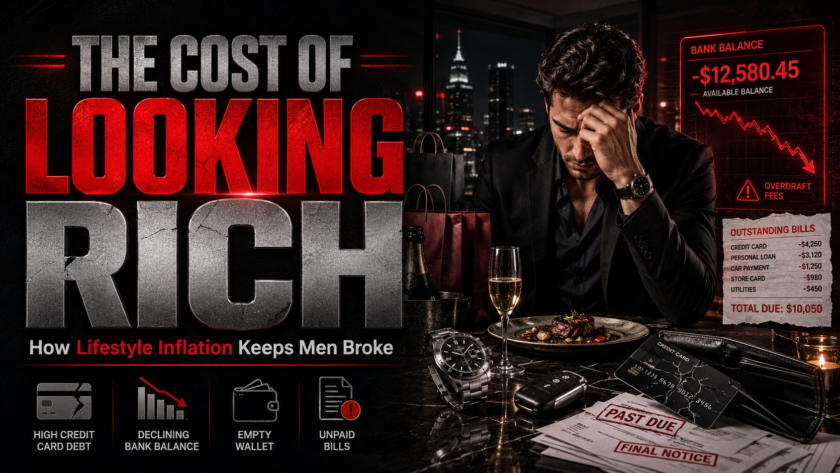
A man receives a pay rise and believes his financial problems are over.
For a short time, he has more breathing room.
There is more money in the account.
The bills feel easier to manage.
He begins imagining what the extra income could make possible.
Then the upgrades begin.
A more expensive car.
A better phone.
New clothes.
More meals out.
More subscriptions.
More convenience.
A larger monthly payment.
A more expensive holiday.
Within months, the extra income has disappeared.
He earns more—but feels no richer.
His lifestyle has expanded to consume almost everything he gained.
This is lifestyle inflation.
It is the silent process through which a man’s spending rises as his income rises.
The danger is not only the money being spent.
It is the freedom being lost.
Each new payment increases the amount he must earn simply to maintain his current life.
The bigger house must be heated.
The more expensive car must be financed, insured, serviced, and repaired.
The premium subscriptions renew every month.
The upgraded lifestyle becomes the new minimum.
The man may look more successful while becoming more financially fragile.
He earns more.
But he needs more.
He owns better things.
But he has fewer options.
He receives a larger salary.
But more of it is already committed before it reaches his account.
The Alpha Wealth position is simple:
A disciplined man allows his income to rise faster than his lifestyle.
He does not reject comfort.
He does not believe enjoying money is wrong.
He does not force himself to live poorly forever.
But he builds the foundation before upgrading the image.
He strengthens savings.
Reduces destructive debt.
Builds assets.
Develops valuable skills.
Creates additional income.
Protects his future.
Then he upgrades deliberately—not emotionally.
Because the goal is not to earn more and remain trapped.
The goal is to earn more and become freer.
Alpha Thought:
A bigger income does not create freedom when every extra pound is immediately assigned to a bigger lifestyle.
Quick Alpha Summary
Lifestyle inflation, also called lifestyle creep, happens when spending gradually increases as income increases.
A pay rise may lead to a more expensive car, higher housing costs, premium subscriptions, frequent meals out, costlier holidays, and new recurring payments.
The man’s income rises, but his savings, investments, debt reduction, and financial security may barely improve.
Lifestyle inflation is dangerous because luxuries gradually begin to feel like necessities.
The man becomes dependent on maintaining a high income just to support the life he has created.
Avoiding lifestyle inflation does not mean refusing all enjoyment.
It means making sure part of every income increase strengthens:
- Emergency savings
- Debt reduction
- Investments
- Pension contributions
- Valuable skills
- Business assets
- Additional income
- Long-term financial resilience
The Alpha standard is not deprivation.
It is intentional control.
Enjoy money without allowing appearances, comparison, or recurring commitments to consume your future freedom.
Alpha Thought:
A richer life does not always require a more expensive life. It requires a more intentional one.
What Is Lifestyle Inflation?
Lifestyle inflation is the gradual increase in spending that often follows an increase in income.
It may happen after:
- A pay rise
- A promotion
- A successful business month
- A bonus
- A new job
- A growing side income
- A financial windfall
- Paying off an old debt
The man suddenly has more money available.
Instead of directing most of the increase toward savings, ownership, or debt reduction, he increases his standard of living.
At first, the changes may seem harmless.
He buys lunch instead of preparing it.
He upgrades his phone plan.
He adds another streaming service.
He takes taxis more frequently.
He buys premium versions of ordinary products.
He replaces things sooner.
He chooses a more expensive gym.
He starts financing a better car.
One decision does not destroy his finances.
But the decisions compound.
The new spending becomes normal.
The temporary luxury becomes a permanent expectation.
The extra income disappears into a higher monthly baseline.
This is the central danger:
Lifestyle inflation converts an increase in income into an increase in obligation.
A man should enjoy part of his progress.
But every rise in income should not automatically become a rise in fixed expenses.
If his salary increases by £500 per month and his lifestyle immediately expands by £500 per month, he has gained income without gaining freedom.
He still needs every payday.
He still has little margin.
He is still vulnerable to job loss, illness, business decline, or unexpected expenses.
The numbers became larger.
The position did not become stronger.
Alpha Thought:
More income changes the numbers. Only disciplined allocation changes the man’s financial position.
Why Lifestyle Inflation Is So Difficult to Notice
Lifestyle inflation rarely arrives as one dramatic financial mistake.
It usually enters quietly.
A few extra conveniences.
One new subscription.
One car upgrade.
One slightly more expensive home.
One habit of ordering food.
One preference for premium brands.
Each decision appears affordable on its own.
The man tells himself:
“I earn more now.”
“I deserve this.”
“It is only an extra £20.”
“I can cover the monthly payment.”
“This is what successful people do.”
Over time, the small upgrades form a completely different financial life.
Convenience becomes expectation
At first, paying for convenience feels like a treat.
Then the man becomes unwilling to perform tasks he previously handled himself.
Preparing food feels inconvenient.
Walking feels inconvenient.
Waiting feels inconvenient.
Repairing something feels inconvenient.
Convenience spending becomes automatic.
Luxury becomes normal
The first premium purchase feels special.
After repeated exposure, it becomes the standard.
The man no longer feels grateful for it.
He simply feels deprived without it.
Recurring costs become invisible
A purchase made once is noticeable.
A small payment deducted every month may disappear into the background.
The man may have streaming services, software, memberships, insurance add-ons, storage plans, delivery services, app subscriptions, and finance agreements quietly claiming hundreds each month.
Social comparison resets the standard
The man earns more and enters new professional or social circles.
He sees better cars.
Larger homes.
More expensive clothes.
More elaborate holidays.
What once looked luxurious begins to feel average.
His definition of “enough” moves again.
This is why lifestyle inflation is dangerous.
The spending does not always feel reckless.
It feels normal.
Alpha Thought:
The most dangerous expenses are often the ones that stop feeling optional.
Looking Rich vs Being Financially Strong
Looking rich and becoming financially strong are not the same mission.
They may even move in opposite directions.
The man trying to look rich
He spends to create an impression.
He wants people to see:
- Success
- Status
- Power
- Confidence
- Progress
- Importance
He may finance a car he cannot comfortably afford.
Buy designer clothing to gain approval.
Take expensive trips mainly for photographs.
Upgrade technology before it needs replacing.
Use credit to protect an image.
He may receive attention.
But attention is not financial security.
The financially strong man
He knows his numbers.
He understands:
- His income
- His spending
- His debt
- His savings
- His recurring commitments
- His assets
- His financial risk
He may enjoy quality products.
But he does not need possessions to prove his worth.
He builds:
- Emergency reserves
- Debt freedom
- Investments
- Pension assets
- Business ownership
- Valuable skills
- Additional income
- Financial flexibility
He may look ordinary while becoming difficult to break.
That is the key difference.
Appearance creates attention.
Financial strength creates options.
The man trying to look rich asks:
“What will people think when they see me?”
The financially strong man asks:
“What will this decision do to my future?”
Alpha Thought:
A wealthy image can be rented. Financial strength must be built.
Why Men Spend to Impress
Status spending is rarely only about the object.
The car, watch, clothing, holiday, or phone may represent something deeper.
Competition with other men
Men often measure themselves against one another.
Who earns more?
Who drives the better car?
Who has the larger home?
Who appears more successful?
Competition can motivate growth.
But when competition controls spending, it becomes expensive.
The man begins buying symbols instead of building substance.
Social-media comparison
Online platforms show a constant stream of apparent success.
Luxury cars.
Hotels.
Watches.
Trading profits.
Designer clothes.
Beautiful homes.
The man sees the outcome but rarely sees the financing, debt, family support, sponsorship, staged photography, failed businesses, or unstable income behind it.
He compares his complete financial reality with someone else’s edited presentation.
Low self-worth
A man who does not feel valuable may attempt to purchase visible proof that he matters.
The object temporarily gives him confidence.
But because the deeper insecurity remains, another purchase is eventually needed.
Fear of appearing unsuccessful
Some men are terrified of looking as though they are struggling.
They hide financial pressure.
Avoid admitting that something is unaffordable.
Agree to expensive plans.
Spend beyond their comfort.
All to prevent others from thinking less of them.
Childhood scarcity
A man who grew up without much may understandably want to enjoy what he once lacked.
That desire is not wrong.
But unresolved scarcity can lead to overcompensation.
He may believe denying himself any purchase means returning to the hardship of the past.
External pressure
Friends, partners, colleagues, or family may expect a certain standard.
The man may feel required to keep pace.
But financial consequences remain his responsibility even when the pressure came from others.
A disciplined man must learn the difference between buying something because he values it and buying it because he needs validation.
Alpha Thought:
A purchase made to prove your worth often reveals that you have not yet recognised it.
The High-Income Trap
A high income can create opportunities.
It can accelerate saving.
Increase investment capacity.
Fund a business.
Protect a family.
Provide better experiences.
But a high income can also hide financial weakness.
A man earning £100,000 may still be financially vulnerable if he has:
- Large car payments
- High housing costs
- Expensive consumer debt
- No emergency reserve
- Minimal pension or investments
- No alternative income
- High monthly commitments
- A lifestyle dependent on bonuses
- No margin for interruption
Because his income is high, people assume he is wealthy.
He may assume it too.
But wealth is not simply what enters the account.
It is what remains.
What is owned.
What is protected.
What can survive disruption.
A high earner may be one missed bonus away from financial stress.
One redundancy away from panic.
One business downturn away from debt.
The larger the lifestyle, the more income is required to support it.
That can turn a successful career into a cage.
The man may hate the job but feel unable to leave.
He may want to build a business but cannot tolerate reduced income.
He may want more time with family but cannot reduce his hours.
His lifestyle consumes his negotiating power.
High income is a tool.
High fixed expenses can become chains.
Alpha Thought:
A large salary creates power only when the man keeps enough of it to build options.
Fixed Expenses: The Chains Men Build Quietly
One-time purchases matter.
But recurring obligations can be more dangerous.
A one-time expense leaves the account once.
A recurring expense claims part of every future paycheque until it is cancelled, paid off, sold, or renegotiated.
Common recurring commitments include:
- Car finance
- Mortgage or rent
- Credit repayments
- Phone contracts
- Insurance
- Streaming services
- Gym memberships
- Software plans
- Storage subscriptions
- Delivery memberships
- Private clubs
- Device finance
- Regular beauty or grooming costs
- Premium banking services
- School or childcare commitments
- Maintenance costs for luxury assets
Every payment may be manageable individually.
Together, they create a heavy financial baseline.
Before the man buys food, saves, invests, or handles an emergency, much of his income has already been claimed.
This reduces flexibility.
A man with low fixed expenses can adapt.
A man with high fixed expenses needs consistent income simply to remain stable.
Before accepting a new monthly commitment, ask:
- How long will I be paying this?
- What is the total cost?
- What happens if my income falls?
- Is this genuinely valuable?
- Could I buy it later with cash?
- Am I paying mainly for status?
- What financial goal will this delay?
- Will I still value this in one year?
A recurring expense is not only today’s decision.
It is a promise made on behalf of your future income.
Alpha Thought:
A recurring expense is a decision your future self must continue paying for.
The Alpha Upgrade Rule
A man should not refuse every upgrade.
Success should improve life.
The purpose of financial discipline is not endless deprivation.
The goal is to upgrade from strength rather than emotion.
The Alpha Upgrade Rule is simple:
Before increasing lifestyle spending, strengthen your financial foundation first.
Before upgrading the car, holiday, phone, home, wardrobe, or entertainment budget, strengthen at least one of the following:
- Emergency savings
- High-interest debt reduction
- Pension contributions
- Diversified investments
- Business assets
- Income-producing skills
- Additional income
- Insurance protection
- Cash-flow margin
A man may create a personal rule for allocating each pay rise.
For example:
- 50% toward wealth building
- 30% toward lifestyle improvement
- 20% toward short-term goals or enjoyment
These numbers are not universal.
A man with expensive debt may allocate far more toward repayment.
A man with no emergency savings may prioritise cash reserves.
A man with dependants may need more protection.
The principle matters more than the exact percentages:
Your financial strength should rise before or alongside your lifestyle.
Never allow the lifestyle to consume the entire increase.
Alpha Thought:
Earn the upgrade by strengthening the foundation that must support it.
How to Enjoy Money Without Losing Control
Financial discipline should not turn life into punishment.
Money can be used for enjoyment.
Travel.
Food.
Clothing.
Experiences.
Hobbies.
Comfort.
Generosity.
The problem is not enjoyment.
The problem is unconscious expansion.
Set a guilt-free enjoyment budget
Choose an amount that can be spent freely after essential commitments and financial goals are addressed.
This allows enjoyment without destroying the plan.
Choose a few luxuries that genuinely matter
A man may value travel but care little about cars.
He may prefer quality clothing but not expensive restaurants.
He may value technology because it supports his work.
Spend more intentionally in areas that add genuine value and less in areas driven by appearance.
Avoid upgrading everything at once
A pay rise does not require a new car, phone, wardrobe, home, and holiday in the same year.
Choose slowly.
Save before purchasing
Saving creates a pause.
It allows the man to discover whether he truly wants the item or only wanted the immediate emotional reward.
Prefer quality over constant replacement
A durable, useful item may be better than repeated cheap purchases.
But “quality” should not become an excuse for buying the most expensive option.
Review recurring spending
Ask whether each recurring cost still earns its place.
Enjoyment is strongest when it is chosen.
Not when it quietly becomes an obligation.
Alpha Thought:
The goal is not to remove pleasure from money. It is to remove loss of control.
Delay the Upgrade
One of the strongest ways to resist lifestyle inflation is to delay major changes after an income increase.
When a man receives a promotion, bonus, or business improvement, excitement may cause him to act too quickly.
He may not yet know:
- His true after-tax increase
- Whether the income will remain stable
- Whether new work expenses will appear
- Whether the role will last
- Whether the business improvement is temporary
- How much of the increase can realistically be saved
For the first three to six months after an income increase, consider:
- Maintaining the previous lifestyle where possible
- Building emergency reserves
- Clearing expensive debt
- Increasing pension or investment contributions
- Measuring actual monthly cash flow
- Avoiding major new finance agreements
- Waiting before increasing housing costs
- Testing whether the income is reliable
Delay is not denial.
It is a protection against emotional decision-making.
The man is not saying:
“I can never have this.”
He is saying:
“I will decide from evidence rather than excitement.”
Alpha Thought:
Delay is not denial. It is the space where intelligent decisions are made.
Turn Every Pay Rise Into an Asset
Every pay rise creates a choice.
The additional money can increase consumption.
Or it can increase ownership.
It can fund:
- A more expensive lifestyle
- Debt freedom
- Emergency savings
- Pension contributions
- Diversified investments
- Business development
- Professional training
- Digital products
- Property savings
- Intellectual property
- Equipment that supports income
- A cash reserve for opportunity
Imagine two men receiving the same pay rise.
The first increases his car payment, takes on new subscriptions, and begins spending more socially.
The second keeps most of his previous lifestyle.
He clears debt.
Builds savings.
Learns a valuable skill.
Invests in a small business or productive asset.
After five years, the difference may be substantial.
The first man may still earn well but need every payment.
The second may have assets, savings, stronger skills, and more options.
The pay rise was the same.
The allocation created the difference.
Alpha Thought:
A pay rise can purchase a better image—or build a stronger future.
Social Media and Manufactured Success
Social media places men inside a constant status competition.
They see:
- Luxury vehicles
- Watches
- Designer clothing
- First-class travel
- Expensive hotels
- Large homes
- Trading profits
- Business success
- Perfect offices
- Constant holidays
But they do not see:
- Debt
- Car finance
- Rented vehicles
- Sponsored products
- Borrowed items
- Family money
- Business losses
- Tax obligations
- Unstable income
- Failed investments
- Staged content
- Emotional stress
- Months without sales
This does not mean every successful person online is pretending.
Many have built real success.
The problem is that the viewer usually cannot distinguish ownership from presentation.
He may damage his real finances trying to compete with an image that is incomplete, temporary, rented, sponsored, or false.
The Alpha standard is simple:
Never build a real financial life to compete with someone else’s edited image.
Your bank account does not care how many likes the purchase received.
Your debt still needs paying.
Your future still bears the cost.
Alpha Thought:
Do not build permanent obligations to compete with temporary images.
When Rewards Become Excuses
Men often justify spending by saying:
“I work hard.”
“I deserve it.”
“You only live once.”
“I have had a difficult month.”
“I need to enjoy something.”
These feelings are understandable.
A man should enjoy the results of his effort.
But reward language can become a method of avoiding discipline.
Every stressful week becomes a reason to spend.
Every success becomes an upgrade.
Every disappointment becomes retail therapy.
The reward begins costing more than the achievement created.
A strong reward should not undermine the progress it is meant to celebrate.
Before making a reward purchase, ask:
- Can I afford this without debt?
- Does it interfere with an important goal?
- Am I buying from joy or emotional exhaustion?
- Will this still feel valuable next month?
- Is there a less expensive reward that would be equally meaningful?
- Have I already rewarded myself repeatedly?
Reward yourself.
But do not use rewards to sabotage the future you are working to build.
Alpha Thought:
A reward should celebrate progress—not quietly reverse it.
The Lifestyle Inflation Audit
A man cannot correct lifestyle inflation until he sees it.
Review the past 12 months and ask:
Income
- Did my income increase?
- Was the increase permanent or temporary?
- How much did I actually receive after tax and deductions?
Spending
- Which expenses increased?
- Which categories grew the most?
- What do I now spend on convenience?
- How much do I spend on subscriptions?
- Which luxuries now feel essential?
Commitments
- How much of my monthly income is committed before payday?
- Which payments would remain if I lost my job?
- How long am I locked into finance agreements?
Motivation
- What am I paying for mainly to impress people?
- Which purchases were influenced by social media?
- What do I own that does not improve my life?
Financial strength
- Did my savings rise when my income rose?
- Did my debt fall?
- Did my investments or pension contributions increase?
- Did my net worth improve?
- Did I build any new assets?
- Could I support my lifestyle through three months of reduced income?
Value
- What upgrade has brought the least real value?
- Which expense would I not choose again?
- What could be redirected without damaging my quality of life?
The goal is not guilt.
It is clarity.
Alpha Thought:
Financial truth may feel uncomfortable for one evening. Financial avoidance can remain expensive for years.
The 30-Day Alpha Lifestyle Reset
This reset is not designed to make a man miserable.
It is designed to restore control.
Week One: Face the Spending
Track every expense.
Review bank statements.
List:
- Housing
- Transport
- Food
- Subscriptions
- Debt payments
- Entertainment
- Shopping
- Convenience spending
- Memberships
- Insurance
- Unplanned purchases
Mark each expense as:
- Essential
- Valuable
- Optional
- Status-driven
- No longer useful
Do not cut yet.
Understand first.
Week Two: Cut the Invisible Drain
Cancel unused subscriptions.
Downgrade services that no longer justify their cost.
Reduce frequent delivery or convenience spending.
Compare insurance and utility costs where appropriate.
Pause unnecessary purchases.
Identify one recurring expense that can be removed.
The aim is not dramatic deprivation.
It is removing spending that offers little value.
Week Three: Redirect the Difference
Money saved must be given a new mission.
Otherwise it will disappear elsewhere.
Redirect it toward:
- Emergency savings
- High-cost debt repayment
- Pension contributions
- Long-term investments
- Professional training
- Business development
- A future planned purchase
Create an automatic transfer if suitable.
Week Four: Create the Upgrade Standard
Write personal rules for future purchases.
Examples:
- I will wait 30 days before major non-essential purchases.
- I will not finance clothing, holidays, or status items.
- I will strengthen savings before upgrading my car.
- I will not increase housing costs after a temporary income rise.
- I will review every subscription quarterly.
- I will invest or save part of every pay rise.
- I will not compete financially with social-media images.
- I will discuss major shared expenses openly with my partner.
This turns temporary restraint into a lasting system.
Alpha Thought:
Financial discipline becomes powerful when the money you stop wasting is given a stronger mission.
Common Lifestyle Inflation Mistakes
Upgrading immediately after a pay rise
The man creates commitments before understanding how much additional income he truly has.
Financing status purchases
The object delivers immediate appearance while the payment remains for years.
Copying wealthier friends
Different people have different incomes, assets, responsibilities, debt, and support.
Their spending level may be unsuitable for your financial position.
Treating bonuses as permanent income
A temporary payment should not automatically fund a permanent monthly obligation.
Increasing housing costs too quickly
Housing is often one of the largest fixed expenses.
A rushed upgrade can dramatically reduce flexibility.
Ignoring recurring expenses
Small monthly payments combine into significant annual costs.
Believing high income removes the need for budgeting
The larger the income, the more damage uncontrolled spending can create.
Using every achievement as a spending excuse
Success should build momentum, not automatically create consumption.
Refusing to reduce lifestyle after income falls
Pride can keep a man inside a lifestyle he can no longer afford.
Confusing comfort with freedom
Comfort is enjoyable.
Freedom is the ability to choose.
A comfortable life with no savings, high debt, and no flexibility may still be a financial prison.
Alpha Thought:
Comfort becomes dangerous when maintaining it removes every option.
The Alpha Lifestyle Code
The fight against lifestyle inflation can be reduced to ten principles.
1. Know the numbers
Track income, spending, debt, savings, and fixed commitments.
2. Increase assets before appearance
Strengthen ownership before upgrading status.
3. Delay major upgrades
Allow excitement to settle before creating a new obligation.
4. Protect part of every pay rise
Save, invest, build skills, or reduce debt.
5. Keep fixed expenses under control
Flexibility creates power.
6. Enjoy money intentionally
Choose luxuries rather than allowing luxury to become the default.
7. Never finance an image
Do not use future labour to impress people today.
8. Ignore manufactured comparison
Build according to your numbers, goals, and responsibilities.
9. Create a financial fortress
Maintain reserves for setbacks and opportunities.
10. Measure freedom, not appearance
Ask how much choice your financial system creates.
Final Alpha Standard
A richer life does not always require a more expensive life.
It requires a more intentional one.
The disciplined man does not reject success.
He does not believe comfort is weakness.
He does not refuse every luxury.
He builds the foundation first.
He allows himself to enjoy money without becoming dependent on appearances.
He upgrades slowly.
He saves before spending.
He buys assets before applause.
He reduces destructive debt.
He controls recurring expenses.
He refuses to let every rise in income create a new financial obligation.
Because the goal is not to earn more and remain trapped.
The goal is to earn more and become freer.
Freer to leave a damaging job.
Freer to build a business.
Freer to support family.
Freer to survive a setback.
Freer to give.
Freer to choose work based on purpose rather than panic.
Freer to live without maintaining an image for people who may not even understand the cost.
The Alpha standard is simple:
Earn more.
Keep more.
Build more.
Own more.
Need less approval.
Create greater resilience.
Do not finance an identity.
Build one.
Do not chase the appearance of wealth.
Build the systems that create freedom.
Final Alpha Thought:
Do not let every increase in income become an increase in dependence. Let it become an increase in freedom.
Stop Financing the Image. Start Building the Freedom.
Alpha Wealth teaches men to replace status spending with financial strength, ownership, discipline, and long-term control.
Earn more.
Keep more.
Build more.
Become harder to break.
Financial Disclaimer
This article is provided for general educational and informational purposes only. It does not constitute personalised financial, investment, tax, legal, debt, pension, accounting, or business advice.
Financial circumstances, income, debts, responsibilities, goals, tax positions, and risk tolerance differ between individuals. No financial outcome, investment return, income increase, or business result is guaranteed.
Before making significant financial, investment, pension, tax, borrowing, or debt decisions, consider speaking with an appropriately authorised and qualified professional.
Do not stop making contractual payments or change debt arrangements without understanding the potential consequences. Anyone experiencing serious debt or financial difficulty should consider contacting a reputable, regulated debt-advice service.
Investments can rise or fall in value, and you may receive back less than you invest. Be cautious of guaranteed returns, pressure to act quickly, unusually high projected profits, unregulated products, and opportunities promoted through fear of missing out.
Nothing in this article is a recommendation to purchase, sell, hold, finance, or invest in any particular product, asset, security, cryptocurrency, property, company, or business opportunity.


No spam. Unsubscribe anytime.