A man can work hard for 30 years.
Earn respectable money.
Pay every bill.
Support a lifestyle.
And still reach the end with very little that truly belongs to him.
Let that sink in………
No meaningful savings.
No business.
No investments.
No intellectual property.
No income-producing system.
No asset capable of continuing beyond his next working hour.
He earned.
But he never converted enough of that income into ownership.
This is one of the greatest financial traps men face.
Most men are trained to earn.
Work.
Get paid.
Pay the bills.
Buy what is needed.
Spend what remains.
Then repeat the process the following month.
There is nothing wrong with earning a wage.
Employment can provide stability, experience, training, relationships, pension contributions, and the capital required to build something larger.
The problem begins when earning becomes the entire financial strategy.
When the work stops, the income may stop.
When the employer disappears, the salary disappears.
When health changes, earning ability may change.
When retirement arrives, the man may discover that decades of labour supported consumption but built little lasting control.
The owner thinks differently.
He asks:
What can I build?
What can I own?
What can continue creating value?
What can grow beyond my next hour of labour?
What can protect my family if my income changes?
What could remain after I am gone?
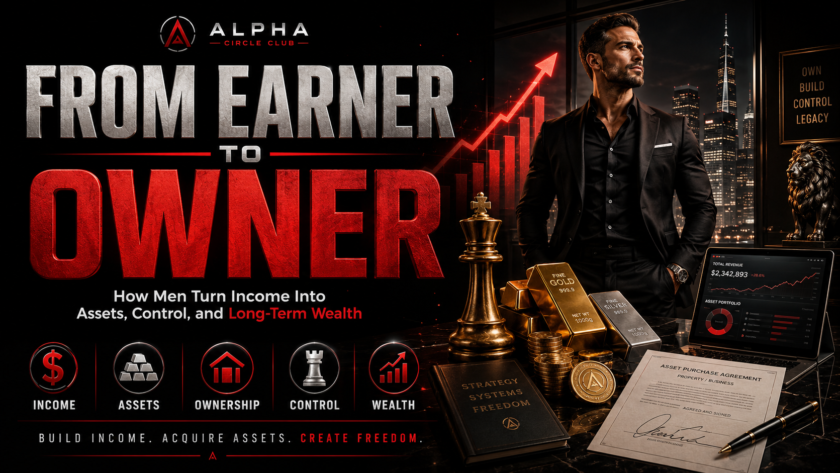
That is the shift from earner to owner.
It does not mean quitting work recklessly.
It does not mean gambling on speculative assets.
It does not mean believing every business, property, website, or investment will make money.
It means using part of today’s income to create tomorrow’s options.
Cash becomes reserves.
Skills become earning power.
Experience becomes products.
Products become intellectual property.
Profits become assets.
Assets create leverage.
Leverage creates choice.
The Alpha Wealth principle is simple:
Labour creates income. Ownership converts income into control.
Alpha Thought:
The man who only earns must keep working. The man who builds ownership begins creating options.
Quick Alpha Summary
Income and wealth are not the same thing.
Income is money flowing into a man’s life.
Wealth is what remains, grows, produces value, reduces dependence, or strengthens future control.
A high-income man may still be financially fragile if he spends everything, carries expensive debt, and owns few productive assets.
A man with a more moderate income may become financially stronger by consistently building:
- Emergency savings
- Valuable skills
- Pension assets
- Diversified investments
- A business
- Intellectual property
- Digital assets
- Property where suitable
- Systems that can continue creating value
The path from earner to owner normally begins with financial stability.
A man may need to:
- Understand his income, spending, debts, and net worth
- Build emergency reserves
- Address expensive debt
- Strengthen his earning ability
- Direct part of every month toward ownership
- Research assets carefully
- Protect what he builds
- Plan how it may eventually be transferred
Ownership does not eliminate risk.
Businesses fail.
Investments fall.
Property creates costs.
Digital products may not sell.
Intellectual property may require protection and enforcement.
The goal is not blind ownership.
It is informed, diversified, patient ownership.
Alpha Thought:
Income passes through your hands. Wealth is what your discipline prevents from disappearing.
The Difference Between Income and Wealth
Income is money received through employment, business, freelancing, investments, pensions, property, royalties, or other sources.
Wealth is the financial strength that remains after earning and spending.
That may include:
- Cash reserves
- Investments
- Pension assets
- Property equity
- Business value
- Intellectual property
- Productive skills
- Income-producing systems
- Low or manageable debt
- Financial flexibility
A man may earn £80,000 a year and spend almost all of it.
He may own an expensive car, wear premium clothing, and live in a large home.
But if his savings are weak, debt is high, and income must remain at its current level just to support the lifestyle, he may have little financial freedom.
Another man may earn £45,000.
He lives more simply.
Builds emergency savings.
Contributes to a pension.
Develops a valuable skill.
Invests consistently.
Builds a small digital product or service.
His income may look less impressive.
But his ownership may be increasing every year.
The first man has a higher income.
The second may be building a stronger financial position.
This is why wealth cannot be judged by appearance alone.
Income creates potential.
Allocation determines what that potential becomes.
A pay rise can build:
- A more expensive lifestyle
- Faster debt repayment
- Larger reserves
- Greater pension contributions
- New investments
- Business development
- Intellectual property
- Professional training
The money is the same.
The destination changes everything.
Alpha Thought:
Income creates opportunity. Ownership determines whether the opportunity survives.
The Earner Mindset vs the Owner Mindset
The earner mindset is not automatically weak.
Every owner must understand how to earn.
The problem is remaining trapped inside an earning-only pattern.
The earner asks:
- How much will I be paid?
- How many hours must I work?
- When is payday?
- Can I afford the monthly payment?
- What can I buy with this increase?
- How much overtime can I complete?
The owner asks:
- What can I build?
- What can I control?
- What produces value?
- What could grow?
- What can be sold more than once?
- What system can continue without my constant presence?
- What reduces dependence on one employer or client?
- What can be protected and transferred?
The earner often thinks mainly in monthly cash flow.
The owner also thinks in assets, systems, rights, equity, resilience, and time.
The earner may ask whether he can afford a car payment.
The owner asks what the payment prevents him from building.
The earner may celebrate a bonus by increasing consumption.
The owner may enjoy part of it while directing another part toward reserves, debt reduction, investments, or business ownership.
The strongest man combines both mindsets.
He knows how to earn.
He also knows how to retain, allocate, protect, and build.
Employment may finance the ownership journey.
A salary can pay for:
- Living expenses
- Emergency savings
- Training
- Business experiments
- Product development
- Pension contributions
- Investment
- Equipment
- Professional advice
The mission is not to despise earning.
It is to make sure decades of earning produce something that remains.
Alpha Thought:
Earning pays for the present. Ownership begins negotiating with the future.
Why Hard Work Alone Does Not Guarantee Wealth
Hard work matters.
Discipline matters.
Reliability matters.
But hard work alone does not guarantee wealth.
A man can work 60 hours a week while:
- Spending everything
- Increasing his lifestyle every year
- Carrying expensive consumer debt
- Ignoring retirement planning
- Owning no productive assets
- Avoiding investment education
- Building only someone else’s business
- Failing to protect his income
- Never calculating net worth
He may be exhausted without becoming financially stronger.
Effort creates movement.
Direction determines where the movement leads.
Imagine two men working equally hard.
The first uses every pay rise to upgrade his lifestyle.
The second directs part of every pay rise toward savings, skills, pension contributions, and ownership.
After one year, the difference may seem small.
After ten or twenty years, the direction may create two very different lives.
This does not mean everyone has equal opportunities.
Income, health, family duties, housing costs, economic conditions, discrimination, location, and unexpected emergencies all matter.
Financial progress may be slower for some men than others.
But whatever the starting position, direction still matters.
The central question is:
What is your effort building?
Only another month of consumption?
Or something your future self may still own?
Alpha Thought:
Hard work creates movement. Ownership determines whether that movement builds your future.
What Is an Asset?
An asset is something that may strengthen a man’s financial position.
Depending on the asset, it may:
- Store value
- Produce income
- Grow in value
- Reduce future costs
- Improve earning ability
- Create legal or commercial rights
- Build resilience
- Provide future options
Potential examples may include:
- Emergency cash reserves
- Pension assets
- Diversified investments
- Shares
- Bonds or savings products
- A profitable business
- Property
- A website
- A customer list
- A recognised brand
- Books
- eBooks
- Courses
- Software
- Licences
- Copyright
- Trade marks
- Professional qualifications
- Valuable skills
But the word “asset” must be used carefully.
Not everything marketed as an asset will make money.
Not everything expensive is an asset.
Not every business is valuable.
Not every property produces profit.
Not every website attracts visitors.
Not every course sells.
Not every investment rises.
Some assets require maintenance.
Some are difficult to sell.
Some are volatile.
Some are valuable only when connected to a working business.
An asset should be judged by evidence, not by the label placed on it.
Ask:
- Does it produce income?
- Could it rise or fall in value?
- What does it cost to maintain?
- Is there a real market for it?
- Can it be sold?
- Is it protected legally?
- Does it improve my earning ability?
- Does it reduce financial dependence?
- What risks are attached?
Alpha Thought:
Do not call something an asset merely because someone wants to sell it to you as one.
The Five Asset Classes of Alpha Wealth
Alpha Wealth can be built through five broad categories of assets.
They serve different purposes.
A man does not need every asset immediately.
He needs the right sequence for his circumstances.
Asset Class 1: Security Assets
Security assets protect a man from immediate financial collapse.
Examples include:
- Emergency savings
- Accessible cash reserves
- Appropriate insurance protection
- Money set aside for known future expenses
- A buffer for irregular income
These assets may not produce dramatic returns.
But they give the man time.
Time to find work.
Time to recover.
Time to compare options.
Time to reject a damaging offer.
Time to avoid expensive borrowing.
Security assets create breathing room.
They are the first wall in the financial fortress.
Asset Class 2: Skill Assets
A skill asset improves the man’s ability to create income.
Examples include:
- Sales
- Marketing
- Leadership
- Negotiation
- Technical qualifications
- Coding
- Design
- Video production
- Copywriting
- Product creation
- Project management
- Consulting
- Communication
A valuable skill may help a man:
- Earn more in employment
- Move into a stronger role
- Freelance
- Consult
- Build a service
- Create a product
- Lead a business
Skills can be among the most accessible early assets because they may require more effort than capital.
But knowledge only becomes productive when it is applied.
Asset Class 3: Financial Assets
Financial assets may include:
- Pension investments
- Diversified funds
- Shares
- Bonds
- Cash savings products
- Other regulated investments appropriate to the individual
These may help build long-term ownership.
But they carry different levels of risk.
Some can fall substantially in value.
Some may be difficult to access.
Some carry high fees.
Some may be unsuitable for short-term needs.
Financial assets should be selected according to:
- Goals
- Time horizon
- Risk tolerance
- Financial position
- Tax circumstances
- Need for access
- Professional guidance where appropriate
Asset Class 4: Business and Digital Assets
Business and digital assets may include:
- A company
- A website
- A domain name
- An email list
- A brand
- Customer systems
- Books
- eBooks
- Courses
- Software
- Memberships
- Templates
- Licensing agreements
- Recorded training
These assets may allow knowledge or systems to serve more than one customer.
But they still require:
- Demand
- Quality
- Marketing
- Maintenance
- Customer support
- Legal compliance
- Data protection
- Financial records
A digital asset is not valuable merely because it exists.
It becomes valuable when it serves a market.
Asset Class 5: Legacy Assets
Legacy assets are designed to continue beyond the man himself.
They may include:
- A business with succession planning
- Family property
- Intellectual property
- Long-term investments
- Trust or estate arrangements
- Insurance arrangements
- Organised financial records
- Knowledge passed to children
- A strong family financial culture
Legacy is more than leaving money.
It includes teaching others how to manage, protect, and build what remains.
Alpha Thought:
Security protects the present. Skills increase capacity. Ownership builds the future. Legacy extends the mission.
The First Asset Is Financial Breathing Room
Before chasing investments, property, cryptocurrency, or business expansion, many men need breathing room.
That begins with cash reserves.
An emergency fund may help cover:
- Job loss
- Reduced hours
- Urgent repairs
- Unexpected travel
- Family emergencies
- Temporary illness
- Delayed customer payments
- Essential replacements
Without reserves, every problem may become debt.
A broken appliance becomes a credit balance.
A car repair becomes an expensive loan.
A missed salary becomes panic.
A business downturn becomes desperation.
Cash does not always produce the highest return.
But accessible reserves serve a different mission.
They protect decision-making.
A man with breathing room may be able to:
- Reject an exploitative job
- Leave a dangerous situation
- Wait for a stronger client
- Avoid selling investments at the wrong time
- Handle an emergency without high-cost debt
- Take a calculated business risk
The appropriate reserve depends on circumstances.
A man with dependants, irregular income, property responsibilities, or poor job security may need more than someone with fewer commitments and strong support.
The starting target can still be modest.
One month of essential expenses may be a meaningful first milestone.
Then build further.
Alpha Thought:
Before a man builds wealth, he must build enough breathing room to stop making every decision from panic.
Expensive Debt Can Block Ownership
Debt is not automatically immoral or irresponsible.
Mortgages, education, business borrowing, and emergency debt can arise for many reasons.
But expensive consumer debt can prevent ownership.
Interest claims part of future income before it arrives.
A man may try to invest while paying far more interest on credit balances than he is likely to earn from investments.
He may feel as though he is building assets while expensive debt quietly weakens the foundation.
A strong earner-to-owner plan should therefore review:
- Credit-card balances
- Overdrafts
- Personal loans
- Buy Now Pay Later commitments
- Vehicle finance
- Missed payments
- Interest rates
- Fees
- Repayment terms
The goal is not shame.
It is sequencing.
For many men, the sequence may be:
- Maintain essential payments
- Build a basic emergency buffer
- Address expensive debt
- Strengthen reserves
- Begin or increase long-term ownership
Anyone facing serious debt should seek reputable, qualified support.
Alpha Thought:
A man cannot build freely while yesterday’s spending continues claiming tomorrow’s income.
Your Skills Are Assets—But Only When Applied
Skills can create value repeatedly.
A man may use the same capability throughout his career, business, products, and consulting work.
But unused knowledge is not yet a productive asset.
A course certificate sitting in a drawer does not automatically create income.
A skill becomes valuable when it produces results.
A man may turn a skill into:
- Better employment
- Higher pay
- Freelance work
- Consulting
- Coaching
- A service
- A digital product
- Staff training
- Licensing
- A business system
For example, a man learns email marketing.
He may use that skill to:
- Improve his employer’s sales
- Freelance for small businesses
- Sell email templates
- Create an eBook
- Record a course
- Build an agency
- Consult with companies
One skill becomes several possible layers of value.
To make a skill productive:
- Learn the fundamentals
- Practise repeatedly
- Create examples
- Apply it to real problems
- Collect evidence and results
- Improve communication
- Build a reputation
The market does not pay only for what a man knows.
It pays for what he can apply.
Alpha Thought:
Knowledge creates potential. Application converts potential into value.
Build Intellectual Property
Intellectual property can become one of the most important ownership categories for creators and digital businesses.
It may include:
- Books
- eBooks
- Courses
- Reports
- Frameworks
- Templates
- Software
- Designs
- Recorded training
- Photography
- Brand names
- Logos
- Written content
- Licensing material
Different forms of intellectual property may be protected through copyright, trade marks, patents, design rights, contracts, confidentiality, or other legal mechanisms.
Protection depends on what has been created and how it is used.
One piece of knowledge may be created once and then:
- Sold repeatedly
- Licensed
- Included in a membership
- Used in staff training
- Adapted into several products
- Translated
- Bundled
- Used to strengthen a brand
But intellectual property is not automatically profitable.
It still needs:
- Market demand
- Quality
- Clear ownership
- Protection where appropriate
- Marketing
- Distribution
- Maintenance
- Enforcement
- Good records
Creators should also understand ownership terms when work is created for an employer, client, partner, or contractor.
The person who creates something may not always own every commercial right.
Agreements matter.
Alpha Thought:
Knowledge becomes an asset when it is organised into something useful, ownable, protected, and repeatable.
Build Digital Land You Control
Social platforms are powerful tools.
But a man does not own Instagram, YouTube, TikTok, Facebook, Amazon, Etsy, or any other third-party platform.
Algorithms change.
Accounts may be restricted.
Fees rise.
Policies change.
Organic reach falls.
A business built entirely on one platform remains exposed.
Rented digital land may include:
- Social-media profiles
- Marketplace accounts
- Third-party storefronts
- Affiliate platforms
- External communities
These tools can create attention and sales.
But control remains limited.
More controlled digital assets may include:
- Your own domain
- Your own website
- Your email list
- Your customer database
- Your brand
- Your content archive
- Your community
- Your direct customer relationships
Even these assets carry risk.
Websites can lose traffic.
Email deliverability can change.
Domains must be renewed.
Customer data must be protected.
Technology requires maintenance.
But controlled systems generally give the owner a stronger relationship with the audience.
The strategic principle is:
Use platforms to attract attention.
Use owned systems to retain the relationship.
A social follower should have a path toward:
- A website
- An email list
- A customer account
- A community
- A direct relationship
Alpha Thought:
Do not build your entire future on digital land another company can change overnight.
Productive Assets vs Expensive Possessions
A possession may be enjoyable, useful, beautiful, or meaningful without being a productive asset.
A car may be essential for work.
A home may provide security.
A watch may bring enjoyment.
There is nothing wrong with owning things that improve life.
The mistake is calling every expensive purchase an investment.
Ask:
- Does it produce income?
- Could it rise or fall in value?
- What does it cost to maintain?
- Is there a real resale market?
- Does it improve earning ability?
- Is it mainly lifestyle consumption?
- Does it create debt?
- What other opportunity does the money replace?
A luxury car may create:
- Finance costs
- Insurance
- Maintenance
- Depreciation
- Fuel costs
A larger home may create:
- Mortgage costs
- Taxes or charges
- Repairs
- Utility costs
- Furnishing expenses
A watch may hold value.
Or it may lose value.
The point is not to reject possessions.
It is to classify them honestly.
A lifestyle purchase can still be worthwhile.
But it should be funded and understood as lifestyle—not disguised as wealth building.
Alpha Thought:
An object does not become an asset simply because it is expensive, desirable, or impressive.
The Ownership Percentage
One of the strongest Alpha Wealth rules is simple:
Every month, direct part of your income toward ownership.
The percentage will differ between men.
It may depend on:
- Income
- Essential expenses
- Debt
- Dependants
- Age
- Emergency savings
- Pension arrangements
- Business goals
- Housing
- Risk tolerance
Ownership contributions may include:
- Emergency savings
- Expensive-debt repayment
- Pension contributions
- Investments
- Business development
- Professional training
- Intellectual property
- Website or product development
A man should not wait until he feels wealthy.
Ownership is usually built before the feeling of wealth arrives.
Consistency matters.
A modest amount invested in skills, savings, debt reduction, or long-term assets each month can gradually change the direction of a life.
The amount may begin small.
The identity begins immediately.
The man is no longer only consuming income.
He is assigning part of it to the future.
Alpha Thought:
Ownership begins when every month is required to build something beyond consumption.
Convert Raises, Bonuses, and Side Income Into Ownership
Additional income creates an opportunity.
But it also creates temptation.
A pay rise may quickly become:
- A car upgrade
- A larger home
- New subscriptions
- More eating out
- More expensive travel
- Higher monthly commitments
The man earns more but owns no more.
Raises, bonuses, and side income can be divided intentionally.
A possible structure may include:
- A portion for tax
- A portion for emergency reserves
- A portion for debt repayment
- A portion for investments or pension contributions
- A portion for business or skill development
- A portion for enjoyment
There is no universal formula.
A man with high-cost debt may prioritise repayment.
A man with no emergency reserve may prioritise cash.
A self-employed man may need to reserve a significant amount for tax.
The core principle is:
Temporary income should not automatically create permanent expenses.
A bonus should not necessarily lead to a monthly finance agreement.
A strong side-income month should not immediately expand the lifestyle.
Additional income can accelerate ownership.
Alpha Thought:
Every increase in income should create more control—not merely more consumption.
Ownership Without Understanding Is Dangerous
Ownership sounds powerful.
But uninformed ownership can become expensive.
Men should be cautious about:
- Buying assets promoted by influencers
- Borrowing to speculate
- Concentrating everything in one investment
- Calling an unprofitable business an asset
- Ignoring fees
- Ignoring tax
- Buying property without calculating costs
- Purchasing courses without applying them
- Building products without customer demand
- Confusing revenue with profit
- Believing past returns guarantee future results
- Investing money needed soon
Before buying or building an asset, ask:
- How does this create value?
- What are the risks?
- Could I lose all the money?
- Can I access the money if needed?
- What fees apply?
- What taxes may apply?
- What does maintenance cost?
- Is it regulated?
- Who owns the legal rights?
- What evidence supports the expected return?
- Am I acting from research or fear of missing out?
Ownership creates power only when knowledge, patience, and risk control stand behind it.
Alpha Thought:
Blind ownership is not financial command. It is exposure wearing the uniform of confidence.
Liquidity Matters
An asset may be valuable but difficult to access quickly.
This is called liquidity.
Cash is highly liquid.
Property is less liquid because selling may take time and involve costs.
A private business may be valuable but difficult to sell.
A pension may be designed for later life and unavailable immediately.
A digital asset may have no buyer.
This is why a man should not place all of his wealth into assets that cannot be accessed when needed.
He may appear wealthy on paper while being unable to handle an urgent bill.
A balanced system may include:
- Accessible emergency savings
- Shorter-term savings
- Long-term investments
- Pension assets
- Business or property ownership
Different assets serve different timelines.
Alpha Thought:
An asset is less protective during an emergency when it cannot be accessed without delay, penalty, or loss.
The Asset Ladder
The Asset Ladder gives men a practical sequence.
Step 1: Stabilise
Begin with the foundation.
- Track income and spending
- List debts
- Calculate net worth
- Build a basic emergency reserve
- Address expensive debt
- Review insurance needs
- Stop unnecessary financial leakage
The objective is control.
Step 2: Strengthen Earning Power
Build capacity.
- Develop one valuable skill
- Improve primary income
- Seek stronger roles
- Negotiate pay
- Begin a suitable side service
- Build professional proof
The objective is greater financial fuel.
Step 3: Begin Ownership
Direct income toward assets.
- Strengthen emergency savings
- Contribute to a pension
- Research suitable diversified investments
- Build a website
- Create a small digital product
- Develop an email list
- Save toward larger opportunities
The objective is consistent ownership.
Step 4: Expand
Build on evidence.
- Reinvest profits
- Develop connected products
- Improve systems
- Diversify appropriately
- Add complementary assets
- Build recurring customer relationships
- Protect intellectual property
The objective is leverage.
Step 5: Protect and Transfer
Ownership must eventually be organised.
- Review insurance
- Create or update a will
- Maintain clear records
- Document passwords and accounts securely
- Consider succession
- Review beneficiaries
- Discuss estate or tax planning with qualified professionals
- Teach the next generation
The objective is continuity.
Alpha Thought:
Build in sequence: stability, capacity, ownership, leverage, protection.
The 90-Day Earner-to-Owner Reset
This reset will not make a man wealthy in 90 days.
Its purpose is to change direction.
Days 1–30: Audit
Calculate net worth
List what you own.
Examples may include:
- Cash
- Savings
- Pension assets
- Investments
- Business value
- Property equity
- Valuable commercial assets
Then list what you owe.
Subtract liabilities from assets.
The number may be uncomfortable.
It is still useful.
Track income and spending
Understand where money enters and leaves.
Identify the ownership percentage
Calculate how much of your income currently goes toward:
- Savings
- Debt reduction
- Pension contributions
- Investments
- Business assets
- Skills
Choose one asset goal
Examples:
- Build a one-month emergency reserve
- Clear one expensive debt
- Increase pension contributions
- Build an email list
- Create an eBook
- Learn a marketable skill
Days 1–30 objective: Replace financial vagueness with evidence.
Days 31–60: Build
Automate a contribution
Set up a regular transfer where appropriate.
Improve one income-producing skill
Study and practise consistently.
Create one small owned asset
Examples may include:
- A website
- A guide
- A template
- A portfolio
- A domain
- An email lead magnet
- A simple product
Reduce one damaging expense
Redirect the money toward ownership.
Organise records
Create a clear system for:
- Accounts
- Receipts
- Logins
- Contracts
- Products
- Customer records
- Intellectual property
Days 31–60 objective: Produce visible ownership.
Days 61–90: Expand
Review progress
Measure what has changed.
Reinvest suitable income
Use part of extra income to strengthen the next layer.
Build the audience
Develop website content, email subscribers, customer relationships, or professional connections.
Create a one-year asset plan
Set goals for:
- Emergency savings
- Debt reduction
- Pension contributions
- Investments
- Skills
- Business assets
- Intellectual property
Define the next stage
Do not start everything.
Choose the next logical layer.
Days 61–90 objective: Turn isolated action into a repeatable system.
Alpha Thought:
Ownership begins when part of every month is used to build something your future self may still possess.
Common Earner-to-Owner Mistakes
Waiting for a huge income
Ownership can begin with small, consistent actions.
Spending every pay rise
Higher income without ownership may only create a more expensive life.
Buying assets without research
A popular asset can still be unsuitable or overpriced.
Calling possessions investments
Lifestyle purchases should be classified honestly.
Ignoring liquidity
A man needs access to some of his resources.
Neglecting pension planning
Later-life security should not be ignored while chasing exciting assets.
Starting businesses without customers
A logo and website do not prove demand.
Refusing to track net worth
What is not measured is difficult to improve.
Overconcentrating in one asset
One company, property, cryptocurrency, or business can create dangerous exposure.
Taking excessive debt
Leverage can magnify losses as well as gains.
Chasing rapid appreciation
Fast price rises do not guarantee long-term value.
Failing to protect assets legally
Contracts, intellectual-property rights, insurance, records, and professional advice matter.
Never planning succession
An asset without organised transfer may become confusion for the family.
Alpha Thought:
The goal is not to own more things. It is to own stronger systems with greater understanding.
The Alpha Ownership Code
The entire article can be reduced to ten principles.
1. Respect income
Your earnings are the fuel.
2. Control spending
Do not allow every pound to disappear into lifestyle.
3. Build breathing room
Reserves protect decision-making.
4. Address expensive debt
Stop old consumption from consuming future income.
5. Strengthen skills
Greater capability creates greater earning potential.
6. Direct money toward ownership
Assign part of every month to the future.
7. Research before buying
Ownership without understanding is dangerous.
8. Build controlled systems
Websites, email lists, brands, and intellectual property can increase leverage.
9. Protect what you create
Use records, contracts, insurance, and appropriate legal protection.
10. Plan beyond yourself
Build assets and knowledge that can outlast your direct labour.
Final Alpha Standard
A wage can support a life.
Ownership can transform its direction.
The disciplined man respects income.
But he does not allow every pound to disappear into consumption.
He converts part of today’s work into tomorrow’s control.
Cash becomes reserves.
Skills become income.
Experience becomes products.
Products become intellectual property.
Profits become assets.
Assets create options.
Options create freedom.
The goal is not necessarily to stop working.
Meaningful work can strengthen a man.
The goal is to make sure decades of work build something that remains.
Something that protects him.
Something that gives him choices.
Something that helps his family.
Something that can continue creating value.
Something that proves he did more than earn and spend.
The Alpha standard is simple:
Earn with discipline.
Retain with intention.
Build with patience.
Own with intelligence.
Protect with foresight.
Transfer with responsibility.
Do not spend your entire life proving you can earn.
Build something that proves you learned how to own.
Final Alpha Thought:
Do not spend your entire life proving you can earn. Build something that proves you learned how to own.
Stop Only Earning. Start Building Ownership.
Alpha Wealth helps men turn discipline, skill, income, and knowledge into assets that strengthen their future.
Earn with purpose.
Own with intelligence.
Build what remains.
Financial Disclaimer
This article is provided for general educational and informational purposes only. It does not constitute personalised financial, investment, pension, tax, debt, legal, accounting, estate-planning, insurance, or business advice.
Financial circumstances, income, liabilities, goals, tax positions, investment time horizons, dependants, and attitudes to risk vary between individuals. No investment, business, property, digital product, intellectual-property asset, or wealth-building strategy is guaranteed to produce income, increase in value, or prevent financial loss.
Investments can rise or fall in value, and you may receive back less than you invest. Some higher-risk investments can result in losing all the money invested. Do not invest money required for essential living costs, emergencies, or short-term commitments.
Before investing, taking on debt, purchasing property, leaving employment, creating a business structure, licensing intellectual property, or making major pension, tax, insurance, legal, or estate-planning decisions, consider speaking with appropriately authorised and qualified professionals.
Intellectual-property ownership and protection can depend on contracts, employment status, joint authorship, commissioned work, jurisdiction, and the type of material created. Seek professional advice when ownership, licensing, trade marks, copyright, patents, or enforcement are important.
Nothing in this article is a recommendation to buy, sell, hold, finance, or invest in any particular asset, security, cryptocurrency, fund, property, company, pension product, insurance product, or business opportunity.

No spam. Unsubscribe anytime.