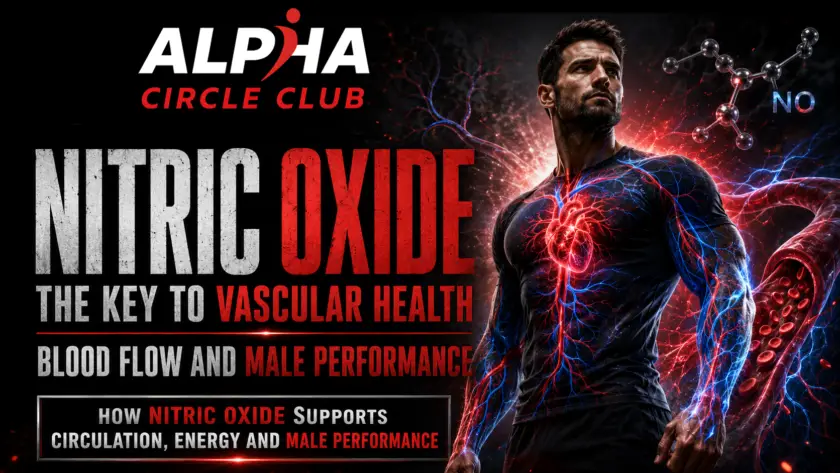
Every muscle you train, every organ you depend on and every demanding moment you face requires healthy blood flow.
At the centre of this system is a tiny signalling molecule most men rarely consider: nitric oxide.
Nitric oxide helps blood vessels relax, supports circulation and contributes to cardiovascular and erectile function. When the body’s ability to produce or use it becomes impaired, the consequences can extend far beyond a disappointing gym pump.
For the alpha man, protecting blood flow means protecting his performance, independence and long-term ability to carry out his purpose.
A strong body requires a strong circulation system. Protecting nitric oxide is not just about today’s performance—it is about preserving the blood vessels that will support you for life.
This article is for education and should not be used to diagnose or treat a medical condition. Speak to a doctor, pharmacist or other qualified healthcare professional about persistent symptoms, medicines or supplements.
1. What Is Nitric Oxide?
Nitric oxide, abbreviated as NO, is a short-lived signalling molecule naturally produced throughout the body.
Within the vascular system, cells lining the blood vessels release nitric oxide. It then sends a signal to the smooth muscle surrounding those vessels, helping the muscle relax.
As that smooth muscle relaxes, the blood vessel can widen. This process is known as vasodilation.
Vasodilation can reduce resistance inside the circulation and allow blood to move more effectively towards tissues that require oxygen and nutrients.
Nitric oxide is not the same as nitrous oxide, commonly known as laughing gas. It is also different from nitrogen dioxide and nitric acid.
Products advertised as “nitric oxide supplements” generally do not contain nitric oxide itself. Because nitric oxide is unstable and short-lived, these products usually contain compounds intended to support the body’s nitric-oxide-producing pathways, such as dietary nitrate, L-arginine or L-citrulline.
Within healthy blood vessels, nitric oxide contributes to vasodilation, vascular balance and protection against excessive inflammation, platelet activity and abnormal smooth-muscle growth.
Nitric oxide may be microscopic, but its influence reaches throughout the entire vascular system.
2. The Endothelium: The Inner Intelligence of Your Blood Vessels
The inside of every blood vessel is lined by a thin layer of cells called the endothelium.
It would be a mistake to think of this lining as passive plumbing.
The endothelium continuously senses and responds to what is happening inside the circulation. It helps influence:
- Blood-vessel constriction and relaxation
- Blood clotting
- Inflammatory activity
- Movement of substances between the bloodstream and tissues
- The response to changes in blood flow
- Growth and behaviour of vascular smooth muscle
Nitric oxide is one of the endothelium’s most important protective signals.
When endothelial function is healthy, blood vessels can respond more effectively to changing demands. They can relax when greater blood flow is needed and help maintain a balanced vascular environment.
When endothelial function deteriorates, the vessels may become less responsive. Nitric oxide production or sensitivity may fall, while constriction, inflammation and clotting tendencies increase.
This state is known as endothelial dysfunction.
Endothelial dysfunction is strongly connected with the development of cardiovascular problems, including hypertension, diabetes-related vascular damage and atherosclerotic disease.
Your vascular health therefore depends on far more than whether your arteries are currently blocked.
It also depends on how effectively their inner lining is functioning every day.
3. Nitric Oxide and Vasodilation
When endothelial cells produce nitric oxide, it moves into the surrounding smooth muscle and activates a signalling process that encourages relaxation.
This widening of the vessel can help:
- Direct blood towards active tissues
- Regulate vascular resistance
- Support blood-pressure control
- Deliver oxygen and nutrients
- Remove metabolic by-products
- Help vessels respond during physical activity
Nitric oxide also helps restrain excessive platelet activation, inflammation and vascular smooth-muscle proliferation. These functions contribute to the body’s natural defence against vascular damage.
This is why nitric oxide should not be reduced to a bodybuilding buzzword.
A temporary gym pump may be visually satisfying. But the underlying ability of your blood vessels to relax and respond effectively matters far more.
The pump lasts for part of a workout.
Vascular function matters for life.
4. Why Nitric Oxide Matters for Blood Pressure
Blood pressure is affected by several factors, including how strongly the heart pumps and how much resistance blood meets as it moves through the vessels.
If blood vessels remain excessively constricted, vascular resistance can increase.
Because nitric oxide promotes vessel relaxation, reduced nitric oxide availability can contribute to endothelial dysfunction and abnormal regulation of vascular tone. Low nitric oxide bioavailability is associated with conditions such as hypertension, diabetes, ageing and atherosclerosis.
Dietary nitrate has attracted scientific interest partly because it can enter an alternative pathway through which the body generates nitric oxide.
Research involving nitrate-rich foods and beetroot preparations has found modest improvements in blood pressure or endothelial function in some groups. However, results differ according to the population, dose, health status and study design. It is not a universal or guaranteed response.
This distinction matters.
Beetroot, leafy vegetables and other supportive foods can form part of a vascularly healthy diet.
They do not replace:
- Prescribed blood-pressure medication
- Medical assessment
- Exercise
- Weight management
- Smoking cessation
- Control of diabetes
- A balanced diet
High blood pressure frequently produces no obvious symptoms while placing additional strain on the blood vessels, heart, brain, kidneys and eyes. Knowing your blood pressure is therefore more reliable than waiting to feel that something is wrong.
Supporting nitric oxide can complement a healthy lifestyle, but it does not give a man permission to ignore high blood pressure.
5. Nitric Oxide and Exercise Performance
During exercise, working muscles require more oxygen and nutrients.
Blood flow must increase to meet this demand.
Nitric oxide contributes to the vascular response that allows vessels to relax and redistribute blood towards active tissue.
Regular exercise can also improve how the endothelium functions.
As blood moves across the endothelial lining, it creates a force known as shear stress. Appropriate increases in shear stress during regular activity can stimulate adaptations that support nitric oxide production and vascular responsiveness.
Systematic reviews have found that different forms of exercise can improve measures of endothelial function. Aerobic exercise has been studied extensively, but resistance, interval and combined exercise may also provide vascular benefits.
Dietary nitrate has also been studied in relation to the oxygen cost of exercise, endurance and physical performance.
Some individuals and exercise types may benefit more than others. Effects can depend on:
- Baseline fitness
- Training status
- The exercise being performed
- Dose and timing
- Dietary habits
- Individual nitrate metabolism
A recreationally active man may not respond in the same way as an elite athlete. A stronger pump also does not automatically prove that long-term cardiovascular health has improved.
Nitric oxide can support:
- Muscular blood flow
- Oxygen delivery
- Exercise efficiency
- Vascular adaptation
- The temporary training pump
But no nitric oxide product can replace progressive training, appropriate recovery and consistent cardiovascular conditioning.
6. Nitric Oxide and Erectile Function
An erection is a vascular event as well as a neurological, hormonal and psychological one.
During sexual arousal, nitric oxide is released from nerve endings and endothelial cells within erectile tissue.
Nitric oxide activates an enzyme that increases levels of cyclic guanosine monophosphate, commonly shortened to cGMP.
This signalling pathway relaxes smooth muscle in the penis and allows more blood to enter the erectile tissue. As blood fills that tissue, the penis becomes firm.
Nitric oxide is therefore a central chemical mediator of normal erectile function.
However, erectile difficulties should not automatically be blamed on “low nitric oxide”.
Erectile dysfunction can be influenced by:
- Cardiovascular disease
- High blood pressure
- High cholesterol
- Diabetes
- Smoking
- Neurological conditions
- Hormonal problems
- Medicines
- Alcohol
- Stress
- Anxiety
- Depression
- Relationship difficulties
- Pelvic injury or surgery
Occasional erection difficulties can occur because of stress, tiredness or alcohol. Persistent problems deserve medical assessment because they may have a treatable underlying cause.
A man should not feel ashamed to discuss erectile function with his GP.
The penis is connected to the same wider vascular system supplying the heart, brain and other organs. Persistent erectile dysfunction can sometimes provide an early warning that cardiovascular risk deserves closer attention.
Erectile performance is not a complete test of vascular health, but persistent changes should not be covered up with supplements and ignored.
7. Blood Flow Is a Whole-Body Issue
Nitric oxide conversations often focus on the gym or sexual performance.
Those areas matter, but they represent only part of the picture.
Blood vessels supply:
- The heart
- The brain
- The kidneys
- The muscles
- The reproductive organs
- The digestive system
- The skin
- Every living tissue in the body
Every cell depends on circulation to deliver oxygen and nutrients while carrying away carbon dioxide and metabolic waste.
Nitric oxide helps regulate vascular tone and maintain a healthier relationship between blood, the endothelium and the smooth muscle surrounding the vessels.
This gives men a much stronger reason to care about vascular health.
Healthy circulation supports your ability to:
- Think clearly
- Train effectively
- Work productively
- Recover from exertion
- Maintain sexual function
- Remain physically independent
- Carry greater responsibility as you age
Blood-flow health is whole-body health.
8. Why Nitric Oxide Availability Can Decline
The body may produce nitric oxide, but that does not mean it will always remain available in sufficient amounts.
Nitric oxide availability can decline when:
- The endothelium produces less of it
- The enzymes involved become dysfunctional
- Oxidative stress destroys nitric oxide rapidly
- Vascular disease makes vessels less responsive
- Metabolic disease damages endothelial function
Important contributors include:
- Ageing
- Smoking
- High blood pressure
- Diabetes
- Poor metabolic health
- Physical inactivity
- Chronic inflammation
- Oxidative stress
- Established cardiovascular disease
Oxidative stress is particularly important because reactive oxygen species can react with nitric oxide, reducing its availability and producing further damaging compounds.
Under unhealthy conditions, endothelial nitric oxide synthase can also become “uncoupled”. Instead of efficiently producing nitric oxide, the enzyme begins generating more oxidative stress, creating a damaging cycle.
Ageing can increase the challenge, but age is not the only factor controlling vascular health.
Daily behaviour continues to matter.
A man cannot choose his age, but he can influence:
- Whether he smokes
- How physically active he remains
- What he eats
- Whether he manages high blood pressure
- Whether he addresses diabetes
- Whether he follows medical treatment
- Whether he spends most of the day sitting
Age may change the vascular challenge, but your habits still influence the environment in which your blood vessels must operate.
9. The Body’s Two Main Nitric Oxide Pathways
The body has more than one way to generate nitric oxide.
Understanding the two main pathways helps explain why vascular health, exercise, food and oral bacteria are all connected.
The L-arginine–eNOS pathway
Inside endothelial cells, an enzyme called endothelial nitric oxide synthase, or eNOS, helps produce nitric oxide from the amino acid L-arginine.
This is an oxygen-dependent process that also requires several cofactors.
Its effectiveness is influenced by:
- Endothelial health
- Blood flow
- Oxidative stress
- Metabolic health
- Enzyme function
- Availability of required substrates and cofactors
When the endothelium becomes dysfunctional, eNOS activity can decline or become uncoupled, reducing effective nitric oxide production.
The nitrate–nitrite–nitric oxide pathway
The second major pathway begins with nitrate.
Dietary nitrate is absorbed into the circulation. Some is then concentrated in saliva, where nitrate-reducing bacteria in the mouth convert it into nitrite.
After the nitrite is swallowed, it can be converted further into nitric oxide and other nitrogen-related compounds.
This pathway may become particularly useful in low-oxygen or acidic environments where the traditional eNOS pathway may be less effective.
Nitric oxide production is therefore connected with:
- Vascular health
- Nutrition
- Exercise
- Metabolism
- Saliva
- Oral bacteria
It is a whole-system process—not a switch that can be permanently turned on by taking one supplement.
10. Foods That Support the Nitrate–Nitric Oxide Pathway
Vegetables are among the most important dietary sources of nitrate.
Common nitrate-rich choices include:
- Beetroot
- Rocket
- Spinach
- Lettuce
- Celery
- Chard
- Other leafy green vegetables
The nitrate content of food can vary according to the soil, season, farming methods, storage and preparation.
Once eaten, dietary nitrate can enter the nitrate–nitrite–nitric oxide pathway.
Research has linked nitrate-rich dietary interventions with potential improvements in blood pressure, endothelial function and certain measures of exercise performance. The size and reliability of the benefit are not identical in every population.
These vegetables also provide other useful nutrients and plant compounds, making them a better foundation than relying solely on a highly marketed pre-workout product.
A practical approach could include:
- Adding rocket or spinach to meals
- Eating a variety of leafy vegetables
- Including beetroot as part of a balanced diet
- Choosing minimally processed foods more often
- Combining vegetables with protein, healthy fats and high-fibre carbohydrates
A daily beetroot drink cannot erase the effects of smoking, inactivity, poor sleep, uncontrolled blood pressure or a consistently poor diet.
You cannot supplement your way out of habits that repeatedly damage your vascular system.
11. Exercise: One of the Strongest Natural Vascular Signals
One of the most effective ways to support endothelial function is to use the vascular system regularly.
Exercise increases blood flow.
Increased blood flow raises shear stress across the endothelial lining.
Over time, this can stimulate beneficial adaptations involving nitric oxide production, antioxidant defence and vascular responsiveness.
A balanced approach can include:
- Regular walking
- Moderate aerobic exercise
- Resistance training
- Shorter periods of higher-intensity work where appropriate
- Breaking up long periods of sitting
- Gradually increasing fitness
Research suggests that several exercise modalities can improve endothelial function. Regularity appears more important than constantly searching for one supposedly perfect method.
This is an important Alpha Circle Club principle:
The man who completes three or four sustainable sessions each week for years may do more for his vascular future than the man who occasionally destroys himself in the gym and repeatedly quits.
Consistency creates adaptation.
Extremes create exhaustion.
12. Smoking Is an Attack on Endothelial Function
Smoking is one of the most destructive habits for vascular health.
Cigarette smoke increases oxidative stress, promotes inflammation and reduces nitric oxide availability. It contributes to endothelial dysfunction, atherosclerosis and greater cardiovascular risk.
Research also raises concerns that newer tobacco and nicotine products should not automatically be treated as harmless to endothelial function simply because they differ from conventional cigarettes.
The damage may develop before the man experiences a dramatic symptom.
This is what makes vascular risk dangerous.
A man may still train.
Still work.
Still appear healthy.
But the internal environment of his arteries may already be changing.
A habit that repeatedly damages the blood vessels cannot be called harmless simply because its consequences are not immediately visible.
Stopping smoking can be difficult. Men who need help should use evidence-based stop-smoking support rather than treating every failed attempt as proof they cannot quit.
13. The Surprising Role of Oral Bacteria
The mouth is part of the nitric oxide story.
Certain bacteria living on the tongue help convert nitrate into nitrite. Without this bacterial stage, the nitrate–nitrite–nitric oxide pathway becomes less effective.
This does not mean all oral bacteria are beneficial or that men should neglect dental hygiene.
Periodontal disease and poor oral health carry their own risks.
The important point is that the oral microbiome contains communities with different functions. Completely disrupting those communities may influence nitrate metabolism.
Studies have examined whether frequent use of strong antiseptic mouthwash reduces nitrate-converting bacteria and affects circulating nitrite or blood pressure. Evidence suggests that antiseptic rinses can suppress parts of the pathway, although the real-world health importance may vary according to the product, frequency and person.
This is not a reason to stop using a mouthwash prescribed or recommended by a dentist.
A responsible standard is:
- Maintain good dental hygiene.
- Brush and floss appropriately.
- Follow professional dental advice.
- Use medicated mouthwash as directed.
- Avoid assuming that more antiseptic use is automatically better.
- Do not sacrifice oral health in an attempt to manipulate nitric oxide.
The correct lesson is not “mouthwash is bad”.
The lesson is that human biology is connected in ways that simple health slogans often miss.
14. Nitric Oxide Supplements: Support, Not Magic
Products marketed as nitric oxide boosters commonly contain:
- Beetroot powder or juice
- Dietary nitrate
- L-arginine
- L-citrulline
- Watermelon extracts
- Plant compounds
- Vitamins or antioxidants
- Pre-workout stimulants
L-arginine is used directly in the eNOS pathway.
L-citrulline can be converted into L-arginine and may increase circulating arginine more effectively in some circumstances.
Research has found potential vascular or blood-pressure benefits from arginine and citrulline supplementation in selected populations, but effects vary. The results of one trial involving people with hypertension, endothelial dysfunction or another condition should not automatically be applied to every healthy man.
Men should reject several common assumptions:
“A stronger pump proves my arteries are healthy.”
A pump is an acute response. It is not a cardiovascular examination.
“More nitric oxide must always be better.”
Biological signalling depends on balance. Excessive or poorly controlled nitric oxide activity can have harmful effects in some disease processes.
“A supplement can replace cardio.”
No powder can reproduce the full-body adaptations created by regular movement and training.
“Beetroot can replace my blood-pressure medicine.”
It cannot. Never change prescribed treatment without speaking to the prescriber.
“A nitric oxide booster will cure erectile dysfunction.”
Erectile dysfunction has multiple possible causes. Persistent problems require assessment.
“Natural means interaction-free.”
Natural products can affect blood pressure, interact with medicines and create side effects.
Build the foundation first:
- Exercise
- Vegetables
- Sleep
- Weight management
- Smoking cessation
- Blood-pressure control
- Treatment of medical conditions
Supplements should remain optional support—not the centre of the strategy.
15. Important Medication Safety
Men must be particularly careful when combining medicines or supplements intended to affect blood flow.
Prescription nitrate medicines are commonly used to prevent or treat angina. Examples can include glyceryl trinitrate and isosorbide medicines.
Sildenafil and related erectile-dysfunction medicines strengthen the cGMP pathway influenced by nitric oxide.
Combining sildenafil with nitrate medicines can produce a dangerous fall in blood pressure. The NHS warns that men taking nitrates for chest pain should not take sildenafil unless specifically cleared by an appropriate healthcare professional.
This is not the same situation as eating vegetables that naturally contain nitrate. However, nitrate-rich foods, concentrated products, supplements and medicines should never be treated as interchangeable.
Speak to a doctor or pharmacist before using a blood-flow supplement when you:
- Take blood-pressure medicine
- Use nitrate medicine
- Take erectile-dysfunction medicine
- Have low blood pressure
- Have heart disease
- Have recently experienced a heart attack or stroke
- Take several medicines
- Have a chronic medical condition
Never experiment with erectile-dysfunction drugs, nitrate medicines or multiple blood-flow products without checking for dangerous interactions.
16. Do Not Self-Diagnose “Low Nitric Oxide”
There is no simple list of symptoms that allows a man to diagnose himself with low nitric oxide.
Symptoms often promoted online—such as fatigue, cold hands, erection difficulties, poor exercise performance or brain fog—can have many different explanations.
These may include:
- Anaemia
- Thyroid problems
- Cardiovascular disease
- Diabetes
- Medication effects
- Low fitness
- Sleep problems
- Stress
- Anxiety
- Hormonal conditions
- Poor nutrition
- Neurological problems
Treating every symptom as “low nitric oxide” can delay the correct diagnosis.
Seek medical assessment when:
- Erectile problems keep happening
- Blood-pressure readings remain high
- Exercise tolerance declines significantly
- Breathlessness is unexplained
- Leg pain repeatedly develops while walking
- You experience fainting or severe dizziness
Recurring leg pain during exercise can be associated with peripheral arterial disease and should be discussed with a GP.
Sudden chest pain or discomfort that does not go away can be an emergency. NHS guidance advises calling 999 for sudden persistent chest pain or pressure.
Do not attempt to cover a warning sign with beetroot juice, arginine, citrulline or an erectile-dysfunction product.
Find the cause.
17. The Alpha Vascular Health Framework
Use this practical standard to support your vascular future:
MOVE → NOURISH → PROTECT → MEASURE → RESPOND
Move
Use your cardiovascular system regularly.
Walk.
Train.
Lift weights.
Improve aerobic fitness.
Break up prolonged sitting.
Build a routine that can survive beyond the first burst of motivation.
Nourish
Base your diet around minimally processed foods.
Include:
- Leafy green vegetables
- Beetroot
- Fruit
- Legumes
- Whole grains where tolerated
- Nuts and seeds
- Appropriate protein sources
- Healthy unsaturated fats
Think in terms of the entire dietary pattern—not one “superfood”.
Protect
Stop attacking your endothelium.
Avoid smoking.
Manage stress.
Prioritise sleep.
Follow treatment for blood pressure, diabetes, cholesterol and other medical conditions.
Do not assume that feeling healthy means every internal marker is normal.
Measure
Know the numbers that matter.
Depending on your age and circumstances, these may include:
- Blood pressure
- Waist measurement
- Body weight
- Blood glucose or HbA1c
- Cholesterol
- Fitness level
- Resting heart rate
A man cannot manage every aspect of health through numbers, but he should not ignore measurable risks.
Respond
Take persistent symptoms seriously.
Do not ignore repeated erectile difficulties, high blood pressure, chest discomfort, unexplained breathlessness or recurring leg pain during walking.
Do not let embarrassment prevent assessment.
The earlier a genuine problem is recognised, the more opportunity there may be to address it.
Vascular-Strength Mindset vs Quick-Fix Mindset
| Vascular-strength mindset | Quick-fix mindset |
|---|---|
| Builds health through daily habits | Searches for one miracle supplement |
| Exercises consistently | Depends on occasional extreme workouts |
| Eats nitrate-rich vegetables | Believes one drink fixes a poor diet |
| Monitors blood pressure | Waits for obvious symptoms |
| Protects endothelial health | Thinks only about the gym pump |
| Stops smoking | Tries to offset smoking with supplements |
| Seeks help for persistent symptoms | Self-diagnoses low nitric oxide |
| Checks medicine interactions | Assumes natural means harmless |
| Thinks in decades | Chases immediate sensations |
Final Thoughts
Your blood vessels are carrying life to every part of your body.
Every workout, every erection, every heartbeat and every demanding moment depends on an effective circulation system.
Nitric oxide is not a magic shortcut.
It is part of a complex vascular network influenced by how you train, eat, sleep, age and live.
Move your body.
Protect your endothelium.
Eat vegetables that support the nitrate–nitrite–nitric oxide pathway.
Stop attacking your circulation with smoking and inactivity.
Know your blood pressure.
Follow necessary treatment.
Check medicine interactions.
Take warning signs seriously.
The man who protects his blood flow is not only protecting today’s performance.
He is protecting the strength, independence and capability he will require in the decades ahead.
Protect your nitric oxide, strengthen your circulation, and build a body capable of carrying your purpose for life.



No spam. Unsubscribe anytime.