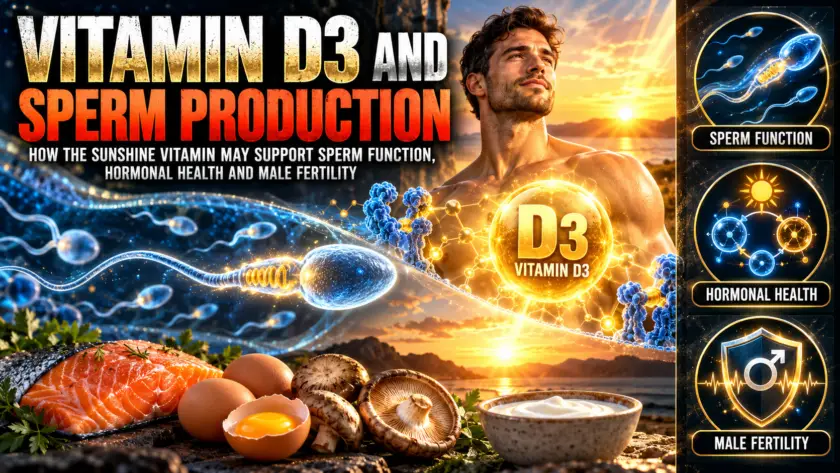
How the Sunshine Vitamin May Support Sperm Function, Hormonal Health and Male Fertility
Vitamin D3 is often called the sunshine vitamin, but its influence may reach further than bones, muscles and immunity.
Scientists have identified vitamin D receptors and vitamin D-metabolising enzymes within the male reproductive system, including the testes, reproductive tract and sperm themselves. These discoveries have created growing interest in the relationship between Vitamin D3 and sperm production.
Could low vitamin D weaken the environment in which sperm develop? Could correcting a deficiency support sperm movement, function or hormonal health? Could vitamin D3 become an important part of a man’s fertility strategy?
The emerging evidence provides reasons for men to protect their vitamin D status—but not reasons to believe exaggerated promises.
Some human studies have connected adequate vitamin D with healthier semen measurements. Several supplementation trials have reported possible improvements in sperm motility or other parameters. Other trials have found little or no benefit. Most importantly, current evidence has not proved that taking vitamin D3 will automatically increase sperm production, achieve conception or produce a live birth.
That does not make vitamin D3 unimportant.
It makes accuracy important.
Vitamin D3 deserves a place within the complete male-fertility foundation: appropriate nutrition, responsible sunlight exposure, sensible supplementation, sleep, exercise, metabolic health, protection from reproductive risks and professional investigation when conception becomes difficult.
The objective is not to force vitamin D levels as high as possible. The objective is to prevent avoidable inadequacy, correct genuine deficiency appropriately and give the body a stronger environment in which normal reproductive function can take place.
Vitamin D3 may help support the biological environment in which sperm develop and function—but one vitamin cannot carry the entire weight of a man’s fertility.
1. Vitamin D3 Is More Than a Bone Vitamin
Most people learn about vitamin D through one message: it helps maintain healthy bones.
That message is correct, but incomplete.
Vitamin D helps regulate calcium and phosphate in the body. These minerals are necessary for healthy bones, teeth and muscles. A serious lack of vitamin D can contribute to osteomalacia in adults, which may cause bone pain and weakness. NHS: Vitamin D
Vitamin D also participates in wider cellular signalling. Vitamin D receptors have been found in many tissues, allowing the active form of the vitamin to influence gene expression and biological activity.
This matters to male fertility because the reproductive system does not work independently from the rest of the body.
The testes require healthy tissue, blood supply, hormonal signalling, cellular energy and adequate nutrition. Developing sperm must divide, organise their genetic material and construct specialised structures. Mature sperm must regulate ions, produce energy, move forward and respond to the female reproductive environment.
Vitamin D3 does not perform all these tasks by itself. No single nutrient does. But it may influence parts of the cellular environment in which those tasks occur.
The most useful question is therefore not:
“Will vitamin D3 make me fertile?”
The better questions are:
- Am I maintaining adequate vitamin D status?
- Am I at greater risk of deficiency?
- Does my current supplement match recognised guidance?
- Am I using several products that contain vitamin D without realising it?
- Do I have symptoms, medical conditions or fertility concerns that require professional assessment?
A man who asks better questions makes better decisions. He stops looking for a miracle and starts strengthening the foundations.
Alpha Fertility Insight
A nutrient does not need to be a fertility treatment to contribute to the biological foundations on which fertility depends.
2. What Is Vitamin D3?
Vitamin D is a fat-soluble vitamin found mainly in two forms:
- Vitamin D2, also called ergocalciferol
- Vitamin D3, also called cholecalciferol
Vitamin D2 commonly comes from plant, fungal or fortified sources. Vitamin D3 can be produced in human skin when suitable ultraviolet-B radiation reaches it. D3 is also found in certain animal-derived foods and is widely used in supplements.
Both forms can increase vitamin D status. Evidence reviewed by the US National Institutes of Health suggests that D3 may raise and maintain blood vitamin D concentrations more effectively than D2 in some circumstances. That does not make D3 a specialised fertility drug; it makes it a practical and common form of supplementation. NIH Office of Dietary Supplements: Vitamin D
Vitamin D must be activated
Vitamin D entering the body is not immediately in its final active form.
It first undergoes processing, primarily in the liver, to form 25-hydroxyvitamin D, written as 25(OH)D. This is the main marker measured when vitamin D status is assessed through a blood test.
Further conversion—mainly in the kidneys but also within some other tissues—produces the active hormone-like form known as 1,25-dihydroxyvitamin D or calcitriol.
This activation pathway explains why vitamin D biology can be affected by more than intake. Absorption, liver function, kidney function, body composition, medicines and other health factors may all influence the wider picture.
Why D3 appears in this article’s title
The phrase Vitamin D3 and sperm production is useful because D3 is the form many men see on supplement labels. However, the research literature often measures total vitamin D status through 25(OH)D or studies vitamin D supplementation more generally.
Men should not assume that the word “D3” automatically means:
- Better sperm
- Higher testosterone
- Improved pregnancy chances
- A superior fertility result
- Permission to take a large dose
D3 is a nutrient form. Its effect depends on need, dose, duration, baseline status, wider health and the cause of any fertility problem.
Alpha Fertility Insight
Understand what enters your body before expecting it to change what your body produces.
3. Why Scientists Are Studying Vitamin D and Male Fertility
Researchers did not become interested in vitamin D and male reproduction simply because supplement companies needed a new claim.
They found biological reasons to investigate.
A landmark human study reported vitamin D receptors and vitamin D-metabolising enzymes in the testes, epididymis, prostate, seminal vesicles and mature sperm. Their presence suggests that male reproductive tissues may be capable of responding to vitamin D activity. PubMed: Vitamin D receptors in the male reproductive tract
Later research has continued to examine possible relationships involving:
- Sperm formation
- Sperm concentration
- Motility
- Morphology
- Calcium movement within sperm
- Capacitation
- The acrosome reaction
- Reproductive hormones
- Fertilisation and pregnancy outcomes
Receptors do not prove treatment benefit
The presence of a receptor is important, but it does not establish that extra supplementation will improve fertility.
Imagine finding a keyhole in a machine. Its presence suggests that a key may regulate something important. It does not tell you that repeatedly forcing additional keys into the machine will make it operate faster.
The body is regulated. When vitamin D status is inadequate, restoring sufficiency may help normal processes. When status is already adequate, adding substantially more may provide no fertility benefit and can eventually cause harm.
Animal and laboratory findings require human confirmation
Animal experiments and laboratory studies have helped scientists investigate mechanisms. They can show what might be biologically possible, but they cannot reproduce the complete circumstances of a man attempting conception with a partner.
Human fertility depends on both partners, intercourse timing, age, reproductive anatomy, egg quality, sperm quality and many other factors. A sperm cell responding to vitamin D in a laboratory dish is not the same as a clinical trial showing more healthy babies.
The scientific pathway should be respected:
- Identify a plausible mechanism.
- Observe associations in people.
- Test supplementation in controlled trials.
- Measure semen and hormonal changes.
- Determine whether pregnancy and live-birth outcomes improve.
Vitamin D research has progressed through several of these stages, but the final clinical answer remains incomplete.
Alpha Fertility Insight
A biological connection creates a reason to investigate—not permission to promise a result.
4. Vitamin D3 and Sperm Production
Sperm production—spermatogenesis—is a long and highly organised process.
Inside the seminiferous tubules of the testes, germ cells divide and develop through multiple stages. They must reduce their chromosome number, reshape the nucleus, package genetic material and construct the head, midpiece and tail.
Supporting Sertoli cells help nurture developing sperm. Leydig cells produce testosterone in response to hormonal signals. After leaving the testes, sperm continue to mature within the epididymis before ejaculation.
This entire system requires:
- Healthy testicular tissue
- Appropriate testosterone within the testes
- Follicle-stimulating hormone and luteinising hormone signalling
- Cell division and DNA organisation
- Protein and membrane production
- Energy
- Adequate micronutrients
- A suitable temperature
- Protection from toxins and damaging exposures
Where vitamin D3 may fit
Vitamin D receptors in reproductive tissues suggest that vitamin D may contribute to cellular regulation within this system. Researchers have examined possible connections with testicular function, sperm development and hormone activity.
However, human supplementation trials have not consistently shown that vitamin D3 increases total sperm count or concentration.
This distinction is essential:
- Biological relevance means vitamin D participates in systems connected with reproduction.
- Nutritional sufficiency means the body has enough vitamin D to support normal health.
- Deficiency correction means restoring an inadequate level under appropriate guidance.
- Fertility treatment means an intervention has been shown to improve meaningful reproductive outcomes.
These are not interchangeable claims.
A man with low vitamin D may have a valid reason to correct it. A man with an adequate level should not assume that doubling or tripling his supplement will make the testes produce more sperm.
Production cannot be separated from the whole body
Vitamin D status may also reflect wider health patterns. Men who spend little time outdoors, have obesity, eat a limited diet or live with chronic illness may have several overlapping fertility risks.
When an observational study finds lower vitamin D alongside poorer semen quality, vitamin D may be one part of the explanation—or simply one marker of a larger health pattern.
This is why controlled trials matter. They help determine whether changing vitamin D itself changes the outcome.
Alpha Fertility Insight
Vitamin D3 may support the environment in which sperm are produced, but one nutrient cannot command the entire production line.
5. The Stronger Connection May Be Sperm Function
Producing sperm is only the beginning. Sperm must also function.
A semen analysis commonly assesses several measurements, including sperm concentration, total count, motility and morphology. These values describe different parts of sperm health.
Total motility
Total motility refers to the proportion of sperm showing movement of any kind.
Progressive motility
Progressive motility refers to sperm moving forward effectively. A sperm that vibrates without useful forward progress is moving, but it may not travel through the reproductive tract as efficiently.
Morphology
Morphology evaluates sperm shape according to laboratory criteria. Abnormal morphology does not make natural conception impossible, and morphology should never be interpreted in isolation.
Why calcium signalling matters
Calcium is important to sperm behaviour. Changes in calcium inside sperm contribute to motility, capacitation and the acrosome reaction.
Capacitation describes functional changes sperm undergo within the female reproductive tract before they become capable of fertilising an egg.
The acrosome reaction involves the release of enzymes from a cap-like structure on the sperm head, helping the sperm interact with the egg’s protective layers.
Vitamin D is deeply connected with calcium regulation throughout the body. Laboratory research has therefore investigated whether vitamin D can influence calcium movement within sperm and affect aspects of motility or function.
Why motility findings deserve cautious optimism
Some supplementation studies and pooled analyses have found improvements in total or progressive motility. This is encouraging, particularly because movement is essential to normal sperm function.
But three limits must remain visible:
- Study populations, doses and treatment durations differ.
- A statistically significant change may not always be large enough to transform an individual man’s fertility.
- Improved motility does not guarantee fertilisation, pregnancy or live birth.
Sperm function is a chain. Vitamin D may influence one link, while infection, varicocele, genetic factors, oxidative damage or female-partner factors influence others.
Alpha Fertility Insight
Producing more sperm and producing sperm capable of functioning effectively are related—but they are not the same objective.
6. What Human Research Actually Shows
The relationship between Vitamin D3 and sperm production cannot be summarised honestly with either “it works” or “it does nothing.”
The evidence is mixed.
Observational studies
Many observational studies have measured vitamin D status and compared it with semen parameters. Some have found that men with adequate or higher vitamin D levels tend to have better motility, concentration or other reproductive measurements.
These findings can identify a relationship, but they cannot prove cause.
Men with adequate vitamin D might also:
- Spend more time outdoors
- Exercise more regularly
- Have a healthier body weight
- Eat a more varied diet
- Experience fewer chronic health problems
- Differ in age, season, location or socioeconomic circumstances
Any of these differences could influence the result.
Randomised trials
Randomised controlled trials provide stronger evidence because participants receive vitamin D or a comparison treatment by chance. Even here, results have not been completely consistent.
Some trials have reported improvements in motility, morphology, concentration or semen volume. Others have found no significant changes in major semen measurements.
Differences may be influenced by:
- Baseline vitamin D status
- Cause and severity of infertility
- Supplement dose
- Treatment duration
- Concurrent calcium or other supplements
- Sample size
- Seasonal changes
- Different laboratory methods
- Natural semen variation
The 2023 meta-analysis
A systematic review and meta-analysis published in 2023 pooled five randomised trials involving 648 infertile or subfertile men.
It found that vitamin D supplementation was associated with improvements in:
- Total sperm motility
- Progressive sperm motility
- Normal morphology
It did not find statistically significant improvements in:
- Total sperm count
- Sperm concentration
- Semen volume
The motility analyses also showed substantial variation between studies, which means the size and reliability of the effect should be interpreted cautiously. The authors called for larger trials. Systematic review: Vitamin D supplementation and sperm parameters
The broader 2026 review
A 2026 systematic review and meta-analysis included eleven studies—eight randomised trials and three observational studies—with 1,168 infertile men.
It reported modest average improvements in selected measurements, including semen volume, sperm concentration, progressive motility and testosterone. However, it found no significant improvement in clinical pregnancy or live-birth rates. The studies differed substantially, and several results were strongly influenced by individual trials. The authors concluded that the evidence remained insufficient to confirm a clinical fertility benefit. Systematic review: Vitamin D supplementation in infertile men
What this means for men
The evidence supports several responsible conclusions:
- Vitamin D is biologically relevant to the male reproductive system.
- Deficiency should not be ignored.
- Supplementation may improve selected semen parameters in some infertile men.
- The most consistent positive signal may involve progressive motility.
- Evidence for increasing sperm count remains inconsistent.
- Better semen measurements do not yet equal proven improvements in pregnancy or live birth.
- Routine high-dose vitamin D should not be promoted as a universal fertility treatment.
This is not a reason to dismiss vitamin D. It is a reason to use it intelligently.
Alpha Fertility Insight
Protecting sufficiency is sensible. Promising conception from a supplement goes far beyond what the evidence can support.
7. Vitamin D Deficiency May Be the Real Issue
The fertility conversation should begin with deficiency—not optimisation theatre.
A deficient man does not need a heroic dose chosen through guesswork. He needs the deficiency identified, its possible causes considered and an appropriate correction plan.
Who may be at greater risk?
Risk can be higher in men who:
- Spend little or no time outdoors
- Work indoors throughout most daylight hours
- Are housebound
- Wear clothing that covers most of the skin
- Have darker skin, which generally requires more ultraviolet exposure to produce the same amount of vitamin D
- Have gastrointestinal conditions that reduce nutrient absorption
- Have undergone certain types of bariatric surgery
- Live with liver or kidney disease
- Have obesity
- Take medicines that influence vitamin D metabolism
- Follow a highly restricted diet
- Live in northern locations with limited winter ultraviolet-B exposure
Deficiency can be silent
Some men with inadequate vitamin D experience no obvious symptoms. Others may notice tiredness, muscle weakness or discomfort—but these symptoms are non-specific.
Fatigue may also arise from:
- Poor sleep
- Anaemia
- Thyroid disease
- Depression or anxiety
- Infection
- Under-eating
- Overtraining
- Diabetes
- Medication
- Many other medical causes
A symptom can justify investigation. It cannot prove the diagnosis.
Correcting deficiency is not the same as chasing excess
The body requires enough vitamin D. It does not require an endlessly rising blood concentration.
When a genuine deficiency is corrected, normal biological systems may function better. Once adequacy is reached, increasing the dose may offer no further fertility benefit.
The 2026 fertility review found no evidence that doses above 4,000 IU per day provided additional clinical benefit. This does not mean 4,000 IU is an appropriate daily target; it reinforces that more was not better. Systematic review: Vitamin D supplementation in infertile men
Alpha Fertility Insight
Do not diagnose deficiency through tiredness or social-media checklists. When status matters, use appropriate testing and professional interpretation.
8. Test Before Using High Doses
Vitamin D status is usually assessed using a blood test for 25-hydroxyvitamin D—25(OH)D.
This marker reflects vitamin D derived from sunlight, food and supplements. It is generally more useful for assessing status than the active form, which is tightly regulated and may remain normal until deficiency becomes severe.
When testing may be appropriate
A healthcare professional may consider testing when a man:
- Has recognised deficiency risk factors
- Has symptoms or a health condition requiring assessment
- Previously had a low result
- Has a condition affecting absorption
- Has kidney, liver, bone or parathyroid disease
- Is considering or already using high-dose supplementation
- Has fertility difficulties alongside possible deficiency
- Requires monitoring during prescribed deficiency treatment
Routine testing is not necessary for every healthy man taking the standard UK autumn-and-winter dose. Testing decisions depend on clinical circumstances and local guidance.
A number needs interpretation
Laboratories may use nanomoles per litre—nmol/L—or nanograms per millilitre—ng/mL. Reference ranges and treatment thresholds can differ between organisations and clinical situations.
The US National Institutes of Health also notes that vitamin D assays can vary between laboratories. A result should therefore be interpreted alongside:
- The laboratory’s range
- Symptoms
- Medical history
- Season
- Current dose
- Duration of supplementation
- Kidney and liver health
- Calcium levels when relevant
- The reason the test was ordered
Do not test repeatedly without purpose
Frequent private testing can become another form of anxiety. A man may start reacting to small numerical changes that have no meaningful effect on his health or fertility.
Testing should answer a question:
- Am I deficient?
- Is the prescribed correction working?
- Is my dose safe?
- Does my medical condition require monitoring?
If the answer will not alter action, the test may add little value.
Alpha Fertility Insight
Do not chase a laboratory number without understanding what it means, why it was measured and what action it genuinely requires.
9. Obtain Sunlight Responsibly
Human skin can produce vitamin D3 when exposed to appropriate ultraviolet-B radiation from sunlight.
That sounds simple, but production varies considerably.
Factors include:
- Season
- Time of day
- Latitude
- Cloud and atmospheric conditions
- Skin pigmentation
- Age
- Clothing
- Time spent outside
- Amount of skin exposed
- Sunscreen use
The UK seasonal reality
The NHS states that most people in the UK can usually make the vitamin D they need from sunlight between late March or early April and the end of September.
Between October and early March, sunlight generally does not contain enough ultraviolet-B radiation for reliable vitamin D production. This is why UK guidance recommends considering a daily supplement during autumn and winter. NHS: Vitamin D
Do not prescribe yourself a precise number of minutes
There is no single safe exposure time suitable for every man. Skin that burns easily requires different protection from skin with more melanin. Location, season and time of day alter ultraviolet intensity.
A rigid online instruction such as “spend twenty minutes unprotected in the sun” ignores these differences.
Sunburn is never a fertility strategy
Vitamin D production does not justify burning the skin. Excess ultraviolet exposure increases skin-damage and skin-cancer risk.
Enjoy outdoor activity sensibly. Follow sun-safety guidance. Use food and recommended supplements during months when sunlight is insufficient rather than attempting to compensate through unsafe exposure.
Movement outdoors has wider value
Walking, exercising or spending time outside can support:
- Physical activity
- Cardiovascular health
- Body-weight management
- Sleep timing
- Stress reduction
- General wellbeing
These benefits matter to a fertility-supportive lifestyle even when the sunlight is not strong enough to produce much vitamin D.
Alpha Fertility Insight
Sunlight can support vitamin D production, but damaging your skin is not an intelligent fertility strategy.
10. Foods That Provide Vitamin D
Vitamin D is naturally present in relatively few foods. That makes deliberate food selection useful, particularly during months with limited sunlight.
Useful food sources
| Food group | Examples | Wider value |
|---|---|---|
| Oily fish | Salmon, sardines, mackerel, trout and herring | Protein, selenium and omega-3 fats |
| Eggs | Egg yolks | Protein, choline and other micronutrients |
| Meat and offal | Red meat and liver | Protein, iron, vitamin B12 and other nutrients |
| Fortified foods | Selected cereals, spreads, milks and plant alternatives | Amount varies; check the label |
| UV-exposed mushrooms | Specially treated mushrooms | Usually provide vitamin D2 rather than D3 |
The NHS notes that UK cows’ milk is generally not fortified with vitamin D, unlike milk in some other countries. A man should check the label rather than assume. NHS: Vitamin D
Oily fish can support more than vitamin D
Oily fish also supplies omega-3 fats, protein and other nutrients relevant to general health. However, one food does not need to be eaten every day. Variety reduces dependence on a narrow diet and makes healthy eating easier to sustain.
Cod-liver oil requires label awareness
Cod-liver oil may contain vitamin D, vitamin A and omega-3 fats. Products vary widely.
Men should check:
- Vitamin D content
- Vitamin A content
- Serving size
- Whether the product duplicates a multivitamin or fertility formula
Taking several products can push total vitamin intake higher than intended.
Food cannot always solve the winter gap
Food should strengthen the foundation, but UK guidance recognises that obtaining enough vitamin D from diet alone can be difficult. That is why a modest seasonal supplement is recommended for most people.
The right approach is not food versus supplementation. It is food plus supplementation when appropriate, each serving its proper role.
Alpha Fertility Insight
Use food to strengthen the foundation, but recognise that diet alone may not provide enough vitamin D during the British winter.
11. Use Vitamin D3 Supplements Responsibly
Vitamin D is one of the few nutrients for which general supplementation is recommended seasonally in the UK.
The NHS advises that adults and children over four should consider taking 10 micrograms—400 IU—of vitamin D daily during autumn and winter.
Some people should consider the same amount throughout the year, including those who:
- Are rarely outdoors
- Are housebound or live in an institution
- Usually cover most of their skin outdoors
- Have darker skin, including many people from African, African-Caribbean or South Asian backgrounds
This is public-health guidance for maintaining vitamin D—not a specialised fertility dose. NHS: Vitamin D
Micrograms and international units
Vitamin D labels may use either measurement:
- 1 microgram equals 40 IU
- 10 micrograms equals 400 IU
- 25 micrograms equals 1,000 IU
- 100 micrograms equals 4,000 IU
Understanding the conversion prevents dosing errors.
Check every product
Vitamin D may appear in:
- Standalone D3 capsules
- Multivitamins
- Male-fertility formulas
- Testosterone-support products
- Cod-liver oil
- Bone-health formulas
- Fortified protein powders
- Combined vitamin D and K products
A man may believe he takes one dose while receiving vitamin D from three or four sources.
Higher treatment doses belong with professional guidance
Confirmed deficiency may require a clinician-directed dose that differs from the standard 10-microgram recommendation. Treatment can involve higher daily or intermittent doses for a defined period followed by maintenance.
That does not make high dosing appropriate for self-experimentation.
Professional advice is especially important if you have:
- Kidney disease
- Sarcoidosis or another granulomatous condition
- Hyperparathyroidism
- High blood calcium
- A history of kidney stones
- Severe liver disease
- A malabsorption disorder
- Relevant prescribed medicines
Vitamin K2 and magnesium do not justify excess D3
Online discussions often claim that magnesium or vitamin K2 makes any vitamin D dose safe. These nutrients have legitimate biological roles, but they do not provide permission to ignore vitamin D limits, blood calcium or medical conditions.
No supplement stack can remove the need for appropriate dosing.
Alpha Fertility Insight
A responsible supplement corrects a need. An irresponsible dose attempts to replace patience, testing and medical judgement.
12. More Vitamin D3 Is Not More Fertility
Vitamin D is fat-soluble, which means excessive supplementation can accumulate and become toxic.
The NHS advises adults not to take more than 100 micrograms—4,000 IU—per day unless a healthcare professional has directed otherwise. This upper limit is not a recommended fertility dose. It is a boundary intended to reduce harm. NHS: Vitamin D
How toxicity causes harm
Vitamin D increases calcium absorption. Excessive supplemental vitamin D can cause abnormally high calcium in the blood—hypercalcaemia.
Possible consequences include:
- Nausea and vomiting
- Loss of appetite
- Constipation
- Weakness
- Confusion
- Excessive thirst
- Frequent urination
- Dehydration
- Kidney stones
- Kidney damage
- Irregular heart rhythm
- Calcium deposits in soft tissues in serious cases
Vitamin D toxicity is usually caused by excessive supplementation rather than ordinary food intake or sunlight. NIH Office of Dietary Supplements: Vitamin D
Large intermittent doses are still large doses
Some products and online protocols use weekly or monthly megadoses. A less frequent dose can still produce a very high average exposure and should not be copied from a research study or prescription without medical supervision.
Clinical trials use eligibility criteria, monitoring and defined durations. A man buying the same amount online does not automatically reproduce the study safely.
Fertility anxiety can drive supplement excess
When fatherhood matters deeply, doing more can feel safer than waiting.
But supplement excess creates an illusion of control. It may expose the body to risk while delaying semen analysis, hormone testing or assessment of a correctable reproductive problem.
Control the actions that evidence supports:
- Meet normal requirements.
- Correct confirmed deficiency appropriately.
- Avoid unnecessary high doses.
- Investigate fertility difficulties.
- Build the complete health foundation.
Alpha Fertility Insight
Optimisation becomes self-sabotage when a man assumes that every useful substance becomes better at a higher dose.
13. Vitamin D3 Cannot Replace a Fertility Investigation
A vitamin D capsule cannot explain why a couple is not conceiving.
An abnormal semen result may be influenced by:
- Varicocele
- Testicular injury or disease
- Previous undescended testes
- Infection or inflammation
- Hormonal conditions
- Genetic factors
- Blockages
- Ejaculation difficulties
- Sexual-function problems
- Fever during the previous months
- Chemotherapy or radiotherapy
- Certain prescribed medicines
- Anabolic steroids
- External testosterone
- Smoking
- Recreational drugs
- Heavy alcohol exposure
- Obesity or metabolic illness
- Unexplained factors
Vitamin D3 cannot diagnose or correct all these causes.
Know when to seek help
The NHS advises speaking to a GP when a couple has been having regular unprotected sex for one year without conceiving. Earlier advice may be appropriate when the female partner is aged 36 or over, when either partner has a known reproductive concern or when medical history suggests a potential problem.
Men should also seek advice sooner when they have:
- A testicular lump, swelling or persistent pain
- A history of testicular surgery or injury
- Previous cancer treatment
- Erectile or ejaculation difficulties
- Anabolic steroid or testosterone use
- A previous abnormal semen test
- A known genetic, hormonal or reproductive condition
Semen analysis provides information supplements cannot
Sexual performance does not prove normal fertility. A man can have libido, erections and normal ejaculation while having a reduced sperm count, low motility or abnormal morphology.
Semen analysis commonly assesses:
- Semen volume
- Sperm concentration
- Total sperm number
- Motility
- Progressive motility
- Morphology
- Other laboratory features when relevant
One abnormal result is not always a permanent verdict. Semen varies, and illness or temporary exposures can influence the sample. A repeat analysis may be recommended after an appropriate interval.
Investigation and healthy living belong together
Medical assessment does not replace healthy habits. Healthy habits do not replace assessment.
The strongest approach uses both:
- Build the best daily environment you can.
- Measure what cannot be seen.
- Investigate abnormal findings.
- Follow through with appropriate care.
- Support your partner without blame.
Alpha Fertility Insight
Supplements support the body. Investigation reveals what supplements cannot see. A man needs both honesty and action.
Build the Complete Vitamin D Fertility Foundation
Vitamin D3 should sit inside a complete reproductive-health system.
Eat for overall fertility
Build meals around vegetables, fruit, wholegrains, legumes, nuts, seeds, quality protein and appropriate healthy fats. Include oily fish and other vitamin D sources where suitable, but remember that sperm development requires many nutrients—not D3 alone.
Protect sleep
Consistent sleep supports energy, appetite regulation, metabolic health and the discipline required to maintain healthy behaviours. Seek help for persistent insomnia, heavy snoring or possible sleep apnoea.
Exercise consistently
Combine aerobic movement with resistance training. Exercise supports cardiovascular health, body composition and insulin sensitivity. Avoid turning training into chronic exhaustion through severe under-eating, inadequate recovery or extreme volume.
Work towards an appropriate body weight
Obesity can influence hormones, inflammation, metabolic health and vitamin D status. Severe calorie restriction and undernutrition can also damage health. Sustainable progress is more valuable than crash dieting.
Avoid reproductive toxins
Stop smoking. Avoid recreational drugs and anabolic steroids. Discuss external testosterone with a qualified clinician before use, especially when future fertility matters, because it can suppress sperm production.
Control alcohol
Heavy alcohol use can damage wider and reproductive health. Reducing intake can improve sleep, diet, weight control and decision-making even before a change in sperm is measured.
Protect the testes
Avoid repeated unnecessary high-heat exposure and protect the testes from occupational or sporting injury. Do not become anxious about ordinary warmth; focus on repeated, modifiable exposures.
Address medical problems
Do not ignore infection symptoms, testicular changes, sexual difficulties or persistent pain. Review medicines with the prescriber rather than stopping them independently.
Give change enough time
Sperm seen in today’s semen sample began developing many weeks earlier. A sustainable fertility plan requires months of consistency—not several days of intense supplement use.
Vitamin D3 is one brick. Your complete health system is the structure.
The Vitamin D3 and Sperm Production Audit
Use this audit to identify the next responsible action. It is not a diagnostic test.
Sunlight and lifestyle
- Do I spend regular time outdoors?
- Do I work indoors throughout most daylight hours?
- Do I normally cover most of my skin outside?
- Do I understand that darker skin may increase deficiency risk in the UK?
- Do I protect my skin from burning?
- Do I exercise, sleep and manage my weight consistently?
Food
- Do I eat oily fish if appropriate for me?
- Do I include eggs or other useful vitamin D foods?
- Do I check whether fortified foods genuinely contain vitamin D?
- Am I relying on one “fertility food” instead of maintaining a varied diet?
- Is my overall food intake sufficient and nutritionally balanced?
Supplements
- Am I taking vitamin D3 now?
- Do I know the dose in both micrograms and IU?
- Is vitamin D also present in my multivitamin, fertility formula or cod-liver oil?
- Does my combined daily intake exceed the dose I intended?
- Am I copying a high-dose protocol without professional advice?
- Have I considered relevant medicines and medical conditions?
Testing and health
- Have I previously been told that my vitamin D is low?
- Did I complete the recommended treatment and follow-up?
- Do I have a digestive, kidney, liver or calcium condition?
- Am I using fatigue as proof of deficiency without investigation?
- Would a clinician consider testing appropriate in my circumstances?
Fertility
- What are my current fatherhood goals?
- How long have we been trying to conceive?
- Have I had a semen analysis?
- Have I followed up an abnormal result?
- Do I have testicular symptoms, sexual difficulties or a relevant medical history?
- Am I using supplements to avoid seeking information I may find uncomfortable?
Define your next actions
Write down:
- One vitamin D food I will include regularly:
- My combined daily supplement dose:
- One question I need to ask a pharmacist or clinician:
- One wider fertility habit I will improve:
- One test or appointment I will arrange if appropriate:
The 90-Day Vitamin D Fertility Foundation
This plan is designed to help a man protect vitamin D sufficiency while strengthening wider reproductive health. It is not a treatment for infertility.
Days 1–30: Assess
Review your exposure
- Record all supplements for seven days.
- Convert the vitamin D amounts into one common unit.
- Check multivitamins, cod-liver oil and fertility products for duplication.
- Review how much time you spend outdoors.
- Identify personal risk factors for deficiency.
Review your fertility position
- Define whether fatherhood is a current, near-term or future goal.
- Record relevant illnesses, medicines and reproductive history.
- Seek professional advice if you have symptoms or known risks.
- Arrange semen analysis when appropriate.
Improve the basics
- Establish a regular sleep window.
- Include suitable vitamin D foods.
- Begin consistent exercise.
- Reduce smoking, alcohol, recreational drugs and avoid anabolic steroids.
Stage-one objective: replace assumption with information.
Days 31–60: Correct
Follow appropriate guidance
- Use the standard seasonal amount when it applies to you.
- Follow clinician-directed treatment for confirmed deficiency.
- Do not add high-dose products independently.
- Take the supplement consistently rather than changing brands and doses repeatedly.
Strengthen diet and body composition
- Plan oily fish or other suitable vitamin D foods.
- Eat a varied, fertility-supportive diet.
- Work towards an appropriate body weight without crash dieting.
- Prepare food in advance for busy days.
Remove avoidable risks
- Stop smoking with support if needed.
- Avoid anabolic steroids and recreational drugs.
- Review external testosterone with a fertility-aware clinician.
- Reduce repeated unnecessary testicular heat exposure.
Stage-two objective: correct what is inadequate without creating excess.
Days 61–90: Maintain and Review
Continue the system
- Maintain the agreed vitamin D dose.
- Continue outdoor activity and sun safety.
- Keep sleep, training and nutrition consistent.
- Avoid adding new supplements without a defined reason.
Review evidence
- Complete follow-up vitamin D testing only if advised.
- Repeat semen analysis according to clinical guidance.
- Discuss abnormal findings rather than interpreting them alone.
- Compare your habits with day one.
Decide what continues
Choose:
- Three habits to maintain
- One risk that still requires action
- One professional question that remains unanswered
- A date for the next fertility-health review
Stage-three objective: turn temporary effort into a lasting reproductive-health system.
Ninety days cannot guarantee a fertility result—but it can prove that a man is willing to give his reproductive future consistent care.
Frequently Asked Questions About Vitamin D3 and Sperm Production
Does vitamin D3 increase sperm count?
Current evidence is inconsistent. Some studies and a 2026 meta-analysis reported modest improvements in sperm concentration, while a 2023 meta-analysis of randomised trials found no significant benefit for sperm concentration or total count. Vitamin D3 should not be presented as a guaranteed sperm-count booster.
Can vitamin D3 improve sperm motility?
This is one of the more promising areas. Several trials and pooled analyses have found possible improvements in total or progressive motility, particularly among infertile men. However, results vary, and better motility does not guarantee conception.
Is vitamin D3 better than vitamin D2 for fertility?
D3 may raise and maintain blood vitamin D more effectively than D2 in some circumstances, but D3 has not been proved to be a uniquely superior fertility treatment. The important goal is appropriate vitamin D status achieved safely.
How much vitamin D3 should a man take for sperm production?
There is no established fertility dose. UK guidance recommends that most adults consider 10 micrograms—400 IU—daily during autumn and winter. Higher doses used to treat confirmed deficiency should follow professional advice.
Is 4,000 IU a fertility dose?
No. The NHS adult upper limit of 4,000 IU—100 micrograms—per day is a safety boundary, not a recommendation or a fertility target. Do not assume that taking the maximum permitted amount will produce the maximum benefit.
How long does vitamin D3 take to affect sperm?
No exact timeframe can be promised. Vitamin D status may respond over weeks or months depending on baseline level and dose, while sperm development takes place across many weeks. Fertility changes should be assessed with appropriate testing rather than assumption.
Should every man have a vitamin D blood test?
Not necessarily. Routine testing is not required for every healthy man using standard seasonal supplementation. Testing may be appropriate when deficiency risk, symptoms, medical conditions, high-dose use or clinician-directed monitoring makes the result useful.
What vitamin D test measures status?
The standard marker is usually serum 25-hydroxyvitamin D, written as 25(OH)D. The active form is not generally the best routine measure of vitamin D status.
Can vitamin D3 increase testosterone?
Some studies report small changes, while others do not. The 2026 fertility review found a modest average increase in testosterone but no meaningful change in several other reproductive hormones. Vitamin D3 should not be marketed as a reliable testosterone treatment.
Can sunlight provide all the vitamin D I need?
Many people in the UK can produce sufficient vitamin D from sunlight during spring and summer. Between October and early March, sunlight is generally insufficient. Some higher-risk groups may also require year-round supplementation.
What foods contain vitamin D3?
Oily fish, egg yolks, red meat, liver and certain fortified foods can contribute. Food contains relatively little vitamin D compared with some supplements, which is why UK seasonal supplementation is recommended.
Can vitamin D3 improve pregnancy or live-birth chances?
Current evidence has not demonstrated a reliable improvement in clinical pregnancy or live-birth rates from vitamin D supplementation in infertile men. Semen measurements are intermediate markers, not the final outcome.
Can too much vitamin D3 damage health?
Yes. Excessive supplementation can cause high blood calcium, potentially leading to nausea, weakness, kidney stones, kidney injury and heart-rhythm problems. More is not automatically better.
Should I take vitamin D3 after an abnormal semen analysis?
Reviewing vitamin D status may be reasonable when risk factors exist, but an abnormal semen analysis needs proper interpretation and often repeat testing or further investigation. Vitamin D3 must not delay assessment of hormonal, genetic, structural, infectious or lifestyle causes.
Can normal erections and ejaculation prove my sperm are healthy?
No. Sexual performance does not reveal sperm concentration, motility or morphology. Semen analysis is needed when those measurements must be assessed.
Closing Declaration
I will protect my vitamin D status without worshipping a supplement.
I will use food, responsible sunlight exposure and appropriate supplementation.
I will test when testing has a clear purpose.
I will not assume that more vitamin D means more sperm.
I will distinguish promising semen measurements from guaranteed fertility.
I will investigate reproductive problems instead of attempting to cover them with capsules.
I will support my sperm through nutrition, sleep, exercise and medical care.
I will remain patient enough to build a system and disciplined enough to follow it.
My reproductive future deserves consistency, evidence and responsible action.
Final Line
Vitamin D3 may help create a stronger environment for sperm—but the strongest fertility strategy is still the complete health system a man builds around it.
Medical Disclaimer
This article provides general education and does not diagnose, prevent or treat infertility, vitamin D deficiency or any other medical condition. Do not begin, stop or alter prescribed medicine or hormone treatment without professional guidance. Seek personalised advice if you have fertility difficulties, kidney or liver disease, a calcium disorder, relevant medicine interactions or symptoms requiring assessment.



No spam. Unsubscribe anytime.