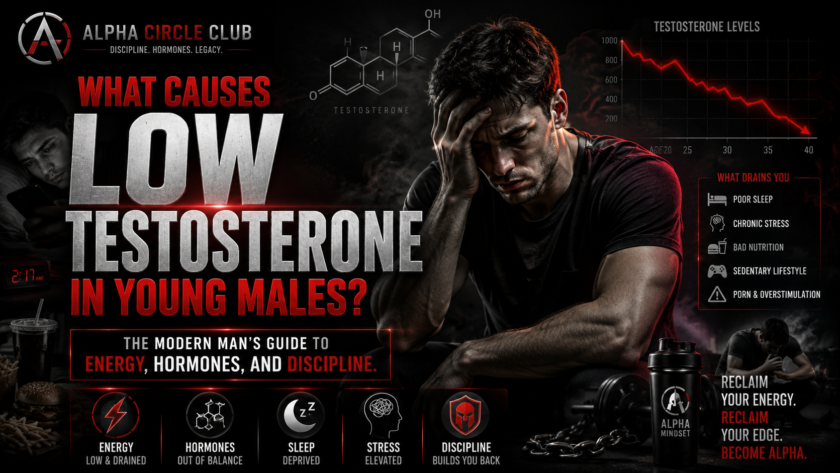
Low testosterone is not only an older man’s issue. So when a young man asks, what causes low testosterone in young males?, the answer is not always simple.
Young men can struggle with low energy, poor motivation, low libido, weak gym progress, brain fog, low mood, stubborn belly fat, poor recovery, erectile problems, and fertility concerns.
But here is the problem.
Many young men search online, recognise a few symptoms, and immediately assume they have low testosterone.
That is dangerous.
Symptoms matter, but symptoms are not enough.
A man can feel tired, unmotivated, anxious, weak, foggy, or flat for many reasons. Poor sleep can do it. Stress can do it. Depression can do it. Overtraining can do it. Undereating can do it. Alcohol can do it. Thyroid issues, diabetes, medications, nutrient deficiencies, fertility problems, and other medical conditions can also play a role.
It may be lifestyle.
It may be medical.
It may be the testicles.
It may be the pituitary gland or hypothalamus.
It may be obesity, poor sleep, chronic stress, overtraining, anabolic steroid use, poor nutrition, alcohol, medications, or a deeper health issue that needs proper investigation.
This article is not written to create fear.
It is written to create clarity.
Because the Alpha standard is simple:
Do not panic.
Do not guess.
Do not jump straight to testosterone replacement without understanding the consequences.
Find the cause.
Fix what can be fixed.
Test properly.
Protect fertility.
Rebuild the system.
A young man should not live disconnected from his energy, strength, focus, discipline, and drive. But he also should not treat hormones like a guessing game.
A serious man investigates.
A serious man tests.
A serious man corrects.
A serious man rebuilds.
Alpha Thought:
A young man should not panic over symptoms. He should investigate, test, correct, and rebuild.
Quick Alpha Summary
Low testosterone in young males can be caused by lifestyle factors, medical conditions, testicular problems, pituitary or hypothalamus issues, medications, anabolic steroid use, obesity, poor sleep, chronic stress, overtraining, alcohol, poor nutrition, chronic illness, and fertility-related hormone disruption.
Symptoms alone do not prove low testosterone.
A man can have low libido, fatigue, brain fog, poor motivation, low mood, weak recovery, or erectile issues for many different reasons.
Proper diagnosis usually requires symptoms plus consistently low testosterone on repeat morning blood tests.
Testosterone replacement therapy can reduce sperm production, so young men who want children should be especially careful before considering TRT.
The goal is not to chase testosterone blindly.
The goal is to find the root cause and rebuild the system.
Alpha Thought:
The disciplined man does not chase shortcuts. He finds the root.
Can Young Males Really Have Low Testosterone?
Yes, young males can have low testosterone.
But it should be treated seriously, not casually.
Testosterone plays an important role in libido, erections, muscle mass, bone health, mood, energy, red blood cell production, fertility, and male development.
When testosterone is genuinely low, it can affect more than one area of a man’s life.
But the key word is genuinely.
A young man should not diagnose himself because he feels tired or unmotivated. Those symptoms matter, but they are not proof by themselves.
Low testosterone in young men may be connected to either primary hypogonadism or secondary hypogonadism.
Primary hypogonadism means the problem starts in the testicles. The testicles are not producing enough testosterone, even when the body is trying to signal them.
Secondary hypogonadism means the testicles may be capable of working, but the signal from the brain is not strong enough. This usually involves the hypothalamus or pituitary gland, which help control hormones such as LH and FSH.
This matters because the cause affects the treatment.
A young man should not simply say, “I need testosterone.”
He should ask, “Why is testosterone low?”
That is the difference between panic and leadership.
If the issue is sleep, lifestyle, obesity, overtraining, alcohol, stress, or nutrition, the solution may be very different from a man with a testicular injury, pituitary problem, genetic condition, or medication-related suppression.
The goal is not to label yourself.
The goal is to understand the system.
Alpha Thought:
The real question is not just “Is testosterone low?” The real question is “What is lowering it?”
Symptoms of Low Testosterone in Young Men
Possible symptoms of low testosterone in young men can include low libido, erectile problems, fatigue, low motivation, brain fog, low mood, loss of muscle, increased belly fat, poor gym recovery, reduced morning erections, infertility concerns, low confidence, poor concentration, and reduced body or facial hair in some cases.
But this section needs maturity.
Many of these symptoms can also come from other causes.
A young man who sleeps five hours a night may feel exhausted and unmotivated.
A man under constant stress may lose libido.
A man who is crash dieting may feel weak, flat, and hormonally drained.
A man with anxiety or depression may experience low mood, low motivation, and sexual performance issues.
A man with thyroid problems, diabetes, nutrient deficiencies, medication side effects, relationship stress, or burnout may also feel like something is wrong.
That is why symptoms should be treated as signals, not final proof.
They are clues.
They are not the full case.
A private detective does not solve a case from one clue.
A disciplined man should not solve his hormone health from one symptom.
He gathers evidence.
He looks at patterns.
He tests properly.
He gets professional advice when symptoms persist.
If a young man has ongoing symptoms, especially low libido, erectile issues, fatigue, low mood, infertility concerns, or loss of morning erections, he should take it seriously.
But taking it seriously does not mean panicking.
It means investigating properly.
Alpha Thought:
Symptoms are clues. Testing is the evidence.
Poor Sleep and Late Nights
Poor sleep is one of the biggest lifestyle issues young men need to face.
Many young men are destroying their sleep without realising the cost.
Late nights.
Phone scrolling.
Gaming.
Porn.
Stress.
Caffeine too late in the day.
Irregular routines.
Alcohol.
Poor recovery habits.
Blue light before bed.
Going to sleep at different times every night.
Waking up already drained.
Then they wonder why they feel low, flat, unfocused, and unmotivated.
Sleep is not weakness.
Sleep is biological discipline.
Poor sleep can affect energy, mood, recovery, hunger, training performance, focus, and hormonal health. A young man cannot live like his body is disposable and expect strong hormones, strong gym performance, strong motivation, and strong mental clarity.
The body keeps score.
If a man wants to support testosterone, he needs to start treating sleep like part of the system.
Practical steps include aiming for seven to nine hours of quality sleep, keeping a regular sleep schedule, reducing screens before bed, avoiding late caffeine, keeping the bedroom cool and dark, getting morning light, and stopping the habit of treating sleep like something only weak people need.
A man who trains hard but sleeps badly is not living with discipline.
He is living in contradiction.
If he wants energy, drive, and better hormonal health, sleep cannot be an afterthought.
It has to become a standard.
Alpha Thought:
A man who disrespects sleep eventually feels it in his body, mood, discipline, and drive.
Excess Body Fat and Poor Metabolic Health
Excess body fat can affect hormone balance, energy, confidence, inflammation, insulin sensitivity, and male performance.
This needs to be said clearly, but not cruelly.
The goal is not shame.
The goal is responsibility.
A young man carrying excess belly fat, eating poor-quality food, avoiding exercise, sleeping badly, and living with weak routines may feel tired, heavy, sluggish, and hormonally flat.
That does not mean he should hate his body.
It means he should lead it.
Body fat is not only about appearance. It is connected to the wider metabolic system. Poor metabolic health can influence energy, mood, appetite, training performance, confidence, and long-term health.
Common factors include belly fat, insulin resistance, ultra-processed food, low activity, poor fitness, weight gain, and low muscle mass.
The Alpha solution is not crash dieting.
Crash dieting can make things worse if it leads to low energy, poor sleep, muscle loss, irritability, and weak recovery.
The better standard is strength training, daily walking, enough protein, better food quality, proper sleep, controlled calories, hydration, and consistency.
A man does not need to destroy himself to lose fat.
He needs structure.
He needs patience.
He needs standards.
He needs to stop living casually and expecting serious results.
Improving body composition is not about chasing perfection.
It is about creating a stronger internal environment.
A leaner, stronger, better-rested, better-fed body is usually a better foundation for male health.
Alpha Thought:
Do not hate your body. Lead it. Train it. Feed it. Rebuild it.
Chronic Stress, Anxiety, and Mental Burnout
Modern young men often carry silent stress.
Money stress.
Work stress.
Relationship stress.
Family pressure.
Porn habits.
Lack of purpose.
Social media comparison.
Loneliness.
Pressure to perform.
Fear of failure.
The constant feeling of being behind in life.
A man can look calm on the outside while his internal system is under pressure every day.
Stress can affect sleep, motivation, eating habits, training, recovery, libido, mood, and discipline.
This does not mean every stressed man has low testosterone.
But it does mean stress can weaken the lifestyle foundation that supports strong male health.
A man cannot live in constant internal chaos and expect his body to operate at a high standard.
The body needs rhythm.
It needs recovery.
It needs safety.
It needs direction.
It needs leadership.
Practical reset ideas include daily walking, prayer or quiet reflection, journaling, better time structure, less social media, training with purpose, talking to someone trustworthy, and getting professional help when needed.
Some men need more than discipline.
They need support.
There is nothing weak about getting help if anxiety, depression, trauma, addiction, or burnout is controlling your life.
The Alpha standard is not pretending everything is fine.
The Alpha standard is facing what is weakening you and taking action.
A young man does not need to be emotionless.
He needs to be responsible.
He needs to stop letting stress silently run his body, habits, and future.
Alpha Thought:
A man cannot live in constant internal chaos and expect his body to operate at a high standard.
Overtraining or Training the Wrong Way
Some young men think more training always equals more testosterone.
More lifting.
More HIIT.
More sweat.
More punishment.
More exhaustion.
But hard training without recovery can backfire.
Training should stimulate the body, not destroy it.
There is a difference between discipline and damage.
Too much HIIT, heavy lifting every day, no rest days, poor sleep, low calories, constant soreness, weak gym performance, low libido, fatigue, and irritability can all be signs that a man is not recovering properly.
This matters because some young men use the gym to fight their frustration.
They feel low, so they train harder.
They feel insecure, so they train harder.
They feel behind, so they train harder.
But if they never recover, the system starts to break down.
The Alpha approach is simple.
Strength train two to four times per week.
Use HIIT one to two times per week.
Walk daily.
Sleep properly.
Eat enough protein.
Take rest seriously.
Track progress.
Do not turn every session into war.
A man should leave some sessions feeling challenged, not destroyed.
He should build his body week by week, not burn it down because he is impatient.
Training without recovery is not discipline.
It is damage repeated with confidence.
Alpha Thought:
Training without recovery is not discipline. It is damage repeated with confidence.
Poor Nutrition and Low-Calorie Dieting
Many young men make one of two mistakes.
They either eat junk constantly or they diet too aggressively.
Both can create problems.
A poor diet can weaken energy, body composition, recovery, mood, digestion, focus, and training performance.
But extreme dieting can also create issues.
If a man cuts calories too low for too long, avoids healthy fats, eats very little protein, and trains hard at the same time, he may feel exhausted, irritable, flat, cold, weak, and unmotivated.
That is not strength.
That is under-fuelling.
This section is not about making nutrition complicated.
It is about getting the basics right.
A man needs enough protein to support muscle repair.
He needs healthy fats from foods like eggs, olive oil, avocado, oily fish, nuts, and seeds.
He needs micronutrients from real food.
He needs minerals such as zinc and magnesium.
He needs vitamin D from sunlight and, when needed, testing and professional guidance.
He needs hydration.
He needs less ultra-processed food.
He needs to stop using food like entertainment and start using food like leadership.
Testosterone support starts with the basics.
Real food.
Enough fuel.
Minerals.
Sunlight.
Hydration.
Consistency.
A man cannot build strong hormones on weak fuel.
Alpha Thought:
You cannot build strong hormones on weak fuel.
Alcohol, Drugs, Vaping, and Lifestyle Damage
Every habit either builds the man or taxes the man.
Heavy alcohol intake, recreational drug use, vaping, smoking, poor sleep from partying, weekend binge habits, low activity, and poor food choices can all weaken the lifestyle foundation that supports energy, fertility, sleep, training, and male health.
This does not mean one mistake ruins a man.
But repeated habits become a system.
A young man cannot keep living in a way that drains the body and then wonder why he feels drained.
Alcohol can disturb sleep, lower training quality, increase poor food choices, weaken recovery, and damage consistency.
Drug use can affect motivation, mental health, sleep, appetite, and decision-making.
Vaping and smoking may also be part of a wider pattern of stress, poor routines, and lifestyle damage.
The issue is not only the habit itself.
It is the identity behind the habit.
Does this habit build the man?
Or does it tax the man?
Does it support energy?
Or does it steal energy?
Does it support fertility?
Or does it damage the foundation?
Does it support discipline?
Or does it weaken self-control?
A young man does not need to be perfect.
But he does need to become honest.
If his lifestyle is damaging the system, he cannot pretend the problem is mysterious.
Sometimes the answer is not hidden.
Sometimes the answer is in the routine.
Alpha Thought:
Every habit either builds the man or taxes the man.
Anabolic Steroids, SARMs, and Testosterone Suppression
This is one of the most important sections for young men.
Many young men are tempted by anabolic steroids or SARMs because they want to look stronger quickly.
They want muscle.
They want confidence.
They want attention.
They want faster results.
But shortcuts can carry serious costs.
Anabolic steroids and similar performance-enhancing substances may suppress the body’s natural hormone system. They can affect natural testosterone production, fertility, testicular size, libido, mood, and long-term hormonal health.
This is not something young men should experiment with casually.
A man may think he is becoming stronger while quietly shutting down the very system he needs.
That is not power.
That is a debt.
And the body may force him to repay it.
Young men also need to understand that testosterone therapy itself can reduce sperm production. That matters deeply for men who want children in the future.
A young man should not treat testosterone, steroids, SARMs, or TRT like casual gym tools.
These decisions can affect fertility, hormones, mood, identity, and long-term health.
If a man has already used steroids or SARMs and feels symptoms afterwards, he should speak to a qualified medical professional. He should not try to fix one mistake with another internet protocol.
The Alpha standard is not reckless enhancement.
The Alpha standard is leadership.
Protect the system.
Protect fertility.
Protect the future.
Alpha Thought:
A shortcut that shuts down your own system is not strength. It is a debt your body may force you to repay.
Medications and Medical Causes
Low testosterone in young males can also come from medical issues.
This is why willpower alone is not always the answer.
Lifestyle matters, but not every problem is solved by training harder, sleeping better, or eating more eggs.
Some problems require proper medical investigation.
Possible medical causes can include testicular injury, undescended testicles, mumps orchitis, genetic conditions, pituitary problems, hypothalamus problems, high prolactin, thyroid issues, chronic illness, type 2 diabetes, hemochromatosis, opioid medication, some steroid medications, sleep apnea, and significant illness or injury.
The testicles, pituitary gland, and hypothalamus are part of the hormone command system.
If one part of that system is damaged, suppressed, or not signalling properly, testosterone may be affected.
This is why blood testing should usually look beyond testosterone alone.
A man may need LH, FSH, prolactin, thyroid markers, vitamin D, glucose markers, lipids, and other health markers depending on symptoms and medical advice.
This is not something to self-diagnose from social media.
Medical causes need medical evaluation.
The Alpha message is balanced:
Fix your lifestyle.
But do not ignore medicine.
Train hard.
But do not ignore testing.
Take responsibility.
But do not pretend you are a doctor.
A serious man knows when to seek professional help.
Alpha Thought:
Lifestyle matters, but not every problem is solved by willpower. Some problems require investigation.
Low Testosterone and Male Fertility
Testosterone and fertility are connected.
But many young men misunderstand this connection.
They assume more testosterone automatically means better fertility.
That is not always true.
External testosterone can suppress LH and FSH, two hormones that help signal the testicles to produce sperm. When that signal is suppressed, sperm production may fall.
This is why young men who want children should be careful before considering testosterone replacement therapy.
A man may start TRT to feel stronger, but if fertility is important to him, he needs to discuss that clearly with a doctor before starting treatment.
This is especially important for young men in their twenties and thirties.
Do not treat testosterone as separate from fertility.
The system is connected.
A man with low testosterone symptoms and fertility concerns may need a more complete evaluation, including hormone testing and semen analysis.
He may need to look at sperm count, motility, morphology, semen volume, lifestyle, nutrition, heat exposure, alcohol, smoking, medications, and hormonal signalling.
This is where Alpha Circle Club can lead men properly.
Not with fear.
With truth.
A young man should protect his strength and his future.
Alpha Thought:
A young man should never treat testosterone as separate from fertility. The system is connected.
How Young Men Should Get Tested
A serious man does not ask for guesses.
He asks for data.
If a young man has ongoing symptoms, proper testing matters.
Testing should usually include more than one number because testosterone is part of a wider hormone system.
Possible blood tests to discuss with a doctor include total testosterone, free testosterone, SHBG, LH, FSH, prolactin, thyroid markers, vitamin D, fasting glucose or HbA1c, lipids, full blood count, and liver and kidney markers.
Testosterone is usually tested in the morning because levels can vary throughout the day. It may also need repeating because one low result does not always tell the full story.
LH and FSH are especially important because they help show what type of problem may be happening.
If testosterone is low and LH or FSH is high, that may suggest the brain is trying to signal the testicles, but the testicles are not responding properly.
If testosterone is low and LH or FSH is low or normal, that may suggest a signalling issue from the brain, or possible suppression from lifestyle, stress, illness, medications, obesity, or other health factors.
This should be kept simple.
A young man does not need to become an endocrinologist.
But he does need to understand that one testosterone number is not the whole story.
Testing gives direction.
Testing reduces panic.
Testing protects the man from guessing.
Alpha Thought:
A serious man does not ask for guesses. He asks for data.
The Alpha Low Testosterone Reset for Young Men
This is where the article becomes more than information.
It becomes a system.
A young man who suspects low testosterone should not panic.
He should reset.
Here is a practical 90-day Alpha Low Testosterone Reset.
Phase 1: Remove the Damage
Weeks 1 and 2 are about stopping the habits that are weakening the system.
Fix your sleep schedule.
Reduce alcohol.
Stop reckless dieting.
Reduce ultra-processed food.
Start walking daily.
Stop overtraining.
Book blood tests if symptoms persist.
This phase is about removing the obvious damage.
Many men want advanced solutions while ignoring basic problems.
That is backwards.
Before chasing testosterone boosters, fix the behaviours that are draining the body.
Sleep.
Walk.
Eat real food.
Stop binge habits.
Stop training like recovery does not matter.
Get tested if symptoms continue.
The first phase is not glamorous.
But it is powerful.
Phase 2: Build the Foundation
Weeks 3 to 6 are about creating structure.
Strength train two to four times weekly.
Eat enough protein.
Add healthy fats.
Improve vitamin D, zinc, and magnesium intake through food, sunlight, and testing where needed.
Manage stress.
Track energy, mood, libido, sleep, and training.
This phase is about building the foundation.
No chaos.
No random effort.
No emotional training plan.
A man needs structure.
He needs repeatable habits.
He needs food that supports the body.
He needs sleep that restores the body.
He needs training that builds the body.
Phase 3: Strengthen the Standard
Weeks 7 to 12 are about progression.
Progress your lifts.
Maintain sleep discipline.
Keep walking daily.
Use HIIT carefully.
Review blood work with a professional.
Adjust based on evidence.
This phase is where the man stops living like the old version of himself.
He is no longer guessing.
He is tracking.
He is training.
He is sleeping.
He is eating.
He is correcting.
He is leading.
The reset is not punishment.
It is the return to command.
Alpha Thought:
The reset is not punishment. It is the return to command.
What Young Men Should Not Do
This section needs to be direct.
A young man should not self-diagnose from TikTok symptoms.
He should not buy random testosterone boosters and expect them to fix a broken lifestyle.
He should not start TRT without proper testing.
He should not ignore fertility.
He should not use steroids or SARMs casually.
He should not train harder while sleeping badly.
He should not crash diet.
He should not ignore depression or anxiety.
He should not pretend symptoms are normal if they persist.
He should not guess when testing is available.
Panic creates shortcuts.
Shortcuts create consequences.
Discipline creates answers.
A young man who feels low, tired, unmotivated, foggy, or disconnected from his drive should not be ashamed.
But he should become serious.
He should investigate.
He should improve the basics.
He should get medical advice when needed.
He should stop letting social media sell him fear and shortcuts.
His body is not a trend.
His hormones are not a game.
His fertility is not an afterthought.
His future matters.
Alpha Thought:
Panic creates shortcuts. Discipline creates answers.
Final Alpha Standard
Low testosterone in young males is not something to ignore.
But it is also not something to panic about.
The right response is not fear.
The right response is investigation, discipline, testing, and correction.
Find the cause.
Fix the habits.
Train with structure.
Sleep like it matters.
Eat like your body needs leadership.
Stop damaging the system.
Test properly.
Protect fertility.
Speak to a professional when symptoms persist.
Because a young man should not live disconnected from his strength, energy, focus, and drive.
He should rebuild the system.
He should lead his body.
He should return to command.
Low testosterone is not just a number to chase.
It is a signal to investigate.
A signal to mature.
A signal to take ownership of sleep, food, training, stress, recovery, habits, fertility, and health.
Do not fear the numbers.
Face them.
Understand them.
Build from truth.
And become the man who no longer lives at the mercy of weakness, confusion, and guesswork.
Final Alpha Thought:
Do not fear the numbers. Face them, understand them, and build the man who rises from the truth.



No spam. Unsubscribe anytime.