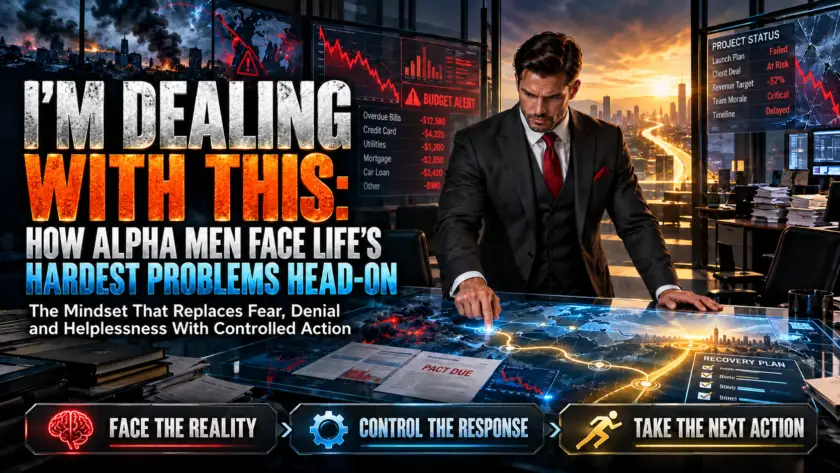
The Mindset That Replaces Fear, Denial and Helplessness With Controlled Action
Some situations arrive without permission.
A business begins losing money. Debt grows faster than expected. An important client walks away. A family crisis develops. A doctor delivers news that changes the atmosphere in the room. Conflict threatens the peace a man has worked to build. A national emergency, war or disaster places people in circumstances they never chose and cannot completely control.
In those moments, fear begins offering alternatives.
Ignore it.
Delay the decision.
Blame somebody else.
Wait for the pressure to disappear.
Distract yourself until reality becomes easier.
Pretend that because you cannot control everything, there is no point controlling anything.
But avoidance is not neutral. While a man looks away, interest continues accumulating. Deadlines move closer. Relationships become more strained. Business problems become more expensive. Health concerns remain unexamined. Rumours become louder because facts have not been established. Fear expands into every space where information and action are absent.
This is where the Alpha mindset becomes visible.
It is not a loud performance. It is not aggression, denial or the claim that a strong man never feels afraid. It is a quiet internal decision:
“I’m dealing with this.”
Those words do not mean he already possesses every answer. They do not guarantee that the ending will match his preference. They do not make him immune to loss, uncertainty or forces larger than himself.
They mean that avoidance is over.
He will look directly at reality. He will establish the facts, identify what needs protecting and separate the things he can influence from the things he cannot. He will seek qualified help when knowledge beyond his own is required. He will control his conduct, take the next necessary action and adapt as new information appears.
An Alpha man does not believe that mindset grants him control over war, markets, illness, nature or other people. He understands something more useful: even when the final outcome cannot be commanded, his response does not have to be surrendered.
That is the foundation of how to face problems head on.
You do not need certainty before beginning. You need enough courage to stop hiding, enough humility to gather the truth and enough discipline to act on what remains within your control.
You may not control everything that stands against you—but it will no longer receive an uncontested victory.
1. “I’m Dealing With This” Is a Decision
The first victory in a crisis is rarely the complete solution. It is the moment a man decides that the problem will no longer be ignored.
Before that decision, his energy is divided. Part of him knows action is necessary; another part searches for reasons to wait. He checks his bank balance without opening the overdue letter. He notices sales declining but avoids the full figures. He knows the relationship needs an honest conversation but hopes silence will repair what silence helped create.
Once he says, “I’m dealing with this,” the internal argument changes.
He may still feel afraid. He may not know how long recovery will take. But he is no longer debating whether reality deserves his attention. His mind becomes available for better questions:
- What is actually happening?
- What needs immediate protection?
- What can I influence?
- Which decision can no longer wait?
- What information is missing?
- Who has the expertise I need?
- What is the first physical action?
This is responsibility before certainty.
Many men wait for a plan that removes all fear. They believe they will act when the perfect answer appears. But answers often emerge only after a man begins gathering evidence, making calls and testing possible routes forward.
Imagine discovering that your business cannot meet every payment due next month. “I’m dealing with this” does not mean pretending money will appear. It means opening the accounts, calculating the real shortfall, protecting essential obligations, contacting the accountant, speaking honestly with relevant parties and deciding what must change.
The problem may still be serious. The difference is that it now faces an active man instead of an absent one.
This decision also rejects the fantasy that somebody else will automatically rescue you. Help may be available, and accepting it can be wise. But leadership begins when you take responsibility for finding, evaluating and using that help.
The words “I’m dealing with this” are not a motivational slogan. They are a transfer of authority—from avoidance back to deliberate action.
Alpha Insight
Responsibility begins before the solution appears. It begins when a man decides that avoidance is over.
2. Face the Facts Before Facing the Fear
Fear grows powerfully in vague territory.
“The business is failing” may mean revenue has fallen for two months, one product is underperforming or cash flow has been mismanaged. “I am in financial ruin” may mean there is a serious but measurable debt that needs restructuring. “Everything is going wrong” may mean three specific problems arrived close together.
None of these realities should be minimised. But each becomes easier to confront when converted from an emotional cloud into verified facts.
Start by asking:
- What has happened?
- What is confirmed?
- What am I assuming?
- Which information comes from a reliable source?
- What is the immediate risk?
- What could happen later if nothing changes?
- What resources are already available?
- Which deadline matters first?
A man under pressure may resist looking because he believes the facts will make fear worse. Frequently, the opposite occurs. The truth may be uncomfortable, but it gives fear boundaries.
If the account contains £2,000 and the essential payments total £3,200, there is a £1,200 shortfall—not an undefined financial monster. If a product has produced thirty sales instead of the expected one hundred, the performance gap can be examined. If a doctor has requested further testing, that request is a fact; the worst diagnosis imagined at 2:00am is not yet a fact.
When real danger exists, accurate information becomes even more important. During war, civil emergency or physical threat, rumours can provoke reckless decisions. Reliable official instructions, local safety information and trained emergency personnel matter more than social-media speculation or the desire to appear fearless.
Facts may not give you the answer you hoped for. They give you something more useful: a solid surface from which to decide.
Write the situation in one paragraph using no dramatic language. Include numbers, dates, names and confirmed events. Then write a separate list titled “What I do not yet know.” This prevents assumptions from disguising themselves as evidence.
A defined problem may still be difficult—but it can be assessed, divided and addressed.
Alpha Insight
A defined problem can be confronted. An undefined fear can grow without limits.
3. Separate What You Control From What You Cannot
The desire for control becomes dangerous when a man applies it to things that do not belong to him.
He cannot control how another person reacts to an honest conversation. He cannot personally direct the economy, force a customer to buy or guarantee the outcome of a medical treatment. He cannot reverse the past. In war or disaster, he cannot command every event around him.
If he mistakes strength for total control, reality will repeatedly make him feel powerless.
The stronger approach is to draw a clear boundary around his authority.
| Within his control | Outside his complete control |
|---|---|
| His preparation | Other people’s decisions |
| His spending choices | The national economy |
| His business response | Every market condition |
| His words and conduct | Other people’s opinions |
| His effort and consistency | Guaranteed success |
| Seeking qualified help | The speed of every result |
| Adapting the plan | The past |
| Following safety guidance | The entire emergency |
This distinction does not make a man passive. It prevents him from wasting strength on impossible commands while neglecting the actions that remain available.
He cannot force the client to return, but he can discover why the account was lost, protect the remaining customers and strengthen his offer. He cannot control an interest-rate decision, but he can examine expenses, build reserves and seek qualified financial advice. He cannot command another person to become respectful, but he can set a boundary and decide what access that person will continue to receive.
Whenever you feel overwhelmed, divide a page into two columns:
Mine to control and Not mine to control.
Be honest. Some things will sit between the columns because you can influence but not command them. Place those under “Mine to influence” and decide what responsible influence looks like.
Then stop giving your best energy to the final column.
Acceptance does not mean approval. It means recognising reality accurately enough to direct action where it can matter.
Alpha Insight
Strength is not controlling everything. It is refusing to abandon what remains yours to control.
4. Courage Is Action While Fear Is Present
Courage is frequently misunderstood as the absence of fear.
That definition makes courage almost impossible. If a man believes he must feel fearless before acting, he may wait indefinitely. The telephone remains untouched. The appointment is postponed. The figures stay hidden. The conversation never begins.
Real courage allows two truths to exist together:
“This situation frightens me.”
And:
“I am taking the necessary action anyway.”
A man can feel afraid and still:
- Make the telephone call
- Attend the appointment
- Review the debt
- Open the legal letter
- Confront the business figures
- Move his family towards safety
- Ask for professional advice
- Admit that the original plan failed
- Make an unpopular but necessary decision
- Begin again
The body may react before the mind feels ready. Breathing changes. Thoughts accelerate. The desire to escape becomes strong. Courage does not require denying these responses. It requires preventing them from choosing on your behalf.
Use a simple command:
“Fear is present, but fear is not leading.”
Then reduce the action to its physical beginning. Enter the number. Open the spreadsheet. Put on your coat. Write the first sentence. Walk through the door. Tell the truth.
The mind often treats an untouched action as enormous. Once movement begins, the task becomes more specific. You discover what the person says, what the balance is, what the professional recommends or what the next requirement involves.
Do not wait to become a man who never feels afraid. Become a man who has built evidence that fear cannot automatically stop him.
Every time you act responsibly while uncomfortable, you strengthen that identity.
Alpha Insight
Courage does not wait for fear to disappear. It moves before fear grants permission.
5. Do Not Confuse Immediate Action With Reckless Action
“Face it head-on” can be interpreted badly.
It can sound like a command to charge forward, confront everybody immediately or treat caution as weakness. That is not courage. It is often impatience, ego or fear wearing an aggressive mask.
A decisive man does not move merely to prove that he is moving. He asks whether the action improves the position.
In business, reckless action might mean borrowing more money without understanding why the existing model is losing cash. In a relationship, it might mean beginning a serious confrontation when both people are exhausted and angry. In a legal problem, it might mean responding publicly before receiving advice. During physical danger, it might mean ignoring official safety instructions to appear brave.
Strong action can involve:
- Pausing long enough to establish the facts
- Gathering intelligence
- Consulting somebody qualified
- Creating distance from immediate danger
- Delaying a message until emotion has reduced
- Withdrawing from an indefensible position
- Protecting resources for the next stage
- Choosing not to reveal every intention
- Refusing a fight that serves no useful objective
The difference between delay and preparation is purpose. Avoidance says, “I hope this disappears.” Preparation says, “I am using this time to improve the next decision.”
Before taking a major action, ask:
- What result is this action intended to produce?
- What evidence suggests it may work?
- What could it make worse?
- Is the action reversible?
- Do I need expertise before proceeding?
- Am I acting from strategy or emotional urgency?
The Alpha mindset is not “move fast at all costs.” It is “do not abandon the problem, and do not allow panic to choose the method.”
Alpha Insight
Decisive men move with purpose. Reckless men move merely to escape the discomfort of standing still.
6. Control Yourself Before Trying to Control the Situation
Pressure reveals the quality of a man’s self-command.
When a situation feels threatening, he may speak faster, assume the worst, blame the nearest person or reach for immediate relief. He may send messages he later regrets, spend money impulsively, exaggerate what he knows or attempt to dominate people whose cooperation he needs.
The first position he must defend is himself.
That begins with the body. Slow the breath. Lower the voice. Sit down if pacing is increasing panic. Drink water. Step away from the screen. Delay intoxicants and stimulants that may distort judgement. If exhaustion is driving the crisis response and no immediate safety decision is required, sleep before making a permanent choice.
Then control the information entering the mind. During a business threat, endlessly reading pessimistic commentary is not research. During conflict, repeating rumours is not preparation. During a health scare, searching for the worst possible explanation at midnight is not diagnosis.
Next, control your communication.
Say what you know. Say what you do not know. Avoid promises you cannot guarantee. Do not distribute your panic to your family, staff or partners and call it honesty.
Useful language includes:
“This is serious, and I am establishing the facts.”
“I do not know the complete answer yet. This is the next action.”
“I am not going to make that decision while angry.”
“We will review the position at a specific time.”
Self-control does not mean emotional numbness. You can admit fear, concern or disappointment. The standard is that emotion provides information without receiving unrestricted authority.
When the environment becomes unstable, your conduct should become more deliberate—not more chaotic.
Alpha Insight
When circumstances become unstable, self-control becomes the first position a man must defend.
7. Protect What Matters Most
Not every part of a crisis deserves equal attention.
When pressure is high, everything can feel urgent. Emails, bills, opinions, public appearances and long-term ambitions compete for the same limited attention. A man who treats every demand equally may exhaust himself while failing to protect what cannot easily be replaced.
Build a priority order before distributing resources:
- Life and immediate safety
- Health and essential care
- Children, dependants and vulnerable family members
- Shelter, food, utilities and essential income
- Legal duties and time-sensitive obligations
- Business continuity and critical assets
- Important relationships and reputation
- Long-term rebuilding and growth
The exact order may vary, but the principle remains: preserve the foundations before protecting appearances.
A business owner may need to pause an exciting expansion to preserve payroll and core service. A man under financial pressure may need to cancel status purchases before reducing necessities for his family. During a serious health issue, he may need to temporarily lower his work output instead of pretending nothing has changed until his body forces a complete stop.
This is not surrender. It is triage.
Ask three questions:
- What will create irreversible harm if neglected?
- What can survive temporary delay?
- What am I protecting only because my ego is attached to it?
Crisis clarifies values. A man discovers whether he cares more about appearing successful or keeping his household stable; whether he values being right more than preserving a relationship; whether he wants the image of leadership or the responsibility of it.
Protecting what matters most may require painful choices. Clarity does not remove that pain, but it stops lesser priorities from consuming the strength needed for the essential ones.
Alpha Insight
Pressure becomes more manageable when a man knows exactly what must be protected first.
8. Break the Crisis Into the Next Controllable Move
Large problems create paralysis when a man attempts to solve every stage simultaneously.
He sees the full debt, the entire business turnaround, the complete medical journey or the total family problem. Because he cannot finish everything today, he does nothing today.
The Alpha response is to reduce the crisis to the next controllable move.
That move might be:
- Contacting the bank
- Listing every debt and due date
- Cutting one unnecessary expense
- Speaking to an accountant
- Calling an emergency meeting
- Reviewing a contract
- Booking a medical appointment
- Moving somebody away from immediate danger
- Documenting what happened
- Creating a 72-hour plan
- Making one overdue decision
The next move should satisfy three conditions:
It is physical. “Sort out the business” is not an action. “Download the last six months of transactions” is.
It is available. Do not choose an action that depends entirely on somebody else responding first.
It improves information, safety or position. Movement alone is not progress.
Once the action is complete, reassess. A telephone call may reveal a new requirement. The figures may expose the real expense causing the problem. The professional appointment may change what needs to happen next.
This is controlled momentum: act, observe, adjust.
You do not need to see the entire road in order to stop standing still. In many situations, the next step creates the information needed for the step after it.
When overwhelmed, ask:
“What can I complete in the next thirty minutes that makes this situation clearer, safer or more manageable?”
Then do that before returning to general worry.
Alpha Insight
You do not need complete control of the journey to take control of the next step.
9. Use Help Without Surrendering Leadership
The fake image of the Alpha man says he handles everything alone.
The real man understands that serious problems often require knowledge he does not possess.
He may need:
- A doctor to assess a health concern
- A solicitor to explain legal risk
- An accountant to interpret the business position
- A regulated financial adviser or debt specialist
- A therapist or counsellor
- Emergency services
- A business mentor with relevant experience
- A qualified tradesperson
- A trusted family member
- A spiritual leader
Seeking help is not surrendering control. It is controlling the decision to obtain better information.
Leadership does not mean performing every role. A military commander uses intelligence, logistics, medical support and specialist advice. A responsible business leader consults people who understand law, finance, operations and customers. A father protects his family more effectively when he refuses to hide a problem that requires assistance.
The key is to use help responsibly.
Choose people because of competence, integrity and relevance—not because they tell you what you want to hear. Ask clear questions. Bring accurate information. Record the advice. Understand what the professional is and is not qualified to decide. Retain responsibility for the choices that remain yours.
There is also a difference between support and rescue. Support increases your ability to act. Rescue fantasies allow you to remain passive while waiting for another person to take ownership of your life.
The strongest sentence may be:
“I do not know enough to handle this correctly on my own, so I am finding somebody who does.”
That is not weakness. It is judgement.
Alpha Insight
Leadership is not knowing everything. It is recognising what the situation requires and bringing the right people into the fight.
10. Adapt Without Abandoning the Mission
The first plan may fail.
The customer may still say no. The lender may reject the proposal. The launch may produce fewer sales than expected. New information may change the medical or legal position. Conditions may move faster than the original strategy anticipated.
Some men experience a failed plan as an attack on identity. They defend the method because changing it feels like admitting weakness.
But the method is not the mission.
If the mission is to stabilise the business, one product, platform or marketing strategy may need to change. If the mission is to protect the family, pride may need to give way to temporary downsizing or outside help. If the mission is recovery, the timeline and route may need to be adjusted as professionals provide new information.
Use a review cycle:
- What result did the action produce?
- What new information appeared?
- Which assumption proved wrong?
- What remains unchanged about the objective?
- What should stop, continue or change?
- What is the next controlled experiment or decision?
Adaptation is not random movement. It is disciplined response to evidence.
An Alpha man can say:
“That approach did not work. I am changing it.”
He does not need to pretend the first idea was successful. He does not confuse stubbornness with conviction.
Hold the mission firmly and the method intelligently. Principles such as honesty, responsibility and protection should remain stable. Tactics should remain available for improvement.
Alpha Insight
Changing the plan is not weakness when the original plan no longer serves the objective.
11. Become the Calm Other People Can Rely On
A crisis rarely affects only one person.
Family members watch your face. Employees listen to your tone. Partners notice whether you are hiding information. Children may not understand the details, but they recognise panic, anger and instability.
Calm leadership does not mean pretending there is no problem. False reassurance damages trust when reality becomes undeniable. Calm means communicating truth without spreading unnecessary chaos.
Say:
“This is serious, but we have identified the immediate priorities.”
“I do not have every answer yet. This is what we know, and this is what we are doing next.”
“I will update you when the information changes.”
“We are going to make decisions from facts rather than fear.”
People need clarity about what you know, what you do not know and what is expected from them. They do not need dramatic promises that everything will definitely be fine.
Calm also includes listening. The people around you may possess information you have missed. They may need to express fear before they can focus. Leadership is not a monologue delivered in a deeper voice. It is creating enough stability for useful communication and coordinated action.
Do not use the Alpha identity as permission to dominate. A man becomes dependable when others can trust that pressure will not make him cruel, deceptive or impossible to approach.
Your strength should reduce unnecessary fear in the room—not demand that everybody hide it to protect your ego.
Alpha Insight
In difficult moments, calm leadership gives other people something stable to stand beside.
12. Let the Crisis Reveal the Man You Are Becoming
Hard situations expose weaknesses.
They reveal where a man has avoided the numbers, neglected his health, failed to prepare, depended too heavily on one source of income or allowed pride to block help. This exposure can be painful.
But a crisis can also reveal strength that comfortable periods never required him to use:
- Courage
- Patience
- Resourcefulness
- Financial discipline
- Emotional control
- Decision-making
- Leadership
- Faith
- Humility
- Endurance
This does not mean every hardship was sent to improve you or that suffering should be romanticised. War destroys lives. Illness can be devastating. Financial loss can damage families. Some events leave wounds rather than inspiring lessons.
The Alpha position is more honest:
“I would not have chosen this. But because it is here, I will refuse to waste every opportunity to become wiser, better prepared and more useful.”
After the immediate danger has passed, conduct a review:
- What did I handle well?
- Where did fear control me?
- What preparation was missing?
- Who proved dependable?
- Which resources protected us?
- What must never be neglected again?
- What strength did I discover?
- What will I build before the next challenge arrives?
Then turn the answers into systems. Build the emergency fund. Diversify the customer base. improve the insurance, health habits, documentation, backups, communication or support network. Do not allow the lesson to disappear as soon as comfort returns.
The man who emerges should not merely be relieved that the crisis ended. He should be more capable because he faced it consciously.
Alpha Insight
The crisis may not have arrived to improve you—but you can still refuse to leave it unchanged.
Five Situations and the Alpha Response
1. Financial Pressure
The weak response is to avoid statements, continue unnecessary spending and hope future income will repair present disorder.
The Alpha response is:
- Establish the exact position
- Protect essentials
- Stop financial leakage
- Contact creditors or relevant services early
- Seek qualified guidance when needed
- Create an immediate survival plan and a longer recovery plan
- Refuse spending designed only to maintain appearances
The governing statement is:
“The numbers may be uncomfortable, but they will not remain hidden.”
2. A Business Crisis
The weak response is to blame the market, conceal problems from the team and keep repeating a failing strategy.
The Alpha response is:
- Examine cash flow, sales and costs
- Identify the real constraint
- Protect the core offer and customers
- Communicate honestly with essential people
- Reduce ego-driven projects
- Test solutions quickly but intelligently
- Make decisions before the business makes them through collapse
The governing statement is:
“We will deal with the business that exists—not the business we wish the figures described.”
3. Health News
The weak response is either denial or immediate catastrophe.
The Alpha response is:
- Attend appropriate appointments
- Obtain qualified medical information
- Ask questions and write down answers
- Follow agreed treatment or investigation plans
- Tell the people who genuinely need to know
- Protect sleep, nutrition and emotional support where possible
- Avoid replacing professional assessment with internet certainty
The governing statement is:
“I will not diagnose the ending before the facts are established. I will take the next responsible health action.”
4. Family or Relationship Conflict
The weak response is silence, blame, threats or a public performance.
The Alpha response is:
- Calm down before communicating
- Identify the specific behaviour or issue
- Listen to information that may challenge his position
- Accept his contribution without demanding reassurance
- Establish boundaries without humiliation
- Seek mediation or professional support when appropriate
- Prioritise safety where coercion, abuse or danger is present
The governing statement is:
“I will address the real issue without turning the conversation into another problem.”
5. War, Disaster or Immediate Danger
The weak response may be panic, denial, rumour-sharing or unnecessary risk taken to appear brave.
The Alpha response prioritises:
- Life and immediate safety
- Reliable official information
- Emergency instructions
- Safe shelter, evacuation or medical assistance
- Children, dependants and vulnerable people
- Essential supplies and communication
- Calm cooperation with trained authorities
- Avoiding unnecessary confrontation
The governing statement is:
“Courage means protecting life and making disciplined decisions—not proving fearlessness through avoidable danger.”
The FACE Protocol
When the situation feels larger than your ability to think clearly, use four stages.
F — Face the Reality
Remove denial.
Write down what has happened, what is confirmed and what remains uncertain. Open the letter, examine the account, attend the appointment or begin the conversation. A problem cannot be managed effectively while part of you is still pretending it is not real.
A — Assess the Threat
Determine:
- What is at risk?
- What is urgent?
- What can wait?
- What could become irreversible?
- What resources already exist?
- What expertise is missing?
Do not allow the loudest detail to automatically become the highest priority.
C — Control the Controllable
List the decisions, actions and standards still within your authority.
Control your information, conduct, spending, preparation, communication and next move. Release the demand to guarantee what no individual can guarantee.
E — Execute the Next Move
Choose one meaningful action. Complete it. Review the result. Adapt.
Execution turns courage from an intention into evidence.
Face → Assess → Control → Execute
The “I’m Dealing With This” Crisis Audit
Use this audit when a problem feels overwhelming.
Reality
- What is actually happening?
- Which facts have I confirmed?
- What am I assuming?
- What information is missing?
- Which source can verify it?
Risk
- What is in immediate danger?
- What could become irreversible?
- What can wait twenty-four hours?
- Who else may be affected?
Control
- What remains entirely within my control?
- What can I influence but not command?
- What is outside my authority?
- Where am I wasting energy fighting reality?
Action
- What am I currently avoiding?
- Which decision can no longer wait?
- What is the next physical action?
- When will I complete it?
- How will I know it is complete?
Support
- Whose expertise do I need?
- Who needs accurate information from me?
- Who can help without taking over my responsibility?
- Is anybody’s immediate safety at risk?
Standard
- What conduct must I maintain under pressure?
- Which behaviour would make this worse?
- What promise must I refuse to make?
- What will the man I intend to become do next?
Build a 72-Hour Crisis Plan
For a serious but non-immediate problem, divide the next three days into clear priorities.
First 24 Hours: Stabilise
- Confirm the facts
- Protect life, health and essential resources
- Stop obvious sources of further damage
- Contact essential professionals or services
- Inform the people who genuinely need to know
- Choose the next review time
Hours 24–48: Organise
- Collect documents, figures and evidence
- Compare realistic options
- Assign responsibilities
- Establish communication rules
- Create a short list of essential decisions
- Remove distractions unrelated to the crisis
Hours 48–72: Execute and Review
- Take the highest-value action
- Record the result
- Update the risk assessment
- Adjust the plan
- Define the next seven days
- Restore necessary sleep, food and recovery
If there is immediate danger, do not wait for a 72-hour plan. Follow relevant emergency procedures and official instructions first.
The 24-Hour Head-On Challenge
Choose one important problem you have been avoiding—not necessarily the largest crisis in your life, but one that deserves action.
Within the next twenty-four hours:
- Write the problem in one factual sentence.
- List what is known and unknown.
- Divide the situation into control, influence and no control.
- Identify the greatest immediate risk.
- Choose one action that reduces that risk or increases clarity.
- Contact one person whose knowledge or support is relevant.
- Complete the action before entertainment begins.
- Record what changed.
- Define the next move.
Do not spend the challenge designing a perfect plan. Its purpose is to turn “I should deal with this” into evidence that you have begun.
Frequently Asked Questions
What does it mean to face a problem head-on?
It means acknowledging the problem, establishing the facts and taking responsible action without unnecessary avoidance. It does not mean reacting aggressively or attempting to solve everything immediately.
How do Alpha men handle difficult situations?
They control themselves first, protect what matters most, separate controllable actions from uncontrollable outcomes, seek appropriate expertise and execute the next useful step. Their strength appears in disciplined conduct rather than loud performance.
Can mindset control the outcome?
Mindset can strongly affect preparation, persistence and decision-making, but it cannot guarantee every result. Other people, markets, health conditions, emergencies and chance may influence the outcome. The objective is to take full responsibility for the response without claiming authority over reality.
What if I feel too overwhelmed to act?
Reduce the problem to one physical action that creates safety or clarity. Write down the facts, make one call or gather one document. If distress is severe or daily functioning is breaking down, seek appropriate professional support rather than attempting to overpower everything alone.
Is asking for help an Alpha behaviour?
Yes. Using qualified assistance is responsible leadership when the situation requires knowledge, authority or resources you do not possess. Strength includes recognising the limits of your own expertise.
How can I avoid making a reckless decision?
Identify the intended result, examine possible damage, establish whether the action is reversible and consult relevant experts when necessary. Unless immediate safety requires action, avoid major decisions made at the peak of anger, panic or exhaustion.
What if the first plan fails?
Review the result, identify the assumption that proved wrong and change the method while protecting the mission. A failed strategy is information, not an instruction to abandon the entire objective.
How can I remain calm for my family?
Tell the truth without spreading speculation, explain the immediate priorities and control your tone and conduct. Calm leadership does not require hiding every emotion; it requires preventing your fear from becoming additional danger for the people relying on you.
What should I do first during an emergency?
Prioritise immediate safety and follow the guidance of relevant emergency services or official authorities. Do not allow an online article, motivational message or desire to appear brave to replace situation-specific emergency instructions.
Closing Declaration
I will not strengthen problems through avoidance.
I will face reality without allowing fear to write the conclusion.
I will establish the facts before reacting to assumptions.
I will control myself before attempting to control the situation.
I will separate what belongs to me from what lies outside my authority.
I will protect life, health, family and essential responsibilities before appearances.
I will seek qualified help when the situation requires knowledge beyond my own.
I will act with courage without becoming reckless.
I will adapt when the plan must change.
I may not control every outcome, but I will never surrender the actions that remain mine.
Whatever stands before me, my mindset will be clear: I’m dealing with this.
Final Line
The Alpha man does not wait for the problem to become less frightening. He faces the facts, controls his response and becomes more prepared to meet it.


No spam. Unsubscribe anytime.