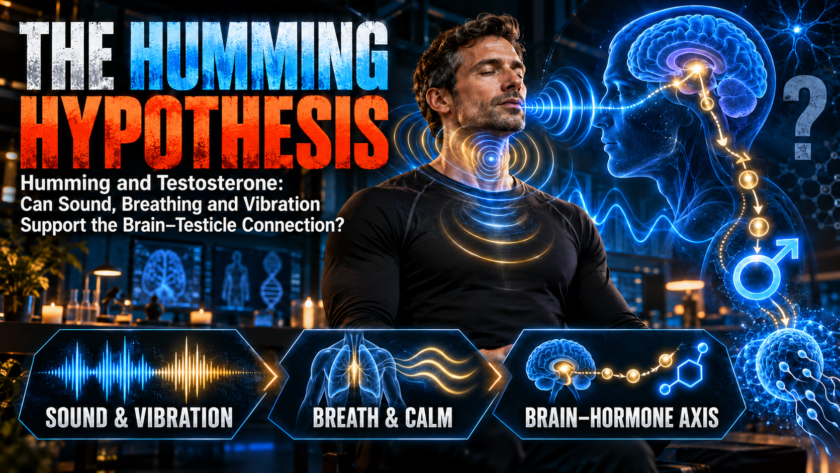
Humming and Testosterone: Can Sound, Breathing and Vibration Support the Brain–Testicle Connection?
Testosterone and sperm production begin with instructions from the brain. That fact makes it understandable that men search for simple practices capable of strengthening the communication between the brain and the testicles.
One of the most interesting suggestions is humming.
Humming creates an audible vibration through the throat, nose and facial cavities. It naturally lengthens the exhalation. It can feel calming, grounding and physically noticeable inside the head. Research has shown that humming can produce a large temporary increase in nitric oxide measured in nasal air. Early studies of humming-style breathing have also reported changes in heart-rate variability and electrical brain activity.
From those findings, a much bigger claim has emerged: that the vibration from humming stimulates the hypothalamus, causes it to release more gonadotrophin-releasing hormone (GnRH), increases LH and FSH, and thereby makes the testicles produce more testosterone and sperm.
It is an attractive chain of reasoning.
It is also not yet a demonstrated chain of evidence.
The hypothalamus really does release GnRH in pulses. GnRH really does signal the pituitary gland. The pituitary really does release luteinising hormone (LH) and follicle-stimulating hormone (FSH). LH stimulates testosterone production in the Leydig cells, while FSH and high concentrations of testosterone inside the testicles help the Sertoli cells support sperm production.
Those biological steps are established.
What has not been established is that ordinary humming vibrations increase hypothalamic GnRH pulses in men. There are currently no good human trials showing that a humming practice increases LH, FSH, testosterone, sperm count, motility, morphology or pregnancy rates.
That does not make humming worthless. It means humming should be used for the effects it may genuinely offer—controlled breathing, relaxation, attention and nasal airflow—without being marketed as a proven fertility treatment.
The Alpha approach is neither blind belief nor automatic dismissal. It is to investigate an idea, understand the mechanism, respect the limits of the evidence and refuse to turn possibility into a promise.
Humming may help regulate the state surrounding male health. It has not yet been shown to activate the reproductive hormone pathway or increase sperm production.
1. Correct the Biology: The Brain Sends the Signal, the Testicles Perform the Production
The first step is to describe the male reproductive system accurately.
The brain does not manufacture testosterone. It does not produce sperm. Those processes occur in the testicles. However, the testicles depend heavily on hormonal instructions originating in the brain.
This communication system is known as the hypothalamic–pituitary–gonadal axis, sometimes shortened to the HPG axis.
The essential pathway is:
- The hypothalamus releases GnRH in pulses.
- GnRH signals the pituitary gland.
- The pituitary releases LH and FSH.
- LH stimulates Leydig cells in the testicles to produce testosterone.
- FSH and intratesticular testosterone support sperm production through the Sertoli cells and seminiferous tubules.
The pulsatile nature of GnRH matters. The reproductive system does not merely need GnRH to be present; it depends on an appropriately timed pattern of release. The pituitary responds to these pulses by releasing LH and, to a lesser degree, FSH in coordinated patterns.
LH travels through the bloodstream to the testicles, where it acts on the Leydig cells. These cells produce testosterone. Some testosterone enters the circulation and supports functions throughout the body. A much higher local concentration is maintained within the testicles, where it is essential to the environment supporting spermatogenesis.
FSH acts primarily on the Sertoli cells inside the seminiferous tubules. Sertoli cells support and coordinate the developing germ cells as they progress towards mature sperm.
The current scientific description of this pathway is detailed in Endotext’s review of testicular endocrinology and spermatogenesis.
This pathway helps explain why disorders affecting the hypothalamus or pituitary can lower testosterone and impair fertility even when the testicles themselves are structurally capable of functioning.
It also explains why the humming hypothesis sounds plausible. If humming could meaningfully increase appropriate hypothalamic GnRH pulsatility, the downstream reproductive pathway could theoretically be affected.
But the word if is doing essential work. The reproductive pathway is established; humming as a trigger for that pathway is not.
Alpha Fertility Insight
The brain sends the reproductive instructions, but the testicles perform the production. Understanding the difference protects men from misleading claims.
2. What Physically Happens When a Man Hums?
Humming is more than silently extending a breath. It combines respiration with vocalisation.
During a gentle hum:
- The mouth usually remains closed
- The vocal folds vibrate to create sound
- Air is released gradually through the nose
- Vibration can be felt around the throat, lips, nose and face
- Exhalation tends to become slower and longer
- Oscillating airflow changes gas exchange between the nasal cavity and sinuses
- Attention may become anchored to a steady internal sound
These effects help humming feel calming and immersive. The sound masks some external distraction, while the long exhalation creates a natural rhythm.
Yet feeling vibration in the skull does not prove that reproductive neurons inside the hypothalamus have been mechanically activated. Sound travels through tissues, but a felt sensation is not the same as evidence of a specific endocrine response.
To establish such a response, researchers would need to measure relevant hormones under controlled conditions. They would need to distinguish the effect of vibration from the effect of slower breathing, expectancy, relaxation, posture and time of day.
Early studies have detected changes in brainwave patterns during Bhramari pranayama, a humming breathing practice. For example, a small 2023 EEG study examined cortical activity before, during and after humming. A 2026 pilot study also reported changes in autonomic and EEG measures after five minutes of Bhramari breathing. These studies suggest that humming can coincide with measurable nervous-system activity, but neither measured the hypothalamus directly, GnRH pulses or male reproductive hormones.
Brain activity is not one single response. A change on an EEG does not mean every brain region and hormonal pathway has been activated.
Alpha Fertility Insight
Feeling a vibration inside the head is a real experience. It is not, by itself, proof that reproductive hormones have been released.
3. The Hypothesis: Could Humming Influence the Hypothalamus?
The central idea can be presented as a hypothesis:
Humming produces vibration and controlled breathing; those inputs may alter autonomic or brain activity; that altered state might influence hypothalamic regulation; and hypothalamic change might affect reproductive-hormone signalling.
Each word matters: may, might and could.
Slow-breathing research suggests that respiration can influence autonomic function and activity in cortical and subcortical brain regions. One systematic review described an fMRI study reporting breathing-associated activity in regions that included the hypothalamus. Humming-specific EEG studies also indicate that the practice can affect measurable cortical patterns.
This supports a broad proposition: breathing practices can interact with the nervous system and brain.
It does not establish the narrower claim that humming vibrations stimulate the GnRH-producing network.
GnRH neurons represent a specialised reproductive control system. Demonstrating their activation would require far more specific evidence than a general change in relaxation, heart-rate variability or cortical electrical activity.
Ideally, researchers would compare:
- Quiet rest
- Slow breathing without sound
- Humming at the same breathing rate
- Vocalisation without nasal humming
- Different frequencies or intensities of vibration
They would then assess frequent blood samples for LH pulsatility, because direct GnRH measurement in humans is difficult. Additional measurements could include FSH, morning testosterone and longer-term semen analysis.
Until such work exists, the scientifically honest conclusion is:
Humming may influence brain and autonomic activity, but stimulation of hypothalamic GnRH release remains an unproven reproductive hypothesis.
This does not close the door. It places the idea at the correct point on the evidence ladder.
Alpha Fertility Insight
A plausible pathway deserves research. It does not deserve to be presented as proof before the measurements exist.
4. If GnRH Increased, What Would Happen Next?
Although humming has not been shown to increase GnRH, understanding the theoretical downstream pathway is valuable.
Stage 1: The hypothalamus releases GnRH in pulses
GnRH travels through a specialised portal blood system connecting the hypothalamus to the anterior pituitary. The timing and pattern of the pulses help determine the pituitary response.
Stage 2: GnRH signals the pituitary gland
GnRH binds to receptors on gonadotroph cells in the pituitary. This stimulates the synthesis and release of the gonadotrophins LH and FSH.
Stage 3: The pituitary releases LH and FSH
LH and FSH enter the circulation and travel to the testicles. Although they work together, they have different principal targets.
Stage 4: LH stimulates Leydig cells to produce testosterone
LH binds to receptors on Leydig cells between the seminiferous tubules. These cells convert cholesterol through a series of steps into testosterone.
Stage 5: FSH and intratesticular testosterone support sperm production
FSH acts on Sertoli cells inside the seminiferous tubules. These cells nourish and regulate the developing germ cells. High local testosterone concentrations within the testicles are also required for normal spermatogenesis.
This biological chain is real. It is the reason GnRH and gonadotrophin treatments can be used medically in selected men with specific forms of hypogonadotropic hypogonadism.
But a medically administered pulse of GnRH cannot be equated with a hum. One is a measured hormone delivered at a controlled dose and interval. The other is a breathing and vocalisation practice whose reproductive endocrine effects have not been established.
Even genuine short-term changes in LH or testosterone would not automatically prove improved fertility. Sperm formation takes place over many weeks, followed by further maturation and transport. A useful fertility intervention would need to produce a sustained, appropriate biological effect and demonstrate improvements in semen or reproductive outcomes.
Alpha Fertility Insight
The downstream reproductive pathway is established. Humming’s entry into that pathway remains the unanswered question.
5. Humming and Nasal Nitric Oxide: What the Research Actually Shows
The strongest direct physiological evidence surrounding humming concerns nasal nitric oxide.
The paranasal sinuses produce nitric oxide. When a person hums, oscillating airflow appears to increase gas exchange between the sinuses and nasal cavity.
A small study involving ten healthy people found that nasal nitric oxide measured during humming was approximately fifteen times higher than during quiet exhalation. The investigators proposed that oscillating airflow released nitric oxide accumulated within the sinuses. The study is indexed by PubMed.
This is a striking result, but it must be described precisely.
The study showed:
- A large rise in nitric oxide measured in nasal air during humming
- Evidence of increased sinus ventilation
- An immediate respiratory effect
It did not show:
- An increase in blood testosterone
- Greater LH or FSH release
- Increased hypothalamic GnRH pulsatility
- Improved testicular blood flow
- Higher sperm concentration or motility
- Improved conception or live-birth rates
A follow-up investigation found that quiet nasal nitric-oxide output was lower immediately after repeated humming, consistent with stored sinus nitric oxide having been washed out during the manoeuvres.
The correct statement is not “humming increases nitric oxide everywhere”. It is that humming causes a marked, temporary change in nitric oxide detected in nasal air.
Nitric oxide is involved in vascular signalling and several other biological processes, but its location and source matter. A nasal measurement cannot be automatically converted into a claim about the testicles.
Alpha Fertility Insight
Humming releases more nitric oxide from the sinuses during the breath. That is an interesting finding—not proof of a testosterone or fertility treatment.
6. Nitric Oxide Is Not a Single Body-Wide Switch
The words “nitric oxide” are often used as though they describe one reservoir circulating uniformly throughout the body.
Biology is more complicated.
Nitric oxide is produced in different tissues by different forms of nitric-oxide synthase. It acts locally and is highly reactive. Nasal nitric oxide, endothelial nitric oxide in blood vessels and nitric-oxide signalling within reproductive tissues cannot simply be treated as interchangeable.
Humming-related nasal nitric oxide might have respiratory relevance. It may participate in local airway defence and sinus physiology. Nasal breathing also allows inhaled air to interact with nitric oxide originating in the upper airway.
However, a high concentration measured in exhaled nasal air does not tell us:
- How much entered the circulation
- Whether systemic availability changed meaningfully
- Whether the hypothalamus received a reproductive signal
- Whether Leydig-cell steroid production changed
- Whether Sertoli-cell support of germ cells improved
- Whether sperm DNA, motility or concentration changed
This is a common error in health content: a real molecule performs important functions, a practice changes one measurement involving that molecule, and the result is stretched into every desirable outcome connected with its name.
Honest health education must keep the compartments, mechanisms and measurements distinct.
Alpha Fertility Insight
A measurable change in one part of the body cannot automatically be converted into a promised result somewhere else.
7. Humming, Slow Exhalation and the Autonomic Nervous System
Humming may be most immediately useful as a controlled breathing practice.
The extended exhalation slows the respiratory cycle. The steady sound provides a focus point. Together, these features may help a man move away from rapid, distracted breathing and towards a calmer state.
A 2025 pilot investigation involving sixteen healthy adults compared humming breathing with slow-paced breathing. Both practices increased several short-term heart-rate-variability measurements and were associated with greater relaxation than baseline. Humming was not significantly superior to slow breathing.
A separate 2026 preliminary study compared rest, deep breathing, humming breathing and calm humming breathing in twenty-four healthy adults to explore whether effects were related to respiratory rhythm or vibration. This developing research is useful because it begins separating the sound from the breathing pattern.
However, small short-term studies cannot establish that humming “resets” the vagus nerve or permanently changes autonomic function. Heart-rate variability is influenced by breathing itself, and different measures require careful interpretation.
The practical conclusion can remain positive:
- Humming may help slow breathing
- It may create a sense of calm
- It may become a grounding ritual
- Its sound may make attention easier to sustain
- Some men may find it more engaging than silent breathwork
These effects are worthwhile without converting them into a hormone guarantee.
Alpha Fertility Insight
The objective is not to hack the nervous system in sixty seconds. It is to practise a calmer physiological response consistently.
8. Stress, Sleep and Testosterone: The Indirect Route
If humming has a place in male hormonal health, the most defensible route is indirect.
A short humming practice may help a man transition out of mental agitation. That could make it easier to disengage from late-night entertainment, prepare for sleep, enter prayer or meditation, and avoid carrying the intensity of work into the bedroom.
Those behavioural effects could support healthier conditions for hormonal function.
For example, a man might use humming to:
- End a stressful work period
- Slow down before sleep
- Interrupt anxious rumination
- Regain composure before a difficult conversation
- Prepare for focused training
- Replace several minutes of compulsive scrolling
- Become conscious of shallow or rapid breathing
The chain would then be behavioural:
Humming practice → calmer transition → improved behaviour → better recovery conditions
That is different from claiming:
Humming vibration → increased GnRH → increased testosterone → increased sperm
The first chain is plausible and partly observable in daily life. The second requires endocrine trials that have not yet been performed.
Stress is also not a single testosterone switch. Short-term stress responses, chronic psychological stress, sleep restriction, illness and excessive training can affect the body differently. Reducing perceived stress may be valuable, but a relaxed feeling immediately after humming does not establish that cortisol fell or testosterone rose.
Alpha Fertility Insight
Reducing an obstacle to hormonal health is valuable, but it should not be confused with directly stimulating hormone production.
9. Does Humming Increase Testosterone?
The direct answer is:
There is currently insufficient evidence to claim that humming increases testosterone in men.
No strong human trial has established that a defined humming practice produces a meaningful, sustained rise in testosterone.
Testosterone is difficult to study casually because it varies with:
- Time of day
- Sleep
- Age
- Illness
- Energy intake
- Body composition
- Medication
- Training load
- Natural day-to-day variation
- Laboratory method
A convincing humming study would need randomisation, an adequate sample, a comparable slow-breathing control and repeated morning measurements. It would ideally measure LH and FSH alongside testosterone so researchers could see whether any change originated within the HPG axis.
If the claim specifically involves hypothalamic GnRH pulsatility, frequent LH sampling may be needed as an indirect marker because GnRH itself is not easily measured in ordinary peripheral blood.
Researchers would also have to show that vibration adds something beyond slow exhalation. Otherwise, any effect might belong to paced breathing rather than humming.
Finally, a temporary post-session fluctuation would not necessarily represent improved baseline hormonal health. Clinical importance depends on size, duration, repeatability and functional consequences.
Alpha Fertility Insight
Do not mistake an attractive mechanism, a relaxed feeling or one fluctuating hormone result for a clinically demonstrated benefit.
10. Does Humming Increase Sperm Production?
Again, the scientifically accurate answer is:
Humming has not been established as a way to increase sperm count, motility, morphology or overall semen quality.
Spermatogenesis is an extended and highly organised process. It requires coordination among germ cells, Sertoli cells, Leydig cells, hormones, testicular temperature and the wider health of the man.
Important influences can include:
- FSH
- Intratesticular testosterone
- Genetics
- Testicular development and health
- Illness and fever
- Medicines and medical treatments
- Smoking and recreational drugs
- Anabolic steroids or external testosterone
- Nutrition and energy availability
- Excessive testicular heat
- Environmental exposures
- Age and general health
Even if humming were eventually shown to produce a small acute hormonal effect, researchers would still need longer studies to determine whether it changes sperm production. Semen parameters would need to be measured before and after a sufficiently long intervention, with appropriate controls.
A man cannot infer improved sperm production from:
- Feeling vibration near the head or pelvis
- Feeling calmer
- Experiencing a stronger erection
- Producing more semen volume
- Having a more intense orgasm
- Believing testosterone has increased
Semen volume is not sperm count. Sexual performance is not a fertility test. Confidence is not a laboratory measurement.
Alpha Fertility Insight
Sperm health is built through a complex biological system—not activated by a sound alone.
11. Where Humming Can Honestly Fit Into Male Health
Rejecting an unsupported fertility promise does not require rejecting humming.
It may earn a useful place as:
- A short calming practice
- A method of slowing the breath
- A transition away from late-night stimulation
- A pre-sleep ritual
- A grounding exercise during stress
- A focus tool before training or work
- A complement to prayer or meditation
- A way to practise comfortable nasal breathing
- A deliberate pause before reacting emotionally
The man who uses it does not need to pretend he is forcing GnRH out of the hypothalamus. He can simply notice whether the practice helps him become calmer, more focused and more consistent with the foundations that matter.
That may sound less dramatic than “hum your way to more testosterone”, but it is more useful because it can be evaluated honestly.
Did the practice help you put down the phone before bed? Did it help you enter sleep without an hour of anxious thought? Did it allow you to regain composure instead of acting impulsively? Did it make a regular breathing practice easier to maintain?
These are meaningful outcomes even though they are not proof of increased fertility.
Alpha Fertility Insight
A practice does not need to be a hormonal miracle to earn a useful place in a man’s routine.
12. The Alpha Humming Practice
This is a simple relaxation exercise—not a medical treatment or fertility protocol.
Step 1: Choose an appropriate setting
Sit somewhere safe and quiet. Do not perform breathwork while driving, bathing, operating equipment or in any situation where dizziness could create danger.
Step 2: Sit upright without becoming rigid
Relax the jaw, shoulders and abdomen. Keep the throat comfortable.
Step 3: Inhale gently through the nose
Take a normal, comfortable breath. Do not force the lungs to maximum capacity.
Step 4: Hum during the exhalation
Keep the mouth closed and produce a steady, gentle tone. Allow the exhalation to last only as long as it remains comfortable. The vibration may be felt around the lips, nose and face.
Step 5: Breathe normally between rounds if needed
Do not compete with yourself. Breath-holding, straining and very long exhalations are unnecessary.
Step 6: Continue for three to five minutes
Beginners can start with less. Stop if you feel dizzy, distressed, short of breath or unwell.
Step 7: Measure the result honestly
Record:
- Tension before and after
- Perceived calmness
- Breathing comfort
- Ability to focus
- Readiness for sleep
- Whether the practice helped a beneficial habit follow
Do not record “testosterone increased” unless testosterone was appropriately measured—and even then, one fluctuating result would not establish causation.
Men with significant respiratory, cardiovascular, neurological or other relevant medical conditions should seek suitable professional advice before beginning unfamiliar breath-control practices.
Alpha Fertility Insight
Use humming to practise calm and control—not to imagine that you can feel testosterone entering your bloodstream.
The HUM Framework
H — Hum Gently
Use a comfortable tone, relaxed posture and unforced nasal exhalation. More volume and more vibration do not mean more hormonal benefit.
U — Use It for Regulation
Treat humming as a breathing, attention and relaxation practice. Do not advertise it to yourself as a proven endocrine intervention.
M — Measure What Matters
Track perceived calm and behavioural consistency for the practice. Use proper morning blood tests and semen analysis when assessing hormones and fertility.
The Evidence Ladder
| Claim | Current position |
|---|---|
| Humming creates vibration and lengthens exhalation | Directly observable |
| Humming increases nasal nitric oxide during the manoeuvre | Supported by small human studies |
| Humming-style breathing may affect short-term autonomic or EEG measurements | Early human evidence with important limitations |
| Slow breathing can influence nervous-system state | Supported more broadly, although effects vary by method and study |
| Humming vibration specifically stimulates hypothalamic GnRH release | Not established |
| Humming increases LH or FSH in men | Not established |
| Humming increases testosterone | Not established |
| Humming increases sperm production or semen quality | Not established |
| Humming treats male infertility | Unsupported |
The Seven-Day Humming and Calm Experiment
This experiment tests whether humming helps your state and behaviour. It does not test fertility.
For seven consecutive days:
- Choose one consistent time, preferably before sleep or after a stressful period.
- Record tension from one to ten.
- Sit upright and breathe naturally.
- Hum gently during each comfortable exhalation.
- Continue for three to five minutes.
- Record tension again.
- Write down the behaviour that followed: sleep preparation, prayer, focused work or calm conversation.
- Do not change prescribed medicine, supplements or fertility treatment for the experiment.
- At the end of seven days, decide whether the practice genuinely improved your routine.
The success question is not, “Did I feel my testosterone rise?”
It is:
Did this practice help me create a calmer state from which I made a better decision?
Build the Foundations That Matter More
Humming should remain a small supporting practice beneath the foundations with far stronger relevance to hormonal and reproductive health:
- Obtain sufficient, consistent sleep
- Perform regular resistance training
- Include appropriate cardiovascular exercise
- Maintain a healthy body composition
- Eat a varied and nutritionally adequate diet
- Avoid smoking
- Limit excessive alcohol
- Avoid anabolic steroids and recreational drugs
- Protect the testicles from excessive heat
- Treat infections and medical conditions
- Review fertility-affecting medicines with a clinician
- Seek assessment for persistent symptoms
- Obtain semen analysis when fertility needs evaluation
No breathing technique can compensate for external testosterone suppressing sperm production. No hum can diagnose a varicocele, obstruction, infection, pituitary disorder or genetic cause of infertility. No vibration can replace sleep night after night.
Use the small practice. Protect the major foundations.
Frequently Asked Questions
Does humming activate the hypothalamus?
Breathing practices can influence nervous-system and brain activity, and some broader slow-breathing research has reported activity in regions including the hypothalamus. However, humming has not been shown to activate the hypothalamic reproductive pathway or increase GnRH release in men.
Does humming vibration release GnRH?
There is currently no good human evidence demonstrating that humming vibration causes the hypothalamus to release more GnRH. It is a hypothesis that would require controlled endocrine research.
What happens if GnRH increases?
Appropriately pulsed GnRH stimulates the pituitary to release LH and FSH. LH supports Leydig-cell testosterone production, while FSH and intratesticular testosterone support Sertoli-cell function and sperm production.
Does humming increase testosterone?
This has not been established. Humming may promote relaxation, but relaxation is not proof of a rise in testosterone.
Does humming increase sperm count?
No reliable evidence currently shows that humming increases sperm concentration, total sperm number, motility or morphology.
Does humming increase nitric oxide?
A small human study found a large temporary increase in nitric oxide measured in nasal air during humming compared with quiet exhalation. This appears to reflect increased gas exchange between the sinuses and nasal cavity.
Does more nasal nitric oxide improve testicular function?
That has not been demonstrated. A nasal-air measurement cannot be assumed to represent increased nitric-oxide activity within the testicles or improved reproductive outcomes.
Does humming stimulate the vagus nerve?
Humming-style breathing can affect short-term autonomic measurements, but claims of directly “resetting” or powerfully stimulating the vagus nerve are often stronger than the evidence. Slow exhalation may explain part of the effect.
How long should I hum?
For a simple relaxation practice, three to five comfortable minutes may be sufficient. There is no validated humming dose for testosterone or sperm production because those benefits have not been proven.
Can humming replace fertility treatment?
No. It cannot diagnose or treat the many possible hormonal, testicular, genetic, structural or medical causes of male infertility.
How can I know whether my sperm health is improving?
Semen analysis provides direct information about sperm concentration, total number, motility and morphology. A single result may require confirmation depending on the clinical context.
Should I still try humming?
If it is comfortable and safe for you, it may be worth trying as a calming or focus practice. Use it for that purpose without assuming an unmeasured hormonal or fertility effect.
Closing Declaration
I will remain open to simple practices without exaggerating their power.
I will understand how the brain, pituitary gland and testicles communicate.
I will recognise the difference between an established pathway and an unproven trigger.
I will use humming to practise calm, controlled breathing and deliberate focus.
I will not pretend that nasal nitric oxide proves increased testosterone.
I will not confuse relaxation with confirmed fertility improvement.
I will build my hormonal health on sleep, movement, nutrition, recovery and responsible medical care.
I will measure testosterone and sperm health with appropriate evidence.
I will explore intelligently, question honestly and protect my reproductive future from unsupported promises.
Final Line
Humming may help calm the system surrounding your health—but until stronger evidence exists, it should never be sold as a switch that turns on GnRH, testosterone or sperm production.
Medical Disclaimer
This article is for general education and does not provide a diagnosis or personalised medical treatment. Humming has not been established as a treatment for low testosterone or male infertility. Men with persistent sexual, hormonal or fertility concerns should consult an appropriately qualified healthcare professional. Do not begin, stop or change prescribed medication or hormone treatment without professional advice.



No spam. Unsubscribe anytime.