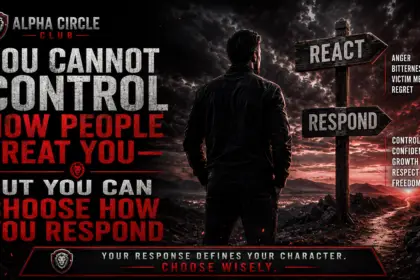
Disrespect demands a response—but not always the response the other person expects.
Sometimes a boundary must be established immediately. The behaviour must be stopped before silence is mistaken for permission.
At other times, the disrespect is bait.
The person wants anger.
They want an explosion.
They want you to react impulsively so they can ignore what they did and make your reaction the new problem.
An alpha man does not ignore disrespect, but neither does he react on command.
He decides whether the moment requires immediate correction or a longer, more strategic response.
His ego does not choose the timing.
His anger does not choose the method.
His judgement does.
The alpha response is not always immediate—but it is always deliberate.
1. Not All Disrespect Is the Same
Disrespect can appear in many forms.
It may be:
- A careless comment
- A dismissive tone
- An insulting joke
- Repeated interruptions
- Public humiliation
- Broken agreements
- Workplace undermining
- A deliberate lie
- Physical intimidation
- Harassment
- An attempt to provoke anger
These situations should not all receive the same response.
A careless remark from someone who normally treats you well may require a calm conversation.
Repeated public humiliation may require an immediate boundary.
A workplace campaign of subtle undermining may require documentation and formal action.
Physical threats may require leaving the situation and seeking help immediately.
Wisdom begins by identifying what is actually happening.
Before responding, ask:
- What exactly was said or done?
- Was it intentional?
- Is this the first incident or part of a pattern?
- Who witnessed it?
- Is anyone in danger?
- What may happen if I ignore it?
- What may happen if I react immediately?
- Is the person seeking resolution—or a reaction?
An insecure man treats every slight as a declaration of war.
A passive man dismisses every violation as unimportant.
A strong man assesses the seriousness accurately and responds proportionately.
Alpha Insight
Not every act of disrespect deserves the same response. Strength begins with seeing the situation clearly before deciding how to act.
2. The Two Alpha Responses to Disrespect
There are two broad ways a man may need to deal with disrespect.
Response One: Immediate Correction
Some behaviour must be challenged in the moment.
Immediate action may be necessary when:
- Safety is threatened
- Someone becomes aggressive
- A clear boundary is crossed
- Another person is being targeted
- Silence could be interpreted as agreement
- The behaviour is likely to escalate
- Your professional authority is being deliberately undermined
- Someone is testing how much mistreatment you will accept
The response should be calm, direct and proportionate.
Response Two: Strategic Patience
Other forms of disrespect are bait.
The person may want you to lose your temper, threaten them or react publicly so they can use your behaviour against you.
The longer approach may involve:
- Remaining composed
- Observing the pattern
- Preserving evidence
- Identifying witnesses
- Reducing access
- Seeking advice
- Preparing a factual response
- Choosing the correct audience
- Acting through formal channels
Neither response is automatically stronger.
The correct response is the one that protects truth, dignity, safety and your long-term position.
Alpha Insight
Sometimes strength means speaking immediately. Sometimes it means refusing to react until the facts, timing and position are in your favour.
3. The Cost of Ignoring Clear Disrespect
Some men use calmness as an excuse to avoid confrontation.
They tell themselves:
“I am being the bigger man.”
“It is not worth responding.”
“I do not want drama.”
But privately, they know they are afraid to establish a boundary.
They continue accepting:
- Repeated insults
- Broken agreements
- Public embarrassment
- Manipulation
- Unreasonable demands
- People speaking to them however they choose
- Constant jokes at their expense
- Intrusions into their time and privacy
Over time, silence can teach people that there are no consequences.
The person may interpret your restraint as permission.
What began as an occasional comment becomes normal behaviour.
The boundary is pushed further because the previous violation produced no resistance.
An alpha man does not need to create a scene.
But he must communicate when a standard has been crossed.
He can say:
- “Do not speak to me like that.”
- “That comment was inappropriate.”
- “You will not address me in that way.”
- “That statement is untrue. Let us correct it now.”
- “This conversation is over until you can speak respectfully.”
The objective is not intimidation.
It is clarity.
Alpha Insight
What you repeatedly tolerate can become the standard people expect you to accept. Calmness must never become permission for continued mistreatment.
4. Immediate Correction Without Losing Control
Responding immediately does not mean reacting emotionally.
A fast response can still be disciplined.
The strongest immediate correction is usually:
- Brief
- Direct
- Calm
- Specific
- Focused on the behaviour
- Free from unnecessary threats
- Proportionate to what happened
A weak response attacks the person:
“You are a disrespectful idiot.”
A stronger response addresses the conduct:
“The way you just spoke to me was disrespectful. Do not repeat it.”
The first response invites a personal argument.
The second establishes a standard.
A controlled correction may follow three steps:
Name the Behaviour
“That comment was disrespectful.”
State the Standard
“I expect us to speak professionally.”
Explain the Consequence
“If it continues, I will end the conversation.”
You do not need a speech.
Long explanations can weaken the boundary by creating opportunities for the other person to debate it.
State the standard.
Remain calm.
Follow through.
Alpha Insight
Immediate does not mean emotional. A strong man can correct disrespect quickly without surrendering control of his voice, language or behaviour.
5. When Disrespect Is a Test
Some people begin with small acts of disrespect to discover what a man will tolerate.
They may:
- Interrupt him repeatedly
- Dismiss his contribution
- Ignore a minor agreement
- Make jokes at his expense
- Speak over him
- Arrive late without explanation
- Use an unnecessarily patronising tone
- Invade his privacy
- Make decisions involving him without consultation
Each incident may appear too small to challenge.
But together, they may form a pattern.
The person is learning:
Will he object?
Will he enforce his standards?
Will there be consequences?
Can we go further next time?
An early, calm correction can prevent a larger problem.
The correction need not be aggressive.
It may be as simple as:
“I was still speaking.”
“We agreed on a different arrangement.”
“Do not make jokes about me in that way.”
“Ask before sharing my information.”
A man does not need to assume malicious intent immediately.
But he should notice whether the behaviour changes after the boundary is stated.
A genuine mistake is usually corrected.
A deliberate test often continues.
Alpha Insight
Small acts of disrespect can be tests of your standards. Correct them early and calmly before another person mistakes patience for permission.
6. When Disrespect Is Bait
Not every disrespectful person is testing a boundary.
Some are setting a trap.
They want you to react.
They may:
- Challenge you publicly
- Use sarcasm
- Make personal comments
- Repeat rumours
- Misrepresent your words
- Question your competence in front of others
- Send provocative messages
- Try to embarrass you
- Continue until you lose your temper
Their objective may be to make you:
- Shout
- Threaten them
- Become aggressive
- Send an abusive response
- Lose credibility
- React in front of witnesses
- Provide evidence they can use
- Make yourself appear unreasonable
Their behaviour may be wrong.
But your reaction can still create serious consequences for you.
You may begin as the person being mistreated and end as the person being investigated.
You may have the truth on your side but damage your position through uncontrolled behaviour.
Recognising the trap changes the response.
Instead of exploding, you observe.
Instead of threatening, you document.
Instead of giving them the scene they want, you protect your future.
Alpha Insight
Sometimes the disrespect is not the real attack. The real attack is the reaction they are trying to pull out of you.
7. Ego Wants an Immediate Victory
Ego hates delay.
It says:
“Answer now.”
“Embarrass them.”
“Show everyone who is stronger.”
“Do not let them think they have won.”
But the wisest response may not provide instant satisfaction.
Strategic patience can feel uncomfortable because the man may remain temporarily misunderstood.
The other person may believe they escaped consequences.
Spectators may mistake his silence for weakness.
His ego may demand visible action.
But a short emotional victory can create a long-term loss.
Winning an argument may damage a working relationship.
Sending the angry message may damage a formal complaint.
Threatening someone may weaken your credibility.
Publicly humiliating them may make both sides appear equally unprofessional.
The disciplined question is not:
“How do I win this moment?”
It is:
“What response protects my position six months from now?”
A mature man is willing to tolerate temporary discomfort to avoid permanent damage.
Alpha Insight
Ego wants to win the moment. Wisdom wants to protect the future. Never trade your long-term position for five minutes of emotional satisfaction.
8. Silence Can Be Part of the Response
Silence does not always mean nothing is happening.
A silent man may be:
- Studying the situation
- Preserving evidence
- Reassessing the relationship
- Identifying a pattern
- Removing access
- Seeking professional advice
- Preparing formal action
- Waiting for the correct audience
- Allowing the other person’s behaviour to become undeniable
The disrespectful person may assume there will be no consequences because the man did not respond immediately.
But consequences do not always arrive as arguments.
They may arrive as:
- Reduced trust
- Less information
- Fewer opportunities
- Formal documentation
- A private correction
- A workplace report
- An ended relationship
- Permanent distance
Silence can be a strategic phase between the incident and the response.
But it must remain a choice.
A man should not use silence to avoid necessary action indefinitely.
Alpha Insight
Silence can be part of the response, but it should never become an excuse for fear. Observe quietly, protect your position and know what you are preparing to do next.
9. The Longer Approach Requires a Purpose
Waiting is not automatically strategic.
A man must know why he is waiting.
Perhaps he needs time to:
- Calm down
- Gather the facts
- Confirm what was said
- Identify witnesses
- Speak privately
- Consult a manager
- Seek legal or professional guidance
- Determine whether the behaviour is a pattern
- Protect an important project
- Choose a safer setting
- Prepare a clear statement
Without a purpose, “playing the long game” may become avoidance.
The man keeps delaying because confrontation feels uncomfortable.
Months pass.
The disrespect continues.
Resentment grows.
Nothing changes.
Strategic patience should answer three questions:
- What am I waiting for?
- What am I doing while I wait?
- What will tell me it is time to act?
The longer approach is powerful only when it moves towards a deliberate outcome.
Alpha Insight
Waiting without a reason is delay. Strategic patience has an objective, a preparation phase and a point at which action begins.
10. Observe Patterns, Not Isolated Words
One careless comment may be a mistake.
Repeated behaviour reveals a pattern.
The longer approach helps a man determine:
- Whether the disrespect is intentional
- Whether it happens only in public
- Whether the person behaves differently around authority
- Whether they target other people
- Whether their story changes
- Whether they apologise sincerely
- Whether behaviour improves after correction
- Whether they respect boundaries once stated
This protects the man from two opposite mistakes.
The first is turning every minor incident into a major conflict.
The second is dismissing a repeated pattern as coincidence.
Context matters.
History matters.
Behaviour after correction matters.
A person who immediately acknowledges a mistake and changes may deserve another opportunity.
A person who apologises but repeats the conduct may be using words to avoid consequences.
Do not judge character from one imperfect moment.
But do not ignore the evidence created by repeated choices.
Alpha Insight
Do not make every mistake into a war, but do not keep calling a pattern an accident. Repeated behaviour deserves a stronger response.
11. Do Not Fight Every Battle Publicly
Public disrespect creates pressure for public retaliation.
A man may feel that he must defend himself immediately so nobody interprets his silence as weakness.
Sometimes a brief public correction is necessary.
He may say:
“That comment was inappropriate.”
“That statement is inaccurate.”
“Do not address me in that way.”
“We can discuss this privately.”
This acknowledges the boundary without turning the entire room into an arena.
A prolonged public confrontation often creates more problems:
- Spectators become involved
- Details are misunderstood
- Pride takes control
- People begin performing for the audience
- The original issue becomes harder to resolve
- Both sides may lose credibility
The objective is not to entertain the room.
It is to protect the standard.
Correct what must be corrected publicly.
Handle the deeper discussion in the correct setting.
Alpha Insight
Public disrespect may require a public boundary, but it rarely requires a public performance. Correct the behaviour without turning spectators into an audience.
12. Protect Your Reputation With Evidence
When disrespect involves lies, workplace undermining, harassment or repeated misconduct, memory is not enough.
Preserve relevant evidence.
This may include:
- Messages
- Emails
- Dates
- Times
- Witnesses
- Agreements
- Screenshots
- Meeting notes
- Accurate written accounts
- Copies of relevant policies
Record events while they are still fresh.
Use factual language.
Avoid exaggeration.
Separate what you directly witnessed from what someone else told you.
For example:
Weak record:
“He is always trying to destroy me.”
Strong record:
“On 14 July at approximately 3:15 p.m., he interrupted me three times during the meeting and stated that my figures were fabricated. Sarah and Michael were present. The figures were later confirmed in the attached report.”
The longer approach becomes powerful when it is built on facts rather than resentment.
Documentation is not revenge.
It is protection.
Alpha Insight
When disrespect becomes a serious pattern, protect your position with facts. Clear evidence carries more weight than emotional memory.
13. Boundaries Must Have Consequences
A boundary is not only:
“Please stop.”
A complete boundary explains what you will do if the behaviour continues.
For example:
“If you continue insulting me, I will end the conversation.”
“If you share my private information again, I will no longer discuss personal matters with you.”
“If this conduct continues at work, I will report it through the appropriate process.”
“If you repeatedly break this agreement, I will end our involvement.”
Consequences may include:
- Ending the conversation
- Leaving the environment
- Reducing contact
- Removing trust
- Declining future work together
- Reporting misconduct
- Ending the relationship
- Protecting private information
- Blocking communication
A consequence must be:
- Realistic
- Proportionate
- Lawful
- Within your control
- Something you are prepared to enforce
Do not threaten consequences you cannot or will not carry out.
Empty warnings weaken future boundaries.
Alpha Insight
A boundary without a consequence is often only a request. State what you will do, then prove that your standards have weight.
14. Remove Access Instead of Repeating Warnings
Some people understand your boundary perfectly.
They simply do not respect it.
You explain.
They apologise.
The behaviour returns.
You explain again.
They promise again.
The cycle continues.
At some point, more words may not help.
The response may need to become:
- Less access
- Less information
- Less availability
- Less trust
- Greater distance
- No further relationship
A man does not need to keep teaching the same lesson to someone committed to failing it.
Changed access can communicate what repeated explanations could not.
This does not always require a dramatic announcement.
You may simply stop involving the person in private matters.
Decline future invitations.
Refuse another business arrangement.
End unnecessary conversations.
Trust is not an entitlement.
It is maintained through behaviour.
Alpha Insight
When words repeatedly fail, changed access becomes the message. Stop giving full privileges to people who repeatedly violate your standards.
15. Do Not Let Disrespect Turn You Into a Disrespectful Man
A man may feel justified in insulting, humiliating or threatening the person in return.
But becoming disrespectful does not restore self-respect.
It only spreads the behaviour.
The other person’s lack of character does not release you from your own standards.
You can be assertive without being abusive.
Firm without being cruel.
Direct without becoming threatening.
You can impose consequences without seeking revenge.
The goal is not only to defeat the other person.
It is to leave the situation without becoming a reflection of them.
Ask:
- Am I protecting a boundary or satisfying anger?
- Am I seeking accountability or humiliation?
- Will this response align with my values tomorrow?
- Am I becoming the type of man I claim to oppose?
Strength is not measured by how much pain you can return.
It is measured by whether another person’s conduct can force you to abandon your own.
Alpha Insight
Do not allow another person’s disrespect to recruit you into becoming disrespectful. Protect your dignity without surrendering your character.
16. Safety Changes the Response
Some situations are more serious than ordinary disrespect.
If there is:
- Physical aggression
- Threats
- Stalking
- Harassment
- Abuse
- Blackmail
- Serious workplace misconduct
- Danger to a child or vulnerable person
- A credible risk of violence
The priority is safety—not proving courage.
Leave the environment where possible.
Contact the relevant authorities or workplace channels.
Preserve evidence.
Seek appropriate professional support.
Do not remain in danger merely because you want to show that you cannot be intimidated.
Walking away from immediate danger is not weakness.
Neither is asking for help.
Self-control includes recognising when a situation should no longer be handled privately.
Alpha Insight
When safety is involved, strength means protection—not performance. Leave danger, seek help and use the proper channels.
17. Faith, Dignity and Self-Control
A faith-led man should not believe Christianity requires accepting every form of mistreatment without boundaries.
He can forgive while creating distance.
Remain peaceful while speaking firmly.
Seek justice without pursuing revenge.
Show compassion without ignoring repeated misconduct.
Faith gives him a higher question:
“What response reflects truth, wisdom and the man God is shaping me to become?”
He is not governed by wounded pride.
But neither does he abandon discernment.
Forgiveness does not always restore trust.
Reconciliation requires honesty and change.
A man may release hatred while recognising that a relationship is no longer healthy.
He can pray for someone and still remove their access.
He can refuse revenge and still report serious wrongdoing.
Peace is not passive acceptance.
It is the ability to act without becoming consumed by hatred.
Alpha Insight
Faith does not require you to abandon boundaries. You can forgive without becoming naïve, seek justice without revenge and remain peaceful while standing firmly in truth.
The Alpha Disrespect Test
Before choosing a response, ask these five questions.
1. Is There Immediate Danger?
When safety is involved, act immediately.
Leave.
Call for help.
Report the situation.
Protect the person at risk.
This is not the moment for a long psychological strategy.
2. Must the Boundary Be Clear Now?
If silence could encourage escalation, damage authority or be interpreted as agreement, correct the behaviour immediately.
Keep the response brief and controlled.
3. Is This Person Trying to Provoke Me?
Look for bait:
- Public comments
- Sarcasm
- Personal attacks
- Repeated interruptions
- Selective disrespect in front of witnesses
- Attempts to create an angry response
Do not provide the evidence they want.
4. What Response Protects My Long-Term Position?
Consider:
- Reputation
- Employment
- Business
- Relationships
- Safety
- Possible legal consequences
- Future access
Choose the response that will still appear wise after the emotion has passed.
5. What Outcome Am I Trying to Create?
Do you want:
- Correction
- Protection
- Accountability
- Distance
- Resolution
- Revenge
The desired outcome should determine the response.
Alpha Insight
Before acting, identify the danger, boundary, motive, long-term risk and desired outcome. A clear assessment prevents emotion from choosing blindly.
The Alpha Disrespect Framework
Use this five-part framework whenever disrespect occurs:
IDENTIFY → CONTROL → CHOOSE → BOUNDARY → CONSEQUENCE
Identify
Determine what you are dealing with.
Is it:
- A mistake
- A boundary test
- A repeated pattern
- Deliberate bait
- Harassment
- Immediate danger
Do not choose the response before identifying the situation.
Control
Bring your emotions back under authority.
Breathe.
Lower your voice.
Avoid sending the immediate message.
Leave the situation temporarily if necessary.
Anger can provide information, but it should not make the entire decision.
Choose
Select the most appropriate response:
- Immediate correction
- Strategic observation
- Private discussion
- Formal reporting
- Reduced access
- Permanent distance
- Emergency action
The most dramatic response is not automatically the strongest.
Boundary
State the standard clearly where necessary.
Name the behaviour.
Explain what must change.
Keep the message specific.
Consequence
Follow through if the behaviour continues.
End the conversation.
Leave.
Reduce access.
Report the matter.
End the relationship.
A consequence transforms the boundary from words into reality.
Alpha Insight
Identify the situation, control yourself, choose deliberately, state the boundary and enforce the consequence. That is how disrespect is handled without surrendering your power.
Immediate Response vs the Longer Approach
| Immediate response | Longer approach |
|---|---|
| Used when safety is involved | Used when provocation is the trap |
| Stops clear boundary violations | Studies repeated patterns |
| Corrects behaviour in the moment | Preserves evidence |
| Prevents silence being mistaken for permission | Avoids emotional mistakes |
| Protects people under your leadership | Protects your long-term position |
| Uses brief, firm language | Chooses the correct audience |
| Establishes an immediate standard | Builds a stronger factual case |
| Ends active mistreatment | Changes access strategically |
| Acts without unnecessary aggression | Responds when timing and facts are stronger |
A Personal Declaration
I will not ignore disrespect.
But neither will I react on command.
Some situations require my immediate voice.
When a boundary must be defended, I will speak calmly, directly and without fear.
Other situations require patience.
I will observe the pattern, preserve the facts and choose the moment that protects my future.
My ego will not decide my timing.
Provocation will not control my behaviour.
I will not give another person the reaction they need to use against me.
I will not confuse aggression with strength.
I will not confuse silence with fear.
I will not accept endless mistreatment in the name of patience.
Whether I respond now or later, the decision will belong to me.
Final Thoughts
Disrespect does not always require silence.
It does not always require immediate confrontation either.
Sometimes the strongest response is immediate.
Look the person in the eye.
Identify the behaviour.
Establish the boundary.
Make the standard clear.
At other times, the strongest response is patience.
Let the pattern reveal itself.
Preserve the evidence.
Protect your position.
Reduce access.
Choose the correct audience.
Respond when your judgement—not your anger—is in command.
Do not ignore disrespect.
But do not become controlled by it.
Learn to distinguish between the boundary that must be defended now and the trap that must not receive your reaction.
Immediate correction and strategic patience are not opposites.
They are two tools.
The power lies in knowing which one the moment requires.
An alpha man does not ask only, “How quickly should I respond?” He asks, “Which response gives me control of the outcome without losing control of myself?”
Final Alpha Insight
The man who reacts to every provocation can be controlled by anyone. The man who chooses his timing, method and consequence remains in command of himself.



No spam. Unsubscribe anytime.