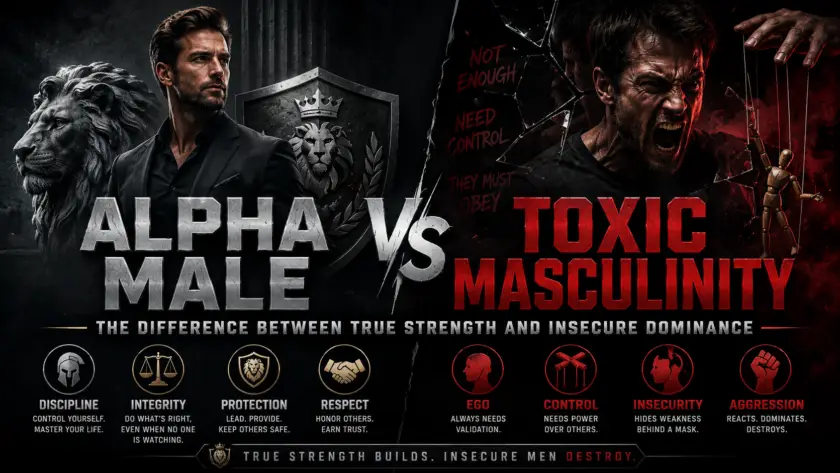
The loudest man in the room is not always the strongest.
The most aggressive man is not always the bravest.
And the man who tries to control everyone around him is rarely in control of himself.
Toxic masculinity often wears the costume of strength. It speaks loudly, demands obedience, rejects vulnerability, and mistakes intimidation for leadership.
Healthy alpha masculinity looks very different.
It is disciplined.
Responsible.
Protective.
Emotionally controlled.
Governed by character.
A true alpha man does not use his strength to make other people feel smaller. He uses it to become someone others can depend on when life becomes difficult.
Toxic masculinity is insecurity disguised as strength. Alpha masculinity is strength governed by character.
The Alpha Male Is Often Misunderstood
The term “alpha male” has become controversial.
To some people, it describes a disciplined, confident, courageous man who leads, protects, takes responsibility, and refuses to live without purpose.
To others, it describes an arrogant man who dominates conversations, disrespects women, humiliates other men, suppresses emotion, and constantly attempts to prove his superiority.
At Alpha Circle Club are goal is the first type of man
The problem is not necessarily the word. Lions are called alpha, they display types of qualities that cannot be questioned. Hyenas are loud and have no leader qualities.
The problem is the behaviour some men try to hide behind it.
Calling yourself an alpha does not make cruelty respectable.
It does not transform aggression into leadership.
It does not make jealousy protective.
It does not make emotional immaturity masculine.
It does not turn manipulation into confidence.
A man is not alpha because he says he is.
His conduct reveals what he is.
Does he keep his word?
Does he remain controlled under pressure?
Does he accept responsibility?
Does he treat people with dignity?
Does he protect those with less power?
Does he use his strength constructively?
Does he admit when he is wrong?
Does he continue growing?
Those questions reveal far more about a man than his appearance, wealth, social status, physical size, or online persona.
Masculinity Is Not the Enemy
Masculinity itself is not toxic.
Courage is not toxic.
Strength is not toxic.
Ambition is not toxic.
Competitiveness is not toxic.
Leadership is not toxic.
Protectiveness is not toxic.
Assertiveness is not toxic.
The willingness to take risks, endure hardship, defend others, and pursue difficult goals can all be valuable masculine qualities.
Problems arise when destructive behaviour is presented as a requirement of being a “real man.”
This can include beliefs such as:
- A real man must never show fear.
- A real man must never ask for help.
- A real man must dominate every room.
- A real man must control his partner.
- A real man must respond to disrespect with violence.
- A real man must hide pain.
- A real man proves himself through sexual conquest.
- A real man never apologises.
- A real man sees kindness as weakness.
- A real man must always win.
These beliefs do not create strong men.
They create men who are terrified of appearing weak.
And a man who is constantly afraid of how others perceive him can become controlled by that fear.
Healthy masculinity does not require a man to reject strength.
It requires him to govern his strength wisely.
What Is Healthy Alpha Masculinity?
A healthy alpha man leads himself before attempting to lead anyone else.
He takes responsibility for his:
- Decisions
- Health
- Finances
- Emotions
- Relationships
- Mistakes
- Habits
- Commitments
- Future
He does not demand respect while living without discipline.
He does not preach responsibility while blaming everyone else.
He does not expect loyalty while behaving dishonestly.
He does not speak about leadership while creating fear and instability around him.
Healthy alpha masculinity begins with self-mastery.
A man must learn to govern his appetite, anger, ego, speech, habits, spending, reactions, and impulses.
Without that foundation, attempts to lead others can easily become attempts to control them.
The first territory an alpha man must conquer is himself.
Self-Control vs Aggression
A toxic man loses control and calls it passion.
He shouts, threatens, punches walls, breaks possessions, humiliates others, and then claims that his anger proves how deeply he cares.
But uncontrolled anger is not evidence of strength.
It is evidence that an emotion temporarily took control of the man.
A strong man can experience intense anger without immediately obeying it.
He can pause before speaking.
He can leave the room before saying something destructive.
He can refuse to turn a disagreement into a threat.
He can confront a problem firmly without becoming reckless.
He understands that temporary emotions can create permanent consequences.
One violent decision can destroy a relationship.
One uncontrolled confrontation can end a career.
One moment of rage can lead to injury, legal consequences, regret, and years of damage.
Any man can become aggressive. It takes strength to remain controlled when aggression would be easier.
Self-control does not mean passivity.
There are times when a man must speak firmly.
There are times when he must defend himself or another person.
There are times when he must refuse, confront, report, leave, or take decisive action.
The difference is that his actions are guided by judgement rather than ego.
Leadership vs Control
Leadership and control can look similar from a distance.
Both may involve making decisions, setting direction, and expecting standards.
But the motive and method are different.
Leadership creates clarity.
Control creates fear.
Leadership earns cooperation.
Control demands submission.
Leadership accepts responsibility.
Control takes credit and distributes blame.
Leadership develops other people.
Control keeps them dependent.
Leadership communicates.
Control manipulates.
Leadership builds trust.
Control monitors, pressures, punishes, and restricts.
A true leader does not need everyone around him to become powerless before he can feel powerful.
He can listen without surrendering authority.
He can consider advice without feeling threatened.
He can change his mind when better information becomes available.
He can make difficult decisions and accept the consequences.
A controlling man often behaves differently.
He treats disagreement as disloyalty.
He needs constant obedience.
He may use silence, anger, financial pressure, jealousy, guilt, threats, or humiliation to influence other people.
He does not want respect.
He wants compliance.
The difference is simple:
Leadership earns cooperation. Control demands submission.
Confidence vs Arrogance
Confidence is quiet.
Arrogance needs an audience.
A confident man knows his strengths without pretending he has no weaknesses.
He can enter a room without needing to become the centre of it.
He can recognise another man’s talent without feeling diminished.
He can receive criticism without immediately becoming defensive.
He can admit that he does not know something.
He can allow another person to succeed.
Arrogance behaves differently.
The arrogant man needs constant comparison.
He must be richer, stronger, more attractive, more important, or more respected than everyone around him.
He talks more than he listens.
He exaggerates his achievements.
He belittles others to elevate himself.
He confuses attention with respect.
But arrogance is often fragile.
It requires constant reinforcement because it is built on external validation.
Confidence remains stable without applause.
A true alpha man does not need to announce his value every five minutes.
His discipline, standards, competence, and conduct speak for him.
Protection vs Possession
A protective man wants the people around him to feel safe, supported, respected, and free.
A possessive man wants control.
This difference is especially important in romantic relationships.
Possession may disguise itself as concern.
A man may say:
“I only tell you what to wear because I care.”
“I need to know where you are at all times because I am protecting you.”
“You should not speak to those people because I know what is best.”
“You do not need your own money because I will handle everything.”
These statements may sound protective, but they can become tools of restriction.
Protection supports another person’s wellbeing.
Possession limits another person’s freedom to reduce the controlling person’s anxiety.
A protective man can communicate concerns honestly.
He can establish boundaries around his own involvement.
He can decide what kind of relationship he is willing to remain in.
But he does not own another adult.
He does not confuse love with surveillance.
He does not use physical strength, money, jealousy, or fear to remove someone else’s independence.
Protection creates security.
Possession creates captivity.
Boundaries vs Intimidation
Healthy alpha men have boundaries.
They know what they value.
They know what behaviour they will accept.
They communicate clearly.
And when a boundary is repeatedly violated, they are prepared to act.
That action may involve ending a conversation, reducing contact, leaving a relationship, changing employment, or removing access.
Intimidation is different.
A toxic man does not simply protect his own life.
He attempts to control the choices of others through fear.
He may:
- Threaten consequences
- Use physical size to frighten
- Humiliate someone publicly
- Invade personal space
- Shout over people
- Punch objects
- Make veiled threats
- Use private information as leverage
- Create fear around disagreement
A boundary says:
“This is what I will do if this behaviour continues.”
Intimidation says:
“You must do what I want, or I will make you afraid.”
Boundaries protect your life.
Intimidation attempts to control someone else’s.
Emotional Strength vs Emotional Suppression
Some men have been taught that masculinity requires them to feel nothing.
They suppress grief.
They deny fear.
They hide disappointment.
They refuse to admit loneliness.
They pretend rejection did not hurt them.
They carry trauma silently because asking for support feels shameful.
But emotions do not disappear simply because a man refuses to name them.
Unprocessed pain may reappear as:
- Anger
- Addiction
- Aggression
- Isolation
- Reckless behaviour
- Emotional numbness
- Controlling behaviour
- Sleep problems
- Relationship breakdown
- Self-destruction
Emotional strength does not mean broadcasting every feeling to everyone.
Not every person deserves access to a man’s inner world.
Privacy can be healthy.
Restraint can be wise.
But honesty with oneself is essential.
A strong man can say:
“I am angry.”
“I am afraid.”
“I am grieving.”
“I feel rejected.”
“I need support.”
“I am not handling this well.”
Those admissions do not make him less masculine.
They allow him to deal with reality before reality begins controlling him.
Emotional strength is not the absence of emotion. It is the ability to face emotion without being ruled by it.
Calm Does Not Mean Weak
Toxic masculinity often treats calmness as weakness.
A man who walks away from a pointless confrontation may be called afraid.
A man who refuses to shout may be treated as passive.
A man who seeks counselling may be mocked.
A man who communicates respectfully may be accused of lacking dominance.
But calmness can be a form of power.
The man who remains controlled keeps access to his judgement.
He notices more.
He chooses his words.
He avoids unnecessary consequences.
He can respond strategically rather than react impulsively.
Loudness is not power.
Aggression is not courage.
Emotional chaos is not passion.
Sometimes the calmest man in the room has the greatest control because he is not being controlled by the room.
Accountability vs Excuses
The toxic man has an explanation for everything.
His former partner was always the problem.
His manager was jealous.
His friends betrayed him.
The world misunderstood him.
His temper was caused by someone else.
His dishonesty was necessary.
His mistakes were unavoidable.
Nothing is ever his responsibility.
This protects his ego, but it prevents growth.
A healthy alpha man examines himself.
He asks:
- What did I do wrong?
- What warning signs did I ignore?
- Did I communicate clearly?
- Did my pride make the situation worse?
- What responsibility belongs to me?
- What must I improve?
- How can I prevent this pattern from repeating?
Accountability does not mean accepting blame for everything.
Some people will genuinely mistreat, betray, manipulate, or deceive you.
A strong man should recognise that clearly.
But he must also be honest about his own contribution where one exists.
Accountability gives a man power because it identifies what he can change.
Blame may protect the ego temporarily.
Responsibility builds a better future.
Respecting Women Does Not Weaken Men
A man does not become stronger by disrespecting women.
He does not prove masculinity through humiliation, manipulation, sexual pressure, infidelity, insults, or control.
A man who needs a woman to become smaller so he can feel larger is not demonstrating strength.
He is revealing insecurity.
A strong man can be assertive without being cruel.
He can disagree without degrading.
He can communicate expectations without threatening.
He can protect without possessing.
He can leave an unhealthy relationship without becoming abusive.
He can recognise differences between men and women without treating either as inferior.
Respect does not mean agreeing with everything.
It does not require a man to abandon standards, boundaries, preferences, or self-respect.
It means treating another human being with dignity while expressing those standards honestly.
How a man treats someone with less physical, financial, or social power reveals more about his character than how he behaves around those he fears.
Brotherhood vs Constant Competition
Competition can be healthy.
It can push men to train harder, think more strategically, develop skills, and raise their standards.
But toxic competition turns every room into a battlefield.
The insecure man needs every other man to lose.
He cannot celebrate another man’s success.
He interprets friendship as ranking.
He becomes jealous when someone improves.
He spreads rumours, withholds support, or attempts to sabotage others because their progress makes him feel threatened.
Healthy brotherhood is different.
Strong men can challenge one another without hatred.
They can compete without betrayal.
They can correct one another without humiliation.
They can celebrate another man’s progress without believing it diminishes their own.
True brotherhood includes:
- Accountability
- Loyalty
- Honest correction
- Shared standards
- Encouragement
- Celebration of progress
- Support during difficult periods
- Respectful competition
The alpha man builds strong men around him.
The insecure man tries to keep everyone beneath him.
Kindness Is Not Weakness
Some men avoid kindness because they fear being exploited.
They believe that empathy, patience, generosity, and compassion will make them look soft.
But kindness without boundaries and kindness with boundaries are not the same.
A weak man may help because he is afraid to say no.
A strong man may help because he has chosen to.
A weak man may tolerate disrespect to keep the peace.
A strong man can remain respectful while refusing mistreatment.
A weak man may give because he wants approval.
A strong man can give without becoming dependent on gratitude.
Kindness becomes powerful when it is voluntary, disciplined, and protected by standards.
The objective is not to become harmless.
It is to become controlled.
Assertiveness vs Cruelty
Assertiveness means expressing your position clearly and respectfully.
Cruelty means using unnecessary harm to establish power.
An assertive man can say:
“No.”
“That is unacceptable.”
“I disagree.”
“I will not continue this conversation while you are speaking to me like that.”
“If this continues, I will leave.”
A cruel man adds humiliation.
He attacks character.
He targets insecurities.
He attempts to wound rather than resolve.
Healthy masculinity does not require a man to become agreeable or submissive.
It requires him to communicate strength without losing character.
You can be firm without being abusive.
You can be powerful without becoming destructive.
Strength Should Make Others Safer
What is the purpose of becoming stronger?
If greater strength makes a man more dangerous to innocent people, more controlling in relationships, or more arrogant towards those with less power, then his character has not developed with his ability.
True strength should make:
- His family safer
- His partner more secure
- His children better guided
- His friends more supported
- His workplace more stable
- His community stronger
- His own behaviour more disciplined
A physically strong man should not use his size to terrorise.
A financially successful man should not use money to control.
An intelligent man should not use knowledge to manipulate.
A socially influential man should not use status to humiliate.
Power reveals character.
When a good man gains power, he becomes more useful.
When an insecure man gains power, he often becomes more dangerous.
The strongest man in the room should not be the greatest threat. He should be the greatest source of stability.
Alpha Masculinity vs Toxic Masculinity
| Healthy alpha masculinity | Toxic masculinity |
|---|---|
| Self-control | Aggression |
| Confidence | Arrogance |
| Leadership | Control |
| Protection | Possession |
| Boundaries | Intimidation |
| Discipline | Recklessness |
| Accountability | Blame |
| Emotional strength | Emotional denial |
| Respect | Humiliation |
| Brotherhood | Constant competition |
| Purpose | Attention-seeking |
| Quiet confidence | Performative dominance |
| Assertiveness | Cruelty |
| Courage | Reckless risk-taking |
| Independence | Refusal to seek help |
| Strength | Abuse of power |
The difference is not whether a man is powerful.
The difference is how he uses power.
The Performative Alpha
The performative alpha is obsessed with appearing masculine.
He talks constantly about dominance.
He tries to control every social interaction.
He judges other men for showing emotion.
He treats relationships as contests.
He needs to be seen as dangerous.
He creates an image rather than developing character.
But true strength does not require constant advertising.
A disciplined man does not need to remind everyone that he is disciplined.
A courageous man does not need to manufacture conflict to prove courage.
A respected man does not need to demand respect in every conversation.
A leader does not need to humiliate others to maintain authority.
Performance focuses on perception.
Character focuses on conduct.
A Real Alpha Can Ask for Help
One of the most destructive beliefs associated with toxic masculinity is that a man must handle everything alone.
This can prevent men from seeking support when they are struggling with:
- Depression
- Anxiety
- Grief
- Addiction
- Trauma
- Financial problems
- Relationship breakdown
- Anger
- Suicidal thoughts
- Physical illness
Asking for help does not automatically mean surrendering independence.
It means recognising when a problem requires knowledge, perspective, treatment, or support that you do not currently possess.
A man who refuses help solely to protect his image may allow a manageable problem to become a crisis.
Strength includes knowing when to carry the load.
Wisdom includes knowing when the load requires assistance.
Discipline Must Include How You Treat People
Some men are disciplined in the gym but chaotic in relationships.
They follow strict diets but cannot control their anger.
They build businesses but neglect their families.
They speak about standards but behave dishonestly.
They develop their bodies while ignoring their character.
Discipline is incomplete when it applies only to visible achievements.
A disciplined man must also control:
- How he speaks when angry
- How he behaves when tempted
- How he treats people who cannot benefit him
- How he responds to rejection
- How he handles power
- How he behaves when nobody is watching
- How he accepts correction
Physical strength without moral discipline can become dangerous.
Financial strength without integrity can become exploitation.
Social influence without responsibility can become manipulation.
The alpha standard must include character.
The Alpha Masculinity Standard
CONTROL → LEAD → PROTECT → RESPECT → GROW
1. Control
Master your emotions, habits, impulses, speech, and reactions before attempting to control your environment.
Pause before acting.
Think before speaking.
Refuse to let anger, lust, pride, jealousy, or fear make your decisions.
A man who cannot govern himself is not ready to lead others.
2. Lead
Create direction through conduct, consistency, and responsibility.
Do not demand standards you refuse to follow.
Do not ask for loyalty while behaving dishonestly.
Do not use fear to manufacture obedience.
Lead in a way that makes people stronger, not smaller.
3. Protect
Use strength to create safety.
Protect your health, family, purpose, boundaries, finances, and future.
Defend people who are vulnerable when it is right and safe to do so.
But never use protection as an excuse for possession or control.
4. Respect
Treat people with dignity without abandoning your standards.
Respect women.
Respect other men.
Respect yourself.
Speak firmly when necessary.
Walk away when required.
But do not make humiliation your method.
5. Grow
Accept correction.
Study your weaknesses.
Repair the damage you have caused.
Learn new skills.
Seek help when necessary.
Continue becoming a better man.
The moment a man believes he has nothing left to learn is often the moment his decline begins.
Questions Every Man Should Ask Himself
A man who wants to practise healthy masculinity should examine himself regularly.
Ask:
- Do people feel safe being honest with me?
- Can I receive criticism without exploding?
- Do I use anger to control conversations?
- Do I respect boundaries?
- Am I dependable?
- Do I keep my word?
- Do I apologise when I am wrong?
- Do I treat women with dignity?
- Can I recognise another man’s strength without becoming jealous?
- Do I ask for help before a problem becomes destructive?
- Does my strength make others safer?
- Am I building character or only an image?
These questions may be uncomfortable.
That is the point.
Growth begins where self-deception ends.
Final Thoughts
The alpha male is not the loudest man.
He is not the most aggressive.
He is not the man who controls his partner, frightens his friends, humiliates weaker people, or refuses to admit pain.
He is not defined by endless dominance, sexual conquest, public attention, or performative toughness.
A true alpha man leads himself.
He controls his reactions.
He accepts responsibility.
He protects without possessing.
He sets boundaries without intimidation.
He respects women without abandoning his standards.
He supports other men without feeling threatened by their success.
He faces his emotions without allowing them to rule him.
He develops strength and then places that strength under discipline.
The world does not need more men pretending to be powerful.
It needs men whose power can be trusted.
The alpha man is not the man everyone fears. He is the man who possesses enough strength to be dangerous, enough discipline to remain controlled, and enough character to use his power for good.
Be the man people respect


No spam. Unsubscribe anytime.