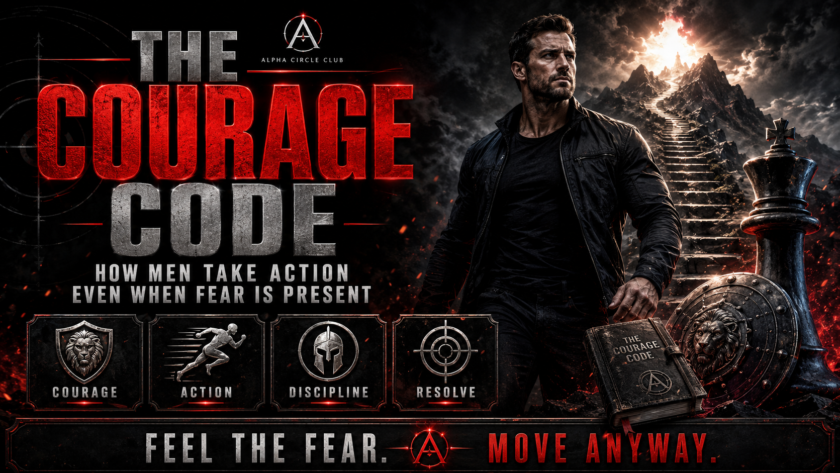
Most men are not being held back by a lack of potential. They are being held back by fear.
Fear of failing. Fear of rejection. Fear of embarrassment. Fear of losing money. Fear of being criticised. Fear of making the wrong decision. Fear of discovering they are not as capable as they hoped. So they wait. They plan, research, overthink, hesitate, and watch other men take the opportunities they wanted.
They tell themselves they are waiting for more confidence, better timing, greater knowledge, or a clearer sign. But often, they are waiting for fear to disappear—and it may never disappear.
The courageous man does not wait until his hands stop shaking.
He does not wait until every doubt is gone.
He does not wait for a guarantee.
He acts while fear is still speaking.
He understands that fear may contain useful information, but it does not deserve complete authority over his future.
A courageous man is not fearless.
He is a man who refuses to let fear make every decision for him.
Fear may warn him.
Challenge him.
Slow him down long enough to prepare.
But fear does not automatically get the final vote.
The final decision belongs to the man.
Alpha Thought:
Courage begins when a man stops asking fear for permission to live.
Quick Alpha Summary
Courage is the willingness to face fear, discomfort, uncertainty, pain, or risk in pursuit of something important.
Courage is not:
- Feeling invincible
- Ignoring genuine danger
- Acting recklessly
- Pretending not to care
- Starting unnecessary conflict
- Taking risks to impress people
- Hiding every emotion
- Refusing advice
- Believing preparation is weakness
Courage means:
- Recognising fear
- Examining the risk
- Controlling the response
- Preparing responsibly
- Accepting uncertainty
- Acting according to values
- Taking the next necessary step
- Moving without perfect confidence
The courageous man does not need to feel ready.
He needs to understand what matters, prepare where possible, and act responsibly.
Alpha Thought:
Fearlessness ignores risk. Courage understands risk and still chooses responsibility.
What Is Courage?
Courage is often misunderstood.
Some men believe courage means never feeling nervous.
Never questioning themselves.
Never feeling vulnerable.
Never admitting concern.
But that is not courage.
That is a fantasy.
Real courage exists because fear is present.
Without fear, discomfort, uncertainty, or risk, courage is not required.
A man demonstrates courage when he:
- Speaks honestly despite possible rejection
- Applies for the opportunity despite uncertainty
- Admits a mistake despite embarrassment
- Sets a boundary despite possible conflict
- Gets tested despite fearing the result
- Starts again despite previous failure
- Asks for help despite pride
- Leaves a destructive situation despite uncertainty
- Publishes his work despite criticism
- Takes responsibility despite consequences
Courage is not always dramatic.
It is often quiet.
It may be a phone call.
An application.
An apology.
An appointment.
A conversation.
A decision to stop running.
A man does not need an audience to be courageous.
Some of the bravest actions he will ever take may happen in private.
Alpha Thought:
Courage is not proved only in dangerous moments. It is proved whenever a man chooses truth and responsibility over fear.
Courage and Recklessness Are Not the Same
Courage and recklessness can look similar from a distance.
Both may involve risk.
Both may require action.
But the motive and judgement behind them are different.
A reckless man acts without properly considering consequences.
A courageous man understands the consequences and decides that responsible action is still necessary.
Recklessness may involve:
- Starting fights
- Driving dangerously
- Gambling essential money
- Ignoring medical advice
- Taking financial risks without research
- Provoking people unnecessarily
- Acting from anger
- Chasing danger for attention
- Pressuring others
- Confusing impulsiveness with strength
Courage may involve:
- Having an honest conversation
- Defending someone responsibly
- Leaving abuse
- Reporting wrongdoing
- Starting again after failure
- Asking for help
- Admitting a mistake
- Setting a clear boundary
- Making a carefully considered change
- Taking a sensible business risk
The Alpha man does not chase danger to prove his masculinity.
He does not need unnecessary chaos to feel strong.
He faces responsibility when fear tells him to hide.
That is the difference.
Alpha Thought:
Recklessness chases danger for ego. Courage faces responsibility for purpose.
Fear Is Not Always the Enemy
Fear can contain useful information.
It may warn a man about:
- Genuine danger
- Poor preparation
- Financial risk
- Lack of knowledge
- Unsafe people
- Health concerns
- Possible consequences
- A weak plan
- A decision being made too quickly
The goal is not to destroy every feeling of fear.
The goal is to examine it.
A man should ask:
- Is this fear warning me or limiting me?
- Is the danger real, exaggerated, or imagined?
- What information am I missing?
- What preparation would reduce the risk?
- What is the cost of acting?
- What is the cost of doing nothing?
- Does this decision align with my values?
- What would a responsible man do?
Sometimes fear is telling a man to stop.
Sometimes it is telling him to prepare.
Sometimes it is simply repeating an old insecurity.
The courageous man learns to recognise the difference.
He does not ignore every warning.
But he does not treat every feeling of discomfort as proof that he should retreat.
Alpha Thought:
Fear can advise the man. It should not automatically command him.
The Cost of Letting Fear Lead
Fear often feels protective.
It promises safety.
It tells a man:
“Do not apply. You might be rejected.”
“Do not speak. They might judge you.”
“Do not start. You might fail.”
“Do not leave. The future is uncertain.”
“Do not get tested. You might receive bad news.”
“Do not publish. Someone may criticise you.”
But avoiding action also carries a price.
Fear can cost a man:
- Opportunities
- Relationships
- Income
- Health
- Confidence
- Time
- Self-respect
- Experiences
- Leadership
- Purpose
- Growth
- Freedom
A man avoids temporary discomfort and creates long-term regret.
He does not apply, so he never knows.
He does not speak, so the situation continues.
He does not start, so the idea dies.
He does not leave, so the damage grows.
He does not get tested, so the health concern remains hidden.
He does not set the boundary, so the disrespect continues.
Doing nothing is still a decision.
Inaction still creates consequences.
Alpha Thought:
Fear charges a price whether a man acts or stays still.
Fear of Failure
Fear of failure keeps many capable men inactive.
They believe that failure would prove they are not good enough.
Not intelligent enough.
Not talented enough.
Not ready.
So they avoid the test.
If they never try, they never have to face the possibility of failing.
But they also never have the opportunity to succeed.
Failure can provide information.
It can expose:
- Weak preparation
- Poor timing
- Missing skills
- Bad assumptions
- Unclear positioning
- Weak discipline
- A strategy that needs adjustment
- An unsuitable opportunity
A man should not seek failure carelessly.
He should prepare.
Think.
Calculate risk.
Learn.
But he must stop treating every failed attempt as a verdict on his identity.
A business idea can fail without the man being permanently incapable.
A relationship can end without the man being unlovable.
An application can be rejected without the man having no value.
A workout can go badly without the man being weak forever.
The stronger question is:
“What can this result teach me?”
Failure becomes more useful when a man studies it instead of allowing it to define him.
Alpha Thought:
Failure is often feedback before it becomes a final outcome.
Fear of Rejection
Men fear rejection in:
- Relationships
- Business
- Sales
- Job applications
- Networking
- Friendships
- Creative work
- Public speaking
- Social situations
Rejection can hurt.
It can affect confidence.
It can trigger old insecurities.
But avoiding all rejection creates a smaller life.
A man must understand:
- Rejection does not always mean personal worthlessness
- Not every opportunity is the right fit
- Other people are allowed to say no
- A rejected offer can be improved
- A rejected man can retain his dignity
- One person’s decision does not define his future
- Rejection may redirect him towards something better suited
Courage does not guarantee acceptance.
It gives a man the strength to survive an answer he may not want.
The man who cannot tolerate rejection eventually becomes controlled by approval.
He changes himself to be liked.
Stays silent to avoid disagreement.
Avoids opportunities where he may be judged.
That is not freedom.
Alpha Thought:
A man who cannot tolerate rejection will eventually become a prisoner of approval.
Fear of Judgement
Many men are not afraid of the action itself.
They are afraid of being seen trying.
They fear:
- Looking inexperienced
- Being laughed at
- Receiving negative comments
- Family criticism
- Friends questioning them
- Public mistakes
- People remembering past failures
- Being accused of changing
This fear can keep a man trapped inside an identity he has already outgrown.
He may know he needs to change his health, career, relationships, or habits.
But he worries about what people will say.
The truth is that criticism is often unavoidable when a man chooses a different direction.
People may misunderstand him.
Mock him.
Question him.
Predict failure.
The man must decide whether the opinions of spectators deserve authority over his mission.
Feedback can be useful.
Wise criticism should be considered.
But random judgement from people who are not carrying the responsibility should not determine the future.
Alpha Thought:
Do not abandon your mission to satisfy people who will not carry the consequences of your inaction.
Fear of Success
Fear of success is discussed less often, but it is real.
Some men fear success because success may require:
- Greater responsibility
- Increased visibility
- Higher expectations
- Different relationships
- Leaving familiar environments
- Making difficult decisions
- Managing more money
- Becoming accountable
- Losing excuses
- Living as a new identity
Struggle may feel familiar.
Success may feel unknown.
A man may sabotage progress because part of him fears what will be required if he truly succeeds.
He procrastinates.
Undervalues his work.
Stops when progress appears.
Creates unnecessary problems.
Returns to old habits.
Success does not only require achieving more.
It requires becoming capable of carrying more.
The man must build the character, systems, discipline, and support required to handle the opportunity he says he wants.
Alpha Thought:
Sometimes a man is not afraid that he will fail. He is afraid that success will require him to become someone new.
Courage Begins With Truth
A man cannot become courageous while lying about what he fears.
He should name it clearly.
“I am afraid of failing.”
“I am afraid she will reject me.”
“I am afraid I will lose money.”
“I am afraid people will laugh.”
“I am afraid I am too old.”
“I am afraid I will discover a health problem.”
“I am afraid I will not know what to do next.”
Naming fear reduces its mystery.
It stops being a shadow moving around in the background.
Once named, it can be examined.
The man can separate facts from imagined outcomes.
He can prepare.
Seek advice.
Create a plan.
Decide whether action is responsible.
Unnamed fear grows in the dark.
Truth brings it into view.
Alpha Thought:
Unnamed fear grows in the dark. Courage begins when a man brings it into the truth.
Preparation Builds Courage
Courage does not mean ignoring preparation.
Preparation makes responsible action possible.
A man can prepare by:
- Learning the required skill
- Researching the decision
- Saving money
- Practising the conversation
- Improving fitness
- Asking experienced people
- Creating a backup plan
- Understanding possible risks
- Starting with a smaller test
- Getting professional advice where appropriate
A man applying for a role can improve his CV and practise interviews.
A man starting a business can research demand and test the offer.
A man facing a difficult conversation can write down the main points.
A man starting exercise can learn proper technique and begin gradually.
Preparation cannot eliminate uncertainty.
But it can reduce avoidable fear.
The danger is when preparation becomes procrastination.
There is always another video to watch.
Another book to read.
Another detail to improve.
At some point, preparation must become action.
Alpha Thought:
Prepare enough to act responsibly—but not so long that preparation becomes a hiding place.
Build Courage Through Small Acts
Courage is strengthened through repetition.
A man does not need to begin with the most frightening challenge in his life.
He can start smaller.
He can:
- Make one phone call
- Speak once in a meeting
- Ask one question
- Say no once
- Publish one piece of work
- Complete one difficult workout
- Admit one mistake
- Book one appointment
- Introduce himself to one person
- Take one practical step towards the goal
Small courageous acts build evidence.
Evidence builds confidence.
Confidence supports bigger action.
The man learns:
“I felt fear and survived.”
“I acted without perfect confidence.”
“I handled the response.”
“I can do difficult things.”
This is how courage becomes identity.
Not through one motivational speech.
Through repeated acts of responsible bravery.
Alpha Thought:
Courage grows every time a man takes a necessary step before confidence fully arrives.
Courage in Difficult Conversations
A courageous man does not avoid every uncomfortable conversation.
He learns to:
- Speak honestly
- Control his tone
- Listen fully
- State boundaries
- Admit mistakes
- Address problems early
- Ask direct questions
- Accept disagreement
- Stay respectful
- Walk away if the conversation becomes abusive
Avoiding the conversation may protect comfort temporarily.
But the unspoken problem often grows.
Resentment builds.
Misunderstanding deepens.
Trust weakens.
A difficult conversation handled with maturity may be uncomfortable.
But months of avoidance can be far more damaging.
Courage does not mean shouting.
Threatening.
Dominating.
Or forcing agreement.
It means being willing to speak truth while respecting the dignity of the other person.
Alpha Thought:
Many relationships are not destroyed by one difficult conversation. They are destroyed by months of avoiding it.
Courage and Physical Health
Health courage may look different from the heroic image many men imagine.
It may mean:
- Booking the health check
- Discussing erectile difficulties
- Getting a semen analysis
- Facing blood-test results
- Admitting an addiction
- Starting exercise while unfit
- Asking for mental-health support
- Changing a damaging lifestyle
- Following professional advice
- Seeking help for persistent pain
Ignoring symptoms is not masculine.
Pretending everything is fine is not strength.
Avoiding a test does not protect a man from the reality of what may already be happening.
Health courage means facing information early enough to act.
It means choosing responsibility over embarrassment.
The appointment may be uncomfortable.
The result may create concern.
But knowledge gives a man options.
Avoidance removes them.
Alpha Thought:
Facing your health is not fear. It is leadership over the body carrying your future.
Courage in Business and Work
Professional courage can include:
- Applying for a better role
- Asking for fair pay
- Starting a responsible business
- Publishing an offer
- Contacting potential customers
- Learning a new skill
- Leaving an exploitative workplace with a plan
- Admitting that a strategy is failing
- Changing direction
- Accepting constructive feedback
- Presenting an idea
- Taking responsibility for an error
A man does not need guaranteed success before beginning.
Guarantees rarely exist.
He needs a reason.
A responsible plan.
A clear understanding of the risk.
And the courage to test the opportunity.
Business courage does not mean gambling essential money.
It means taking considered action despite uncertainty.
Alpha Thought:
The opportunity a man wants may be waiting behind the conversation, application, or offer he keeps avoiding.
Courage in Relationships
Relationship courage involves more than approaching someone.
It can mean:
- Expressing genuine interest
- Accepting rejection with dignity
- Being emotionally honest
- Setting a boundary
- Leaving destructive treatment
- Apologising
- Ending manipulation
- Refusing infidelity
- Asking for counselling
- Choosing commitment
- Admitting that trust has been damaged
- Having a conversation about the future
A man should not use courage as an excuse to pressure another person.
Courage respects consent.
Boundaries.
Choice.
Dignity.
A courageous man can express interest without believing he is entitled to acceptance.
He can state a boundary without threatening.
He can leave without cruelty.
He can apologise without making excuses.
Real courage does not remove respect from the equation.
Courage to Ask for Help
Many men are afraid to ask for help.
They fear appearing weak.
Incapable.
Dependent.
But refusing support can allow problems to grow.
Courage may involve speaking with:
- A trusted friend
- A mentor
- A doctor
- A counsellor
- A financial adviser
- A pastor or faith leader
- A support group
- A qualified professional
A strong man does not ask everyone to carry him.
But he also does not pretend that strength means solving every problem alone.
Sometimes courage is saying:
“I do not know what to do.”
“I need support.”
“This is bigger than I can manage alone.”
“I need professional guidance.”
That honesty can be the beginning of recovery.
Alpha Thought:
Asking for help is not surrender when it is the action required to move forward.
Faith and Courage
For a man of faith, courage can involve trusting God while still taking responsibility.
Prayer should not become an excuse for passivity.
A man can pray for:
- Wisdom
- Discernment
- Courage
- Patience
- Protection
- Strength to do what is right
- Freedom from fear-driven decisions
- Humility to accept correction
Faith does not mean believing nothing difficult will happen.
It means refusing to believe difficulty has the final authority.
Sometimes faith brings peace before action.
Sometimes it gives a man enough strength to act while uncertainty remains.
A frightening path may still need to be walked.
A hard truth may still need to be spoken.
A responsible decision may still involve sacrifice.
Alpha Thought:
Faith does not always remove the frightening path. Sometimes it gives a man the strength to walk it.
The Courage Decision Framework
Before taking serious action, ask these questions.
1. What am I afraid of?
Name the fear clearly.
2. Is the risk real, exaggerated, or imagined?
Separate facts from assumptions.
3. What information do I need?
Do not remain afraid of what could be researched.
4. What preparation can I complete?
Improve the plan where possible.
5. What is the cost of doing nothing?
Inaction has consequences too.
6. Does this action align with my values?
Not every bold action is the right action.
7. Who can offer wise guidance?
Seek knowledge without surrendering responsibility.
8. What is the smallest responsible first step?
Make the action manageable.
9. What outcome must I be prepared to accept?
Courage includes accepting uncertainty.
10. What would courage look like today?
Not someday.
Today.
The Courage Audit
Use this audit honestly.
- What decision am I delaying because of fear?
- Which fear controls me most?
- What opportunity have I avoided?
- Whose judgement am I afraid of?
- What is the realistic worst-case outcome?
- What could I do if that outcome happened?
- What preparation am I using as an excuse to delay?
- What would inaction cost me over five years?
- Where do I need to speak honestly?
- What appointment am I avoiding?
- What conversation am I avoiding?
- What boundary have I failed to establish?
- What small courageous step can I take today?
Do not use this audit to attack yourself.
Use it to identify where fear has quietly gained authority.
Alpha Thought:
A man cannot challenge the fear he refuses to identify.
The 30-Day Courage Reset
Days 1–7: Name the Fear
During the first week:
- Write down your three biggest fears
- Identify where each fear may have come from
- Separate real risks from imagined outcomes
- Record what avoidance is costing you
- Choose one fear to confront first
- Write down the realistic worst-case outcome
- Identify what support may be available
The goal is clarity.
Days 8–14: Prepare the Man
During the second week:
- Learn one relevant skill
- Research the decision
- Speak with someone experienced
- Create a simple backup plan
- Practise the difficult conversation
- Improve one area of physical preparation
- Decide what information is sufficient to act
The goal is responsible preparation.
Days 15–21: Take Small Courageous Actions
During the third week:
- Make the call
- Send the application
- State the boundary
- Publish the work
- Book the appointment
- Speak once when you would normally stay silent
- Admit one mistake
- Record the result and lesson
The goal is evidence.
Days 22–30: Build Courage as Identity
During the final stage:
- Take one larger action
- Create three courage rules
- Stop seeking unnecessary approval
- Review the month’s evidence
- Set one 90-day courage goal
- Decide what fear will no longer control
- Write a statement describing the courageous man you are becoming
The goal is identity.
Courage should no longer be an occasional event.
It should become part of how the man approaches life.
The Alpha Courage Code
1. I acknowledge fear without automatically obeying it
Fear can speak, but it does not make every decision.
2. I separate courage from recklessness
I assess risk and act responsibly.
3. I prepare before taking serious risks
Preparation supports courage.
4. I do not let rejection define my worth
Another person’s decision does not become my identity.
5. I speak truth even when discomfort is present
Avoidance will not lead my relationships.
6. I face health concerns instead of hiding from them
Information gives me options.
7. I take small actions before confidence arrives
Action creates evidence.
8. I accept uncertainty as part of growth
Perfect guarantees are not required.
9. I act according to values rather than approval
My mission is not controlled by spectators.
10. I refuse to let fear design my future
Fear may influence preparation, but purpose will direct the path.
Common Mistakes Men Make With Courage
Pretending not to feel fear
Denial does not create bravery.
Confusing aggression with courage
Starting conflict is not proof of strength.
Taking reckless risks
Unnecessary danger does not make a man more masculine.
Waiting for complete confidence
Confidence often follows action.
Using endless preparation to avoid movement
At some point, research must become execution.
Chasing danger for attention
Courage does not require an audience.
Believing one failure proves permanent weakness
An outcome is not an identity.
Letting rejection destroy self-worth
A no does not erase a man’s value.
Refusing advice
Wisdom strengthens responsible courage.
Trying to change everything at once
Small courageous actions can build lasting evidence.
Making fear-based decisions and calling them logic
A man must be honest about what is influencing him.
Using faith as an excuse for passivity
Prayer and responsible action can work together.
Thinking asking for help is cowardly
Sometimes help is the strongest next move.
Alpha Thought:
Courage is not a performance. It is responsible action taken when fear would prefer retreat.
Final Alpha Standard
Fear will come.
Before the application.
Before the conversation.
Before the business launch.
Before the health test.
Before the boundary.
Before the change.
Before the first public step.
Before the apology.
Before the decision to start again.
The courageous man does not build his life around avoiding that feeling.
He acknowledges it.
Studies it.
Prepares.
Prays.
Takes responsibility.
Then moves.
His voice may shake.
His heart may race.
The outcome may remain uncertain.
Other people may disagree.
He may not receive the answer he hoped for.
But fear does not make the final decision.
He does.
Courage is not the absence of fear.
It is the decision that truth matters more.
Health matters more.
Purpose matters more.
Responsibility matters more.
Freedom matters more.
The future matters more.
A courageous man does not need to conquer every fear today.
He only needs to stop allowing fear to control every tomorrow.
One call.
One application.
One boundary.
One appointment.
One honest conversation.
One responsible step.
That is how courage begins.
Final Alpha Thought:
Courage is not the moment fear disappears. It is the moment a man decides that something else matters more.
Face the Fear. Take the Step. Build the Man.
Alpha Circle Club helps men develop the discipline, confidence, emotional control, faith, and self-command required to act when life demands courage.
Do not wait until fear disappears.
Become the man who can move while it is still present.


No spam. Unsubscribe anytime.