Microplastics in testicles sounds like a headline from the future.
But it is not fiction.
It is now part of the modern male fertility conversation.
Most men worry about testosterone.
They worry about sperm count.
They worry about libido, energy, performance, strength, confidence, and fertility.
But very few men think about plastic.
They drink from plastic bottles.
They microwave food in plastic containers.
They eat from takeaway packaging.
They wear synthetic fabrics.
They breathe household dust.
They consume food and water from a world wrapped in plastic.
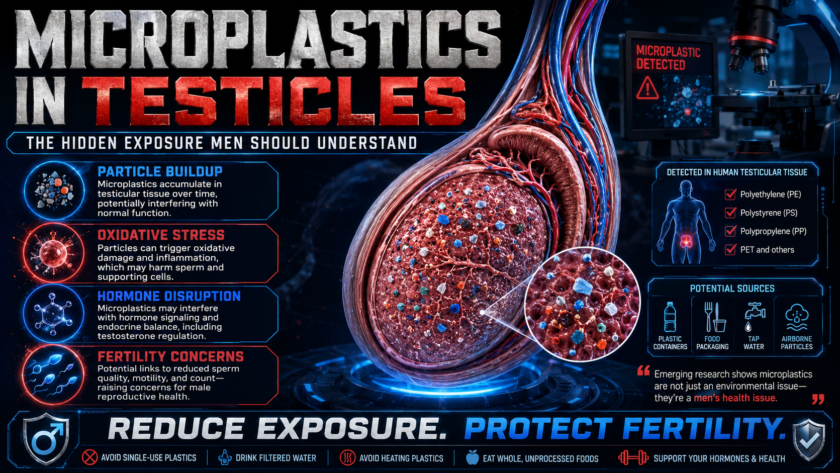
Then research detected microplastics in human testicular tissue.
For men, that should not create panic.
But it should create awareness.
Because the testicles are not just another organ.
They are where sperm are produced.
They are central to testosterone production.
They are part of the male reproductive system.
They are part of the system that helps a man create life.
So when scientists find microplastics in testicular tissue, the serious question is not, “Should men panic?”
The serious question is:
What does this mean for male fertility, sperm count, testosterone, and long-term reproductive health?
The answer is still developing.
Research is early. More human studies are needed. Microplastics have not been proven to directly cause infertility or low testosterone in men.
But early evidence raises enough concern for men to pay attention.
Not with fear.
With discipline.
Not with obsession.
With ownership.
Because modern male fertility is not only about testosterone, diet, sleep, exercise, and sperm count.
It may also be affected by environmental pressure.
Plastic is everywhere.
And if plastic particles are reaching places men never expected, then men need to understand the risk, reduce unnecessary exposure, and protect their reproductive health with higher standards.
What Are Microplastics?
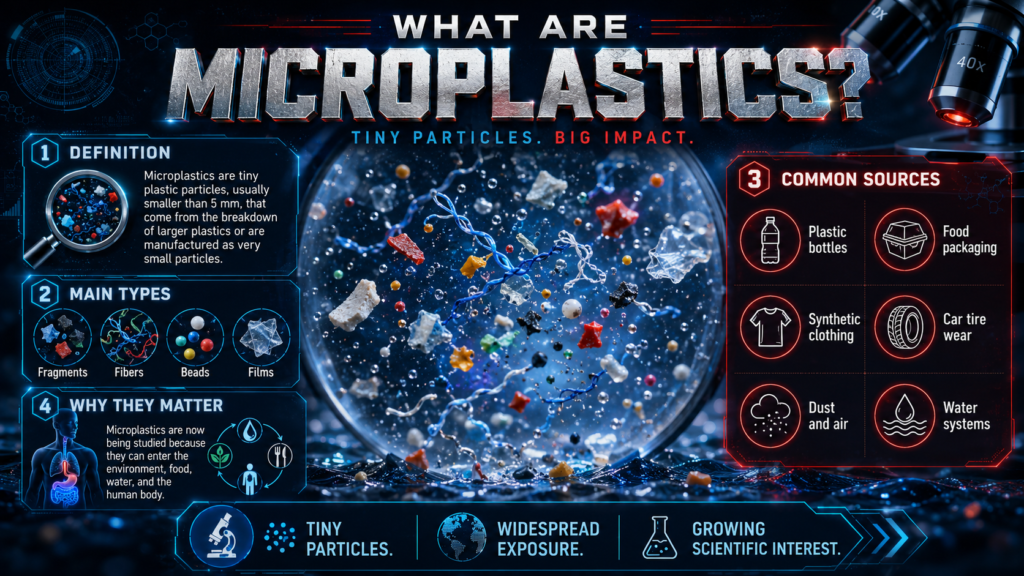
Microplastics are tiny plastic particles, usually defined as plastic fragments smaller than 5 millimetres.
They can come from larger plastics breaking down over time, or they can be manufactured small for certain products and industrial uses.
Microplastics may include:
Plastic fragments
Plastic fibres
Synthetic particles
Microbeads
Particles from packaging
Particles from clothing fibres
Particles from tyres, dust, and degraded plastic waste
There are also nanoplastics, which are even smaller particles. These are harder to detect and may raise additional questions because of their tiny size.
For years, many people mainly associated microplastics with oceans, fish, and environmental pollution.
But the issue has moved beyond beaches and sea life.
Microplastics have now been detected in multiple human biological samples and tissues, including blood, placenta, semen, and testicular tissue. The human health effects are still being studied, and responsible researchers are careful not to overstate what is proven. A 2024 testicular tissue study reported microplastic presence in both human and dog testes, adding to concern about potential reproductive effects.
The key point is simple:
Microplastics are not just an environmental issue.
They may also be a human health issue.
And for men, they may become part of the fertility conversation.
How Were Microplastics Found in Testicular Tissue?
In 2024, researchers published a study investigating microplastics in testicular tissue from humans and dogs.
The study analysed 23 human testes and 47 canine testes using a sensitive laboratory method called pyrolysis-gas chromatography/mass spectrometry. Researchers detected 12 types of microplastics in the samples and reported microplastic presence in all human and canine testes examined.
Important details matter here.
The human samples came from deceased males.
The dog samples came from neutering procedures.
Polyethylene was reported as the dominant polymer type.
The human samples had higher average microplastic concentrations than the dog samples.
The researchers could not measure sperm count in the preserved human samples.
The dog samples allowed researchers to compare microplastic levels with sperm count and reproductive organ weight.
That last point is important.
The study did not prove that microplastics destroy male fertility in humans.
It did not prove that microplastics directly lower testosterone in living men.
It did not show sperm count results in the human testicular samples because the preserved tissue could not be used for that measurement.
But it did show something men should pay attention to:
Plastic particles can reach places men never expected.
That is the warning.
Not proof of disaster.
A warning signal.
Could Microplastics Affect Sperm Count?
This is one of the biggest questions.
Could microplastics affect sperm count?
The careful answer is:
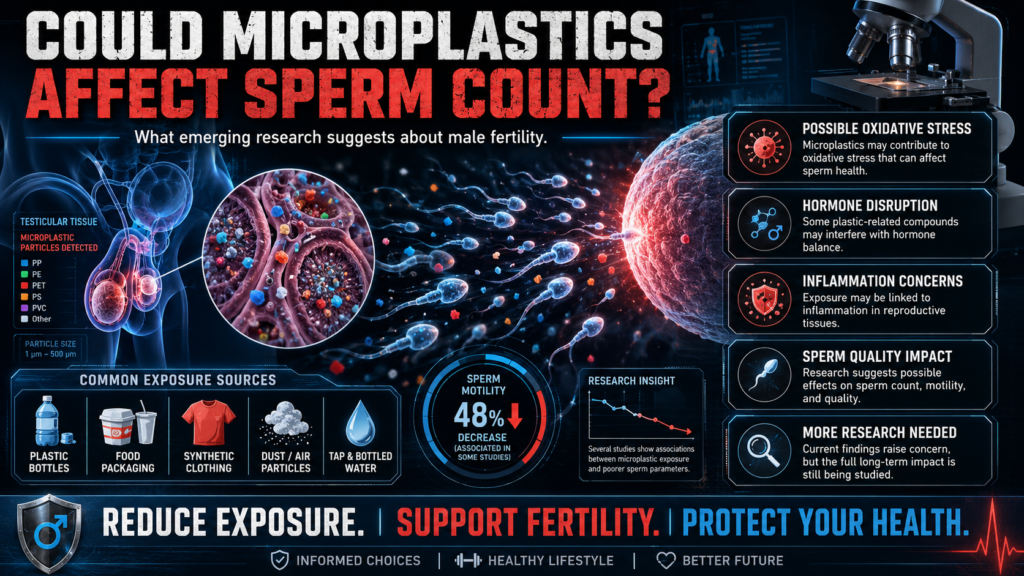
Early evidence raises concern, but more research is needed.
In the 2024 testicular tissue study, researchers could not measure sperm count in the human samples because of how the tissues were preserved. But in the dog samples, the study reported that some polymers were negatively associated with testis weight, and PVC was linked with lower sperm count in canine samples.
That does not prove the same effect happens in living human men.
But it is a signal worth studying.
Other research has also detected microplastics in semen. A 2024 study reported microplastic contamination in semen samples from men without occupational exposure, with polystyrene, polyethylene, and PVC among the detected polymers. The authors called for further research into possible reproductive effects.
Another multi-site study reported microplastics in all semen and urine samples tested and investigated associations with sperm quality, again highlighting that this is an emerging reproductive health area, not a settled conclusion.
So the message must be balanced.
A man should not panic from early evidence.
But he should not ignore it either.
Male fertility is already under pressure from many directions:
Poor sleep
Obesity
Alcohol
Smoking
Stress
Heat exposure
Nutrient deficiencies
Poor diet
Environmental chemicals
Sedentary living
Hormonal disruption
Inflammation
Oxidative stress
Microplastics may be another pressure in that system.
Not the only factor.
But possibly one more factor men need to take seriously.
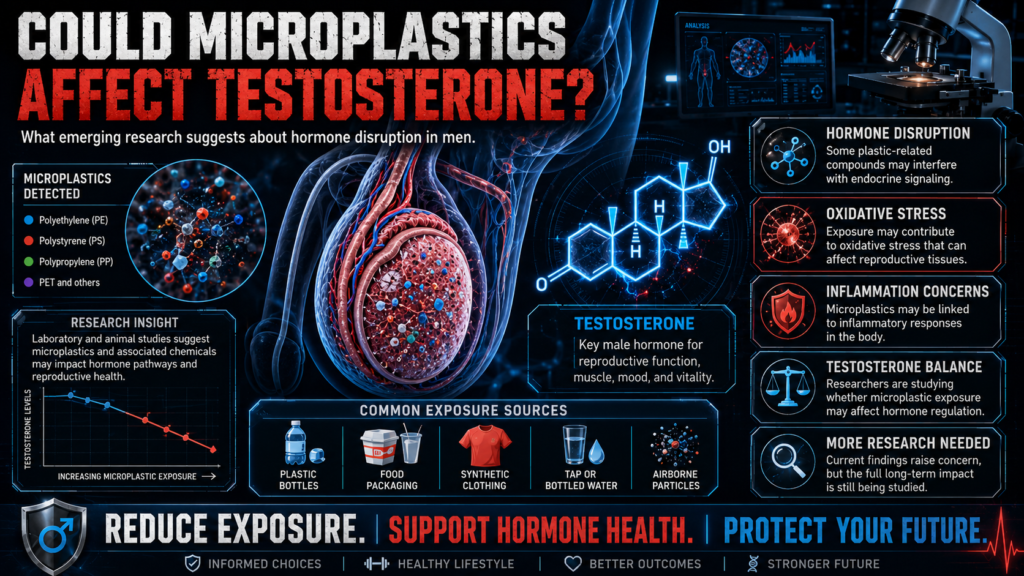
Could Microplastics Affect Testosterone?
This is where the article needs discipline.
It would be easy to write a fear headline like:
“Microplastics destroy testosterone.”
But that would be too strong based on current human evidence.
A more accurate statement is:
Microplastics and plastic-associated chemicals may be linked to endocrine disruption in some experimental research, but human evidence is still developing.
Animal and laboratory research suggests microplastics may affect testicular function through possible mechanisms such as oxidative stress, inflammation, mitochondrial disruption, impaired spermatogenesis, and hormonal disturbance. A 2024 EBioMedicine paper noted that animal studies have shown microplastics can cause testicular inflammation, impaired spermatogenesis, and decreased testosterone, but direct proof in humans remains limited.
That distinction matters.
Animal evidence is not the same as human proof.
Laboratory evidence is not the same as real-world human outcomes.
Associations are not the same as causation.
So yes, microplastics and testosterone is a serious area of concern.
But it is not a settled story.
It is an emerging warning sign.
The right response is not panic.
The right response is awareness, exposure reduction, and better male health standards.
Why This Matters for Male Fertility
Male fertility is not simple.
It depends on many systems working together.
Sperm count matters.
Sperm motility matters.
Sperm morphology matters.
Sperm DNA integrity matters.
Testosterone matters.
LH and FSH signalling matters.
Testicular function matters.
Oxidative stress balance matters.
Heat control matters.
Nutrition matters.
Sleep matters.
Lifestyle matters.
Environmental exposure may matter too.
The testicles are not passive tissue.
They are active biological factories.
They produce sperm.
They support testosterone production.
They respond to hormones.
They respond to inflammation.
They respond to heat.
They respond to nutrients.
They respond to toxins.
They respond to stress.
That means fertility is not isolated from the world a man lives in.
It is affected by the environment he builds around his body every day.
If microplastics are present in testicular tissue, it does not automatically mean they are causing fertility problems.
But it does raise an important question:
What else is the modern male reproductive system being exposed to?
That question matters.
Because a man who wants to protect his fertility cannot only think about gym sessions and testosterone levels.
He must also think about his environment.
The water he drinks.
The containers he uses.
The food he eats.
The heat he exposes himself to.
The dust in his home.
The plastic that touches his food.
The habits he repeats every day.
Your fertility is not just about what happens inside your body.
It is also affected by what you allow around your body.

Common Sources of Microplastic Exposure
Microplastics are widespread, so complete avoidance is not realistic.
The goal is not perfection.
The goal is reduction.
Common sources of exposure may include:
Plastic water bottles
Plastic food containers
Microwaving food in plastic
Takeaway packaging
Plastic-lined cups
Synthetic clothing fibres
Household dust
Plastic chopping boards
Processed packaged foods
Seafood
Some tea bags made with plastic fibres
Personal care products
Airborne particles
Drinking water
Food packaging
Plastic utensils
Plastic wrap
Bottled drinks
This can sound overwhelming.
But men need to keep perspective.
You cannot control every microplastic particle in the modern world.
You can control the obvious exposures.
You can stop heating food in plastic.
You can stop leaving plastic bottles in hot cars.
You can use glass or stainless steel more often.
You can eat more whole foods.
You can improve air quality and dust control at home.
You can reduce unnecessary plastic contact with food and drink.
That is where discipline comes in.
Not paranoia.
Discipline.
How Men Can Reduce Exposure Without Becoming Paranoid
The goal is not to live in fear of plastic.
The goal is to stop being careless with exposure you can easily control.
Here are practical ways men can reduce unnecessary microplastic exposure.
Use Glass or Stainless Steel Water Bottles
Instead of constantly drinking from disposable plastic bottles, use glass or stainless steel where practical.
This is a simple upgrade.
It is not extreme.
It is sensible.
Stop Microwaving Food in Plastic
This is one of the easiest wins.
Heat can increase the movement of chemicals from packaging into food. Even when a container is labelled microwave-safe, many men may prefer to use glass or ceramic as a precaution.
Put the food on a proper plate.
Use glass.
Use ceramic.
Stop heating plastic when you do not need to.
Use Glass Food Storage Containers
Plastic containers are convenient, but glass containers are a better long-term option for many foods, especially warm meals.
This is not about perfection.
It is about reducing repeated exposure.
Reduce Takeaway Packaging
Takeaway food often comes in plastic containers, coated cardboard, plastic lids, plastic-lined cups, and packaging exposed to heat.
You do not need to avoid takeaway forever.
But if it is a daily habit, it may be worth reducing.
Better food.
Less packaging.
More control.
Do Not Leave Plastic Bottles in Hot Cars
Heat and plastic are not a good combination.
Leaving plastic bottles in hot cars is an easy habit to stop.
Vacuum and Dust Regularly
Household dust can contain microplastic fibres from clothing, carpets, furniture, and synthetic materials.
Regular vacuuming, dusting, ventilation, and air filtration where practical may help reduce indoor particle exposure.
Choose Natural Fibres More Often Where Practical
Synthetic clothing can shed plastic fibres.
You do not need to throw away your wardrobe.
But choosing cotton, wool, linen, or other natural fibres more often may be one practical reduction step.
Avoid Heavily Processed Packaged Foods Where Possible
Whole foods usually involve less packaging, less processing, and better nutrition.
This helps on two levels:
Less plastic contact.
Better fertility-supportive fuel.
Use Wooden, Glass, or Safer Cutting Boards
Worn plastic chopping boards may shed particles.
Consider wood, glass, or other alternatives where appropriate, and replace heavily damaged boards.
Eat More Whole Foods
This is one of the strongest male fertility moves anyway.
Whole foods support nutrient intake, antioxidant defence, body composition, testosterone-supportive habits, and general health.
And they often reduce reliance on plastic-wrapped processed food.
A man does not need to become paranoid.
He needs to become intentional.
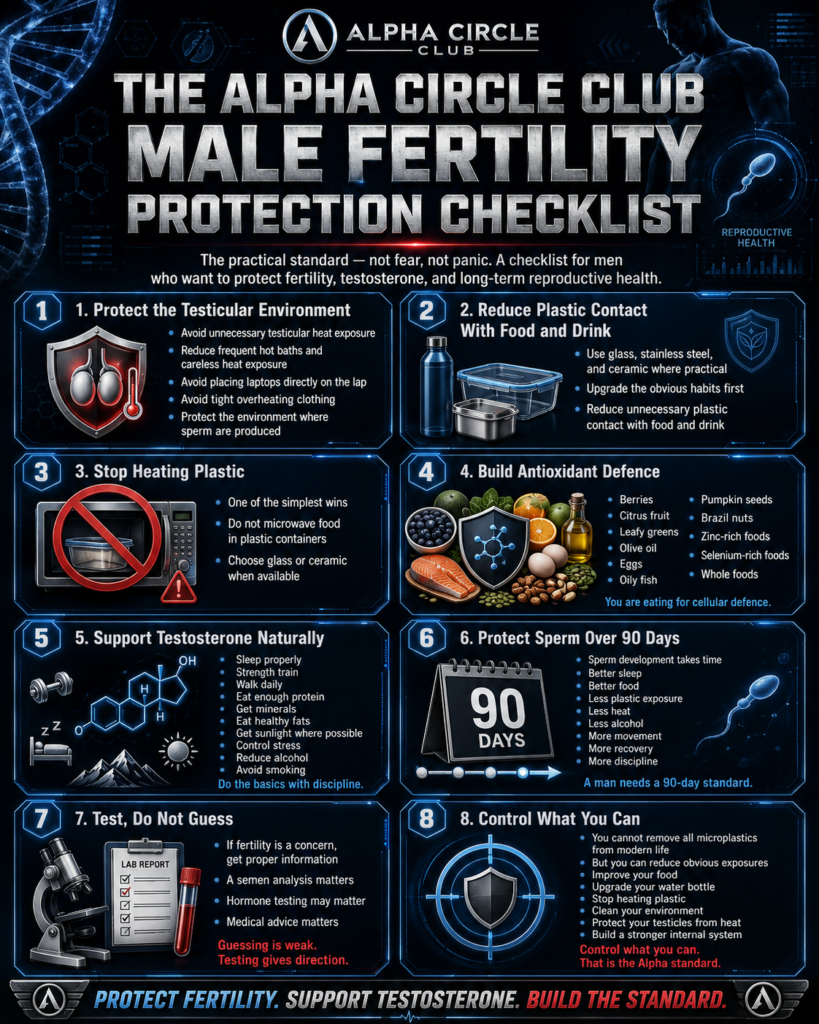
The Alpha Circle Club Male Fertility Protection Checklist
This is the practical standard.
Not fear.
Not panic.
A checklist for men who want to protect fertility, testosterone, and long-term reproductive health.
1. Protect the Testicular Environment
Avoid unnecessary testicular heat exposure.
That may include frequent hot baths, placing laptops directly on the lap, tight overheating clothing, and careless heat exposure.
Heat is already a known fertility concern.
Protect the environment where sperm are produced.
2. Reduce Plastic Contact With Food and Drink
Use glass, stainless steel, ceramic, and safer storage choices where practical.
Do not obsess.
Upgrade the obvious habits first.
3. Stop Heating Plastic
This is one of the simplest wins.
If you change one thing, start here.
Do not microwave food in plastic containers when glass or ceramic is available.
4. Build Antioxidant Defence
Sperm cells are vulnerable to oxidative stress.
Build the foundation with real food:
Berries
Citrus fruit
Leafy greens
Olive oil
Eggs
Oily fish
Pumpkin seeds
Brazil nuts
Zinc-rich foods
Selenium-rich foods
Whole foods
You are not just eating for taste.
You are eating for cellular defence.
5. Support Testosterone Naturally
A man should protect the foundations before chasing advanced solutions.
Sleep properly.
Strength train.
Walk daily.
Eat enough protein.
Get minerals.
Eat healthy fats.
Get sunlight where possible.
Control stress.
Reduce alcohol.
Avoid smoking.
Do the basics with discipline.
6. Protect Sperm Over 90 Days
Sperm development takes time.
A man does not rebuild fertility with one good week.
He needs consistency.
A 90-day standard.
Better sleep.
Better food.
Less plastic exposure.
Less heat.
Less alcohol.
More movement.
More recovery.
More discipline.
7. Test, Do Not Guess
If fertility is a concern, get proper information.
A semen analysis matters.
Hormone testing may matter.
Medical advice matters.
Guessing is weak.
Testing gives direction.
8. Control What You Can
You cannot remove all microplastics from modern life.
But you can reduce obvious exposures.
You can improve your food.
You can upgrade your water bottle.
You can stop heating plastic.
You can clean your environment.
You can protect your testicles from heat.
You can build a stronger internal system.
Control what you can.
That is the Alpha standard.
What This Article Is Not Saying
This section matters because health content needs integrity.
This article is not saying microplastics definitely cause infertility in men.
It is not saying microplastics definitely lower testosterone in humans.
It is not saying every man with fertility issues has microplastic damage.
It is not saying you can completely detox microplastics from the body with a simple hack.
It is not saying plastic is the only reason male fertility problems happen.
What this article is saying is more responsible:
Research has detected microplastics in human testicular tissue.
Early evidence raises concern about reproductive health.
Animal and semen studies suggest possible links worth taking seriously.
More human research is needed.
Men can take practical steps to reduce unnecessary exposure.
That is the balanced position.
Not fear.
Not denial.
Awareness.
Awareness Without Fear
Microplastics in testicles is not just a shocking headline.
It is a modern male fertility warning sign.
Not a reason to panic.
A reason to pay attention.
Men are already dealing with poor sleep, stress, obesity, alcohol, processed food, heat exposure, endocrine disruptors, and declining fertility markers.
Microplastics may be another pressure in the system.
The answer is not paranoia.
The answer is ownership.
Reduce what you can.
Upgrade your environment.
Protect your sleep.
Train properly.
Eat real food.
Support testosterone naturally.
Get tested if needed.
A serious man does not need fear to take action.
He needs awareness, discipline, and standards.
Your fertility is not isolated from the world you live in.
It is affected by the environment you build around your body every day.
The modern world may be full of plastic.
But your standards do not have to be weak.
Want to protect your fertility, testosterone, and long-term male health?

Non-Medical Disclaimer
This article is for educational and informational purposes only. It is not medical advice and should not be used to diagnose, treat, prevent, or cure any condition. If you are concerned about fertility, testosterone, sperm count, hormone health, or possible exposure-related health issues, speak to a qualified healthcare professional for personalised advice, testing, and treatment options.



No spam. Unsubscribe anytime.