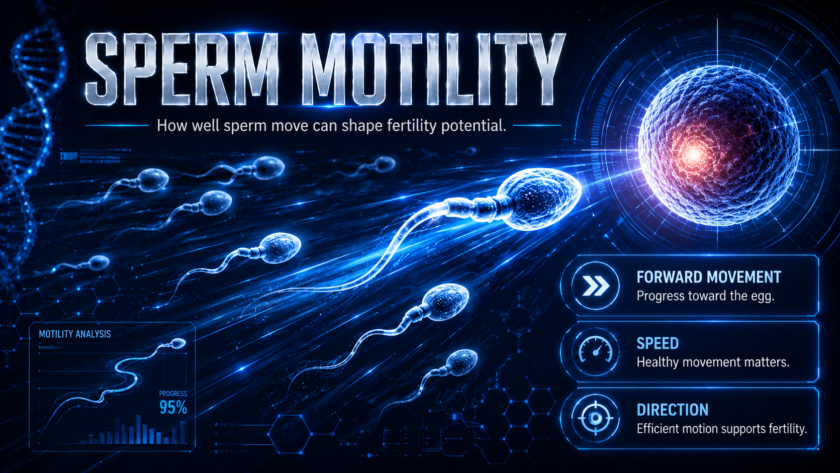
Sperm motility is one of the most important parts of male fertility.
It is not enough for a man to produce sperm.
Those sperm also need to move properly.
That movement matters because sperm must travel through the female reproductive tract, reach the egg, and have the ability to take part in fertilization.
If sperm are slow, weak, poorly directed, or not moving at all, conception can become harder.
This is why sperm motility deserves serious attention from men who want to build a family.
A man can have normal sexual performance and still have poor sperm movement.
He can have normal ejaculation and still have weak sperm.
He can feel physically strong and still have fertility markers that need work.
That is why fertility should never be judged by ego.
It should be judged by facts.
At Alpha Circle Club, the message is built around discipline, strength, and ownership. Fertility fits directly into that standard because a man who wants legacy must first take responsibility for the health of his own body.
This guide explains what sperm motility means, why it matters, what can cause low motility, how to improve sperm movement naturally, and when medical testing is needed.
What Is Sperm Motility?
Sperm motility means the ability of sperm to move.
That sounds simple, but sperm movement is highly important.
For natural conception to happen, sperm must move through cervical mucus, travel through the uterus, reach the fallopian tube, and get close enough to the egg.
If sperm cannot move well, they may never reach the egg.
That is why movement is one of the key measurements in a semen analysis.
A semen analysis usually checks sperm count, concentration, motility, morphology, semen volume, and other semen markers.
Motility is not only about whether sperm are alive.
It is about whether they can move in a useful way.
A sperm cell that only twitches or moves in circles is not the same as one that moves forward with strength.
This is why progressive movement matters.
Progressive Motility vs Total Motility
When men hear the word sperm motility, they often think it means any movement.
That is not fully accurate.
There are different types of movement.
Total motility refers to the percentage of sperm that show any movement.
Progressive motility refers to sperm that move forward in a useful direction.
Progressive motility is especially important because sperm must move forward to reach the egg.
A sperm cell may be moving, but if it is not moving effectively, fertility can still be affected.
That is why a semen report may show more than one motility number.
A man should not try to interpret results through panic or guesswork.
He should review them properly with a qualified clinician.
Why Sperm Motility Matters for Male Fertility
Sperm motility matters because sperm have a mission.
They are not just present in semen.
They have to travel.
If sperm count is the number of soldiers, motility is their ability to move across the battlefield.
A high sperm count may still be less useful if too many sperm cannot move properly.
On the other hand, a man with a moderate count but good movement may still have a reasonable chance depending on the full fertility picture.
This is why male fertility should be viewed as a complete system.
Count matters.
Movement matters.
Shape matters.
DNA quality may matter in some cases.
Hormones matter.
Timing matters.
The female partner’s fertility also matters.
No single number tells the whole story.
But poor sperm motility can be one of the reasons conception takes longer.
Low Sperm Motility: What It Means
Low sperm motility is often called asthenozoospermia.
It means a lower-than-expected percentage of sperm are moving properly.
This can make natural conception more difficult because fewer sperm are able to reach the egg.
Low motility does not always mean pregnancy is impossible.
Some couples still conceive naturally.
Others may need lifestyle improvement, medical treatment, or fertility support.
The right next step depends on the full semen analysis, the man’s health history, the female partner’s fertility, and how long the couple has been trying.
This is where testing matters.
A man should not assume.
He should know.
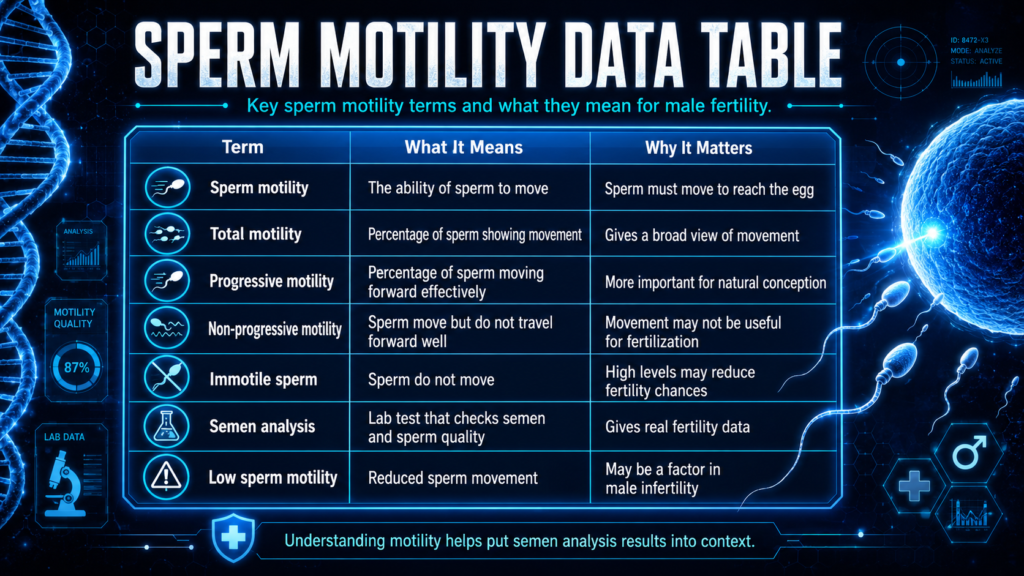
Sperm Motility Data Table
| Term | What It Means | Why It Matters |
| Sperm motility | The ability of sperm to move | Sperm must move to reach the egg |
| Total motility | Percentage of sperm showing movement | Gives a broad view of movement |
| Progressive motility | Percentage of sperm moving forward effectively | More important for natural conception |
| Non-progressive motility | Sperm move but do not travel forward well | Movement may not be useful for fertilization |
| Immotile sperm | Sperm do not move | High levels may reduce fertility chances |
| Semen analysis | Lab test that checks semen and sperm quality | Gives real fertility data |
| Low sperm motility | Reduced sperm movement | May be a factor in male infertility |
Common Causes of Low Sperm Motility
There is no single cause of low sperm motility.
Many different factors can affect sperm movement.
Some are lifestyle-related.
Some are medical.
Some are temporary.
Some require treatment.
A man should not immediately blame himself, but he should also not avoid responsibility.
The right approach is direct and mature.
Find the cause where possible, improve the controllable factors, and seek medical help when needed.
Oxidative Stress
Oxidative stress is one of the major themes in male reproductive health.
It happens when the body has too many damaging free radicals and not enough antioxidant defense.
Sperm cells are especially sensitive because their membranes contain fatty acids and their structure is delicate.
Oxidative stress may affect movement, shape, and DNA quality.
Smoking, poor diet, pollution, infections, obesity, alcohol misuse, toxins, and inflammation can all contribute to oxidative stress.
This is why nutrition, sleep, weight control, and toxin reduction matter.
A man who wants better sperm health needs to reduce the pressure on his reproductive system.
Heat Exposure
Sperm production and function are sensitive to temperature.
The testicles sit outside the body for a reason.
They need to stay cooler than the body’s core temperature.
Repeated heat exposure may affect sperm production and motility in some men.
This can include frequent hot tubs, saunas, long hot baths, heated seats, tight underwear, laptops on the lap, or high-heat work environments.
A man does not need to become paranoid.
But if he is trying to improve sperm motility, reducing unnecessary heat exposure for a few months is a smart move.
Smoking
Smoking can harm male fertility in several ways.
It may increase oxidative stress and affect sperm count, movement, shape, and DNA quality.
It also damages blood vessels, lungs, stamina, skin, heart health, and long-term performance.
No serious fertility plan should include smoking.
A man cannot claim to be protecting his future while feeding a habit that damages the body daily.
Quitting is not easy.
But it is one of the strongest decisions a man can make for fertility and overall health.
Heavy Alcohol Use
Heavy alcohol use can affect hormones, sleep, liver function, sexual performance, and general health.
It may also weaken the lifestyle foundation needed for better sperm quality.
Alcohol often brings poor sleep, poor food choices, dehydration, emotional instability, and lower discipline.
For men trying to conceive, reducing alcohol is a practical step.
For some men, a 90-day break is even better.
The body responds to standards.
If the standard is chaos, the results will show it.
Obesity and Poor Metabolic Health
Excess body fat can affect hormones, inflammation, insulin sensitivity, and reproductive health.
Obesity has been linked with poorer semen quality in some research.
A man does not need to chase an extreme body.
But he should build a healthy body composition, better cardiovascular health, and stable energy.
A body under metabolic stress is not in its best reproductive state.
Losing weight slowly and properly may support better male fertility in men who are overweight.
The key is consistency, not crash dieting.
Infections and Inflammation
Infections and inflammation can affect semen quality.
Past sexually transmitted infections, prostate inflammation, epididymal inflammation, urinary infections, or other reproductive tract issues may play a role in some men.
Warning signs should not be ignored.
Pain, swelling, burning urination, discharge, blood in semen, painful ejaculation, or testicular discomfort should be checked.
A disciplined man does not “tough it out” when the body is clearly signaling a problem.
He gets evaluated.
Varicocele
A varicocele is an enlargement of veins in the scrotum.
It can affect testicular temperature and may contribute to reduced sperm production or quality in some men.
Not every varicocele needs treatment.
But if a man has fertility concerns and abnormal semen results, a reproductive urologist may evaluate whether varicocele is part of the problem.
This is another reason a proper male fertility evaluation matters.
Lifestyle is important, but some issues need medical eyes.
Hormone Problems
Hormones help control sperm production.
Testosterone is important, but it is not the only hormone involved.
FSH and LH also matter because they help signal the testicles to produce sperm and testosterone.
Thyroid problems, high prolactin, low testosterone, steroid use, and other hormone issues may affect sperm health.
Men should be careful with hormone products.
External testosterone and anabolic steroids can reduce sperm production and may harm fertility.
A man who wants children should not experiment with hormones based on gym advice or online forums.
Medications and Drugs
Some medications may affect semen quality in certain men.
This can include testosterone therapy, anabolic steroids, some chemotherapy drugs, certain psychiatric medications, some blood pressure medications, and other treatments.
Recreational drugs may also affect reproductive health.
Men should not stop prescribed medication without speaking to a doctor.
But if fertility matters, medication review is wise.
A man should tell his doctor that he is trying to conceive so treatment can be considered with fertility in mind.
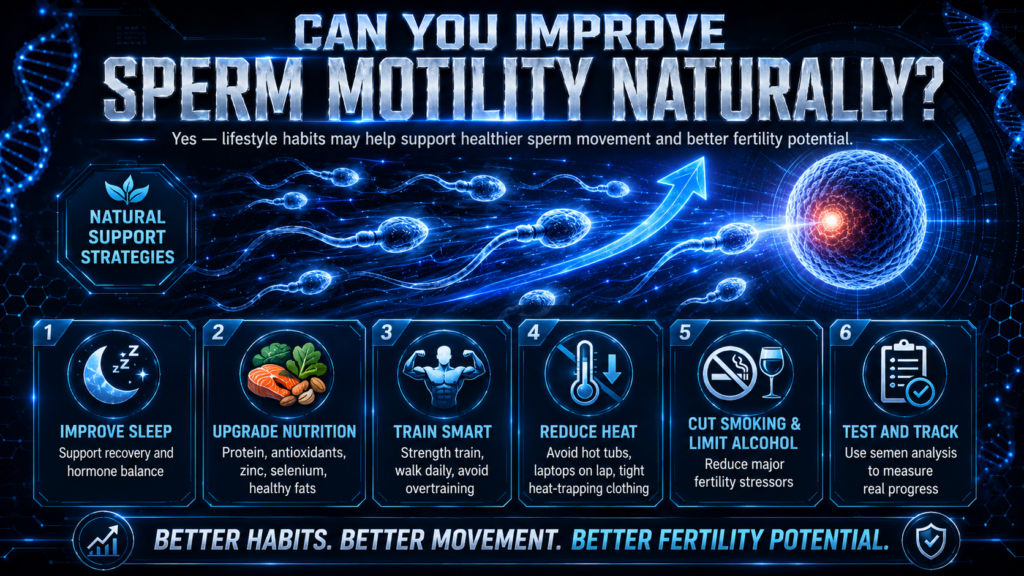
Can You Improve Sperm Motility Naturally?
Many men can support better sperm motility through lifestyle improvement.
This does not mean every case can be fixed naturally.
Some men need medical treatment.
Some have genetic causes.
Some have blockages, severe varicocele, infections, hormone issues, or other conditions that need professional care.
But lifestyle still matters.
A man who improves sleep, nutrition, training, stress control, weight, heat exposure, smoking, and alcohol use is creating a better environment for sperm.
That may help motility and overall reproductive health.
Natural improvement should be treated as a disciplined foundation, not a magic promise.
The 90-Day Sperm Motility Timeline
Sperm development takes time.
That is why fertility changes are usually not instant.
A 90-day timeline is useful because it gives the body enough time to respond to improved habits.
It also gives men a clear structure.
Instead of randomly taking supplements and hoping, a man can build a serious plan.
He can remove damaging habits.
He can improve nutrition.
He can train properly.
He can reduce heat.
He can sleep.
He can test and retest.
This is how discipline turns into data.
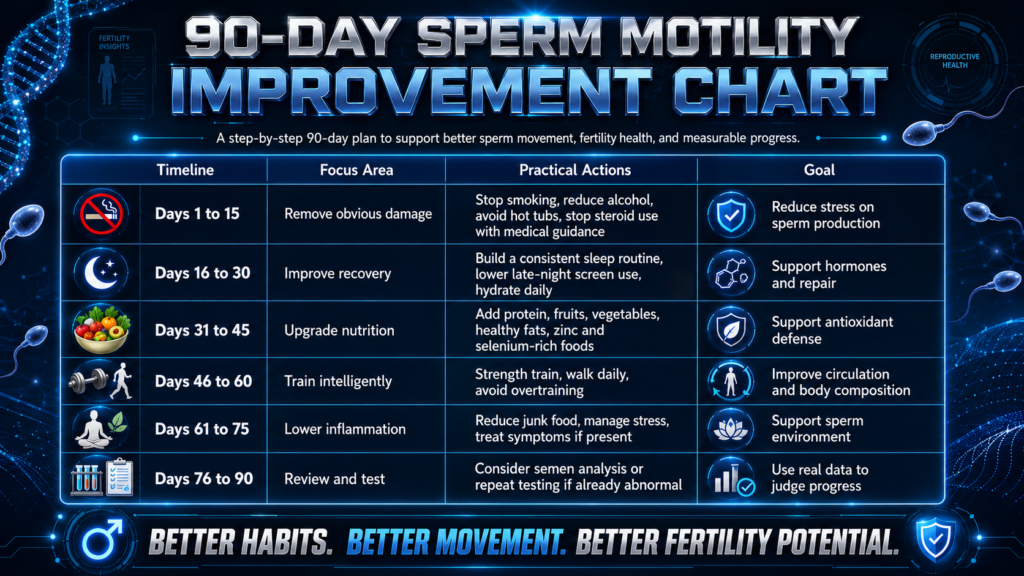
90-Day Sperm Motility Improvement Chart
| Timeline | Focus Area | Practical Actions | Goal |
| Days 1 to 15 | Remove obvious damage | Stop smoking, reduce alcohol, avoid hot tubs, stop steroid use with medical guidance | Reduce stress on sperm production |
| Days 16 to 30 | Improve recovery | Build a consistent sleep routine, lower late-night screen use, hydrate daily | Support hormones and repair |
| Days 31 to 45 | Upgrade nutrition | Add protein, fruits, vegetables, healthy fats, zinc and selenium-rich foods | Support antioxidant defense |
| Days 46 to 60 | Train intelligently | Strength train, walk daily, avoid overtraining | Improve circulation and body composition |
| Days 61 to 75 | Lower inflammation | Reduce junk food, manage stress, treat symptoms if present | Support sperm environment |
| Days 76 to 90 | Review and test | Consider semen analysis or repeat testing if already abnormal | Use real data to judge progress |
How to Improve Sperm Motility Through Sleep
Sleep is one of the most underrated fertility tools.
Poor sleep affects hormones, energy, appetite, stress, immune function, and recovery.
A man who sleeps badly for months is not giving his body the best environment for sperm production or movement.
Improving sleep does not require a complicated plan.
It requires discipline.
Go to bed at a consistent time.
Wake at a consistent time.
Keep the room cool and dark.
Reduce screens before bed.
Avoid heavy alcohol near bedtime.
Stop treating sleep like an optional luxury.
Sleep is biological maintenance.
If a man wants better sperm motility, he should first stop living in a state of constant exhaustion.
How Nutrition Supports Sperm Movement
Sperm movement depends on energy, structure, and cellular health.
Nutrition helps provide the materials the body needs.
A fertility-supportive diet should include enough protein, healthy fats, antioxidants, minerals, and whole-food carbohydrates.
The goal is not perfection.
The goal is consistency.
Men should eat like their future matters.
That means fewer processed foods, fewer sugar-heavy snacks, fewer fried meals, and more real food.
Protein
Protein supports hormones, tissue repair, muscle, metabolism, and recovery.
Good sources include eggs, fish, poultry, lean meat, Greek yogurt, cottage cheese, beans, lentils, and other whole foods.
Men who train should be especially mindful of protein.
Under-eating while training hard can stress the body.
Healthy Fats
Healthy fats support hormone function and cell membranes.
Olive oil, avocado, nuts, seeds, eggs, and fatty fish can all be useful.
Fat should not be feared.
Poor-quality food should be.
A man trying to improve fertility should focus on high-quality fats rather than fried junk and processed snacks.
Antioxidants
Antioxidants help the body deal with oxidative stress.
Sperm are vulnerable to oxidative damage, so antioxidant-rich foods can support a healthier reproductive environment.
Good choices include berries, citrus, pomegranate, leafy greens, tomatoes, carrots, peppers, and cruciferous vegetables.
This does not mean one fruit fixes fertility.
It means a consistent pattern of nutrient-dense eating supports the system.
Zinc and Selenium
Zinc and selenium are often discussed in relation to sperm production and male fertility.
Food sources include seafood, beef, eggs, pumpkin seeds, Brazil nuts, and other mineral-rich foods.
Supplements may help some men, especially if there is a deficiency.
But high-dose supplementation should not be careless.
A serious man does not guess with his health.
He builds the basics first and uses testing where needed.
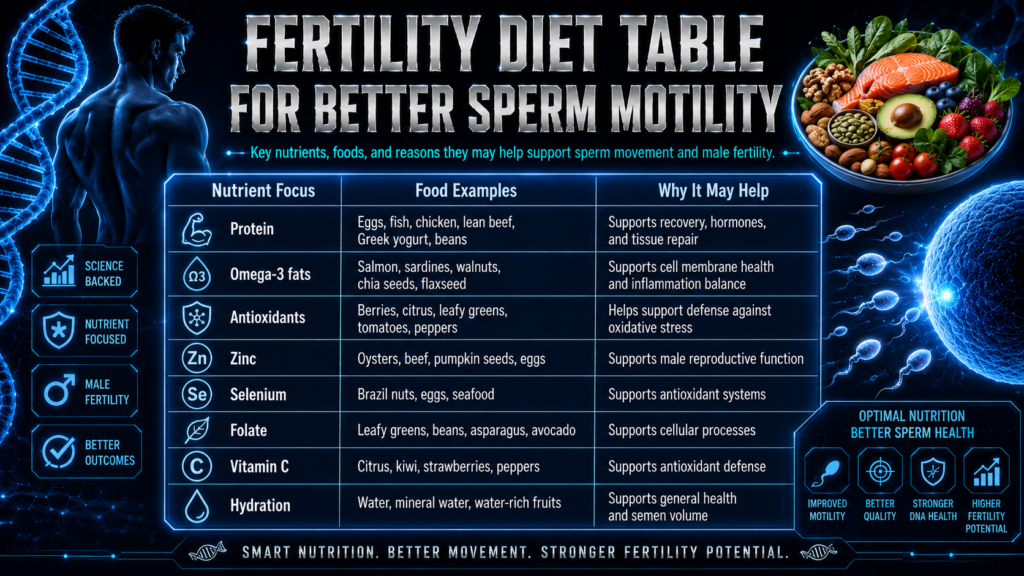
Fertility Diet Table for Better Sperm Motility
| Nutrient Focus | Food Examples | Why It May Help |
| Protein | Eggs, fish, chicken, lean beef, Greek yogurt, beans | Supports recovery, hormones, and tissue repair |
| Omega-3 fats | Salmon, sardines, walnuts, chia seeds, flaxseed | Supports cell membrane health and inflammation balance |
| Antioxidants | Berries, citrus, leafy greens, tomatoes, peppers | Helps support defense against oxidative stress |
| Zinc | Oysters, beef, pumpkin seeds, eggs | Supports male reproductive function |
| Selenium | Brazil nuts, eggs, seafood | Supports antioxidant systems |
| Folate | Leafy greens, beans, asparagus, avocado | Supports cellular processes |
| Vitamin C | Citrus, kiwi, strawberries, peppers | Supports antioxidant defense |
| Hydration | Water, mineral water, water-rich fruits | Supports general health and semen volume |
Exercise and Sperm Motility
Exercise can support male fertility through better circulation, healthier body composition, improved insulin sensitivity, stress control, and stronger hormonal patterns.
But training must be intelligent.
More is not always better.
A man who trains too hard, sleeps too little, eats poorly, and stays constantly stressed may be weakening his body instead of building it.
The best approach is balanced.
Strength train three to four times per week.
Walk daily.
Use moderate cardio.
Recover properly.
Do not crash diet.
Do not overtrain.
The goal is to build a strong body that can also support reproduction.
That is real masculine fitness.
Weight Management and Motility
Excess body fat may influence hormones, inflammation, and semen quality.
For men who are overweight, losing fat may help improve fertility markers.
But the method matters.
Crash diets can damage energy, hormones, mood, libido, and recovery.
A better approach is steady fat loss.
Eat enough protein.
Control calories without starving.
Walk daily.
Train consistently.
Sleep properly.
Be patient.
The man who builds slowly often wins longer.
Fertility is not improved by panic.
It is improved by standards.
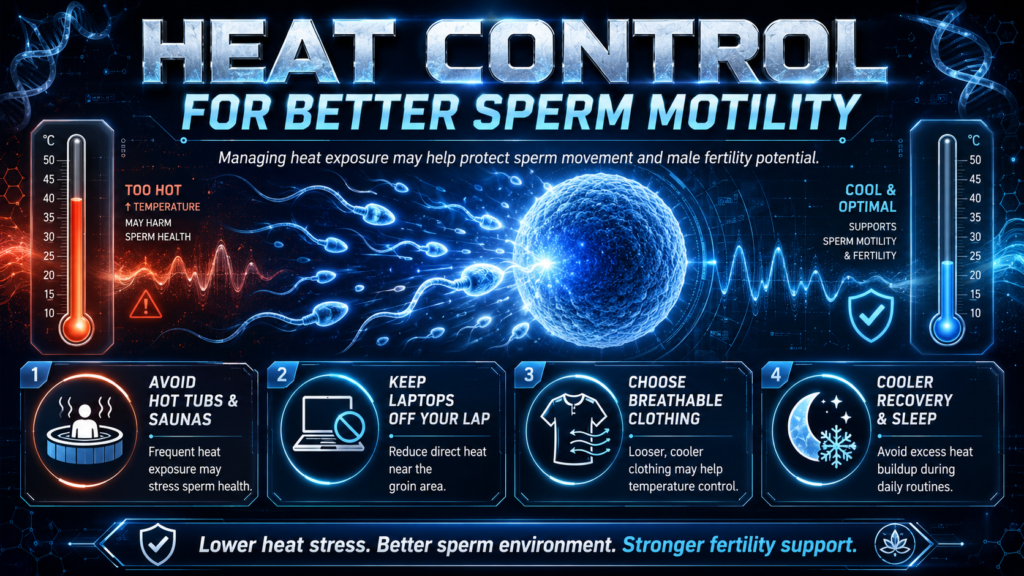
Heat Control for Better Sperm Motility
Heat is a practical issue.
Men often overlook it because it seems too simple.
But sperm production and function are temperature-sensitive.
If a man is trying to improve sperm motility, he should be careful with repeated heat exposure.
Avoid frequent hot tubs.
Limit long hot baths.
Be careful with sauna use while actively trying to conceive.
Do not place laptops on the lap.
Avoid tight underwear if it creates heat.
Take breaks from high-heat work when possible.
These are simple changes.
But simple does not mean useless.
A disciplined man respects the basics.
Smoking, Vaping, and Sperm Movement
Smoking is strongly linked with poorer overall health and may affect semen quality.
For sperm movement, smoking is a serious concern because of oxidative stress and toxic exposure.
Vaping should not be treated as harmless either.
Research is still developing, but inhaling chemicals is not a fertility strategy.
If a man wants stronger sperm, he should remove the obvious damage.
That includes nicotine dependence.

Quitting is hard, but fatherhood requires harder things than quitting a habit.
A man who wants legacy must be willing to sacrifice comfort.
Alcohol and Sperm Motility
Alcohol can affect sleep, hormones, liver health, sexual function, mood, and recovery.
Heavy alcohol use may work against fertility.
Men who are trying to conceive should reduce alcohol and avoid binge drinking.
A 90-day fertility reset is a good time to be strict.
Not because one drink destroys everything.
But because discipline creates clarity.
When alcohol is removed, sleep improves, energy improves, training improves, and the body gets a cleaner environment.
That matters.
Stress Control and Male Fertility
Stress is not only emotional.
It becomes physical.
It affects sleep, hormones, inflammation, appetite, libido, and relationship health.
Trying to conceive can also create pressure.
Some men feel like every fertile window becomes a test.
That mindset can harm intimacy and confidence.
A man should learn to control stress with structure.
Walk daily.
Train consistently.
Reduce late-night phone use.
Pray or meditate.
Speak honestly with his partner.
Get medical facts instead of living in silent fear.
The mindset taught through The Alpha Reports fits this perfectly because discipline is not only about pushing harder. It is also about controlling chaos.
Supplements for Sperm Motility
Supplements can be useful for some men, but they are not magic.
Many male fertility supplements focus on antioxidants, minerals, amino acids, and nutrients that may support sperm health.
Common ingredients include CoQ10, L-carnitine, zinc, selenium, vitamin C, vitamin E, folate, omega-3, and vitamin D.
Some men may benefit.
Others may not.
The problem is when men use supplements as a replacement for discipline.
A supplement cannot cancel smoking.
It cannot repair five hours of sleep.
It cannot undo steroid misuse.
It cannot fix a varicocele by itself.
It cannot treat an infection.
The smart approach is simple.
Fix the lifestyle foundation first.
Use supplements carefully.
Speak with a clinician if there are abnormal semen results or medical concerns.
Medical Conditions That Can Affect Sperm Motility
Some causes of poor sperm motility are medical.
These may include varicocele, hormone disorders, infections, inflammation, genetic conditions, autoimmune issues, diabetes, thyroid disease, or reproductive tract problems.
This is why semen analysis matters.
If motility is low, doctors may recommend repeat testing, physical examination, hormone testing, infection testing, ultrasound, or other evaluation depending on the case.
A man should not be embarrassed by this.
The body gives signals.
A responsible man investigates them.

When to Get a Semen Analysis
A semen analysis is the best starting point for understanding sperm movement.
Men should consider testing if a couple has been trying to conceive for 12 months without success.
If the female partner is 35 or older, testing is often recommended sooner, commonly after 6 months of trying.
Testing may also be smart earlier if the man has risk factors.
These include testicular injury, undescended testicle, varicocele, anabolic steroid use, testosterone therapy, cancer treatment, infections, sexual function problems, or previous reproductive surgery.
A semen analysis does not weaken a man.
It gives him information.
And information creates options.
How to Read Motility Results Without Panic
Semen results can be emotional.
Men often see one abnormal number and assume the worst.
That is not always accurate.
Semen quality can vary.
Illness, fever, stress, collection issues, abstinence time, medications, recent heat exposure, and lifestyle changes may influence results.
Doctors often repeat semen analysis before drawing firm conclusions.
A man should not panic over one report.
He should review it, understand it, and decide the next step with proper guidance.
This is the mature way.
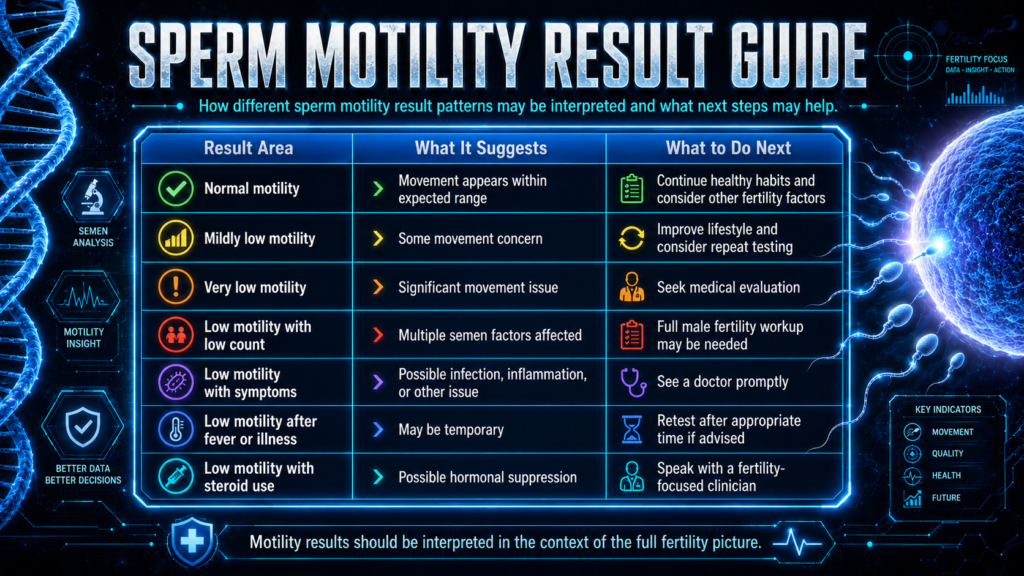
Sperm Motility Result Guide
| Result Area | What It Suggests | What to Do Next |
| Normal motility | Movement appears within expected range | Continue healthy habits and consider other fertility factors |
| Mildly low motility | Some movement concern | Improve lifestyle and consider repeat testing |
| Very low motility | Significant movement issue | Seek medical evaluation |
| Low motility with low count | Multiple semen factors affected | Full male fertility workup may be needed |
| Low motility with symptoms | Possible infection, inflammation, or other issue | See a doctor promptly |
| Low motility after fever or illness | May be temporary | Retest after appropriate time if advised |
| Low motility with steroid use | Possible hormonal suppression | Speak with a fertility-focused clinician |
Male Fertility Is a Couple Issue
When fertility is difficult, men sometimes step back.
They assume the woman should handle testing first.
That is not leadership.
Male factors can contribute to infertility, so both partners should be evaluated.
A man should not wait for his partner to go through months of testing while he avoids one semen analysis.
That is not strength.
That is avoidance.
If a man wants fatherhood, he should act like a partner.
Get tested.
Improve habits.
Support the relationship.
Stay steady.
Do not blame.
Do not hide.
Do not make fertility a silent war.
Sperm Motility and Sexual Performance Are Different
This point matters.
A man can have strong erections and still have poor sperm motility.
He can have a high libido and still have abnormal semen results.
He can perform well sexually and still need fertility support.
Sexual performance is visible.
Sperm movement is not.
Do not confuse bedroom confidence with sperm health.
A mature man understands the difference.
He does not use performance as proof.
He uses testing as proof.
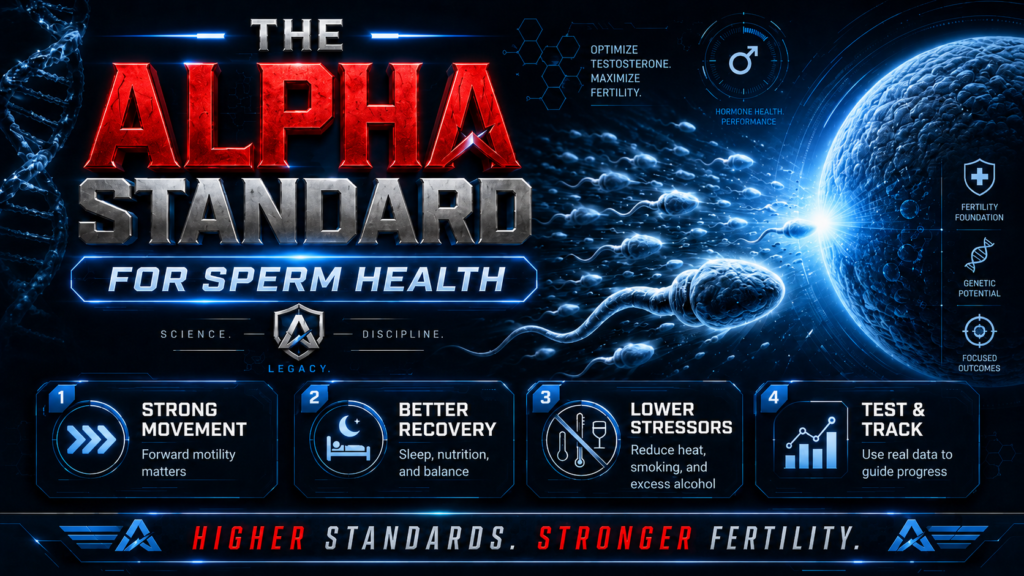
The Alpha Standard for Sperm Health
Improving sperm motility is not about weakness.
It is about responsibility.
A man who wants children should care about his reproductive system.
He should protect his sleep.
He should eat with discipline.
He should train wisely.
He should quit smoking.
He should control alcohol.
He should reduce heat exposure.
He should stop reckless hormone use.
He should get tested when needed.
This is not fear.
This is leadership.
The same mindset that builds strength, business, discipline, and respect should also build reproductive health.
That is the standard men should hold themselves to through the broader philosophy of Alpha Circle Club.
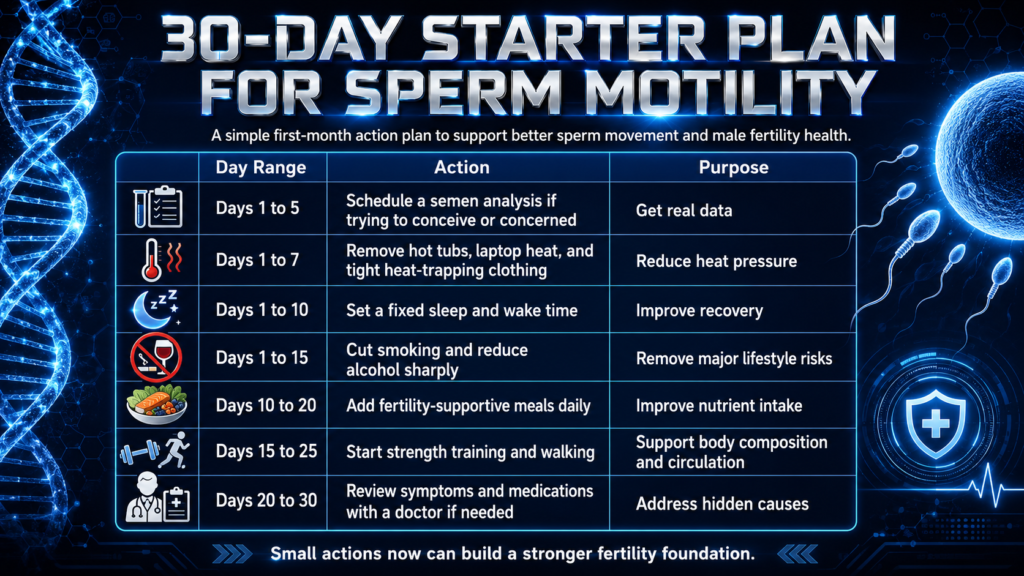
30-Day Starter Plan for Sperm Motility
| Day Range | Action | Purpose |
| Days 1 to 5 | Schedule a semen analysis if trying to conceive or concerned | Get real data |
| Days 1 to 7 | Remove hot tubs, laptop heat, and tight heat-trapping clothing | Reduce heat pressure |
| Days 1 to 10 | Set a fixed sleep and wake time | Improve recovery |
| Days 1 to 15 | Cut smoking and reduce alcohol sharply | Remove major lifestyle risks |
| Days 10 to 20 | Add fertility-supportive meals daily | Improve nutrient intake |
| Days 15 to 25 | Start strength training and walking | Support body composition and circulation |
| Days 20 to 30 | Review symptoms and medications with a doctor if needed | Address hidden causes |
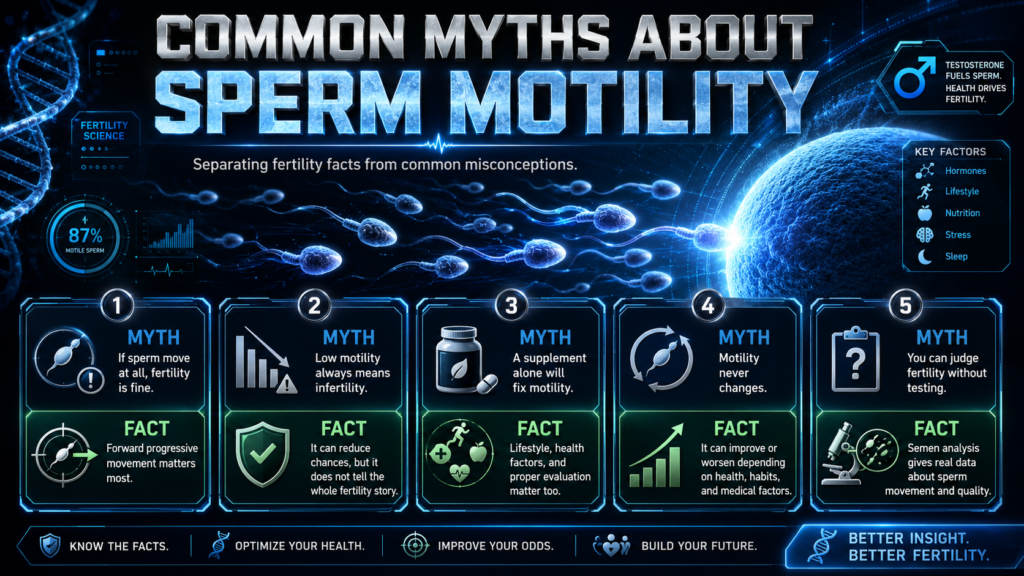
Common Myths About Sperm Motility
Myth 1: More Semen Means Better Motility
Semen volume and sperm movement are not the same.
A man may release normal or high semen volume but still have poor sperm movement.
Only a semen analysis can check motility properly.
Myth 2: Strong Erections Mean Strong Sperm
Erections and sperm movement are different systems.
Good sexual performance does not guarantee healthy sperm.
A man can perform well and still have abnormal semen parameters.
Myth 3: Supplements Can Fix Everything
Supplements may help some men, but they do not replace sleep, nutrition, quitting smoking, reducing alcohol, medical testing, or treatment when needed.
The basics still matter most.
Myth 4: Low Motility Means You Cannot Have Children
Low motility can make conception harder, but it does not always mean pregnancy is impossible.
The outlook depends on the full semen analysis, the cause, the female partner’s fertility, and treatment options.
Myth 5: Fertility Is Mostly a Woman’s Problem
This is false and damaging.
Male factors are an important part of fertility evaluation.
A responsible man gets checked.
FAQs About Sperm Motility
What is sperm motility?
Sperm motility means how well sperm move.
It is one of the key markers measured in a semen analysis. Good motility helps sperm travel through the female reproductive tract and reach the egg.
What causes low sperm motility?
Low sperm motility may be caused by oxidative stress, smoking, heavy alcohol use, heat exposure, obesity, infections, varicocele, hormone problems, medications, toxins, genetic factors, or other medical issues.
Sometimes the cause is not immediately clear.
Can sperm motility improve naturally?
Some men may improve sperm movement through better sleep, nutrition, exercise, weight control, smoking cessation, alcohol reduction, heat reduction, and stress management.
However, medical causes may need professional treatment.
How long does it take to improve sperm motility?
Many men use a 90-day window because sperm development takes time.
Lifestyle changes may take two to three months to appear in semen results, although the exact timeline varies.
What foods help sperm motility?
No single food guarantees better motility.
A strong fertility diet includes protein, healthy fats, fruits, vegetables, omega-3 sources, zinc-rich foods, selenium-rich foods, and antioxidant-rich foods.
Does heat affect sperm motility?
Repeated heat exposure may affect sperm production and function in some men.
Men trying to conceive may benefit from reducing hot tubs, long hot baths, tight heat-trapping clothing, heated seats, and laptops on the lap.
Does smoking reduce sperm motility?
Smoking may harm semen quality and increase oxidative stress.
Quitting smoking is one of the most important lifestyle steps for men who want better sperm health.
Can testosterone therapy affect sperm motility?
External testosterone can reduce sperm production and may harm fertility.
Men who want children should speak with a qualified doctor before using testosterone therapy or anabolic steroids.
Should I repeat a semen analysis if motility is low?
Many clinicians repeat semen testing because results can vary.
A single abnormal result does not always give the full picture. A doctor can advise when to repeat testing and what additional evaluation may be needed.
Final Thoughts
Sperm motility is not a small detail.
It is one of the main ways sperm prove they can do their job.
A man may have sperm, but those sperm need to move.
They need direction, energy, structure, and function.
If movement is poor, fertility may become harder.
The good news is that men have options.
Improve sleep.
Eat better.
Train wisely.
Quit smoking.
Reduce alcohol.
Avoid excess heat.
Manage stress.
Protect your hormones.
Get a semen analysis.
See a doctor when needed.
This is not about panic.
It is about ownership.
A man who wants fatherhood should not leave fertility to chance.
He should build the body, habits, and discipline that support the future he wants.
That is the Alpha standard.

Medical note: This article is for educational purposes only and is not medical advice. Men concerned about fertility, testosterone, semen quality, or conception should speak with a qualified healthcare professional or fertility specialist.



No spam. Unsubscribe anytime.