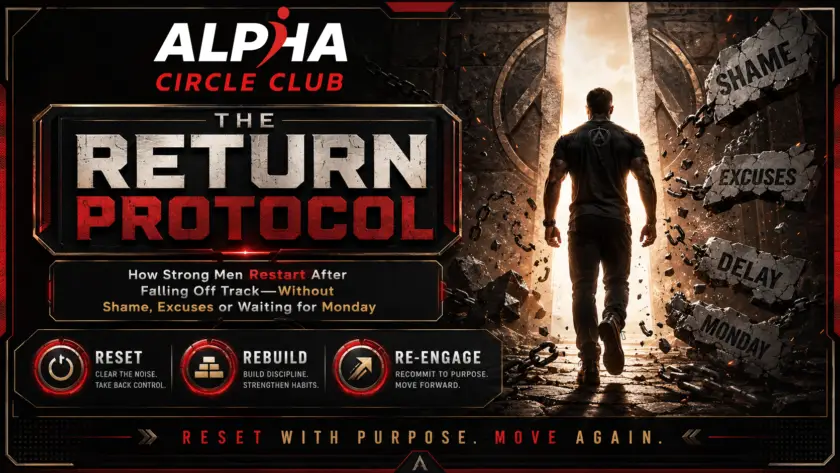
Falling off track does not define you. The speed and intelligence of your return does.
A SETBACK IS AN EVENT. SURRENDER IS A DIRECTION. LEARN THE DIFFERENCE—AND RETURN.
Introduction — The Most Dangerous Moment Comes After the Mistake
There is a dangerous moment after a man breaks a promise to himself. The workout is missed. The project remains untouched. Entertainment consumes the hours he intended to protect. He reaches the end of the day disappointed, frustrated and ashamed. But the greatest damage is rarely caused by the original mistake. It is caused by what he decides the mistake means. If he treats one failure as proof that he has not changed, guilt becomes avoidance, avoidance becomes another missed day and another missed day becomes a return to the life he was trying to escape. Strong men are not men who never fall off track. They are men who refuse to build a new identity around the place where they stumbled. They recognise the failure, extract the lesson and return before weakness has time to establish a home.
The previous Alpha Circle Club articles established a complete system of transformation.
The Century Code established the standards.
Prove the Code demanded evidence.
The Point of No Return closed the door to the former self.
The Discipline Engine designed an environment that makes execution easier to repeat.
But even a strong system will eventually encounter pressure.
There will be illness, exhaustion, family responsibilities, emotional strain, disappointment and circumstances that disrupt the plan. There will also be days when no legitimate crisis occurs and you simply choose the easier option. You will know what you should do and avoid it anyway.
The existence of that moment does not make the previous work meaningless. It makes a recovery system necessary.
Many men know how to start when motivation is high. Far fewer know how to return when their confidence has been damaged by their own behaviour.
They wait for a new week, new month, perfect morning or powerful emotional state. They create another plan, announce another beginning and promise that this attempt will finally be different. Yet every hour spent preparing to return becomes another hour in which the weak pattern regains authority.
You do not need another ceremonial beginning.
You need a protocol.
A protocol tells you what to do when emotion is unreliable. It prevents guilt from designing the next decision. It replaces vague promises with a sequence: stop the slide, state the failure accurately, find the first break, repair the system, complete the minimum action and return to the full standard.
This article will not tell you that failure does not matter. It matters because your standards matter. But it will also refuse the lie that one failure cancels your identity, your progress or your future.
You are responsible for the return.
And the return can begin before this day ends.
Chapter 1 — Every Man Will Eventually Lose Momentum
Momentum feels powerful because action begins making the next action easier. The work is open, the routine is familiar and evidence is accumulating. You feel less resistance because your recent behaviour has already established a direction.
Then something interrupts it.
Sometimes the cause is outside your control. A health problem, family need, changing work demand or unexpected responsibility may consume the time and energy you intended to protect.
Sometimes the cause is internal. You become tired of repetition, underestimate a distraction, relax the entertainment boundary or decide that one careless day will not matter.
Either way, the rhythm breaks.
Losing momentum is not the same as losing every gain created while building it. The completed work still exists. The lessons remain. The physical capacity, skill, knowledge and self-awareness you developed do not disappear at midnight because yesterday was unproductive.
What disappears first is the feeling of movement.
This is why a missed period can appear more destructive than it is. You compare the present resistance with the recent ease of action and conclude that you have returned to the beginning. You have not. You are experiencing the cost of re-entry.
Expecting endless momentum creates fragility. When the first interruption arrives, you interpret it as proof that the system failed. A stronger expectation is different:
“I will build momentum, protect it and use a prepared return process whenever it breaks.”
This expectation does not excuse careless behaviour. It removes the shock that makes a normal setback feel fatal.
Distinguish between three events:
- Interruption: circumstances temporarily prevent the planned behaviour.
- Lapse: you break the standard once or for a short period.
- Abandonment: you stop attempting to return and allow the lapse to become your direction.
The first two require response. The third is what the response is designed to prevent.
A disciplined man is not protected by the fantasy that momentum will never break. He is protected by knowing exactly what he will do when it does.
Alpha Insight
The expectation of perfection makes one mistake feel fatal. The expectation of recovery makes it correctable.
Chapter 2 — Stop Turning Guilt into Another Excuse
Guilt can serve a useful purpose.
It can tell you that your behaviour fell below a standard you genuinely value. If you promised to complete the work and chose distraction instead, discomfort is understandable. The discomfort shows that the promise mattered.
But guilt becomes destructive when it stops addressing behaviour and begins attacking identity.
Useful guilt says:
“I broke the standard. I need to understand why and repair it.”
Shame says:
“I broke the standard because I am fundamentally incapable of change.”
The first statement creates a problem that can be solved. The second creates a permanent identity that makes action feel pointless.
This is where guilt becomes another excuse. A man may appear to be holding himself accountable because he is speaking harshly to himself, but nothing is being repaired. He spends the evening repeating how disappointed he is, then avoids the next action because facing it would remind him of the failure.
Self-condemnation begins replacing responsibility.
Do not confuse cruelty with honesty.
Honesty describes what happened accurately:
- I opened entertainment before completing the priority.
- I ignored the written first action.
- I broke the boundary I had agreed to protect.
- I had time for the minimum action and chose not to perform it.
Cruelty exaggerates the conclusion:
- I ruin everything.
- I have no discipline.
- I will never change.
- There is no point trying again.
The exaggerated statements may feel emotionally appropriate, but they contain no instruction.
Accountability requires four things:
- Admit the broken standard.
- Accept the consequence without inventing excuses.
- Identify the first point where behaviour changed direction.
- Complete a corrective action.
You do not honour your standards by spending another day apologising to them. You honour them by returning to the behaviour they require.
Feel the disappointment. Tell yourself the truth. Then refuse to let guilt consume the energy needed for repair.
Alpha Insight
Guilt is useful when it points towards correction. It becomes another form of avoidance when it leaves you staring only at yourself.
Chapter 3 — Separate the Event from Your Identity
Language influences what you believe is possible next.
When a man uses permanent language to describe temporary behaviour, he turns an event into an identity.
“I am lazy” sounds like a fixed condition.
“I avoided the task today” describes an action that can be examined and changed.
This is not positive thinking designed to protect you from reality. It is accurate thinking designed to create a useful response.
| Destructive identity conclusion | Accurate event description | Constructive direction |
|---|---|---|
| I am lazy | I avoided today’s planned task | I will complete the minimum action now |
| I always fail | This system failed under these conditions | I will repair the first failure point |
| I have ruined everything | I broke one part of the routine | I will restore the next action |
| I have no discipline | My discipline was not demonstrated today | I will produce new evidence |
| I am back at the beginning | My momentum has been interrupted | I will restart with existing experience |
Your identity should not be built from your worst hour or your best speech. It should be built from the pattern you repeatedly choose—including the pattern of recovery.
One failure belongs inside your story. It does not have to become the title.
This distinction also prevents false confidence. You should not say, “I am disciplined,” and use the label to ignore repeated evidence of undisciplined behaviour. Identity must remain accountable to action.
Use a balanced statement:
“I am becoming a disciplined man, and disciplined men correct this kind of failure quickly.”
The identity now creates a responsibility rather than a shield.
When a lapse occurs, use three sentences:
- The event: “I did not complete the work I planned.”
- The cause: “I opened entertainment before beginning and allowed confusion about the task to continue.”
- The return: “I will close the distraction, define the next action and work for ten minutes now.”
This language is honest, specific and actionable. It neither excuses the failure nor allows it to become your entire identity.
You are not required to pretend the mistake did not happen. You are required to stop allowing it to make decisions that belong to the man returning.
Alpha Insight
Describe the failure as an event that requires correction, not as a permanent identity that makes correction impossible.
Chapter 4 — Perform a Failure Autopsy
Do not examine a setback only at the final moment.
The missed workout, unfinished project or lost evening is usually the end of a sequence. If you look only at the final outcome, you may conclude that you need more motivation. The useful lesson often exists earlier.
Perform a failure autopsy.
The purpose is not to punish yourself or repeatedly relive the disappointment. It is to find the first moment where the system stopped protecting the standard.
1. What Standard Did I Break?
Name it precisely. “I failed at life” is meaningless. “I broke the produce-before-you-consume rule” can be repaired.
2. What Happened Immediately Beforehand?
Record the environment, time, physical state and preceding action. Were you tired? Was the task unclear? Did you pick up the phone for a legitimate purpose and remain there?
3. Which Emotion or Excuse Appeared?
Perhaps you felt overwhelmed, bored, discouraged or entitled to relief. Record the exact sentence you accepted:
- “I will start after one video.”
- “There is not enough time to make today worthwhile.”
- “I have already worked hard this week.”
- “I need to feel clearer before I begin.”
4. Which Protection Was Missing?
Was the phone still within reach? Was the website blocker disabled? Had tomorrow’s task not been prepared? Did entertainment have no gate?
5. Where Was the First Point of Failure?
The first failure may not have been opening entertainment. It may have been going to sleep without defining the task, beginning the day with the phone or allowing the working area to remain unprepared.
6. What Must Change During the Next Attempt?
Choose one physical repair. Move the device, simplify the task, schedule the work, prepare the tools or reduce the minimum action.
The autopsy should produce a conclusion such as:
“The failure began when I entered the work period without a defined first action. I felt overwhelmed, opened social media to avoid deciding and lost the hour. Tonight I will prepare the exact task, leave the document open and keep the phone outside the room.”
This is far more useful than “I need to try harder.”
Do not conduct endless analysis. Once the cause is clear enough to test a repair, return to action. An autopsy that never reaches behaviour becomes another hiding place.
Alpha Insight
Do not study failure to prove that you are broken. Study it to discover where the system first broke.
Chapter 5 — Return Before You Feel Ready
After losing momentum, you may feel that something must happen before you can restart.
You want the guilt to disappear, the energy to return, the plan to feel exciting or the calendar to offer a cleaner beginning.
Waiting appears reasonable because you imagine that a better internal state will create better action.
Often, the action must create the better state.
The return command is:
Do not wait for another Monday. Return within 24 hours.
The 24-hour rule does not mean every full routine must be restored immediately regardless of illness, safety or genuine responsibility. It means that within 24 hours, you perform an appropriate action proving that the return has begun.
That action might be:
- Completing the minimum version of the standard
- Clearing and preparing the workspace
- Restoring the distraction blocker
- Writing the first paragraph
- Performing a short movement session
- Recording and reviewing the financial figures
- Sending the message required to resume accountability
If you recognise the lapse late at night, do not create another failure by sacrificing necessary sleep to perform an unrealistic recovery session. Complete a short, meaningful action and prepare the full return for the next appropriate period.
For example:
- Write tomorrow’s primary outcome.
- Define the first ten-minute action.
- Prepare the tools.
- Remove the distraction.
- Begin at the scheduled time.
Readiness often follows evidence. Ten minutes of work reduces the psychological distance between you and the project. One completed set reminds your body that training has resumed. One honest report replaces the private shame with visible responsibility.
The longer you wait, the more ceremonial the restart becomes. You begin believing you need a perfect plan because the gap now feels too large for an ordinary action.
Break that illusion quickly.
The first return does not need to look impressive. It needs to happen.
Alpha Insight
Do not wait until you feel like the disciplined man again. Perform the action that gives the disciplined man new evidence.
Chapter 6 — Use the Minimum Restart Action
The first action after a setback carries unusual psychological weight.
If you make it too large, resistance may defeat it and reinforce the belief that you cannot return. If you make it meaningless, it produces no genuine evidence.
Use a minimum restart action.
A strong minimum restart action has four qualities:
- It can begin immediately or at the next realistic opportunity.
- It is small enough to survive low motivation.
- It contains physical evidence.
- It points directly towards the full standard.
Examples include:
| Area | Full standard | Minimum restart action |
| Business | Complete a 60-minute development block | Work on the priority for ten focused minutes |
| Writing | Produce 1,000 words | Finish one purposeful paragraph |
| Training | Complete the programmed workout | Perform one appropriate set or short movement session |
| Sales | Complete the outreach target | Send one qualified offer |
| Finances | Perform the full weekly review | Open and record one essential account figure |
| Environment | Complete the full evening reset | Clear the desk and prepare the next task |
| Learning | Complete a study session | Read two pages and write one lesson |
Do not choose a minimum unrelated to the broken standard. Cleaning the room may feel productive, but it does not count as restarting the sales task unless the room was the specific barrier preventing it.
Use this sentence:
“The smallest honest evidence that I have returned is…”
Complete the answer before redesigning the entire plan.
The minimum action is a doorway, not a destination. Once you begin, continue if capacity and circumstances allow. If ten minutes becomes 30, accept the momentum. If the minimum is all you can responsibly complete, record it and restore the full standard at the next scheduled opportunity.
Never use the minimum repeatedly when the target remains within your capacity. A recovery tool becomes an excuse when it is used permanently to avoid full effort.
The purpose is to shorten the distance between failure and evidence.
Alpha Insight
The minimum restart action is not designed to impress anyone. It is designed to prove that the setback no longer controls the next decision.
Chapter 7 — Repair the System, Not Only the Mood
Motivational recovery can feel powerful. You listen to a speech, write an aggressive declaration and promise that everything changes now.
The emotion may help you begin, but if the system remains unchanged, the same weakness is waiting beneath the new energy.
Repair what failed.
| Repeated problem | Possible system weakness | Practical repair |
| Starting with distraction | Phone and entertainment remain immediately available | Move the phone and activate the entertainment gate |
| Avoiding the work | The first action is vague or too large | Define a ten-minute physical action |
| Missing training | No time or equipment is prepared | Schedule the session and prepare clothing beforehand |
| Losing the evening | No transition exists after daily responsibilities | Create a short reset and a fixed starting trigger |
| Failing when tired | The target assumes maximum energy every day | Define a meaningful minimum and address recovery |
| Forgetting priorities | Goals remain hidden or spread across several systems | Display one primary outcome in the working area |
| Repeated overspending | Purchases remain effortless and saving remains optional | Add a waiting period and automate responsible transfers |
System repair begins with the failure autopsy. Once you find the first break, change the environment, instruction, timing or boundary associated with it.
Do not make ten changes after one lapse. Too many corrections can create a system so complicated that maintaining it becomes another burden. Choose the repair most directly connected to the failure and test it.
You should also distinguish a system problem from a commitment problem.
Sometimes the task was clear, the environment was prepared and the time was available—but you chose not to act. Do not invent a technical explanation to avoid responsibility. In that case, the repair may be a stronger consequence, immediate accountability or recommitment to the entertainment gate.
The system supports your decision. It cannot make the decision for you.
Ask after every setback:
- What should the system have prevented, prepared or made visible?
- What still required character from me?
- Which one change will make the next correct action easier to perform?
Motivation can restart the engine. Repair prevents the same damaged part from stopping it again.
Alpha Insight
A powerful recommitment may restart you today. A repaired system makes tomorrow’s failure less likely.
Chapter 8 — Rebuild Self-Trust Through Evidence
When you repeatedly break private promises, the damage reaches beyond the individual task. You begin doubting your own instructions.
You write a plan without believing it. You set a deadline while expecting another delay. You tell yourself that tomorrow will be different, but the promise no longer carries authority.
Self-trust cannot be restored through a larger promise.
It is restored through evidence.
Begin with commitments small enough to honour and meaningful enough to matter. If you have missed an entire week of work, do not attempt to repair self-trust by promising an immediate ten-hour day. Promise one focused block, protect it and complete it.
Use the Evidence Ladder:
Level 1 — Immediate Evidence
Complete the minimum restart action.
Level 2 — Daily Evidence
Keep one clearly defined promise for the next three days.
Level 3 — Weekly Evidence
Follow the repaired standard for seven days and record each completion.
Level 4 — Expanded Evidence
Increase the target only after consistency has returned.
This gradual approach is not weakness. It prevents ambition from writing promises your current system cannot yet support.
Record evidence visibly:
- The task completed
- The time spent
- The distraction refused
- The minimum protected
- The system repair used
- The recovery completed
Do not rely on how you feel about yourself each evening. Feelings may lag behind behaviour. Let the record speak until confidence catches up.
Self-trust also requires honesty when you fail. Do not mark a partial action as complete or continually redefine the promise after breaking it. A small honest result builds more trust than an exaggerated report.
Eventually, your word begins regaining weight. When you write tomorrow’s action, part of you expects it to happen because recent evidence supports the expectation.
Confidence is no longer borrowed from motivation. It is earned from remembered behaviour.
Alpha Insight
Self-trust returns when your promises become small enough to keep, clear enough to measure and important enough to prove.
Chapter 9 — Never Restart from Zero
A setback can make a man speak as though everything has been lost.
“I am back at square one.”
Usually, this is not true.
The calendar may show a gap. Recent performance may be weaker. Physical capacity or sharpness may have declined if the interruption was long. But you are not the same man who began without experience.
You know more about the task.
You know which distractions defeat you.
You know how momentum feels and which actions created it.
You know where the system failed.
You possess completed work, recorded evidence and lessons that did not exist before the first attempt.
You are not restarting from zero. You are restarting from truth.
However, experience should not make you overestimate your current condition. If you stopped training for a significant period, returning immediately to the previous physical workload may be unwise. If a complex project has been untouched, you may need to review the current state before resuming full speed.
Return from the correct level, not from an imaginary zero and not from remembered peak performance.
Use three questions:
- What ability, knowledge or progress remains?
- What capacity has genuinely declined?
- What is the safest and most effective next level?
This creates an intelligent return.
Do not rebuild lessons you have already learned. Reuse the checklist, template, environment and method that previously worked. Restore the useful parts quickly while correcting what caused the interruption.
Your setback belongs to the price of experience. Extract its value.
The man returning should be more informed than the man who first began—even if he is temporarily moving more slowly.
Alpha Insight
You may return with less momentum, but you return with more knowledge. That means you are not beginning again—you are beginning wiser.
Chapter 10 — Turn the Setback into a Stronger Standard
A setback should leave behind more than regret.
If examined honestly, it can reveal the exact condition your previous system was not strong enough to survive.
Perhaps your standard worked only when motivation was high. The setback teaches you to define a minimum.
Perhaps your focus depended on the phone remaining harmless. The setback teaches you to remove access.
Perhaps your schedule assumed every day would be predictable. The setback teaches you to create recovery windows and prioritise the essential action.
Perhaps your plan contained no return rule. The setback creates one.
Turn the lesson into a stronger standard using this structure:
Because this happened, my system will now…
Examples:
- Because entertainment repeatedly opened first, my system will now block it until visible production exists.
- Because vague tasks created avoidance, my system will now define the first ten-minute action the night before.
- Because one missed day became a week, my system will now require a return action within 24 hours.
- Because exhaustion repeatedly defeated the full target, my system will now include an honest minimum and stronger recovery practices.
- Because I hid the failure, my system will now include a daily report or accountability check.
This is how failure becomes structural intelligence.
The objective is not to celebrate the setback or pretend it was necessary. Some failures produce real costs that cannot be recovered. Respect the cost by refusing to waste the lesson.
Your new standard should be specific, sustainable and connected to the failure. Do not respond to one weak day by building an extreme system that cannot survive an ordinary week.
Then test the stronger standard. Record whether it changes behaviour under the same trigger. Improvement must be demonstrated, not merely described.
Eventually, your recovery ability becomes part of your identity. You are not a man who assumes he will never fall. You are a man who has built the intelligence, humility and urgency required to return.
The setback becomes the last time that particular weakness was allowed to operate without a prepared response.
Alpha Insight
The setback stops being wasted when the weakness it exposed is no longer left unprotected.
The 24-Hour Return Report
Complete this report as soon as you recognise that momentum has broken. Keep the answers accurate and concise.
The Standard I Broke
What exact behaviour, boundary or commitment was not honoured?
What Happened
Describe the event without exaggeration or identity judgement.
The First Point of Failure
Where did the sequence begin moving in the wrong direction?
The Excuse I Accepted
Write the exact sentence you used to permit the behaviour.
What the Failure Cost Me
Record the time, progress, trust, money, energy or opportunity affected.
What It Taught Me
What does the failure reveal about the system, environment or decision?
The Environmental or System Repair
Which one physical change will reduce the chance of repetition?
My Minimum Restart Action
What is the smallest honest evidence that the return has begun?
The Time I Will Complete It
Choose a specific time or clear trigger within the next 24 hours.
The Evidence I Will Record
What will visibly prove that the action happened?
My Full-Standard Return
When will the complete behaviour resume?
The Eight-Step Return Protocol
Step 1 — Stop the Slide
Interrupt the weak behaviour as soon as you become aware of it. Do not continue merely because the day is already imperfect.
Step 2 — State the Failure Accurately
Name the broken standard and actual behaviour. Remove catastrophic language.
Step 3 — Remove the Shame-Based Identity Judgement
Replace “This is who I am” with “This is what happened, and this is what I will correct.”
Step 4 — Identify the First Failure Point
Trace the sequence backwards until you find the earliest useful place for intervention.
Step 5 — Repair One Part of the System
Change the environment, boundary, instruction or preparation connected to the failure.
Step 6 — Complete a Minimum Action Immediately
Produce the smallest honest evidence of return.
Step 7 — Restore the Full Standard Within 24 Hours
Return at the next appropriate opportunity. If genuine circumstances prevent the full behaviour, complete the minimum and schedule the full restoration clearly.
Step 8 — Record the Evidence
Write what you completed and what the return taught you. Allow the evidence—not the promise—to close the report.
The Seven-Day Momentum Restoration
Day 1 — Return
Complete the minimum restart action and repair the first failure point.
Day 2 — Repeat
Perform the same protected behaviour again. Do not increase the target merely to prove enthusiasm.
Day 3 — Restore
Return to the appropriate full standard or a carefully increased version.
Day 4 — Protect
Strengthen the environmental boundary most connected to the original lapse.
Day 5 — Record
Review the evidence from the previous four days and identify what is working.
Day 6 — Extend
Add a second supporting behaviour only if the primary standard is stable.
Day 7 — Review
Complete a short assessment:
- How quickly did I return?
- Which repair mattered most?
- Where does resistance remain?
- What standard will protect the next seven days?
The objective is not to create a heroic week. It is to restore a dependable direction.
The Return Declaration
I will not allow one mistake to become an abandoned future.
I will tell myself the truth without destroying myself with it.
I will accept responsibility without turning guilt into another excuse.
I will examine the failure and strengthen the system.
I will not wait for Monday, next month or another emotional beginning.
When I fall, I will return with greater intelligence.
When I lose momentum, I will create new evidence.
I will rebuild self-trust through promises kept in private.
My setback will become instruction—not identity.
I am not starting from nothing. I am returning with experience.
You Need One Honest Action Now
You may be reading this article while disappointed with yourself.
Perhaps you stopped following the routine, avoided the project or returned to the entertainment pattern you had promised to control. You may feel embarrassed by another restart and tempted to wait until you can return with greater confidence.
Do not wait.
Confidence is not the admission price for returning. It is one of the results the return begins rebuilding.
Complete the report. Find the first break. Repair one part of the system. Choose the minimum action and produce evidence before weakness turns another hour into another week.
You do not need to prove that the setback never happened.
Prove that it does not control what happens next.
A man is not defeated every time he falls below his standard. He is defeated when he decides that the distance between his present behaviour and that standard is no longer worth crossing.
Cross it again.
Return without drama. Return without a speech. Return without waiting for the calendar to make the beginning feel cleaner.
The future does not require another apology.
It requires evidence.
You do not need another perfect beginning. You need one honest action now.
Your Move
Complete the 24-Hour Return Report.
Choose your minimum restart action.
Then perform it before another day is allowed to disappear.



No spam. Unsubscribe anytime.