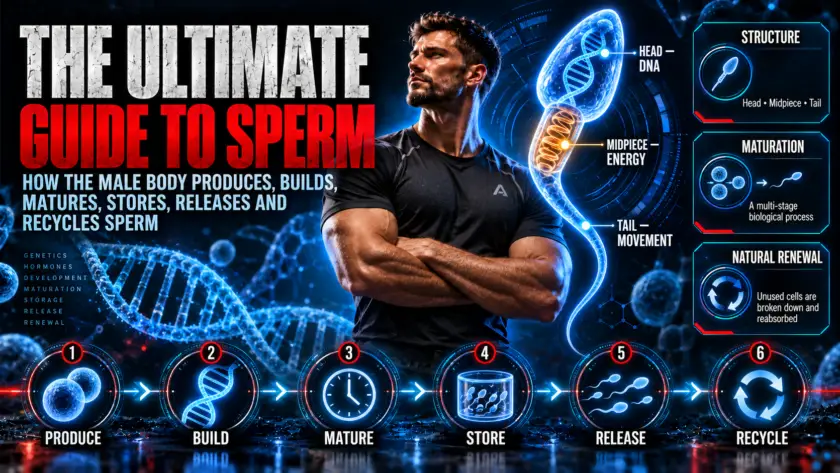
How the Male Body Produces, Builds, Matures, Stores, Releases and Recycles Sperm
Sperm are not produced instantly or stored without limits. Every cell is the result of an extraordinary biological production system involving the brain, hormones, testicles, epididymides, nutrients, temperature and approximately ten weeks of development.
At this moment, millions of new sperm cells are being developed inside the male body.
The process is silent, continuous and far more complicated than most men realise. Inside the testicles, immature germ cells divide, reduce their chromosomes, compress their DNA and transform into some of the most specialised cells in the human body. Each develops a genetic head, a mitochondria-rich midpiece and a microscopic tail capable of movement.
The cells then leave the testicles unfinished.
They enter the epididymides, where their membranes and functional abilities continue changing. Some eventually reach the storage region and wait for possible ejaculation. Others grow old, lose viability and are broken down or cleared without ever leaving the body.
This entire journey takes weeks. It depends upon precisely regulated hormones, functioning reproductive anatomy and a supportive internal environment. It can be influenced by health conditions, medicines and exposures that occurred long before a semen sample was produced.
Yet many men know almost nothing about it.
They may assume that sperm and semen are the same thing. They may believe that normal erections or producing a large volume of fluid prove fertility. They may expect a few days of supplements to transform cells that take more than two months to develop. Some expose themselves to anabolic steroids or external testosterone without understanding that these substances can suppress the signals required for sperm production.
Male fertility begins with better knowledge.
To understand sperm health, a man must understand what sperm actually are, how the body builds them, where they mature, how many may be produced and stored, what they require, what can disrupt them and what happens when they are never ejaculated.
This is the complete journey.
The Essential Sperm Facts
| Question | Evidence-based answer |
|---|---|
| What is a sperm cell? | A spermatozoon is a specialised male reproductive cell carrying 23 chromosomes. |
| How long is it? | A typical human sperm is approximately 50–60 micrometres long, although measurements and morphology vary. |
| Where is it produced? | Inside the seminiferous tubules of the testicles. |
| How many are produced? | Roughly 100 million per day is a useful order-of-magnitude estimate for a man producing sperm within expected ranges. |
| How many per hour? | Approximately four million, although production varies and is not literally counted hour by hour. |
| How long does formation take? | The classic estimate for spermatogenesis inside the testicle is approximately 64 days. |
| What happens after formation? | Sperm undergo further functional maturation during transit through the epididymis, commonly estimated at roughly 2–6 days in human reviews. |
| How long until ejaculatable sperm exist? | Approximately nine to ten weeks is a responsible general estimate, not an exact countdown for every cell. |
| Where are mature sperm stored? | Primarily in the cauda—the tail region—of each epididymis. |
| How many can be stored? | Human research has estimated an epididymal reserve of around 200 million sperm, but this is not a universal fixed capacity. |
| What happens to unused sperm? | Ageing cells can be degraded and their components cleared or reabsorbed; others may leave during a later ejaculation or nocturnal emission. |
| Are sperm and semen the same? | No. Sperm are cells; semen is the complete fluid containing sperm and secretions from several reproductive glands. |
The correct singular term is epididymis. The plural is epididymides.
Every number in this guide should be understood as a population estimate or laboratory reference—not a prediction of one man’s fertility.
1. Sperm and Semen Are Not the Same Thing
The words are often used interchangeably, but they describe different things.
Sperm are the microscopic reproductive cells produced in the testicles.
Semen is the complete fluid ejaculated through the penis. It contains sperm suspended within seminal plasma: a complex mixture of secretions contributed mainly by the seminal vesicles and prostate, with smaller contributions from the testicles, epididymides and other glands.
This distinction immediately corrects several common myths.
A large volume of semen does not automatically mean a high sperm count. A small-looking volume does not tell a man whether the sperm present move normally or carry healthy DNA. A man who has had a successful vasectomy can usually continue producing and ejaculating semen even though sperm are prevented from entering it.
What Seminal Plasma Does
Seminal plasma is not meaningless filler. It helps:
- Carry sperm out of the male reproductive tract.
- Dilute sperm released from the storage ducts.
- Provide a chemical environment containing sugars, proteins, enzymes, ions and other molecules.
- Allow semen to coagulate temporarily and then liquefy.
- Influence sperm function and interactions within the female reproductive tract.
Published estimates vary, but reviews describe sperm cells as only around 2–5% of seminal fluid, with the rest consisting of plasma from the reproductive glands. The seminal vesicles usually provide the largest volume and the prostate provides another substantial portion. Review of hormones and components in human seminal plasma
This is why semen analysis does not judge fertility by volume alone. The laboratory must examine what is within the fluid.
Alpha Insight
You cannot properly understand sperm health until you stop using sperm and semen as though they mean the same thing.
2. Meet the Sperm Cell: Head, Midpiece and Tail
A human sperm cell is a microscopic biological delivery system built for one extraordinary objective: carrying paternal genetic material towards an egg and participating in fertilisation.
It is commonly divided into three recognisable areas: the head, midpiece and tail. Under closer examination, the tail itself contains several specialised regions.
The Head: Protecting and Delivering the Genetic Message
The sperm head is typically around four to five micrometres long. It contains a nucleus in which the DNA has been compressed into an extremely compact package.
Most cells in the human body contain 46 chromosomes. A sperm cell carries only 23 because germ cells undergo a special division called meiosis. If fertilisation occurs, these 23 chromosomes can combine with the egg’s 23 to form the usual total of 46.
The sperm may carry either an X or a Y chromosome. The egg contributes an X chromosome, so the sperm’s sex chromosome is involved in determining the embryo’s chromosomal sex.
Covering part of the front of the head is the acrosome. This cap-like structure contains specialised molecules and participates in the reactions required for the sperm to interact with and pass through the egg’s surrounding layers.
The head is therefore not just a container. Its shape, DNA packaging, membrane and acrosome must function together.
The Midpiece: A Mitochondria-Rich Power Section
Behind the head sits the connecting region and midpiece. Mitochondria are organised in a tight helical sheath around the beginning of the tail apparatus.
These mitochondria contribute energy used during movement and other sperm functions. However, the familiar description of the midpiece as the sperm’s only “battery” is too simple. Human sperm can obtain energy through more than one metabolic pathway, including processes operating along other parts of the tail.
Even so, midpiece structure and mitochondrial function remain important to effective motility.
The Tail: A Microscopic Propulsion System
The tail, or flagellum, contains a precisely organised internal framework of microtubules, commonly described as a “9 + 2” axoneme, supported by additional structures found in mammalian sperm.
Coordinated bending creates the movement that propels the sperm forward. The tail is not a simple thread flicking randomly; it is an organised mechanical system responding to energy, chemical conditions and signalling.
Together, these parts create a cell measuring only about the width of a human hair divided many times over, yet carrying half the chromosomes required to begin a new human life. MedlinePlus: Sperm structure and function and The functional anatomy of the human spermatozoon
Alpha Insight
A sperm cell is not merely DNA with a tail. It is a specialised biological system built for transport, survival and fertilisation.
3. The Sperm Factory Inside the Testicles
Sperm do not begin with a recognisable head and tail. They begin as immature germ cells within the tightly coiled seminiferous tubules of the testicles.
The journey from stem-like germ cell to elongated spermatozoon is called spermatogenesis.
The Main Stages
The terminology becomes technical, but the basic progression is understandable:
- Spermatogonial stem cells maintain the germ-cell population.
- Some spermatogonia commit to development and multiply.
- Primary spermatocytes enter meiosis.
- Chromosome number is reduced through meiotic divisions.
- Round spermatids emerge with 23 chromosomes.
- During spermiogenesis, these round cells reshape dramatically.
- The nucleus compresses, the acrosome forms, mitochondria reorganise and the tail develops.
- Elongated spermatozoa are released into the tubule lumen through spermiation.
The result looks like a sperm cell, but it is not yet ready to perform every function associated with fertilisation.
Sertoli Cells: The Production-Support Team
Developing germ cells do not complete this transformation alone. Sertoli cells provide structural, nutritional and signalling support. They help organise germ-cell development, form the blood–testis barrier and remove residual material discarded as round cells transform into streamlined sperm.
The number and functional capacity of Sertoli cells help influence how many developing germ cells the testicle can support.
Leydig Cells: Producing Testosterone Locally
Between the seminiferous tubules sit Leydig cells, which produce testosterone in response to luteinising hormone.
Testosterone levels inside the testicle are critically important for normal spermatogenesis. This local requirement explains why a normal blood-testosterone reading does not describe every part of testicular function—and why taking testosterone from outside the body can create an unexpected fertility problem.
The testicle is therefore not simply a container in which sperm wait. It is a living production facility in constant turnover, regulated by the brain and supported by highly specialised cells. Endotext: Endocrinology of the testis and spermatogenesis
Alpha Insight
Healthy sperm production depends upon an entire biological factory—not one food, supplement or isolated hormone.
4. The Hormonal Command Chain Behind Sperm Production
The instruction to produce sperm begins above the testicles.
The brain, pituitary gland and testicles communicate through the hypothalamic–pituitary–gonadal axis.
Step 1: The Hypothalamus Sends the First Signal
The hypothalamus releases gonadotrophin-releasing hormone, or GnRH, in pulses.
The pulsing pattern matters. This is not a tap permanently turned on; it is a timed biological signal.
Step 2: The Pituitary Releases LH and FSH
GnRH stimulates the pituitary gland to release:
- Luteinising hormone (LH)
- Follicle-stimulating hormone (FSH)
Step 3: LH Supports Testosterone Production
LH acts on Leydig cells, stimulating the production of testosterone. High testosterone concentrations within the testicle help support multiple stages of sperm development.
Step 4: FSH Works Through Sertoli Cells
FSH acts mainly through Sertoli cells, supporting the environment in which germ cells develop.
Step 5: Feedback Keeps the System Regulated
Testosterone and other signals feed information back to the brain and pituitary. This helps prevent uncontrolled hormone production and keeps the axis regulated.
The Testosterone Fertility Paradox
Testosterone is essential for spermatogenesis, yet testosterone therapy is not a fertility treatment.
When testosterone enters the body from an injection, gel, pellet or another external source, the brain may detect sufficient hormone and reduce GnRH, LH and FSH signalling. Blood testosterone can rise while testosterone production within the testicle and sperm production fall. In some men, sperm output can decline severely or stop.
The AUA/ASRM guideline states that testosterone monotherapy should not be prescribed to men interested in current or future fertility. The Endocrine Society also recommends against starting testosterone therapy in men planning fertility in the near term. AUA/ASRM male-infertility guideline and Endocrine Society testosterone guideline
Men should not start, adjust or stop prescribed hormone treatment without qualified medical guidance. The correct plan depends upon the diagnosis and the man’s fertility goals.
Alpha Insight
The body does not produce sperm through testosterone alone. It depends upon an intelligently regulated hormonal conversation.
5. How Many Sperm Does a Man Produce?
The scale of sperm production is difficult to imagine.
Endotext describes an average man with sperm concentrations within expected ranges as producing approximately 1,000 sperm per heartbeat. This is a memorable estimate, not a claim that heart rate controls sperm production. It conveys the approximate scale of a continuous biological process. Endotext: Endocrinology of the testis and spermatogenesis
Expressed across different time periods, a useful order-of-magnitude illustration is:
| Time | Approximate production |
|---|---|
| One second | 1,000–1,500 sperm |
| One minute | 60,000–90,000 sperm |
| One hour | 3.5–5 million sperm |
| One day | 90–120 million sperm |
| One week | Hundreds of millions of sperm |
These figures must be treated responsibly.
No man produces an identical number every second. Production varies considerably between men and can change within one man. The number of sperm produced by the testicles is also different from the number recovered in one ejaculate.
What Influences Production?
Factors can include:
- Testicular size and function
- The number and capacity of Sertoli cells
- Hormonal signalling
- Age
- Genetics
- Illness and fever
- Testicular injury or infection
- Medicines and medical treatment
- Anabolic steroids or external testosterone
- Environmental and occupational exposures
- General metabolic health
- Obstruction within the reproductive tract
Production Is Not the Same as Fertility
A man might produce a large number of sperm, but successful reproduction depends on more than output.
The cells must also:
- Reach the ejaculate
- Remain alive
- Move effectively
- Have suitable structure
- Carry sufficiently intact genetic material
- Respond to signals in the female reproductive tract
- Interact successfully with the egg
Quantity matters, but it is one part of a multi-stage system.
Alpha Insight
The male body can produce sperm on an extraordinary scale, but high production does not automatically mean high fertility.
6. Why Sperm Take Months to Develop
A man cannot manufacture a completely new population of sperm over a weekend.
The classic human research by Heller and Clermont estimated that spermatogenesis within the seminiferous epithelium takes approximately 64 days. Modern endocrine references continue to describe the process as taking more than two months. Heller and Clermont: Spermatogenesis in man
That is not the end of the journey.
After release from the seminiferous tubules, sperm pass through the rete testis and efferent ducts before entering the epididymis. Human reviews commonly estimate epididymal transit at around 2–6 days, although estimates vary according to the method and individual biology. New insights into epididymal biology and function
This supports a practical general estimate of around nine to ten weeks from early development to a sperm cell prepared for storage and possible ejaculation.
It is a timeline, not a stopwatch.
Why the Timeline Matters
The sperm ejaculated today began their development many weeks ago. Consequently:
- A recent improvement in diet cannot remake every sperm immediately.
- A damaging exposure may not appear in a semen result the next day.
- Recovery after fever, illness or hormone suppression may take time.
- A fertility plan should be judged across months rather than a handful of days.
- Follow-up testing is often timed to allow another production cycle to occur.
The NHS states that when an initial semen analysis identifies a possible problem, a second analysis is usually performed around three months later. That interval allows clinicians to see whether the finding persists rather than judging the entire system from one moment. NHS: Low sperm count
Alpha Insight
Sperm health operates on a biological delay. What a man does today may influence cells that will not appear in his semen for months.
7. The Epididymis: Maturation Centre, Transport System and Reservoir
Each testicle has an epididymis lying along its rear surface. Although it looks compact, it contains a long, highly coiled duct.
Its work can be understood through three main regions.
Caput: The Head
The caput epididymidis receives sperm arriving from the testicle. Considerable fluid is absorbed as sperm enter the duct, increasing their concentration.
These newly arrived sperm may look complete, but their membranes and functional characteristics remain immature.
Corpus: The Body
As sperm travel through the corpus, they encounter a carefully regulated luminal environment. Proteins, lipids and other molecules associated with the sperm surface change. Their capacity for progressive movement and later fertilisation develops.
This is not the epididymis “feeding” sperm in a simple sense. It is a complex maturation process involving interactions between sperm, epididymal secretions and the surrounding epithelium.
Cauda: The Tail and Main Reservoir
The cauda epididymidis is the principal storage area for mature sperm awaiting possible ejaculation. Its smoother muscle contributes to propelling sperm into the vas deferens during emission.
How Many Sperm Can the Epididymides Store?
Research has estimated that the human epididymal reserve may contain around 200 million sperm, with approximately half in the caput and corpus and the remainder in the cauda in cited human work.
This figure should not be treated as the specification of a manufactured storage tank.
Capacity varies with sperm production, anatomy, abstinence interval, clearance, ejaculation frequency and individual health. There is no home method that can tell a man how “full” his epididymides are. The number stored also does not reveal how many sperm are motile, alive, normally shaped or genetically intact. Human epididymal sperm-reserve research
The scientifically responsible wording is therefore:
Around 200 million is a research estimate of the human epididymal reserve—not a fixed universal maximum.
Alpha Insight
The epididymis does not merely hold sperm. It helps transform newly produced cells into sperm capable of completing the next stage of their journey.
8. When Is a Sperm Cell Fully Mature?
The question appears simple, but the word mature can describe several stages.
Structurally Developed
At the end of spermiogenesis inside the testicle, the cell has developed its compact head, acrosome, midpiece and tail.
It looks like a sperm cell.
Epididymally Mature
During epididymal transit, the sperm undergoes molecular and functional changes. Its membrane is remodelled, its proteins change and it acquires the potential for effective motility and fertilisation.
Ready for Ejaculation
After reaching the distal epididymis, sperm can be held in a relatively quiet state until contractions move them into the vas deferens during emission.
Capacitated
Even epididymally mature sperm are not fully activated for fertilisation at ejaculation. They must undergo capacitation after exposure to conditions within the female reproductive tract—or comparable laboratory conditions during assisted reproduction.
Capacitation involves coordinated changes to the sperm membrane, signalling and movement. It prepares the sperm for hyperactivated motility and the acrosome reaction required during interaction with the egg.
This is why “sperm take exactly 64 days to mature” is incomplete.
A more accurate explanation is:
Sperm formation takes approximately 64 days. Further epididymal maturation requires additional days. Final functional preparation for fertilisation occurs after ejaculation.
Development is a sequence of upgrades rather than one finishing line.
Alpha Insight
A sperm cell is built in the testicle, refined in the epididymis and finally activated for fertilisation later in its journey.
9. What Does the Body Need to Make Sperm?
Sperm production requires far more than a handful of nutrients.
The complete biological system needs:
- Functioning testicular tissue
- Healthy Sertoli and Leydig cells
- GnRH, LH and FSH signalling
- High local testosterone within the testicles
- Adequate energy and protein intake
- Vitamins, minerals and essential fats
- Blood supply and oxygen
- A suitably regulated scrotal temperature
- Intact reproductive ducts
- Time
Nutritional Foundations
Developing germ cells divide rapidly, restructure their membranes, package DNA and build an elaborate tail. This requires energy and raw materials supplied through the diet and wider metabolism.
Nutrients commonly discussed in reproductive biology and male-fertility research include:
- Zinc, involved in numerous enzymes, DNA processes and normal reproduction
- Selenium, required for selenoproteins and normal spermatogenesis
- Folate and vitamin B12, involved in one-carbon metabolism and DNA synthesis
- Vitamin A derivatives, important biological signals in germ-cell development
- Vitamins C and E, which contribute to antioxidant systems
- Vitamin D, studied in relation to reproductive and general health
- Choline, involved in cell membranes and methyl metabolism
- Essential fatty acids, which contribute to membrane structure
- Protein and amino acids, used throughout cell construction and enzyme production
This does not mean that swallowing more of each nutrient creates increasingly powerful sperm.
Three Claims That Must Not Be Confused
- A nutrient participates in reproductive biology.
- A genuine deficiency may impair health.
- Taking more as a supplement improves pregnancy or live-birth rates.
These are different claims requiring different evidence.
The AUA/ASRM guideline advises clinicians to explain that the benefits of supplements such as antioxidants and vitamins for treating male infertility are of questionable clinical utility and that evidence is insufficient to recommend specific agents. AUA/ASRM male-infertility guideline
A balanced, varied diet creates a more responsible foundation than an uncontrolled supplement stack. Men with suspected deficiencies, restrictive diets, medical conditions or fertility problems should seek qualified assessment rather than self-prescribing high doses. More is not automatically safer—some nutrients can cause harm in excess or interact with medicines.
Alpha Insight
Sperm require nutritional raw materials, but more capsules do not automatically create better fertility. Correct deficiency—do not worship excess.
10. What Happens to Surplus or Unejaculated Sperm?
The testicles continue producing sperm whether or not a man ejaculates regularly.
This raises an obvious question: where do all the unused cells go?
The reproductive tract does not operate like an infinitely expanding warehouse. Sperm have a limited functional life. If they remain unejaculated, some stay temporarily within the epididymides and reproductive ducts. As cells age or become damaged, they lose viability and can be degraded, cleared and reabsorbed.
Immune cells such as macrophages and the epididymal epithelium may participate in disposal, although the exact fate of every unejaculated sperm in healthy human epididymides is not completely mapped.
Other sperm may leave during:
- A later ejaculation
- Masturbation
- Nocturnal emission
- Rarely, other forms of genital-tract clearance
There Is No Dangerous Sperm Backlog
A man does not need to ejaculate to prevent his body from becoming poisoned by old sperm. The reproductive system has clearance and recycling processes.
Nor does abstinence permanently stop sperm production. Production and storage adapt dynamically; they are not controlled by a simple “empty or full” switch.
What About Vasectomy?
After a successful vasectomy, the testicles normally continue making sperm, but the divided or blocked vas deferens prevents them from entering the ejaculate. The body must therefore break down and clear sperm upstream of the obstruction.
The man still produces semen because most seminal fluid comes from the seminal vesicles and prostate—not from the sperm themselves.
The important point is neither “retention is harmful” nor “ejaculation is medically compulsory”. The biology is that unused sperm do not remain preserved forever. Ageing cells are managed by the body.
Alpha Insight
The body does not maintain every unused sperm forever. It breaks down, clears and recycles cells that have exceeded their useful life.
11. Why Millions of Sperm Are Released for One Egg
If only one sperm normally fertilises an egg, why can an ejaculate contain tens or hundreds of millions?
Because ejaculation is the beginning of an extraordinarily selective journey—not delivery to the finish line.
Stage 1: Semen Is Deposited
During intercourse, semen is deposited in the vagina. The sperm must first survive a new and challenging chemical environment.
Stage 2: Semen Liquefies
Freshly ejaculated semen often forms a temporary gel-like coagulum. Enzymes from the prostate help it liquefy, releasing sperm to move more freely.
Stage 3: Sperm Encounter the Cervix
Cervical mucus changes across the menstrual cycle. Around the fertile window it can become more supportive of sperm survival and transport, but it still represents a major selection point.
Stage 4: Movement Through the Uterus
Sperm movement works alongside contractions and fluid dynamics within the female reproductive tract. The idea that every sperm simply races independently through an empty tunnel is inaccurate.
Stage 5: The Correct Fallopian Tube
The sperm must reach the side on which an egg is available. Many cells are lost, trapped, damaged or directed elsewhere.
Stage 6: Capacitation and Hyperactivation
Surviving sperm undergo capacitation. Their movement pattern and membrane properties change, preparing them for interaction with the egg and its surrounding cells.
Stage 7: Egg Interaction
Successful fertilisation requires coordinated recognition, the acrosome reaction, movement through surrounding layers and fusion with the egg membrane. After one sperm fuses successfully, the egg initiates mechanisms that help prevent additional sperm from entering.
Millions begin the journey because the route is selective and demanding. Yet numbers alone do not decide the result. Timing, motility, vitality, structure, DNA integrity, sperm–egg interaction and the health of both partners all contribute.
Alpha Insight
Fertilisation is not won by numbers alone. Sperm must survive, move, respond and function at the right place and time.
12. What a Semen Analysis Actually Measures
A semen analysis is the primary laboratory test used to evaluate sperm and semen.
It does not directly prove whether a man can or cannot father a child. It provides measurable information that must be interpreted alongside reproductive history, health, examination and, when necessary, further testing.
The Main Measurements
Semen volume
The amount of fluid collected. Low or high volume can have several explanations and must be interpreted with the completeness of the sample and abstinence period in mind.
Sperm concentration
The number of sperm per millilitre of semen.
Total sperm number
The estimated number of sperm in the entire ejaculate. This combines concentration with semen volume.
Total motility
The percentage of sperm showing any movement.
Progressive motility
The percentage moving forwards rather than merely vibrating or travelling in ineffective patterns.
Vitality
The percentage of sperm that are alive. A motionless sperm is not automatically dead, which is why vitality testing may be useful in selected samples.
Morphology
The percentage meeting strict laboratory criteria for head, midpiece and tail form.
Other observations
The laboratory may also examine liquefaction, viscosity, pH, agglutination, round cells and other characteristics.
WHO Reference Values Are Not Fertility Cut-Offs
The WHO sixth-edition manual provides standardised methods and reference distributions derived from men whose partners conceived within a defined period. Commonly cited lower fifth-centile values include:
| Parameter | Lower fifth-centile reference value |
|---|---|
| Semen volume | 1.4 mL |
| Sperm concentration | 16 million/mL |
| Total sperm number | 39 million per ejaculate |
| Total motility | 42% |
| Progressive motility | 30% |
| Vitality | 54% |
| Normal morphology | 4% |
These values are not a pass–fail line. A result below one reference point does not make natural conception impossible. A result above every reference point does not guarantee pregnancy.
The WHO manual is intended to improve consistent laboratory examination—not to replace clinical judgement. WHO laboratory manual for the examination and processing of human semen
One Sample Is a Snapshot
Results can vary with:
- Abstinence interval
- Incomplete collection
- Fever or recent illness
- Medicines
- Laboratory technique
- Stress and collection difficulty
- Natural biological variation
The NHS states that a repeat semen analysis is usually arranged around three months after an initial result identifies a possible problem. Persistent abnormalities may lead to specialist assessment. NHS: Low sperm count
Alpha Insight
A semen analysis provides evidence about one sample. It does not reduce a man’s fertility—or his worth—to one number.
13. What Can Disrupt the Sperm Production Line?
Male fertility problems do not have one cause.
Sometimes a clear factor is found. Sometimes several small factors overlap. In other cases, available testing does not establish why sperm production or function is impaired.
Hormonal Disruption
Pituitary or testicular conditions can interfere with LH, FSH, testosterone and Sertoli-cell function. External testosterone and anabolic steroids can also suppress the hormonal axis.
The NHS lists reduced sperm count, infertility and testicular shrinkage among the potential effects of anabolic-steroid misuse. NHS: Anabolic steroid misuse
Heat
The location of the testicles in the scrotum helps maintain a temperature below core body temperature. Repeated or intense heat exposure may affect sperm production in some men.
The practical response should be sensible rather than obsessive: avoid repeatedly overheating the testicles where possible, but do not interpret every warm bath or fitted garment as permanent damage.
Smoking, Alcohol and Drugs
Smoking can reduce semen quality. Excessive alcohol and recreational drugs may affect hormones, sexual function or sperm production. The NHS also advises avoiding anabolic steroids and cocaine when addressing low sperm count. NHS: Low sperm count
Metabolic Health
Obesity, diabetes and wider metabolic ill health can affect hormones, inflammation, oxidative balance and sexual function. Improving general health is not a guaranteed fertility cure, but it can address important foundations.
Illness and Fever
Sperm development is sensitive to the testicular environment. Significant illness or fever can temporarily affect semen quality, with changes becoming visible later because sperm take weeks to develop.
Infection and Inflammation
Some sexually transmitted infections, reproductive-tract infections and inflammatory conditions can interfere with fertility through tissue damage, obstruction or effects on semen.
Varicocele
A varicocele is an enlargement of veins around the testicle. It is common and does not make every affected man infertile, but it can be relevant in selected men with abnormal semen parameters or testicular changes.
Injury, Surgery and Blockage
Testicular trauma, torsion, previous surgery, congenital absence of reproductive ducts or acquired obstruction can reduce the number of sperm reaching the ejaculate even if production continues.
Medicines and Medical Treatment
Some medicines, chemotherapy and radiotherapy can impair sperm production. Men facing treatment known to threaten fertility should be offered timely discussion about fertility preservation where appropriate.
Never stop prescribed medication without medical advice.
Genetics and Unexplained Factors
Chromosomal conditions, Y-chromosome changes, cystic-fibrosis-related gene variants and other genetic factors can affect sperm production or transport. Many cases of severe male infertility require specialist investigation.
Lifestyle responsibility matters, but blame does not belong in the investigation room. Not every problem is self-inflicted, and excellent habits cannot guarantee conception.
Alpha Insight
Responsibility means reducing avoidable risks without blaming men for biological problems they did not create.
14. The 90-Day Sperm Perspective
The sperm cycle changes how a man should think about reproductive-health action.
Because sperm require approximately nine to ten weeks to be produced, matured and prepared for possible ejaculation, one good meal, one supplement or one week of improved sleep cannot rebuild the system immediately.
The same truth creates hope: a man is not necessarily trapped by every past habit. Where change is possible, sustained action can influence future generations of developing sperm.
A Responsible 90-Day Foundation
1. Remove known harms
- Stop smoking and seek support if necessary.
- Avoid recreational drugs.
- Do not use anabolic steroids.
- Discuss fertility plans before starting testosterone therapy.
- Reduce hazardous exposures where practical and use workplace protection.
2. Build general health
- Perform regular physical activity.
- Build and maintain useful muscle.
- Work towards an appropriate body weight.
- Protect sleep.
- Eat a varied, balanced diet.
- Manage alcohol responsibly.
- Address diabetes, high blood pressure and other conditions with professional care.
3. Protect reproductive health
- Avoid unnecessary repeated testicular overheating.
- Protect the testicles during sport and hazardous work.
- Seek urgent help for sudden severe testicular pain.
- Arrange assessment for persistent swelling, a lump, pain or significant change.
- Obtain STI testing when exposure is possible.
4. Replace assumptions with evidence
- Learn your reproductive and medical history.
- Review relevant medicines with a clinician.
- Arrange a semen analysis when appropriate.
- Follow the collection instructions exactly.
- Repeat an abnormal test when advised.
- Involve both partners in fertility assessment.
5. Avoid false guarantees
- Do not judge fertility by semen volume.
- Do not assume erections prove sperm health.
- Do not buy unregulated hormones.
- Do not treat one home test as a lifetime verdict.
- Do not expect supplements to correct an undiagnosed obstruction, genetic condition or hormonal disorder.
Why 90 Days?
Ninety days covers more than one commonly described sperm-development and epididymal-transit period. It is therefore a useful planning window.
It is not a guarantee that every semen parameter will improve. It is not a reason to delay medical assessment when warning signs or fertility difficulties already exist. It is a framework for consistent action while biology completes a long production cycle.
Alpha Insight
Do not judge a long biological process through a seven-day experiment. Give responsible changes enough time to influence a new generation of sperm.
The Complete Sperm Journey
| Stage | Location | What happens |
|---|---|---|
| Hormonal instruction | Hypothalamus and pituitary | GnRH stimulates LH and FSH release. |
| Testosterone support | Leydig cells | LH helps stimulate local testosterone production. |
| Germ-cell support | Sertoli cells | FSH and local signals help maintain the developmental environment. |
| Cell multiplication | Seminiferous tubules | Spermatogonia renew and commit to differentiation. |
| Meiosis | Seminiferous tubules | Chromosome number is reduced from 46 to 23. |
| Spermiogenesis | Seminiferous tubules | Round spermatids form a head, acrosome, midpiece and tail. |
| Spermiation | Testicle | Shaped spermatozoa are released into the tubule lumen. |
| Transport | Rete testis and efferent ducts | Sperm move towards the epididymis and fluid is absorbed. |
| Maturation | Caput and corpus epididymidis | Membrane and functional properties continue changing. |
| Storage | Cauda epididymidis | Mature sperm wait in a relatively quiet state. |
| Emission | Vas deferens and accessory glands | Sperm are propelled forwards and mixed with seminal fluid. |
| Ejaculation | Urethra | Semen leaves the body. |
| Capacitation | Female tract or laboratory medium | Sperm undergo final functional changes needed for fertilisation. |
| Possible fertilisation | Fallopian tube | One sperm may ultimately fuse with an egg. |
Brain signals → hormonal activation → germ-cell division → meiosis → sperm shaping → testicular release → epididymal maturation → storage → emission → ejaculation → capacitation → possible fertilisation
The Sperm Knowledge Audit
Answer each question honestly:
- Do I understand the difference between sperm and semen?
- Do I know that erections, orgasm and ejaculation do not prove fertility?
- Do I understand that sperm produced today may not appear in semen for many weeks?
- Am I protecting my testicles from avoidable injury and repeated excessive heat?
- Have I used anabolic steroids, external testosterone or other hormones?
- Do I smoke or use recreational drugs?
- Is excessive alcohol affecting my wider health?
- Am I relying on supplements instead of obtaining proper investigation?
- Do I know which medicines or treatments may require fertility discussion?
- Have I ignored testicular pain, swelling, a lump or a significant physical change?
- Could an STI or previous reproductive infection require assessment?
- Do I understand what a semen analysis measures?
- Would I follow laboratory abstinence and collection instructions correctly?
- Would I repeat an abnormal test when advised?
- Am I prepared to seek help without treating fertility as a test of masculinity?
Choose the three questions that expose the most important gap. For each one, write:
- The fact I need to learn
- The behaviour I need to change
- The professional question I need to ask
- The first action I will take
- The date I will review it
Knowledge becomes power only after it changes action.
Frequently Asked Questions About Sperm
How are sperm made?
Sperm develop from germ cells inside the seminiferous tubules. The cells multiply, undergo meiosis to reduce their chromosome number, and reshape through spermiogenesis to form the sperm head, midpiece and tail. Sertoli cells support the developing germ cells while hormones including FSH and high local testicular testosterone help regulate the process.
How many sperm are produced per day?
Roughly 100 million per day is a useful estimate for a man producing sperm within expected ranges. Actual production varies substantially, and the number made is not the same as the number found in an ejaculate.
How many sperm are produced per hour?
A rough illustration is approximately four million sperm per hour. The body produces sperm continuously across different areas of the seminiferous tubules; it does not release a fixed batch at the end of every hour.
How long do sperm take to mature?
The classic estimate for spermatogenesis inside the testicle is approximately 64 days. Epididymal transit and maturation add further days, making roughly nine to ten weeks a responsible general estimate before sperm are available for ejaculation. Final capacitation occurs later in the female tract or laboratory conditions.
How many sperm can the epididymides store?
Human research has estimated an epididymal sperm reserve of approximately 200 million. This is not a fixed capacity shared by every man and should not be treated like the volume label on a container.
Where are sperm stored?
Mature sperm are stored mainly in the cauda—the tail portion—of each epididymis. Some sperm are also present in more proximal regions and the vas deferens.
What happens when sperm are not ejaculated?
They do not accumulate forever. Sperm may remain temporarily in the reproductive ducts, leave during a later ejaculation or nocturnal emission, or age and be broken down, cleared and reabsorbed.
Does a large amount of semen mean a high sperm count?
No. Most semen volume is fluid from the seminal vesicles and prostate. Only laboratory analysis can estimate sperm concentration, total number, movement, vitality and morphology.
Does frequent ejaculation stop sperm production?
No. Production continues, although frequent ejaculation can alter the number of sperm and volume recovered in individual samples. Men providing a clinical sample should follow the laboratory’s abstinence instructions rather than inventing their own protocol.
Can a man run out of sperm permanently?
Normal production is continuous after puberty, but illness, ageing, hormone suppression, injury, genetics, obstruction and medical treatment can reduce or stop sperm appearing in semen. A temporary reduction after repeated ejaculation is not the same as permanent loss of production.
Do testosterone injections increase sperm count?
They may do the opposite. External testosterone can suppress LH and FSH signalling and reduce or stop sperm production. Men who want current or future fertility should discuss this before treatment.
Which nutrients make sperm?
The body needs adequate energy, protein, fats, vitamins and minerals, but there is no single sperm-making food. Zinc, selenium, folate, vitamin B12, vitamin A derivatives, antioxidant nutrients and essential fatty acids all relate to reproductive biology. Supplementation should address genuine need and must not be presented as a guaranteed fertility treatment.
Does one abnormal semen analysis prove infertility?
No. Semen results vary, and a repeat test is commonly needed. The NHS says another semen analysis is usually performed around three months after an initial result finds a possible problem.
When should a man seek fertility help?
The NHS advises seeing a GP when a couple has been having regular sex without contraception for more than one year without pregnancy, or after six months when the female partner is aged 36 or over. Men with known reproductive risks, testicular concerns, sexual-function problems or previous cancer treatment may need advice sooner. NHS: Low sperm count
The Sperm Health Declaration
I will understand the reproductive system I expect to serve my future.
I will not confuse semen volume with sperm quality.
I will respect the time required to produce and mature sperm.
I will provide my body with sound nutritional foundations without chasing unproven guarantees.
I will protect my testicles, hormones and wider health.
I will not use external testosterone or anabolic steroids without understanding the fertility consequences.
I will seek testing when appropriate and treat results as information rather than shame.
I will follow up abnormal findings instead of hiding from them.
I will remember that fertility is shared responsibility.
I will protect today the sperm health that may help create my future family tomorrow.
Conclusion: Respect the Process Behind the Possibility
A sperm cell is microscopic, but the system required to produce it is enormous.
The brain must release the correct signals. The pituitary must respond. Leydig cells must produce testosterone. Sertoli cells must support developing germ cells. Chromosomes must divide correctly. DNA must be packaged. The head, acrosome, midpiece and tail must form. The sperm must leave the testicle, pass through the epididymis, undergo further maturation and wait for possible release.
If ejaculation occurs, the journey remains unfinished.
The sperm must be mixed into semen, leave the male body, survive within the female reproductive tract, undergo capacitation, reach the correct location and interact successfully with an egg.
Most sperm will never complete that journey. Many will never be ejaculated at all. They will age, be cleared and become part of the body’s continuous cycle of production and renewal.
Understanding this system changes how a man should think about fertility.
Sperm cannot be judged by semen volume. Production cannot be transformed overnight. External testosterone is not automatically fertility-friendly. Nutrients are necessary, but supplements are not magic. Storage has limits, yet there is no dangerous backlog demanding constant release. One test provides information, not a final verdict.
The male body is always working on sperm that belong to the future.
That makes sperm health a long-term responsibility.
Final Line
Every sperm begins as a microscopic possibility—but bringing that possibility to maturity requires hormones, health, protection, nutrients and time. Learn the system, respect the process and protect the future it may help create.



No spam. Unsubscribe anytime.