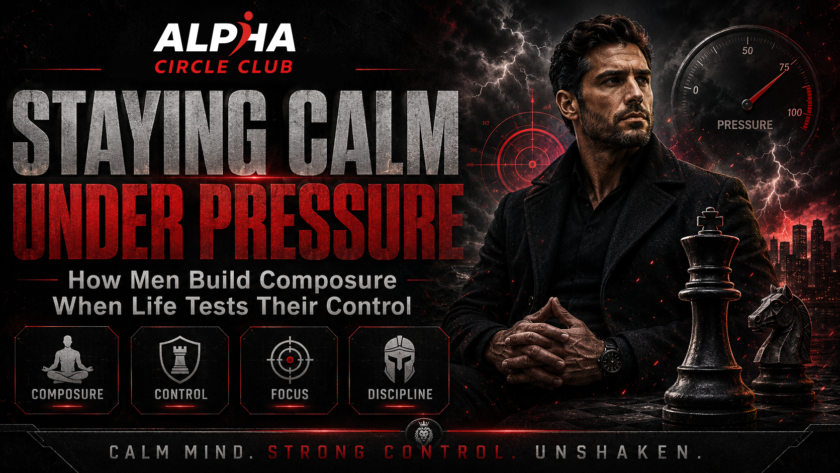
Staying calm under pressure is one of the strongest skills a man can build because pressure does not wait until he is ready.
It arrives suddenly, tests his emotions, challenges his discipline, exposes his habits, and reveals whether he truly controls himself. Most men want to believe they are strong, calm, controlled, confident, and ready for anything. But life does not test a man’s strength when everything is comfortable.
It tests him when someone disrespects him, when money becomes tight, when the plan collapses, when conflict enters the room, when the relationship becomes tense, when criticism hits, when a business problem appears, and when fear starts speaking louder than logic. That is when the real man is revealed. Not the version he posts online. Not the version he imagines in his head. The real version. The version that either pauses or reacts, thinks or panics, leads or loses control.
Pressure does not ask what kind of man you claim to be.
It reveals what kind of man you have been training to become.
A man can talk about discipline when life is easy.
He can talk about confidence when everyone agrees with him.
He can talk about strength when nothing is challenging him.
But when pressure rises, the mask comes off.
His breathing changes.
His voice changes.
His posture changes.
His words change.
His decisions change.
His true level of self-command is exposed.
The Alpha man does not build his identity on the fantasy that life will never test him.
He builds himself so that when the test arrives, he does not lose command.
He breathes.
He observes.
He slows down.
He chooses his words.
He controls his body.
He protects his standards.
He acts from discipline, not panic.
Alpha Thought:
Pressure does not ask what kind of man you claim to be. It reveals what kind of man you have been training to become.
Quick Alpha Summary
Staying calm under pressure means remaining clear, controlled, and responsible when stress, conflict, fear, anger, or uncertainty rises.
It does not mean:
- Feeling nothing
- Suppressing every emotion
- Pretending everything is fine
- Becoming cold or robotic
- Avoiding difficult situations
- Refusing to admit stress
It means:
- Pausing before reacting
- Thinking clearly
- Controlling your voice
- Managing your body language
- Choosing words carefully
- Acting according to values
- Refusing emotional impulsiveness
- Staying focused on the mission
- Making decisions from discipline, not panic
A calm man is harder to provoke.
Harder to manipulate.
Harder to intimidate.
Harder to break.
A man who loses control quickly gives other people access to his buttons.
A man who stays calm protects his authority.
The goal is not to become emotionless.
The goal is to become self-commanded.
Alpha Thought:
Calm is not the absence of pressure. Calm is the refusal to let pressure take command.
What Does Staying Calm Under Pressure Mean?
Staying calm under pressure is the ability to remain grounded, clear, and controlled when life applies force.
That force may come through conflict.
Money stress.
Relationship tension.
Business problems.
Criticism.
Disrespect.
Health concerns.
Family responsibility.
Unexpected setbacks.
Fear.
Embarrassment.
Uncertainty.
Pressure creates a moment where a man must choose who leads.
Will emotion lead?
Will ego lead?
Will fear lead?
Will anger lead?
Will panic lead?
Or will discipline lead?
A composed man may still feel emotion.
He may feel anger.
Fear.
Frustration.
Stress.
Embarrassment.
Sadness.
Uncertainty.
But he refuses to hand control of his actions to those emotions.
He creates a gap between pressure and response.
That gap is where strength lives.
A reactive man is controlled by what happens to him.
A calm man chooses who he becomes in response.
Staying calm under pressure is not about weakness.
It is not about letting people disrespect you.
It is not about avoiding difficult conversations.
It is not about pretending every situation is acceptable.
It is about responding from power instead of reacting from impulse.
Alpha Thought:
The man who can pause under pressure keeps control of the one thing that matters most: himself.
Why Calmness Is an Alpha Trait
Calmness is one of the most underrated Alpha traits.
Many men confuse strength with loudness.
They think power means shouting louder, reacting faster, dominating the conversation, or proving they cannot be challenged.
But real strength often looks quieter.
A calm man has power because he does not give his emotions away cheaply.
He does not become easy to provoke.
He does not expose his weakness through panic.
He does not allow disrespect, fear, anger, or ego to control the situation.
Calmness creates:
- Better decisions
- Stronger leadership
- More respect
- Clearer thinking
- Better communication
- Greater emotional control
- Reduced regret
- Stronger presence
- Better conflict management
- More self-respect
A man who loses control quickly can be controlled quickly.
If someone knows which words make him explode, they can use those words.
If someone knows criticism makes him panic, they can use criticism.
If someone knows disrespect makes him reckless, they can use disrespect.
If someone knows fear makes him surrender, they can use fear.
But a calm man is different.
He is harder to move.
Harder to bait.
Harder to manipulate.
Harder to dominate emotionally.
He listens, watches, assesses, and chooses.
That is power.
Alpha Thought:
A man who cannot control his reactions can be controlled by anyone who knows how to trigger them.
Pressure Reveals the Training
Pressure does not usually create a new man.
It reveals the man already being built.
If a man repeatedly practises anger, he will likely react with anger under pressure.
If he repeatedly practises avoidance, he will likely withdraw under pressure.
If he repeatedly practises blame, he will likely look for someone to attack.
If he repeatedly practises panic, he will likely collapse into panic.
If he repeatedly practises impulsive speech, he will likely say things he regrets.
But if a man repeatedly practises discipline, breathing, prayer, reflection, emotional control, and self-command, he has a better chance of staying steady.
Composure is trained before the crisis arrives.
A man does not become calm in one dramatic moment.
He becomes calm through small repeated acts of control.
Not sending the angry message.
Not raising his voice.
Not making the impulsive purchase.
Not quitting in frustration.
Not reacting defensively to correction.
Not speaking before thinking.
Not allowing stress to control his standards.
Every small act trains the man.
The crisis simply reveals the training.
Alpha Thought:
The man you become under pressure is often the man you have been practising in private.
The Difference Between Reaction and Response
A reaction is automatic.
A response is chosen.
Reaction says:
“I must defend myself now.”
“I must prove I am right.”
“I must attack back.”
“I must escape this feeling.”
“I must act immediately.”
“I must win this moment.”
“I must show them who I am.”
Response says:
“What is actually happening?”
“What outcome do I want?”
“What does the strongest version of me do here?”
“What should I not say right now?”
“What decision can wait until I am clear?”
“What action protects my standards?”
“What is the wise move?”
A reactive man is owned by the moment.
A responsive man owns the gap between feeling and action.
That gap may only last a few seconds.
But those seconds can change everything.
They can stop a man from saying something destructive.
Sending a damaging message.
Escalating a conflict.
Making a reckless financial decision.
Walking away from something important.
Allowing pride to control his future.
The Alpha man learns to protect the gap.
Pressure rises.
He pauses.
He breathes.
He observes.
He chooses.
Alpha Thought:
The gap between pressure and response is where self-command is built.
What Makes Men Lose Calm Under Pressure?
A man cannot master his reactions if he refuses to understand his triggers.
Men often lose calm for deeper reasons than the situation itself.
Common causes include:
- Ego
- Fear of disrespect
- Financial stress
- Lack of sleep
- Poor health
- Insecurity
- Unprocessed anger
- Childhood conditioning
- Feeling trapped
- Lack of preparation
- Digital overstimulation
- Poor emotional awareness
- Need to appear strong
- Fear of failure
- Fear of rejection
- Shame
- Pride
- Exhaustion
- Lack of purpose
Sometimes the trigger is not the full problem.
The trigger simply touches an older wound.
A comment feels like disrespect.
A disagreement feels like rejection.
A delay feels like failure.
A bill feels like danger.
A criticism feels like humiliation.
A man who does not understand himself may blame the situation every time.
But a stronger man asks:
Why did that affect me so strongly?
What emotion was underneath my reaction?
What did I feel I had to prove?
What fear was speaking?
What old pattern did this activate?
What would the disciplined version of me do next time?
Understanding the trigger is not an excuse.
It is a map.
A man who knows his triggers can prepare his response.
Alpha Thought:
A man cannot master what he refuses to examine.
The Body Under Pressure
Pressure is not only mental.
The body reacts too.
A man may experience:
- Faster breathing
- Tight chest
- Racing heart
- Tense jaw
- Shaking hands
- Heat in the face
- Narrow thinking
- Tight shoulders
- Clenched fists
- Urge to speak quickly
- Desire to fight, run, or shut down
These physical signs matter.
They are early warning signals.
If a man learns to read his body early, he can stop pressure from becoming reaction.
When he notices the signs, he can take control.
He can slow his breathing.
Relax his jaw.
Drop his shoulders.
Unclench his hands.
Slow his voice.
Stand or sit with control.
Take a pause before speaking.
The body and mind are connected.
A tense body can feed a tense mind.
A controlled body can help create a controlled response.
This does not mean the pressure disappears.
It means the man begins to lead himself through it.
Alpha Thought:
A man who can read his body early can stop pressure from becoming reaction.
Control Your Breathing First
Before you control the situation, control your breathing.
Under pressure, many men breathe shallow and fast.
This can intensify panic, anger, urgency, and confusion.
A man who controls his breath begins to regain command of his body.
A simple practice:
- Inhale slowly through the nose
- Hold briefly
- Exhale longer than the inhale
- Repeat before speaking
This is simple, but powerful.
The longer exhale helps slow the body down.
It creates space.
It gives the mind time to return.
It stops the man from reacting too quickly.
In a tense conversation, the man who breathes before speaking often says less damage.
In a business problem, the man who breathes before acting often makes clearer decisions.
In conflict, the man who breathes before responding often protects his standards.
Breathing is not weakness.
It is command.
Alpha Thought:
Before a man leads the situation, he must first lead his own nervous system.
Slow Your Voice
A man’s voice often reveals his internal state.
Under pressure, he may speak faster.
Louder.
Sharper.
More defensively.
More emotionally.
More aggressively.
A calm man slows his voice.
He does not rush to fill silence.
He does not let the other person’s emotion dictate his tone.
He does not allow volume to become a substitute for authority.
Practical ways to control the voice:
- Speak slightly slower
- Lower the volume
- Use fewer words
- Avoid insults
- Ask questions
- Pause before answering
- Do not explain yourself endlessly
- Do not compete with someone else’s chaos
- Let silence work for you
A controlled voice can calm a room.
It can reduce conflict.
It can show confidence.
It can make a man appear more grounded.
But this must be real control, not passive aggression.
The goal is not to sound superior.
The goal is to remain steady.
Alpha Thought:
A controlled voice can calm a room before an argument becomes a battle.
Do Not Make Permanent Decisions From Temporary Pressure
Under pressure, men often make decisions they later regret.
They quit jobs impulsively.
Send damaging messages.
End relationships in anger.
Make reckless purchases.
Take unnecessary risks.
Say things they cannot take back.
Start fights.
Make emotional business decisions.
Burn bridges.
Abandon goals.
Pressure creates urgency.
But urgency is not always truth.
Sometimes the strongest move is to delay the decision until the mind is clear.
A powerful rule:
If the decision is not urgent and your emotions are high, delay the decision until your mind is clear.
Not every decision must be made in the heat of the moment.
Some decisions deserve sleep.
Prayer.
A walk.
A conversation with a wise person.
A review of the facts.
A clear head.
This is not weakness.
It is wisdom.
A calm man understands timing.
He knows that pressure can distort perspective.
He refuses to let temporary emotion create permanent consequences.
Alpha Thought:
Never hand your future to a temporary emotional state.
Calmness in Conflict
Conflict is one of the biggest tests of composure.
Anyone can appear calm when nobody challenges them.
The test comes when someone disagrees, criticises, insults, confronts, or disappoints them.
A calm man handles conflict differently.
He:
- Listens without interrupting
- Does not insult
- Does not threaten
- Does not shout to feel powerful
- Asks what outcome is needed
- Separates facts from emotion
- Takes responsibility where needed
- Sets boundaries without losing control
- Refuses to speak with cruelty
- Knows when to leave a conversation that is becoming destructive
The goal is not to “win” every argument.
The goal is to remain aligned with standards.
A man may win an argument and lose respect.
He may prove a point and damage trust.
He may dominate the conversation and still fail as a leader.
The Alpha man asks:
What outcome matters here?
What truth needs to be spoken?
What emotion must I control?
What boundary must be set?
What would I regret saying?
What response reflects strength?
Conflict reveals whether a man is controlled by ego or guided by standards.
Alpha Thought:
Winning an argument is worthless if a man loses control of himself to do it.
Calmness in Relationships
Many relationships are damaged because men react before they understand.
A man hears criticism and becomes defensive.
He feels rejected and withdraws.
He feels disrespected and attacks.
He feels guilty and avoids the conversation.
He feels misunderstood and raises his voice.
Over time, these reactions damage trust.
A composed man learns to:
- Listen fully
- Ask better questions
- Avoid defensive reactions
- Apologise when wrong
- State boundaries clearly
- Avoid silent punishment
- Avoid cruel words
- Address issues early
- Speak with respect
- Control tone
- Choose timing wisely
Calmness in relationships does not mean weakness.
It does not mean accepting disrespect.
It does not mean never disagreeing.
It means handling tension without becoming destructive.
The strong man can say:
“I hear you.”
“I need a moment before I respond.”
“That is not acceptable to me.”
“I was wrong there.”
“Let us talk about the actual issue.”
“I want to solve this, not attack you.”
This is leadership.
Not loudness.
Not control through fear.
Leadership through composure.
Alpha Thought:
A man who can stay calm in emotional conversations protects trust, respect, and his own character.
Calmness in Business and Money
Money pressure tests men deeply.
A man may panic when:
- Sales drop
- Bills increase
- Debt rises
- A customer complains
- A business plan fails
- A financial mistake is exposed
- A payment is delayed
- Expenses rise
- Income becomes uncertain
Panic creates poor financial decisions.
A panicked man may overspend to feel better.
Ignore the numbers.
Avoid the bank account.
Take reckless risks.
Blame everyone.
Quit too soon.
Chase desperate opportunities.
Make emotional business decisions.
A calm man does something different.
He reviews numbers.
Cuts unnecessary spending.
Seeks advice where needed.
Builds a plan.
Looks at facts.
Identifies options.
Takes action from clarity.
Money pressure punishes panic and rewards clear thinking.
This does not mean financial pressure is easy.
It can be heavy.
But panic rarely improves the situation.
A man must train himself to look at reality directly.
Avoidance increases fear.
Clarity reduces chaos.
Alpha Thought:
Money pressure punishes panic and rewards clear thinking.
Calmness and Physical Training
Training can build composure.
Hard sets.
Heavy lifts.
Sprints.
Martial arts.
Long walks.
Cold conditions.
Controlled discomfort teaches a man to remain steady when his body wants to quit.
The gym is not only for muscle.
It can also train self-command.
A man learns:
- How to breathe under strain
- How to continue through discomfort
- How to stay focused
- How to control aggression
- How to recover after effort
- How to respect limits
- How to return after failure
- How to keep form when tired
Physical training gives a man controlled exposure to pressure.
The weight is heavy, but he breathes.
The sprint burns, but he continues.
The final round tests him, but he stays focused.
This matters because the body teaches the mind.
A man who repeatedly faces controlled discomfort becomes less fragile when uncontrolled discomfort appears.
Alpha Thought:
The gym can train more than muscle. It can train the man to stay steady under strain.
Faith, Prayer, and Calm Under Pressure
Faith can help a man remain calm when pressure rises.
It reminds him that he is not carrying everything alone.
Prayer can create space between panic and action.
A man can pause and ask:
What is the right response?
What would honour God here?
What action reflects strength and humility?
What must I surrender?
What responsibility must I take?
What words should I avoid?
What truth must I speak with control?
Faith does not remove every problem.
It does not mean pressure disappears.
But it can give a man perspective.
He remembers that fear is not his master.
Ego is not his guide.
Panic is not his authority.
A man grounded in faith can respond from a deeper place than emotion.
He can choose patience.
Wisdom.
Humility.
Courage.
Self-control.
Alpha Thought:
Prayer gives a man space to respond from faith instead of fear.
The Calm Under Pressure Protocol
When pressure hits, use this protocol.
1. Stop
Do not rush into reaction.
Create the first pause.
2. Breathe
Slow the body before trying to solve everything.
3. Relax the body
Drop the shoulders.
Relax the jaw.
Unclench the hands.
4. Slow the voice
Speak with control.
Use fewer words.
5. Name the pressure
Ask yourself:
What is actually happening?
What emotion is rising?
6. Ask what outcome matters
Do not chase ego.
Choose the result that matters.
7. Separate facts from emotion
Fear may be loud, but facts must lead.
8. Choose the next right action
Not ten actions.
One clear action.
9. Delay non-urgent decisions
Do not let temporary pressure create permanent damage.
10. Review later and learn
Every pressure moment can become training.
This protocol is simple.
But simple does not mean weak.
In pressure moments, a man needs something he can remember.
Stop.
Breathe.
Control the body.
Slow the voice.
Choose the response.
Alpha Thought:
A calm system gives a man something to stand on when emotion tries to take over.
The Pressure Audit
A man cannot master pressure if he refuses to study how pressure affects him.
Use this audit honestly.
Triggers
- What situations make me lose calm?
- Which people trigger me most?
- What type of criticism affects me?
- What pressure do I avoid?
Emotional patterns
- Which emotion controls me most under pressure?
- Anger?
- Fear?
- Shame?
- Defensiveness?
- Panic?
- Embarrassment?
Behaviour
- Do I shout, shut down, blame, panic, or escape?
- Do I send messages I regret?
- Do I make rushed decisions?
- Do I become cold or silent?
Physical signs
- What physical signs appear first?
- Tight chest?
- Fast breathing?
- Tense jaw?
- Racing heart?
- Heat in the face?
Consequences
- What words do I regret most often?
- What relationships have been affected?
- What decisions did I make too quickly?
- What opportunities did I damage through reaction?
Standards
- What pattern must I break?
- What pressure rule do I need?
- What response would the strongest version of me choose?
This audit is not for shame.
It is for awareness.
Awareness gives a man the chance to change.
Alpha Thought:
The pressure pattern you refuse to study is the pressure pattern likely to repeat.
The 30-Day Calm Under Pressure Reset
This reset helps a man build composure as a trained identity.
It will not make him perfect.
But it can make him more aware, controlled, and disciplined.
Days 1–7: Awareness
During the first week:
- Identify your top three pressure triggers
- Track emotional reactions
- Notice physical signs
- Record situations where you lost calm
- Practise slow breathing daily
- Write down what you said or did under pressure
- Identify one repeated pattern
The goal is awareness.
A man cannot change what he does not notice.
Days 8–14: Control the Body
During the second week:
- Practise controlled breathing
- Slow your speech during conversations
- Relax your shoulders and jaw
- Train three times
- Reduce stimulants or habits that increase agitation
- Take short walks when tension rises
- Practise standing or sitting with control
The goal is physical command.
Control the body early and the mind has a better chance of following.
Days 15–21: Control the Response
During the third week:
- Pause before replying
- Delay emotional decisions
- Practise listening without interrupting
- Walk away before anger escalates
- Journal one pressure situation per day
- Ask better questions during conflict
- Use fewer words when emotions rise
The goal is response over reaction.
The man begins protecting the gap.
Days 22–30: Build Composure as Identity
During the final stage:
- Create three pressure rules
- Practise one difficult conversation calmly
- Review progress
- Set a 90-day composure target
- Decide what kind of man you will be under pressure
- Identify one standard you will no longer abandon
- Choose one trigger you will master next
Examples of pressure rules:
“I do not send messages when angry.”
“I slow my voice when conflict rises.”
“I breathe before answering criticism.”
“I do not make financial decisions from panic.”
“I walk away before I become destructive.”
The goal is identity.
Calmness becomes powerful when it stops being occasional and starts becoming who the man is.
Alpha Thought:
Composure becomes strength when calmness stops being an occasional reaction and becomes a trained identity.
The Alpha Calm Code
The Alpha Calm Code can be reduced to ten principles.
1. Breathe before reacting
The first battle is internal.
2. Slow the voice
A controlled voice reflects a controlled man.
3. Observe before acting
Pressure demands awareness, not impulse.
4. Control the body
Relax the jaw, shoulders, hands, and breathing.
5. Do not make permanent decisions from temporary emotion
Delay what does not need to be decided in the storm.
6. Separate facts from fear
Fear speaks loudly. Facts must lead.
7. Choose response over reaction
A reaction is automatic. A response is chosen.
8. Train discomfort before crisis
Physical training, difficult conversations, and discipline prepare the man.
9. Use prayer or reflection to regain perspective
Faith can create space between panic and action.
10. Review pressure moments and improve
Every failure can become training if the man studies it honestly.
Common Mistakes Men Make Under Pressure
Speaking too quickly
Fast speech often creates more chaos.
Shouting to feel powerful
Volume is not authority.
Making emotional decisions
Pressure can distort judgement.
Sending angry messages
Written words can create lasting damage.
Taking criticism personally
Not every correction is an attack.
Refusing to pause
A pause can prevent regret.
Trying to win every argument
Winning is worthless if the man loses control of himself.
Confusing aggression with strength
Aggression without control is weakness wearing armour.
Ignoring body signals
The body often warns before the mouth reacts.
Blaming instead of thinking
Blame may feel relieving, but it rarely solves the problem.
Escaping into alcohol, food, porn, scrolling, or spending
Escape habits may numb pressure temporarily, but they weaken self-command long term.
Calling panic “instinct”
Sometimes it is not instinct. It is untrained emotion.
Never reviewing what went wrong
A man who never reviews pressure moments keeps repeating them.
Alpha Thought:
A man does not become calm by pretending he never loses control. He becomes calm by studying every moment he did.
When Pressure Requires Support
Some pressure is heavy enough that a man should not carry it alone.
Seeking support does not make a man weak.
It can be wisdom.
A man may need help when pressure leads to:
- Persistent anxiety
- Depression
- Panic attacks
- Addiction
- Suicidal thoughts
- Violent urges
- Severe anger
- Emotional numbness
- Trauma responses
- Relationship breakdown
- Financial crisis
- Inability to function normally
Support may come from:
- A trusted friend
- A mentor
- A pastor or faith leader
- A counsellor
- A doctor
- A support group
- A financial adviser where money pressure is involved
- Emergency services if there is immediate danger
The Alpha man takes responsibility.
Sometimes responsibility means asking for help before the pressure becomes destructive.
Alpha Thought:
Strength is not refusing help. Strength is doing what is necessary to protect your life, your mind, and the people connected to you.
Final Alpha Standard
Pressure will come.
Disrespect will come.
Stress will come.
Conflict will come.
Financial pressure will come.
Relationship pressure will come.
Unexpected problems will come.
The Alpha man does not build his identity on the fantasy that life will never test him.
He builds himself so that when the test arrives, he does not lose command.
He breathes.
He observes.
He slows down.
He chooses his words.
He controls his body.
He protects his standards.
He acts from discipline, not panic.
He does not need to prove strength through noise.
His calm becomes the proof.
The strongest man in the room is not always the loudest.
Often, he is the one who remains steady when pressure tries to make everyone else lose control.
He is the man who can be challenged without becoming reckless.
Criticised without collapsing.
Disrespected without becoming destructive.
Afraid without surrendering.
Angry without losing command.
Uncertain without panicking.
Tired without abandoning his standards.
That is composure.
That is self-command.
That is Alpha strength.
Build calm before the crisis.
Train your response before the test.
Master your breathing before emotion masters your mouth.
Protect the gap between pressure and action.
Do not let temporary stress create permanent regret.
Do not let pressure control the man you become.
Final Alpha Thought:
The strongest man in the room is not always the loudest. Often, he is the one who remains calm when pressure tries to make everyone else lose control.
Stay Calm. Stay Controlled. Stay Alpha.
Alpha Circle Club helps men build the discipline, mindset, emotional control, and self-command required to stay strong when life applies pressure.
Do not let pressure control the man you become.
Build calm command before the test arrives.

No spam. Unsubscribe anytime.