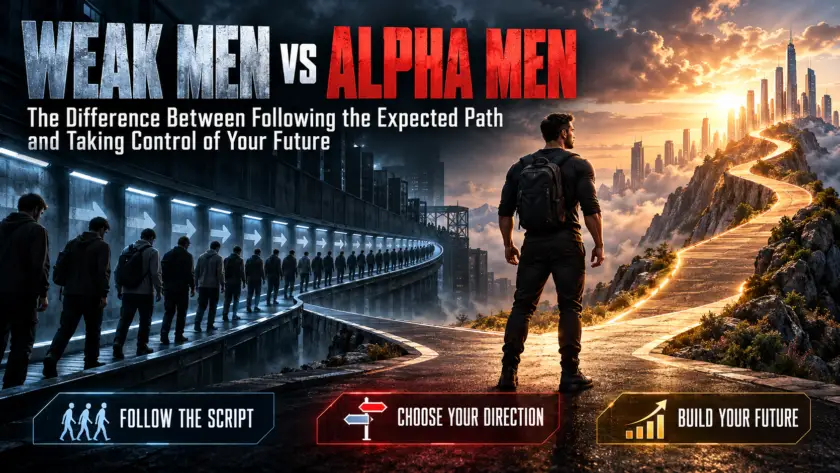
Weak Mindset vs Alpha Mindset: The Difference Between Following the Expected Path and Taking Control of Your Future
Most men do not deliberately choose the structure of their lives. They inherit it.
They are taught to find a secure job, work hard, accept the income offered, wait for annual pay rises, contribute to a pension and postpone freedom until retirement. Their evenings become recovery time. Their weekends become escape. Their ambitions are gradually reduced until they fit safely around the demands of the life they never consciously designed.
There is nothing dishonourable about honest employment. Providing for yourself and your family through disciplined work is worthy of respect. A good employer can offer income, training, relationships, experience, pension contributions and the stable ground from which a man builds his future.
The danger begins when a man mistakes his current job for the full limit of his potential.
It begins when he stops asking questions. When he assumes his employer will always need him, his health will always support him and retirement will eventually deliver the freedom he keeps postponing. He may work extremely hard, yet never build a skill, asset, reputation or source of value that belongs to him independently.
That is the real difference between the weak mindset and the Alpha mindset.
The weak mindset is not defined by a man’s salary, job title or present circumstances. It is defined by surrendered responsibility. It waits for society, an employer, the economy or a future date to create security.
The Alpha mindset accepts that no man controls everything—but every man must take responsibility for what he can control. He develops his health, increases his value, understands his money, protects his family, builds useful skills and creates options before he desperately needs them.
One man waits for life to release him.
The other begins constructing greater freedom while faithfully handling today’s responsibilities.
This is weak mindset vs Alpha mindset: passive dependence versus deliberate preparation; inherited limitation versus examined possibility; comfortable surrender versus responsible control.
The weak-man mindset waits for society, an employer or retirement to provide security. The Alpha mindset accepts responsibility for building greater control over his health, income, time, character and future.
1. Weakness Begins When a Man Stops Questioning His Life
Weakness does not always look like laziness. Sometimes it arrives wearing a uniform, carrying a full diary and working overtime.
A man can be busy every day and still avoid the most important questions of his life:
- Where is this path taking me?
- Who controls most of my income and time?
- Which abilities could I use outside my present role?
- What happens if this job changes or disappears?
- Will the future I am funding support the life I expect?
- What am I building that will still belong to me in ten years?
- Am I growing—or have I merely become efficient at repeating the same year?
The weak mindset accepts the expected path without examination. It says, “This is simply what adults do.” It tells a man to be grateful for what he has and feel guilty for imagining more. It convinces him that starting a business, learning a new profession, creating a product or developing another income source is for people who possess something he does not.
Gratitude matters. But gratitude and ambition are not enemies. A man can appreciate today’s income while preparing for tomorrow’s responsibility. He can respect the position he holds without treating it as a permanent ceiling.
Questioning your life does not mean despising it. It means refusing to live unconsciously.
Perhaps your current path is right. Perhaps it provides meaningful work, development, security and time for the people you love. If you examine it honestly and choose it deliberately, that is strength.
But if you remain only because uncertainty frightens you, approval controls you or you have stopped believing that growth is possible, comfort may have become a cage.
The first act of control is not resignation. It is awareness.
Look at the direction of your life without exaggeration or excuses. Ask whether your repeated decisions are building the future you claim to want. A man cannot take control of a reality he refuses to examine.
Alpha Control Insight
A life inherited without examination can become a prison maintained through habit.
2. Honest Employment Is Not Weakness
The internet often reduces masculinity to a false choice: either become an entrepreneur or admit that you are weak. That message is shallow, irresponsible and insulting to millions of men who build, teach, heal, protect, transport, repair, manage and serve through honest employment.
A man is not weak because he works for somebody else.
Employment can provide:
- Reliable income for essential responsibilities
- Professional training and qualifications
- Experience that would be expensive to acquire alone
- Access to mentors and skilled colleagues
- Structure and discipline
- Pension contributions and other benefits
- Relationships that strengthen a career
- Capital with which to save, invest or build
- Stability during fatherhood, illness or other demanding seasons
A responsible Alpha man does not reject these advantages to impress strangers online. He understands the difference between courage and recklessness.
If a man has a partner, children, rent, a mortgage, debts or medical needs, walking away from employment without preparation may not be freedom. It may simply transfer the cost of his impulse to the people who trusted him.
The question is not, “Do you have a job?”
The question is, “How are you using it?”
Does the job develop your ability—or merely consume your energy? Are you learning transferable skills? Do you understand your pension and benefits? Are you controlling lifestyle inflation as your income grows? Are you saving part of what you earn? Are you using the experience to become more valuable? Are you protecting time for health, family, faith and future building?
Your employment can be a platform. It can finance education, supply business capital, strengthen your network and teach you how organisations work. It can also be meaningful work you choose to continue for life.
Weakness begins only when employment becomes total dependence without thought, preparation or options.
The Alpha man may be an employee, a business owner, a tradesman, a professional, a creator—or several of these over a lifetime. His status is not the point. His defining quality is that he remains awake, responsible and deliberate.
Alpha Control Insight
A job can become a platform for your future—or the boundary beyond which you never permit yourself to think.
3. The Weak Man Outsources His Future
The weak mindset hands responsibility away piece by piece.
It gives the employer responsibility for income. It gives the government responsibility for retirement. It gives the economy responsibility for opportunity. It gives the doctor responsibility for health. It gives a partner responsibility for happiness. It gives social media responsibility for self-worth. It gives debt responsibility for maintaining an appearance the salary cannot support.
Then, when life becomes unstable, the man discovers how little influence he has developed.
This does not mean a man should refuse help, reject institutions or pretend he is completely self-sufficient. We all depend upon other people and systems. Mature independence is not isolation.
The problem is passive dependence: relying upon a system you have never tried to understand while building no resilience around it.
A man may spend forty or fifty hours each week producing value, yet own none of the processes, intellectual property, customer relationships or reputation created by that work. He receives his agreed salary, which is fair—but if that is the only value-producing system he has, his entire financial life may depend upon one decision made in a room he never enters.
He may also work hard enough to feel responsible while avoiding every action that could create genuine control. Overtime feels productive. Learning a new skill after work feels uncertain. Complaining about pay feels justified. Testing a small offer feels vulnerable. Buying status feels rewarding. Building reserves feels slow.
Hard work is essential, but hard work alone does not guarantee freedom. Direction, ownership and leverage matter.
The Alpha mindset asks:
- What knowledge from this role can I carry with me?
- Which professional relationships should I strengthen?
- Which skills would make me valuable in several markets?
- What financial reserves would give my family breathing room?
- What can I create that remains mine?
- Where have I placed responsibility outside myself because taking action would feel uncomfortable?
You cannot control recessions, redundancies, regulations, health events or other people’s decisions. You can improve your preparation, competence, savings, relationships and response.
That is where control begins.
Alpha Control Insight
Hard work does not automatically create freedom when all of its leverage belongs to somebody else.
4. The Alpha Man Believes He Can Become More
The Alpha mindset begins with a belief that sounds simple but changes everything:
My current position is not my permanent identity.
A weak mindset looks at a salary and sees personal value. It looks at a title and sees a permanent rank. It looks at an early failure and sees proof that future attempts will fail. It hears what society expects and reduces ambition until it fits.
The Alpha man sees his current circumstances accurately—but not finally.
He does not pretend success is guaranteed. He does not believe positive thinking can replace ability, judgement or work. He understands that business can fail, investments can fall, skills can become outdated and plans can take longer than expected.
But uncertainty does not prove that growth is impossible.
He believes he can become more capable through:
- Learning
- Practice
- Discipline
- Honest feedback
- Faith
- Patience
- Experimentation
- Consistent action
- Recovery after failure
This belief changes his relationship with difficulty. A rejected application becomes information. A failed offer becomes market feedback. A weak first draft becomes material to improve. A gap in knowledge becomes a subject to study.
The weak mindset says, “I am not good at this.”
The Alpha mindset says, “I am not good at this yet. What would competence require?”
The weak mindset says, “People like me do not build businesses.”
The Alpha mindset says, “What small problem can I learn to solve well enough that somebody would pay for the result?”
The weak mindset waits to feel confident.
The Alpha mindset understands that confidence is often evidence remembered by the mind. Each completed workout, saved amount, difficult conversation, published article and finished project becomes proof: I can trust myself to act.
Potential is not entitlement. You are not owed success because you desire it. But you owe yourself an honest investigation of what disciplined effort could make possible.
Alpha Control Insight
Your present position describes where you are. It does not establish the limit of what you can become.
5. Security Can Become a Comfortable Illusion
Security is valuable. Men with responsibilities should seek stability, protect essential expenses and avoid unnecessary risks.
But security becomes dangerous when it is assumed rather than built.
A role may feel permanent until the company restructures. A valued function may change when technology advances. A healthy salary may stop when illness limits work. A supportive manager may leave. An industry may contract. A relationship inside the workplace may deteriorate. A business that seemed unshakeable may make redundancies.
The lesson is not to become anxious or distrust everyone. Fear is not preparation.
The lesson is to build options while life is relatively stable.
Real security has several layers:
- Health capacity – caring for the body and mind that produce your work.
- Skill capacity – possessing abilities that remain useful beyond one role.
- Financial capacity – controlling debt, building reserves and understanding long-term plans.
- Relationship capacity – maintaining a trusted network before a crisis.
- Character capacity – remaining calm, honest and decisive when plans change.
- Ownership capacity – gradually creating assets, work and systems that are not entirely controlled by one employer.
Depending upon one income is not automatically foolish. It may be the present reality, especially during a demanding season. But dependence should be recognised honestly. Once identified, it can be reduced gradually.
Begin with small acts of resilience. Update your CV. Document your achievements. Learn which skills are becoming more valuable in your field. Build an emergency fund at a pace you can sustain. Understand your essential monthly costs. Maintain professional relationships. Protect your health. Test one useful idea.
None of these actions guarantee that difficulty will never arrive. They give you more ways to respond when it does.
The weak mindset calls familiarity security.
The Alpha mindset calls preparation security.
Alpha Control Insight
Real security is not depending upon one door remaining open forever. It is developing the ability to create another door.
6. A Pension Is a Tool—Not the Entire Future
A pension is not a symbol of weakness. It can be one of the most useful long-term assets a working man builds.
Workplace pensions may include contributions from both the employee and employer, with tax relief applying in many circumstances. Giving up those benefits without understanding them can damage rather than strengthen a man’s future. Pension arrangements also differ: some promise benefits according to scheme rules, while defined-contribution pensions depend upon contributions, charges and investment performance.
The Alpha response is not to mock pensions. It is to understand them.
Ask:
- What type of pension do I have?
- How much is currently being contributed?
- Does my employer contribute more if I increase my contribution?
- What charges apply?
- Where is the money invested?
- What might the projected income be?
- What State Pension could I qualify for under current rules?
- What happens if I retire earlier or later?
- Who are the nominated beneficiaries?
- When did I last review this information?
A projection is not a promise. Rules, markets, inflation and personal circumstances can change. That is precisely why the figures deserve attention now, not twenty years from now.
A wider financial foundation may include:
- An emergency reserve
- Reduced high-cost or unnecessary debt
- Appropriate insurance
- Skills that protect earning power
- Savings for short- and medium-term goals
- Suitable, diversified investments where appropriate
- Additional income or business assets
- A realistic retirement plan
- Regulated financial advice when needed
This is not an instruction to invest in any particular product or to chase high returns. Investment values can fall as well as rise, and higher potential returns generally bring greater risk. Offers promising guaranteed, easy or unusually high profits deserve suspicion. Understand what you are buying, consider when you may need the money and check that any financial firm you use is properly authorised.
An Alpha man does not confuse boldness with gambling.
He also remembers that money is only one part of retirement preparation. A large pension cannot automatically restore decades of neglected health, repair distant family relationships or create a purpose that was never developed.
Fund the future—but also become physically, emotionally and relationally capable of living it.
Alpha Control Insight
Hope is not a retirement strategy. Understand the future you are funding.
7. The Herd Rewards Familiarity
The herd is not a particular class of people. It is the pressure to surrender independent judgement because a choice is common, approved or comfortable.
It says:
- Do not ask too many questions.
- Spend more when you earn more.
- Buy what signals success.
- Keep ambition private unless it is socially approved.
- Mock the beginner before his work becomes impressive.
- Wait for perfect conditions.
- Avoid any risk, even when the greater risk is permanent stagnation.
- Seek permission from people who have never attempted the life you want.
Following the herd provides psychological shelter. If everyone makes the same choice, no individual feels completely responsible for the destination. If the outcome disappoints, a man can say, “I did what everybody told me to do.”
But a crowded path is not automatically a bad path—and an unconventional path is not automatically wise.
Independent thinking is not blind rebellion.
Some traditional decisions remain powerful: working hard, living below your means, honouring commitments, developing a profession, saving consistently and contributing to a pension can all be intelligent. The Alpha man does not reject something merely because it is conventional. He examines it.
He asks whether the decision fits his responsibilities, values and long-term goals. He looks for evidence. He considers the downside. He listens to qualified advice without handing away final responsibility. He distinguishes thoughtful risk from ego-driven danger.
The weak mindset wants the emotional safety of agreement.
The Alpha mindset wants the clarity of truth.
That may mean staying in a role when internet influencers tell him to quit. It may mean declining lifestyle debt when colleagues upgrade their cars. It may mean studying after work while friends consume another evening. It may mean beginning quietly and allowing results to speak later.
You do not become independent by automatically opposing the crowd. You become independent by learning to judge a path for yourself.
Alpha Control Insight
The fact that a path is crowded does not prove it leads towards the future you want.
8. Control Begins With Skills
Money can be lost. Jobs can change. Industries can decline. A developed skill can travel with you.
Skills increase the number of problems you can solve and the number of environments in which you can create value. They can improve your performance as an employee, strengthen your negotiating position, support a side income or form the foundation of a business.
High-value skills may include:
- Sales
- Marketing
- Writing
- Public speaking
- Leadership
- Negotiation
- Financial understanding
- Data analysis
- Technology
- Project management
- Product creation
- Skilled trades
- Relationship building
- A specialised professional ability
The right skill depends upon your strengths, market, responsibilities and intended direction. Do not choose one merely because an influencer says it is profitable. Study real demand. Speak to people doing the work. Understand the standard of competence. Decide whether you can practise long enough to become useful.
Then produce evidence.
Watching videos about writing is not writing. Reading about sales is not making an offer. Collecting courses is not developing competence. A man turns information into skill through repeated performance, feedback and correction.
Use a simple cycle:
- Learn one principle.
- Apply it immediately.
- Produce a visible result.
- Request informed feedback.
- Correct the weakness.
- Repeat at a higher standard.
Build a portfolio, not merely a playlist of saved lessons. Write the article. Design the page. Repair the item. Analyse the data. Lead the meeting. Create the proposal. Help one person achieve a measurable outcome.
Skills also change identity. Every hour of deliberate practice sends a message: My future is not limited to what I can do today.
A qualification may prove knowledge. A portfolio proves application. A reputation proves repeated value. Build all three where they matter.
Alpha Control Insight
The more valuable your skills become, the less completely your future depends upon one employer.
9. Build Before You Escape
The fantasy of escape is seductive.
A man dislikes his job, watches a powerful video and imagines resigning on Monday. He sees entrepreneurs displaying revenue, cars and freedom, but he does not see unstable cash flow, tax, customer acquisition, failed products, legal duties, late payments or years of quiet development.
Emotional escape is not a strategy.
The Alpha man builds a bridge before leaving stable ground. He considers:
- Essential household expenses
- Family responsibilities
- Emergency reserves
- High-cost debt
- Healthcare and insurance needs
- Pension and employment benefits he would lose
- Taxes and business expenses
- Proven demand for the offer
- Customer acquisition costs
- Realistic profit rather than headline revenue
- Seasonal or irregular income
- The time required to reach competence
- His own tolerance for uncertainty
He tests the future at a manageable scale.
If he wants to sell a service, he finds the first client while employed. If he wants to write, he publishes consistently before expecting an income. If he wants to create a product, he speaks to potential buyers before building an expensive version. If he wants a new profession, he studies entry requirements and begins the qualification.
He lets reality challenge the idea early.
This does not eliminate risk. Every transition contains uncertainty. But testing replaces fantasy with evidence. It reveals whether customers care, whether the price works, whether he enjoys the daily activity and whether the model can support the responsibilities he carries.
Beware of replacing employment dependence with business dependence. One large client can become another employer without benefits. A business that cannot operate without every hour of your attention may own your time more completely than the job you left.
The goal is not dramatic escape. The goal is increasing control.
Sometimes the strongest decision is to stay employed while building. Sometimes it is to negotiate reduced hours, move into a better role or make a carefully prepared transition. The right choice is the one supported by evidence, responsibility and the life you are actually living.
Alpha Control Insight
Freedom built recklessly can become a new form of captivity. Construct the bridge before leaving stable ground.
10. Take Back Control of Your Time
A man may not control his entire day. Work, commuting, children, care duties and household responsibilities all make legitimate demands.
But the hours he does control must stop disappearing without consent.
Many men say they have no time to build a different future while giving entire evenings to scrolling, gaming, streaming and aimless browsing. Recreation is not weakness. Rest protects performance, relationships and health. The problem begins when recovery becomes avoidance and entertainment consumes the only hours available for growth.
Conduct an honest time audit for seven days. Record where the controllable hours go. Do not estimate. Measure.
You may discover that your future does not require four free hours every evening. It may require one focused hour protected from distraction.
That hour could be used for:
- Strength training or walking
- Learning a marketable skill
- Building a product or service
- Creating useful content
- Reviewing finances
- Strengthening your marriage
- Preparing for fatherhood
- Deepening faith
- Developing professional relationships
- Recovering deliberately instead of consuming automatically
Protect the hour before the day begins or immediately after a fixed responsibility. Decide the task in advance. Prepare the required tools. Remove the phone. Define what “done” means. Record the output.
Do not fill every spare moment with work. A controlled life includes sleep, family, reflection and joy. The objective is not exhaustion. It is alignment.
Your calendar reveals what your declared priorities often conceal. If health, wealth, family and purpose matter, they require visible space.
Begin small enough to remain consistent. Five focused hours each week produce 260 hours in a year. That is enough time to create a substantial body of work, make real progress in a qualification, improve physical health or validate a business idea.
The weak mindset says, “I will begin when life becomes less busy.”
The Alpha mindset says, “What can I protect inside the life I have?”
Alpha Control Insight
You may not control every hour of the day, but the hours you do control must stop disappearing.
11. Ownership Changes the Mindset
Ownership changes the way a man thinks because it connects decisions with consequences.
Ownership can include:
- A business
- A product or service
- A website
- A book or training resource
- Intellectual property
- A customer list built with consent and trust
- A portfolio
- Professional qualifications
- A respected personal brand
- Repeatable operating systems
- Savings and appropriate investments
- An audience earned through useful work
Not every asset produces passive income, and almost nothing is truly passive at the beginning. Products require creation. Businesses require service. Audiences require trust. Investments require capital, patience and risk awareness. Qualifications require study. Systems require testing.
But ownership can separate future value from a single hour sold today.
An article can attract a reader after it is published. A book can serve many people. A system can improve repeated work. A qualification can increase access to opportunities. A carefully constructed business can eventually operate through a team and processes. Diversified long-term investments may participate in economic growth, although values can fall and returns are never guaranteed.
Ownership also strengthens responsibility. When your name is attached to the result, excuses become less useful. You must understand the customer, manage quality, communicate clearly, keep promises and correct mistakes.
This is why ownership is not simply a wealth strategy. It is character training.
Start with something small enough to finish. A useful guide. A service package. A portfolio project. A simple website. A professional qualification. A documented workflow. One month of emergency savings built gradually. The first version does not need to look like an empire. It needs to exist.
Do not confuse ownership with appearance. A rented car creates an image. A reliable system creates capacity. A large social following may attract attention. A small trusted customer base may create a business. Choose substance over performance.
Income pays today’s responsibilities. Ownership can create tomorrow’s options. A wise man respects both.
Alpha Control Insight
Income pays today’s responsibilities. Ownership can create tomorrow’s options.
12. The Alpha Man Does Not Need Permission to Begin
Many men are waiting for an invisible authority to approve their ambition.
They want a manager, parent, partner, friend or online audience to confirm that they are intelligent enough, experienced enough and likely enough to succeed. Until that approval arrives, preparation continues without action.
Some activities rightly require licences, qualifications, legal compliance, capital or professional advice. Responsibility means respecting those requirements.
But you do not need society to declare that you deserve to grow.
You can begin by:
- Learning one useful skill
- Saving the first amount
- Reading your pension statement
- Paying down one damaging debt
- Testing one idea
- Publishing one helpful article
- Contacting one potential customer
- Creating one product section
- Updating one professional profile
- Improving one health habit
- Protecting one daily work block
Small beginnings expose the excuses that large dreams can hide.
It is easy to say, “I want financial independence.” It is harder to review the last three months of spending. It is easy to say, “I could run a business.” It is harder to ask a real customer to pay. It is easy to say, “I need more time.” It is harder to switch off entertainment and protect forty-five minutes tonight.
Action turns identity into evidence.
Do not announce a five-year vision to receive admiration for work you have not begun. Complete the first meaningful action. Then complete the next. Allow consistency to build a reputation inside your own mind.
The Alpha man is not free from fear. He simply refuses to give fear permanent authority.
He understands that courage is often quiet. It is opening the document after a long shift. It is asking the uncomfortable financial question. It is admitting a skill gap. It is saying no to a purchase that would impress others but weaken the plan. It is continuing when the first attempt produces little attention.
No one can guarantee where the path will lead. But remaining passive is also a decision, and it carries its own risks.
Begin responsibly. Begin imperfectly. Begin now.
Alpha Control Insight
You do not need permission to begin becoming more capable than your present circumstances require.
Weak-Man Mindset Versus Alpha Mindset
This comparison is about patterns of thought and behaviour—not the permanent worth of a person. A man can recognise a weak pattern today and choose a stronger one next.
| Weak-man mindset | Alpha mindset |
|---|---|
| Accepts the expected path automatically | Examines where the path leads |
| Depends completely on one income without a plan | Builds skills, reserves and additional options |
| Waits for retirement to experience freedom | Creates greater control throughout life |
| Treats a job title as his identity | Treats employment as one part of his strategy |
| Consumes most income to display success | Saves, plans and builds responsibly |
| Follows the herd for approval | Thinks independently and examines evidence |
| Complains about circumstances | Identifies controllable actions |
| Chases quick escape plans | Builds a responsible transition |
| Waits for confidence | Builds confidence through evidence |
| Assumes somebody else will provide security | Accepts responsibility for preparation |
| Fears beginning imperfectly | Tests ideas at a manageable scale |
| Surrenders every evening to distraction | Uses protected time to build the future |
| Confuses recklessness with courage | Balances ambition with responsibility |
| Rejects pensions without understanding them | Uses pensions as one part of a wider plan |
| Wants the appearance of wealth | Builds real capability, assets and options |
Signature Framework: The Alpha Control Plan
Greater freedom is rarely created through one dramatic decision. It is built through a sequence that protects present responsibilities while expanding future options.
Step 1: Stabilise
Before chasing expansion, reduce avoidable disorder.
- Understand essential monthly expenses.
- List debts, rates and minimum payments.
- Begin building an emergency reserve.
- Review workplace benefits and pension information.
- Protect sleep, fitness and medical needs.
- Honour obligations to your partner and children.
- Address urgent legal, tax or insurance concerns with qualified professionals.
Stability is not the final goal. It is the ground from which intelligent action becomes possible.
Step 2: Strengthen
Increase the capacity of the man carrying the plan.
- Choose one marketable skill.
- Improve communication and financial understanding.
- Build physical energy through sustainable health habits.
- Practise emotional control under pressure.
- Complete work consistently enough to rebuild self-trust.
- Learn directly from credible people with relevant experience.
Do not ask only, “How can I earn more?” Ask, “How must I become more useful, reliable and capable?”
Step 3: Build
Create something that has independent value.
- A service
- A product
- A portfolio
- A qualification
- A website
- A body of useful content
- A repeatable system
- A carefully considered saving or investment plan
Select one. Scattered ambition produces unfinished projects.
Step 4: Prove
Move from imagination into reality.
- Attract the first customer.
- Complete the first paid project.
- Publish the first useful asset.
- Pass the first assessment.
- Save the first target amount.
- Collect honest feedback.
- Measure demand, costs and results.
Proof does not require perfection. It requires contact with reality.
Step 5: Expand
Strengthen what has demonstrated value.
- Improve quality.
- Document the process.
- Reinvest responsibly.
- Increase distribution.
- Build recurring value.
- Diversify gradually.
- Reduce dependence without creating unnecessary instability.
STABILISE → STRENGTHEN → BUILD → PROVE → EXPAND
Do not rush to the final step because it looks impressive. Expansion magnifies whatever already exists. If the foundation is disorganised, growth can multiply the disorder.
Signature Exercise: The Life-Control Audit
Answer these questions privately and honestly. Use figures where possible instead of vague impressions.
Income and resilience
- How dependent is my household upon one employer or income source?
- How many months of essential expenses could I cover?
- Which debts are reducing my options?
- Do I understand my workplace benefits and pension?
- Have I checked my current retirement projections rather than merely assuming they will be enough?
Skills and ownership
- Which valuable skills do I own independently of my job title?
- What evidence proves that I can apply those skills?
- What am I currently building that will remain mine?
- Which problem could I learn to solve for other people?
- What is the first asset I could complete within 30 days?
Time and attention
- How many controlled hours disappear into automatic entertainment each week?
- Which one-hour block could I protect consistently?
- What task would make that hour valuable?
- Does my calendar support the priorities I claim to hold?
Health and family
- Is my body capable of carrying the future I want?
- Does my ambition strengthen or neglect my closest relationships?
- What would greater control make possible for my family?
- Which responsibility must remain protected while I build?
Belief and action
- Which belief keeps me inside my current position?
- Am I building a bridge—or merely dreaming about escape?
- What risk must be reduced before I make a major change?
- What can I complete during the next 30 days?
Choose the three answers that create the greatest discomfort. They may reveal where control has been surrendered.
Practical Challenge: The 30-Day Control Shift
The purpose of this challenge is not to transform your entire financial life in one month. It is to replace passive intention with visible movement.
Week 1: Examine Your Current Life
- Record how you use your time for seven days.
- Review income, essential expenses, debts and subscriptions.
- Read your latest pension information.
- Check relevant retirement forecasts using official tools.
- List the areas in which one decision by somebody else could seriously affect you.
- Define what greater control would mean in practical terms.
Required output: a one-page Current Reality document containing actual figures, major dependencies and the first priority.
Week 2: Select One Valuable Skill
- Choose a skill aligned with your intended future.
- Find one credible learning source.
- Schedule at least five focused practice sessions.
- Produce a small piece of evidence.
- Request feedback from somebody qualified to judge it.
Required output: one completed portfolio exercise, demonstration or assessed practice result.
Week 3: Build Something You Own
- Outline a small product.
- Package a basic service.
- Publish useful content.
- Create a portfolio page.
- Document a repeatable process.
- Begin an appropriate saving action after essential priorities are considered.
Required output: a finished first asset—not another folder of plans.
Week 4: Test the Future
- Show the work to real people.
- Contact potential customers or employers.
- Ask specific questions about usefulness and value.
- Record objections and confusion.
- Improve the first version.
- Define the next 90-day phase.
Required output: evidence from reality—a response, application, customer conversation, completed assessment, first sale or measurable financial action.
At the end of 30 days, do not ask whether you have become free. Ask whether you have become more capable, informed and difficult to control through fear.
Frequently Asked Questions
Does having a normal job mean I have a weak mindset?
No. Honest employment can be purposeful, responsible and strategically valuable. The weak mindset appears when a man stops thinking independently, builds no resilience and assumes his employer will manage his entire future. An Alpha mindset can exist inside employment when a man develops skills, understands his finances, protects his health and deliberately creates options.
Should I quit my job to take control of my future?
Not simply because you feel frustrated or inspired. A major transition should consider family responsibilities, emergency savings, debt, healthcare, tax, benefits, proven demand and realistic income. In many cases, the stronger strategy is to build and test alongside employment before making a change.
Are pensions only for followers?
No. A pension can include valuable employer contributions and tax advantages and may be an important part of long-term planning. The Alpha approach is to understand what you have, review projections and build a wider plan—not reject a useful tool through pride or ignorance.
Does an Alpha man need several income streams?
Not as a badge of status. Multiple sources can reduce dependence, but each may require time, capital and risk. Start by stabilising your finances and building one valuable skill or asset. One strong additional source is more useful than six neglected projects.
What if I have very little spare time?
Begin by measuring rather than guessing. Protect a small repeatable block—perhaps thirty to sixty minutes several times a week—and assign one clear output. If your season genuinely leaves little capacity, focus on stability, health and the next smallest action. Progress can be slower without becoming meaningless.
Is entrepreneurship always the best route to freedom?
No. A business can create opportunity, but it can also introduce financial pressure, long hours and uncertainty. Greater control may come through a better role, a scarce professional skill, consultancy, a trade, responsible investing, flexible employment or a carefully developed business. Choose the route that fits the responsibilities and evidence in your life.
How do I stop following the herd?
Do not become oppositional merely to feel independent. Define your values and goals, examine evidence, understand the downside, consult qualified people and decide deliberately. Independent thinking is disciplined judgement—not automatic rebellion.
What should I build first?
Choose the smallest asset connected to a real need and your developing skill. It might be a portfolio project, useful article, service outline, qualification module, product prototype or emergency reserve. Select something that can be completed and tested within 30 days.
How can I build confidence to pursue more?
Keep smaller promises to yourself. Practise the skill, finish defined tasks, track outputs and seek real feedback. Confidence becomes more stable when it rests upon evidence rather than motivational emotion.
What if my first attempt fails?
Study the failure. Was the skill too weak, the offer unclear, the demand absent, the price wrong or the execution inconsistent? Correct what the evidence reveals. An unsuccessful test is not automatically a verdict on your potential; sometimes it is the information that protects you from a larger mistake.
Closing Declaration
I will not confuse familiarity with security.
I will respect honest employment without allowing a job to define the limit of my future.
I will understand the pension, income and systems upon which my family depends.
I will develop valuable skills that increase my options.
I will protect time for the life I am building.
I will not chase reckless escape or abandon my responsibilities.
I will build before I move and test before I expand.
I will think independently without rejecting wise advice.
I will create evidence before demanding recognition.
I will stop waiting for society to tell me that I am capable of more.
My current position will support my development—it will not imprison my imagination.
Final Line
The weak mindset waits for life to provide freedom. The Alpha mindset accepts responsibility for building it.


No spam. Unsubscribe anytime.