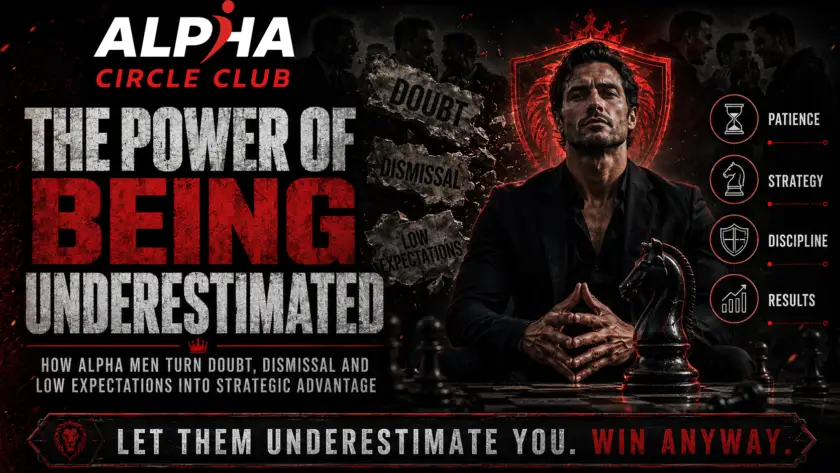
Being underestimated can feel like an insult.
Someone looks at your current position and assumes they have seen your entire future. They mistake a quiet personality for weakness, a difficult season for permanent failure or an unfinished goal for a lack of ability. They may see the job you have now and decide what you will never become. They may hear one mistake, one rumour or one incomplete version of your story and believe they have measured the whole man.
The natural response is to correct them immediately.
You may want to announce every ambition, reveal every plan and explain how successful you intend to become. You want them to recognise your intelligence, strength and potential before they dismiss you again.
But there is a problem: the harder a man argues about his future, the more energy he takes away from building it.
An Alpha man chooses a stronger response.
In this article, Alpha does not mean loud, arrogant or desperate to dominate other people. It means self-governed. An Alpha man understands that another person’s opinion does not require an immediate emotional performance. He decides whether the underestimation is harmless, useful or damaging—and responds according to its real effect rather than his wounded pride.
Sometimes underestimation creates space.
While others are relaxed by their assumptions, he is learning. While they are talking, he is observing. While they believe they have already measured him, he is developing strengths they have never considered. Their low expectations reduce how closely they watch, how seriously they prepare and how ready they are for what he produces next.
But being underestimated is not automatically an advantage. If it affects pay, credit, reputation, safety, professional advancement or access to a rightful opportunity, silence may become expensive. Strategic men know when to use low expectations and when to correct them with evidence.
The purpose is not revenge. It is not to spend years building a life controlled by the desire to humiliate doubters. The goal is to remain focused, extract useful information, develop real capability and allow completed results to reveal what argument never could.
Their estimate does not determine your ceiling. It only reveals the current limit of their perception.
When people underestimate you, they reveal how little they can currently see—not how far you are capable of going.
1. Their Estimate Is Not Your Identity
People form judgments from fragments.
They may judge you through:
- Your current circumstances
- A past mistake
- Your appearance
- Your personality
- Your financial position
- Your education
- A temporary setback
- Something another person told them
- Their own biases, fears or insecurities
Some of these observations may contain truth. You may genuinely lack experience in an area. Your first attempt may have failed. You may not yet possess the evidence required to support your ambition.
But “not yet demonstrated” does not mean “incapable of development.”
A current snapshot is not a final biography.
The danger begins when another person’s estimate becomes internal language:
“Maybe I am not intelligent enough.”
“Maybe people like me do not succeed.”
“Maybe that failure revealed my real level.”
The man starts editing his goals to fit somebody else’s imagination. He attempts less, speaks more cautiously and treats a temporary position as a permanent identity.
Separate three things:
- Current reality: What is objectively true now?
- Developmental potential: What could improve through learning, practice and opportunity?
- Their conclusion: What have they assumed beyond the available evidence?
This allows honest self-assessment without surrender.
If you lack a skill, develop it. If your work is weak, improve it. If their judgment is unsupported, do not carry it as truth merely because they delivered it confidently.
Alpha Insight
Another person’s estimate becomes dangerous only when you begin treating it as your limit.
2. Stop Auditioning for People Who Have Already Misjudged You
Once a man feels dismissed, he may begin performing for recognition.
He talks repeatedly about how successful he will become. He lists every project he intends to launch, every investment he plans to make and every personal transformation he expects to achieve. He wants the audience to revise its judgment before the work has produced evidence.
This is an exhausting position.
Every conversation becomes an audition. Every doubtful expression feels like another rejection. His mission gradually shifts from creating value to managing opinions.
You do not need to announce:
- How wealthy you intend to become
- Every business plan
- Every personal transformation
- Every skill you are developing
- Every strategic move
- Every future victory
There is a difference between communicating a real plan to people who need to know and advertising potential to people who have not earned access to it.
Use an Access Test before sharing:
- Does this person have a legitimate role in the plan?
- Have they demonstrated trust and discretion?
- Can their feedback materially improve the work?
- Am I sharing for clarity—or craving admiration?
- Would discussing this reduce the energy available for execution?
If the answer is that you are seeking reassurance, pause. Return to the work.
Your future does not become more real because a sceptical person temporarily approves of it. It becomes real when systems, skills and completed results support it.
Alpha Insight
You do not need permission from people whose imagination is too small to see where you are going.
3. Low Expectations Can Create Strategic Space
When people underestimate you, they may give you something valuable without intending to: room.
They may:
- Watch you less closely
- Reveal more than they intended
- Prepare less carefully
- Ignore your progress
- Leave your ideas unchallenged
- Give you time to learn privately
- Expect less from your next move
That space can be used for preparation.
You can study the market without announcing the business. You can strengthen your body without photographing every workout. You can build the product without seeking applause for each unfinished section. You can learn from mistakes before they become part of a public performance.
Use this advantage ethically.
Do not deliberately pretend to be incompetent, deceive partners or withhold information from people who are entitled to receive it. Strategic privacy is not dishonesty. You are simply refusing to correct every harmless assumption or reveal unfinished work before disclosure serves a purpose.
Low expectations also reduce one common danger: premature praise. When people celebrate a plan too early, the emotional reward can arrive before the result. A man begins feeling accomplished because he described what he intends to do.
Quiet development keeps the reward connected to execution.
The space must not become complacency. Being underestimated helps only when the man is actually preparing. Silence without development is not strategy; it is invisibility.
Alpha Insight
Being overlooked can provide the quiet in which serious preparation becomes possible.
4. Listen While They Reveal How They See You
Underestimation is information.
When people believe you lack influence, intelligence or awareness, they may become less careful about revealing their assumptions. They may show:
- Where they believe you are weak
- What they do not expect you to notice
- Which abilities they value
- How they treat people without status
- Whether their respect depends on money or power
- What they say when they believe you cannot challenge them
- How much they actually understand about your work
Do not react to every dismissive comment. Observe the pattern.
One careless remark may mean very little. Repeated behaviour across different situations carries more information. Record what affects important decisions rather than trying to decode every facial expression or change in tone.
Ask:
- What exactly do they believe about me?
- What evidence are they using?
- Which assumption gives them false confidence?
- Does their behaviour reveal a useful weakness in my position?
- Is this merely annoying—or materially important?
Observation does not mean paranoia. Do not assume every neutral comment hides an agenda. The strategic man separates direct evidence, reported information, reasonable inference and suspicion.
He also watches how people treat others. A person who respects only visible wealth or status has revealed the conditional nature of that respect. This helps the man decide whose approval has value and who should receive less access to his plans.
Alpha Insight
When people believe you are not significant, they may reveal what they would carefully hide from someone they wanted to impress.
5. Turn Dismissal Into Data
Not every negative judgment is completely useless.
A critic may communicate badly yet notice a real weakness. Someone may underestimate your potential while accurately identifying that your current plan lacks evidence, skill or structure.
The emotionally reactive response is to reject everything because the delivery was disrespectful. The strategic response separates the message from the identity attached to it.
Ask:
- Is there a real weakness hidden inside the dismissal?
- What result have I assumed rather than demonstrated?
- Which skill would make my position stronger?
- What evidence am I currently missing?
- Am I relying on potential without producing output?
- What would make this criticism irrelevant?
Suppose someone says, “You are not capable of building a serious business.” The identity judgment may be unsupported. But perhaps your offers are unfinished, your marketing is inconsistent and the customer journey has not been tested. Those are correctable facts.
Do not accept “incapable.” Do address “unfinished, inconsistent and untested.”
This creates a Conversion Question:
“What capability, evidence or system would convert this alleged weakness into a genuine strength?”
Then work on that.
The goal is not to obey every critic. Some criticism is uninformed, biased or malicious. Use evidence, expertise and relevance to decide what deserves attention.
Alpha Insight
A strong man can extract a useful lesson from a poor delivery without accepting the limiting identity attached to it.
6. Build in Silence
Silent building protects attention.
It allows a man to place energy into the work instead of the performance surrounding the work. He can experiment, fail, revise and improve without turning each stage into a public judgment.
Build the skill.
Complete the product.
Strengthen the body.
Improve the finances.
Test the system.
Correct the weakness.
Produce the evidence.
Silence is not secrecy for its own sake. Important plans may need to be discussed with a spouse, business partner, adviser, employee, lender or stakeholder. People affected by your decisions deserve appropriate transparency.
The principle is selective disclosure:
- Share with people who have responsibility.
- Seek feedback from people with relevant expertise.
- Protect commercially or personally sensitive details.
- Avoid announcing fragile plans for applause.
- Reveal the work when feedback, accountability, sales or opportunity require it.
There is also a danger in hiding forever. A man may call it “building in silence” when he is actually afraid to release the work. A product cannot receive customer feedback while permanently private. A writer must eventually publish. A business must eventually make an offer.
Silent building has an exit date.
Define when the work will be shown, tested or launched. Privacy should strengthen execution—not protect perfectionism.
Alpha Insight
Do not spend the energy describing what you are going to build when that energy is still required to build it.
7. Use Doubt as Fuel—Not Poison
Being underestimated can create powerful determination.
A man remembers the dismissive comment when he trains, studies or works late. He decides that the people who doubted him will eventually see what they failed to recognise.
This fuel can start movement. But revenge is an unstable energy source.
If the entire mission exists to prove somebody wrong, that person remains at its centre. Their reaction determines whether the victory feels complete. If they refuse to acknowledge the result, the man remains emotionally unpaid.
Purpose is stronger.
Build because you want to:
- Fulfil your potential
- Serve people
- Protect your family
- Create financial freedom
- Honour your faith and values
- Solve a real problem
- Become trustworthy
- Leave a meaningful legacy
Let doubt light the first match if necessary. Then transfer the fire to a reason capable of surviving long after the doubters disappear.
Use the Motivation Test:
“If this person never saw my success, would the goal still be worth completing?”
If the answer is no, the mission may be too dependent on external validation. If the answer is yes, you have found something deeper.
Anger can also distort decisions. A man may take reckless financial risks, overtrain, choose dishonest marketing or neglect his health because he wants the result quickly. Do not let the desire to prove strength produce weak judgment.
Alpha Insight
Let doubt light the match if necessary—but build the lasting fire from purpose.
8. Prepare Beyond Their Expectations
Underestimation creates an opening. Preparation determines whether the opening has value.
A man cannot rely on surprise alone. If he enters the opportunity without competence, the low expectations may prove accurate.
Real preparation includes:
- Knowledge
- Rehearsal
- Contingency planning
- Emotional control
- Technical ability
- Communication
- Consistent execution
- Evidence
- Recovery from mistakes
Prepare for the obvious task and the pressure surrounding it.
If you expect a difficult meeting, know the facts, organise the documents, anticipate questions and practise delivering the central point calmly. If you are launching a product, test the checkout, delivery, mobile layout and customer communication. If you are competing physically, train the movement, recovery and mental response to setbacks.
Use the Expectations Gap:
- What do they currently expect?
- What does the situation objectively require?
- Which capability would create the greatest difference?
- What failure point are they unlikely to anticipate?
- How will I verify readiness before the reveal?
Do not confuse preparation with endless delay. The objective is not to surprise people with perfection. It is to arrive more capable, more controlled and more ready than their estimate allowed.
Alpha Insight
Underestimation creates the opening. Preparation determines whether you can use it.
9. Do Not Reveal Every Move
A strong man does not narrate his entire strategy.
He shares information according to trust, responsibility, necessity and timing. This protects unfinished work from unnecessary interference and protects his own attention from premature debate.
Before disclosing a plan, ask:
- Who needs to know?
- What do they need to know?
- When do they need to know it?
- What is the benefit of sharing now?
- What risk does disclosure create?
- Am I seeking useful involvement or emotional recognition?
Strategic privacy can protect:
- Business concepts before launch
- Negotiating positions
- Personal goals still being developed
- Financial information
- Creative work before it is ready for feedback
- Evidence in a formal dispute
But privacy must remain ethical and lawful. Do not use secrecy to mislead customers, partners, employers or family members who are materially affected. Do not conceal conflicts of interest or required information.
When somebody pushes for details they do not need, use direct language:
“I am still developing it, so I am keeping the details private until the first version is complete.”
“I will share the relevant information when the timing is right.”
“The people responsible for the decision have what they need.”
You do not owe everybody a live broadcast of your development.
Alpha Insight
Privacy protects potential while it is becoming strong enough to face public judgment.
10. Let Results Correct What Arguments Cannot
Some people will not reconsider you because of a speech.
They may nod politely and continue holding the same opinion. They may interpret your confidence as arrogance or your explanation as defensiveness.
Completed results create a different kind of conversation.
Results may include:
- The completed qualification
- The launched business
- The transformed health habit
- The published work
- The fulfilled commitment
- The calmly handled confrontation
- The improved financial position
- The repeated evidence of reliable character
Results do not guarantee universal recognition. People may protect their original opinion, move the standard or claim they always believed in you. Bias is not always corrected by evidence.
That is why the result must have value independent of their reaction.
The business should serve customers even if the doubter never apologises. The stronger body should improve your life even if nobody compliments it. The completed work should develop your capability even if applause remains absent.
Use results to create options—not to beg for a verdict.
When recognition does arrive, receive it without demanding a confession:
“Thank you. I stayed focused on completing the work.”
The result has already spoken. It does not need a victory speech designed to humiliate the audience.
Alpha Insight
Arguments ask people to reconsider you. Results give reality new evidence.
11. Know When Silence Is No Longer Strategic
“Let them underestimate you” is incomplete advice.
Sometimes another person’s low estimate affects only their private opinion. That may deserve no response. But underestimation can also produce material harm.
Do not remain silent when it contributes to:
- Unfair pay
- Workplace discrimination
- False allegations
- Stolen credit
- Unsafe decisions
- Exclusion from rightful opportunities
- An inaccurate professional record
- Denial of authority you legitimately hold
- Decisions based on incorrect information
Use the Impact Test:
Low impact and reversible
Someone doubts your personal ambition. Their opinion controls no important decision. Continue building.
Moderate impact
A colleague misunderstands your ability and may influence an opportunity. Correct the assumption with relevant evidence.
High impact or difficult to reverse
The judgment affects pay, employment, safety, legal rights, reputation or formal decisions. Document the facts and use the appropriate channel promptly.
A direct correction might sound like:
“That assessment does not reflect the work I completed or the results recorded. Here is the relevant evidence, and I would like the decision reviewed against the stated criteria.”
Or:
“I am willing to be evaluated, but the evaluation must be based on accurate information. This statement is incorrect, and these documents show why.”
When discrimination, harassment, defamation, safety or legal rights may be involved, obtain qualified advice appropriate to the situation and jurisdiction.
Silence is not strength when it allows preventable damage to become permanent.
Alpha Insight
Silence is an advantage only while it protects your position. When it permits serious harm, clarity becomes the stronger strategy.
12. Remain Humble When They Finally Notice
Recognition creates another test.
A man who was once dismissed may be tempted to become arrogant when success arrives. He wants to remind everybody what they said, display the difference in status and make former doubters feel small.
If he does, underestimation continues controlling him—even after the estimate has changed.
Real strength is visible in how a man handles recognition:
- He remains professional.
- He remembers who supported him.
- He avoids humiliating former doubters.
- He gives credit accurately.
- He continues learning.
- He allows achievement to increase responsibility.
- He does not stop building because applause has begun.
Humility does not mean pretending the result was accidental or allowing others to take credit. You can acknowledge your work clearly:
“I am proud of what I built and of the discipline it required.”
Confidence states the truth. Arrogance needs the truth to make someone else feel inferior.
Some people may apologise. Decide whether trust should be restored based on accountability and changed behaviour, not simply because your status improved. A person who respects you only after visible success may have revealed something important about the conditions attached to their respect.
Your final victory is not becoming impressive to people who misjudged you. It is becoming capable without becoming bitter, successful without becoming cruel and recognised without becoming dependent on recognition.
Alpha Insight
The final victory is not making doubters feel small. It is becoming successful without becoming small-minded.
Reactive Man vs Strategic Alpha Man
| Reactive response | Strategic response |
|---|---|
| Announces every ambition | Protects unfinished plans |
| Argues about potential | Develops demonstrable ability |
| Tries to impress doubters | Concentrates on the mission |
| Reacts to every comment | Observes evidence and patterns |
| Builds from revenge | Transfers motivation to purpose |
| Mistakes silence for weakness | Uses silence deliberately |
| Relies on surprise | Prepares beyond expectations |
| Wants immediate recognition | Accepts delayed or absent validation |
| Remains silent during material harm | Corrects serious errors with evidence |
| Humiliates people after succeeding | Maintains discipline and humility |
The Underestimation Decision Matrix
| Situation | Best initial response |
|---|---|
| A stranger doubts your long-term ambition | Protect your energy and continue building. |
| A friend makes a dismissive joke | Address it directly if it becomes a repeated pattern. |
| A customer doubts an unproven product | Provide proof, clarity and a useful demonstration. |
| A colleague questions your ability | Ask for objective criteria and show relevant results. |
| A manager overlooks completed work | Document contributions and request a formal review. |
| Someone repeats false information | Correct the claim clearly and preserve evidence. |
| An opponent expects weak preparation | Avoid boasting; prepare thoroughly and execute. |
| A biased decision affects rights or safety | Use the proper formal or professional channel. |
The Underestimation Advantage Protocol
Step 1: Separate perception from identity
Their judgment is information—not a verdict.
Step 2: Control the first emotional reaction
Do not advertise insecurity through anger, threats or desperate explanation.
Step 3: Identify the impact
Decide whether the assumption is harmless, useful or materially damaging.
Step 4: Observe the belief
What do they expect, and what information produced that expectation?
Step 5: Extract useful data
Examine any genuine weakness without accepting an inaccurate identity.
Step 6: Protect the plan
Share only what trust, responsibility and timing require.
Step 7: Close the capability gap
Develop the skill, system, evidence or consistency currently missing.
Step 8: Prepare beyond expectations
Test the work and strengthen the failure points before the important moment.
Step 9: Reveal through delivery
Publish, launch, compete, present or complete the result.
Step 10: Correct serious harm
When the estimate affects rights, pay, credit, reputation or safety, respond through the appropriate channel.
Step 11: Continue after recognition
Do not make surprise the final destination. Build lasting capability.
Direct Responses When You Are Underestimated
When someone dismisses your ambition
“You are entitled to your view. I am continuing with the work.”
When someone wants you to defend your entire future
“I would rather complete the first result than argue about what may happen.”
When you receive useful criticism wrapped in disrespect
“The personal judgment is unnecessary. If there is a specific weakness in the work, state it clearly and I will examine it.”
When your contribution is overlooked
“For accuracy, I completed these parts of the project. I have documented the deliverables and dates.”
When a decision is based on false information
“That conclusion relies on information that is not correct. Here is the evidence, and I am requesting that the decision be reviewed.”
When someone demands private details
“I am still developing the project. I will share the relevant information when the first version is ready.”
When people suddenly recognise the result
“Thank you. I stayed focused on the work and continued improving it.”
The Underestimation Audit
Choose one situation and answer honestly:
- Who is underestimating me?
- What exactly do they appear to believe?
- What evidence directly supports that conclusion?
- What part is assumption or bias?
- Does the situation create emotional discomfort, material harm or both?
- Is silence currently protecting me or costing me?
- Which information should remain private?
- Who legitimately needs access to the plan?
- Is there a genuine weakness I need to address?
- Which capability would strengthen my position most?
- What completed result would create useful evidence?
- What is the deadline for revealing or testing it?
- Am I building from purpose or revenge?
- Would the goal still matter if the doubter never saw it?
- Does the matter require documentation?
- Does it affect pay, credit, reputation, rights or safety?
- What direct statement may be necessary?
- What professional or formal support might be appropriate?
- How will I behave if recognition arrives?
- What is my next private action?
The 30-Day Silent Build Challenge
Choose one measurable result to develop over the next thirty days.
Week 1 — Define and protect
- Name the result.
- Define what completion means.
- Decide who needs to know.
- Stop announcing the plan to everyone else.
- Identify the capability gap.
Week 2 — Build the capability
- Practise the required skill daily.
- Obtain relevant feedback privately.
- Correct one important weakness.
- Record evidence of work completed.
Week 3 — Test the result
- Create a working version.
- Test the weakest point.
- Ask a qualified person for feedback.
- Revise without turning the process into a public performance.
Week 4 — Reveal through delivery
- Complete the result.
- Publish, launch, present or submit it.
- Measure the response.
- Record what the evidence changed.
- Select the next development target.
Every day:
- Perform one mission action.
- Record the output privately.
- Refuse one unnecessary argument.
- Remove one validation-seeking behaviour.
- Prepare tomorrow’s next action.
Frequently Asked Questions
Is being underestimated always an advantage?
No. It becomes advantageous when low expectations create useful space without causing serious harm—and when you use that space to prepare. Underestimation affecting pay, credit, opportunity, safety or rights may require direct correction.
Should I tell people about my goals?
Tell people who have a legitimate role, provide useful expertise, share responsibility or offer trusted accountability. Avoid announcing unfinished plans merely to gain recognition.
How do I stop being angry when people underestimate me?
Name the specific assumption, assess its real impact and direct the emotional energy towards a useful action. Anger becomes less controlling when the next step is clear and your purpose is larger than their opinion.
Is building in silence the same as hiding?
No. Strategic privacy has a purpose and an exit date. Hiding avoids testing or judgment indefinitely. Build privately, then reveal the work when feedback, responsibility or delivery requires it.
What if results still do not change their opinion?
Some people will protect their original judgment regardless of evidence. Build results that create value, skill and options independent of their approval. Universal recognition is not required.
When should I speak up immediately?
Speak when an inaccurate judgment may affect safety, employment, pay, professional credit, reputation, legal rights or an important irreversible decision. Use evidence and the proper channel rather than an emotional confrontation.
How can I use criticism without accepting disrespect?
Separate the specific claim about your work from the identity judgment. Examine relevant evidence, correct genuine weaknesses and establish a boundary around personal attacks.
How should I treat people who doubted me after I succeed?
Remain professional and humble. You do not need to restore trust automatically or pretend their behaviour did not matter. Let accountability and changed conduct determine future access.
Closing Declaration
I will not allow another person’s limited perception to define my potential.
I will not waste my energy arguing about the man I intend to become.
I will observe, prepare and build.
I will extract useful lessons without accepting disrespectful labels.
I will protect my plans while they are still developing.
I will allow purpose—not revenge—to direct my ambition.
I will prepare beyond the expectations placed upon me.
I will speak when silence permits material harm.
I will produce evidence that empty words cannot replace.
When recognition arrives, I will remain disciplined and humble.
Let them underestimate me when their assumption costs me nothing. When the work is ready, my results will reveal what their perception failed to see.
Final Line
Do not interrupt harmless underestimation with empty promises. Use the space, build the strength and let completed results reveal what they failed to see.


No spam. Unsubscribe anytime.