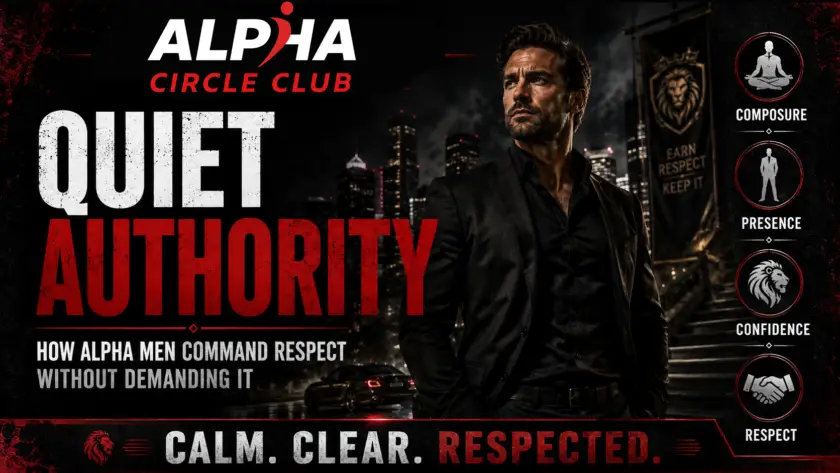
There is a difference between a man who desperately wants people to respect him and a man whose presence naturally makes people take him seriously. One tries to prove himself. He talks louder, interrupts more, forces eye contact, boasts about achievements, reacts aggressively to challenges and constantly checks the room to see who is watching. The other man does not need the performance. He walks into the room already comfortable with himself. His eyes are calm. His posture is composed. His movements are deliberate. He speaks clearly. He does not rush to fill every silence. He listens when someone deserves his attention, sets boundaries when someone crosses a line and remains in control when others try to provoke him. Most importantly, his character backs up his presence. His word means something. He treats people properly. He knows what he is doing. He admits when he is wrong. He does not beg for approval, and he does not need fear to create obedience. That is quiet authority. The strongest man in the room is often not the man trying hardest to look powerful—it is the man who has become so secure in who he is that he no longer needs to prove it.
Respect is rarely commanded by demanding it. It is communicated through the way a man carries himself, speaks, listens, sets boundaries, handles pressure and behaves when he has nothing to prove.
1. Stop Entering the Room Looking for Validation
Imagine a man walking into a room.
Immediately his eyes begin searching.
Who noticed me?
Who is looking at me?
Is that person watching?
Should I make eye contact?
Does anyone think I look confident?
His mouth may say nothing.
But his behaviour may communicate something:
“I need confirmation from this room.”
There is a stronger way to carry yourself.
Walk where you are going.
Look where you need to look.
Remain naturally aware of your surroundings.
But do not constantly search for another person’s gaze merely to confirm that you have been noticed.
There is an important distinction between observing the environment and scanning for approval.
One is awareness.
The other can become validation-seeking.
When somebody actually engages with you, give them your attention.
Until then, you do not need to chase theirs.
Your attention has value.
Not because you are better than anybody else.
But because attention is one of the most limited resources you possess.
Give it deliberately.
Alpha Insight
A confident man does not enter the room asking with his eyes, “Who approves of me?” He enters already comfortable with his own presence.
2. Eye Contact Should Communicate Presence, Not Aggression
Strong eye contact does not mean staring somebody down.
That is where many men misunderstand confidence.
They read advice about eye contact and begin trying to overpower everyone visually.
Now the interaction becomes uncomfortable.
Real confidence does not need to stare.
Good eye contact is usually:
- Natural
- Relaxed
- Present
- Steady
- Appropriate to the conversation
When someone speaks, look at them.
When you speak, connect naturally.
Allow your gaze to break occasionally.
Then return.
The message should be:
“You have my attention.”
Not:
“I am trying to prove that I am more dominant than you.”
The first communicates presence.
The second can communicate insecurity disguised as toughness.
Alpha Insight
The purpose of eye contact is connection and confidence—not turning every conversation into a contest.
3. Your Attention Should Be Given, Not Chased
This is one of the deeper principles behind your eye-contact idea.
Some men behave as though their attention belongs to whoever manages to attract it.
Someone enters.
Their head turns.
Someone laughs.
They look.
Someone checks them.
They immediately check back.
A notification appears.
The phone comes out.
Every stimulus can redirect them.
Quiet authority requires greater control over attention.
You notice what is happening.
But you decide what deserves focus.
This is not arrogance.
It is attentional discipline.
And when you do choose to engage with another person, give that person proper attention.
Do not constantly look over their shoulder searching for somebody “more important”.
Do not keep checking the phone.
Do not make them compete for your presence.
Alpha Insight
Do not chase everybody’s attention. But when you choose to give yours, give it properly.
4. Stop Fidgeting With Your Eyes
The eyes can reveal nervous energy.
A man’s gaze may constantly:
- Dart around
- Look down
- Check the phone
- Scan the room repeatedly
- Break contact instantly
- Follow every movement nearby
This does not mean every shifting gaze indicates insecurity.
People naturally look around.
Situational awareness matters.
But unnecessary visual restlessness can make a man appear unsettled.
Try becoming slightly more deliberate.
See what you need to see.
Then allow your gaze to settle.
You do not need to react visually to every tiny stimulus.
This creates a calmer overall presence.
Alpha Insight
A settled gaze can communicate that your mind is present instead of being pulled in ten directions at once.
5. Stillness Communicates Composure
Watch what happens when people become nervous.
The body speeds up.
Feet tap.
Legs bounce.
Hands constantly move.
Faces are touched.
Clothing is repeatedly adjusted.
Objects are picked up and put down.
Posture changes every few seconds.
None of these behaviours automatically means weakness.
But excessive restless movement can communicate internal agitation.
A composed man allows himself to become physically comfortable.
He does not freeze like a statue.
He simply removes unnecessary motion.
His movements have purpose.
He reaches for something because he needs it.
He changes posture because he chooses to.
He gestures because the gesture supports what he is saying.
Stillness gives presence weight.
Alpha Insight
Controlled movement communicates something restless movement often cannot: “I am comfortable enough here that I do not need to constantly react.”
6. Stand As Though You Belong There
A man should not walk through life physically apologising for occupying space.
Collapsed shoulders.
Head down.
Chest caved.
Arms pulled tightly into the body.
Trying to disappear.
That posture can affect how a man feels and how others perceive him.
A stronger posture is simple:
- Spine upright
- Shoulders relaxed
- Head level
- Chest naturally open
- Feet comfortably planted
- Hands relaxed and visible
Notice what is missing:
No exaggerated chest puffing.
No artificially wide stance.
No attempt to look physically larger than everyone else.
The goal is not dominance theatre.
It is simply:
Stand like you have every right to be where you are.
Because you do.
Alpha Insight
Do not shrink your body as though your presence requires permission.
7. Move With Purpose Instead of Nervous Urgency
Nervous energy often accelerates behaviour.
Fast speech.
Fast gestures.
Rushing.
Quickly answering.
Immediately turning whenever somebody calls.
Constant reacting.
Calm presence tends to be more deliberate.
Somebody asks you a question.
Pause.
Think.
Answer.
You hear your name.
Turn normally.
You enter a room.
Walk with purpose.
You sit down.
Get comfortable.
Do not turn this into theatrical slowness.
That looks artificial.
The principle is simpler:
Stop behaving as though every stimulus deserves an emergency response.
Alpha Insight
A composed man decides his pace whenever the situation allows it. He does not let nervousness decide for him.
8. The Voice Can Command More Respect Than the Body
A man can have excellent posture and still undermine himself when he speaks.
His voice matters.
Respectful vocal authority often involves:
- Clear speech
- Complete sentences
- Appropriate volume
- Less mumbling
- Controlled pace
- Comfortable pauses
- Not constantly filling silence
One of the biggest changes many men can make is removing excessive verbal softening.
Instead of:
“I was just sort of wondering if maybe we could perhaps change this?”
Say:
“I’d like us to change this.”
Instead of:
“I don’t know if this makes sense, but maybe…”
Say:
“Here’s how I see it.”
Clear does not mean rude.
It means the other person does not have to decode what you are trying to say.
Alpha Insight
When your message is clear, you do not need unnecessary words to protect it from existing.
9. Stop Overexplaining Every Decision
A reasonable decision does not always need ten minutes of defence.
“No, I can’t make Friday.”
Sometimes that is enough.
You do not always need:
“I’m really sorry, it’s just that I have this thing and then I need to do that, and I hope you don’t think…”
Explain when explanation helps the relationship or situation.
But notice when explanation becomes an attempt to gain permission.
Overexplaining can unintentionally communicate:
“Please tell me that my decision is acceptable.”
A confident man can remain courteous while recognising that some decisions belong to him.
Alpha Insight
A clear decision does not always need a courtroom defence.
10. Become Comfortable With Silence
Silence exposes insecurity.
Someone pauses.
An uncomfortable man immediately talks.
Someone challenges him.
He rushes to defend himself.
Someone asks a difficult question.
He starts answering before he knows what he thinks.
A composed man can tolerate a few seconds of silence.
He listens.
Processes.
Then responds.
Silence gives you time.
It prevents emotional answers.
It can stop you from revealing information unnecessarily.
It gives your words more weight because you are not speaking merely to stop the room becoming quiet.
Alpha Insight
Silence is not emptiness when it is being used to think.
11. Speak Directly Without Becoming Disrespectful
There is a huge difference between directness and hostility.
Weak communication hides everything inside hints.
“You know, sometimes people can be a little disrespectful…”
Direct communication says:
“I don’t appreciate being spoken to like that.”
Weak communication says:
“I don’t know, maybe this isn’t quite working…”
Direct communication says:
“This arrangement isn’t working for me. We need to change it.”
No insult.
No shouting.
No threat.
Just clarity.
Direct men are easier to respect because people know where they stand.
Alpha Insight
Direct does not mean aggressive. Clear does not mean cruel.
12. Boundaries Teach People How to Deal With You
Respect is difficult to maintain without boundaries.
A boundary tells people:
“This behaviour is acceptable.”
“This behaviour is not.”
But a boundary is not simply a sentence.
It requires:
- Clarity.
- Calm communication.
- Appropriate consequences.
- Consistency.
Suppose somebody repeatedly speaks to you disrespectfully.
You might say:
“Do not speak to me like that.”
If it continues:
“I’m ending this conversation. We can continue when we can speak respectfully.”
Then end it.
No screaming.
No threats.
No performance.
The power comes from follow-through.
Alpha Insight
A boundary without follow-through eventually becomes a suggestion.
13. Control Yourself Before You Try to Control the Situation
Someone insults you.
Challenges you.
Provokes you.
Spreads something false about you.
The first temptation may be:
React.
Shout.
Attack.
Humiliate.
But the strongest response begins internally.
Control yourself first.
Because once you retain control, you still have options.
You can:
- Challenge the behaviour
- Ask for clarification
- Set a boundary
- Leave
- Document what happened
- Escalate appropriately
- Ignore something trivial
The second you lose emotional control, your options narrow.
This is why one principle should sit at the heart of the article:
The first person an alpha man commands is himself.
A man who cannot govern his own emotions cannot convincingly talk about commanding anything else.
Alpha Insight
Self-control is not weakness under provocation. It is what allows you to choose the strongest response instead of merely producing the fastest one.
14. Stop Nervous-Laughing at Disrespect
Some men receive a comment they dislike and automatically laugh.
Someone insults them.
“Haha, yeah.”
Someone crosses a boundary.
They smile.
They go along with it.
Then twenty minutes later:
“Why did I let that happen?”
You do not need to challenge every joke.
You do not need to become humourless.
But do not train yourself to signal approval every time discomfort appears.
Sometimes the strongest response is simply a neutral face.
Pause.
Then:
“What do you mean by that?”
Now you are responding consciously instead of hiding discomfort behind laughter.
Alpha Insight
Do not make your face communicate agreement when your standards are telling you something was wrong.
15. Ask People to Explain Disrespect
Ambiguous disrespect often survives because nobody brings it into the open.
Someone makes an insulting comment.
Then hides behind:
“I’m joking.”
Instead of immediately escalating, ask:
“What do you mean by that?”
Or:
“Explain what you meant.”
Now the statement has to stand on its own.
Sometimes the person will clarify innocent intent.
Sometimes they will realise they crossed a line.
Sometimes their hostility becomes obvious.
Either way, ambiguity has been reduced.
Alpha Insight
Calm questions can expose more than emotional accusations.
16. Stop Competing for Every Conversation
A man does not need to win every discussion.
He does not need to:
- Top every story
- Correct every tiny detail
- Mention a greater achievement
- Turn every conversation towards himself
- Have the final word
- Demonstrate intelligence constantly
The compulsion to prove yourself can actually communicate insecurity.
A respected man can listen.
He can allow someone else to know more.
He can let another person tell the better story.
He contributes when he has something useful to contribute.
He does not need to constantly perform his value.
Alpha Insight
You do not become smaller because someone else has the floor.
17. Listen Properly
This is where your idea about attention becomes especially powerful.
If your attention has value, then when you give it to someone, give it with quality.
Listen.
Do not stare at the phone.
Do not search the room for someone more impressive.
Do not mentally prepare your answer while ignoring theirs.
Listen to understand.
Ask intelligent follow-up questions.
Remember important details.
People notice when someone genuinely hears them.
And respect often becomes reciprocal.
Alpha Insight
Do not chase everybody’s gaze. But when you choose to engage with someone, make them feel that your attention is actually there.
18. Treat People With the Same Basic Dignity Regardless of Status
One of the clearest character tests is how a man treats people from whom he wants nothing.
Watch how he speaks to:
- Waiters
- Cleaners
- Receptionists
- Junior employees
- Retail staff
- Drivers
Some men transform around power.
They become extremely polite around wealthy or influential people.
Then rude towards anyone they consider beneath them.
That is not confidence.
It is status anxiety.
A strong man maintains basic dignity in both directions.
Alpha Insight
Character is revealed by how you treat the person who has nothing you need.
19. Competence Is One of the Deepest Sources of Respect
Body language can influence first impressions.
Competence determines whether respect survives.
You can have:
Perfect posture.
Strong eye contact.
A powerful voice.
But if you are:
Unreliable.
Unprepared.
Dishonest.
Constantly late.
Bad at what you claim to understand.
the impression eventually collapses.
Become good at something.
Know your craft.
Study.
Prepare.
Practise.
Deliver.
The deepest confidence is not created by pretending.
It is built from evidence.
Alpha Insight
Presence may open the door. Competence gives people a reason to keep listening once you are inside.
20. Do What You Say You Will Do
Reliability commands respect.
“I’ll send it tonight.”
Send it.
“I’ll be there at ten.”
Be there.
“I’ll handle it.”
Handle it.
Over time, people begin learning:
“His words mean something.”
That reputation is more powerful than any body-language trick.
Because it reaches beyond the room.
People respect you when you are not there.
They trust your commitments.
They rely on you.
That is real authority.
Alpha Insight
Your word becomes valuable when people repeatedly see evidence that your actions follow it.
21. Stop Bragging
Men who desperately need status often advertise themselves constantly.
Money.
Possessions.
Connections.
Achievements.
Who they know.
Where they have been.
What they have done.
There is nothing wrong with discussing achievement when it is relevant.
The problem is needing every conversation to become proof of importance.
A man with real substance can allow some things to remain unsaid.
He knows what he has done.
He does not need everyone to know immediately.
Alpha Insight
The stronger the substance, the less desperately it needs advertising.
22. Dress Like You Respect Yourself
People form impressions before conversation begins.
Clothing matters.
Not because designer brands create masculinity.
They do not.
The fundamentals matter more:
- Clean clothes
- Good hygiene
- Grooming
- Clothes that fit
- Appropriate footwear
- Dressing appropriately for the situation
Your presentation communicates:
“I take care of myself.”
That is different from:
“Look how expensive I am.”
Self-respect is not about price tags.
It is about standards.
Alpha Insight
Dress to communicate care and standards—not desperation for status.
23. Stop Seeking Permission for Your Preferences
Some men become so concerned with keeping everyone happy that they erase their own preferences.
“Where do you want to eat?”
“I don’t mind.”
“What do you want to do?”
“Whatever you want.”
“What do you think?”
“I don’t know. What do you think?”
Compromise is healthy.
Self-erasure is not.
You can say:
“I’d prefer this.”
Then discuss it.
You can have an opinion without demanding everyone agrees.
You can express preference without becoming controlling.
Alpha Insight
Confidence allows you to have preferences without requiring everybody else to share them.
24. Make Decisions and Take Responsibility
Indecision weakens leadership when a decision genuinely belongs to you.
You will not always have perfect information.
Sometimes enough is enough.
Decide.
Act.
Then take responsibility.
That final part matters.
A decisive man is not somebody who believes he is always right.
It is somebody willing to say:
“This is the decision I am making based on what I currently know, and I accept responsibility for what follows.”
If new evidence appears, adjust.
That is strength.
Alpha Insight
Decisiveness does not mean always being right. It means being willing to choose, act and take responsibility for the result.
25. Admit When You Are Wrong
This is one of the greatest tests of secure confidence.
An insecure ego thinks:
“If I admit I was wrong, I lose.”
A strong man can say:
“I was wrong.”
“You were right.”
“I handled that badly.”
“I need to correct this.”
Those sentences do not automatically reduce respect.
Often they increase it.
Because people realise the man’s identity is strong enough to survive correction.
He wants truth more than he wants the appearance of perfection.
Alpha Insight
A man who can admit an error demonstrates that truth has more authority over him than ego does.
26. Never Pretend to Know What You Do Not Know
Few things damage credibility faster than pretending.
If you do not know:
Say it.
“I don’t know.”
Then:
“I’ll find out.”
There is no shame in not knowing everything.
Nobody does.
The embarrassment comes when a man values looking knowledgeable more than actually being accurate.
Humility and competence are not opposites.
The strongest experts often know exactly where the limits of their knowledge begin.
Alpha Insight
You do not weaken credibility by admitting what you do not know. You weaken it by pretending until reality exposes you.
27. Do Not Become Easily Impressed by Status
Some people completely change around wealth, beauty, fame or authority.
Their posture changes.
Their voice changes.
They laugh harder.
Agree more.
Try to get noticed.
Start performing.
The other person’s status pulls them out of their own centre.
A self-respecting man can recognise achievement without worshipping it.
He can respect authority without becoming submissive.
He can speak to a powerful person with the same fundamental dignity he gives everyone else.
Alpha Insight
Another person’s status should not cause you to abandon your own centre.
28. Stop Needing Everyone to Like You
This may be one of the foundations of respect.
You cannot maintain meaningful boundaries if you desperately need universal approval.
You cannot speak honestly if disagreement terrifies you.
You cannot lead if every negative opinion destroys your confidence.
Most people prefer being liked.
That is normal.
The danger begins when being liked becomes more important than:
- Integrity
- Truth
- Boundaries
- Self-respect
- Responsibility
Some people will misunderstand you.
Some will disagree.
Some simply will not like you.
You can survive that.
Alpha Insight
The need to be liked becomes dangerous when it becomes stronger than the need to respect yourself.
29. Respect Other People’s Boundaries Too
A man cannot demand treatment he refuses to give.
If someone says no:
Respect it.
If someone needs space:
Respect it.
If someone disagrees:
They are allowed.
If somebody establishes a reasonable boundary:
Do not deliberately test it to prove dominance.
You cannot build genuine respect through forced submission.
Mutual dignity is stronger.
Alpha Insight
The man who expects his boundaries to be respected must also demonstrate that he understands the boundaries of others.
30. Calmness Under Pressure Creates Social Authority
A problem appears.
Everybody starts panicking.
Voices become louder.
People talk over one another.
Then one person says:
“What is actually happening?”
Then:
“What needs doing first?”
Notice what happens.
Attention begins moving towards that person.
Why?
Because composure is useful.
People naturally value someone who remains functional under pressure.
Calmness alone is not enough.
Competence matters.
But calm competence is powerful.
Alpha Insight
In chaos, the calmest competent person often becomes the person everyone begins looking towards.
31. Respect Is Not Fear
This distinction should never be lost.
Fear can create compliance.
Respect creates trust.
Fear says:
“I don’t want him angry.”
Respect says:
“His word means something.”
“He handles pressure well.”
“He treats people properly.”
“I trust his judgement.”
“He cannot easily be manipulated.”
“He knows what he is doing.”
A feared man may control a room while present.
A respected man influences how people speak about him after he leaves.
Aim for respect.
Not intimidation.
Alpha Insight
Fear makes people manage your reactions. Respect makes people value your character.
The Alpha Respect Framework
Use this five-part framework:
PRESENCE → COMPOSURE → CLARITY → BOUNDARIES → CHARACTER
PRESENCE
Carry yourself as though you belong.
Use:
- Relaxed eye contact
- Upright posture
- Intentional movement
- Calm awareness
- Deliberate attention
Do not constantly scan for approval.
Alpha Insight
Presence begins when you stop asking the room for permission to exist inside it.
COMPOSURE
Control your reactions.
Pause.
Think.
Respond.
Do not give every provocation direct access to your emotions.
Alpha Insight
The first person an alpha man commands is himself.
CLARITY
Say what you mean.
Speak directly.
Stop hiding reasonable decisions behind endless qualifiers.
Alpha Insight
Clarity earns respect because people do not have to guess where you stand.
BOUNDARIES
Know what treatment you accept.
Communicate it.
Follow through appropriately.
Respect the boundaries of others as well.
Alpha Insight
Healthy boundaries protect dignity without requiring hostility.
CHARACTER
This is where everything becomes real.
Be:
- Competent
- Reliable
- Honest
- Fair
- Consistent
- Humble enough to admit mistakes
- Strong enough to keep your word
Because posture without character is theatre.
Alpha Insight
Body language can suggest strength. Character proves whether the strength is real.
The Alpha Respect Equation
Use this as a practical Alpha Circle Club framework:
RESPECT = SELF-RESPECT + COMPETENCE + COMPOSURE + CONSISTENCY
Self-Respect
Sets the standard for how you allow yourself to be treated.
Competence
Gives people confidence in your capability.
Composure
Shows that pressure does not immediately control you.
Consistency
Proves that your behaviour is character rather than performance.
Respect-Seeking vs Quiet Authority
| Respect-seeking behaviour | Quiet authority |
|---|---|
| Searches the room for approval | Observes naturally |
| Forces eye contact | Uses relaxed eye contact |
| Talks constantly | Speaks when useful |
| Brags | Allows substance to show |
| Overexplains | Communicates clearly |
| Needs the final word | Can tolerate unresolved disagreement |
| Reacts emotionally | Responds deliberately |
| Threatens boundaries | Enforces them calmly |
| Treats powerful people better | Treats people consistently |
| Tries to look dominant | Builds genuine competence |
| Demands respect | Behaves respectably |
| Needs universal approval | Can tolerate disapproval |
| Mistakes fear for respect | Builds trust and credibility |
| Chases attention | Gives attention deliberately |
| Pretends to know everything | Admits what he does not know |
The Alpha Presence Audit
Ask yourself:
- Do I constantly look around to see who is watching me?
- Is my eye contact relaxed or forced?
- Do I fidget unnecessarily?
- Do I physically shrink myself around certain people?
- Do I speak too quickly when nervous?
- Do I overexplain reasonable decisions?
- Am I comfortable with silence?
- Do I laugh nervously when someone crosses a boundary?
- Can I disagree without becoming hostile?
- Do I keep promises?
- Do I treat people consistently regardless of status?
- Do I become overly impressed by powerful people?
- Can I admit when I am wrong?
- Do my boundaries have follow-through?
- Am I genuinely competent at what I expect people to respect me for?
- Do I demand behaviour from others that I do not demonstrate myself?
- Can people rely on my word?
- Do I need everybody to like me?
- How do I respond when someone tries to provoke me?
- Would people describe me as calm, fair and dependable when I am not in the room?
Do not answer according to the man you want to be.
Answer according to your recent behaviour.
That is where growth begins.
The Seven-Day Quiet Authority Challenge
Day 1 — Control the Eyes
Notice whether you unnecessarily search rooms for approval.
Practise calm environmental awareness without chasing eye contact.
Day 2 — Control the Body
Reduce unnecessary fidgeting.
Stand upright.
Move deliberately.
Day 3 — Control the Voice
Slow down slightly.
Speak clearly.
Remove unnecessary qualifiers.
Day 4 — Control the Words
Catch yourself overexplaining.
Give one reasonable, clear answer without turning it into a long defence.
Day 5 — Strengthen a Boundary
Identify one boundary you have communicated poorly.
Clarify it calmly.
Day 6 — Practise Composure
When something irritates you, pause before responding.
Create space between stimulus and behaviour.
Day 7 — Strengthen Character
Choose one promise you have made.
Complete it.
Because the deepest respect challenge is not visual.
It is whether your behaviour supports the man you claim to be.
Personal Declaration
I will not chase attention.
I will give attention deliberately.
I will stand as though I belong without attempting to dominate the room.
I will maintain calm, natural eye contact.
I will move with purpose.
I will speak clearly.
I will stop overexplaining every decision.
I will become comfortable with silence.
I will establish boundaries without hostility.
I will control myself before attempting to control any situation.
I will treat people with dignity regardless of their status.
I will keep my promises.
I will build real competence.
I will admit when I am wrong.
I will say when I do not know.
I will not become intimidated by status.
I will not demand respect while behaving disrespectfully.
I will respect the boundaries of others.
I will not confuse fear with respect.
I will become the kind of man whose behaviour gives people a reason to take him seriously.
Final Thoughts
You do not need to walk into every room attempting to prove that you are the alpha.
You do not need to stare people down.
Talk the loudest.
Win every conversation.
Mention every achievement.
React to every insult.
Or make everyone aware that you demand respect.
That is performance.
Real presence is quieter.
You walk in.
You know where you are going.
Your eyes do not beg the room for reassurance.
Your posture does not apologise for your existence.
Your voice does not disappear when you need to speak.
Your boundaries are clear.
Your emotions remain under your command.
You listen.
You treat people properly.
You know your craft.
Your word carries weight because your behaviour has repeatedly supported it.
And when you are wrong, you possess enough confidence to admit it.
That is the man people remember.
Not because he demanded their attention.
Because his presence deserved it.
Not because they feared his reaction.
Because they respected his character.
Not because he spent the entire conversation telling everyone how strong he was.
Because nothing in his behaviour needed to announce it.
The most respected man in the room is rarely the one working hardest to prove that he deserves respect. His posture, composure, boundaries, competence and character have already said enough.
Final Alpha Insight
Quiet authority begins when a man stops trying to control how everybody sees him and starts controlling the one thing that actually belongs to him—how he carries himself, how he responds, what he tolerates and the character he demonstrates every day.



No spam. Unsubscribe anytime.