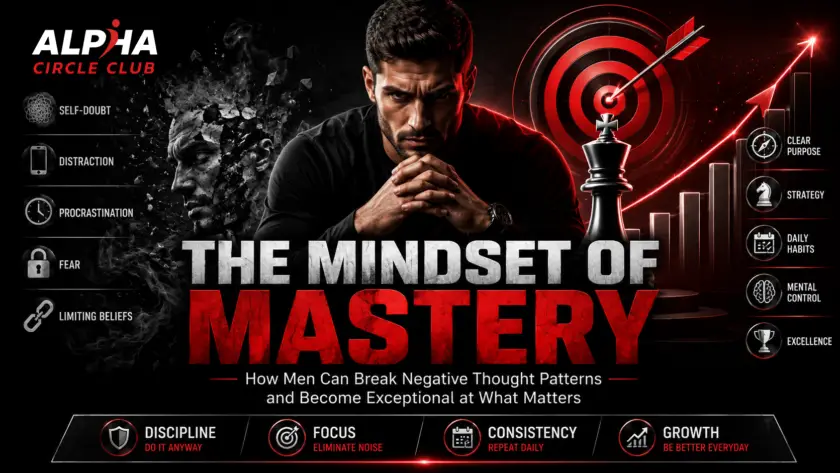
Every man has untapped ability.
But potential means nothing when fear, doubt, distraction, and negative thinking prevent it from becoming action.
Mastery begins when a man stops waiting to feel ready, chooses what matters, and returns to the work until weakness becomes competence and competence becomes excellence.
You do not become exceptional by waiting to feel capable. You become capable by repeatedly doing the work your weaker thoughts tell you to avoid.
1. What Does Mastery Really Mean?
Mastery is often misunderstood.
Some men imagine that mastery means reaching a level where mistakes disappear, confidence becomes permanent, and no further learning is required.
That is not mastery.
A true master still makes mistakes.
He still encounters difficult problems.
He still discovers weaknesses.
The difference is that he has developed the knowledge, discipline, judgement, and emotional control required to respond effectively.
Mastery is not perfection.
It is earned capability.
It is the ability to perform a skill consistently, understand it deeply, recognise errors quickly, and continue improving without needing constant external motivation.
A master does not believe he has finished learning.
In many cases, the more capable he becomes, the more clearly he sees how much there is still to understand.
A beginner may think a skill is simple because he cannot yet see its complexity.
A master sees the details.
He notices small errors.
He understands timing.
He recognises patterns.
He knows when to act, when to wait, when to simplify, and when to return to the fundamentals.
Mastery is not the destination where learning ends.
It is the point where learning becomes part of your identity.
Alpha Insight
The man who believes he has nothing left to learn has already begun to decline. Remain a student, even as your ability grows.
2. Choose What Deserves to Be Mastered
A man cannot master everything at once.
His time, energy, attention, and resources are limited.
When he attempts to improve ten areas simultaneously, he often makes meaningful progress in none of them.
He reads about fitness but does not train consistently.
He watches business videos but does not build anything.
He studies communication but avoids difficult conversations.
He makes plans for his finances but never creates a budget.
He becomes mentally busy while remaining practically unchanged.
The first step towards mastery is selection.
Ask yourself:
Which area of my life, if mastered, would create the greatest positive change?
That area may be:
- Physical fitness
- Business
- Communication
- Leadership
- Financial management
- Emotional control
- Relationships
- Fatherhood
- Writing
- Sales
- Technology
- A profession or trade
- Self-defence
- Observation
- Spiritual discipline
The correct choice is not always the most exciting one.
It may be the area you have avoided because it exposes weakness.
A man struggling financially may want to master motivation, but what he needs may be sales, budgeting, or financial discipline.
A man struggling socially may want to study success, but what he needs may be conversation, confidence, posture, or boundary-setting.
A man who feels physically weak may need to master training consistency before worrying about advanced performance techniques.
Choose the area that will create leverage.
Mastery requires concentration.
The goal is not to appear busy in many areas.
It is to become highly capable in the few areas that genuinely matter.
Alpha Insight
Scattered effort creates scattered results. Choose the skill that will change your life, then give it enough attention to change you.
3. Negative Thought Patterns Are Destroying Male Potential
Many men are not being defeated by a lack of intelligence, talent, or opportunity.
They are being defeated by the thoughts that influence their behaviour.
A negative thought does not have to be true to become destructive.
It only needs to be believed strongly enough to change what a man does next.
A man thinks:
“I am not talented enough.”
So he does not practise.
He tells himself:
“I have left it too late.”
So he never begins.
He believes:
“Other men are naturally better than me.”
So he compares instead of learning.
He says:
“I always fail.”
So one setback becomes permission to quit.
The thought creates hesitation.
Hesitation prevents action.
Lack of action produces weak results.
Those weak results then appear to confirm the original belief.
The cycle becomes:
NEGATIVE BELIEF → AVOIDANCE → WEAK PERFORMANCE → MORE NEGATIVE BELIEF
Eventually, the man stops seeing the belief as a thought.
He begins treating it as his identity.
He no longer says:
“I am struggling with confidence.”
He says:
“I am not a confident person.”
He no longer says:
“I have not learned this skill yet.”
He says:
“I am bad at this.”
He turns temporary difficulty into a permanent definition of himself.
Common destructive thought patterns
All-or-nothing thinking
“If I cannot do it perfectly, there is no point trying.”
This turns normal mistakes into total failure.
Catastrophising
“If I fail, everything will go wrong.”
This mentally converts one difficult outcome into complete disaster.
Comparison
“He is already better than me, so I will never catch up.”
This ignores the years of practice that may separate two people.
Identity-based defeat
“I am simply not the type of person who can do this.”
This makes a current weakness feel permanent.
Fear of judgement
“People will laugh if they see me learning.”
This allows imagined opinions to control real behaviour.
Past-based thinking
“I failed before, so I will fail again.”
This treats the past as a prison instead of a lesson.
Impatience
“I have practised for a month and I am still not great.”
This underestimates how long meaningful skill development takes.
These patterns destroy more than confidence.
They prevent the repetition through which confidence would have been built.
Alpha Insight
A negative thought becomes dangerous when you allow it to decide your next action. Interrupt the thought by moving forward anyway.
4. Separate Thoughts From Commands
Your mind produces thoughts automatically.
Some will be useful.
Some will be fearful.
Some will be irrational.
Some will be based on old experiences, insecurity, embarrassment, or exhaustion.
You do not have to obey all of them.
“I cannot do this” is a thought.
It is not an instruction.
“I feel afraid” is an emotional observation.
It is not a command to retreat.
“I am behind” may describe the present.
It does not determine the future.
“I might fail” may be true.
It does not mean the attempt is worthless.
A man often creates unnecessary suffering by treating every thought as evidence.
He feels uncertain, so he assumes he is unprepared.
He feels nervous, so he assumes he is incapable.
He feels resistance, so he assumes he should stop.
But resistance often appears precisely because the task matters.
The purpose is not to eliminate every negative thought before acting.
That may never happen.
The purpose is to develop enough awareness to notice the thought, question it, and choose a better response.
When the mind says:
“You will embarrass yourself.”
Respond:
“Possibly—but embarrassment will not destroy me.”
When it says:
“You are not ready.”
Respond:
“I will prepare through action.”
When it says:
“You failed before.”
Respond:
“I now know more than I knew then.”
When it says:
“This is too difficult.”
Respond:
“Difficulty reveals what I need to develop.”
Your mind may continue producing fear, doubt, and excuses.
Mastery begins when you stop treating every thought as an order.
Alpha Insight
You are not required to feel fearless. You are required to stop allowing fear to make your decisions.
5. Replace the Fixed Mindset
The fixed mindset treats ability as something a man either possesses or lacks.
It believes talent is permanent.
Mistakes expose weakness.
Difficulty proves inadequacy.
Correction feels like an attack.
Another man’s success feels threatening.
The fixed mindset asks:
“Am I naturally good at this?”
If the answer appears to be no, the man withdraws.
The mastery mindset asks a different question:
“What must I practise to become better?”
That question creates movement.
The mastery mindset understands:
- Ability can be developed.
- Mistakes produce information.
- Difficulty reveals the next area to train.
- Correction accelerates improvement.
- Another man’s success can provide evidence and instruction.
- Current weakness does not predict final capability.
This does not mean every man can become the best in the world at every skill.
Genetics, opportunity, health, age, resources, and individual circumstances matter.
But many men operate far below their true capability because they confuse “not yet” with “never.”
They experience early difficulty and assume they lack talent.
Yet the early stage of almost every advanced skill feels uncomfortable.
The body is not conditioned.
The mind is not familiar with the process.
The movements are slow.
The judgement is weak.
The outcome is inconsistent.
This does not mean the man cannot improve.
It means improvement has only just begun.
Alpha Insight
Do not ask whether you already possess the ability. Ask what daily work would make the ability unavoidable.
6. Define the Exact Skill
Many men fail because their goals are too vague.
They want to:
- Become successful
- Get fit
- Build confidence
- Improve their business
- Become a better leader
- Make more money
- Communicate better
These are ambitions.
They are not training instructions.
A man cannot deliberately practise “success.”
He must identify the skills that success requires.
Instead of saying:
“I want to become better at business,”
identify the specific components:
- Sales conversations
- Copywriting
- Website conversion
- Email marketing
- Product creation
- Financial management
- Customer research
- Negotiation
- Leadership
- Follow-up
Instead of saying:
“I want to become confident,”
identify the visible behaviours:
- Maintaining eye contact
- Improving posture
- Speaking clearly
- Starting conversations
- Expressing disagreement
- Setting boundaries
- Remaining composed under pressure
- Handling rejection
- Entering unfamiliar environments
Instead of saying:
“I want to become fit,”
define what fitness means:
- Increasing strength
- Building muscle
- Reducing body fat
- Improving cardiovascular capacity
- Increasing mobility
- Training consistently
- Improving nutrition
- Recovering properly
The more precisely you define the skill, the more effectively you can train it.
Vague goals produce vague effort.
Specific goals produce specific action.
Alpha Insight
You cannot master what you have not clearly defined. Turn the dream into a skill and the skill into a daily action.
7. Break Mastery Into Components
Every advanced ability is built from smaller skills.
A strong writer must understand:
- Ideas
- Structure
- Clarity
- Vocabulary
- Rhythm
- Editing
- Research
- Audience
- Storytelling
A strong salesman must understand:
- Listening
- Questioning
- Rapport
- Problems
- Value
- Objections
- Follow-up
- Negotiation
- Closing
A strong lifter must develop:
- Technique
- Mobility
- Strength
- Stability
- Recovery
- Nutrition
- Programming
- Consistency
A strong leader must develop:
- Communication
- Decision-making
- Accountability
- Emotional control
- Delegation
- Conflict management
- Vision
- Judgement
Mastery becomes more achievable when the area is broken into components.
The complete skill may appear overwhelming.
The next component is manageable.
Once the components are identified, assess them honestly.
Which are already strong?
Which are adequate?
Which are limiting progress?
Your weakest component may be controlling the entire outcome.
A salesman may know his product but fail to listen.
A writer may have powerful ideas but weak structure.
A lifter may possess strength but poor technique.
A business owner may create excellent products but avoid promotion.
Working harder on your strongest area may feel satisfying, but it may not solve the real problem.
Sometimes you do not need more effort.
You need more precise effort.
Alpha Insight
Do not keep polishing your strengths while your weakest skill controls your future. Identify the bottleneck and train it directly.
8. Build a Deliberate Practice System
Practice alone does not guarantee mastery.
A man can repeat poor technique for years and become highly experienced at performing badly.
Deliberate practice is different.
It includes:
- A specific target
- Focused repetition
- Immediate or regular feedback
- Work near the edge of current ability
- Conscious correction
- Gradual increases in difficulty
- Measurement of progress
Consider two men learning public speaking.
The first gives the same speech repeatedly without reviewing it.
He uses the same weak posture.
He speaks too quickly.
He avoids eye contact.
He finishes each attempt relieved that it is over.
The second records himself.
He studies his pace.
He marks unnecessary words.
He improves one section at a time.
He practises eye contact separately.
He asks for informed feedback.
Both men practise.
Only one is deliberately correcting.
The same principle applies to every area.
Do not merely repeat.
Observe.
Evaluate.
Adjust.
Repeat again.
A useful deliberate-practice session might follow this structure:
- Choose one specific weakness.
- Perform the skill.
- Review the result.
- Identify one error.
- Correct that error.
- Repeat under slightly greater challenge.
- Record what improved.
The goal is not simply to complete the session.
It is to leave the session with a clearer understanding of what needs to change.
Repetition makes behaviour familiar. Corrected repetition creates mastery.
Alpha Insight
Never confuse time spent with progress made. Practice becomes powerful when every repetition contains attention and correction.
9. Embrace the Beginner Stage
Many men avoid becoming beginners because beginning threatens their ego.
They want to appear competent immediately.
They avoid asking questions because they fear looking uninformed.
They refuse to practise where others may see them struggle.
They attempt advanced techniques before mastering the basics.
They quit because early performance does not match the image they wanted to present.
But every master was once awkward.
Every expert once misunderstood the fundamentals.
Every confident speaker once experienced nerves.
Every strong man once handled lighter weights.
Every successful business owner once made decisions without knowing exactly what would happen.
The beginner stage is not humiliation.
It is entry.
Being bad at something is often the price of eventually becoming good at it.
The man who cannot tolerate appearing inexperienced will never remain in the process long enough to become exceptional.
Your ego may tell you:
“You should already know this.”
Ignore it.
Ask the question.
Practise the basic movement.
Study the introductory material.
Request correction.
The beginner who remains humble and consistent will eventually overtake the talented man who refuses to be taught.
Alpha Insight
Do not be ashamed of beginning. Be ashamed only of allowing pride to keep you permanently unskilled.
10. Use Failure as Information
Failure hurts.
It can create embarrassment, disappointment, financial loss, rejection, and self-doubt.
It should not be romanticised.
But it should be studied.
The weak response to failure is:
“I failed, therefore I am a failure.”
The mastery response is:
“This result exposed the next weakness I need to train.”
After a poor result, ask:
- What exactly went wrong?
- Was my preparation inadequate?
- Did I misunderstand the task?
- Did I practise the wrong component?
- Was my strategy weak?
- Did pressure affect my performance?
- Did I ignore a warning sign?
- What skill was missing?
- What will I change next time?
These questions turn pain into information.
A failed sales conversation may reveal weak questioning.
A failed business launch may reveal poor audience research.
A poor workout may reveal inadequate recovery.
A damaged relationship may reveal weak communication or ignored boundaries.
A rejected application may reveal that experience, presentation, or interview technique must improve.
Failure does not always contain a simple lesson.
Sometimes external circumstances play a major role.
But even then, the man can still ask:
“What remains within my control?”
Failure becomes most destructive when it produces no change.
If a man continues using the same strategy, ignoring the same weakness, and expecting a different result, he is not learning.
He is repeating.
Alpha Insight
Failure is expensive. Make sure you extract the lesson so you never have to pay the same price twice.
11. Stop Comparing Your Beginning to Another Man’s Mastery
Comparison can educate or destroy.
Used correctly, it reveals what is possible.
It provides models.
It exposes higher standards.
It helps a man understand the gap between his current level and the level he wants to reach.
Used incorrectly, comparison becomes self-punishment.
You may be comparing:
- Your first year with another man’s tenth
- Your private struggle with his public success
- Your weakest skill with his strongest
- Your unfinished work with his polished result
- Your current resources with everything he has built over time
You see the performance.
You do not see every failed attempt, sacrifice, correction, mentor, advantage, setback, and year of practice behind it.
Study successful men.
Analyse their habits.
Learn from their strategy.
Observe their standards.
But do not use their achievement as evidence that your achievement is impossible.
Their mastery should become a map—not a weapon you use against yourself.
Compete primarily with the man you were yesterday.
Ask:
Am I more capable?
More consistent?
More informed?
More controlled?
More disciplined?
More willing to face weakness?
That comparison produces progress.
Alpha Insight
Another man’s success does not reduce your potential. Let his results instruct you, not intimidate you.
12. Consistency Defeats Intensity
Many men begin with emotional intensity.
They feel inspired.
They create extreme schedules.
They practise for hours.
They announce major goals.
They attempt to transform their entire lives immediately.
Then the intensity collapses.
The routine was too demanding.
The emotional high disappears.
The results do not arrive quickly enough.
The man stops.
Mastery is rarely built through occasional heroic effort.
It is built through repeatable standards.
Thirty focused minutes per day can become more powerful than one six-hour session followed by three weeks of avoidance.
Three well-planned workouts every week can outperform an extreme programme a man abandons after ten days.
A small daily writing target can produce a book.
A consistent savings habit can build financial security.
A regular sales routine can transform a business.
The individual session may not look extraordinary.
The accumulation becomes extraordinary.
Consistency also builds trust with yourself.
Every time you complete what you planned, you prove that your word has weight.
Every time you repeatedly abandon the plan, your mind learns not to take your commitments seriously.
Start with a standard you can maintain.
Then strengthen it.
Intensity can begin the journey. Consistency is what carries a man to mastery.
Alpha Insight
Do not build a routine that impresses people for one week. Build a standard that transforms you over one year.
13. Build a Daily Mastery Ritual
Decision fatigue destroys consistency.
When a man must decide every day whether to practise, when to begin, what to work on, and how long to continue, avoidance becomes easier.
A ritual removes unnecessary decisions.
A simple daily mastery ritual could include:
1. Review the current objective
Remind yourself exactly what you are trying to improve.
2. Practise one specific component
Do not attempt to master everything in one session.
Choose one targeted weakness.
3. Record mistakes and observations
Write down what happened while the experience is still fresh.
4. Correct one weakness
Make an immediate adjustment where possible.
5. Measure one indicator of progress
Track a behaviour or outcome that matters.
6. Decide the next action before stopping
Prepare tomorrow’s session today.
This creates momentum.
When the next practice period begins, the man does not need to ask:
“What should I do?”
The system already knows.
A ritual also helps separate action from mood.
You may not feel motivated.
The ritual still begins.
You may feel uncertain.
The ritual still guides you.
You may have had a difficult day.
The minimum standard can still be completed.
Mastery becomes more reliable when it is connected to structure rather than emotion.
Alpha Insight
Motivation asks how you feel. A ritual tells you what happens next. Build a system strong enough to operate without permission from your mood.
14. Measure Progress Correctly
Progress is not always dramatic.
A man may be improving even when the final outcome has not yet arrived.
The business may not yet be profitable, but sales conversations are improving.
The body may not yet look transformed, but strength and consistency are increasing.
Confidence may not feel complete, but difficult situations are being handled better.
The book may not be finished, but pages are being written every day.
Measure both results and the behaviours that produce them.
Useful measurements may include:
- Repetitions completed
- Accuracy
- Speed
- Weight lifted
- Sales conversations attempted
- Conversion rate
- Pages written
- Errors reduced
- Practice time completed
- Feedback received
- Difficult situations handled successfully
- Days of consistency
- Revenue
- Body measurements
- Recovery
- Completed projects
Choose measurements that provide useful information.
Do not track everything simply because it can be tracked.
Data should improve decisions.
It should not become another form of procrastination.
A man may also need to measure progress across a longer period.
Daily results fluctuate.
One bad practice session does not mean the system is failing.
One strong session does not prove mastery.
Look for the direction of travel.
Compare months, not moods.
Alpha Insight
Measure what you can control as well as what you want to achieve. Daily actions reveal whether the future result is being built.
15. Mastery Requires Boredom Tolerance
Beginning is exciting.
The goal feels new.
The equipment arrives.
The books are purchased.
The schedule is created.
The man imagines the future result.
Then the novelty fades.
Progress becomes slower.
The fundamentals require repetition.
The work becomes predictable.
This is where many men leave.
They do not necessarily lack ability.
They lack boredom tolerance.
They want constant excitement.
They want new techniques.
They want visible breakthroughs every week.
But mastery is often hidden inside repetition.
The boxer repeats basic footwork.
The writer edits sentences.
The salesman practises questions.
The musician repeats scales.
The lifter rehearses technique.
The successful man continues respecting fundamentals long after the beginner becomes tired of them.
Boredom can also reveal whether a man is committed to the result or merely addicted to novelty.
Can you continue when nobody is praising you?
Can you practise when the task feels ordinary?
Can you maintain the standard after the excitement disappears?
The man who can remain focused during the repetitive middle stages gains an advantage over the man who constantly begins new things.
Alpha Insight
Most men leave when the work stops feeling exciting. Stay long enough for repetition to create an advantage they can no longer catch.
16. Protect Your Attention
Mastery requires depth.
Depth requires sustained attention.
Modern life constantly attacks that attention.
Notifications interrupt work.
Short-form content conditions the mind to expect rapid stimulation.
Endless information creates the illusion of learning without the discipline of application.
A man may spend hours consuming content about a skill while avoiding the uncomfortable work of practising it.
Information feels productive.
Execution creates progress.
To protect your attention:
- Turn off unnecessary notifications.
- Leave the phone in another room.
- Set a defined practice period.
- Work on one task at a time.
- Close unrelated browser tabs.
- Reduce unnecessary content consumption.
- Create a dedicated working environment.
- Tell others when you are unavailable.
- Use a timer when focus is weak.
- Decide in advance what the session must accomplish.
Protecting attention does not mean rejecting technology.
It means using technology deliberately rather than allowing it to use you.
A distracted man may possess enormous potential and still produce little.
His energy is divided into fragments too small to build anything meaningful.
Attention is one of a man’s most valuable resources.
Where it repeatedly goes, his life eventually follows.
Alpha Insight
Every distraction makes a withdrawal from your future. Guard your attention as seriously as you guard your money.
17. Find Feedback Without Losing Self-Belief
Feedback is essential to mastery.
Without it, a man may continue repeating errors he cannot see.
But not every opinion deserves equal weight.
Some criticism comes from knowledgeable people who want you to improve.
Other criticism comes from people who misunderstand the field, dislike ambition, project their own insecurity, or simply want attention.
Seek feedback from people who:
- Understand the field
- Can identify specific weaknesses
- Offer actionable correction
- Want you to improve
- Possess evidence of competence
- Can explain why a change is needed
Useful feedback is specific.
It might say:
“Your opening is strong, but the middle lacks structure.”
“Your squat depth changes when the load becomes heavy.”
“You explain the product before understanding the customer’s problem.”
“You speak clearly, but you rush when challenged.”
Vague criticism provides little direction.
Examples include:
“This is bad.”
“You are not good at this.”
“I would not bother.”
Do not reject useful correction because it hurts your ego.
But do not surrender your direction to random negativity.
Receive the feedback.
Examine it.
Test it.
Keep what improves the work.
Discard what has no value.
A master separates correction from discouragement.
Alpha Insight
Do not protect your ego from the feedback that could improve you. Protect your mission from opinions that offer no useful direction.
18. Develop the Identity of a Master
A powerful shift occurs when practice stops feeling like something a man occasionally does and becomes part of who he is.
Instead of saying:
“I am trying to write,”
he says:
“I am a writer who practises daily.”
Instead of saying:
“I am trying to get fit,”
he says:
“I am a man who trains and protects his health.”
Instead of saying:
“I am trying to improve at sales,”
he says:
“I study communication and sales every day.”
Identity influences behaviour.
When a man sees himself as disciplined, he becomes more likely to protect the routines that support that identity.
When he sees himself as a learner, correction becomes easier to accept.
When he sees himself as someone who finishes, incomplete tasks become uncomfortable.
But identity must be supported by evidence.
Do not claim the identity to avoid the work.
Do not call yourself a writer while refusing to write.
Do not call yourself an entrepreneur while endlessly planning and never selling.
Do not call yourself disciplined because you completed one difficult day.
Use action to construct identity.
Each completed practice session casts a vote for the man you are becoming.
One action will not define you.
Repeated action eventually will.
Alpha Insight
Do not announce the identity and hope the work follows. Perform the work until the identity becomes undeniable.
The Mastery Mindset System
CHOOSE → BREAK DOWN → PRACTISE → CORRECT → MEASURE → REPEAT
The following framework can be applied to fitness, business, communication, leadership, finances, relationships, creativity, or almost any other meaningful skill.
Step 1: Choose
Select one important area that deserves concentrated attention.
Ask:
- Why does this matter?
- What would mastery change?
- What will happen if I continue avoiding it?
- Is this genuinely important or merely interesting?
- Am I willing to give this consistent time?
Do not scatter your energy across too many ambitions.
Choose the area capable of creating the greatest transformation.
Step 2: Break Down
Divide the area into smaller skills.
Identify:
- The fundamentals
- The most important components
- Your strongest component
- Your weakest component
- The component currently limiting progress
Turn the larger ambition into specific training targets.
Step 3: Practise
Work on one defined component using focused repetition.
The practice should be challenging enough to expose weakness without being so difficult that useful technique collapses.
Remove distractions.
Set a clear objective.
Begin.
Step 4: Correct
Study the result.
Seek feedback.
Identify errors.
Change the method.
Do not carelessly repeat a mistake when it can be consciously corrected.
Correction is not an interruption to mastery.
Correction is how mastery is built.
Step 5: Measure
Track the actions and outcomes that reveal improvement.
Measure enough to understand progress without becoming obsessed with numbers that do not matter.
Ask:
- What improved?
- What remained weak?
- What evidence proves movement?
- What requires more attention?
Step 6: Repeat
Return to the process.
Continue long enough for effort to become ability.
Continue until ability becomes reliable.
Continue until reliable behaviour becomes identity.
Mastery is created through cycles of action, feedback, correction, and repetition.
Alpha Insight
Mastery is not one heroic breakthrough. It is a system that keeps converting weakness into skill.
The 30-Day Mastery Launch Plan
Thirty days will not create complete mastery.
It can, however, create direction, discipline, and momentum.
Use this plan to begin building the system.
Days 1–3: Choose and Define
Select one area.
Write down:
- Why it matters
- What mastery would change
- What continued weakness is costing you
- What you want to achieve within 90 days
- How you will know progress is occurring
Make the goal specific.
Do not write:
“I want to improve my business.”
Write:
“I will improve my sales conversations by completing and reviewing five outreach conversations each week.”
Clarity removes confusion.
Alpha Insight
A goal becomes powerful when it tells you exactly what must happen next.
Days 4–7: Break Down the Skill
List the individual abilities the area requires.
Identify the three most important components.
Then identify the weakest one.
Study how skilled people approach it.
Gather only the information necessary to begin.
Avoid spending the entire week collecting resources.
Learning must quickly become application.
Alpha Insight
Research is useful only when it sharpens action. Do not hide from practice behind endless preparation.
Days 8–14: Establish the Routine
Choose:
- A daily or weekly practice time
- A minimum session length
- A specific location
- The exact component to practise
- A method for recording completion
Remove obvious distractions.
Track consistency rather than perfection.
Your first objective is to prove that the practice can become part of your life.
Alpha Insight
Before you attempt to become exceptional, prove that you can become consistent.
Days 15–21: Seek Correction
Review your work.
Ask for informed feedback where possible.
Study your own recordings, results, errors, or performance.
Identify repeated weaknesses.
Adjust the training.
Do not become defensive.
The purpose of this stage is not to prove you are already good.
It is to discover what will make you better.
Alpha Insight
The weakness you are willing to examine is the weakness you can eventually defeat.
Days 22–30: Increase the Challenge
Make the practice slightly harder.
Add:
- Complexity
- Resistance
- Pressure
- Speed
- Precision
- Duration
- Real-world conditions
Do not increase every variable at once.
Choose one intelligent progression.
At the end of the month, assess:
- What improved?
- What remained weak?
- Which practice produced the most progress?
- What did I learn about myself?
- What must change?
- What is the next 30-day objective?
Then continue.
The first month is not the conclusion.
It is the foundation.
Alpha Insight
Do not finish the 30 days and return to your old identity. Use the evidence of progress to begin the next level.
When Motivation Disappears
Motivation is valuable.
It can inspire a man to begin.
But it cannot be trusted to appear every day.
There will be mornings when the goal feels distant.
Days when confidence disappears.
Weeks when progress seems slow.
Moments when old negative thoughts return.
This does not mean the system has failed.
It means the system is now being tested.
On difficult days, reduce the size of the action if necessary—but protect the habit.
Write one page.
Complete one set.
Make one sales call.
Practise for fifteen focused minutes.
Review one weakness.
A reduced action maintains continuity.
No action strengthens avoidance.
The mastery mindset does not demand perfect performance every day.
It demands that a man keeps returning.
Alpha Insight
Your future is not decided by the days when action feels easy. It is decided by what you do when motivation is absent.
Mastery and the Man You Become
The greatest reward of mastery is not only the skill.
It is the man the process forces you to become.
To master something meaningful, you must develop:
- Patience
- Humility
- Focus
- Discipline
- Self-awareness
- Emotional control
- Resilience
- Honesty
- Consistency
- Respect for correction
You learn to delay gratification.
You stop treating discomfort as danger.
You become less dependent on praise.
You discover that confidence is often the result of preparation rather than positive thinking.
You begin trusting yourself because you have evidence that you continue when things become difficult.
The skill changes your external capability.
The process changes your internal character.
That is why mastery is worth pursuing.
It does more than improve what a man can do.
It improves who he is while doing it.
Alpha Insight
Choose a challenge that demands a stronger version of you. The pursuit of mastery should transform the man as much as the skill.
Final Thoughts
Negative thoughts have held too many men beneath their potential.
They have convinced capable men that they started too late.
They have made beginners ashamed of learning.
They have turned temporary failure into permanent identity.
They have encouraged comparison, hesitation, avoidance, and surrender.
But thoughts are not commands.
The past is not a prison.
Weakness is not destiny.
A man can choose what matters.
He can break it into components.
He can practise deliberately.
He can study failure.
He can accept correction.
He can measure progress.
He can protect his attention.
He can continue when motivation disappears.
And through repeated action, he can become far more capable than his former thinking allowed him to imagine.
You do not need to master everything.
But you must stop remaining weak in the areas that control your future.
Choose the skill.
Set the standard.
Begin the work.
Correct yourself.
Return tomorrow.
Then repeat the process until the man who once doubted himself becomes unrecognisable.
Greatness is not discovered inside a man fully formed. It is constructed every time he confronts weakness, corrects himself, and returns to the work.
Final Alpha Insight
Your current ability is only the starting point. The man you become will be decided by what you are willing to practise, correct, and repeat.

No spam. Unsubscribe anytime.