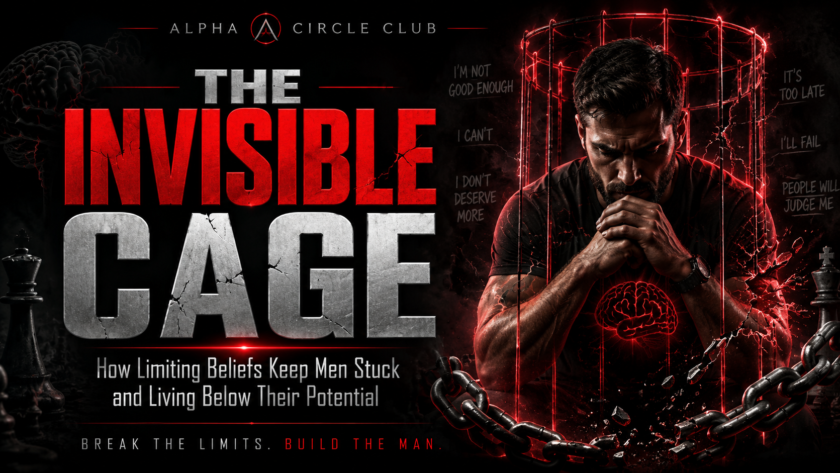
Limiting beliefs can imprison a man without placing a single visible chain around him. There may be no locked door, no physical barrier, and nobody standing in his way—yet he remains in the same position year after year. He sees the opportunity but does not take it.
He knows what must change but delays again. He imagines a stronger, wealthier, healthier, more purposeful life, then immediately creates reasons it could never belong to him. He calls it realism. He calls it caution. He tells himself he is waiting for the right moment.
Beneath those explanations may be an old belief quietly controlling every decision: I am not good enough. I always fail. I am too old. Men like me do not become successful. It is too late to change. The most dangerous part is that the belief may not feel like a belief anymore.
It may feel like his personality, his identity, or an unquestionable fact about life.
That is how the invisible cage is built.
Not from steel.
From conclusions.
From memories.
From criticism.
From rejection.
From painful experiences that were interpreted too broadly.
A boy struggles at school and concludes:
“I am not intelligent.”
A teenager experiences rejection and concludes:
“Nobody will ever want me.”
A young man attempts a business, fails, and concludes:
“I am not capable of success.”
A man misses several workouts and concludes:
“I have no discipline.”
The experience may have been real.
The permanent conclusion may not be.
Yet once a man accepts that conclusion, it begins influencing what he attempts, what he avoids, what he tolerates, and what he believes is available to him.
His beliefs shape his decisions.
His decisions shape his actions.
His actions shape his results.
Those results then appear to confirm the original belief.
The cage becomes self-reinforcing.
The Alpha mindset does not ask a man to pretend every obstacle exists only inside his head.
Real limitations exist.
Health, money, responsibilities, qualifications, discrimination, time, and economic conditions can all create genuine barriers.
But a man must learn to separate the barrier in front of him from the belief telling him he is permanently incapable of overcoming, adapting to, or working around it.
A belief should not be accepted merely because it feels familiar.
It must be examined against evidence.
Alpha Thought:
The most dangerous prison is the one a man mistakes for his personality.
Quick Alpha Summary
Limiting beliefs are assumptions or conclusions that restrict what a man believes is possible, appropriate, or available to him.
Common examples include:
- “I am not good enough.”
- “I cannot change.”
- “I am naturally lazy.”
- “I always fail.”
- “I am too old.”
- “Nobody will take me seriously.”
- “I am terrible with money.”
- “I do not deserve success.”
- “A man must handle everything alone.”
- “My past defines me.”
These beliefs may develop through childhood experiences, criticism, rejection, failure, bullying, difficult relationships, financial hardship, or repeated disappointment.
A limiting belief becomes powerful when it influences behaviour.
A man who believes he will fail may avoid trying.
Because he avoids trying, he gains no new experience.
Because he gains no experience, he remains unprepared.
His lack of progress then appears to prove that the belief was true.
Breaking this cycle requires more than positive thinking.
A man must:
- Identify the belief
- Trace its possible origin
- Separate facts from interpretations
- Test the belief against evidence
- Replace it with a more accurate working belief
- Take action before full confidence arrives
- Record evidence of growth
- Repeat the process until identity begins to change
Alpha Thought:
A limiting belief weakens when your actions begin producing evidence it cannot explain.
What Are Limiting Beliefs?
Limiting beliefs are assumptions, conclusions, or internal rules that restrict how a man sees himself, other people, and his future.
They may concern:
- Identity
- Intelligence
- Ability
- Worth
- Confidence
- Money
- Relationships
- Health
- Age
- Leadership
- Success
- Masculinity
A limiting belief often sounds like a fact.
Examples include:
- “I am not disciplined.”
- “I cannot change.”
- “I am not a leader.”
- “I will never earn more.”
- “I always ruin relationships.”
- “Nobody respects me.”
- “I am too old to begin.”
- “I am not intelligent enough.”
- “People from my background do not become successful.”
- “If I fail, everyone will think I am a joke.”
A belief does not need to be objectively true to influence behaviour.
It only needs to be accepted.
Once accepted, it can affect:
- Which opportunities a man notices
- Which risks he considers
- How he responds to criticism
- Whether he asks for help
- How much he charges
- Which relationships he tolerates
- Whether he speaks up
- Whether he continues after failure
- What level of success feels possible
The belief becomes a filter.
The man begins noticing evidence that supports it while ignoring evidence that contradicts it.
This does not mean he is intentionally deceiving himself.
It means the belief has become familiar enough to shape interpretation.
Alpha Thought:
A belief does not need to be true to control a man. It only needs to remain unchallenged.
How Limiting Beliefs Are Formed
Limiting beliefs rarely appear from nowhere.
They are often formed through experiences that carried strong emotion.
Childhood criticism
A parent, teacher, coach, or relative may repeatedly describe a child as:
- Lazy
- Weak
- Difficult
- Unintelligent
- Unreliable
- Too sensitive
- Not athletic
- Bad with money
A child may not have the maturity to question the label.
He absorbs it.
Years later, the voice may remain even when the original person is gone.
Embarrassment
A child answers a question incorrectly and classmates laugh.
He may conclude:
“I should never speak unless I am certain.”
The embarrassment lasts minutes.
The behavioural rule may last decades.
Rejection
A teenager experiences romantic or social rejection and concludes:
“I am unattractive.”
“I am unlikeable.”
“Nobody will want me.”
One person’s decision becomes a universal judgement.
Failure
A man launches a business and loses money.
The accurate conclusion might be:
“The offer, timing, strategy, or execution did not work.”
The limiting conclusion is:
“I am not built for business.”
Bullying
Repeated humiliation can shape beliefs about worth, confidence, appearance, and personal power.
Even after the bullying ends, the man may continue behaving as though he is still being judged.
Financial hardship
Growing up around financial stress may produce beliefs such as:
- “Money always disappears.”
- “Wealth is for other people.”
- “Investing is only for rich people.”
- “Wanting more makes me greedy.”
- “I will always struggle.”
Difficult relationships
A controlling or abusive relationship may lead a man to believe:
- “My needs do not matter.”
- “I cannot trust myself.”
- “Conflict always becomes dangerous.”
- “I must keep everyone happy.”
Social comparison
Constantly comparing himself with men who appear further ahead may cause him to conclude:
“I have failed.”
“I missed my chance.”
“I will never catch up.”
The comparison rarely accounts for differences in age, resources, support, health, experience, or starting position.
The event happened.
The pain was real.
But the permanent belief may still be inaccurate.
Alpha Thought:
An experience can be real without the belief formed from it being permanently true.
The Belief–Action–Evidence Loop
Limiting beliefs often strengthen themselves through a repeating cycle.
Step One: Belief
The man thinks:
“I am not confident.”
Step Two: Action
Because he believes he lacks confidence, he:
- Avoids speaking in meetings
- Refuses leadership opportunities
- Avoids meeting new people
- Does not negotiate
- Stays silent when he has an idea
Step Three: Result
Because he avoids these situations, he gains little experience.
He never practises speaking.
He never learns how to manage discomfort.
He never discovers that he could survive criticism.
Step Four: Confirmation
He then says:
“I knew I was not confident.”
The belief created the behaviour that produced the apparent proof.
Another example:
Belief
“I am terrible with money.”
Action
The man avoids checking his accounts, learning about money, creating a budget, or reviewing debt.
Result
His finances remain disorganised.
Confirmation
He concludes:
“See? I am terrible with money.”
This loop can affect fitness, careers, relationships, discipline, leadership, and business.
Breaking it requires a new action before the man fully feels different.
Alpha Thought:
A belief can create the behaviour that appears to prove it.
Limiting Beliefs vs Genuine Limitations
Not every obstacle exists only inside the mind.
It is irresponsible to tell men that every problem can be solved through belief alone.
Real limitations may involve:
- Health conditions
- Disability
- Financial hardship
- Family responsibilities
- Lack of qualifications
- Discrimination
- Economic conditions
- Legal restrictions
- Limited time
- Caring responsibilities
- Location
- Access to opportunities
An Alpha mindset does not deny reality.
It examines reality clearly.
A man should separate four categories:
What cannot currently be controlled
Certain circumstances may be fixed for now.
They must be acknowledged.
What may be influenced
The entire situation may not be controllable, but part of it may be.
What must be accepted
Acceptance is not surrender.
It is refusing to waste energy fighting facts that cannot presently be changed.
What can be changed through action
Skills, routines, communication, knowledge, planning, and environment may all be developed.
The question is not:
“Can I force reality to become whatever I want?”
The question is:
“Within this reality, where do I still have responsibility, influence, and choice?”
Alpha Thought:
The Alpha mindset is not fantasy. It is the discipline to face reality without surrendering unnecessary ground.
The Most Common Limiting Beliefs Men Carry
“I am not good enough”
This belief can produce:
- Overpreparation
- Procrastination
- Avoidance
- Perfectionism
- Undercharging
- Staying invisible
- Rejecting opportunities
The man may spend years preparing for a moment that requires action.
“I must never appear weak”
This belief may prevent a man from:
- Asking for help
- Admitting uncertainty
- Discussing mental health
- Seeking medical support
- Apologising
- Learning from others
Real strength does not require pretending to need nothing.
“I am too old”
This belief can stop men from:
- Changing careers
- Improving fitness
- Learning new skills
- Starting a business
- Building relationships
- Returning to education
Age can change the strategy.
It does not automatically eliminate the possibility.
“I do not have enough confidence”
The man waits for confidence before taking action.
But confidence often develops because action was taken.
“Failure proves I am incapable”
One unsuccessful result becomes a permanent identity.
The man treats failure as a verdict rather than information.
“Money is for other people”
This belief may lead to:
- Avoiding negotiation
- Undercharging
- Refusing financial education
- Remaining dependent
- Never building assets
- Feeling guilty about ambition
“I must keep everyone happy”
The man avoids boundaries.
He says yes when he wants to say no.
He becomes resentful while continuing to please others.
“My past defines me”
Previous mistakes become a life sentence.
The man may believe he is unworthy of a different future.
Alpha Thought:
Your past may explain your current beliefs. It does not automatically earn the right to control your future.
How Limiting Beliefs Create Self-Sabotage
Self-sabotage often looks irrational from the outside.
A man receives an opportunity and avoids it.
Progress begins and he destroys it.
A relationship becomes healthy and he withdraws.
A business starts gaining attention and he stops promoting it.
Why?
Because success may conflict with his existing identity.
If he believes:
“I am not successful,”
then success creates tension.
The old belief and the new evidence cannot comfortably coexist.
Failure may feel painful.
But it is familiar.
Success may feel positive.
But it is unfamiliar.
Self-sabotage may appear as:
- Procrastination
- Quitting early
- Undercharging
- Avoiding applications
- Rejecting compliments
- Choosing unavailable partners
- Remaining in damaging environments
- Overspending
- Refusing help
- Abandoning fitness plans
- Creating excuses before trying
- Starting conflict when life becomes stable
- Destroying progress when success approaches
The man may believe he fears failure.
He may also fear what success would require:
- Responsibility
- Visibility
- Higher expectations
- New relationships
- Leaving familiar people behind
- Becoming accountable for his potential
Alpha Thought:
Sometimes a man sabotages progress because the old identity feels safer than the future he says he wants.
The Language of a Limiting Belief
Limiting beliefs often reveal themselves through absolute language.
Listen for words such as:
- Always
- Never
- Everyone
- Nobody
- Impossible
- Too late
- Not someone like me
- I am just this way
- That would never work
- I cannot help it
Examples:
“I always fail.”
“Nobody respects me.”
“I will never become disciplined.”
“I am just bad with money.”
“People like me cannot build businesses.”
These statements often turn temporary patterns into permanent identity.
A more accurate statement may be:
“I have failed several times in this area.”
That is different from:
“I always fail.”
Accuracy creates room for action.
Alpha Thought:
Be careful when a temporary struggle begins speaking in permanent language.
The Difference Between a Fact and a Story
A fact describes what happened.
A story adds meaning, prediction, and identity.
Example One
Fact:
“I applied for three positions and was rejected.”
Story:
“Nobody will ever hire me.”
Example Two
Fact:
“My first business failed.”
Story:
“I am not capable of building a business.”
Example Three
Fact:
“I missed several workouts.”
Story:
“I have no discipline.”
Example Four
Fact:
“A relationship ended.”
Story:
“I am impossible to love.”
Example Five
Fact:
“I made several poor financial decisions.”
Story:
“I will always be bad with money.”
The fact may require responsibility.
It may require improvement.
It may reveal a genuine weakness.
But the story often extends far beyond the evidence.
Describe events accurately.
Do not automatically convert them into judgements about your permanent identity.
Alpha Thought:
Facts help a man improve. Stories can keep him trapped when they turn one event into a lifelong verdict.
Challenge the Belief With Evidence
A limiting belief should be questioned carefully.
Ask:
- Is this belief completely true?
- When did I first begin believing it?
- Whose voice does it resemble?
- What evidence supports it?
- What evidence contradicts it?
- Am I turning one event into a universal rule?
- Have there been exceptions?
- What would I tell another man in this situation?
- What action am I avoiding because of this belief?
- What does continuing to believe it protect me from?
- What could become possible if the belief weakened?
The objective is not to pretend there is no evidence supporting the belief.
A man may genuinely lack experience.
He may have failed repeatedly.
He may need training, support, treatment, accountability, or a different strategy.
The goal is greater accuracy.
Instead of:
“I am incapable,”
the evidence may suggest:
“I am currently unprepared.”
One describes a permanent identity.
The other describes a problem that can be addressed.
Alpha Thought:
An accurate belief does not protect the ego. It reveals the next useful action.
Replace Limiting Beliefs With Working Beliefs
A limiting belief should not be replaced with an unrealistic slogan.
Do not replace:
“I always fail”
with:
“I succeed at everything.”
That statement is unbelievable and unhelpful.
Use a working belief instead.
A working belief is:
- More accurate
- Credible
- Flexible
- Connected to action
- Open to new evidence
Limiting belief:
“I always fail.”
Working belief:
“I have failed before, but failure can provide information that improves my next attempt.”
Limiting belief:
“I am not confident.”
Working belief:
“Confidence can grow when I practise difficult situations.”
Limiting belief:
“I am terrible with money.”
Working belief:
“I have not yet built strong financial systems.”
Limiting belief:
“I am too old.”
Working belief:
“My age changes the strategy, but it does not automatically remove the possibility.”
Limiting belief:
“I am not disciplined.”
Working belief:
“I can strengthen discipline by keeping small promises consistently.”
The strongest new belief is not the most flattering.
It is the most truthful belief that supports forward action.
Alpha Thought:
Replace the belief with something accurate enough to trust and strong enough to act upon.
Action Must Come Before Full Belief
Many men wait to feel confident before acting.
But confidence is often the result of action.
The process may look like this:
- Take a small courageous action
- Experience discomfort
- Survive the discomfort
- Gain new evidence
- Adjust the belief
- Take a larger action
Examples include:
- Speak once in a meeting
- Apply for one position
- Attend one training session
- Publish one piece of content
- Set one boundary
- Ask one difficult question
- Save the first £50
- Contact the first customer
- Attend one social event
- Ask for professional guidance
The action does not need to be dramatic.
It needs to contradict the old belief.
A man who believes he never finishes anything can finish one small project.
A man who believes he cannot speak confidently can ask one question publicly.
A man who believes he cannot manage money can track his spending for one week.
New action produces new evidence.
Alpha Thought:
Do not wait for a new identity before acting. Act until the old identity can no longer explain the evidence.
Build an Evidence File
The mind can remember failure more strongly than progress.
A man may forget:
- Promises kept
- Work completed
- Difficult conversations survived
- Skills learned
- Compliments received
- Rejections handled
- Boundaries enforced
- Financial improvement
- Fitness progress
- Moments of courage
Create an evidence file.
This may be a notebook, digital document, or private journal.
Record:
- What you completed
- What fear you faced
- What feedback you received
- What improved
- What you survived
- What promise you kept
- What action contradicted the old belief
The evidence file is not an ego document.
It is a correction.
It reminds the man that his identity is larger than his failures.
Alpha Thought:
Do not allow your mind to preserve every failure while deleting the evidence of growth.
Limiting Beliefs About Discipline
Common beliefs include:
- “I am naturally lazy.”
- “I never finish anything.”
- “I cannot stick to routines.”
- “I have no willpower.”
- “I always lose motivation.”
These may feel like character judgements.
But the real problem may involve:
- Vague goals
- Unrealistic routines
- Poor sleep
- Too many priorities
- Constant distraction
- No accountability
- No meaningful purpose
- An environment filled with temptation
- Failure to return after mistakes
A man may not lack discipline as a permanent trait.
He may lack a system that supports disciplined action.
This does not remove responsibility.
It changes where responsibility must be applied.
Alpha Thought:
Do not convert a weak system into a permanent judgement about your character.
Limiting Beliefs About Wealth and Success
Men may carry financial beliefs such as:
- “Wanting money makes me greedy.”
- “I will never earn more.”
- “Business is only for certain people.”
- “I do not deserve success.”
- “People from my background do not become wealthy.”
- “I am too late.”
- “I must know everything before I begin.”
- “Rich people are all dishonest.”
These beliefs may affect:
- Salary negotiation
- Pricing
- Investment education
- Business creation
- Skill development
- Networking
- Ownership
- Saving
- Asking for opportunities
Money should not become a man’s master.
But fear of money should not prevent him from building security, supporting family, giving generously, or creating useful work.
Ambition should be guided by character.
Not buried by fear.
Alpha Thought:
A man can reject greed without rejecting growth, ownership, responsibility, and financial strength.
Limiting Beliefs About Masculinity
Some beliefs about masculinity can become restrictive.
Examples include:
- “A man must handle everything alone.”
- “Asking for help is weakness.”
- “Men should not feel fear.”
- “Anger proves strength.”
- “My worth depends on income.”
- “I must dominate every situation.”
- “Vulnerability makes me less masculine.”
- “Admitting a mistake makes me weak.”
These beliefs can damage:
- Mental health
- Relationships
- Leadership
- Physical health
- Financial decisions
- Communication
- Fatherhood
Strength includes:
- Self-awareness
- Responsibility
- Emotional control
- Seeking qualified help
- Protecting others
- Admitting mistakes
- Listening
- Learning
- Setting boundaries
- Taking corrective action
A man who needs help and seeks it responsibly may be showing greater strength than the man who continues collapsing in silence.
Alpha Thought:
Masculine strength is not pretending to have no weaknesses. It is confronting weakness without allowing shame to control the response.
The Alpha Belief Audit
Complete the following statements honestly:
- I am the kind of man who…
- Men like me never…
- Success means…
- Money is…
- Relationships always…
- People will think…
- I cannot…
- I am too…
- It is too late to…
- If I fail, it means…
- If I succeed, people may…
- The reason I have not started is…
Then ask:
- Which answers are facts?
- Which are assumptions?
- Which were inherited from someone else?
- Which formed during painful experiences?
- Which are still controlling behaviour?
- Which belief costs me the most?
- Which action would challenge it?
Do not try to change everything at once.
Choose the belief that currently restricts the most important area of your life.
Alpha Thought:
You cannot challenge a belief you refuse to name.
The 30-Day Alpha Belief Reset
This reset will not erase years of conditioning in one month.
Its purpose is to begin creating awareness, accuracy, and new evidence.
Days 1–7: Identify the Cage
- Record recurring negative thoughts
- Notice absolute language
- Identify the three most restrictive beliefs
- Trace their possible origins
- Separate facts from interpretations
- Observe which behaviours they influence
The goal is awareness.
Days 8–14: Challenge the Story
- Write evidence supporting each belief
- Write evidence contradicting each belief
- Identify exceptions
- Create a more accurate working belief
- Stop repeating identity-level insults
- Identify one avoided action
The goal is accuracy.
Days 15–21: Produce New Evidence
- Take one uncomfortable action each day
- Keep one promise to yourself
- Speak where you normally remain silent
- Attempt something previously avoided
- Ask for feedback
- Record each result
The goal is evidence.
Days 22–30: Build the New Identity
- Review the evidence file
- Strengthen the working beliefs
- Set a larger 90-day challenge
- Remove environments that reinforce the old identity
- Decide which standards the stronger version of you follows
- Identify where professional support may be useful
The goal is continuation.
Alpha Thought:
A limiting belief weakens every time your actions produce evidence it cannot explain.
The Alpha Belief Code
1. Question inherited conclusions
Familiar does not automatically mean true.
2. Separate facts from stories
Describe what happened without turning it into permanent identity.
3. Reject permanent language about temporary struggles
Always and never are often exaggerations.
4. Challenge beliefs with evidence
Test the conclusion.
5. Replace fantasy with accurate working beliefs
The new belief must be credible.
6. Take action before confidence arrives
Action can produce confidence.
7. Record proof of growth
Do not allow progress to be forgotten.
8. Stop using the past as an identity
History explains. It does not have to imprison.
9. Seek help when the obstacle requires it
Strength includes using appropriate support.
10. Build beliefs through repeated action
Identity changes when evidence accumulates.
Common Mistakes When Challenging Limiting Beliefs
Repeating affirmations without action
Words alone rarely create enough evidence.
Pretending real obstacles do not exist
Positive thinking should not replace planning or responsibility.
Expecting instant change
Beliefs repeated for years may take time to weaken.
Attacking yourself for negative thoughts
Shame can strengthen the problem.
Waiting for fear to disappear
Fear may reduce after action, not before it.
Trying to change every belief at once
Choose the most important one.
Returning to environments that reinforce the old identity
Environment influences belief.
Treating one setback as proof
A setback does not automatically validate the old conclusion.
Refusing professional support
Some beliefs may be connected to trauma, anxiety, depression, abuse, or other serious experiences that deserve qualified help.
Replacing one extreme with another
Accuracy is stronger than exaggerated positivity.
Alpha Thought:
The goal is not to think positively about everything. It is to think accurately enough to act wisely.
When Professional Support May Help
Some limiting beliefs are connected to deep emotional pain.
A man may understand the belief intellectually but still feel overwhelmed by it.
Professional support may be valuable when beliefs are connected to:
- Trauma
- Abuse
- Severe anxiety
- Depression
- Persistent hopelessness
- Addiction
- Eating disorders
- Self-harm
- Suicidal thoughts
- Relationships involving control or violence
- Symptoms that seriously disrupt daily life
Seeking help does not weaken the Alpha mindset.
It strengthens it.
Responsibility means using the right tool for the problem.
Alpha Thought:
A strong man does not insist on fighting every battle alone. He chooses the support required to fight it properly.
Final Alpha Standard
A limiting belief is not always a fact.
Sometimes it is a memory wearing the clothes of truth.
A conclusion formed when you were younger.
A sentence spoken by someone who never understood your potential.
A failure interpreted too broadly.
A rejection carried too far.
A fear repeated until it began sounding like your identity.
The Alpha mindset does not demand blind confidence.
It demands honest examination.
Challenge the belief.
Trace the origin.
Test the evidence.
Separate the fact from the story.
Replace the old conclusion with a working belief.
Take the action.
Record the result.
Repeat.
Do not allow an old version of you to keep making decisions for the man you are trying to become.
Your past may explain the belief.
It does not have to control the future.
You may have failed before.
That does not mean failure is your identity.
You may lack confidence now.
That does not mean confidence cannot be built.
You may have made poor financial decisions.
That does not mean financial control is unavailable.
You may have started late.
That does not mean you must remain still.
The invisible cage becomes weaker the moment a man stops calling it home.
Final Alpha Thought:
You do not break a limiting belief by arguing with it forever. You break it by becoming evidence that it was incomplete.
Break the Belief. Raise the Standard. Become the Man.
Alpha Circle Club helps men confront the beliefs, habits, and fears keeping them beneath their potential.
Stop accepting old conclusions as permanent limits.
Question the belief.
Take the action.
Build the evidence.
Create a stronger identity.

No spam. Unsubscribe anytime.