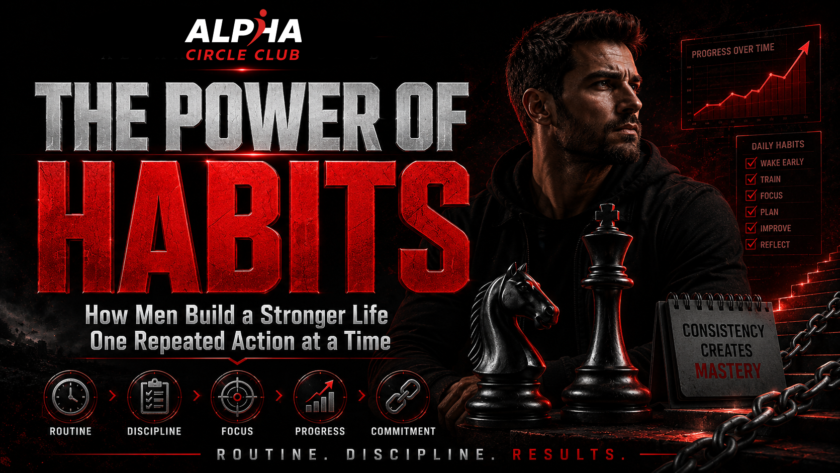
The power of habits is that they shape a man long before he notices the change. A man does not become strong, disciplined, wealthy, confident, or respected through one emotional decision; he becomes that man through what he repeats when nobody is watching. The alarm he obeys or ignores, the food he chooses, the workout he completes, the money he saves, the anger he controls, the content he consumes, the promises he keeps, and the excuses he allows all begin training his identity. Every habit is a vote. Some habits vote for strength, discipline, and self-respect. Others vote for weakness, delay, and regret. A man’s future is not built only by what he wants. It is built by what he repeatedly does.
Most men think their life changes through one big decision.
The moment they finally become disciplined.
The moment they finally get serious.
The moment they finally stop wasting time.
The moment they finally become the man they were meant to be.
But life rarely changes through one dramatic moment.
It changes through what a man repeats.
The food he eats when nobody is watching.
The alarm he obeys or ignores.
The workout he completes or delays.
The money he saves or spends.
The emotion he controls or releases.
The content he consumes.
The people he listens to.
The promises he keeps.
The standards he repeats until they become normal.
This is the power of habits.
They build quietly.
They shape slowly.
They do not ask permission.
And over time, they either create a stronger man—or they quietly weaken him.
A man does not rise to the level of his dreams if his daily habits are pulling him in the opposite direction.
He may dream of wealth, but his spending habits create pressure.
He may dream of strength, but his training habits remain inconsistent.
He may dream of confidence, but his avoidance habits keep him small.
He may dream of leadership, but his emotional habits damage trust.
He may dream of discipline, but his daily routine teaches his mind that comfort is in charge.
Your habits are not small when repeated for months and years.
They are the invisible training system shaping your body, mind, confidence, discipline, relationships, money, and future.
Every day, your habits are casting votes.
A man who repeatedly trains, saves, studies, reflects, prays, controls his emotions, protects his sleep, and completes his work is voting for a stronger identity.
A man who repeatedly scrolls, overspends, avoids hard conversations, skips training, eats without discipline, reacts emotionally, and breaks promises to himself is also voting.
The question is simple:
What kind of man are your habits building?
Alpha Thought:
Your habits are either building the man you respect or feeding the version of you that keeps you stuck.
Quick Alpha Summary
Habits are repeated behaviours that become automatic through consistency.
They can strengthen or weaken a man.
Good habits build:
- Discipline
- Confidence
- Health
- Wealth
- Focus
- Self-respect
- Emotional control
- Stronger relationships
- A stronger identity
Bad habits create:
- Procrastination
- Weakness
- Escapism
- Poor health
- Financial pressure
- Broken self-trust
- Emotional reactions
- Avoidance
- Long-term regret
The power of habits is not found in one action.
It is found in repetition.
One workout may not transform the body.
One saved £20 may not create wealth.
One focused hour may not build a business.
One honest conversation may not repair everything.
But repeated over time, these actions compound.
The same is true for destructive habits.
One skipped workout may not matter.
One night of scrolling may not destroy focus.
One impulsive purchase may not ruin finances.
But repeated long enough, the pattern becomes costly.
A man’s habits are training his identity.
Choose the habits that build the man you respect.
Remove the habits that feed the man you are trying to outgrow.
Alpha Thought:
A habit is not just something you do. It is something that is slowly teaching you who you are.
What Are Habits?
Habits are repeated behaviours that become easier and more automatic through consistency.
They are the actions a man performs so often that they begin to feel normal.
Some habits are obvious.
Others are so automatic that the man may barely notice them.
Examples include:
- Brushing teeth
- Checking the phone first thing in the morning
- Training after work
- Overspending when stressed
- Reading before bed
- Snacking late at night
- Responding angrily under pressure
- Saving automatically
- Avoiding difficult conversations
- Scrolling when bored
- Praying or reflecting each morning
- Leaving work until the last minute
Habits reduce decision fatigue.
The behaviour becomes familiar.
The mind does not need to debate every step.
This can be powerful when the habit is good.
A man who has made training part of his routine does not need a motivational speech every time.
He trains because that is what he does.
A man who saves automatically does not need to fight every impulse.
The system has already moved the money.
A man who plans his week every Sunday is less likely to begin Monday in chaos.
But automatic behaviour can also be destructive.
A man may automatically check his phone when he feels uncomfortable.
Automatically spend when stressed.
Automatically avoid conflict.
Automatically eat poorly at night.
Automatically react defensively when criticised.
The habit does not need permission anymore.
It simply runs.
That is why habits matter.
They are not just behaviours.
They are repeated instructions to the man’s future.
Alpha Thought:
A habit is repeated behaviour that begins shaping identity.
Why Habits Are More Powerful Than Motivation
Motivation changes.
Habits remain.
Motivation is useful at the start.
It can give a man energy.
It can make the future feel possible.
It can help him begin.
But motivation is unstable.
It rises and falls with mood, sleep, stress, novelty, confidence, and emotion.
A man may feel motivated to train for three days.
But the habit of training can keep him going for three years.
A man may feel motivated to save money after watching a financial video.
But the habit of automatic saving builds real control.
A man may feel motivated to improve his relationship after an argument.
But the habit of regular communication protects trust long term.
Motivation is strongest when the idea is new.
Habits are strongest when the behaviour has been repeated.
This is why disciplined men do not depend on feeling ready.
They build routines that continue when feelings change.
A man should use motivation when it appears.
But he should not worship it.
Motivation can start the journey.
Habits carry the journey through ordinary days.
Alpha Thought:
Motivation starts the fire. Habits keep the flame alive when emotion fades.
Your Habits Are Training Your Identity
Every habit tells the mind something.
Training tells the mind:
“I am a man who looks after his body.”
Saving tells the mind:
“I am a man who controls his money.”
Reading tells the mind:
“I am a man who keeps learning.”
Praying or reflecting tells the mind:
“I am a man who seeks direction before rushing into the day.”
Keeping promises tells the mind:
“My word still means something.”
But destructive habits also train identity.
Repeated avoidance tells the mind:
“I am a man who runs from pressure.”
Repeated overspending tells the mind:
“I am a man who cannot control impulses.”
Repeated emotional reactions tell the mind:
“I am ruled by the moment.”
Repeated lateness tells the mind:
“My standards are flexible.”
Repeated quitting tells the mind:
“I do not finish what I start.”
This is why habits are deeper than routines.
They become evidence.
Over time, the man starts believing what his behaviour repeatedly proves.
A man does not become confident simply by calling himself confident.
He becomes confident by repeatedly taking actions that prove courage, competence, and self-respect.
A man does not become disciplined because he posts about discipline online.
He becomes disciplined because he keeps standards when nobody is watching.
Identity is built through repeated evidence.
Alpha Thought:
The man you become is trained by what you repeatedly do.
The Compound Effect of Habits
Small habits may not look powerful in one day.
One workout may not transform a body.
One healthy meal may not restore health.
One saved £20 may not create wealth.
One focused hour may not build a business.
One honest conversation may not repair a relationship.
But repeated over months and years, these actions compound.
The same is true for bad habits.
One skipped workout may not matter.
One impulsive purchase may not destroy finances.
One night of scrolling may not ruin focus.
One angry response may not destroy a relationship.
But repeated long enough, the pattern becomes costly.
The danger of bad habits is that they often feel harmless in the moment.
The reward is immediate.
The cost is delayed.
The benefit of good habits is that they often feel difficult in the moment.
The reward is delayed.
The cost is immediate.
This is why many men choose the wrong habits.
Bad habits pay today and charge interest later.
Good habits charge today and pay interest later.
The Alpha man learns to think beyond the moment.
He asks:
Where will this habit take me if repeated for one year?
What will this do to my body?
My money?
My confidence?
My relationship?
My mind?
My faith?
My future?
A habit is powerful because repetition multiplies the result.
Alpha Thought:
Habits are dangerous or powerful because they multiply over time.
Good Habits vs Bad Habits
Good habits make the future easier.
Bad habits make the future heavier.
Good habits may include:
- Training consistently
- Sleeping properly
- Saving money
- Eating with intention
- Reading or learning daily
- Planning the week
- Praying or reflecting
- Communicating honestly
- Controlling emotional reactions
- Completing focused work
- Keeping promises
- Preparing the next day
- Reviewing progress
Bad habits may include:
- Constant scrolling
- Pornography
- Overspending
- Avoiding responsibility
- Skipping workouts
- Eating without control
- Reacting in anger
- Sleeping late without reason
- Procrastinating
- Blaming others
- Living without a plan
- Escaping into entertainment
- Breaking promises to yourself
- Avoiding difficult conversations
A good habit may feel inconvenient today but strengthens tomorrow.
A bad habit may feel comforting today but makes tomorrow harder.
The question is not only:
“What feels good now?”
The stronger question is:
“What does this habit make easier or harder later?”
Alpha Thought:
Good habits charge a price today and pay you later. Bad habits pay you today and charge you later.
The Habit Loop
Most habits follow a basic pattern.
Cue
Something triggers the behaviour.
Routine
The behaviour happens.
Reward
The brain receives something.
That reward may be:
- Comfort
- Relief
- Pleasure
- Stimulation
- Escape
- Progress
- Pride
- Peace
- Connection
- Control
For example:
Stress becomes the cue.
Scrolling becomes the routine.
Distraction becomes the reward.
Or:
Loneliness becomes the cue.
Pornography becomes the routine.
Temporary escape becomes the reward.
Or:
The alarm sounds.
The man gets up and trains.
Self-respect becomes the reward.
Or:
The workday ends.
The man prepares tomorrow’s priorities.
Control becomes the reward.
To change a habit, a man must understand what triggers it and what reward it provides.
Many bad habits survive because they meet a need quickly.
The man may think the problem is the phone, the food, the spending, or the distraction.
But underneath, the real issue may be stress, boredom, loneliness, fear, pressure, or emotional pain.
If the man removes the habit without addressing the reward, the mind will search for another escape.
The stronger approach is to ask:
What triggers this habit?
What does it give me?
What better action could provide relief, progress, peace, or control without weakening me?
Alpha Thought:
To change a habit, study the trigger and the reward—not only the behaviour.
Why Men Struggle to Break Bad Habits
Bad habits often provide immediate relief.
They may help a man escape:
- Stress
- Boredom
- Loneliness
- Fear
- Pressure
- Emotional pain
- Responsibility
- Difficult work
- Shame
- Conflict
The problem is that short-term relief can create long-term weakness.
A man may not be addicted only to the habit itself.
He may be attached to the escape the habit provides.
Scrolling may not only be entertainment.
It may be avoidance.
Overspending may not only be pleasure.
It may be emotional relief.
Pornography may not only be desire.
It may be loneliness, stress, or escape.
Anger may not only be emotion.
It may be a defence against feeling powerless.
Procrastination may not only be laziness.
It may be fear of failure, fear of judgement, or perfectionism.
This does not excuse the habit.
It explains why willpower alone often fails.
To break a bad habit, a man must deal with the need underneath it.
He must build better ways to face discomfort.
Alpha Thought:
Many bad habits are not about pleasure. They are about escape.
Keystone Habits: The Habits That Change Everything
Some habits create a powerful ripple effect.
These are keystone habits.
They influence multiple areas of life at once.
A man should not try to fix every habit at the same time.
He should begin with the habits that affect everything else.
Strength training
Strength training can improve:
- Confidence
- Discipline
- Energy
- Posture
- Mood
- Sleep
- Self-respect
- Body composition
- Masculine presence
The habit of training teaches the man to face resistance.
Sleep discipline
Sleep affects:
- Focus
- Hormones
- Emotional control
- Training recovery
- Decision-making
- Hunger
- Stress tolerance
- Motivation
A tired man often becomes a reactive man.
Weekly planning
Planning reduces chaos.
It helps a man see responsibilities before they become urgent.
It creates direction.
Tracking spending
Tracking money builds awareness.
Awareness creates control.
A man cannot improve what he refuses to look at.
Morning prayer or reflection
This habit can strengthen:
- Purpose
- Patience
- Gratitude
- Emotional stability
- Faith
- Decision-making
It gives the day direction before distractions arrive.
Focused work blocks
Focused work can build:
- Career progress
- Business growth
- Income
- Skill
- Confidence
- Momentum
A man who protects deep focus becomes more dangerous to mediocrity.
Alpha Thought:
Build the habit that improves several areas of life at once.
The Alpha Morning Habit Stack
The morning should establish command.
It does not need to be complicated.
A strong morning habit stack may include:
- Wake at a set time
- Avoid the phone for the first 30 minutes
- Hydrate
- Pray, reflect, or journal
- Move the body
- Review the top three priorities
- Begin one meaningful task
The goal is not to create a perfect routine for social media.
The goal is to prove that the day begins under your leadership.
Many men lose control within minutes of waking.
They check messages.
Scroll feeds.
React to notifications.
Absorb other people’s opinions.
Compare themselves.
Start the day in response mode.
A stronger morning says:
“My attention belongs to my mission before it belongs to the world.”
The first hour does not need to be extreme.
It needs to be intentional.
Alpha Thought:
The way a man begins the day often tells him who is in control.
The Alpha Evening Habit Stack
A strong evening routine protects the next day.
The evening is not only the end of today.
It is the preparation ground for tomorrow.
A strong evening habit stack may include:
- Review the day honestly
- Prepare tomorrow’s priorities
- Set clothes, food, or equipment ready
- Stop scrolling late
- Create a sleep window
- Reflect on one win and one lesson
- Reset the mind before bed
A man who ends the day in chaos often begins the next day behind.
Late-night scrolling weakens sleep.
No plan creates morning confusion.
Unprepared meals create poor choices.
Unfinished mental stress carries into rest.
A disciplined evening does not have to be long.
It simply needs to remove tomorrow’s friction.
The Alpha man prepares before pressure arrives.
Alpha Thought:
A man who ends the day with control gives tomorrow a stronger start.
Habits and Physical Health
A man’s body is not built through occasional intensity.
It is built through repeated behaviour.
Strong health habits include:
- Strength training
- Walking or cardio
- Protein and nutrient-dense meals
- Hydration
- Sleep
- Recovery
- Medical check-ups
- Reduced alcohol
- No smoking or vaping
- Fertility-protective choices
- Managing stress
- Stretching or mobility
- Getting sunlight where possible
Many men wait until the body forces them to listen.
They wait until weight gain becomes obvious.
Energy drops.
Sleep declines.
Confidence disappears.
Health warnings arrive.
The proactive man builds health habits before the crisis.
He understands that the body is part of the mission.
If the body becomes weak, every area of life becomes harder.
Work becomes harder.
Leadership becomes harder.
Relationships become harder.
Discipline becomes harder.
Confidence becomes harder.
A strong body is not built by wishing.
It is built by repetition.
Alpha Thought:
Your body becomes the visible record of the habits you repeat most often.
Habits and Wealth
A man does not become financially stronger by accident.
He becomes stronger by creating money habits that repeat.
Wealth habits include:
- Tracking money
- Saving automatically
- Avoiding lifestyle inflation
- Building high-value skills
- Creating assets
- Reviewing subscriptions
- Avoiding emotional spending
- Planning purchases
- Learning about money
- Thinking long term
- Building emergency savings
- Reducing destructive debt
- Reviewing income and expenses regularly
Bad money habits can feel small.
A few unnecessary purchases.
A subscription nobody uses.
A habit of emotional spending.
Avoiding bank accounts.
Never planning for tax.
Never saving before spending.
Over time, the pattern becomes pressure.
Good money habits may not feel exciting at first.
But they build freedom slowly.
The Alpha man does not wait for financial panic before creating financial control.
He builds habits before crisis arrives.
Alpha Thought:
Financial freedom is built through small money habits repeated before crisis arrives.
Habits and Relationships
Trust is not built through one grand gesture.
It is built through repeated evidence.
Relationship habits matter.
A man may build or damage trust through what he repeatedly does.
Strong relationship habits include:
- Listening properly
- Keeping promises
- Communicating early
- Apologising sincerely
- Showing appreciation
- Setting boundaries
- Speaking with respect
- Being present
- Addressing issues before resentment grows
- Following through
- Not using silence as punishment
- Managing emotion before speaking
Weak relationship habits include:
- Avoiding conversations
- Reacting defensively
- Breaking promises
- Going silent
- Using harsh words
- Taking people for granted
- Letting resentment build
- Dismissing concerns
- Speaking only when conflict becomes urgent
The strongest relationships are not built only during special moments.
They are built through repeated patterns of respect.
A man should ask:
What do people experience from me repeatedly?
Do they experience consistency?
Respect?
Calmness?
Honesty?
Presence?
Or do they experience avoidance, defensiveness, broken promises, and emotional reactions?
Alpha Thought:
Trust is built through repeated evidence.
Habits and Emotional Control
Emotional reactions can become habits too.
A man may habitually respond with:
- Anger
- Defensiveness
- Withdrawal
- Blame
- Jealousy
- Avoidance
- Escapism
- Sarcasm
- Silence
- Impulsive decisions
If repeated long enough, these responses feel automatic.
The man says:
“That is just how I am.”
But often, it is not who he is.
It is what he has practised.
Emotional control is built by practising better responses:
- Pause before speaking
- Breathe before reacting
- Walk away before saying something destructive
- Write before confronting
- Pray before responding
- Ask questions instead of assuming
- Address issues early
- Name the emotion honestly
- Choose the response before pressure arrives
A man becomes emotionally stronger through repeated self-command.
He does not deny emotion.
He refuses to let emotion drive every action.
Alpha Thought:
A reaction repeated often enough becomes a habit. A pause practised often enough becomes strength.
How to Build a New Habit
A man should not rely on vague intention.
He needs a practical system.
1. Start small
Begin smaller than your ego wants.
A habit that is easy to start is easier to repeat.
2. Attach it to an existing routine
For example:
“After brushing my teeth, I will read for five minutes.”
“After work, I will go straight to the gym.”
“After dinner, I will prepare tomorrow’s priorities.”
3. Make the habit visible
Keep the book on the desk.
Place gym clothes ready.
Put the journal beside the bed.
4. Remove friction
Make the good habit easy to begin.
Prepare the environment in advance.
5. Track completion
Use a checklist, calendar, journal, or habit tracker.
Visible progress builds momentum.
6. Reward progress
The reward does not have to be huge.
Self-respect can become the reward.
So can peace, clarity, energy, or pride.
7. Protect consistency
The habit matters most when motivation fades.
8. Return quickly after failure
Missing once is not failure.
Quitting is the danger.
Instead of saying:
“I will become fit,”
say:
“I will train Monday, Wednesday, and Friday at 7pm.”
Specificity builds success.
Alpha Thought:
A vague intention becomes powerful only when it is turned into a specific repeated action.
How to Break a Bad Habit
A man should not rely only on willpower.
Willpower matters.
But systems matter too.
To break a bad habit:
1. Identify the trigger
What starts the behaviour?
Stress?
Boredom?
Loneliness?
Fatigue?
Conflict?
Late-night phone use?
2. Identify the reward
What does the habit give you?
Relief?
Escape?
Pleasure?
Distraction?
Control?
3. Remove the cue where possible
If the phone triggers scrolling, keep it away during focused work.
If junk food triggers overeating, stop keeping it in the house.
4. Add friction to the bad habit
Log out.
Delete apps.
Remove stored payment details.
Block websites.
Keep distractions out of the bedroom.
5. Replace it with a better response
If stress triggers late-night scrolling, try walking, journalling, prayer, reading, stretching, or preparing for sleep earlier.
6. Change the environment
Your surroundings should support the man you are becoming.
7. Get accountability
Some habits are easier to break with support.
8. Track progress
What is measured becomes clearer.
9. Return after setbacks
A slip is information.
It is not permission to surrender.
Alpha Thought:
Do not only remove the bad habit. Replace the escape it was providing with something that strengthens you.
The Alpha Habit Audit
A man cannot change what he refuses to examine.
Use these questions honestly:
- What habit is helping me most?
- What habit is damaging me most?
- What do I do automatically when stressed?
- What do I do first in the morning?
- What do I do last at night?
- What habit is quietly affecting my health?
- What habit is quietly affecting my money?
- What habit is damaging my relationships?
- What habit is weakening my confidence?
- What habit is strengthening my discipline?
- What habit would future me beg me to change?
- What one habit would improve several areas at once?
- What habit have I normalised that is actually costing me?
- What habit would the strongest version of me practise daily?
Do not try to change everything at once.
Choose one habit to build.
Choose one habit to reduce.
Start there.
Alpha Thought:
The habit you ignore today may become the problem your future self is forced to fight.
The 30-Day Alpha Habit Reset
This reset is designed to help a man become aware, structured, consistent, and identity-driven.
It will not transform every area of life in one month.
But it can change direction.
Days 1–7: Awareness
During the first week:
- Track current habits
- Identify triggers
- Choose one good habit to build
- Choose one bad habit to reduce
- Remove one environmental obstacle
- Record what you do when stressed
- Notice your morning and evening patterns
The goal is awareness.
A man cannot master what he does not observe.
Days 8–14: Structure
During the second week:
- Set a clear time and place
- Create reminders
- Prepare the environment
- Add friction to the bad habit
- Track completion daily
- Attach the new habit to an existing routine
- Decide the replacement behaviour for the bad habit
The goal is structure.
Make the right action easier and the wrong action harder.
Days 15–21: Consistency
During the third week:
- Protect the habit even on difficult days
- Use a smaller version when needed
- Review triggers
- Strengthen accountability
- Record early evidence
- Return quickly after any missed day
- Remove another source of friction
The goal is consistency.
This is where the habit begins becoming part of the man.
Days 22–30: Identity
During the final stage:
- Review progress
- Identify what changed
- Decide the next habit layer
- Create a 90-day habit plan
- Turn the habit into a personal standard
- Write the identity connected to the habit
For example:
“I am a man who trains.”
“I am a man who controls his money.”
“I am a man who speaks with respect.”
“I am a man who protects his sleep.”
“I am a man who keeps promises.”
The goal is identity.
The habit becomes powerful when it is no longer just a challenge.
It becomes who the man is becoming.
Alpha Thought:
A habit becomes powerful when it stops being a challenge and starts becoming who you are.
The Alpha Habit Code
The Alpha Habit Code can be reduced to ten principles.
1. Your habits are training your identity
What you repeat becomes evidence.
2. Small actions compound
The result may be invisible today, but repetition multiplies it.
3. Motivation is not enough
Build habits that survive changing emotions.
4. Environment shapes behaviour
Make the right action easier and the wrong action harder.
5. Bad habits often hide emotional escape
Understand the reward underneath the behaviour.
6. Start smaller than your ego wants
A small habit repeated beats a perfect routine abandoned.
7. Track what you repeat
Awareness creates control.
8. Return quickly after failure
Missing once is not defeat.
9. Build keystone habits first
Start with habits that improve several areas at once.
10. Become the man your habits are voting for
Every day is evidence.
Common Habit Mistakes
Trying to change everything at once
Too much change creates collapse.
Starting too big
The ego wants intensity.
Progress needs consistency.
Depending on motivation
Motivation fades.
Habits must carry the standard.
Keeping temptation nearby
Do not constantly test willpower against an environment designed for failure.
Ignoring triggers
The cue matters.
Find what starts the behaviour.
Not replacing the bad habit
If the old habit provided relief, the replacement must meet the need in a healthier way.
Quitting after one missed day
A missed day is not surrender.
Return quickly.
Choosing habits with no clear purpose
A habit should serve the mission.
Tracking too much
Simple tracking is better than complicated systems nobody maintains.
Expecting instant identity change
Identity changes as evidence accumulates.
Treating rest as failure
Recovery can be part of discipline.
Building habits that impress others instead of serving the mission
Do not create a routine for applause.
Create one that builds the man.
Alpha Thought:
The strongest habits are not always impressive. They are the ones that quietly make the man harder to break.
Final Alpha Standard
A man’s life is not shaped only by what he wants.
It is shaped by what he repeats.
The repeated workout.
The repeated excuse.
The repeated prayer.
The repeated impulse.
The repeated hour of focus.
The repeated night of scrolling.
The repeated act of courage.
The repeated avoidance.
The repeated promise kept.
The repeated promise broken.
These repetitions become identity.
Then identity becomes destiny.
The Alpha standard is simple:
Choose the habits that build the man you respect.
Remove the habits that feed the man you are trying to outgrow.
Start small.
Repeat daily.
Return quickly after failure.
Let discipline become normal.
Let your standards become automatic.
Let your environment support your mission.
Let your routines carry you when motivation fades.
And become the man your strongest habits are training you to be.
Your future is not only being shaped by your dreams.
It is being built by your daily repetitions.
What you repeat in private will eventually show up in public.
What you tolerate daily will eventually define you.
What you practise repeatedly will eventually feel normal.
So choose carefully.
Because your habits are already building something.
Make sure they are building the man you were meant to become.
Final Alpha Thought:
Your future is being built by what you repeat when nobody is watching.
Build the Habit. Build the Man. Build the Future.
Alpha Circle Club helps men develop the discipline, routines, mindset, and self-command required to transform every area of life.
Your habits are already building something.
Make sure they are building the man you were meant to become.

No spam. Unsubscribe anytime.